Tag Archives: HBCU investment strategy

Institutional Agriculture: How HBCUs and Black Banks Can Build a Farm Credit System of Our Own

It’s tough for all farmers, but when you throw in discrimination and racism and unfair lending practices, it’s really hard for you to make it. – John Boyd, Jr., Founder of the National Black Farmers Association

America’s oldest financial divide is agricultural. Once, the majority of African Americans lived and labored on land; now, less than 1.4% of the nation’s 3.4 million farmers are African American. The disappearance of Black farmers is not only a human story—it is a story of capital deprivation, institutional neglect, and the collapse of an ecosystem that once linked land, education, and community credit. To reverse this, imagine if each of the 19 land-grant institutions in the 1890 HBCU system committed $1 million from their endowments and alumni associations to create a unified private lending fund. This $19 million “1890 Fund” would not sit passively in treasuries or bond portfolios but circulate directly through African American banks and credit unions, financing African American farmers and food producers across the country. Such a fund would be modest in scale but revolutionary in concept, a self-directed act of institutional cooperation that reconnects three critical arteries of African American economic life: land-grant HBCUs, African American financial institutions, and Black agricultural producers.

The 1890 HBCUs, institutions such as Tuskegee University, Prairie View A&M, North Carolina A&T, and Florida A&M were established as part of the Second Morrill Act of 1890 to serve African Americans excluded from the original land-grant colleges. Their purpose was not abstract scholarship but applied science: to teach, research, and extend knowledge about agriculture, engineering, and the mechanical arts. Over time, many of these schools evolved into comprehensive universities. Yet the decline of Black farmers and the consolidation of farmland under non-Black ownership represent a direct erosion of the very population these universities were created to serve. Between 1910 and 2020, African American land ownership fell by roughly 90%, from an estimated 15–16 million acres to less than 2 million today. The structural dispossession through discriminatory lending, heirs’ property laws, and USDA bias has left African American farmers with less access to credit and fewer pathways to generational land retention. HBCUs were founded to be a shield against such vulnerability. The 1890 Fund would revive that founding spirit, transforming their agricultural programs and extension centers into engines of financial empowerment rather than merely research hubs dependent on federal grants.

Each 1890 HBCU would allocate $1 million from a combination of its endowment and alumni association reserves, with matching commitments encouraged through philanthropic donors or corporate partners. The pooled fund $19 million at launch would be professionally managed under a cooperative structure, similar to a community development financial institution or business development company. The fund would not make direct loans itself but would place its capital into African American-owned banks and credit unions identified in HBCU Money’s 2024 African American-Owned Bank Directory. Institutions such as OneUnited Bank, Industrial Bank, Citizens Trust Bank, and smaller but vital credit unions like FAMU Federal Credit Union or Hope Credit Union would serve as the lending conduits. In effect, the 1890 Fund would function as the “wholesale” capital pool of low-interest (but profitable), long-duration deposits or certificates placed with African American banks that, in turn, originate and service loans to qualified African American farmers, cooperatives, and agri-businesses. Loans would range from $25,000 micro-lines for new producers to $500,000 or more for established operations seeking equipment, irrigation, or land expansion. Priority would be given to farmers with relationships to HBCU agricultural programs such as those who have completed workshops, extension training, or student partnerships. Each bank or credit union participating would commit to transparent reporting, with loan performance and demographic data shared annually with the 1890 Foundation. The revolving structure of repayments would ensure that as farmers succeed, their payments replenish the pool for new borrowers creating a regenerative loop of institutional and community wealth.

Routing the fund through African American financial institutions is not symbolic it is structural. Historically, Black farmers were denied access to credit through traditional banks and faced redlining by federal programs. Even today, USDA lending disproportionately benefits white farmers. African American banks and credit unions remain among the few institutions with both the cultural understanding and community trust necessary to underwrite these borrowers responsibly. Moreover, these banks themselves are chronically undercapitalized. With combined assets of roughly $7.5 billion across the sector, African American banks represent barely 0.001% of total U.S. banking assets, insufficient to exert meaningful influence in national credit markets. By placing deposits into these banks, HBCUs would strengthen their liquidity ratios, reduce dependence on volatile retail deposits, and expand lending capacity far beyond the fund’s nominal amount through fractional reserve leverage. In short, every dollar committed by an HBCU could translate into $7–$10 in agricultural lending capacity once multiplied through the banking system.

HBCU alumni associations hold untapped potential as financial intermediaries. While endowments must operate under fiduciary and investment constraints, alumni associations often have greater flexibility. They can act as private limited partners in the 1890 Fund, contributing capital from dues, life membership funds, or targeted campaigns such as “Adopt-a-Farmer.” Imagine an alumni chapter of Florida A&M underwriting 10 acres of hydroponic greens for a local farmer who agrees to hire FAMU agriculture graduates. Or Prairie View alumni pooling funds to purchase cold-chain trucks for dairy producers across Texas. These actions extend the HBCU brand into the real economy transforming loyalty into tangible economic development. Each alumni association could also create its own micro-fund linked to the central 1890 Fund, mirroring the “chapter endowment” concept used by major universities. This networked structure would democratize investment and bring the broader African American middle class into the process of agricultural renaissance.

Lending alone does not sustain farmers; ecosystems do. The 1890 Fund would operate most effectively if it integrated with the broader HBCU agricultural and business infrastructure. HBCU agricultural economists could conduct continuous impact analysis tracking how capital access affects yields, profitability, and land retention. Their findings would strengthen advocacy for increased African American private capital. Extension programs could pair loan recipients with agronomists and soil scientists to ensure that capital is used productively and sustainably. HBCU-affiliated food labs, hospitality programs, and dining services could prioritize procurement from funded farmers, creating closed-loop demand. Business schools could develop crop insurance products and risk models tailored to small producers, mitigating the vulnerability that has historically devastated African American farms. Student internships in finance, agriculture, and data science could be embedded in the fund’s operations training the next generation of agricultural financiers and analysts. This approach transforms the 1890 Fund from a mere loan pool into a comprehensive agricultural development platform.

The greatest strength of the 1890 Fund lies in its multiplier effect. Consider: $19 million revolving annually at a conservative 6% loan rate generates roughly $1.1 million in annual interest income—income that can be reinvested or partially distributed back to participating universities to grow the fund. If repayments are recycled annually, the fund could underwrite over $100 million in cumulative loans within its first decade. The macroeconomic ripple is job creation, land retention, and input purchases that would expand rural GDP in African American counties and increase deposit growth for the participating banks. Contrast this with the status quo: endowment funds largely held in Wall Street instruments that yield moderate returns but generate no localized impact. By re-directing even a fraction of assets into mission-aligned community lending, HBCUs align their investments with their historic purpose of educating and empowering the descendants of those who built the land.

The global contest for food security is intensifying. Nations that control food production, water, and soil fertility will control the future. For African America, regaining agricultural capacity is not nostalgic it is strategic. Every acre restored to productive use by African American farmers increases food sovereignty and reduces dependence on foreign or corporate supply chains. If HBCUs act collectively through the 1890 Fund, they position themselves as key players in regional and national food policy. They could partner with African universities for climate-resilient crop research, link with Caribbean agricultural cooperatives for trade, and develop transatlantic agribusiness ventures under the banner of Black institutional power. Such cooperation would redefine “land-grant” for the 21st century not as a relic of American expansion but as a global model of Pan-African capital deployment.

The road to building the 1890 Fund will not be smoothed by political cooperation. The federal and state governments that oversee the 1890 land-grant system are, in many cases, openly hostile toward African American advancement. Most of the 1890 HBCUs operate in states where racial resentment, austerity politics, and legislative interference remain the norm. These are states that have withheld or delayed millions in matching funds, imposed discriminatory audits, and used political appointments to keep HBCUs subordinate to their predominantly white peers. Under such conditions, the 1890 Fund is not merely an investment vehicle it is a form of institutional defense. Federal and state policy cannot be relied upon to sustain African American agriculture or financial independence. The only realistic path forward is one where HBCUs, alumni associations, and African American banks coordinate their own internal economy of capital, shielded from political manipulation.

This is where the 1890 Foundation becomes indispensable. Established to support the collective mission of the 1890 universities, the Foundation already exists as a neutral, centralized, and professionally managed entity capable of administering joint initiatives on behalf of all 19 institutions. Tasking it with managing the 1890 Fund would provide immediate credibility, legal infrastructure, and continuity. The Foundation could structure the fund as a private, revolving loan pool, capitalized through contributions from university endowments, alumni associations, and strategic partners, while remaining beyond the reach of hostile state legislatures. Governance through the 1890 Foundation would also protect participating universities from political retaliation. Rather than each HBCU appearing to act independently potentially inviting scrutiny from governors or state boards the fund’s activities could be coordinated under the Foundation’s national charter. This collective structure would allow for scale, professional risk management, and a unified investment policy aligned with the long-term interests of African American farmers and institutions.

Nevertheless, challenges remain. Some university boards, especially those with state-appointed trustees, may hesitate to commit endowment dollars to what they perceive as politically sensitive or unconventional investments. The uneven size of endowments ranging from under $50 million at smaller 1890s to more than $200 million at the largest could create tensions over proportional contributions. And while the 1890 Foundation provides an ideal governance structure, it would still need to secure regulatory clarity and investment expertise to manage a multi-million-dollar lending operation through external financial institutions. These risks, however, are outweighed by the opportunity to build economic sovereignty in an era of state hostility. The very conditions meant to weaken HBCUs like political obstruction, financial starvation, and bureaucratic oversight can become the catalysts for collective independence. If the 1890 Fund channels its capital through African American banks and credit unions, it strengthens two institutional pillars simultaneously: HBCUs regain control over how their endowments circulate, and Black-owned financial institutions gain the liquidity and leverage they need to expand.

The political hostility surrounding 1890 HBCUs should not be seen as a deterrent, but as confirmation of why this fund must exist. It demonstrates that African American progress, even in the 21st century, cannot depend on state benevolence. By empowering the 1890 Foundation to manage a private, self-sustaining fund, HBCUs would be acting in the same spirit of independence that defined their creation in 1890 when the federal government forced states to either open their existing land-grant colleges to Black students or create new ones for them. The 1890 Fund would be the modern continuation of that act of defiance transforming exclusion into enterprise. Through the 1890 Foundation’s leadership, African American endowments, farmers, and banks could finally operate in unison, beyond the grasp of state control. In doing so, they would build not just a lending mechanism, but a shield—a financial structure capable of outlasting political hostility and securing the long-term survival of Black agricultural and institutional power.

If the 1890 Fund fulfills its purpose, its long-term success should evolve into something even greater, a joint venture between the 1890 Foundation, African American banks, and African American credit unions that establishes a new national financial institution: one modeled on the Farm Credit System but existing independently from it to preserve full financial sovereignty. The Farm Credit System is a government-sponsored network of cooperative lenders that provides over $400 billion in loans and financial services to farmers, ranchers, and agricultural businesses across the United States. Its reach is vast and influential, covering roughly 40% of all agricultural debt in the country. Yet African American farmers have historically been excluded from its benefits. The FCS, like much of American agricultural policy, was built in an era when Black ownership was being systematically dismantled. It became a backbone for white rural wealth while African American farmers were left to navigate a labyrinth of local banks, discriminatory USDA programs, and predatory lending.

A successful 1890 Fund would prove that African American institutions: universities, banks, and credit unions can design a credit network capable of rivaling the FCS’s effectiveness, without its dependencies or racial exclusions. Over time, this collaboration could be formalized into a joint enterprise: the African American Agricultural Credit Alliance: a cooperative, member-driven, nationwide system built to finance not just farms but the entire food and fiber value chain. Like the FCS, it could be composed of multiple regional lending cooperatives, each capitalized by a blend of HBCU endowment investments, bank deposits, and credit union member capital. At its center would sit a national coordinating body responsible for liquidity management, risk pooling, and bond issuance. But unlike the FCS, this alliance would be entirely private and its governance drawn from the 1890 Foundation, the African American Credit Union Coalition, and the National Black Farmers Association. The goal would not be to replicate the FCS’s structure exactly but to rival its scale, providing affordable credit, insurance, equipment financing, and agri-business investment under the umbrella of Black-owned control.

Refusing to integrate into the existing Farm Credit System is not a rejection of efficiency it is a declaration of sovereignty. The FCS, though cooperative in name, ultimately answers to federal regulators, congressional committees, and a system of oversight that has never prioritized Black agricultural survival. Independence ensures that capital allocation decisions remain rooted in African American priorities—restoring land, building ownership, and sustaining communities rather than maximizing short-term returns. Financial sovereignty also allows for creative lending models that the FCS cannot adopt under federal restrictions, such as cooperative land trusts, heirs’ property buyouts, carbon-credit-backed collateral, or blockchain-based agricultural exchanges.

The evolution from the 1890 Fund to a fully realized agricultural credit system would expand capital from millions into billions. Once the fund demonstrates consistent performance, its track record could attract institutional investors like African American foundations, pension funds, and even sovereign funds from the African diaspora seeking mission-aligned, asset-backed investments. Through securitization and bond issuance, the alliance could channel long-term capital into rural Black communities, funding everything from precision agriculture and agroforestry to food processing and logistics. This would make agriculture once again an attractive sector for young entrepreneurs and HBCU graduates. Over time, the 1890 Fund could thus mature into an ecosystem capable of reindustrializing Black rural America through ownership and control of capital.

The creation of such a system would carry global implications. It could link with agricultural cooperatives in Africa and the Caribbean, forming a transatlantic agricultural finance corridor and positioning African American institutions as both lenders and investors in global food systems. The founding of the 1890 Fund, therefore, would not be an endpoint but the beginning of a long journey toward financial nationhood. The eventual establishment of an independent agricultural credit alliance would mark the institutionalization of economic sovereignty—a transformation from temporary coordination to permanent capacity.

The 1890 Fund embodies the principle that power comes from ownership, not participation. For too long, African American institutions have waited for external validation or federal rescue. The tools for rebuilding agricultural sovereignty already exist: universities with land and research infrastructure, banks with local lending channels, and farmers with generational knowledge. When linked together, these elements form a complete ecosystem capable of restoring both land and leverage. The $1 million commitment from each 1890 HBCU would not be a gift it would be a strategic investment in self-determination. If executed, within a generation the 1890 Fund could help reclaim millions of acres, incubate thousands of Black-owned farms, and expand the asset base of African American financial institutions. It would also serve as a model for other sectors like manufacturing, housing, and technology demonstrating how collective capital deployment transforms a marginalized community into a nation within a nation.

As Dr. Booker T. Washington once observed, “No race can prosper till it learns that there is as much dignity in tilling a field as in writing a poem.” The modern corollary is that no people can be free until they can finance their own fields. The 1890 Fund is not only a mechanism for loans it is a blueprint for liberation through institutional coordination. Its success could lay the groundwork for a sovereign financial architecture that, like the land it seeks to reclaim, will belong entirely to the people who cultivate it.

Disclaimer: This article was assisted by ChatGPT.
When the Gift Isn’t the Power: Prairie View’s Historic Donations and the Quiet Reality of UTIMCO Control

“A gift can open a door, but only ownership lets you walk through it on your own terms.”

When Prairie View A&M University announced that it had received a historic $63 million unrestricted gift from philanthropist MacKenzie Scott, headlines celebrated the moment as a watershed for the institution, the Texas A&M University System, and the broader HBCU sector. It was framed as both a moral recognition of PVAMU’s legacy and a financial turning point that would catalyze new academic, cultural, and research frontiers.

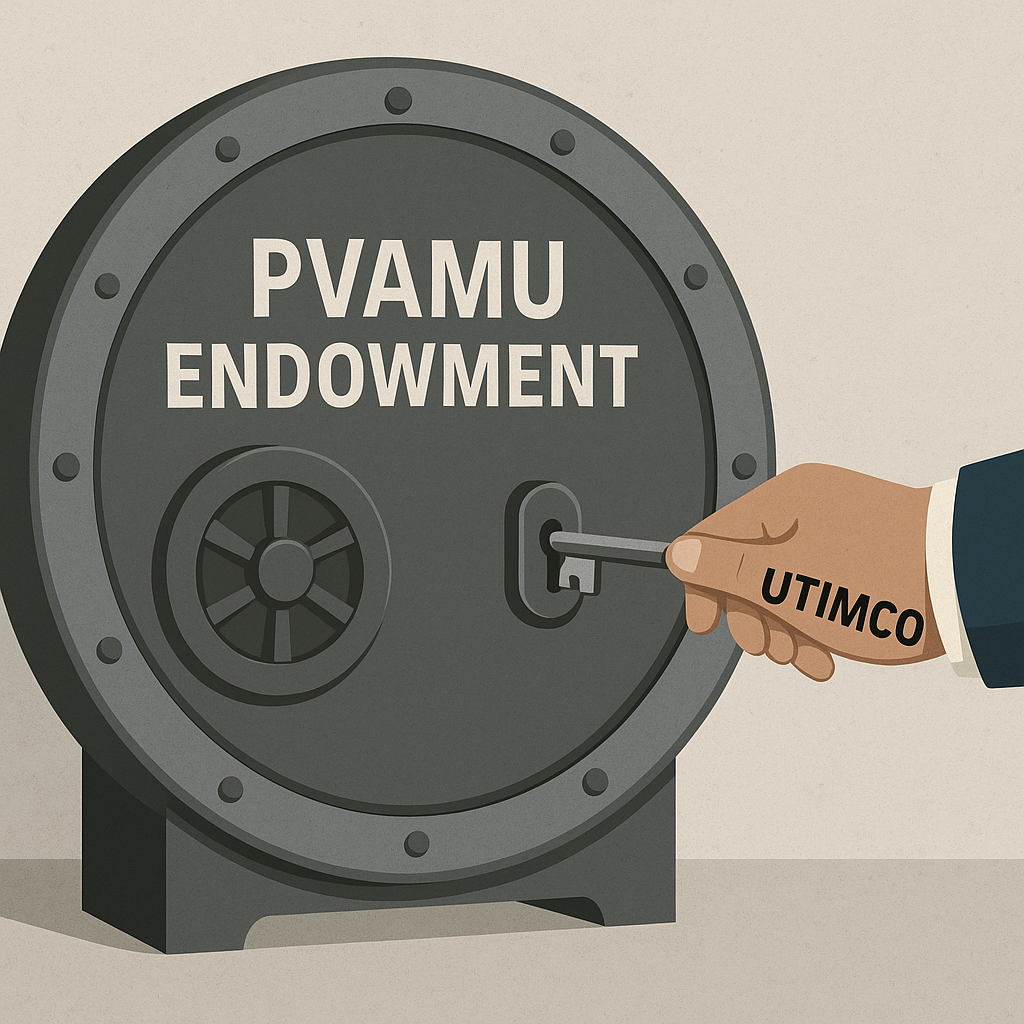
And yet, behind the applause and the very real gratitude there remains a more sobering, structural reality: Prairie View does not actually control its capital. The university’s endowment, like that of all Texas A&M System schools, is controlled and managed by UTIMCO, the University of Texas/Texas A&M Investment Management Company. UTIMCO is one of the largest public endowment management entities in the United States, overseeing well over $70 billion in assets. It is powerful, sophisticated, and critically not directly accountable to Prairie View’s leadership or the African American community whose future PVAMU represents.

This is the overlooked truth in the philanthropic triumph narrative: historic gifts do not necessarily translate into historic power. And power, not simply capital, is the currency African American institutions have always lacked most in the American economic order. Prairie View A&M University’s situation is a case study in the difference.

This article explores:

  • Why Prairie View’s record-setting gift still leaves it structurally dependent
  • How UTIMCO’s control restricts the institution’s long-term sovereignty
  • What this tells us about HBCU philanthropy and institutional design
  • Why African American institutional power requires ownership, not just funding
  • What steps Prairie View, other public HBCUs, and African American philanthropists can take to change the paradigm

This is not about questioning the value or impact of MacKenzie Scott’s generosity. It is about ensuring that gifts to African American institutions actually translate into durable, compounding power not momentary uplift that still sits under someone else’s governance.

The Gift Was Unprecedented—But the Structure Wasn’t

MacKenzie Scott’s philanthropic investments in Prairie View were transformational by any measure. Unrestricted capital is rare. Unrestricted capital at that scale is almost unheard of for HBCUs. Prairie View announced bold plans: initiatives in student success, research expansion, recruitment of top scholars, and community-facing programs that would have immediate impact.

However, beneath these aspirational goals lies a structural constraint. As a member of the Texas A&M University System, Prairie View’s endowment assets are not independently managed. Instead, they are placed under UTIMCO stewardship.

This means:

  • Prairie View cannot choose its own investment strategy
  • Prairie View cannot decide its own risk profile
  • Prairie View cannot determine long-term reinvestment philosophies
  • Prairie View cannot directly leverage its endowment as collateral or strategic capital
  • Prairie View has limited input into how its own financial future is shaped

Prairie View is wealthy in name, but not in governance. This is the difference between having money and having power.

Why UTIMCO Control Matters

UTIMCO is a financial powerhouse. It runs an endowment strategy modeled on the “Yale model” of diversified, high-yield, alternative-asset heavy investing. Its size gives it access to premier private equity, hedge funds, venture capital, and global asset vehicles that smaller endowments could never reach. But Prairie View is not UTIMCO’s strategic priority. And Prairie View does not have representation proportionate to its needs, mission, or history on the governance side of the investment enterprise.

The problems with this arrangement are structural, not personal:

1. Prairie View’s capital becomes part of a system that does not share its cultural mission.

UTIMCO’s fiduciary responsibility is to the entire system—primarily UT Austin and Texas A&M University, the two flagship institutions with the largest political influence and endowment weight.

2. Prairie View does not benefit proportionately from its own growth.

When UTIMCO’s investments outperform, the rising tide lifts the entire system but Prairie View’s small allocation does not allow it to meaningfully influence direction or capture outsized opportunity.

3. Prairie View is locked out of using its endowment to build independent institutional leverage.

For example:

  • Launching Prairie View–controlled venture funds
  • Building independent real-estate portfolios
  • Creating sovereign partnerships with African universities
  • Developing major research parks or revenue-producing assets
  • Issuing bonds based on endowment performance
  • Using the endowment to create a Prairie View Development Corporation
  • Deposit into African American Owned Banks

These are the exact strategies that allow elite institutions to become global players. Without endowment control, Prairie View cannot follow the same playbook.

4. African American institutional power remains externally governed.

Even when philanthropy flows to us, governance does not.
This is the core dilemma.

The Limits of Public-Sector HBCU Philanthropy

Public HBCUs occupy an uncomfortable position in American philanthropy. They exist inside systems created by and for institutions that do not share their origin story, demographic composition, or cultural mission. As a result, public HBCUs rarely benefit from the full compounding power that large donations should create. A $63 million donation to a private HBCU with full endowment control is a generational shift. A $63 million donation to a public HBCU inside a state-controlled investment empire is uplift but not sovereignty. The structure, not the gift itself, limits the long-term multiplier effect.

The True Power of an Endowment Is Governance, Not Size

The most elite universities such as Harvard, Yale, Stanford understand that the endowment is not merely a pot of money. It is the engine of independence, the foundation of strategic risk-taking, and the vault that allows them to pursue multi-century planning horizons. Prairie View’s endowment, while larger than before, becomes one more line item inside a massive investment entity whose priorities were never designed around the empowerment of African American institutions.

This raises fundamental questions:

  • If Prairie View doubled or tripled its endowment, would it gain any more control?
  • If Prairie View received a $500 million gift tomorrow, would it govern that capital?
  • What does “wealth” mean if the institution cannot direct it?

These questions get at the heart of African American philanthropic strategy:
Power is not the receipt of capital it is the control of capital.

Why This Matters for African American Philanthropy

The African American community is entering a new era of giving. Donors both internal and external to the community are showing increased willingness to fund African American institutions, particularly HBCUs. But if those donations sit inside structures that we do not control, then the long-term compounding advantage is lost. Philanthropy that uplifts without empowering is charity. Philanthropy that transfers capital and governance is institution-building. Prairie View deserves the latter. All HBCUs deserve the latter. African America deserves the latter.

What Would It Look Like for Prairie View to Have Full Capital Control?

If Prairie View controlled its own endowment strategy, several catalytic changes could occur:

1. PVAMU could launch its own independent investment office.

This would allow:

  • Hiring Black fund managers
  • Building partnerships with African investment firms
  • Investing directly in Prairie View–based startups
  • Growing an internal investment culture among alumni and students

2. PVAMU could build a multibillion-dollar research and development ecosystem.

The endowment could seed:

  • A Prairie View Innovation Corridor
  • A Black-owned semiconductor research consortium
  • Autonomous vehicle labs
  • Agricultural technology incubators
  • An African Diaspora science and engineering exchange
  • A rural Texas innovation hub exporting expertise globally

3. PVAMU could pursue independent financial engineering strategies.

Including:

  • Issuing bonds based on endowment earnings
  • Creating a real estate trust
  • Launching a PVAMU-controlled venture fund
  • Building a revenue-producing hospital network
  • Constructing Prairie View–owned student housing developments

4. PVAMU could fundamentally reshape African American institutional futures.

With full investment autonomy, Prairie View could become:

  • A national model for Black endowment governance
  • A financial anchor for African American rural communities
  • A bridge between Texas and the global African Diaspora
  • A site of intergenerational wealth-creation for African American students
  • An institution that attracts not only students but developers, scientists, and investors

This is the scale of possibility currently constrained by UTIMCO governance.

What Needs to Change—A Philanthropic and Policy Framework

To transition from uplift to sovereignty, African American leaders, donors, and policymakers must pursue concrete reforms:

1. Public HBCUs must secure special provisions for independent endowment management.

This could include:

  • Carve-outs from state systems
  • Special legislative exemptions
  • Hybrid governance models where system oversight continues but investment control shifts with the ultimate goal of full sovereignty

2. Large donors should explicitly require endowment autonomy as part of major gifts.

Imagine if MacKenzie Scott had stipulated:

“This gift must be placed in a separately managed fund controlled solely by Prairie View A&M University and its own designated board of trustees.”

That single sentence would have changed the institution’s next 100 years.

3. Prairie View alumni must build parallel philanthropic capital pools.

This includes:

  • Alumni-controlled investment funds
  • Prairie View-specific donor-advised funds
  • Community investment vehicles
  • A Prairie View Cooperative Endowment Fund

These independent vehicles can partner with but not be controlled by state systems.

4. National African American institutions must lobby for HBCU endowment independence.

A single policy shift could alter the landscape for every public HBCU:

Public HBCUs must have governance authority over capital donated specifically to them.

A Moment of Truth for HBCU Philanthropy

Prairie View’s historic gift was a moment of celebration—but also a moment of clarity. If African American institutions cannot control the endowments gifted to them, then the path to sovereignty remains blocked.

The philanthropic sector must confront this truth:

We cannot build African American power without African American control of African American capital.

Prairie View A&M University has always carried a dual identity, an HBCU of national importance inside a system not built for it. The generosity of donors like MacKenzie Scott can change the scale of Prairie View’s work, but only structural reform can change the nature of Prairie View’s power. The next era of HBCU philanthropy cannot simply be about larger gifts. It must be about gifts that come with governance, strategy, and autonomy.

Because endowments don’t build institutions.
Endowment sovereignty does.

Disclaimer: This article was assisted by ChatGPT.

While Howard Is Chasing Harvard, What Public HBCUs Are Chasing UTIMCO?

“I make no apology for the love of competition.” – John Harbaugh

In the world of higher education finance, few numbers turn heads quite like endowment size. It is the ultimate scoreboard for institutional power—a metric that signals not only a university’s wealth but also its capacity to shape research, drive innovation, support students, and influence national policy. In this rarefied air, Howard University has made history, becoming the first Historically Black College or University (HBCU) to surpass the $1 billion endowment mark. According to HBCU Money’s 2024 rankings, Howard’s endowment now stands at $1.03 billion.

Spelman College, long regarded as Howard’s fiercest private competitor, received a record-setting $100 million donation in 2023. Yet even with that windfall, its endowment reached $506.7 million—leaving it more than $500 million behind Howard. Nevertheless, Spelman’s donor base remains one of the strongest in Black higher education, and it may still overtake Howard in the race to $2 billion. But the $1 billion baton has already been passed.

If Howard is chasing Harvard, and Spelman is setting its sights on Yale, then who among public HBCUs dares to chase the Goliath of public university endowments—UTIMCO?

The Silent Behemoth in Texas

UTIMCO—the University of Texas/Texas A&M Investment Management Company—is not just large; it is colossal. As of 2024, UTIMCO manages a staggering $64.3 billion in assets across the University of Texas and Texas A&M university systems. That figure is nearly $15 billion more than Harvard’s own endowment and more than three times the size of the second-largest public university endowment at the University of Michigan.

This financial empire is largely invisible to the public eye. Few outside of elite Texas financial and political circles are even aware of UTIMCO’s existence, let alone its scale. It quietly funds a wide spectrum of research, real estate development, and private equity plays that influence state and national agendas.

If an HBCU—or group of HBCUs—is ever to rival that level of public endowment control, it will not happen by accident. It must be built. And it will most likely be built collectively.

HBCUs and the Endowment Gap

The endowment disparity between HBCUs and Predominantly White Institutions (PWIs) has been well-documented. HBCUs represent around 3% of America’s colleges, yet account for less than 1% of total U.S. endowment wealth. According to a McKinsey report, HBCUs would need $12.5 billion in incremental funding to achieve endowment parity with similarly sized PWIs.

While private HBCUs like Howard and Spelman appear to be making some headway, public HBCUs remain largely behind. Most of them are tethered to state systems that have historically underfunded them and which rarely—if ever—extend the full benefits of their system-wide endowment strategies.

Consider the University of North Carolina System. It includes North Carolina A&T, the largest HBCU by enrollment, and North Carolina Central University. Yet both institutions have endowments under $200 million. Meanwhile, UNC Chapel Hill boasts an endowment exceeding $5.4 billion. Similarly, Florida A&M University has an endowment of less than $200 million, while the University of Florida’s soars above $2 billion.

The Case for a Public HBCU Endowment Challenger

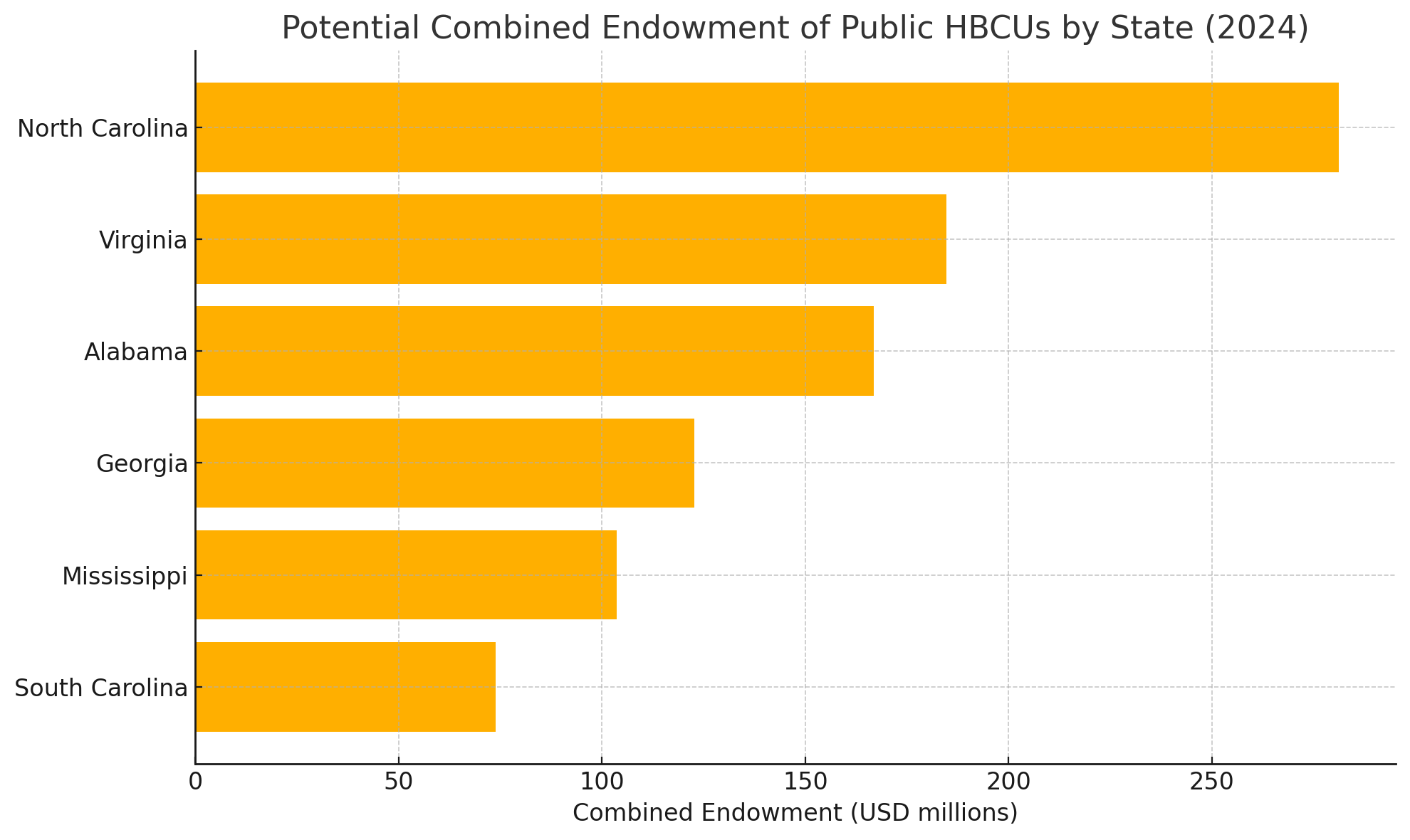
In identifying a public HBCU capable of mounting a challenge to UTIMCO’s financial supremacy, the most promising strategy does not lie in the strength of one institution—but in the collective power of several. States that are home to multiple public HBCUs present the most viable path to establishing a unified, independently managed investment entity that can leverage scale, pooled capital, and institutional collaboration.

Virginia, Alabama, Georgia, North Carolina, South Carolina, and Mississippi all house two or more public HBCUs, each with proud legacies and strategic regional influence. A coordinated financial framework across these schools could form the foundation of a “Black UTIMCO”—a professionally managed, state-based consortium endowment capable of rivaling small PWI systems in both return and influence.

The most likely candidates must share a few key characteristics:

  1. State-Level Endowment Consortium Model – States with two or more public HBCUs, such as Virginia (Virginia State, Norfolk State), Georgia (Albany State, Fort Valley State, Savannah State), or Alabama (Alabama A&M, Alabama State), are uniquely positioned to pioneer a collective endowment strategy. Rather than relying on marginal support from broader university systems, these HBCUs could form a joint investment vehicle modeled on UTIMCO—pooling their endowments under a professionally managed, independent investment company. Such a fund would enable economies of scale, competitive asset management, and unified long-term planning, boosting their ability to generate investment alpha and philanthropic leverage.
  2. Flagship Status Among HBCUs – Institutions with strong alumni networks, national reputations, and federal research capabilities are better positioned to attract major philanthropy.
  3. Strategic Location – HBCUs located in fast-growing economic zones can leverage regional corporate ties for private partnerships.

However, creating such a financial architecture is not purely a technical endeavor. It is inherently political—and often fraught with social resistance.

The Political Geography of Resistance

Many of the states that host multiple public HBCUs are governed by conservative legislatures and state boards of regents that have long resisted equitable funding for Black institutions. Despite proclamations about diversity, equity, and inclusion, these power structures often withhold support from Black-led entities that could challenge traditional hierarchies.

  • Alabama, with Alabama State and Alabama A&M, underfunded its HBCUs by over $527 million between 1987 and 2020, according to the U.S. Department of Education.
  • Georgia’s consolidation of HBCUs like Albany State into broader system structures has often diluted their financial and governance autonomy.
  • Mississippi has repeatedly neglected basic infrastructure and funding needs at its three public HBCUs—Jackson State, Alcorn State, and Mississippi Valley State—despite allocating surpluses elsewhere. It is also no secret that Mississippi has purposely constructed a singular board of trustees for all of its public higher education institutions across the state with Ole Miss and Mississippi State unabashedly dominating the board.

Even in Virginia, perceived as more moderate, a move by Virginia State University and Norfolk State to pool their endowments might be seen as too bold a play in a state that still subtly resists Black institutional consolidation.

Social Impediments and Institutional Fragmentation

Beyond politics, there are intra-HBCU dynamics that complicate collaboration. These institutions have historically been forced to compete for scraps, which can breed a zero-sum mentality. Trustees, alumni, and administrations often prefer complete local control over modest assets rather than shared governance over substantial ones.

Convincing institutions to pool their endowments requires cultural alignment and a long-term vision of shared prosperity. Donors, too, may resist giving to multi-institutional funds, preferring the emotional appeal of a singular alma mater.

Nonetheless, this mindset must change. The math is clear: five public HBCUs each contributing $100 million can produce a $500 million investment base. That scale opens doors to private equity, hedge funds, and other vehicles that outperform the conservative allocations typically used by smaller institutional portfolios.

Institutions Poised for Leadership

  • North Carolina A&T State University, with an endowment of $201.9 million, remains the largest public HBCU endowment. With deep ties to tech and defense industries, it has both alumni momentum and industry leverage.
  • Florida A&M University, despite setbacks surrounding its pledged $237 million donation, has an official endowment of $124.1 million and stands to benefit immensely from partnership with institutions like Bethune-Cookman or Edward Waters.
  • Virginia State University and Norfolk State University, with $96.5 million and $88.2 million respectively, could combine to form the financial cornerstone of a Virginia HBCU Investment Company—managing nearly $185 million in assets at inception.

The Need for a “Black UTIMCO”

Rather than wait for state systems to share the wealth equitably, some in the HBCU policy space are advocating for the creation of a consortium endowment fund — a kind of “Black UTIMCO.” This collective endowment manager would pool assets from willing HBCUs, allowing them to negotiate better investment terms, lower fees, and generate alpha through scale.

Such an initiative would require governance innovation, donor transparency, and trust between institutions that are often underfunded and overburdened. But it may be the only viable path forward for public HBCUs to compete against mega-managers like UTIMCO, MITIMCo, or the Yale Investments Office.

A $5 billion consortium fund, even divided across 25 HBCUs, would be transformational. It could fund scholarships, capital improvements, faculty chairs, and technology upgrades, while giving HBCUs the financial leverage to attract major federal research grants.

A New Competitive Mindset

In American higher education, the metaphorical arms race is very real. Endowments are the stockpiles. Harvard and Yale are the gold standard in the private arena. UTIMCO is the titan in the public sector. And HBCUs, despite their contributions to Black excellence, continue to be locked out of the upper tier.

John Harbaugh’s quote about competition resonates because it points to a deeper truth: love of competition does not require parity at the outset, only the will to chase. Howard is in the final lap toward $1 billion, setting a new bar for Black institutional capital. Spelman may outdistance them on the next lap to $2 billion. But in the public sphere, the silence is deafening.

Where is the public HBCU that dares to dream of beating Michigan, surpassing UNC, or even challenging UTIMCO?

The Race Begins with Vision

Howard is chasing Harvard. Spelman is perhaps chasing Yale.

But no single public HBCU can chase UTIMCO. The scale is too vast, the machinery too entrenched, and the rules too uneven.

What public HBCUs can do, however, is combine. They can look across their borders, past their rivals, and toward a shared future. They can imagine a world where collective African American endowment power reshapes not just education, but the broader economy and policy landscape.

It is not a failure of ambition that no public HBCU has reached $1 billion. It is a failure of coordination and imagination.

The first African American UTIMCO will not be built by a single school. It will be built by a desire for compeition. A desire to win.