
Tag Archives: black wealth building

A Merger of (Potential) Might: Why Prairie View A&M and Texas Southern Should Combine Their Foundations to Challenge the Endowment Establishment

It is reason, and not passion, which must guide our deliberations, guide our debate, and guide our decision. – Barbara Jordan
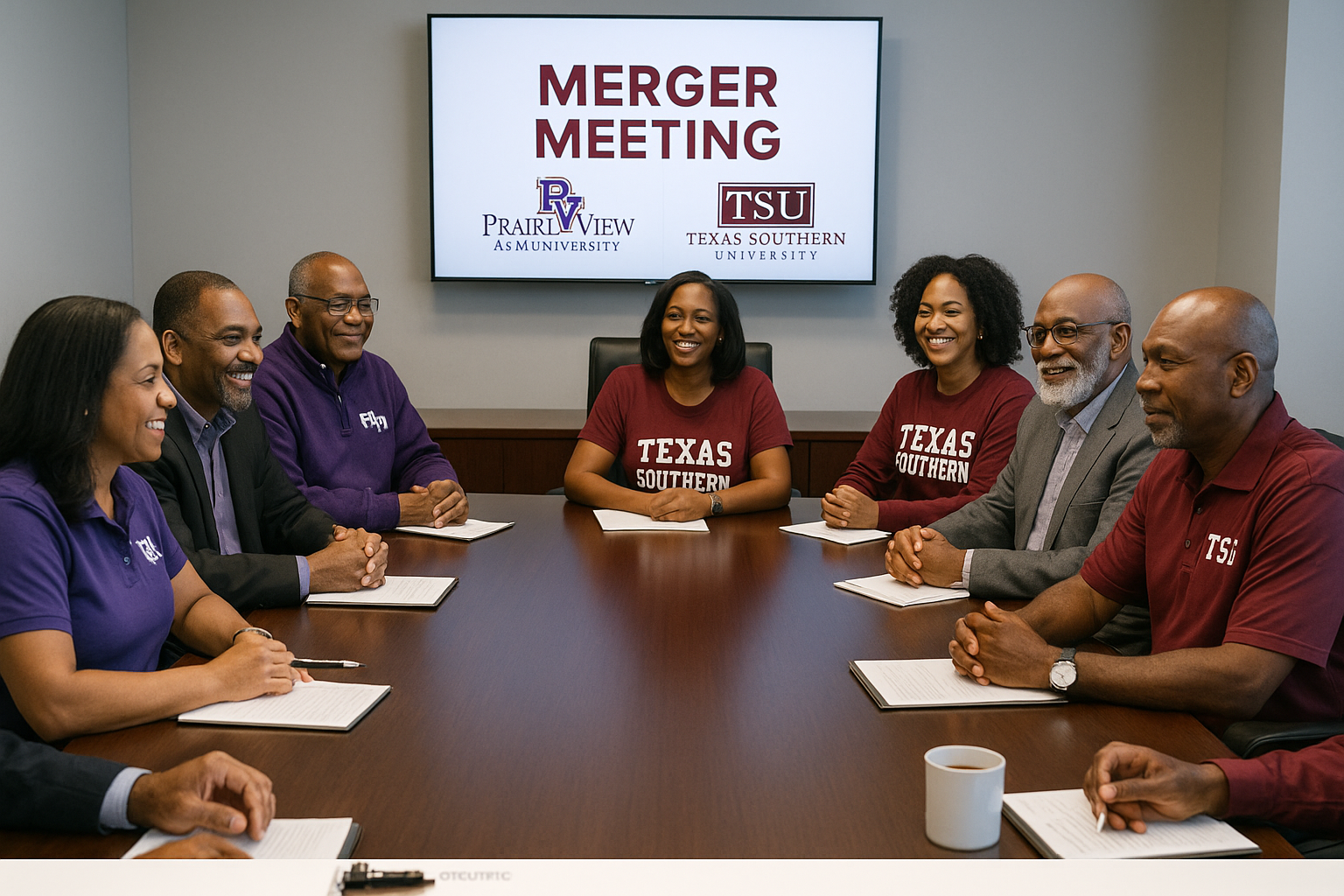
In the gilded halls of America’s elite universities, financial firepower is both a symbol and source of dominance. Endowments—the great silent engines of academia—determine not only which students get scholarships but which schools can recruit Nobel-calibre faculty, fund original research, and shape public policy. At the apex of this order stands UTIMCO, the University of Texas and Texas A&M’s investment juggernaut, with more than $70 billion under management. Below, far below, exist the undercapitalised yet ambitious Historically Black Colleges and Universities (HBCUs) of Texas.

Two of the state’s largest HBCUs—Prairie View A&M University (PVAMU) and Texas Southern University (TSU)—have long histories, loyal alumni, and vital missions. What they do not have is institutional wealth. PVAMU’s foundation reported a modest $1.83 million in net assets in 2022. TSU’s foundation, better capitalised, holds $22.7 million. Combined, that amounts to just $24.5 million. For comparison, Rice University, less than 50 miles from either campus, holds an endowment north of $7.8 billion.

That yawning disparity matters. But it also presents an opportunity: a merger of the two foundations into a single, more potent philanthropic and investment entity. Done properly, it could reorient how Black higher education competes—not by appealing to fairness or guilt, but through scale, strategy, and institutional force.

A Rebalancing Act

To understand the potential of a PVAMU-TSU foundation merger, one must first grasp the dynamics of university endowments. Large endowments benefit from economies of scale, granting them access to exclusive investment opportunities—private equity, venture capital, hedge funds—often unavailable to smaller players. They attract the best fund managers, demand lower fees, and can weather market volatility without compromising their missions. Small foundations, by contrast, tend to be conservatively invested, costly to manage per dollar, and too fragmented to punch above their weight.

A consolidated HBCU foundation in Texas would be small compared to UTIMCO, but large relative to its peers. With a $25 million corpus as a starting point, the new entity could position itself for growth by professionalising its investment strategy, adopting a more ambitious donor engagement plan, and forming partnerships with Black-owned banks, family offices, and community institutions. Call it the Texas Black Excellence Fund, or perhaps, more simply, the TexHBCU Endowment.

To be sure, the legal and logistical barriers to such a merger are real. Foundation boards guard their autonomy jealously. Alumni pride can turn parochial. Governance models would need careful negotiation to ensure representation and avoid turf wars. But the arguments in favour are compelling.

The Power of One

First, a merger would cut overhead. Legal, accounting, auditing, and compliance costs—duplicated today—could be streamlined. A joint fundraising apparatus could create a single point of entry for corporate partners and high-net-worth donors. Branding efforts would gain coherence: instead of competing for attention, the institutions would stand together as a symbol of Black institutional unity and strength.
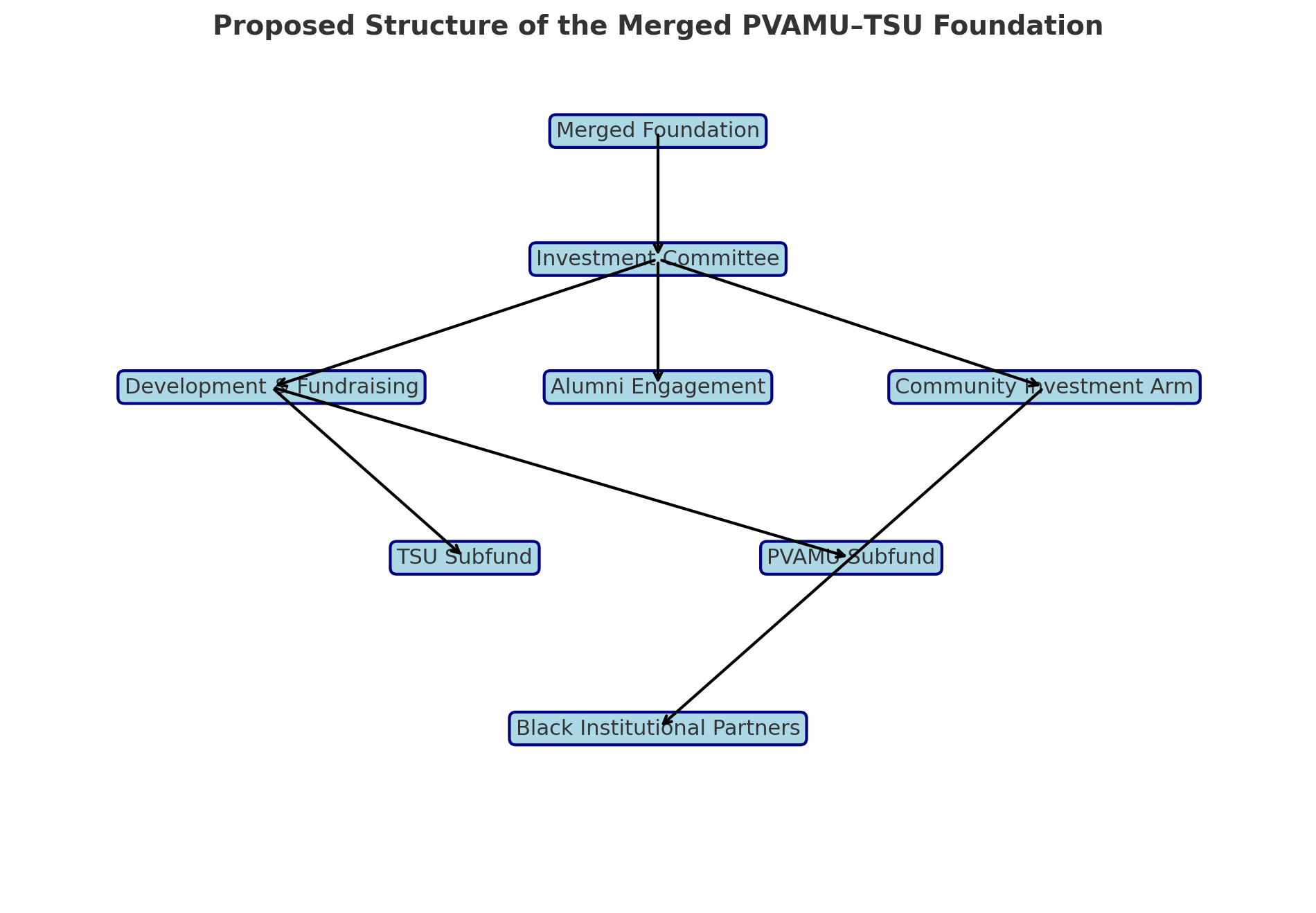
Second, scale invites leverage. A $25 million foundation cannot change the world overnight, but it can attract co-investments, engage in pooled funds, and perhaps even launch a purpose-driven asset management firm in the model of UTIMCO. If successful, this would be the first Black-led institutional investor of serious size in Texas—capable not only of managing endowment funds but of influencing broader economic flows across Black Texas.

Third, the merger would send a strategic signal to policymakers and philanthropic networks. It would say, in effect: “We are no longer asking for permission to grow. We are building the engine ourselves.” That tone matters. Too often, HBCUs are framed as needing rescue. A merged foundation flips that narrative. It becomes an asset allocator, a market participant, a builder of capital rather than a petitioner of it.

UTIMCO: A Goliath in the Crosshairs?

No one expects a $25 million fund to challenge a $70 billion behemoth. But that is not the point. UTIMCO’s dominance is as much political as it is financial. Its influence flows from its role as gatekeeper to resources, shaping everything from campus architecture to graduate fellowships. The merged HBCU foundation would not dethrone UTIMCO—it would decentralise power by becoming a second pole.

Indeed, the comparison may inspire mimicry. Just as UTIMCO serves multiple institutions, so too could a joint HBCU foundation. Prairie View and Texas Southern are only the beginning. Over time, the model could scale to include other Black-serving institutions across Texas and the South. This would amplify investment impact and accelerate institutional wealth-building.

Moreover, such a foundation could adopt an unapologetically developmental investment strategy. Where UTIMCO optimises for returns, the TexHBCU fund could optimise for both returns and racial equity—by investing in Black entrepreneurs, affordable housing, climate-resilient infrastructure, or educational tech. The dual mandate—profit and purpose—would not be a hindrance but a hallmark.

Regional Stakes

Prairie View sits on a rural hilltop. Texas Southern sprawls in urban Houston. But their communities are deeply connected—culturally, economically, demographically. A combined foundation could create regional development strategies that go beyond scholarship aid.

Imagine a venture fund seeding Black-owned start-ups in Houston’s Third Ward. A real estate initiative turning vacant lots into mixed-income housing for PVAMU students and local residents. A workforce development fund retraining returning citizens for green jobs across both cities. Each dollar invested becomes more than a balance sheet entry; it becomes a force for transformation.

This matters not just to students and faculty, but to the broader Texas economy. Black Texans make up 13% of the state population but own less than 3% of its small businesses. Educational attainment gaps persist. Institutional neglect deepens. The merger would not fix all this—but it would give the community a new tool for shaping its destiny.

Copy, Then Paste

If the model works, it would not stay in Texas. Southern University in Louisiana has multiple campuses and foundations that could benefit from consolidation. So does the University System of Maryland’s HBCUs. Indeed, the entire sector could adopt a federated endowment strategy—unified in purpose but distributed in governance.

HBCUs have long suffered from institutional atomisation. They are asked to compete individually in a system that rewards consolidation. Merging foundations is not just a finance play—it is a strategy for survival and sovereignty.

The Alternative: Stagnation

Critics may say a merger is too ambitious. That it risks alumni backlash or donor confusion. That it could take years to execute. But delay is itself a cost. Each year the foundations remain separate is another year of opportunity lost. Another year where millions in potential returns go unrealised. Another year where larger institutions deepen their lead.

PVAMU and TSU have histories to be proud of. But institutional pride must not become institutional inertia. A merger is not surrender—it is evolution.

In the long arc of higher education, moments of boldness define legacy. This is one of those moments. Two foundations. One future. Let the uniting begin.
Powell’s Precarious Position: What HBCU Real Estate Investors Must Prepare For

“Real estate power does not wait on political peace—it plans around it.”HBCU Money

In commercial real estate, calm markets are often a prerequisite for aggressive growth. When volatility creeps in—especially from policy uncertainty—wise investors do not panic, but they do reposition. As rumors swirl that Federal Reserve Chair Jerome Powell may be removed from office before the end of his term, the CRE market is already baking in disruption. For HBCU alumni who invest in real estate, this moment demands attention, strategy, and foresight.

Although Powell’s official term runs through May 2026, and he can technically serve until 2028, market insiders are moving as if his exit could happen sooner—possibly under a second Trump administration. On July 17, GlobeSt.com reported that commercial real estate markets are increasingly factoring in political risk, with deal structures, loan pricing, and capital flows tightening ahead of any actual policy change.

For HBCU alumni who have spent years assembling rental portfolios, developing mixed-use properties, or backing Opportunity Zone projects near campuses, this isn’t abstract economic theory. This is cash flow, cap rates, and leverage dynamics in real time.

The Federal Reserve controls interest rates, liquidity, and lending standards—the lifeblood of commercial real estate. But the Chair also shapes expectations. Even the perception of instability at the Fed causes lenders to pull back and investors to reprice assets.

Jerome Powell has been seen as a steady hand, even when unpopular. His cautious rate policy—especially amid post-pandemic inflation—kept CRE markets from overheating or crashing. But if he’s ousted or disempowered, markets may expect more aggressive rate cuts under political pressure, a weakening dollar complicating international investment and supply chain costs, and a loss of institutional independence introducing a political lens into every Fed decision.

For HBCU alumni real estate investors, it means more volatile borrowing costs, reduced predictability in returns, and a need to re-evaluate how aggressively to pursue expansion or refinance.

Lenders are tightening up—and they are doing so before Powell is removed. That should concern anyone whose real estate model is sensitive to capital cost.

Bridge and construction loans are becoming harder to secure without pristine credit and higher equity injections. Cash-out refinances—especially for small portfolios—are being capped or delayed altogether. Development deals in low-income communities (where many HBCU graduates invest as a mission) are being scrutinized harder or shelved entirely.

As one investment banker told GlobeSt, “We’re seeing deals priced as if Powell’s out in six months, and we’re living in a very different rate environment.” It’s not a prediction—it’s a hedge. And HBCU alumni need to do the same.

If you’re invested in—or considering entering—any of the following CRE asset classes, Powell’s fate may shape your returns:

CRE SectorRisk From Fed Instability
MultifamilyRising rates hurt acquisitions and refinancing; rent growth may not keep up with cost of capital
RetailAlready under pressure from e-commerce; volatile rates shrink tenant pool and landlord leverage
HospitalityHeavily exposed to economic cycles; refinancing becomes challenging if Fed turmoil hits
Industrial/LogisticsGenerally stable, but price compression expected if Fed credibility drops
Development ProjectsMost vulnerable—cost of capital, input inflation, and credit availability all in flux

HBCU alumni often favor multifamily and mixed-use in urban corridors. That makes preparation even more critical.

Let’s be clear: instability in the Fed disproportionately hurts Black real estate investors.

Less institutional capital backing Black developers means higher reliance on bank debt. Lower net worth and liquidity reserves can make it harder to endure tightened credit cycles. Projects in historically Black neighborhoods—often underinvested already—face greater scrutiny from conservative lenders during uncertain times. And Black investors are more likely to reinvest locally, meaning pullbacks hit community wealth and revitalization efforts harder.

If you’re financing student housing near Howard, renovating a historic property near Southern, or redeveloping land near Fort Valley State, you may suddenly find banks “reassessing” your application—not because of your deal, but because of Washington.

HBCU alumni have a legacy of building through adversity. This moment demands no less. Key investor moves right now include:

Renegotiate your debt terms while rates are still predictable. If your loans mature in 2026 or 2027, the window to lock in current rates or secure extensions is closing. Powell’s tenure—and potential replacement—will shape forward rate curves. Beat the volatility while you still can.

Shift to fixed-rate debt. Adjustable-rate debt was cheap two years ago. Now it’s a ticking time bomb. Consider refinancing into fixed-rate debt, even at a slight premium, to gain stability and prevent future cash flow disruptions.

Expand your lender relationships. Do not depend on one or two institutions. Build ties with Black-owned banks, CDFIs, and credit unions aligned with HBCU values. These institutions may have more mission-aligned flexibility if traditional banks tighten up.

Build a liquidity cushion. Discipline now prevents desperation later. Liquidity is the real hedge during economic uncertainty—especially if tenants default, contractors raise costs, or refinance windows close.

Delay discretionary projects. This is the time to tighten pro formas, not push for maximum leverage. If a deal still pencils at 9% debt, proceed. If it only works at 6%, wait.

Pool capital. Use alumni associations and real estate clubs to form investment syndicates. One investor may get denied a $5M deal. Five alumni together might get approved for $25M. Leverage unity, scale, and relationships.

Crisis also presents acquisition opportunities. There will be distressed sellers needing to offload assets quickly, developers unable to complete projects, and landlords who can’t refinance expiring loans. HBCU alumni, especially those with capital or credit, should keep an eye out. Joint ventures among alumni can create scale and deploy capital when others retreat. Use this time to buy smart, not fast.

Beyond Powell himself, it’s the Fed’s credibility that gives investors confidence to commit capital to 10–30 year projects. If a new Chair appears beholden to political pressure, markets may price in new risks to long-term bonds, accelerate inflation fears, and depress asset values. That would slow not just your next project—but the next generation’s.

That is why HBCU alumni must take this seriously, not just as investors—but as stewards of intergenerational wealth.

HBCU institutions also have a role to play. They can create alumni investment syndicates that provide deal flow and capital. They can offer discounted land or property near campus to alumni developers. They can develop relationships with mission-driven lenders and introduce alumni projects for financing. And they can host economic briefings and real estate strategy sessions to keep their alumni sharp and agile in rapidly changing markets.

Colleges like Tuskegee, Texas Southern, and FAMU have alumni who are reshaping skylines. These institutions must recognize this as an extension of their impact—and protect it.

The Federal Reserve Chair is not a figurehead. Powell’s potential removal would represent a seismic shift in economic planning—especially for real estate. For HBCU alumni, many of whom have built their portfolios in the shadows of systemic exclusion, the message is clear: this is not a time to panic—but it is time to prepare.

Build alliances, lock in rates, stockpile liquidity, and be ready. The future of our neighborhoods, our campuses, and our financial independence will be shaped by how we respond to this moment.

And if the rest of the market goes quiet, remember: Black investors have never needed perfect conditions to build power—we’ve just needed a plan and each other.

Disclaimer: This article was assisted by ChatGPT.

This Week in the Economy: May 5–9, 2025

Analyzing the U.S. Economic Calendar Through the Lens of African American Economic Empowerment

Monday, May 5

  • S&P Final U.S. Services PMI (Apr): 51.0 (Prev: 51.4)
  • ISM Services Index (Apr): 50.4% (Prev: 50.8%)

A cooling services sector raises concerns for Black-owned businesses and workers concentrated in service-based industries. Marginal growth may mean tighter margins and slower hiring, especially in personal care, retail, and small hospitality—fields where many African American entrepreneurs and employees operate.


Tuesday, May 6

  • U.S. Trade Deficit (Mar): -$136.0B (Prev: -$122.7B)

The growing trade deficit highlights America’s deepening reliance on imports, reinforcing structural challenges for domestic manufacturing. This imbalance is particularly troubling for aspiring Black manufacturers and export-driven enterprises that struggle to compete with cheaper foreign supply chains and lack equitable access to capital or infrastructure.


Wednesday, May 7

  • FOMC Meeting & Fed Chair Powell Press Conference
  • Consumer Credit (Mar): $11.0B (Prev: -$800M)

The Federal Reserve’s direction this week is critical. Interest rate policy affects African American households disproportionately, with higher borrowing costs hitting hardest among those with lower credit scores and less generational wealth. A rise in consumer credit signals that families—many Black households included—may be increasingly relying on debt to maintain basic living standards amid inflation. The burden of debt is rising, not falling.


Thursday, May 8

  • Initial Jobless Claims (May 3): 230,000 (Prev: 241,000)
  • U.S. Productivity (Q1): -0.5% (Forecast: +1.5%)
  • Wholesale Inventories (Mar): +0.5% (Prev: +0.3%)

Jobless claims are stable, but national figures obscure racial disparities. Black unemployment remains consistently higher than average. Meanwhile, negative productivity numbers may point to slower wage growth—again affecting African American workers in roles offering limited career mobility. Rising wholesale inventories suggest slowing consumer demand, which could hit Black-owned consumer goods businesses that often operate without deep cash reserves.


Friday, May 9

  • Fed Governor Lisa Cook Speech (6:45 AM ET)
  • Multiple Fed Speakers Throughout Day

All eyes will be on Lisa Cook, the first Black woman on the Fed’s Board of Governors. Her remarks may provide valuable insight into how the central bank views labor market equity and inflation’s disproportionate impact on communities of color. The deluge of Fed speeches will shape interest rate sentiment and financial market reactions—affecting everything from mortgage rates for HBCU alumni to capital access for Black banks, credit unions, and small businesses.


HBCU Money Perspective:
This week’s economic events carry clear signals for the African American economy. Slower service sector growth, rising debt reliance, and stagnant productivity reinforce the need for systemic change—particularly in access to capital, support for Black manufacturing, and inclusive monetary policy. As Fed policy direction becomes clearer, HBCUs, Black-owned financial institutions, and policy advocates must prepare to assertively engage with these shifts to protect and grow Black wealth.