Category Archives: Editorial

Dr. King’s Dream is Dead: African America Must Focus On Its Own Institutional Sovereignty and Survival

“I fear I may have integrated my people into a burning house.” – Dr. Martin Luther King, Jr.

By William A. Foster, IV

For my parents and grandparents not many years ago, it was the White Citizens Council, Ku Klux Klan, Bull Connor, George Wallace, and more. Today, it is MAGA, ICE, Donald Trump, Charlie Kirk, and more. African America long held out hope that we would be in someway accepted into America’s fabric. We contributed centries of free labor capital, centuries of cultural capital, and did it all under an umbrella of racial terrorism. This hope was held without so much as an apology or reparation. The Civil Rights Movement of which much of my family was a part of from my mother’s letter to Dr. King himself that now sits in the archives of Boston College to part of our family that was forced to relocate to Jamaica by the US government, likely Hoover’s FBI. They fought for equal protections and equal opportunities, but it was and has always been a fool’s errand. A group in power will never voluntarily relinquish that power and European Americans are no exception to that rule. The problem is and has always been that only African America was fighting for reconciliation. It has been a dance between two dance partners where one is constantly stomping on the feet of the other, stealing money out of our pockets as they swirl us around, and smiling at us while putting a knife nine inches in our back and pulling it out six inches while calling it progress.

As a child, my sister and I had the privilege of attending Wee Care, an African American primary school in Prairie View, Texas in the town where our family’s illustrious HBCU, Prairie View A&M University is located and where my mother has taught students, developed faculty, and served in leadership for almost five decades. Unfortunately for us, the school only went up to the first grade at which time my mother was forced to choose her “best” option. My mother’s best option was an overwhelmingly European American Catholic school in the heart of Tomball, Texas, at the time a fairly known small Texas town – with all of the small town Texas dynamics when it came to race. Only my second and fifth grade teachers were nice to me. One was really young and the other a hippy. In sixth and seventh grade at another predominantly European American Catholic school I would experience the first time being called the N word by a fellow classmate. Even in the resulting aftermath of the fight I was blamed by the principal for being violent. Imagine that. The African American private schools were limited and given the distance from where we lived almost impossible for my mother to change us to an African American school where we would be culturally safe. That though was not the whole story. You see my classmates through elementary in particular were thought to be lifetime friends, but in my later years I would learn a valuable lesson from a graduate program I would attend in Boston at a Jewish institution. Do not confuse friendship and loyalty. I am thankful to this day for the lessons from that institution because it opened my eyes to so much in the world of navigating power dynamics. It was in those lessons that I realized that many of my so called friends from elementary were also loyal to causes that would see me and my family back on a plantation if the winds blew in the right direction and they saw no moral or ideological conflict.

From that point on, I realized that what I must lean into is the institutional development of my own people. From African America to the African Diaspora and that the connectivity of our institutions would be our strength and saving grace. But alas, many of us still yearned for acceptance into PWIs, European American corporations even though we do not think of them as such that is exactly who they are owned by when you examine their ownership, and predominantly European American neighborhoods. To access whiteness is seen as progress and success. In every place we lived, I largely remember us always being the only African American family in the neighborhood. Something I know that none of my childhood “friends” ever thought about or crossed their mind. Their families would never move into an African American community and be the only one. They saw our spaces as hostile even though we have always been overly welcoming even to our detriment, but as I said being the only African American family in a predominantly European American community was often seen as “progress” for many in our community. It was a mistake, a violent psychological mistake that still harms many of us to this day. The same way Ruby Bridges, a six-year old child, had to be escorted by Federal agents into a school because we assumed the fight for desegregation was making America true to its values. We were wrong then and we have been wrong about what Ameria’s values actually are.

Dr. King said in his famous speech, “I have a dream that one day this nation will rise up and live out the true meaning of its creed. We hold these truths to be self-evident that all men are created equal. I have a dream that one day out in the red hills of Georgia the sons of former slaves and the sons of former slaveowners will be able to sit down together at the table of brotherhood. I have a dream that one day even the state of Mississippi, a state sweltering with the heat of oppression, will be transformed into an oasis of freedom and justice. I have a dream that my four little children will one day live in a nation where they will not be judged by the color of their skin but by their character. I have a dream today. I have a dream that one day down in Alabama, with its vicious racists, with its governor having his lips dripping with the words of interposition and nullification; that one day right down in Alabama little black boys and black girls will be able to join hands with little white boys and white girls as sisters and brothers. I have a dream today.”

The dream is dead. It was a dream that required two parties to reconcile their past with only one willing to do so while suffering the brutality that has persisted since 1619. Dr. King’s speech was given on August 28, 1963 and two weeks later on September 15, 1963, the KKK bombed 16th Street Baptist Church and killed four African American girls: Addie Mae Collins (age 14, born April 18, 1949), Carol Denise McNair (age 11, born November 17, 1951), Carole Rosamond Robertson (age 14, born April 24, 1949), and Cynthia Dionne Wesley (age 14, born April 30, 1949). My mother was born in 1949. It could have easily been her. There are countless African American deaths at the hands of racial terrorism that we will never know about. The Red Summer of 1919 when the most African Americans (on record) were lynched. An entire Civil War just decades prior was waged over whether or not the United States should or should continue to be a country rooted in the slave economy. The complexity by which the North and South were guilty of profiting from – looking at you Harvard and others and have never rectified. The bloodshed, terror, and violence has been endless and it has not receded.

“I wouldn’t give it no more thought than wringing a cat’s neck! And there ain’t a court in Mississippi that’d convict me for it.” Frank Bailey’s, a character in Mississippi Burning, quote in regards to killing African Americans. This is and has been America’s attitude towards African America in its entirety. Not just individuals, but our institutions and communities as well. The underfunding of HBCUs or the burning of countless towns from Rosewood to Tulsa, our death and demise is sport and entertainment. African America has constantly believed that we could appeal to the morality of fellow Americans and “Christians”. We could work hard enough and show them our humanity. Imagine us thinking we need to prove to them we were hard working, civil, or human. It is both comical and insulting. But like many centuries ago, we have since the end of the Civil Rights Movement returns to working hard for everyone but ourselves and our institutions. That time needs to be over and we need to return to the principles and efforts that built towns like Rosewood, Greenwood, 100 HBCUs, 100 African American boarding schools, and over 500 African American owned hospitals. It is time to abandon any hope that peace can be achieved. Our sovereignty and survival is all that matters going forward. There are no more olive branches to be had. Not even from those that call themselves moderates or liberals because far too often we have seen them fall silent or pushed us to assimilate into spaces that did not empower us, did not provide institutional ownership to us, and often were spaces that were paternalistic and just as hostile to us as their conservative cousins. No, there are no more olive branches to be had because our survival depends on it.

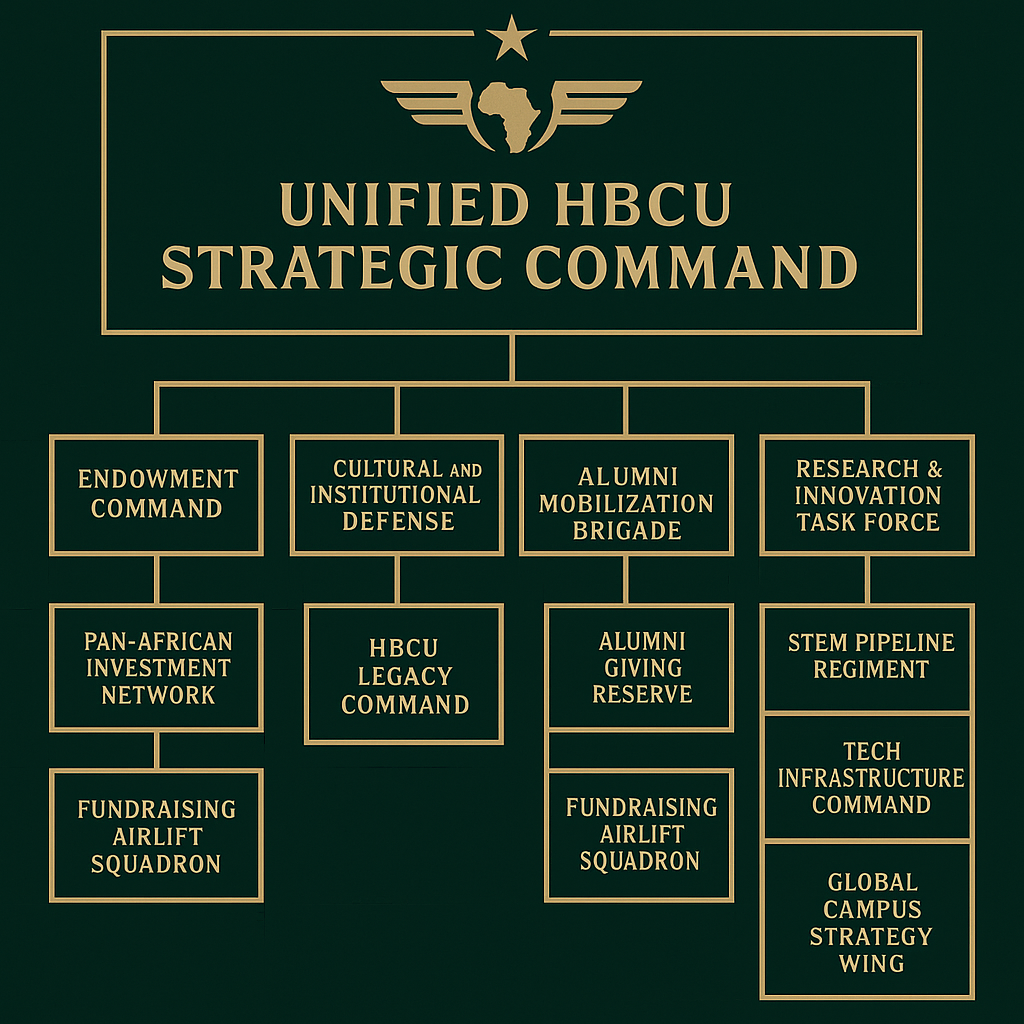
Dr. John Henrik Clarke, a noted Pan-African historian, and someone who I consider an unofficial mentor said that any African American who is looking to devise a plan must look at our communities as nation-states and therefore must consider these fundamental pillars:

How will my people be housed?

How will my people be educated?

How will my people be fed?

How will my people be defended?

The answers to these questions can no longer be grassroots, they have to be institutional and they have to be thought about in a way that recognizes that our sovereign nation-state is adjacent to an adversary who has and will invade us. It is not a question of if they will, but when will they because they have so many times before. Unfortuantely, we cannot ask Dr. King what his thoughts about his “Dream” for America would be today because at the age of 39 he was assassinated. He was assassinated three years after his contemporary Malcolm X was assasinated and five years after Medgar Evers was assassinated in his driveway. Medgar Evers just two months before the “I Have A Dream” speech would take place. He was not blind to what America was for African America and he was certainly not blind to how our adversaries saw us or the lengths they were willing to go to in order to silence us. For the last 50 plus years since Dr. King’s passing African America has tried to make a peace that we should now see is not possible. It is time for the Dream Redefined and that dream should start and stop with actions that provide for the institutional sovereignty and survial of African America period.

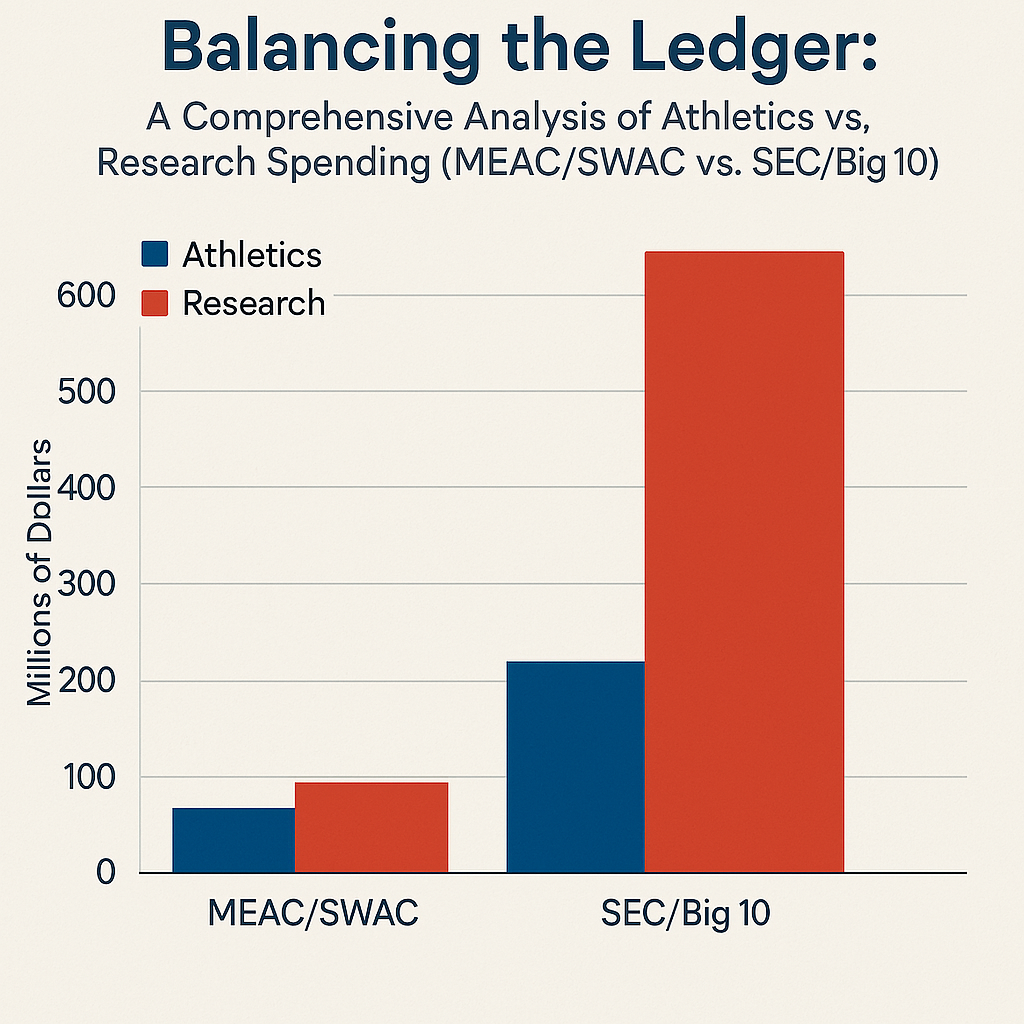
Balancing the Ledger: A Comprehensive Analysis of Athletics vs. Research Spending (MEAC/SWAC vs. SEC/Big 10)

“Since new developments are the products of a creative mind, we must therefore stimulate and encourage that type of mind in every way possible.” – George Washington Carver

In the financially stratified ecosystem of American higher education, institutions are increasingly confronted with a binary tension: to invest in athletic visibility or academic viability. For universities across the NCAA spectrum, especially those in the MEAC and SWAC conferences compared to their counterparts in the SEC and Big Ten, this decision is less about preference and more about resource constraints and strategic direction. Yet, data reveals a persistent imbalance in how these priorities manifest, and more critically, the long-term costs of these choices.

Conference Dynamics: Institutional Identity and Capital Exposure

The MEAC and SWAC are defined by institutions that are predominantly Historically Black Colleges and Universities (HBCUs). These universities have traditionally operated under capital scarcity, navigating chronic underfunding while serving as incubators of social mobility for African American communities. Their mission, often grounded in equity and community uplift, limits their ability to generate large commercial revenues through athletics. This is not due to a lack of talent or audience, but because media deals, booster contributions, and government funding disproportionately favor PWI institutions.

By contrast, the SEC and Big Ten represent the economic elite of collegiate athletics and academia. With flagship state universities at their helm, these conferences are buttressed by multi-billion-dollar endowments, large donor bases, and lucrative broadcast contracts. Their budgets allow for investments in both athletics and research without having to cannibalize one to fund the other. In essence, they play the game with more capital and fewer trade-offs.

Athletics Budgets: Symbolism vs. Strategy

MEAC and SWAC institutions report average athletics expenditures between $11 million and $12 million annually. Notable programs like North Carolina A&T and Prairie View A&M may hover slightly higher, but Mississippi Valley State and others operate on budgets as low as $3.9 million. These figures pale in comparison to SEC schools like Alabama or Texas A&M, where athletic spending exceeds $150 million. The Big Ten’s Ohio State leads all with $215 million dedicated to athletics alone.

While athletic programs at HBCUs serve as cultural centers and enrollment drivers, their limited revenue-generating capacity renders them economically unsustainable without substantial subsidization. Many are forced to divert institutional funds, raise student fees, or solicit local donations just to keep programs afloat. In contrast, SEC and Big Ten programs function as media properties, brand engines, and financial assets, often contributing revenue back to their academic institutions.

Athletics at HBCUs carry significant intangible value, cultural pride, alumni engagement, community identity, but these cannot substitute for financial sustainability. The opportunity cost of maintaining expensive athletic programs without equivalent return on investment demands strategic scrutiny.

Research Spending: The Forgotten Core

Where the real divergence occurs is in research investment. MEAC and SWAC research expenditures are overwhelmingly modest. With the exceptions of Howard University ($122 million) and Florida A&M ($41 million), most institutions sit between $2 million and $25 million in annual research activity. These figures reflect decades of underinvestment and insufficient infrastructure, not a lack of capacity or talent.

Meanwhile, SEC and Big Ten institutions routinely surpass $500 million in annual research outlays. Schools like Michigan ($1.67 billion), Wisconsin ($1.36 billion), and Penn State ($996 million) operate on a scale comparable to government agencies and national labs. They attract large NIH, NSF, and Department of Defense grants. They lead clinical trials, generate patents, and build interdisciplinary research parks.

This disparity is not simply numerical; it is strategic. Research drives federal grants, patents, corporate partnerships, and endowment growth. It also attracts high-performing faculty and students, serving as the foundation of institutional longevity and economic influence.

The Ratio That Tells the Future

The athletics-to-research spending ratio offers a lens into institutional philosophy:

  • Norfolk State: 2:1 athletics to research
  • Jackson State: 0.7:1
  • Mississippi Valley State: 6:1
  • Alabama: 0.15:1
  • Michigan: 0.11:1
  • Wisconsin: 0.11:1

While SEC and Big Ten schools spend more on athletics than HBCUs, they also spend exponentially more on research. The imbalance within HBCUs is a reflection not of poor prioritization, but of systemic capital deprivation. These ratios also underscore how HBCUs are often forced to choose between visibility and viability, between entertainment and innovation, because they lack the financial bandwidth to pursue both.

Research as Revenue: Commercialization and the Innovation Economy

University research is not merely an academic endeavor it is a gateway to commercialization. Inventions born in labs often become patents. Patents become licensing agreements. Licensing revenue, in turn, flows back into the institution. The University of Florida’s development and commercialization of Gatorade yielded more than $280 million over time. Stanford’s involvement in launching Google and Hewlett-Packard has helped fuel its $36 billion endowment. Wisconsin’s WARF fund manages $4 billion in research-derived assets.

This model is not just aspirational; it is replicable. But replication requires infrastructure, policy, and intention.

Building the Infrastructure: A Two-Track Strategy for HBCUs

Campus Infrastructure

  1. Strengthen Technology Transfer Offices (TTOs): These serve as the conversion points from research to revenue. TTOs are responsible for managing patents, evaluating commercial potential, and negotiating licensing agreements.
  2. Invest in Innovation Facilities: Makerspaces, incubators, wet labs, and data science centers can all be built in underused buildings or retrofitted spaces.
  3. Embed Commercialization in Curriculum: Courses in IP law, venture creation, product development, and ethics should be available to both undergraduates and graduate students.
  4. Create Campus Accelerators: Provide seed funding, pitch competitions, and alumni mentorship. These accelerators can be industry-specific (e.g., AgTech at Tuskegee, FinTech at Howard).
  5. Celebrate Wins: Every patent, startup, or licensing deal should be internally recognized and externally marketed. Visibility breeds validation and investment.

Capital Infrastructure

  1. Black-Owned Banks: Offer startup lines of credit and financial education embedded in innovation ecosystems. These institutions can also hold endowment funds or manage cash flow from royalty revenues.
  2. Diaspora Sovereign Wealth Funds: Channel African and Caribbean capital into HBCU startups and joint ventures. Funds like Nigeria’s NSIA or Pan-African VC firms could provide growth capital.
  3. HBCU Venture & Endowment Funds: Seeded by Black VC firms, family offices, and institutional investors. These funds can create co-investment syndicates for promising faculty or student ventures.
  4. Donor-Advised Funds (DAFs): Enable alumni to contribute to IP pipelines through tax-efficient giving. DAFs could also be matched by corporate sponsors or philanthropic partners.

Building Strategic Partnerships for Scale

HBCUs need not operate in silos. Strategic collaboration can accelerate commercialization and R&D outcomes:

  • Inter-HBCU R&D Collaboratives: Morgan State and FAMU could co-sponsor patent consortiums.
  • Cross-registration commercialization programs with PWIs like Johns Hopkins or Emory.
  • Statewide HBCU innovation districts tied to workforce pipelines and rural development.

From the Lab to the Ledger: Case Studies in ROI

  1. University of Florida – Gatorade: In the 1960s, UF researchers developed a hydration drink to help football players endure Florida’s brutal heat. The result, Gatorade, has yielded over $280 million in licensing revenue. These funds helped UF build research infrastructure, attract top scientists, and grow its endowment.
  2. Stanford University – Silicon Valley: Stanford was not always wealthy. Its proximity to innovation and its open policies toward student and faculty entrepreneurship led to the creation of Google, Cisco, and more. Today, Stanford’s alumni-founded companies generate trillions in global market value.
  3. University of Wisconsin – WARF: Established in 1925, the Wisconsin Alumni Research Foundation has monetized research in Vitamin D, stem cells, and imaging. With over $4 billion in assets, WARF reinvests in faculty, students, and commercialization pipelines.
  4. MIT – Ecosystem Builders: MIT’s Deshpande Center and The Engine Fund act as innovation pipelines that commercialize tough tech. MIT startups have created over 4.6 million jobs globally.

What HBCUs Must Avoid: Dependency Without Ownership

Too often, HBCUs have served as intellectual suppliers while other institutions and corporations reap the financial rewards. Faculty develop ideas, only for those patents to be captured by universities with larger TTOs. Students build prototypes, only to license them under incubators unaffiliated with their home campus.

To shift this paradigm, ownership must be embedded from the start. That means building institutional IP portfolios and teaching students the economics of invention.

A Circular Ecosystem Rooted in Culture and Capital

StakeholderRole in the Pipeline
Black-Owned BanksStartup capital, credit access, and embedded finance literacy
Diaspora Wealth FundsStrategic investment, global partnerships, and joint IP deals
African American NPOsStakeholder investors, endowment builders, and R&D supporters
Black Media & AlumniNarrative shaping, promotional power, and advocacy
HBCU TTOs & LeadershipPatent management, research development, and startup formation

Final Calculations: Wealth Is Institutional, Not Individual

The data from MEAC, SWAC, SEC, and Big Ten schools paints a vivid picture of the financial landscape of higher education. While SEC and Big Ten schools show that it is possible to be excellent in both athletics and academics, MEAC and SWAC institutions face tougher choices due to structural inequalities and historical underfunding.

As conversations around equity, student success, and public accountability continue, this kind of comparative data is essential. Whether aiming for a championship or a Nobel Prize, universities must remember that their ultimate mission is to educate, innovate, and uplift communities.

University research isn’t just about publications and academic prestige it’s a launchpad for innovation, economic growth, and financial sustainability. When strategically supported, it becomes a core driver of commercialization, entrepreneurship, and long-term prosperity through patents and endowment growth.

Many HBCUs and smaller institutions already are incubators of brilliance but they’ve been left out of the research-to-wealth pipeline due to underfunding and limited infrastructure. With targeted investments and smart policy, they can flip the script and become not just engines of education, but engines of innovation and wealth creation.

Disclaimer: This article was assisted by ChatGPT.

A Letter To Malcolm

I’ve always been a poet. My dad went to Lincoln University with Gil-Scott Heron, so I came out of the womb listening to Gil-Scott Heron. – Malcolm Jamal-Warner

Dear Malcolm,

I will never forget where I was when the alert came on my phone. I was sitting in the woods for work. We were having a retreat of sorts in the Santa Fe National Forest for the morning. The cellphone service was spotty at best and most of the time my service said SOS. But every now and then I would get one bar and notifications would come pouring in. Around late morning early noon an alert from the Associated Press came in that you had passed and my entire insides collapsed. I had to find every way I could to hold it together. The disbelief helped. That cannot be right, but of course it coming from the Associated Press made it almost impossible for it to be an error. Yet, I hoped it was. My mind raced to find composure. I certainly could not shout out what I just saw on my phone. It would not make sense to anyone around me. While I am sure there are some around my age that work with me I cannot readily think of who. Even moreso, I am the only African American in my organization. It would not make sense to anyone to break down in tears at that moment. To have to explain why you are crying over a celebrity, but in a space of African Americans we know you were never that even if you were that.

It is complicated at times to understand cousins and play siblings AKA “Brother/Sister from another Mother” to those outside of our community. These connections are deep and I do mean DEEP. There are cousins who I have not spoken to in years who could call me right now and I would get on the first plane smoking to go defend them in whatever capacity they needed. They just need say the word. You became that to so many of us. A cousin and/or brother from another mother. You were an eclectic soul and that meant the world to me. You explored the world and your curiousities without feeling bound. Something I so deeply value in my own life. To explore your interests without worry of what anyone would think and say. Many wish they could live life without those restrictions and you did it effortlessly. You never “Sold Out” or went “Hollywood” on us. You were always willing to speak up and speak about the African American community in a manner that felt real and felt true. I appreciated that despite your own admitted struggles of feeling like enough you overflowed the cups of so many African American boys and girls who grew up with you.

Since you left us I kept thinking about how to describe you to the world as I saw you. You were a regular Brotha who was EXCEPTIONAL. That is all I keep thinking as I grapple with the tears of knowing another Brotha being gone far too soon. I took for granted that we would see you in our older years. That you would continue to impart your wisdom of how you saw the world and just the shining example of being an African American man, son, brother, husband, father, and all the complex layers that come with the lives we live.

There is no need to discuss your accomplishments. We all know them. We all lived them with you. I told a friend today you were someone who I wished I could meet one day and share ideas for our community and knew you would understand. They would be ideas you would love and embrace and support. For me, there are so few that I believe I could have those conversations with in the world and deeply saddens me that now there is one less person in this world I feel I can realte to and who would understand me. It took a lot to hold it together the rest of that day. Until I get home and sit with the stages of grief that it feels like the entirety of African America is trying to find the words for day after day right now. I think about your daughter and wife. How you really were the regular guy just enjoying a family vacation. The regular guy who loved being a father and put her flower in your fitted cap as you left us your final message. It still feels like one of the worst dreams I have ever had. For a community that needs good Brothas and often feels like we have too few this is a blow that I am uncertain we will ever an answer for anytime soon – if ever. I could go on, but there is no need. All I can do, all any of us can do from today forward is think of you, reminisce of you, and try each day to carry just a little of the light you showed to the world in our own way.

May the Ancestors welcome you home.

Your Cousin and Brother from Another Mother,

William

Building Bridges for the Future: How Claflin University and Africa University Are Reimagining HBCU-African Higher Education Partnerships

“The regeneration of Africa means that a new and unique civilization is soon to be added to the world.” — Dr. Edward Wilmot Blyden

In a world increasingly threatened by climate change, biodiversity loss, and global inequality, it is not only science that must rise to meet the moment—it is institutions. The historic collaboration between Claflin University, a leading Historically Black College and University (HBCU) in Orangeburg, South Carolina, and Africa University in Zimbabwe is a testament to what the future of Pan-African higher education cooperation can and must look like.

As seen in the powerful image of four smiling graduates—young scholars representing Africa University’s Class of 2025—this partnership is more than symbolic. These four AU alums were awarded Master of Science degrees in Biotechnology and Climate Change through an online program with Claflin University. It marks a significant step forward in bridging the gap between HBCUs and African universities, offering not just degrees, but transformation, elevation, and a realignment of institutional relationships across the African Diaspora.

Claflin University’s Dr. Gloria McCutcheon, a seasoned environmental scientist and scholar, alongside Africa University’s Dr. James Salley, deserves our deepest thanks and congratulations for stewarding this visionary effort. This is more than an academic exercise. It is an investment in Black global agency—an institutional architecture that boldly resists the neo-colonial fragmentation of Black intellect and instead forges knowledge capital across oceans.

The Institutional Revolution: Why It Matters

Historically, relationships between HBCUs and African universities have been underdeveloped. While shared historical and cultural lineages run deep, formal cooperation in research, degree programs, and faculty development has often been episodic and underfunded. This is due in part to a lack of intercontinental policy alignment, but also due to the structural underinvestment in both HBCUs and African institutions of higher learning.

Yet this partnership challenges that stagnation. By aligning their academic missions, Africa University and Claflin University are modeling a future where Black institutions on both sides of the Atlantic are no longer rivals for Western validation, but co-creators of global excellence.

Biotechnology and climate change are not only timely fields—they are strategic. These disciplines shape the future of agriculture, health, water, and energy. As climate change disproportionately affects the Global South, it is imperative that scientists and researchers from Africa and the African Diaspora lead in developing regionally grounded and globally relevant solutions. The MS program is designed with this in mind, empowering graduates with the tools to confront challenges that affect their communities directly.

This is the praxis of Black institutional sovereignty. It is not merely symbolic, it is materially transformational.

Online Education as Pan-African Infrastructure

One of the most remarkable elements of this partnership is its fully online format. In doing so, it sidesteps the exorbitant costs and restrictive visa policies that often inhibit African students from accessing U.S.-based graduate education. Rather than uprooting scholars from their communities and obligations, this model allows them to remain embedded in the ecosystems they intend to serve.

It is also a vital counterpoint to the often exploitative model of international student tuition dependency seen at many Predominantly White Institutions (PWIs). Instead of recruiting African students primarily as revenue sources, this partnership honors them as scholars and change-makers—collaborators in knowledge production, not customers.

This is especially crucial as online education technologies mature and expand access. The future of African Diaspora cooperation must be hybrid and tech-savvy, using every digital tool available to scale education, connect institutions, and reinforce the sovereignty of Black intellectual spaces.

Claflin’s leadership in this area signals what is possible for other HBCUs. Morehouse School of Medicine has already begun integrating global health partnerships, and Howard University has longstanding African studies initiatives. Yet this direct academic program collaboration between Claflin and Africa University sets a new precedent—one that should become a norm, not an exception.

The Bigger Picture: Climate, Biotechnology, and Black Sovereignty

The selection of Biotechnology and Climate Change as the focus of this master’s program is a strategic masterstroke. Climate adaptation, agricultural sustainability, and bio-innovation are the battlegrounds of the 21st century. From Nairobi to New Orleans, African-descended people are often the first to feel the tremors of ecological collapse. We are also, too often, the last to benefit from the technological revolutions responding to it.

By placing young African scholars at the cutting edge of these fields, Claflin and Africa University are not just preparing students for careers—they are preparing them to lead revolutions. Innovations in biotech can reshape everything from vaccine distribution to drought-resistant crops. Expertise in climate change can determine which communities survive sea-level rise, which economies can adapt to volatile weather, and which governments can formulate climate justice policies that center the most vulnerable.

This partnership builds knowledge that is simultaneously scientific and sovereign. It reflects a belief that Black students should not just study solutions crafted elsewhere, but invent their own. In a world that too often imposes external “development” frameworks on African nations and communities, this program declares: we are the architects of our own future.

A Framework for Expansion: What Comes Next?

One successful cohort is a seed. But the real question is how to scale this model.

Here are five recommendations:

  1. Joint Endowments – HBCUs and African universities should pursue shared endowment vehicles that fund joint programs, scholarships, and research. Such funds would represent a new kind of transatlantic educational capital—independent, mission-driven, and Pan-African in structure.
  2. Faculty Exchange Pipelines – Beyond student exchanges, institutions must prioritize reciprocal faculty exchange programs. African professors teaching at HBCUs (physically or virtually) and vice versa would broaden curricular offerings and deepen cultural fluency. HBCU Faculty Development Network is the perfect conduit to sponsor the programming infrastructure for such an exchange.
  3. Shared Research Institutes – HBCUs and African universities could establish co-branded research institutes focusing on themes like climate change, food security, public health, and digital governance—topics where the Global Black experience offers unique insights.
  4. Diasporic Accreditation Models – One major barrier is credential recognition. A Pan-African accreditation body could facilitate mutual recognition of degrees and allow smoother transitions for students moving between institutions in the Diaspora.
  5. Government & Philanthropy Engagement – African governments and HBCU-aligned philanthropies must see this kind of partnership as strategic infrastructure. They must fund it accordingly. Every dollar spent here is a dollar spent on self-determination.

The Role of Leadership

Credit must be given where it is due. Dr. Gloria McCutcheon’s work at Claflin demonstrates what it means for faculty to move beyond the classroom and into institution-building. Her leadership not only provided the academic structure for the MS program but built the trust and collaborative framework that such international partnerships demand.

Likewise, Dr. James Salley’s leadership at Africa University—an institution that has long carried the banner of Pan-African Christian higher education—has been instrumental. AU was founded on the principle of serving Africa through excellence, and this collaboration expands that mission into the Diaspora.

This is what visionary leadership looks like: daring to connect what colonialism sought to divide.

The Image as Testament

Courtesy of Claflin University

The image that inspired this article—four young scholars, standing confidently in front of a brick building, adorned in the sunlight of new opportunity—represents more than a graduation. It is a visual declaration of Pan-African potential. Their smiles, their presence, their achievement—each affirms the power of institutions that choose cooperation over competition, legacy over ego, and elevation over exploitation.

They are not just Claflin graduates or Africa University alumni. They are trailblazers of a new academic order—one that transcends borders and builds Black excellence into the very structure of education itself.

Final Thoughts: Pan-African Pedagogy Is The Future

In a century defined by ecological upheaval, technological disruption, and renewed global competition, the African Diaspora cannot afford fragmented institutions. HBCUs and African universities must see each other as natural allies—extensions of a common historical, intellectual, and cultural struggle.

This Claflin-AU partnership is not just a program. It is a model of what is possible when Pan-African Diaspora institutions collaborate with purpose. It is a rejection of dependency and a commitment to capacity-building. It is the beginning of an educational ecosystem rooted in mutual respect, sovereign vision, and Pan-African commitment.

Let it grow. Let others follow. Let this be the future of Pan-African education—intercontinental, interdisciplinary, empowering, and unapologetically transformative.

Congratulations again to the Class of 2025. Your success is our collective success.

#SCUMCConference #elevationandtransformation