Category Archives: Banking & Credit Unions

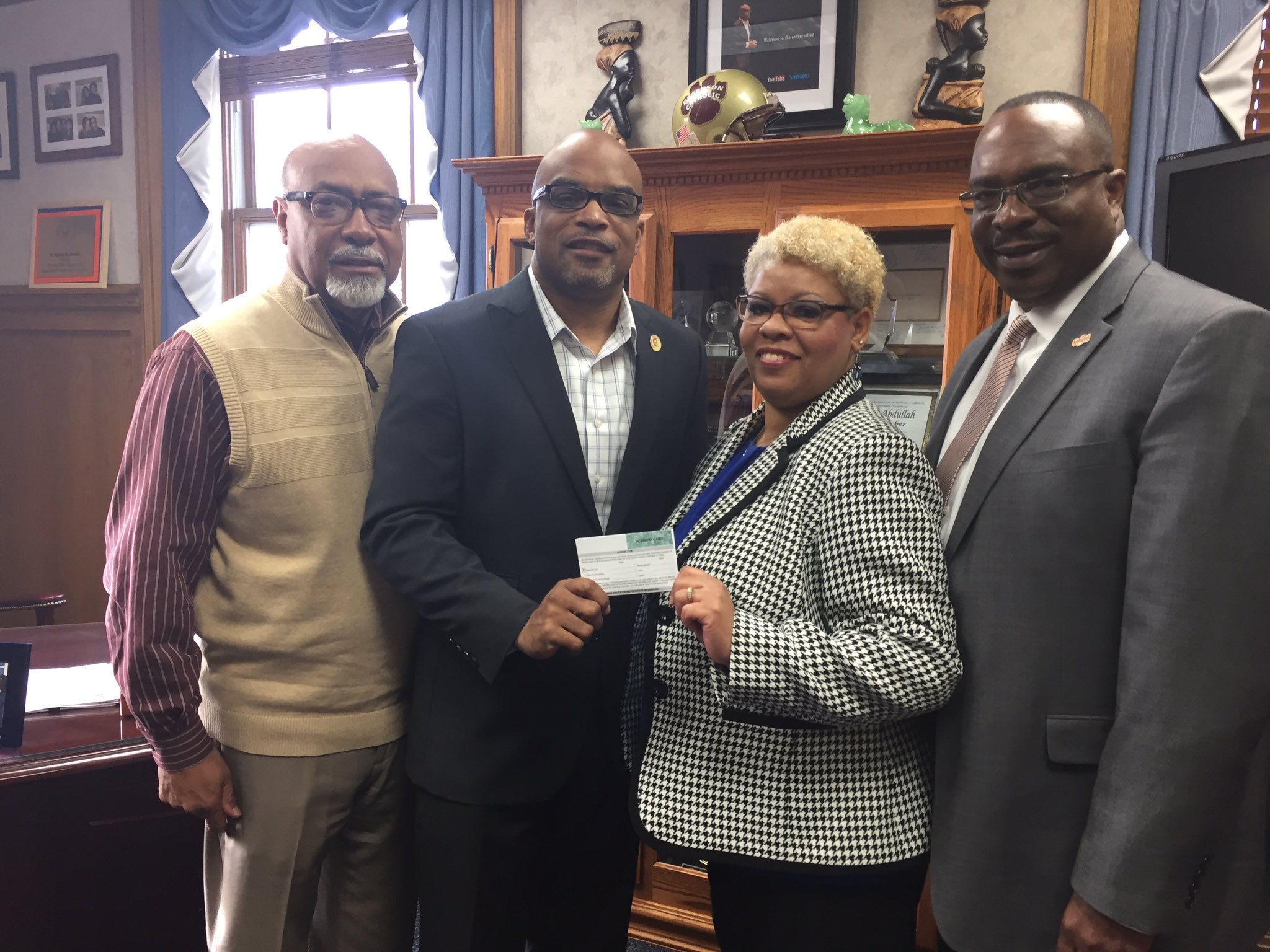
Virginia State’s President Abdullah Leading By Example: Establishes Banking Relationship at VSU Credit Union

c2jwujaxaaaqfio

In a release on Twitter, Kevin Davenport, Virginia State University’s Chief Financial Officer, announced that President Makolah Abdullah would be establishing a personal banking relationship with Virginia State University Federal Credit Union, which is the  fourth largest HBCU-based credit union with $8.6 million assets.

It is a move that is prominent after the massive banking black movement began last year. Noted web traffic to HBCU Money would spike anytime there was a police shooting last year to our African American Bank and Credit Union directories. Many African American owned banks and credit unions reporting thousands of accounts being opened and millions of dollars being moved as African Americans looked to take more ownership of their economic power. The movement also coupled with years of financial abuse by banks like Wells Fargo, Bank of America, and others towards the African American community.

The decision by President Abdullah is an important moment as college presidents tend to be more a more financially affluent group. Financially affluent African Americans have often been a group that has been missing among African American owned financial institutions as clients, leaving many institutions to try and survive by piecemealing less financially stable customers and contributing to decades of stagnant products and services offered. We hope this will spur many other HBCU presidents to move their banking relationships and continue to set the example for their students and our community that in order to build a stronger African American ecosystem our institutions, all of them, need our support, investment, and patronage.

Of course, the major missing piece is moving institutional accounts. HBCUs control billions in institutional money and could significantly enlarge the $10.4 billion that is now controlled by 339 African American owned banks and credit unions left. However, very few African American financial institutions are capable of handling institutional accounts. Currently, OneUnited Bank, the largest African American owned bank or credit union with $648 million in assets, has two HBCUs, Roxbury Community College and Florida Memorial as institutional clients. As the banks and credit unions become more stable with growing deposits from individuals, then they will be able to offer the more complex products that institutions and businesses need. So while President Abdullah maybe just one account, the halo effect could begin a second wave in the #BankBlack movement in 2017 and beyond.


Not Just Deposits But Shares: Buying A Stake In African America’s Publicly Traded Banks

image1(1)

Editor’s Correction: Broadway Federal Bank located in Los Angeles, California is also publicly traded and information added below (July 19, 2016)

“But not only that, we’ve got to strengthen black institutions. I call upon you to take your money out of the banks downtown and deposit your money in Tri-State Bank. We want a “bank-in” movement in Memphis. Go by the savings and loan association. I’m not asking you something that we don’t do ourselves at SCLC.”- Martin Luther King, Jr.

It has been noted here at HBCU Money that after every tragic death of an African American by a police officer our site spikes. The primary cause for that spike has been a search for African American owned banks and credit unions and it usually last for a few days, then there are marches, pacification, and all returns to normal as does our site’s traffic. After the recent deaths of Alton Sterling and Philando Castile though something changed and the current numbers say it may finally be the groundswell needed for a permanent paradigm shift in African America’s thought process of self-dependence and empowerment. Banks are the foundation of allowing a community, city, state, nation to control its money and circulate their dollars within the aforementioned entities. This has been at the root of African America’s problem with getting dollars to circulate within its community – simply put a lack of dollars within the financial institutions in the community. Deposits turn into loans and those loans turn into mortgages to increase African American home ownership, reduces predatory lending, and helps launch small businesses which translates into jobs and wealth in the community usually of the bank or credit union entity.

The shift has been profound as banks like Unity National Bank and Citizens Trust (featured here) are overwhelmed by the number of new accounts to the point that their staff simply can not process the volume. Lobbies are jam packed with African Americans moving their money. The seed is planted, but it can not stop there. Another leg of this has to be investing in these institutions from an ownership perspective. More demand for their shares will cause the institutions share prices to increase and increase the value of the company. This allows the company to expand, open new offices, hire more people, and eventually buy other banks. As it buys other banks, it can scale up and drive down cost, which it can then pass that savings on to customers. All of this is investment in our institutions leads to a cycle of economic independence and empowerment that begins to grow and feed on itself like a snowball rolling down hill.

Lastly, America has roughly 3,700 publicly traded companies, but there are only four African American owned public companies (0.1% of all American public companies) and three of them are banks. Below are their profiles. If you want to buy shares in these companies, visit our link on Opening A Brokerage Account.

_______________________________________________________

CITIZENS BANCSHARES CORPORATION

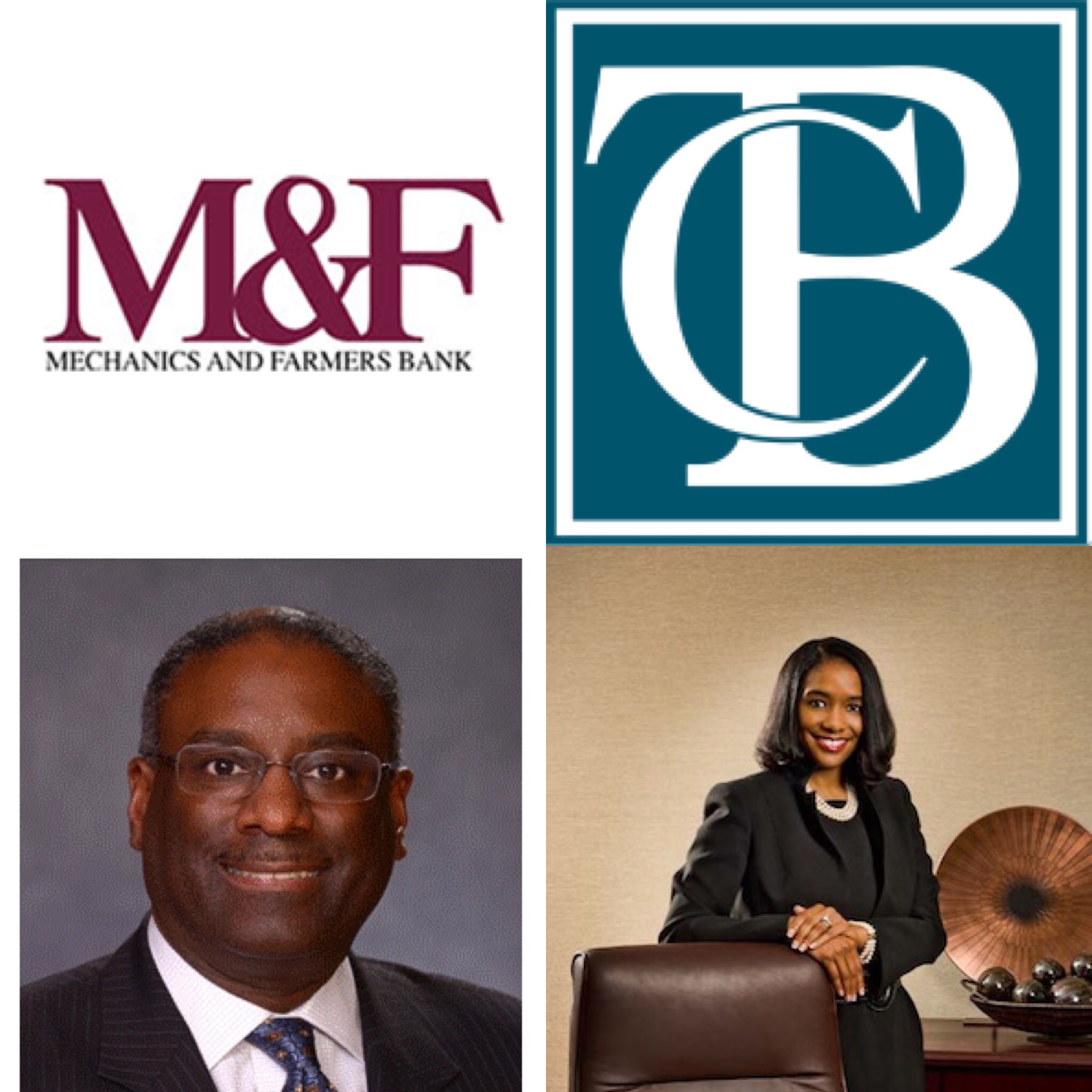
CEO: Ms. Cynthia N. Day, CPA (Above Right)

Ticker Symbol: CZBS

Citizens Bancshares Corporation operates as the holding company for Citizens Trust Bank that provides various commercial banking products and services. The company accepts commercial and consumer deposit accounts, such as non-interest bearing checking accounts, money market checking accounts, negotiable order of withdrawal accounts, individual retirement accounts, time certificates of deposit, sweep accounts, and regular savings accounts. Its loan products include consumer/installment loans, mortgage loans, home equity lines of credit, construction loans, commercial loans, and small business loans. The company operates seven full-service financial centers in metropolitan Atlanta, Georgia; one full-service branch in Columbus, Georgia; one full-service branch in Birmingham, Alabama; and one full-service branch in Eutaw, Alabama. Citizens Bancshares Corporation was founded in 1921 and is based in Atlanta, Georgia.

M&F BANCORP

CEO: Mr. James H. Sills, III (Above Left)

Ticker Symbol: MFBP

M&F Bancorp, Inc. operates as the bank holding company for Mechanics and Farmers Bank that provides consumer and commercial banking products and services in North Carolina. The company offers deposit products, including checking, savings, negotiable order of withdrawal, money market, and individual retirement accounts, as well as certificates of deposit. It also provides loans for real estate, construction, businesses, personal use, home improvement, and automobiles; and equity lines of credit, credit lines, consumer loans, and credit cards. In addition, the company offers safe deposit boxes, Internet and mobile banking services, traveler’s checks, notary services, and automated teller machine services, as well as electronic funds transfer services, such as wire transfers. It operates seven branch offices in Durham, Raleigh, Charlotte, Greensboro, and Winston-Salem, North Carolina. The company was founded in 1907 and is headquartered in Durham, North Carolina.

BROADWAY FEDERAL BANK

CEO: Wayne-Kent A. Bradshaw

Ticker Symbol: BYFC

Broadway Financial Corporation operates as the holding company for Broadway Federal Bank, f.s.b. that provides savings and loan business services for low to moderate income communities in Southern California. The company accepts various deposit products, such as passbook savings accounts, checking accounts, NOW accounts, money market accounts, and fixed-term certificates of deposits. It also provides loan products, including multi-family mortgage, commercial real estate, single family mortgage, church, construction, commercial, and consumer loans. It operates three full service branches comprising two in the city of Los Angeles and one in the city of Inglewood, California. The company was founded in 1946 and is headquartered in Los Angeles, California.

Source: Company profiles provided by Yahoo Finance.

African American Banks Reduced To 21 – North Milwaukee State Bank Closes

NorthMilwakeeStateBanK_home_wp

The state of Wisconsin has lost one of its two African American owned banks. North Milwaukee State Bank, which was almost three times the size of Wisconsin’s other African American owned bank, Columbia Savings & Loan Association, officially had its doors shutdown on March 11, 2016. It is one of only two American bank failures in 2016 thus far.

Per the FDIC, “To protect the depositors, the FDIC entered into a purchase and assumption agreement with First-Citizens Bank & Trust Company, Raleigh, North Carolina, to assume all of the deposits of North Milwaukee State Bank.” First-Citizens Bank & Trust is controlled by a bank holding company, First Citizens Bancshares, which is publicly traded on the NASDAQ. Its primary shareholders are the Holding family and Fidelity Investments.

For the entire FDIC official release click here.

The closure takes $67.1 million in assets and $61.5 million in deposits off the books of African American owned banks as a collective.

XULA FCU Growing, Virginia State University FCU In Crisis, And 2016 HBCU-Based Credit Unions Overall – Stagnant

Even if I knew that tomorrow the world would go to pieces, I would still plant my apple tree. – Martin Luther

header

2016’s HBCU-based credit unions are stuck in neutral. Eleven HBCU-based credit unions assets are unchanged from 2015 and still stand at $87 million. Membership saw a decline from just over 17 000 in 2015 to 16 546 in 2016. For comparison, Navy Federal Credit Union, America’s largest credit union has $73.3 billion in assets and 5.9 million members.

  1. Southern Teachers & Parents (LA) – $28.3 million ($28 million)
  2. Florida A&M University (FL) – $20.1 million ($19.6 million)
  3. Howard University Employees (DC) – $10.8 million ($11.3 million)
  4. Virginia State University (VA) – $8.6 million ($9.6 million)
  5. Prairie View (TX) – $4.8 million ($4.8 million)
  6. Savastate Teachers (GA) – $3.7 million ($3.6 million)
  7. Councill (AL) – $3.4 million ($3.4 million)
  8. Xavier University (LA) – $2.6 million ($2.4 million)
  9. Arkansas A&M College (AR) – $2.4 million ($2.3 million)
  10. Tennessee State University (TN) – $1.6 million ($1.4 million)
  11. Shaw University (NC) – $0.6 million ($0.5 million)

HBCU-based credit unions while having almost $90 million in assets are too top heavy as a collective. The top four HBCU-based credit unions have almost 80 percent of the group’s combined assets. Unfortunately, the fourth member of the group, Virginia State University Federal Credit Union, is dragging down the collective. Over the past two years VSU FCU has seen its assets decline almost 20 percent. VSU FCU is in the process of a transition in leadership after the long-term CEO Peggy Custis stepped down after a multi-decade run. In her place, Katrina Peerman, is serving as interim CEO while the board looks to make a long-term decision. That long-term decision, whether it remains Ms. Peerman or an outside choice could have a rippling effect that impacts the group as a whole. Can HBCU-based credit unions come into the 21st century? It remains to be seen whether they possess the leadership or aggressive vision required to facilitate

HBCU Money’s 2015 review and analysis of HBCU-based credit unions remain unchanged:

Unfortunately, there also seems to be no urgency by these credit unions to do the things necessary to increase their membership and assets. Students entering into HBCUs today may be more financially illiterate than a generation ago, but they have more complex financial needs thanks in large part to student loans playing such a large role into today’s higher education finance. Not to mention the reduced role that social security will play in their long-term retirement planning. An issue that should be prompting more HBCU-based credit unions to find ways to help students reduce student loan debt and start retirement planning while in college. A hard task to give this group given the limited financial products and services they offer leave HBCU-based credit unions minute opportunity to serve the needs of students, faculty, campus organizations, or even the HBCUs themselves. These limited products and services are largely an issue of lacking scale. Instead of a credit union with at least $87 million in assets, the median is $3.6 million amongst eleven with declining assets and membership. Instead of students, faculty, and institutions who travel more today than ever to conferences, tournaments, etc. being able to access their money at one of the eleven branches or through mobile app banking along the way, they are limited to just one insular branch with technology that at best reminds you of AOL dial-up. Holding onto students is even more difficult with most returning to their hometowns or nearest major city upon graduation and only returning to the campus at most once a year for homecoming. Incentive to keep banking beyond graduation? None.

Lauryn Hill has a wonderful song called the Ex-Factor that I think often describes African America institutional strategic behavior and with HBCU-based credit unions it seems no different. “It could all be so simple, but you’d rather make it hard. Loving you is like a battle and we both end up with scars.” I still believe with the right vision, an HBCU credit union could rival the Navy Federal Credit Union and give African America a place of financial safety instead of the scars we constantly end up with from predatory financial services that come into communities because we are left with such meager choices from our own financial institutions. It really all could be so simple, but more than likely we will continue to make it hard.

Citicorp, JPMorgan Chase, And Others Plead Guilty – African American Banking Opportunity?

It isn’t the size of the dog in the fight, but the size of the fight in the dog that counts. – Woody Hayes

Wells-Fargo

I have to say if I was CEO at an African American owned bank or credit union right now I would be salivating at the news where two of America’s largest banks plead guilty to felony charges for manipulating currencies and rigging interest rates. Citibank and J.P. Morgan Chase control a combined $2.3 trillion in deposits worldwide. For perspective, total bank deposits in the United States total $9.3 trillion. This provides an opportunity to give a new narrative to African American communities about the value of banking with someone they know and trust. A bank/credit union owned by and for their community. Although not charged, I would also lump Bank of America and Wells Fargo into my attack, which given their recent settlements for predatory lending towards African American communities would not be a reach at all.

NPR reports, “Citicorp, JPMorgan Chase, Barclays, The Royal Bank of Scotland and UBS AG have agreed to plead guilty to felony charges and pay billions in criminal fines, the Department of Justice says. The offenses range from manipulating the value of dollars and euros to rigging interest rates.” The banks charged will be paying a $5.6 billion in fines combined, with Citigroup and J.P. Morgan Chase paying $1.26 billion and $892 million, respectively. Despite the heavy fines, no one will face actual criminal chargers. Bear in mind for perspective that Citigroup and J.P. Morgan Chase had 2014 net income of $7.3 billion and $21.8 billion, respectively. In other words, Citigroup will be paying 17.3 percent of its net income (profits) and J.P. Morgan Chase will pay 4.1 percent of its net income (profits). It is not clear however if they have to pay the fine at once or have been put on a payment plan.

By now, we have all heard the number – $1.1 trillion. That is the buying power of African America, but what we rarely hear is that less than 1 percent of that buying power sits in African American banks and credit unions (AABCUs). This continuously leaves African America in dire straits needing access to capital, but putting non-AABCUs like Citigroup, JP Morgan, Wells Fargo, and Bank of America in a position to take our money and then use it as a predatory weapon against our communities. One of a bank’s objectives is move the risk from those that own it onto other groups. The aforementioned banks not owned by us are doing their job and doing it well. We just keep aiding them by giving them a larger deposit base which in turn gets loaned back to us at predatory rates so that the owners can secure loans at discounted rates. Our communities pay more so that their communities can pay less. In other words, we deposit $1.00 in the bank and they deposit $1.00 in the bank. The bank now has $2.00 it can lend out. They will borrow $0.50 at 4 percent and our community borrows $0.25 (but needs $0.50) at 8 percent. But why have AABCUs not take advantage of this telling this narrative?

African American banks and credit unions have as a collective not done a good job of expounding their benefits to the communities they are in. Not nearly enough community outreach or customer acquisition investment has been done by African American owned financial institutions. The question if its the chicken or the egg in this case remains in flux. Do you spend limited resources to market to get deposits or do you wait for deposits then market to get more customers? Whichever approach is taken, it must be done with resolute commitment to increasing the AABCUs deposit hold within our communities.  It baffles me the number of AABCUs who are not even on social media. Are you kidding me? It is FREE. If AABCUs created internships for HBCU marketing and communication majors each semester they could have a millennial team of four or five students rotating every three to four months. And while many do not like them, I would hire club promoters and street teams to get the word out. Incentivize the community to become your word of mouth advertising in exchange for perks. In an interview I did with Donna Shuler, co-founder of Answer Title in Washington D.C. and former bank CEO, she said, “More community outreach starting when students are still in school. Banks and agents should use more images of African Americans in their marketing.” One thing that continues to plague African American organizations and firms is the copycat complex that ignores cultural differences between the way our community consumes products and services and the way other communities do. We do this despite Nielsen, an American global information and measurement company, having an entire site dedicated to the African American consumer trends and behavior.

We also have to stop being afraid to use what in hip-hop is known as “beef” with our counterparts. This is a competition after all. My marketing campaign would go something like this – “You know who has NOT  been fined for predatory practices against African Americans – (insert AABCU name).” Or I would have a list of the non-AABCUs who have been fined for their practices against our community and call it a public service announcement. People love a good guy, bad guy scenario. A mentor always said to me once to use what you have. Whatever it is that draws people to you – use it. In AABCUs case, it is using what the others have done to our community to your advantage of getting those deposits to switch institutions. It is also being more engaged in community activities where you can have the captive attention to get financial literacy and marketing message out.

African Americans continue to lose ground in wealth accumulation, our communities and neighborhoods continue to be at risk of gentrification because of lack of development and access to capital, and these are all a reflection of a weak banking system. We know what happened to Harlem and what is happening to places like Third Ward in Houston  among other places. This latest behavior by the non-AABCUs is just a long list of a wedge that AABCUs should be using to distinguish themselves among their core consumer demographic. They have given more than an inch to exploit and it is time we take the mile.