
Author Archives: hbcumoney

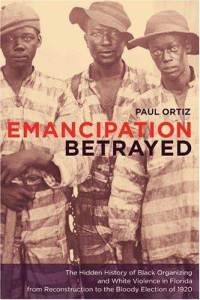
HBCU Money™ Business Book Feature – Emancipation Betrayed: The Hidden History of Black Organizing and White Violence in Florida from Reconstruction to the Bloody Election of 1920

emancipation-betrayed-hidden-history-black-organizing-white-violence-paul-ortiz-hardcover-cover-art

In this penetrating examination of African American politics and culture, Paul Ortiz throws a powerful light on the struggle of black Floridians to create the first statewide civil rights movement against Jim Crow. Concentrating on the period between the end of slavery and the election of 1920, Emancipation Betrayed vividly demonstrates that the decades leading up to the historic voter registration drive of 1919-20 were marked by intense battles during which African Americans struck for higher wages, took up arms to prevent lynching, forged independent political alliances, boycotted segregated streetcars, and created a democratic historical memory of the Civil War and Reconstruction. Contrary to previous claims that African Americans made few strides toward building an effective civil rights movement during this period, Ortiz documents how black Floridians formed mutual aid organizations–secret societies, women’s clubs, labor unions, and churches–to bolster dignity and survival in the harsh climate of Florida, which had the highest lynching rate of any state in the union. African Americans called on these institutions to build a statewide movement to regain the right to vote after World War I. African American women played a decisive role in the campaign as they mobilized in the months leading up to the passage of the Nineteenth Amendment. The 1920 contest culminated in the bloodiest Election Day in modern American history, when white supremacists and the Ku Klux Klan violently, and with state sanction, prevented African Americans from voting. Ortiz’s eloquent interpretation of the many ways that black Floridians fought to expand the meaning of freedom beyond formal equality and his broader consideration of how people resist oppression and create new social movements illuminate a strategic era of United States history and reveal how the legacy of legal segregation continues to play itself out to this day.
HBCU Money™ Dozen Links 12/31 – 1/4

Did you miss HBCU Money™ Dozen via Twitter? No worry. We are now putting them on the site for you to visit at your leisure.

Government Departments

House Dem: GOP plan to cut spending with debt ceiling is ‘legislative terrorism’ l House News bit.ly/Wt0p9l

Life in the Fast Lane: Racing to Identify Species as Biodiversity Shrinks l National Science Foundation 1.usa.gov/WsaGm9

Education Council selection is underway. We encourage parents to nominate themselves for a seat! l NYC Schools on.nyc.gov/138QFXn

House GOP seeks to abolish IRS, replace income tax with consumption tax l House News bit.ly/WsbRC9

DYK African-Americans have an increased risk for glaucoma? l Women’s Health go.usa.gov/gG7W

Secretary’s Column: Looking Ahead to #2013 l Department of Agriculture ow.ly/gyIGT

Federal Reserve, Central Banks, & Financial Departments

Interested in some context to financial crises? Check out this interactive timeline l Chicago Fed ow.ly/gyK3K

Examine how social networks, payments and banking intersect l KC Fed ow.ly/gyLef

Megan Cohen blogs on the piggy bank’s origin and evolution l NY Fed bit.ly/XqrsYN

The global financial & economic crisis in 2008 has reawakened interest in fiscal policy l World Bank ow.ly/gyLJz

Teachers, how do you explain the quasi-governmental nature of the Fed? Let the Classroom Economist help l Atlanta Fed goo.gl/SLwH3

16% of sub-Saharan Africans use mobile phones for banking, vs. 3% in the rest of the developing world l World Bank http://bit.ly/UcBImB

Thank you as always for joining us on Saturday for HBCU Money™ Dozen. The 12 most important government and central bank articles of the week.

The HBCU Money™ Weekly Market Watch

Our Money Matters /\ January 4, 2013

NAME TICKER PRICE (GAIN/LOSS %)

African American Publicly Traded Companies

Citizens Bancshares Georgia (CZBS) $4.12 (UNCH)

Carver Bank New York (CARV) $4.15 (3.75% UP)

Radio One (ROIA) $0.88 (14.29% UP)

African Stock Exchanges

Bourse Regionale des Valeurs Mobilieres (BRVM)  167.12 (0.4% UP)

Botswana Stock Exchange (BSE)  7 510.24 (UNCH)

Ghana Stock Exchange (GSE)  1 199.32 (0.03% DN)*

Nairobi Stock Exchange (NSE)  97.30 (N/A)

Johannesburg Stock Exchange (JSE) 40 274.79 (0.07% UP)

International Stock Exchanges

New York Stock Exchange (NYSE) 8 649.99 (0.49% UP)

London Stock Exchange (LSE)  3 191.10 (0.66% UP)

Tokyo Stock Exchange (TOPIX)  888.51 (3.34% UP)

Commodities

Gold 1 651.70 (1.37% DN)

Oil 92.89 (0.03% DN)

*Ghana Stock Exchange shows current year to date movement. All others daily.

All quotes reported as of 2:00 PM Eastern Time Zone

The HBCU Endowment Feature – Howard University

391563_10150893820927185_1925738357_n

School Name: Howard University

Median Cost of Attendance: $41 483

Undergraduate Population: 7 164

Endowment Needed: $5 943 684 160

Analysis: Howard University needs approximately $6 billion for all of its students to attend debt free annually. Howard University is in pole position to become the first HBCU to reach the billion dollar mark. The school has historically had a very dedicated alumni base that has translated into consistent giving which for compound interest reasons can be more important than inconsistently larger donations. The only full service HBCU with both a law and medical school, it has at its disposal a higher income bracket of graduate school alumni than all other HBCUs. This provides a significant advantage in its fundraising. It does not hurt that the school is located in the nation’s capital where many federal funding decisions are made. Washington D.C. also being the home of one of the strongest African American populations in terms of social, economic, and political capital. One mistake that could be made by its alumni and university however is being content. Spelman and Hampton are closing the gap rapidly and on the more macro scale Harvard is widening the institutional gap between African America and European America’s top universities. Resting on its laurels could be fatal especially as Howard continues to be one of the most expensive colleges, HBCU or not, in the country. Howard, not becoming dependent on the tuition revenue that its higher cost of attendance brings is vital to keep in the forefront of the development office. Making families and communities feel good about the investment they are making and reducing the burden should be at the forefront of their alumni so the school can continue to recruit the cream of the crop in academic talent which translates into wealthier alumni on average. Ultimately, it is hard not to see Howard University becoming the first HBCU to achieve a billion dollar endowment with its healthy dose of donations and consistently high investment returns. It appears inevitable with the only thing that can get in its away is itself, but the competition to a billion will be fierce make no mistake about it.

As always it should be noted that endowments provide a myriad of subsidies to the university for everything from scholarship, faculty & administration salaries, research, and much more.

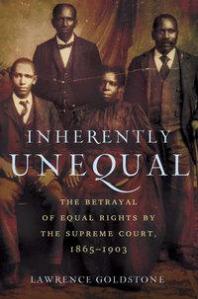
HBCU Money™ Business Book Feature – Inherently Unequal: The Betrayal of Equal Rights by the Supreme Court, 1865-1903

unequal

A potent and original examination of how the Supreme Court subverted justice and empowered the Jim Crow era.

In the years following the Civil War, the 13th Amendment abolished slavery; the 14th conferred citizenship and equal protection under the law to white and black; and the 15th gave black American males the right to vote. In 1875, the most comprehensive civil rights legislation in the nation’s history granted all Americans “the full and equal enjoyment” of public accommodations. Just eight years later, the Supreme Court, by an 8-1 vote, overturned the Civil Rights Act as unconstitutional and, in the process, disemboweled the equal protection provisions of the 14th Amendment. Using court records and accounts of the period, Lawrence Goldstone chronicles how “by the dawn of the 20th century the U.S. had become the nation of Jim Crow laws, quasi-slavery, and precisely the same two-tiered system of justice that had existed in the slave era.”

The very human story of how and why this happened make Inherently Unequal as important as it is provocative. Examining both celebrated decisions like Plessy v. Ferguson and those often overlooked, Goldstone demonstrates how the Supreme Court turned a blind eye to the obvious reality of racism, defending instead the business establishment and status quo–thereby legalizing the brutal prejudice that came to define the Jim Crow era.