
Author Archives: hbcumoney

HBCU Money™ Business Book Feature – Tower of Basel: The Shadowy History of the Secret Bank that Runs the World

basel

Tower of Basel is the first investigative history of the world’s most secretive global financial institution. Based on extensive archival research in Switzerland, Britain, and the United States, and in-depth interviews with key decision-makers—including Paul Volcker, the former chairman of the US Federal Reserve; Sir Mervyn King, governor of the Bank of England; and former senior Bank for International Settlements managers and officials—Tower of Basel tells the inside story of the Bank for International Settlements (BIS): the central bankers’ own bank.

Created by the governors of the Bank of England and the Reichsbank in 1930, and protected by an international treaty, the BIS and its assets are legally beyond the reach of any government or jurisdiction. The bank is untouchable. Swiss authorities have no jurisdiction over the bank or its premises. The BIS has just 140 customers but made tax-free profits of $1.17 billion in 2011–2012.

Since its creation, the bank has been at the heart of global events but has often gone unnoticed. Under Thomas McKittrick, the bank’s American president from 1940–1946, the BIS was open for business throughout the Second World War. The BIS accepted looted Nazi gold, conducted foreign exchange deals for the Reichsbank, and was used by both the Allies and the Axis powers as a secret contact point to keep the channels of international finance open.

After 1945 the BIS—still behind the scenes—for decades provided the necessary technical and administrative support for the trans-European currency project, from the first attempts to harmonize exchange rates in the late 1940s to the launch of the Euro in 2002. It now stands at the center of efforts to build a new global financial and regulatory architecture, once again proving that it has the power to shape the financial rules of our world. Yet despite its pivotal role in the financial and political history of the last century and during the economic current crisis, the BIS has remained largely unknown—until now.

HBCU Money™ Dozen Links 7/8 – 7/12

12STEPBALL_2

Did you miss HBCU Money™ Dozen via Twitter? No worry. We are now putting them on the site for you to visit at your leisure. We have made some changes here at HBCU Money™ Dozen. We are now solely focused on research and central bank articles from the previous week.

Research

Watch the Oregon Sea Grant video, “How to Feed a Giant Pacific Octopus l Oregon Sea Grant http://ow.ly/mT6Vl

Classroom pets and plants can quickly become invasive too, so be careful with them l IL-IN Sea Grant http://ow.ly/mT6Zd

Did you know there are approx. 800,000 miles of public sewer lines in the US l EPA Research http://1.usa.gov/1346xYb

Do you know what Vibrio vulnificus is? l Louisiana Sea Grant http://fb.me/36k7WFyc2

Need to model the hydraulic & water quality behavior of water distribution piping systems? l EPA Research http://1.usa.gov/RCeIfO

Ever wonder why E=mc^2 is so incredibly famous? “Starts With a Bang!” l SLAC http://bit.ly/176JQqI

Federal Reserve, Central Banks, & Financial Departments

Lawmakers propose PATH Act to create housing sustainability l Housing Wire http://hwi.re/3f2y0d

New home purchase mortgage apps decrease by 15% l Housing Wire http://hwi.re/3f21kg

The Crash, Risk and Monetary Policy. A look at 1987 market behavior l Chicago Fed http://ow.ly/mSDf7

See today’s import/export data broken down by country and type of product l St. Louis Fed http://bit.ly/gzko7h

Teachers: Get resources to inspire your students about entrepreneurship at our workshop 7/19 l Kansas City Fed http://ow.ly/mT8D3

Elementary teachers: Register for “Talking Economics, Walking History” on Aug. 7 in Little Rock l St. Louis Fed http://bit.ly/12jkeHm

Thank you as always for joining us on Saturday for HBCU Money™ Dozen. The 12 most important research and finance articles of the week.

The HBCU Money™ Weekly Market Watch

Our Money Matters /\ July 12, 2013

A weekly snapshot of African American owned public companies and HBCU Money™ tracked African stock exchanges.

NAME TICKER PRICE (GAIN/LOSS %)

African American Publicly Traded Companies

Citizens Bancshares Georgia (CZBS) $6.00 (8.81% DN)

Radio One (ROIA) $2.22 (2.78% UP)

African Stock Exchanges

Bourse Regionale des Valeurs Mobilieres (BRVM)  208.16 (0.12% DN)

Botswana Stock Exchange (BSE)  8 664.65 (0.14% DN)

Ghana Stock Exchange (GSE)  1 910.98 (59.29% UP)*

Nairobi Stock Exchange (NSE)  121.39 (N/A)

Johannesburg Stock Exchange (JSE) 40 734.89 (0.47% UP)

International Stock Exchanges

New York Stock Exchange (NYSE) 9 471.23 (0.23% DN)

London Stock Exchange (LSE)  3 468.85 (0.08% UP)

Tokyo Stock Exchange (TOPIX)  1 201.99 (0.60% UP)

Commodities

Gold 1 279.50 (0.03% DN)

Oil 105.96 (1.00% UP)

*Ghana Stock Exchange shows current year to date movement. All others daily.

All quotes reported as of 5:00 PM Eastern Time Zone

HBCU Money™ B-School: How Is The Federal Reserve Board Selected?

usmap3

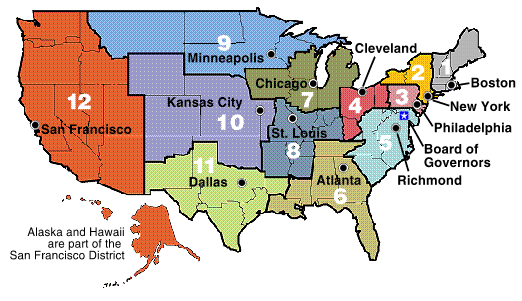
Editor’s Note: There are HBCUs located in 11 of the 12 Federal Reserve Districts with the Minneapolis Federal Reserve District territory being the lone exception. Also, it should be noted that 8 of the 12 cities that house the primary headquarters of the respective Federal Reserve District have HBCUs in them with Cleveland, Kansas City, Minneapolis, and San Francisco being the exceptions.

The members of the Board of Governors are nominated by the President of the United States and confirmed by the U.S. Senate. By law, the appointments must yield a “fair representation of the financial, agricultural, industrial, and commercial interests and geographical divisions of the country,” and no two Governors may come from the same Federal Reserve District.

The full term of a Governor is 14 years; appointments are staggered so that one term expires on January 31 of each even-numbered year. A Governor who has served a full term may not be reappointed, but a Governor who was appointed to complete the balance of an unexpired term may be reappointed to a full 14-year term.

Once appointed, Governors may not be removed from office for their policy views. The lengthy terms and staggered appointments are intended to contribute to the insulation of the Board–and the Federal Reserve System as a whole–from day-to-day political pressures to which it might otherwise be subject.

In addition to serving as members of the Board, the Chairman and Vice Chairman of the Board serve terms of four years, and they may be reappointed to those roles and serve until their terms as Governors expire. The Chairman serves as public spokesperson and representative of the Board and manager of the Board’s staff. The Chairman also presides at Board meetings. Affirming the apolitical nature of the Board, recent Presidents of both major political parties have selected the same person as Board Chairman.

The Congress sets the salaries of the Board members. For 2012, the Chairman’s annual salary is $199,700. The annual salary of the other Board members (including the Vice Chairman) is $179,700.

Source: Federal Reserve

African America’s June Unemployment Report – 13.7%

jobs_pic

Overall Unemployment: 7.6% (7.6%)

African America Unemployment: 13.7% (13.5%)

Latino America Unemployment: 9.1% (9.1%)

European America Unemployment: 6.7% (6.7%)

Asian America Unemployment: 5.0% (4.3%)

Analysis: The unemployment rates overall remains unchanged. Two of the four diaspora groups remain unchanged while the other two saw upticks. Asian America saw a significant uptick but remains the group with the lowest unemployment. African America remains the only group with a double digit unemployment rate.

African American Male Unemployment: 13.0% (13.5%)

African American Female Unemployment: 12.0% (11.2%)

African American Teenage Unemployment: 43.6% (42.6%)

African American Male Participation: 67.1% (67.9%)

African American Female Participation: 62.3% (62.5%)

African American Teenage Participation: 28.1% (28.0%)

*Previous month in parentheses.

Analysis: African American women and teenagers saw significant upticks in their unemployment rate while the unemployment rate for men saw a moderate decrease. Participation rate for teenagers remain virtually unchanged while men and women both saw decreases. The men saw a substantial drop in their participation rate.

Conclusion: The overall economy added 195 000 jobs in the month of June. African America shows a loss of 112 000 jobs for the month of June. A significant loss after four straight months of positive job growth. The African American labor force shrunk by almost 100 000 and most disturbing is the participation rate as it dropped to its second lowest rate in the past five months. A sign that fatigue is setting in and the desire to find employment is waning. African American women’s participation rate has held steady over the past five months while the men have shown an alarming drop. The continued crisis of African American teenagers proves to be worsening as the group hit a new high again for its unemployment rate which still stands at the third highest in the developed world. It appears the sequester is setting in and unemployment fatigue is starting to take a turn for the negative in the African American community.

Source: Department of Labor