
Monthly Archives: August 2025

Debt Fit for a Queen (and Her King): Why Beyoncé and Jay-Z’s $110 Million Mortgage Is a Lesson in Black Wealth Strategy

“The wealthy don’t fear debt they master it. While others pay to own, they borrow to control.” — HBCU Money

In the hills of Bel Air, where the gates are high and the price of privacy even higher, a royal couple reigns not with crowns or thrones, but with compound interest, limited liability companies, and a mastery of capital structuring. This month, Beyoncé and Jay-Z made headlines again, not for a new album or tour, but for a second mortgage. The couple whose combined net worth now exceeds $3 billion, per Forbes secured an additional $57.8 million mortgage on their $88 million Bel Air estate. This raises their total mortgage debt on the property to $110.6 million. For many, it triggered confusion: Why would billionaires take out debt especially this much? They own the intellectual property rights to chart-topping albums, entire music catalogs, clothing lines, venture funds, and streaming services. They’re not short on liquidity. But for those fluent in institutional wealth-building, the move is textbook. It’s what banks do. What private equity does. What families like the Rockefellers, Rothschilds, and yes, now the Carters, do: they leverage good debt to expand their control over assets, preserve liquidity, and legally reduce taxes. As the headlines obsess over the couple’s $637,244 monthly burn rate including mortgage and property taxes we must step back and understand the real play at work.

The Structure of Power: Debt as a Wealth Instrument

There are two kinds of debt in America, debt you drown in, and debt you climb on. The former is predatory and suffocating: payday loans, credit card interest, subprime mortgages. The latter is engineered and liberating: investment real estate, operating capital, bridge financing. This second category, good debt is what powers Wall Street, Silicon Valley, and, increasingly, the portfolios of Black billionaires. When Beyoncé and Jay-Z financed their Bel Air estate rather than pay in cash, it wasn’t a lack of funds it was a maximization of strategy. With interest rates still historically low by long-term standards, the effective cost of borrowing is cheaper than the opportunity cost of deploying equity elsewhere. That $110 million in borrowed capital is likely earning multiples elsewhere in touring infrastructure, private equity ventures, tech startups, and, of course, real estate. The Carter empire does not rely on liquidating assets to make acquisitions. It builds on leverage, like any institution should.

Cash Is King, Debt Is the Horse It Rides

Jay-Z once rapped, “I’m not a businessman. I’m a business, man.” And that business understands that cash flow is oxygen. In a high-inflation, high-yield environment, holding liquidity is more valuable than owning a paid-off house in Bel Air. Let’s model it simply:

  • Suppose the couple borrowed $110 million at a 3.5% interest rate.
  • The annual cost is approximately $3.85 million.
  • That same $110 million deployed into touring, film production, or venture investments yielding 10% generates $11 million annually.

Net result? Over $7 million in arbitrage.

This is how institutions think. Not in terms of how much they “own,” but in how much capital they control and multiply. African American families and institutions should take note: Being debt-free is not synonymous with being economically powerful. Control, not ownership alone, is the more sophisticated metric of power.

The Bel Air Property: Trophy or Tool?

It’s tempting to dismiss the Bel Air estate as just another status symbol, a personal flex. But that’s the wrong lens.

For the Carters, real estate like music catalogs, business equity, and IP is a balance sheet line item. This home, aside from its lifestyle function, serves several institutional purposes:

  1. Collateralization – The home is a high-value, appreciating asset. It anchors future lending.
  2. Credit Enhancement – With reliable payment performance, it increases the couple’s access to cheap capital.
  3. Tax Optimization – Interest payments on a mortgage of this type can be partially deducted, even under current tax caps.

Moreover, the couple reportedly pays $100,343 monthly in property taxes, more than the annual income of the median U.S. household. But again, context matters. Their global income and asset base far outpace such obligations, and that property tax provides further tax deduction possibilities depending on structure.

A Note to the Emerging Class: Institutional Thinking Required

The divide in America today is less about income and more about how wealth thinks. Many African American households are still taught to see debt as something to eliminate completely often because of the trauma associated with its misuse. The wealth class, by contrast, uses debt as a financial tool.

The Carters didn’t get here by mistake. Their trajectory offers lessons that should be taught in HBCU finance classrooms and African American family wealth summits alike:

  • Leverage is not a vice if it is structured.
  • A mortgage is not debt when the return exceeds the cost.
  • Liquidity is more powerful than ownership in times of economic opportunity.
  • Institutions survive because they think beyond the personal.

This is especially important for HBCU alumni and African American families looking to build dynastic wealth. Too often, debt is only associated with student loans and credit cards. Rarely is it discussed as an accelerant for asset acquisition, tax minimization, or capital scaling.

Building the Empire: What the Rest of Us Can Learn

You don’t need a Bel Air zip code to think like an institution. The Carter model can be scaled:

  1. Buy Investment Property
    Use mortgage debt to buy a duplex, triplex, or quadplex where tenants cover your mortgage and generate passive income.
  2. Preserve Your Capital
    Avoid putting 100% down on assets. Leverage 20–30% and maintain the rest for emergencies or investments.
  3. Learn the Tax Code
    Understand how to deduct interest, depreciate properties, and structure your finances to reduce liability legally.
  4. Think Generationally
    Set up trusts, LLCs, and estate plans. Don’t just buy for today—structure for tomorrow.
  5. Teach the Next Generation
    Share strategies at the dinner table. Incorporate wealth-building into family conversations and HBCU alumni networks.

From Debt-Averse to Debt-Aware: A Cultural Pivot

For African America, there must be a shift from being debt-averse to being debt-aware. Not reckless, but informed. Not afraid, but empowered. Beyoncé and Jay-Z’s move may make for juicy tabloid fodder, but the real story is about capital strategy. With every refinance, with every debt restructuring, they’re deepening their institutional footprint. We often praise their performances, their music, their style. But perhaps we should spend more time studying their moves not just on stage, but on paper. Their empire isn’t built on vibes it’s built on vehicles, vision, and valuation strategy.

The Carter Codex

The narrative shouldn’t be, “Beyoncé and Jay-Z are spending $637,000 a month.” It should be, “Beyoncé and Jay-Z have leveraged a property to unlock hundreds of millions in investment capital while maintaining their lifestyle and optimizing their taxes.” That’s the story HBCU students in finance departments should be analyzing. That’s the story African American financial advisors should be breaking down. That’s the story Black families gathering for holiday dinners should be dissecting. Because wealth isn’t what you show it’s what you can withstand, what you can structure, and what you can scale. In a country that often denies African America the full benefits of capitalism, the Carter family is rewriting the playbook. Not with debt as a burden. But with debt as a bridge.

Disclaimer: This article was assisted by ChatGPT.
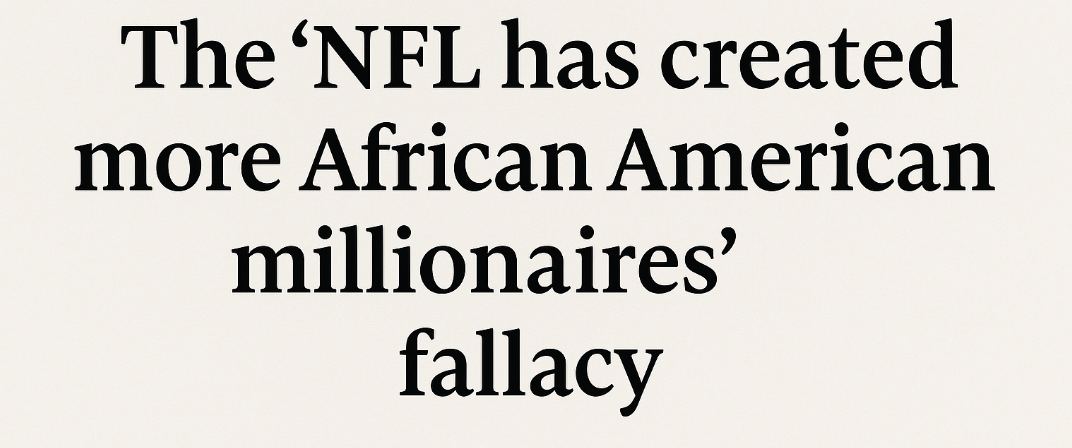
The Gridiron Mirage: Debunking the NFL as the Engine of African American Wealth

“A lot of enslaved people actually made money, but they had no power.” – William Rhoden

In the annals of American mythology, few institutions occupy as outsized a symbolic role in African American economic advancement as the National Football League. It is a league awash in spectacle and saturated with the rhetoric of opportunity. “The NFL has made more African American millionaires than any other institution,” say its defenders. This refrain—recited with patriotic pride or cynical resignation—has come to function as a social truism, a talisman held up to justify the nation’s meager investments in structural equity. But like most myths, its repetition does not make it true.

This article contends that this notion is not only false but insidious. It misrepresents the scale and structure of wealth in the African American community, diverts attention from more potent engines of generational prosperity, and masks the extractive and precarious nature of professional sports as a vehicle for wealth creation. The NFL is not a wealth escalator; it is, at best, a short-lived income spurt machine for a statistical elite, and at worst, a cultural and physical treadmill leading back to zero.

Gridiron Arithmetic: The Numbers Game

The first fallacy is numerical. As of the 2023 season, there were approximately 1,696 active NFL players spread across 32 teams. Around 58% of these players identified as African American, or roughly 984 athletes. Even when one accounts for the extended rosters, practice squads, and recent retirees still living off their earnings, the figure remains marginal—perhaps a few thousand men across multiple generations.

Contrast this with sectors such as healthcare, education, government, and business. The National Black MBA Association alone counts tens of thousands of members, many of whom have built sustainable wealth through entrepreneurship, investment, or corporate ascendancy. African American doctors number over 50,000. Black-owned businesses, according to the U.S. Census Bureau, exceed 140,000 with paid employees, and millions more operate as sole proprietorships.

The American Bar Association reports over 50,000 African American attorneys. Even the public sector, often decried as slow or bureaucratic, employs hundreds of thousands of Black professionals across local, state, and federal levels. These occupations, while lacking the glamour of a touchdown, generate far more stable, scalable, and generationally transferrable wealth.

Income vs. Wealth: The Shaky Foundations of NFL Riches

To understand the illusion, one must disentangle income from wealth. Wealth is not what one earns; it is what one owns. It is the portfolio, the property, the equity stake, the passive income stream, and, perhaps most critically, the ability to transfer resources across generations. NFL players earn substantial salaries during their brief careers—an average of $2.7 million per year, though the median is closer to $860,000. But careers are short, averaging just 3.3 years.

This creates what economists call a “high burn rate, low accumulation” profile. Studies have found that 15% of NFL players file for bankruptcy within 12 years of retirement, despite millions in earnings. Others do not go bankrupt but live in quiet precarity, reduced to local celebrity gigs and motivational speaking to sustain a post-football identity. The 2022 National Bureau of Economic Research paper “Bankruptcy Rates among NFL Players with Short-Lived Income” confirms this vulnerability, showing how the lack of financial literacy, support systems, and institutional guidance leads to dissipation rather than accumulation.

Meanwhile, wealth in America is driven by ownership: of businesses, real estate, stocks, and institutions. The NFL offers none of these to the vast majority of its Black athletes. Ownership, it must be said, remains the exclusive domain of white billionaires. As of 2025, there are zero majority African American owners of NFL franchises. While the NBA has made token strides—see Michael Jordan’s brief tenure as majority owner of the Charlotte Hornets—the NFL remains rigid in its old-world capital structure.

The Plantation Paradigm: Extraction, Not Empowerment

It is hard to avoid the uncomfortable metaphor that the NFL structurally resembles a modern-day plantation. African American bodies fuel the labor force, endure the risks, suffer the injuries, and entertain the masses. White ownership, white commissioners, and white-centered media conglomerates reap the institutional profits. The league generates $18 billion in annual revenue. The average team is valued at $5 billion. And yet, the athletes, even at the apex of their earning power, remain labor, not capital.

This is not a critique of sports per se. Athletics can inspire and galvanize. But the mythologizing of football as a viable strategy for racial uplift is akin to mistaking a single rainstorm for an irrigation system. The commodification of Black excellence in a space so structurally white in ownership and control cannot plausibly be the foundation for true economic emancipation.

This is made all the more clear by examining the fates of even the most successful. Players like Vince Young, who signed a $26 million contract and ended up broke, or Warren Sapp, who earned $82 million only to file for bankruptcy, are cautionary tales. Exceptions like LeBron James, who has parlayed his brand into equity ownerships and venture capital, are held up as archetypes. But these are aberrations, not templates. And they are not NFL stories.

The Opportunity Cost of Myth-Making

Perhaps the greatest harm of the “NFL creates millionaires” myth is opportunity cost. It distorts the allocation of attention, aspiration, and investment within the African American community. While youth in other demographics are taught to pursue STEM, financial literacy, or entrepreneurship, too many African American boys are sold a lottery ticket disguised as a profession. A 2021 study by the Journal of Black Studies found that African American adolescent males are 40 times more likely to aspire to a professional sports career than to become an engineer or entrepreneur.

This has ramifications far beyond the individual. It weakens pipelines to industries that are scalable, recession-resistant, and foundational to intergenerational wealth. No serious community-wide wealth can be built on the shoulders of 53-man rosters. Nor can economic independence arise from dependency on one of the most exploitative and physically damaging professions in modern labor.

There are also societal consequences. The overrepresentation of African Americans in professional sports distorts public perception. It fosters the narrative that “Black people are doing fine” because a few are seen in Super Bowl commercials or luxury car ads. It becomes a justification for denying systemic reform, funding cutbacks to HBCUs, or underinvestment in majority-Black schools. “Why do they need help?” ask the indifferent. “They have the NFL.”

Institutional Power vs Individual Stardom

In the game of wealth, institutions win. The NFL is an institution—one whose structure benefits its owners and media affiliates. The real wealth in sports lies not in being a player but in being an owner, a broadcaster, a media rights holder, or a licensed merchandiser. It lies in being Robert Kraft, not the running back who suffers a concussion under his ownership.

African American wealth building must shift its focus toward institutions that compound, aggregate, and replicate power. HBCUs, Black-owned banks, cooperative land trusts, investment syndicates, media companies, and technology accelerators are more viable pathways to collective advancement than any draft pick. Consider that a single Black-owned private equity fund managing $500 million will produce more Black millionaires than five decades of NFL careers.

In fact, historical analogues suggest that professional exclusion led to the construction of powerful Black institutions. During segregation, African Americans built hospitals, universities, bus lines, and newspapers. These were incubators of both economic and cultural power. In today’s integrationist fantasy, too many of these have been sacrificed in favor of proximity to elite white institutions—like the NFL—that will never relinquish true control.

The Global Lens: Transnational Wealth Thinking

Moreover, the fixation on domestic sports ignores the global economic realignment. The world’s fastest-growing wealth markets are in Africa, Asia, and Latin America. Forward-thinking African Americans should be exporting services, partnering with Pan-African institutions, and investing in sovereign wealth opportunities. Yet, the “NFL as savior” narrative keeps too many tethered to a narrow, provincial idea of success.

The NFL does not build factories. It does not fund innovation. It does not seed capital. It does not provide passive income. It does not own land, develop cities, or engage in infrastructure. It sells tickets. It sells ads. It breaks bodies. It builds billion-dollar stadiums on taxpayer subsidies and pays its workers less than hedge fund interns.

Real wealth is built through scale and succession. The Black farmer who owns 1,000 acres and passes it down is more transformative than the Pro Bowler whose children inherit post-career medical bills and reality show royalties.

Toward a New Narrative: Wealth Without Injury

African American communities need new wealth myths—ones grounded in fact, finance, and future orientation. The idea that the NFL is a pinnacle of Black achievement should be retired. In its place must come narratives about investment clubs, fintech startups, regenerative agriculture, urban development, and cooperative real estate ventures.

Educational institutions and cultural gatekeepers have a responsibility here. Public school counselors, pastors, and media platforms should deglamorize the sports-to-riches narrative and illuminate more durable paths. Foundations and philanthropies should invest not in football camps, but in coding bootcamps, maker spaces, and entrepreneurship labs.

Policy must evolve, too. Tax incentives should reward community ownership and capital retention. States should support Black-owned banks the way they support stadium construction. Reparations conversations should be about equity stakes, not honorary jerseys.

The NFL is not evil. It is, however, a business. And like all businesses, it is designed to maximize returns for its investors—not to solve racial inequality. The sooner we disabuse ourselves of the myth that it is a wealth escalator, the sooner we can begin the real work of building wealth—wealth that endures beyond the roar of the crowd, the flicker of the lights, or the brevity of a three-season career.

Trading Helmets for Holdings

In conclusion, the NFL is a distraction, not a development strategy. It is a parade, not a pipeline. It is a pageant of athletic excellence exploited for institutional enrichment. And it is a cultural sedative—one that soothes legitimate anger over systemic inequality with the spectacle of a few lucky gladiators.

The real revolution will not be televised on Monday Night Football. It will be written in balance sheets, ownership ledgers, and multi-generational trusts. African Americans must trade the helmet for holdings, the franchise tag for franchise ownership, and the myth of athletic salvation for the measured, compound reality of institutional power.

That is not as thrilling as a fourth-quarter comeback. But it is the only way to win the long game.

For Paying College Athletes? Yes, Then Cut The High School Athletes A Check Too

By William A. Foster, IV

“When hypocrisy is a character trait, it also affects one’s thinking, because it consists in the negation of all the aspects of reality that one finds disagreeable, irrational or repugnant.” – Octavio Paz

My freshman year of high school was nerve wracking and exciting. As far as academics were concerned I did fairly well that first year, but the football field was where I was most excited. I had a good year and heard rumblings that the varsity head coach had me in consideration for varsity my coming sophomore year. I fit his system of defense. I was small, but I had good football IQ and did not mind taking or giving a hit. All of that changed though when he got fired at the end of my freshman year for using an ineligible player during the year and having to forfeit almost all of the school’s games. In his place came a coach I was familiar with because the year before me and father went to see Jack Yates High School, the high school I grew up watching my father coach play in the state playoffs take on Temple High School and the offensive coordinator would then become our school’s head coach. I was excited, but nervous. They ran a different brand of football. We had been a predominantly running team and our talent fit that style. Instead, he ran an early version of the spread that was not very popular throughout. We were built for ground and pound and he wanted an air attack. I was switched positions from defense to offense and scored the first touchdown of the new regime, and from there it was all down hill.

By my junior year, I was deep into my academics and this was becoming a problem unbeknownst to me for my coaches. It would come to a head when I asked for more time before practice to get tutoring and one of my coaches said to me, “Son, you need to choose between them books and this team.” I would never forget that moment. I was shocked. I had parents who were college professors. Choose? Is he serious? Not only was he, but it would escalate. After our game that week, which I did not have a particularly good one and little did I know it was really the end of my football career. As we sat and watched game film the next week a play that I missed came up. The coach stopped the film, flipped on the lights, and looked dead at me and said to the team, “We have some players who are not committed to this team.” Being the hot tempered teenager I was at the time, I calmly put my head down as if I was rubbing it with one finger. I will let you guess which one. From that point on, I was in the dog house and at the end of the season was told to turn my equipment in. My father would talk me back onto the team for my senior year, but quite honestly it was hell and part of me wish I had never gone through it. I loved football growing up, playing in the street, watching my father coach, going to the state championship, and thought one day that would be me. Little did I understand, the “business” I was walking into.

Texas high school football is different. There is no doubt about that and Friday NIght Lights probably left more than a few things out that would traumatize people. I for one recall getting pulled over one night after drinking and in no condition to be behind a wheel, but once the police found out I played for the local high school team they were more interested in telling me about them playing for the police football team. Ultimately, they let me go with a minor in possession and let me drive myself home. On my high school football team we had some of everything going on from the drug dealers, drug users, massive illiteracy, and more than a few things I have blocked from my memory for good reason.

You see most of them were not just playing football for the love of the game. They were playing because they saw it as their only way out. Many of my teammates came from impoverished backgrounds, with few educational opportunities and even fewer economic ones. For them, football was not just a pastime it was a potential career. And yet, despite the immense pressure placed on high school athletes to perform, there is virtually no financial compensation for their efforts. If we are going to argue that college athletes deserve to be paid for their labor, then high school athletes who also generate millions of dollars in revenue deserve the same consideration.

The financial power of high school football, especially in states like Texas, is undeniable. According to a 2019 report by the Texas Education Agency, the state spent over $500 million on high school football stadiums between 2008 and 2018. Some stadiums rival those of small colleges in both size and amenities, with the most expensive high school stadium in the country, Legacy Stadium in Katy, Texas costing $72 million to build. These stadiums are packed on Friday nights, bringing in millions of dollars in ticket sales, sponsorships, and media rights.

Despite this, the players on the field, the ones drawing the crowds see none of this revenue. While their coaches earn six-figure salaries (the highest-paid high school coach in Texas makes $158,000 per year), the athletes themselves play for free, risking injury and sacrificing their time and education in the hopes of making it to the next level.

The physical toll on high school athletes is just as severe as it is for college players. According to a study by the National Federation of State High School Associations (NFHS), there are approximately 1.1 million high school football players in the U.S., and every year, an estimated 300,000 sports-related concussions occur among high school athletes. The risk of serious, long-term injury is real, yet these players receive no compensation for putting their bodies on the line.

Consider this: the National Collegiate Athletic Association (NCAA) has been pressured to provide financial assistance for athletes suffering from chronic traumatic encephalopathy (CTE), a brain disease caused by repeated head trauma. If college athletes deserve compensation for these risks, shouldn’t high school athletes who are just as vulnerable also receive financial protection?

Some may argue that high school sports do not generate as much money as college athletics. While it is true that high schools do not have billion-dollar TV contracts like the NCAA, local revenue generation is still significant. The Texas University Interscholastic League (UIL) collects millions of dollars in revenue from the state football championships, including ticket sales, sponsorships, and broadcasting rights. ESPN, Fox Sports, and other major networks regularly feature high school games, and Nike and Adidas have begun sponsoring elite high school programs.

In 2021, Alabama’s Hoover High School reported earning over $2 million annually from its football program. Southlake Carroll High School in Texas made nearly $1.5 million in a single season from ticket sales, donations, and sponsorships. The bottom line? High school football is not just a game it is a business. And in any other business, the labor force gets paid.

The NCAA’s decision to allow Name, Image, and Likeness (NIL) deals for college athletes has already set a precedent. High school athletes in several states including Texas, California, and Florida are now allowed to profit from their NIL rights. Players like Jaden Rashada, a high school quarterback in California, reportedly signed a $9.5 million NIL deal before ever playing a college snap. This demonstrates that high school athletes do, in fact, have market value.

But what about the majority of players who will never receive NIL deals? They are still sacrificing their time, bodies, and educational opportunities for the sport. If coaches, administrators, and organizations profit from their efforts, then why should the athletes themselves be excluded? A stipend, medical coverage, or even a trust fund for players who complete their high school careers would be a step in the right direction.

Critics argue that paying high school athletes could open the door to corruption, recruiting scandals, and financial mismanagement. However, these problems already exist in amateur sports. Boosters have been caught illegally paying recruits for decades, and schools have been sanctioned for bending the rules to secure top talent. If anything, formalizing a compensation structure would bring transparency to a system that already operates in the shadows.

Others worry about the financial burden on school districts. However, if schools can afford multi-million-dollar stadiums and six-figure coaching salaries, then they can find ways to fairly compensate athletes. The money is already there but the question is who gets to benefit from it.

The reality is that high school football is more than just a game. It is an industry, one that generates millions of dollars while placing tremendous physical and mental demands on young athletes. If we accept the argument that college athletes should be paid because of the revenue they generate, then we must apply that same logic to high school athletes.

High school athletes do more than just entertain. They fill stadiums, drive merchandise sales, and fuel an economy that benefits everyone except them. It is time to acknowledge their worth and compensate them accordingly. Whether through stipends, medical coverage, or NIL opportunities, high school athletes deserve to see a share of the wealth they help create. Otherwise, we continue to exploit their labor under the guise of “amateurism.” The system is broken, and until high school athletes get a piece of the pie, it will remain unfairly rigged against them.

 Disclaimer: This article was assisted by ChatGPT.

The Political Assault on Lisa D. Cook: Why the Fed’s Only HBCU Alum Faces an Outsized Storm

“You can not win a war that you will not acknowledge you are in, and African America refuses to acknowledge it is in a war and therefore has not built the institutional defense necessary to win.” – William A. Foster, IV

The latest calls for Federal Reserve Governor Lisa D. Cook to resign reveal less about her alleged financial entanglements and more about the precarious place of African American excellence in America’s institutional hierarchy. Cook, an alum of Spelman College—the jewel of the Atlanta University Center—sits as the only Historically Black College and University graduate in the Federal Reserve’s history. Her very presence at the central bank represents a seismic shift in the composition of economic policymaking. It also explains why she has become a lightning rod for partisan attacks.

On August 20, 2025, Donald Trump posted on Truth Social: “Cook must resign, now!!!!” The demand followed remarks from Bill Pulte, the Trump-appointed Director of the Federal Housing Finance Agency, who urged the Department of Justice to probe Cook’s role in allegedly questionable mortgages. What might otherwise be dismissed as yet another skirmish in Washington’s perpetual political warfare assumes broader significance when one considers who Cook is, what she represents, and what she symbolizes to African American institutions.

Lisa Cook’s rise to the Federal Reserve Board of Governors in May 2022 marked a watershed moment. For over a century, the Fed had been populated by a homogenous cadre of policymakers—almost exclusively White men with Ivy League or equivalent pedigrees. Cook, a Black woman educated at Spelman College, Oxford, and the University of California, Berkeley, carved a path through both racial and gendered barriers that have long defined the economics profession. Her scholarship is well known in academic circles: her pioneering work on the relationship between racial violence and African American innovation remains a cornerstone of economic history. By quantifying how lynching and Jim Crow violence curtailed patent activity by African Americans, she exposed a structural mechanism by which systemic racism suppressed not just Black lives but also Black wealth creation. At the Fed, she carried this analytical rigor into debates on labor markets, innovation, and most recently, the economic implications of artificial intelligence. For African America, her appointment was not just symbolic. It was strategic. HBCU graduates have long been overrepresented in producing the nation’s Black professionals—doctors, lawyers, judges, engineers. But in macroeconomic governance, their footprint has been virtually nonexistent. Cook’s ascension offered a foothold in one of the world’s most powerful institutions, where decisions reverberate across global markets, shape credit availability, and indirectly determine whether African American households can access affordable mortgages, student loans, and capital for small businesses.

The ferocity of the attacks against Cook cannot be divorced from her identity. The allegations hinge on supposed mortgage irregularities, amplified by Pulte and weaponized by Trump. Yet, even before these accusations, Cook faced resistance. Her Senate confirmation was one of the narrowest in Fed history, with Republicans uniformly opposed and some explicitly questioning her “fitness” for monetary policy on the grounds that her academic research leaned too heavily into racial economics. This rhetorical sleight-of-hand—dismissing racialized economic analysis as political—is a familiar tactic. It seeks to delegitimize the very work that challenges the dominant narrative. Cook’s critics often sidestep her publications in American Economic Review or her leadership within the American Economic Association, preferring instead to cast her as a “diversity appointment.” The current calls for her resignation escalate this narrative. To remove Cook under a cloud of controversy would not just eliminate a Fed governor. It would roll back the fragile gains of HBCU institutional representation in elite economic policymaking. It would signal, once again, that African American advancement is conditional, fragile, and always subject to reversal.

It is important to situate these attacks in a wider political economy. Trump’s demand is not only about Cook. It is about control of the Federal Reserve itself. The central bank has become increasingly politicized in recent years, with Republicans casting inflation and interest rate policy as partisan issues. To force out Cook would not only weaken President Biden’s appointees but also demoralize constituencies who view her as a critical voice for equity in macroeconomic policy. The Fed has traditionally projected itself as a technocratic, apolitical institution. Yet this veneer has cracked. Appointments are now battlefield contests. Cook’s vulnerability demonstrates that while America’s institutions have formally opened their doors to HBCU graduates, they have not yet fortified protections against political weaponization. This dynamic mirrors a historical pattern. African Americans who rise into positions of structural authority—whether judges, regulators, or corporate executives—often find themselves targets of disproportionate scrutiny. The goal is not merely to unseat them but to delegitimize the institutions that empowered them.

HBCUs stand uniquely implicated in this episode. Spelman College, Cook’s alma mater, is one of the leading producers of Black women in economics and STEM. Yet, despite their track record, HBCUs remain underfunded relative to predominantly White institutions. Cook’s ascent to the Fed was a triumph for the HBCU ecosystem, proof that institutional excellence could translate into influence at the very highest levels. That triumph is now under attack. If Cook were to resign or be forced out under pressure, it would reverberate across HBCUs. It would reinforce perceptions that HBCU alumni, even at their most accomplished, remain vulnerable to political takedowns. For African American students pursuing economics at Howard, Morehouse, or North Carolina A&T, the message would be chilling: success does not guarantee security. From an institutional development standpoint, the HBCU community must interpret this not as an isolated incident but as a case study in institutional fragility. Without strong networks of advocacy, media response, and financial backing, HBCU alumni who enter elite spaces will continue to stand exposed.

Cook’s potential ouster matters beyond symbolism. At a time when the Federal Reserve is grappling with questions of inflation persistence, labor market dynamics, and the disruptive potential of artificial intelligence, her perspective is invaluable. She has consistently foregrounded the idea that innovation is not distributed equally and that policy must account for structural barriers to participation. In her July 2025 speech at the National Bureau of Economic Research, Cook warned that generative AI could entrench inequality if its benefits accrued only to a narrow segment of firms and workers. This perspective matters because it forces the Fed to grapple with the distributional consequences of macroeconomic shifts, not just aggregate averages. Her departure would narrow the intellectual diversity of the Fed at precisely the moment it most needs heterodox insights.

What then must be the response of African American institutions—HBCUs, banks, think tanks, chambers of commerce? Silence cannot be an option. Cook’s defense should not be left to partisan politicians alone. Instead, a coordinated institutional defense is required, one that frames this attack not just as an assault on an individual but as an assault on African American institutional legitimacy. African American-owned banks could highlight the importance of a Fed governor who understands the structural barriers to credit access in Black communities. HBCU presidents could jointly issue statements defending the integrity of their alumna and reminding the public of their role in producing top-tier economists. Think tanks could produce rapid-response analyses showing the economic costs of underrepresentation in monetary policy. The lesson is clear: individual success must be buttressed by institutional power. Without that scaffolding, every Lisa Cook who rises will remain vulnerable to political storms.

Ultimately, the attack on Lisa Cook exemplifies America’s struggle with inclusion at the highest levels of institutional power. It is not enough to allow “firsts” to break through. True inclusion requires protecting them from disproportionate scrutiny, ensuring that they can govern with the same presumption of competence afforded to their peers. For African America, Cook’s ordeal is a reminder that victories in representation must be consolidated by institutional strategy. HBCUs cannot rest on symbolic triumphs; they must translate them into sustained influence, advocacy, and resilience. Otherwise, every gain risks being undone at the first sign of political backlash.

Lisa D. Cook stands at a crossroads. Her presence at the Federal Reserve is not simply about her credentials, which are unimpeachable. It is about what she represents: the intellectual capacity of HBCUs, the resilience of African American scholarship, and the potential for inclusive economic governance. The calls for her resignation are not neutral. They are part of a larger contest over who gets to shape America’s financial architecture. If African American institutions fail to rally, Cook may become another cautionary tale of progress reversed. But if they respond with clarity and force, this moment could mark the beginning of a new era—one in which HBCU alumni are not just present in elite institutions but are protected by a scaffolding of institutional power equal to the challenges they face. Her fate, in many ways, is a referendum on whether African America can defend its foothold in the commanding heights of global economic governance.

Disclaimer: This article was assisted by ChatGPT.

Cultural Triumph, Institutional Fragility, Financial Violence: Uncle Nearest and the Case for Black-Owned Banks

“Financial violence has always been America’s quietest weapon and when African America builds without its own banks, it builds on sand.” – HBCU Money

The announcement that Farm Credit Mid-America, a Kentucky cooperative lender, had placed Uncle Nearest and its affiliated companies under federal receivership has shaken both the whiskey industry and African American business circles. The suit, seeking repayment of more than $108 million in loans, highlights not only the fragility of high-growth consumer brands but also a longstanding structural reality: the absence of large, African American-owned financial institutions that could have acted as lender, partner, and safeguard. At its height, Uncle Nearest was not just a spirits company. It had become a cultural symbol, a multimillion-dollar brand built on the rediscovered story of Nathan “Nearest” Green, the enslaved man who taught Jack Daniel to distill. But symbols are poor substitutes for capital. When the credit cycle turns and lenders impose stricter terms, symbols do not pay creditors, nor do they provide the liquidity needed to weather missteps. Uncle Nearest’s fate is therefore not only a corporate matter but a macro-lesson in institutional gaps that continue to undermine African American economic power. And it is inseparable from a longer history of European Americans wielding financial violence to weaken or erase African American institutions.

Farm Credit Mid-America’s complaint is straightforward in legal framing but heavy in consequence. It alleges default on revolving and term loans, misuse of proceeds—including purchase of a Martha’s Vineyard property outside agreed-upon terms—and inflated valuations of whiskey barrel inventories pledged as collateral. The cooperative insists the company failed to provide accurate financial reporting and violated covenants on net worth and liquidity. For the court, these alleged breaches justified appointing a receiver to oversee Uncle Nearest’s assets. For the wider market, the case raises questions about how one of the fastest-growing American whiskey brands could become so overextended in such a short time. But to view this only through the narrow lens of corporate mismanagement is to miss the structural point. Uncle Nearest turned to Farm Credit Mid-America precisely because African America has no equivalent institution at scale. The problem is not just a troubled borrower but a financial architecture in which African Americans must seek credit from institutions historically aligned against them.

European Americans have long recognized that domination requires more than guns and laws—it requires control of finance. Throughout American history, financial violence has been deployed to cripple African American economic advancement. The Freedman’s Savings Bank collapse in 1874 wiped out the life savings of formerly enslaved depositors, and the federal government refused to fully compensate them, teaching African Americans early that their deposits could be sacrificed without recourse. In the 20th century, European American banks and the federal government codified racial exclusion through redlining maps, systematically denying mortgages in Black neighborhoods. This was not neutral finance; it was engineered financial violence, preventing African Americans from entering the homeownership wealth pipeline. The burning of Greenwood in Tulsa in 1921, often remembered as a physical massacre, was also a financial one. Banks, insurance companies, and credit lines were destroyed alongside homes and businesses. Without access to capital, Greenwood could never fully rebuild. In more recent times, financial violence has taken the form of predatory lending. Subprime mortgage products were disproportionately pushed onto African American homeowners before the 2008 financial crisis, wiping out a generation of household wealth. European American-controlled finance profits from African American participation in the economy while denying equal access to capital formation. Uncle Nearest’s entanglement with Farm Credit Mid-America is not an anomaly but a continuation. When European American-controlled institutions are the gatekeepers of capital, they wield the power not only to finance but also to foreclose, to empower but also to erase.

The Uncle Nearest saga is a case study in how celebrated success stories often obscure fragile foundations. For nearly a decade, business media and cultural outlets heralded the brand as a triumph of African American entrepreneurship. The company claimed exponential growth, distribution in all 50 states, and a flagship distillery that drew tourists. Yet financial statements were rarely disclosed, and profitability was never the focus. The enthusiasm reflected a broader dynamic: African American brands often become cultural darlings before they become financially resilient. Without deep ties to institutional lenders within their own community, they must rely on external credit relationships that can sour quickly. When this happens, the story moves from triumph to turmoil in a matter of months.

At the core of this episode lies a more sobering truth. African American households control nearly $1.7 trillion in annual spending power, but African American-owned financial institutions hold less than 0.5% of U.S. banking assets. The top African American-owned bank has under $1 billion in assets; Farm Credit Mid-America, the plaintiff in the Uncle Nearest case, controls more than $25 billion. This mismatch leaves African American entrepreneurs, even those with national brands, dependent on institutions whose strategic priorities do not necessarily align with sustaining African American economic power. When defaults arise, the lender’s duty is to recover capital—not to protect the cultural or institutional significance of the borrower. European American-controlled finance, then, becomes not merely a neutral system but an instrument of selective gatekeeping. It funds African American brands when profitable, then withdraws and seizes control when convenient, replicating patterns of dispossession stretching back centuries.

Receivership is not always terminal. In many instances, companies emerge leaner and restructured. A skilled receiver may stabilize operations, preserve brand value, and even attract new capital. But for Uncle Nearest, the optics are punishing. A brand that marketed authenticity, resilience, and cultural restoration is now under external control. From an institutional perspective, the more important lesson is this: receivership often transfers control of assets from founders to outsiders. In this case, the intellectual property, inventory, and brand narrative of Uncle Nearest may ultimately end up in the hands of a major spirits conglomerate. The cultural capital painstakingly built could be monetized by global firms with no obligation to the communities that celebrated the brand’s rise.

This is hardly a new pattern. African American economic history is dotted with enterprises that gained cultural significance but lacked the institutional scaffolding to survive financial storms. From insurance firms in the early 20th century to radio stations in the late 20th century, the cycle repeats: individual success, rapid expansion, external borrowing, crisis, foreclosure, and eventual transfer of ownership. The absence of African American-controlled capital at scale explains why these cycles recur. Wealth is preserved and multiplied not through consumption but through financial intermediation like banks, insurers, investment funds, and cooperatives. Without these, individual businesses operate in a structurally hostile financial environment, an environment designed and maintained by European American interests.

The Uncle Nearest case illustrates several lessons that extend beyond whiskey or even consumer goods. Growth without institutional capital is fragile; rapid expansion must be supported by lenders whose incentives align with the borrower’s long-term survival. Transparency is essential; overstated inventory, inflated collateral, or vague reporting create vulnerabilities. Community lenders could impose discipline while understanding cultural context. Symbols cannot substitute for structures; a brand can inspire, but only institutions preserve value across generations. And perhaps most importantly, financial violence must be anticipated. Entrepreneurs cannot treat European American-controlled capital as neutral. It must be engaged with caution, hedged against, and ultimately replaced by African American-owned capital.

If African American entrepreneurs are to avoid similar fates, the ecosystem must address the capital gap at its root. That means building financial institutions with assets measured not in millions but in tens of billions. Institutional investments by profitable African American owned corporations and high net-worth African Americans of existing African American banks could create scale and efficiency. Other institutional investment vehicles such as real estate investment trusts, private credit funds, and venture platforms controlled by African American institutions could channel capital into businesses without reliance on external lenders. Partnership with HBCUs could pool university endowments, serving as anchor investors for community-controlled funds. These strategies require not just capital but governance discipline. Failed experiments in the past show that poorly managed institutions can collapse under their own weight. The challenge is to combine professional financial management with community accountability.

Internationally, minority communities have built financial ecosystems as buffers against exclusion. In South Korea, family-owned conglomerates leveraged domestic banks to grow global brands like Samsung and Hyundai. In Israel, tight networks of banks, state funding, and venture capital built the foundation for a high-tech economy. African American institutions remain far from achieving comparable coordination. Philanthropic donations, though celebrated, often flow into consumption or temporary relief rather than capital formation. Until African American institutions master the art of financial intermediation, the cycle of celebrated rise and sudden vulnerability will continue.

Uncle Nearest’s predicament carries symbolic weight precisely because the brand itself was constructed around reclaiming lost African American contributions. Nathan “Nearest” Green’s story gave the company authenticity, and Fawn Weaver’s stewardship turned it into a case study of cultural entrepreneurship. But culture without capital is precarious. If the brand is ultimately sold or absorbed into a global portfolio, the irony will be stark: once again, the African American contribution will be remembered, but the financial returns will flow elsewhere. This pattern mirrors the broader reality of African American culture in America—ubiquitous in influence, marginal in ownership.

What would a different outcome look like? Imagine a scenario where an African American-owned financial cooperative, with $20 billion in assets, had been Uncle Nearest’s primary lender. When financial stress emerged, restructuring discussions would occur within the community, balancing creditor protection with brand preservation. A workout plan could have extended maturities, injected bridge capital, and preserved ownership. Instead, the present outcome will likely see the brand either auctioned, restructured under external oversight, or sold into a larger portfolio. The story of Uncle Nearest will remain in museums and marketing campaigns, but the financial rewards will slip away—just as European American institutions have ensured through financial violence for generations.

The Uncle Nearest receivership is not just a cautionary tale about aggressive borrowing or mismanagement. It is a systemic reminder of what happens when cultural triumphs outpace institutional capacity, and when European American-controlled finance holds the decisive power. Financial violence has been the consistent tool used to limit African American progress—from denying mortgages, to burning banks, to predatory subprime lending. Today it manifests in legal filings, receiverships, and foreclosures that strip ownership while preserving value for others. Until African American communities control financial institutions of sufficient scale, stories like this will recur: brilliant brands, celebrated entrepreneurs, cultural resonance—and eventual loss of ownership when credit turns cold. Only when African America builds banks, insurers, funds, and cooperatives at scale will financial violence cease to be an inevitability and become a relic of the past.

The call to action is clear. This moment must not be treated as another sad headline in the long story of African American dispossession. It must be the spark for a generational project to build the financial scaffolding that has been systematically denied. African American investors, entrepreneurs, and institutions cannot wait for European American finance to treat them fairly; fairness has never been the logic of capital. They must pool resources, scaling banks, capitalize funds, and demand that philanthropy move beyond symbolic gifts toward endowments and capital vehicles that last. The future of African American business depends not on individual brilliance or cultural resonance but on the quiet, disciplined construction of financial power. If Uncle Nearest becomes a turning point, it will not be because of whiskey. It will be because African America finally decided that financial violence would no longer be its inheritance, and that institutional capital, built and controlled internally, would be its defense.

Disclaimer: This article was assisted by ChatGPT.