
The one thing that many of my fellow economists forget sometimes and my fellow financiers always consider is that supply and demand can absolutely be manipulated. – William A. Foster, IV
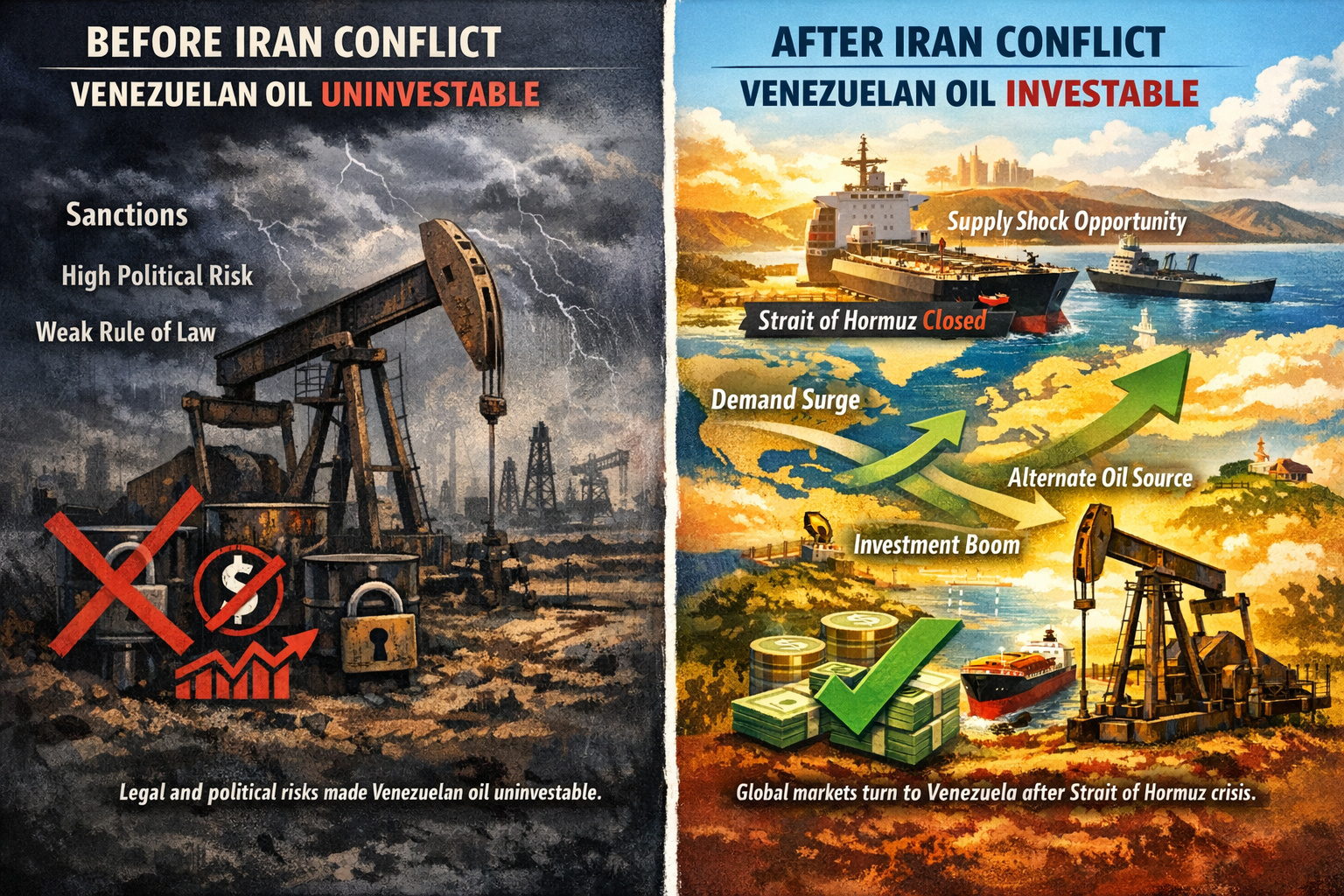
Venezuela sits atop the world’s largest proven oil reserves, but there is a reason the world’s largest oil companies have spent decades looking the other way. Venezuelan crude is among the heaviest, most expensive oil to extract and refine on the planet and at prevailing global prices, the economics have never justified the risk. To make Venezuelan oil investable, you would need to do one thing above all else: constrain enough of the world’s more accessible supply to drive prices high enough that the Orinoco Belt finally pencils out. What follows in this article is a hypothesis but it is one grounded in data, in sequence, and in the financial interests of an administration that has already invited 20 oil executives to the White House to discuss $100 billion in Venezuelan investment. When you map the Trump administration’s simultaneous pressure on Iran, the Strait of Hormuz, and Canada — nations and chokepoints representing an extraordinary share of global oil supply — against the economic preconditions required to make Venezuelan oil viable, what emerges may not be a series of unrelated geopolitical events. It may be the roadmap.
When the United States and Israel launched coordinated strikes on Iran on February 28, 2026, the world’s attention rightly fixed on the geopolitical shockwave radiating outward from the Persian Gulf. Oil markets braced. Analysts warned of prices surging past $100 a barrel. Iran’s Revolutionary Guard announced it was restricting navigation through the Strait of Hormuz and suddenly the global economy was staring at the edge of a cliff.
But here is the question that deserves more scrutiny, particularly from an economics perspective: Who benefits when Hormuz closes?
The easy answer is that no one does and that may be correct in the short term. According to the U.S. Energy Information Administration, oil flow through the Strait averaged 20 million barrels per day in 2024, roughly 20% of global petroleum liquids consumption and more than one-quarter of all seaborne oil traded worldwide. The EIA is unambiguous on a point that makes the stakes even higher: very few alternative options exist to move oil out of the region if the Strait is closed. Unlike other maritime chokepoints that can be circumvented by longer routes, most volumes transiting Hormuz have no practical alternative means of exiting the Persian Gulf. Beyond oil, approximately one-fifth of all global liquefied natural gas trade also moves through the Strait — primarily from Qatar — meaning a closure would simultaneously shock both oil and gas markets worldwide. China, which receives a substantial share of its crude imports through the Strait, would be hit hard. Asia broadly would scramble. Global recession becomes a credible scenario.
But in the medium to long term, there is another answer and it points south, toward South America, toward a country sitting atop the single largest proven oil reserve on the planet: Venezuela.
Venezuela holds 303.2 billion barrels of proven reserves. Iran, the nation now at war with the United States and Israel, holds 208.6 billion — the world’s third largest. Together, countries one and three on that global leaderboard account for more than a third of all documented reserves on Earth. When Iran’s oil already sanctioned and constrained for years becomes even more inaccessible due to active military conflict and Strait disruption, the scramble for alternative supply sources intensifies immediately. And Venezuela, which the Trump administration directly intervened in militarily in January 2026, resulting in the removal of President Nicolás Maduro, suddenly becomes the most geopolitically convenient alternative on the map.
Coincidence? Perhaps. But as an economics exercise, the question is worth pressing — because the financial architecture around Venezuela was already being assembled before the first bomb fell on Iran.
Before that architecture can be understood, a fundamental point about Venezuelan oil must be established, because all oil is not equal and that inequality is the key to understanding everything that follows. The global crude market distinguishes sharply between light and heavy crude based on API gravity, a scale developed by the American Petroleum Institute that measures how dense crude oil is relative to water. As Mansfield Energy explains, light crude, with its lower density and lower sulfur content, breaks down easily through relatively simple distillation into high-value products like gasoline, jet fuel, and diesel. It commands a market premium precisely because refiners can process it cheaply and quickly with standard equipment, generating fewer byproducts and higher profit margins. Heavy crude is a fundamentally different proposition. It is denser, thicker, and higher in sulfur, requiring advanced and expensive processing methods — upgrading, de-asphalting, hydrotreating, and coking — that demand major capital investment in specialized equipment, generate more residual byproducts, and carry greater environmental costs. Critically, refineries are designed around specific crude grades; a refinery built for light crude cannot simply switch to processing heavy oil. Venezuela’s reserves sit overwhelmingly in the Orinoco Belt, where the crude is not merely heavy but extra-heavy coming out of the ground, as UC Berkeley economist David Levine described it in January 2026, with the consistency of cold peanut butter. Before it can even move through a pipeline, it must be mixed with costly imported diluents such as naphtha, adding roughly $15 per barrel to costs before it reaches a port. Once it arrives at the rare refinery equipped to handle it, Venezuelan crude still trades at a $12 to $20 discount compared to Brent, the global benchmark. At $60 a barrel, Levine concluded, it simply is not economical to ramp up Venezuelan production quickly, despite the staggering reserve figures on paper.
To understand why that price environment matters so much, consider the global cost of production context. According to Hagen Energy Consulting, Saudi Arabia with its vast, easily accessible conventional reserves and established infrastructure produces a barrel of oil for as little as $10 to $15. North American producers, relying on more technically demanding methods like fracking and oil sands extraction, spend $30 to $70 per barrel depending on the operation. These are the benchmarks against which Venezuela must compete for capital. Venezuela cannot. Before a single barrel of Orinoco extra-heavy crude reaches a tanker, the operator has already spent roughly $15 per barrel on diluents just to make it flow through a pipe. Add to that the operational costs of extracting oil from a deteriorated production infrastructure that has not seen serious investment in decades, the cost of the specialized coker refinery processing required at the other end, and the $12 to $20 per barrel discount applied at market because of the crude’s inferior quality — and a conservative estimate of the all-in cost to produce and deliver a marketable barrel of Venezuelan oil runs well above $50, and by many industry assessments significantly higher once capital recovery on new infrastructure is factored in. For comparison, at $60 per barrel global crude pricing, Saudi Arabia earns $45 to $50 of profit per barrel. Venezuela may be breaking even — or losing money — on the same barrel. This is not a marginal disadvantage. It is a structural one, and it explains why the reserves number that appears so staggering on paper has translated into so little investment in practice.
This is the economic trap — and it reveals the hidden logic of the Hormuz crisis. The only variable that changes the investment calculus is the global price of crude, and the only thing that moves that price high enough, fast enough, is removing a significant portion of the world’s most accessible supply from the market. At $100 a barrel — the price level analysts warned a Hormuz closure could trigger — the Venezuelan math begins to shift. And the Strait, as the EIA makes clear, is not a disruption that can be routed around. Iran, which was producing over three million barrels per day before the escalation, is now effectively removed from accessible global markets. The Strait disruption threatens to pull millions more barrels per day offline across the entire Gulf. Canada, subjected to tariff warfare and annexation pressure, faces economic distress that clouds its own production investment climate. Each of these actions, viewed separately, looks like geopolitics. Viewed together through an economics lens, they look like a price floor being constructed — one that would make the Orinoco Belt profitable for the first time in a generation. Trump himself, in an earlier iteration of his public comments, called Venezuelan oil “garbage oil” and “the worst oil probably anywhere in the world.” That the same administration would then order a military intervention and immediately convene 20 oil executives to discuss $100 billion in Venezuelan investment is not a contradiction if the plan all along was to engineer the price environment in which garbage oil becomes gold.
On January 9, 2026 — just days after U.S. military intervention effectively ended the Maduro government — a group of executives from approximately 20 oil companies met at the White House at President Trump’s invitation. Trump urged them to commit at least $100 billion of their own capital to rebuild Venezuela’s aging infrastructure and restore production. ExxonMobil CEO Darren Woods offered a blunt assessment: Venezuela’s current frameworks make it “uninvestable,” requiring “durable investment protections” and wholesale changes to the country’s hydrocarbon laws. This was not a discouragement. It was a to-do list. For decades, Venezuela’s oil sector had been precisely what a February 2026 GIS Reports analysis called it — uninvestable — due to erratic nationalist policy, the nationalization of the industry under PDVSA in 1976, repeated asset seizures, and deep institutional erosion. The country that was uninvestable last year was suddenly, in the span of a military operation, being re-imagined as indispensable. But indispensable only works as an investment thesis if the price is right. And the price only gets right if the supply everywhere else gets tight.
The arc of the strategy becomes clearer when you add the third data point: Canada. Canada holds the world’s fourth-largest proven oil reserves at approximately 163 billion barrels — the single largest reserve holder in the Western Hemisphere outside of Venezuela. Since the earliest days of his second term, Trump has relentlessly pushed the idea of making Canada the 51st state of the United States. What many initially dismissed as rhetorical provocation has proven to be a sustained, multi-front campaign. Trump told the World Economic Forum that Canada could avoid his sweeping 25 percent tariffs simply by becoming a U.S. state. Canadian Foreign Minister Mélanie Joly stated plainly that Trump’s goal was to weaken Canada economically “in order eventually to annex us.” Former Prime Minister Justin Trudeau warned that the administration sought a total collapse of the Canadian economy to make annexation easier. The Chicago Council on Global Affairs connected this directly to Trump’s 19th-century view of American power — a period when the nation’s wealth was built on high tariffs and territorial acquisition, when “growing” literally meant expanding the map.
Now hold all three data points at once: Venezuela, the world’s largest reserve nation, subjected to military intervention. Iran, the world’s third-largest, subjected to military strikes and Strait disruption. Canada, the world’s fourth-largest, subjected to economic warfare and annexation pressure. Three of the top four reserve nations on Earth, targeted through three different methods of coercion, all trending toward the same directional outcome: greater American control over, or direct access to, the world’s most valuable underground assets.
This analysis cannot be separated from the broader financial context of this administration, and to ignore that context would be an economics failure. A landmark investigation published in The New Yorker documented that by early 2026, Trump and his family had made nearly $4 billion off the presidency through crypto ventures, Gulf real estate and licensing deals, private clubs, and lucrative transactions with foreign governments. As government ethics reform advocate Fred Wertheimer of the Campaign Legal Center observed, the sheer volume of financial arrangements flowing to the Trump family creates a clear mechanism for purchasing presidential favor. The family’s major financial dealings in the Persian Gulf region — the same region now destabilized by U.S.-backed military action — raise questions that economics-minded observers are obligated to ask openly.
The map that emerges from all of this is not random. Look at the full top ten proven reserve rankings. Saudi Arabia holds 267.2 billion barrels at number two. Canada is fourth at 163 billion. Iraq holds 145 billion at fifth. The UAE holds 113 billion at sixth. Kuwait 101.5 billion at seventh. Russia 80 billion at eighth. Libya 48 billion at ninth. And at number ten sits Nigeria, with 37.3 billion barrels. With the exception of Venezuela, Iran, and Canada — all currently under forms of American pressure — the remaining nations on that list are aligned with or accommodating of American strategic interests to varying degrees. Saudi Arabia is a decades-long security partner. Iraq is a country whose government was reconstructed under U.S. military occupation. The UAE and Kuwait host American military installations. Libya, despite its chronic instability, has been a site of Western-backed political intervention since 2011.
The pattern is this: nations outside the architecture of American strategic alignment get targeted. Nations inside it get protected, or at minimum, left alone to convert their reserves into durable sovereign wealth.
Nigeria sits at number ten, the only majority-Black nation in the top ten, and it is conspicuously absent from the strategic conversation happening in Washington boardrooms and war rooms. For now. Nigeria is the most populous Black nation on Earth and the economic anchor of sub-Saharan Africa. Despite holding 37.3 billion barrels of proven oil reserves and 210 trillion cubic feet of natural gas — the largest gas reserves on the African continent — Nigeria’s production share remains far below what its reserve ranking would suggest, hampered by underinvestment and infrastructure deficits. Its oil wealth has historically flowed outward toward Western and Asian energy majors, with relatively little strategic agency exercised by African institutions over the terms, the pricing, or the downstream development. That profile of vast reserves, underperforming production, weak institutional leverage, and no formal alignment with American strategic infrastructure is not a description of a nation safely outside this administration’s field of vision. It is a description of a nation that fits the pattern precisely. Venezuela was uninvestable until Washington decided it wasn’t. Iran was sanctioned until sanctions gave way to strikes. Canada was a trusted ally until its oil reserves made it a target for annexation rhetoric. The question is not whether Nigeria is on anyone’s chessboard. The question is whether Nigeria and the institutions that speak for the African world will have any hand in determining what move comes next.
And here is where the analysis must be unflinching about a structural gap: there is no established framework, no durable institutional channel, through which African American institutions in particular but not limited to African American policy organizations exercise real influence over Nigerian energy strategy, African Union economic policy, or the terms under which African reserves get developed and monetized. The intellectual talent exists. The cultural and ancestral connection exists. What does not exist at least not in any operationally significant form is the institutional architecture to translate that into geostrategic relevance. Jewish American institutions spent a century building the financial, political, and diplomatic infrastructure to influence U.S. foreign policy toward Israel. Indian American networks developed sophisticated pathways into technology policy and trade diplomacy. Arab American organizations have grown their Washington footprint substantially. African American institutions, by contrast, have historically been oriented inward toward civil rights, domestic policy, and economic inclusion within the United States for reasons that are entirely understandable given the weight of that struggle. But the world being drawn in front of us now is one in which the reserves map is being rewritten by force and economic coercion, and the strategic conversation about what Nigeria’s number ten ranking means is happening almost entirely without Black American institutional input, and arguably without sufficient African institutional agency either.
The scenario this article poses is, to be clear, a hypothesis — a geopolitical and economic reading of events that fit a pattern but have not been confirmed as deliberate strategy. The chaos of military conflict has its own logic, and actors in Washington, Tel Aviv, and Tehran are all operating with competing interests. But the circumstantial case is compelling: an administration with documented financial entanglements across the Gulf region solicited $100 billion in Venezuelan investment from oil executives — weeks before strikes that made alternative oil supply a global emergency. Whether this is coordinated design or opportunistic exploitation of circumstances, the pattern points toward the same beneficiaries.
The question it forces upon Black institutions on both sides of the Atlantic is whether the moment will finally compel the building of what has never been built: a serious, long-range framework for Diaspora engagement with African resource sovereignty before Washington, Beijing, or Riyadh decides what that sovereignty is worth.
In economics, we follow the money. Right now, the money trail leads from the Strait of Hormuz to the Orinoco Belt, through the Oval Office, and toward a continent whose largest reserve nation has no seat at the table where its future is being decided.
HBCU Money covers economics, finance, and wealth-building from a perspective that centers Black communities and institutions. The views expressed in Economics section analysis pieces represent the author’s independent economic assessment.
Disclaimer: This article was assisted by ClaudeAI.


 HBCU Money