“The doll that’s a nice doll… the doll that’s a bad doll.” – Dr. Kenneth Clark, recalling the study’s core questions, 1985
In the old Akan trading towns along the Gold Coast, a young carver could choose one of two paths once his hands proved skilled enough to earn coin. The first path led to the chief’s court, where a steady commission awaited any carver willing to produce masks and stools bearing the court’s preferred likeness, paid promptly, praised publicly, and forgotten the moment a newer hand arrived. The second path led to the carver’s own workshop, built slowly with his own timber, stocked with his own apprentices, selling to whoever would buy but owned by no patron. The court path paid faster. The workshop path paid forward, to sons, to students, to a guild that outlived the carver himself. Both carvers were skilled. Both were paid. Only one built something that did not depend on being chosen again tomorrow.
On July 1, 2026, the Boston Celtics traded Jaylen Brown to the Philadelphia 76ers for Paul George and four draft picks, ending a ten-season partnership that produced an NBA championship and six trips to the Eastern Conference finals. Boston’s stated rationale was structural, and every part of it is true: a roster straining under two supermax contracts, a collapsed pursuit of Giannis Antetokounmpo, and a first-round exit that exposed real fit problems on the floor. None of that is manufactured. But a trade’s stated logic and its full logic are rarely the same document, and this one is worth reading past the press release.
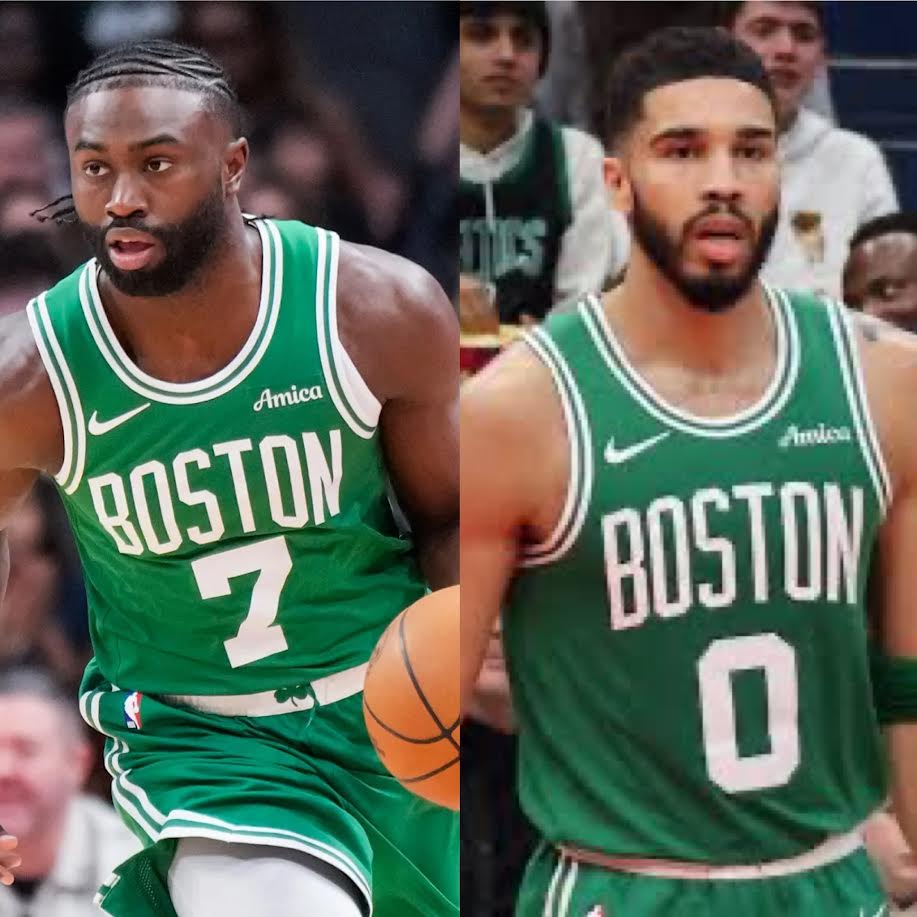
For a decade Boston fielded one pairing of stars, and the city called them, with the affection reserved for a matched set, “the Jays.” Brown and Tatum arrived within a year of each other, won a championship together in 2024, and built back-to-back supermax contracts that made them two of the highest-paid athletes in league history. They shared a locker room, a coaching staff, and a fan base that likes to believe it is more progressive than any other in professional basketball. What they never shared was an economic strategy, and that gap is worth sitting with not because one man was more talented, but because their divergence resembles a pattern in how American capital treats Black masculinity that this piece can only describe, not adjudicate.
What makes the trade’s timing worth reading closely is what did not happen in the weeks before it. As speculation mounted that Boston might move Brown, Tatum said nothing; no public defense of his co-star, no stated wish that the front office keep the partnership intact. The silence was loud enough that Bill Simmons devoted airtime to it, speculating it reflected an understanding, shared inside the organization, that Brown wanted a team of his own and Tatum probably wanted him to have it. Tatum had separately acknowledged in a January interview that the partnership carried real “growing pains.” None of this proves intent, and this piece draws no conclusion about what Tatum was or wasn’t thinking. It does mean the silence around the trade was not neutral, it had already been noticed and discussed by the same media apparatus this piece is describing.
Start with the ledger. In 2023, Brown turned down more than $50 million in conventional endorsement offers — turned them down, not failed to receive them — to fund 741 Performance, his own apparel and footwear company, and to scale 7uice, the media venture he had already built. A year later he launched Boston XChange, an incubator modeled on the idea of Black Wall Street, targeting $5 billion in community wealth across Greater Boston, with a first cohort of grants, workspace, and Harvard Business School (we will forgive him for it not being an HBCU Business School) delivered coaching for local Black founders. Brown’s public language around these moves is institutional rather than personal: he describes the goal as addressing a wealth disparity “no one wants to talk about,” not building his own celebrity profile.
Tatum’s ledger runs the other direction, and it runs long. By industry counts he has endorsed more than two dozen brands; Nike and Jordan Brand, Gatorade, AT&T, Amica, Coach, Subway, 2K Sports, Ruffles, JBL, and others making him one of the most heavily endorsed players in the league by sheer volume of paid-spokesman relationships. This is not a marginal career; it is the standard model for a superstar of his caliber, the same model that has generated wealth for Black athletes going back to Michael Jordan. Tatum is good at it, and there is nothing dishonorable in the choice. But it is a fundamentally different choice than his backcourt partner made, and the difference invites a question rather than answers one since it is not about talent or marketability, since both men have those in comparable measure.
What explains two stars, on the same roster, choosing such different relationships to capital? Part of the answer may be personal preference, which deserves respect without further interrogation. But part may sit inside research worth taking seriously: the market narrates lighter skin and biracial identity differently than it narrates darker skin, even within a league that is overwhelmingly Black. A 2019 American Journal of Sociology study of televised college basketball found broadcasters consistently described lighter-skinned players in terms of intelligence and control, and darker-skinned players in terms of raw physicality, a gap that held even after controlling for on-court performance and the announcer’s own race. A Brookings review reached the same conclusion: skin tone, not race alone, shapes how a player is narrated, and that narration is the raw material brands buy in an endorsement deal. A separate compensation study found weaker evidence that skin tone directly moves pay, a useful caution against overclaiming. None of this proves what happened between one front office and two players. It documents a pattern the Brown-Tatum split resembles closely enough to raise, not settle.
This is not a new pattern, and skin tone alone has never been the whole explanation for it, values and choices may matter just as much. Muhammad Ali’s refusal of the draft cost him three years of his career and most of his commercial appeal, not because promoters doubted his marketability but because his assertion of autonomy over his own body and institutional affiliations read as a threat rather than a story brands wanted to rent. A generation later, Craig Hodges, a two-time NBA champion and elite three-point shooter, tested that same autonomy from inside his own locker room: he asked Michael Jordan and Magic Johnson to boycott Game 1 of the 1991 Finals over the beating of Rodney King, wore a dashiki to the Bulls’ White House visit that year, and handed President Bush’s staff a letter demanding a real plan to address poverty in Black communities. He was out of the league within a year, still one of its most accurate shooters, and no team called. Jordan is instructive precisely because he is not light-skinned or biracial, he is one of the most conventionally marketed dark-skinned athletes in American history, and by Hodges’s own account, Jordan understood that taking a political stance could hamper his economics, and declined to test that trade-off. Hodges and Jordan shared a skin tone and a locker room. Only one was pushed out, a fact that raises a question rather than answers it. Colin Kaepernick’s endorsement portfolio collapsed to essentially one relationship after asserting similar autonomy from NFL ownership, and Kaepernick himself is biracial, a detail that should complicate any account of this pattern as pure colorism rather than erase colorism’s role elsewhere. Two of these three men do not even share a skin tone. What they may share, more than pigment, is a decision to make institutional autonomy non-negotiable; though a pattern across three careers is a pattern, not a proof. Brown’s version is lower-stakes than any of the three, but the same open question recurs: does capital move more easily toward Black athletes who remain legible as spokesmen for institutions they do not control, and more cautiously toward those who assert control of their own, regardless of skin tone? This piece cannot answer that with certainty. It can only note how often the shape recurs.
The pattern extends past Boston, and past sports entirely, though here too what follows is an observation, not a verdict. Patrick Mahomes and Dak Prescott, the two most heavily endorsed quarterbacks of their generation, are both biracial, sons of Black fathers and white mothers. Mahomes has built one of the largest endorsement portfolios in American sports, anchored by a record-setting Adidas deal alongside State Farm and Oakley; Prescott’s corporate slate runs comparably broad. None of this proves brands set out to favor biracial athletes. But it sits alongside the pattern documented above closely enough to warrant the question, in a league and sport where the majority of players are Black. A second pattern is worth placing beside the first, one this publication has already reported without moralizing: Black men have recorded the fastest-growing intermarriage rate of any male demographic group in America, from 8 percent of newly married Black men in 1980 to 24 percent by 2015, according to Pew Research Center analysis, concentrated precisely among the educated, high-earning cohort most likely to reach the kind of professional visibility Mahomes and Prescott occupy. No causal line connects that statistic to either man’s marriage, and this piece draws none. What it raises is a broader question this publication is positioned to ask: whether a market’s comfort with biracial Black men and a fast-growing intermarriage rate concentrated in the same professional class are two separate stories, or two readings of one. If they are one story, the connective thread is unlikely to be race in the abstract. It is more plausibly ownership, or the absence of it, across every domain a community needs to hold its own capital. Jaylen Brown’s story, told above, describes what happens when a Black athlete tries to build wealth inside institutions he controls rather than institutions that rent his image. Does the intermarriage data describe a parallel mechanism operating on family formation — capital and talent flowing toward whichever institutions exist to receive them, absent Black-owned alternatives built to receive them instead? This piece cannot answer that with the data available. It can note that no institutional framework currently exists to prepare African American partnerships before formation, comparable to what other communities have long maintained for their own members, and that this absence, not any individual’s marriage, may be the more consequential gap. Whether it constitutes a liability the community carries into every domain where Black institutional ownership remains thin — family, business, media, capital — is the question this piece leaves open. Patterns are not proof. But a community that declines to ask the question because it lacks proof is choosing a different kind of vulnerability.
The trade also relocates Brown to a city whose relationship with Black institutional life is a different proposition than Boston’s. Bill Russell, who won eleven championships in this same uniform, called Boston a flea market of racism in his memoir, describing a city that layered institutional bigotry over civic pride without ever reconciling the two. That reputation has proven durable: in Boston Globe surveys of Black residents conducted in 2010, 2013, and 2017, Boston finished last among seven major cities behind Atlanta, Chicago, New York, Charlotte, San Francisco, and Philadelphia on how welcoming it is to people of color. The same reporting found the median net worth of non-immigrant Black households in Greater Boston to be $8, against $247,500 for white households, and Black representation on Massachusetts corporate boards at roughly one percent. Philadelphia carries its own history of segregation and disinvestment, and no one should romanticize it. But it is also the city where, in 1837, a Quaker philanthropist’s bequest founded what became Cheyney University, the nation’s first institution of higher learning for African Americans, and where Lincoln University, seventeen years later, became the first HBCU to confer degrees. Whether a builder of Black-owned infrastructure landing in the city that produced the nation’s first Black-serving colleges, rather than remaining in the city its own most decorated Black player once called a flea market of racism, is coincidence or pattern is a question this publication’s readers are equipped to sit with.
None of this requires believing any single Celtics executive consciously weighed Jaylen Brown’s politics before making the call, and treating it as a boardroom conspiracy would badly undersell how institutional racism can function when it exists. It can survive in culture rather than decision memos. Boston’s sports-media environment has its own well-documented record independent of any front office. In 2017, Baltimore Orioles outfielder Adam Jones said he had been called a racial slur and had peanuts thrown at him at Fenway Park; Black journalists who covered the aftermath have said the dominant response on Boston sports radio was indignation directed at Jones rather than reckoning with the city’s reputation. In February 2023, a host on Boston’s top sports-talk station was suspended for a racist joke; weeks later, another used an ethnic slur on air against a Black woman sportswriter. Black reporters who cover Boston teams have described vetting spaces before entering them; Black fans have described watching games at home rather than risk a stadium environment they cannot control. None of that required anyone in the Celtics organization to think a conscious thought about Brown specifically. It raises the question of whether the trade simply moved through a press box and a call-in culture that have, for decades, treated assertive Black men with more suspicion than compliant ones, an environment that would not need anyone’s permission to shape which star ends up costing more to keep. This piece does not claim to have proven that. It notes only that the pattern, once named, is difficult to unsee.
None of this is an accusation against Jayson Tatum, who has built a disciplined, values-driven endorsement career, including a foundation for generational wealth-building in his hometown of St. Louis. The point is not that one Jay is virtuous and the other compromised. The point is structural, and it is a pattern this publication keeps observing rather than a verdict on any single institution’s intent: corporate America has a well-developed machinery for renting a Black athlete’s image, and a comparatively undeveloped machinery for financing his ownership stakes in Black-controlled infrastructure. Endorsement money flows easily because it requires nothing of the brand except a media budget and a face. Ownership capital, the kind Brown is building with Boston XChange; requires a brand, a bank, or an institution to accept a Black founder as a peer with equity claims rather than a spokesperson with a contract term. The endorsement machine is fast and comfortable. The ownership machine barely exists, and where it does, it is disproportionately built by athletes willing to walk away from the safer story.
This is where this publication’s readers should focus, because the lesson is about capital formation, not sports pages. If African American-owned financial institutions, HBCU business schools, and Black venture networks are serious about closing the wealth gap Brown keeps naming publicly, they cannot treat athletes as donor targets for one-time gifts or career-day speakers. Boston XChange is, functionally, an unincorporated development fund with a five-year, $304 million balance sheet behind it. Institutions like Fisk, Tougaloo, and Grambling’s business programs, not only the flagships that already receive this attention, have more to gain by building pipeline relationships with athlete-founded ventures like Brown’s than by waiting for a landmark gift that may never come. Equity partnerships, curriculum ties to incubators like BXC’s creator accelerator, and coordinated deal flow between HBCU alumni networks and athlete-backed funds would do more for capital retention than another round of applause for a sneaker deal.
The two Jays no longer share a locker room, and nothing here requires believing anyone in Boston’s front office consciously moved against Jaylen Brown for what he represents. Institutional racism, when it operates at all, rarely announces itself as intent. It can accumulate instead as a weather pattern in press boxes, call-in shows, and roster rooms, quietly making the assertive, self-determined Black star cost more to keep than the compliant one, until a trade that reads as pure salary-cap logic also leaves the more marketable Jay standing alone as the face of the franchise. Whether that is what happened here is a question this piece raises rather than settles. What is not in question is where Brown lands: a city with a deeper institutional relationship to Black self-determination than the one that just let him go. What HBCU business schools, alumni networks, and Black venture funds can control is what they do with his arrival in a city already home to Cheyney and Lincoln and whether they treat it as a genuine opening or let it pass as sports-page trivia.
Disclaimer: This article was assisted by Claude AI.