HBCU Presidential Opening? Hire Neil deGrasse Tyson

If you want to build a ship, don’t drum up people to collect wood and don’t assign them tasks and work, but rather teach them to long for the endless immensity of the sea. – Antoine de Saint-Exupery

neil-degrasse-tyson-with-telescope-rocket

I will admit that while I respect a great many of the new and rising leadership at HBCUs I still feel as if there is a secret sauce missing. We often still mentally box what we view leadership must be like to lead our colleges and universities. They are often from traditional African American disciplines or professions. That is not meant to be a slight at them because they are what they are. Those disciplines are needed but sometimes you need different. That difference could be the missing sauce to make this new hamburger we are building or re-building standout (depending on how one looks at it). To make it dynamic.

After watching Dr. Tyson speak before the Commerce, Science, and Transportation Committee it became clear to me that this is someone who could lead the STEM and research revolution amongst HBCUs. There is currently no more prominent of an African American face associated with STEM. Would it cost to get him? Yes. Is he interested in an HBCU? As often the case we will not know unless we ask. The real question is what board or alumni would be creative and aggressive enough to pursue someone like Dr. Tyson. If we want to improve our place in STEM then we need someone who understands it intimately on a structural level and on a public relations level.

Currently, HBCUs as a whole do about $600 million combined annually in research expenditures. On the surface while that sounds like a lot, it would not make the list of top 30 list of  research budgets at colleges and universities across the nation. Yes, there are 30 plus institutions that do over $600 million individually annually in research. Florida A&M, who led HBCUs in research in 2012, is doing only $53.5 million. The top of the heap continues to be John Hopkins University who conducts $2.1 billion annually in research by itself. It also would potentially create avenues that could allow HBCUs to become more competitive among the minefield that is the National Science Foundation and its questionable grant disbursements. Historically, HBCUs have received inadequate research funding from even the NSF and while President Obama has promised HBCUs $850 million over 10 years it would be much nicer if HBCUs were in position to receive the over $1 billion annually that the NSF hands out to the top tier research institutions.

If we need a reminder of why research is important then we just need to look at the economic state of our communities and our institutions. My favorite example of just what research on college campuses can produce is Google. It was developed at Stanford University while the two founders were PhD graduate students. An issue of HBCUs further developing their graduate programs and keeping their most talented within HBCU institutions is another article itself. The search engine that is now a verb currently employs 50 000 people. That is equivalent to 1/6th of the entire current HBCU student population. That is just ONE company whose co-founders have a combined net worth of $52 billion. There are thousands of other companies who have emerged as a result of STEM research on college campuses. The impact is so profound that the Kauffman Foundation’s study shows that MIT created companies alone would be the 17th largest economy in the world if they were their own nation. Unfortunately, due to a number of different reasons – a scientific vision not least among them – HBCUs have been slow to re-embrace its strong research heritage of the late 19th and early 20th century when men like George Washington Carver and others were transforming the American way of life through scientific research on HBCU campuses.

Dr. Neil deGrasse Tyson could provide a necessary spark to bring attention and resources to an HBCU willing to make the commitment. His presence would certainly make many gifted African Americans interested in STEM potentially pause and consider an HBCU. A school like Morris Brown, St. Paul’s, or Lewis College of Business who want to transform themselves could become the HBCU Institute of Technology. If we want to reach for the stars just maybe it is time we give leadership to someone who knows literally where to find them.


HBCU Money™ B-School: Financial Derivatives

Financial derivatives are financial instruments that are linked to a specific financial instrument or indicator or commodity, and through which specific financial risks can be traded in financial markets in their own right. Transactions in financial derivatives should be treated as separate transactions rather than as integral parts of the value of underlying transactions to which they may be linked. The value of a financial derivative derives from the price of an underlying item, such as an asset or index. Unlike debt instruments, no principal amount is advanced to be repaid and no investment income accrues. Financial derivatives are used for a number of purposes including risk management, hedging, arbitrage between markets, and speculation.

Source: IMF

African America’s May Unemployment Report – 13.5%

jobs_pic

Overall Unemployment: 7.6% (7.5%)

African America Unemployment: 13.5% (13.2%)

Latino America Unemployment: 9.1% (9.0%)

European America Unemployment: 6.7% (6.7%)

Asian America Unemployment: 4.3% (5.1%)

Analysis: Overall unemployment saw a rise primarily due to a rise in the number of people entering the labor force. African America saw the largest rise in unemployment rate among all groups. Latino and European America experienced virtually no change. Asian America was the only group with a significant drop in its unemployment rate. African America remains the only group with double digit unemployment.

African American Male Unemployment: 13.5% (12.6%)

African American Female Unemployment: 11.2% (11.6%)

African American Teenage Unemployment: 42.6% (40.5%)

African American Male Participation: 67.9% (67.4%)

African American Female Participation: 62.5% (62.3%)

African American Teenage Participation: 28.0% (27.5%)

*Previous month in parentheses.

Analysis: African American male unemployment saw a sharp uptick. African American women saw another healthy decline in their unemployment rate. The teenage group continues to see significant rises in unemployment. All three groups saw a rise in their participation rates suggesting more African Americans looking for work in the month of May.

Conclusion: The overall economy added 175 000 in the month of May. African America after adding 100 000 jobs last month in April only added an estimated 35 000 jobs in May. There just does not seem to be much to enjoy right now if you are African America still trying to recover from over 5 years ago now. Job growth in the private sector for African America is moving at a snail pace if it is moving at all. The continued crisis that is African American teenage unemployment continues unabated. Civilian labor force (those looking for work) has picked up for a second straight month but it is fairly apparent there are not many places for them to go. African American men have lost 70 000 jobs over the past two months. Thankfully, African American women have netted 260 000 jobs over that same two month stretch. Given the latter group is more vital to African American households economically speaking they are once again carrying the majority of the household burden. African American teenagers have lost 60 000 jobs over the past two months as well. It appears while more African Americans are looking for jobs it might be more a result of the continuing job loss for African America not job gains that is spurring them to do so.

The HBCU Endowment Feature – Texas College

Official Seal - Texas College

School Name: Texas College

Median Cost of Attendance: $17 208

Undergraduate Population: 878

Endowment Needed: $302 172 480

Analysis: Texas College needs approximately $300 million for all of its students to attend debt free. Located 100 miles from Dallas, TX and 90 miles from Shreveport, LA puts Texas College in a sweet spot geographically. This could allow the school to grow triple in size in a very short period if its infrastructure could keep up with such exponential growth. Part of this growth could easily come from establishing a relationship for transfers from Southern University-Shreveport which is a two-year HBCU. Texas College is actually closer to SU-S than the flagship Southern University-Baton Rouge and could easily sway students who want to be away from home but not more than a few hours. With less than 1000 students the school needs to hit a growth spurt and fast in order to graduate enough alumni on an annual basis and increase the donor pool available to it. Of course at its current size there is the opportunity to build very intimate relationships with these graduates and establish donor relationship much earlier and on a personal basis. Texas College in 2012 led all HBCUs reported in NACUBO in terms of return on investment at 12.8 percent in a year when 70 percent of the top ten HBCU endowments had negative returns. This type of continued performance could bode well for them if they can get the raw dollars to boost the size of the money it is managing. The school has the talent to manage the money but its demographics need to grow for it become a relevant endowment in this era of expand or die.

As always it should be noted that endowments provide a myriad of subsidies to the university for everything from scholarship, faculty & administration salaries, research, and much more.

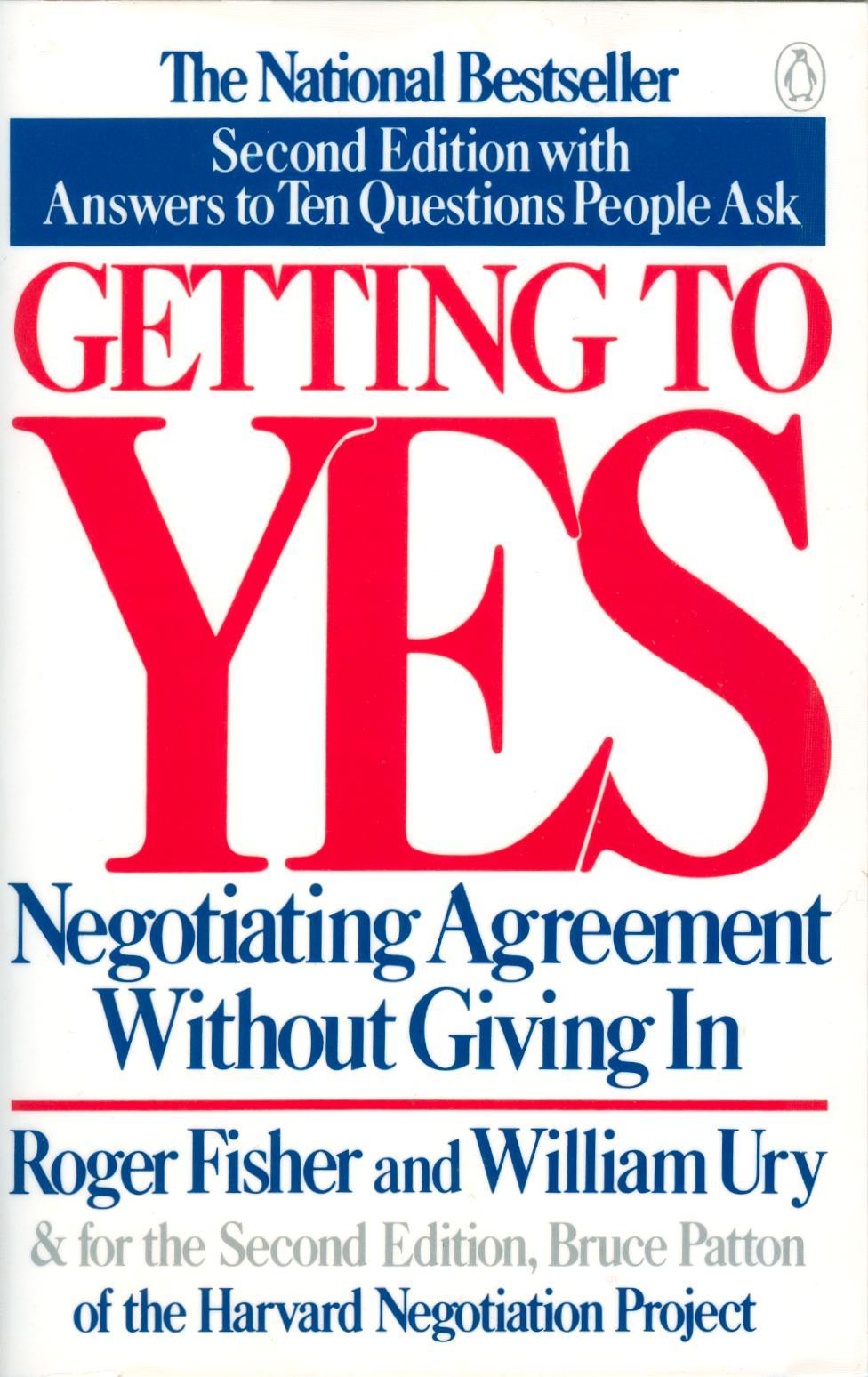
HBCU Money™ Business Book Feature – Getting to Yes: Negotiating Agreement Without Giving In

getting-to-yes

Since its original publication nearly thirty years ago, Getting to Yes has helped millions of people learn a better way to negotiate. One of the primary business texts of the modern era, it is based on the work of the Harvard Negotiation Project, a group that deals with all levels of negotiation and conflict resolution.

Getting to Yes offers a proven, step-by-step strategy for coming to mutually acceptable agreements in every sort of conflict. Thoroughly updated and revised, it offers readers a straight-forward, universally applicable method for negotiating personal and professional disputes without getting angry-or getting taken.