In 2024, Apple quietly killed its electric vehicle project. After nearly a decade of speculation, leaked prototypes, and engineering talent poached from Detroit and Stuttgart, the announcement arrived with a shrug. Markets barely moved. What looked like a retreat was, on closer inspection, something more interesting — a door left open to a far more consequential ambition.
Apple was never going to win by building another car. The automotive market is brutally competitive, capital-intensive, and increasingly commoditised at the electric end. Tesla, BYD, and Rivian are fighting that war. The smarter bet — and the one Apple is uniquely positioned to make — is building the platform that makes car ownership less necessary in the first place.
This is not a utopian argument. It is a business one.
The global infrastructure gap is estimated at $94 trillion by 2040, according to the World Bank. American water systems lose roughly 6 billion gallons of treated water daily through deteriorating pipes. The U.S. electrical grid, designed for a centralised fossil fuel economy, is structurally ill-suited for the distributed renewable future that both climate policy and energy economics now demand. Passenger rail — a basic connective tissue across Europe and Asia — remains an afterthought across vast stretches of the United States. Traffic congestion drains an estimated $179 billion from the American economy annually in lost time and fuel. Vehicle emissions contribute to more than 60,000 premature deaths each year in the U.S. alone.
These are not niche concerns. They are the failing arteries of modern life. And very few companies on earth are better positioned than Apple to redesign them.
Apple already integrates hardware, software, and services with a precision that no competitor has matched at scale. Its chip design produces some of the most energy-efficient processors ever built. Its cloud infrastructure, sensor technology, and payment systems span billions of devices across every continent. Its supply chain discipline and design sensibility are, by any measure, world-class. The question is not whether Apple has the capability to enter the infrastructure space. The question is whether it has the strategic imagination to try.
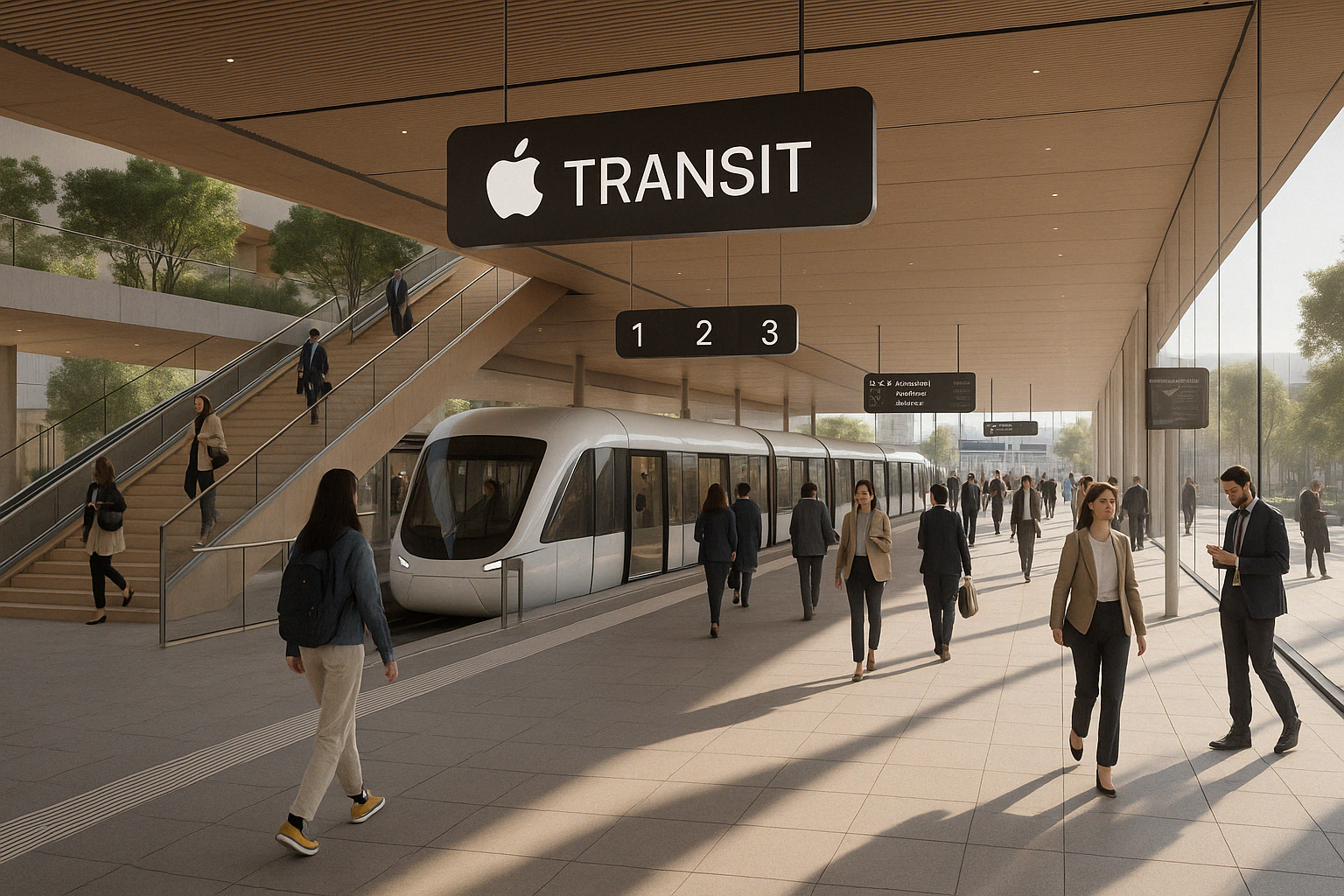
Consider transit. Apple would not need to lay track, operate buses, or run a single vehicle. What it could build is the operating layer — AI-optimised routing drawing on Apple Maps data, seamless ticketing through Apple Wallet, personalised journey planning through Siri, real-time crowd flow management at interchange hubs, and demand-responsive electric shuttles for lower-density districts. The iPhone would become, in effect, a passport to a life less dependent on car ownership — and all the financial and environmental costs that car ownership imposes.
The economics of this argument are well established, even if they remain politically underappreciated. Every dollar invested in public transit generates roughly five dollars in broader economic returns, according to the American Public Transportation Association. Transit-oriented development raises property values, expands tax bases, and improves labour market access for workers priced out of car ownership. Cities that invest in dense, multimodal systems reduce emissions, reclaim public space, and generate measurable public health gains. The infrastructure of movement is not a social expenditure. It is a productive one.
The opportunity extends beyond transit. Apple’s energy-efficient chip architecture translates naturally to smart grid management, where modular, predictive systems are precisely what is needed to integrate distributed solar, battery storage, and dynamic demand response. Apple sensors and cloud infrastructure already exist at the scale required to monitor water systems in real time — detecting pipe failures, tracking quality, and optimising pressure through smart valves. Apple Pay processes billions of transactions. The components for an Apple Water platform or an Apple Grid service layer are, in many respects, already assembled. What is missing is the strategic decision to point them at a larger problem.
The water case is particularly stark. The U.S. Environmental Protection Agency estimates that $472 billion in maintenance investment is required over the next twenty years simply to sustain existing water infrastructure — before a single mile of new pipe is laid. Globally, nearly one in three people lacks reliable access to safe drinking water. The market for intelligent water management — leak detection, quality monitoring, pressure optimisation — is enormous and structurally underserved. Apple’s skill in miniaturising technology, combining sensors with privacy-grade cloud processing, and delivering consumer-grade interfaces for complex data makes it an unusually credible entrant.
For Apple, the strategic logic is also a defensive one. iPhone sales have plateaued. Its Services division faces antitrust scrutiny across multiple jurisdictions. Its cash reserves — exceeding $160 billion — are an asset in search of a return that consumer electronics can no longer reliably provide. Infrastructure, by contrast, offers recurring revenue through service agreements and municipal contracts, structural diversification away from device cycles, and long-term relevance at a civilisational rather than product level. The infrastructure market is not glamorous. But it is enormous, it is durable, and it is ripe for the kind of systemic redesign that Apple has historically done better than anyone.
The risks are genuine and should not be minimised. Apple is famously secretive, consumer-oriented, and averse to the slow-moving regulatory complexity that infrastructure demands. City contracts are messier than product launches. Margins are narrower. Failures are public and politically costly. But Apple has navigated hostile regulatory environments before — in financial services, in healthcare, in China. Its high public trust and strong ESG record are genuine assets in a domain where government partnerships require demonstrated credibility over time. And crucially, Apple would not need to own pipes, track, or transmission lines. It would build the intelligent systems layered atop them — and license those systems to governments, utilities, and citizens at scale.
The model already exists in adjacent industries. Schneider Electric and Siemens have built large, profitable businesses selling digital operating layers to physical infrastructure owners. Veolia manages water and energy systems for municipalities across the developed and developing world. These are not Apple-scale companies in terms of design capability or brand trust. Apple entering this space would not be a departure from what it does. It would be an extension of it — at a higher level of ambition.
What would this look like in practice? In dense cities, an Apple Transit platform could reduce car usage, lower emissions, and return public space to pedestrians and parks. In smaller cities and rural regions — places too dispersed for high-frequency bus networks but underserved by the on-demand platforms that have flourished in major metros — demand-responsive electric shuttles dynamically routed through Apple Maps could reconnect communities that car dependence has quietly strangled. In energy markets, an Apple Grid service could allow households to manage solar and storage through iOS, enable peer-to-peer energy trading between neighbours, and give grid operators the real-time visibility they need to prevent blackouts in a renewables-heavy system. In water, an Apple Water platform could give cities the predictive maintenance tools they currently lack, and give households transparent, real-time visibility into their consumption and the health of their local system.
None of this requires Apple to become a utility or a transport operator. It requires Apple to become what it has always been at its best: the company that builds the operating system everyone else runs on.
Steve Jobs once described the computer as a bicycle for the mind — a tool that amplifies human capability far beyond what either could achieve alone. The infrastructure of the coming century needs exactly that kind of amplification. Roads that manage themselves. Grids that think. Water systems that speak before they fail. Transit that fits around people’s lives rather than demanding they organise their lives around it.
The real disruption in mobility is not a better electric vehicle. It is a better alternative to vehicles altogether — and the broader infrastructure intelligence that makes modern life function without the waste, the inequity, and the environmental cost that the 20th century model baked in.
Apple has the cash, the capability, and the moment. The question is whether it has the ambition to match.
Disclaimer: This article was assisted by ClaudeAI.
Technology is, of course, a double-edged sword. — Alvin Toffler
History does not wait for consensus. The atomic bomb was built before most of the world understood what splitting an atom meant. Chemical weapons were deployed in World War I before international law had language to prohibit them. Surveillance infrastructure was constructed across American cities before most residents knew it existed. In each case, the people most harmed by these technologies were not the people who built them and their eventual objection to the technology, their absence, their refusal to participate did nothing to slow the construction. A weapon being built does not require your approval. It does not require your involvement. It does not even require your awareness. It only requires that someone, somewhere, with sufficient resources and motivation, decided to build it. That is the context in which Black communities must now reckon with artificial intelligence.
Yet in many Black communities and in particular African American institutions, AI is too often treated as a threat to avoid, a fad to dismiss, or a force that is “not for us.” This hesitation is understandable. Black people have learned through painful history that new systems of power often arrive disguised as progress, only to produce new forms of inequality. But the hard truth is this: AI will move forward with or without Black people. And if we choose not to engage it, we guarantee it will be built without our perspective, without our priorities, and without our protection. Rejecting AI does not prevent harm. It only ensures we have less influence over how that harm is shaped and who it harms most.
There is a more urgent framing that Black communities must internalize: AI is not merely a tool to be cautious about it is a weapon already being aimed and protest is not a counterattack or defensive strategy. Predictive policing systems profile Black neighborhoods. Hiring algorithms screen out Black applicants. Credit scoring models redline Black borrowers. Facial recognition technology misidentifies Black faces at rates that endanger Black lives. These are not hypothetical risks. They are documented, operational, and expanding. History is clear on what happens when one community monopolizes a powerful weapon while another refuses to pick one up. The answer to a weapon being formed against us is not retreat. It is the development of counterweapons — tools built by us, owned by us, and deployed in the service of our survival and advancement.
This is where the concept of institutional AI ownership becomes essential. Black communities do not simply need AI literacy we need AI proprietorship. We need HBCUs, Black-owned banks, Black medical institutions, Black legal organizations, and Black civic bodies to own the models, the datasets, the patents, and the platforms. Ownership is not the same as access. Millions of Black people access highways they did not design, hospitals that did not include them in clinical trials, and financial systems built to exclude them. Access without ownership is dependency. What this moment demands is that African Americans treat AI the way earlier generations treated land, law, and the ballot as a domain of institutional power that must be claimed, defended, and wielded.
The world is entering a new era of inequality, not one defined by segregation signs or discriminatory laws, but by invisible systems: recommendation engines, automated hiring tools, predictive policing software, medical diagnostic models, financial risk scoring systems, and generative AI. The communities that build these systems set the terms. The communities that merely use them accept them. This is the defining stakes of the AI moment for Black America: not whether to engage, but whether to engage as subjects or as sovereigns.
There is growing sentiment among skeptics that AI is too dangerous to embrace, and some advocate banning or severely limiting it. While a ban is unrealistic, the concerns behind that sentiment deserve to be treated seriously — not mocked, not dismissed, and not ignored. Many Black Americans are concerned that AI is accelerating misinformation and destabilizing trust in public institutions. Deepfakes, AI-generated propaganda, and synthetic news content can manipulate elections and distort civic discourse. For communities that have historically been targeted by voter suppression and political disinformation, this fear is not paranoia it is rational. If AI becomes a weapon of influence, communities already vulnerable to manipulation will be the first casualties. But the problem is not AI itself. The problem is who controls AI and how it is regulated. If Black communities opt out of our own AI development, then AI governance will be decided entirely by other groups with minimal Black representation at the tables where the rules are written. The answer is not simply to lobby for better regulation, though that matters. The deeper answer is to build Black-owned AI systems that are structurally incapable of being weaponized against Black communities because we designed them, we trained them, and we control them. You do not neutralize a weapon aimed at you by asking its owner to be more careful. You build a counterweapon of your own.
Many critics argue that AI encourages intellectual laziness. If students can generate essays instantly and professionals can automate tasks with a click, what happens to discipline, creativity, and hard-earned expertise? This concern is valid. Overdependence on AI can weaken critical thinking, reduce originality, and blur accountability. But it also misses a key historical reality: tools have always replaced certain forms of labor. Calculators did not destroy mathematics. Spellcheck did not destroy writing. The internet did not destroy learning it changed how learning happens. AI is simply the newest tool. The question is not whether AI makes people lazy. The question is whether we are teaching people to wield it with intention. HBCUs must build education models that go beyond productivity training, that teach students not how to use AI as a shortcut, but how to build with it, own it, and direct it toward the problems that matter most to Black communities.
Job displacement is one of the most serious fears in the Black community, and for good reason. Black workers are disproportionately represented in industries vulnerable to automation — retail, transportation, customer service, clerical work, and entry-level administrative jobs. Many of these roles are prime targets for AI replacement. But the response cannot simply be to train Black workers to fill the lower rungs of someone else’s AI economy, to become the new labor class servicing infrastructure we do not own, feeding data into systems we did not build, and executing decisions made by algorithms we cannot audit. That is not advancement. That is a more sophisticated version of the same arrangement. The goal must be ownership: of the companies building AI, of the models being trained, of the intellectual property being filed, of the venture funds writing the checks. HBCUs must orient their graduates not toward employment in the AI industry but toward founding it. The difference between a Black workforce that operates AI and a Black community that owns AI is the difference between wages and wealth and that distinction will compound across generations.
A major criticism of AI is that it consumes enormous energy. But an even less discussed reality is that AI consumes enormous amounts of water. Modern AI runs on massive data centers that require constant cooling to prevent overheating. Many of these facilities rely on water-based cooling systems that consume millions of gallons annually. Researchers estimate that training a single large AI model can consume hundreds of thousands of gallons of water when factoring in data center cooling demands and electricity generation. This is not theoretical. In many regions facing droughts or water restrictions, data centers are consuming water at industrial levels while residents face conservation mandates. But embedded in this crisis is one of the most significant entrepreneurial opportunities of the next two decades. The AI industry desperately needs breakthroughs in energy-efficient computing, low-heat chip architecture, passive and liquid cooling innovation, and renewable-powered data infrastructure. These are not solved problems they are open problems, and open problems are where fortunes and institutions are built. HBCUs are uniquely positioned to lead here. Engineering and computer science programs at HBCUs can orient entire research agendas around sustainable AI infrastructure, competing for federal grants, Defense Department contracts, and private R&D investment. The students and faculty who crack these problems will not simply publish papers they will file patents, spin off companies, and own the solutions the entire AI industry will have to buy. The energy crisis of AI is not just a threat to communities bearing its environmental cost. For those with the vision to pursue it, it is an invitation to build the next generation of technology companies from the inside of an HBCU lab.
Even more troubling is the emerging pattern of where these data centers are being built. Across the U.S., data centers are increasingly constructed in areas that are cheaper to build in, politically weaker, under-resourced, historically undervalued, and disproportionately Black. This mirrors a long-standing trend in America where environmentally burdensome infrastructure — highways, factories, waste facilities gets placed near Black neighborhoods. In effect, this creates what some advocates now call “AI redlining.” The benefits of AI from profits, corporate growth, stock market gains are extracted upward, while the environmental strain gets dumped into communities with the least political power to resist it. The solution is not to reject AI. If Black communities sit out the AI revolution, we won’t stop the environmental cost. We will simply lose the ability to negotiate where that cost is placed and who gets compensated. African American institutions should push for policies requiring mandatory water usage disclosure, environmental impact assessments before zoning approval, sustainability audits, green cooling requirements, and renewable energy sourcing. Communities should demand Community Benefit Agreements requiring data centers to provide infrastructure investment, local hiring pipelines, job training programs, tax revenue reinvestment into local schools, and environmental mitigation funding. HBCUs could also lead the nation in Green AI research, building intellectual property around sustainable computing, energy-efficient AI, and water-saving data center technologies.
The most dangerous thing happening right now is not that Black people fear AI. It is that too many are dismissing it without building anything in its place. Fear without construction is just surrender by another name. If we do not develop our own research institutions, our own datasets, our own models, and our own policy arguments, we cede every seat at every table where AI’s future is being decided. Other communities are not waiting. They are filing patents, training models, lobbying legislatures, and writing the rules. Our absence is not neutrality. It is forfeiture.
Nowhere is that forfeiture more consequential than in healthcare. Black people face notorious disparities in outcomes — maternal mortality, hypertension, diabetes, heart disease, cancer detection delays, and mental health underdiagnosis. AI has the potential to improve diagnostics, predict risk earlier, and increase efficiency. But AI only works equitably if the data used to train it includes accurate representation of Black populations. If Black communities are underrepresented in healthcare datasets, AI tools will misdiagnose and under-detect conditions in Black patients not out of malice, but out of absence. Black maternal mortality runs roughly two to three times higher than that of white women. That gap will not close by using someone else’s model. It will close when Black medical institutions are building their own. HBCUs should establish AI healthcare research centers and partner with Black hospitals and clinics to develop maternal health monitoring tools, diagnostic models trained on Black patient datasets, and predictive systems for chronic disease management. We cannot outsource our survival to someone else’s dataset.
One reason economic inequality persists is because the Black community often lacks robust data infrastructure. We need AI to better analyze Black household wealth gaps, credit access patterns, housing appraisal disparities, small business loan outcomes, and generational income mobility. Without strong data, we cannot make powerful arguments in policy spaces. Decisions get made based on incomplete or misleading statistics. If you cannot measure injustice, you cannot prove it. And if you cannot prove it, you cannot correct it. AI tools can allow Black institutions to build community-level dashboards for employment trends, entrepreneurship activity, housing discrimination patterns, and lending disparities. If we don’t build this infrastructure, we remain dependent on outsiders to define our economic reality.
Black students face disparities in standardized testing, school funding, disciplinary action, access to advanced coursework, and teacher turnover rates. AI has the potential to identify patterns that human analysis often misses. AI models can detect whether certain districts disproportionately suspend Black students or deny gifted program access but this only happens if someone is collecting and analyzing the data. HBCUs can create AI education labs focused on predictive models for dropout prevention, tutoring systems for underserved schools, bias detection in school disciplinary systems, and literacy and math intervention tools.
The ownership imperative extends beyond economics into culture, politics, and identity itself. AI is being trained on datasets that misinterpret Black culture, Black dialect, and Black history. Systems routinely fail to understand African-American Vernacular English and mislabel it as incorrect or unprofessional. If Black people are not involved in building the systems that process human language, cultural misrepresentation does not just persist it gets automated, scaled, and encoded as objective truth. Politically, AI will increasingly govern voter outreach, campaign strategy, political advertising, and law enforcement surveillance. A community without ownership in those systems is a community being governed by algorithms it cannot see, challenge, or correct. And economically, the greatest wealth-building opportunities of the next 20 years will flow from AI ownership — patents, startups, data assets, and proprietary platforms. The next generation of billionaires will not come from oil. They will come from algorithms. The question is whether any of them will come from HBCUs.
One of the most clarifying facts in this debate is this: HBCU students are not rejecting AI. They are already using it. Surveys show AI adoption among HBCU students above 90% in some reports. The problem is not resistance. The problem is that students are using AI as a consumer product while their institutions have not yet equipped them to build, own, or direct it. There is no AI curriculum grounded in Black ownership. There are no research labs generating Black-controlled intellectual property. There are no institutional frameworks teaching students that the goal is not to get a job at an AI company it is to found one. We are handing students a weapon and teaching them to hand it back.
The solution is not to shame dissenters or pretend AI is harmless. The solution is to build a structured response that combines caution with action. AI should be taught at HBCUs not as an elective but as a foundational literacy, like writing or math. Rather than each HBCU fighting alone, they could form a national consortium to share computing infrastructure, datasets, research funding, and faculty development programs. HBCUs should expand incubators focused on AI startups, fintech and credit access tools, healthcare AI apps, education platforms, and legal justice tools. Black communities should lead in shaping ethical AI laws requiring bias audits, explainability standards, civil rights protections, and anti-surveillance restrictions. And the community must prioritize ownership of data, because data is the oil of the AI economy. If Black communities do not own their datasets, they will never fully control the systems built from them.
If HBCUs want to remain relevant not just historically, but economically and politically in the next 50 years they must move aggressively on a clear ownership agenda. In the first 12 months, every student regardless of major should graduate with AI literacy training, prompt engineering fundamentals, AI ethics coursework, and data verification and misinformation training. Each institution should form an internal AI Ethics Board including faculty, students, alumni in tech, legal experts, and community leaders to oversee how AI is adopted on campus and how students are trained to deploy it with intention. A required AI Skills Certificate open to all majors should cover Python basics, data analytics, machine learning foundations, and the fundamentals of building and launching AI-powered ventures. Over the following two years, HBCUs should build a shared computing consortium that supports AI research, student projects, and community-owned datasets — infrastructure that belongs to the network of Black institutions, not to any outside vendor. Every HBCU should prioritize building pipelines into Black-owned and Black-led technology ventures first feeding talent back into institutions the community controls. Where partnerships with larger tech companies, healthcare systems, federal research agencies, and defense and cybersecurity programs are pursued, they must be negotiated on terms that preserve IP ownership, protect student data, and create reciprocal investment in HBCU infrastructure not simply pipelines that funnel Black talent into someone else’s institution and call it progress. Each school should develop a startup incubator focused on AI healthcare tools, fintech solutions, education technology, environmental AI monitoring, and civil rights auditing software — companies built to be owned, not just to be acquired.
Over the longer horizon of three to ten years, HBCUs must focus on patents, proprietary research, and scalable tools — not just academic publications. They should become national voices shaping AI governance, civil rights protections, workplace automation policy, data center zoning laws, and environmental justice in AI infrastructure. And by partnering with alumni and Black-owned banks to create a venture fund investing in student startups, faculty innovations, and Black AI entrepreneurs, HBCUs can ensure that the wealth generated by AI does not pass Black communities by entirely.
The Black community has every right to be skeptical of new systems of power. History proves that skepticism is justified. But skepticism is not a strategy and caution is not a counterforce. If a weapon is being formed against us, and the evidence is overwhelming that it is, then we are obligated to form counterweapons. We are obligated to build AI systems that protect Black neighborhoods from surveillance overreach, that audit algorithms for racial bias, that train on Black medical data to save Black lives, that document economic discrimination and place it irrefutably before courts and legislatures. We are obligated to claim institutional ownership of this technology not as guests in someone else’s ecosystem, but as architects of our own. AI will shape the future of medicine, education, business, culture, and governance. The most dangerous outcome is not that AI exists. The most dangerous outcome is that it exists without us and for others to use against us. The future is being coded right now. We must be on the playing field. We must hold the pen.
Disclaimer: This article was assisted by ClaudeAI.
We will always have STEM with us. Some things will drop out of the public eye and will go away, but there will always be science, engineering, and technology. And there will always, always be mathematics. – Katherine Johnson
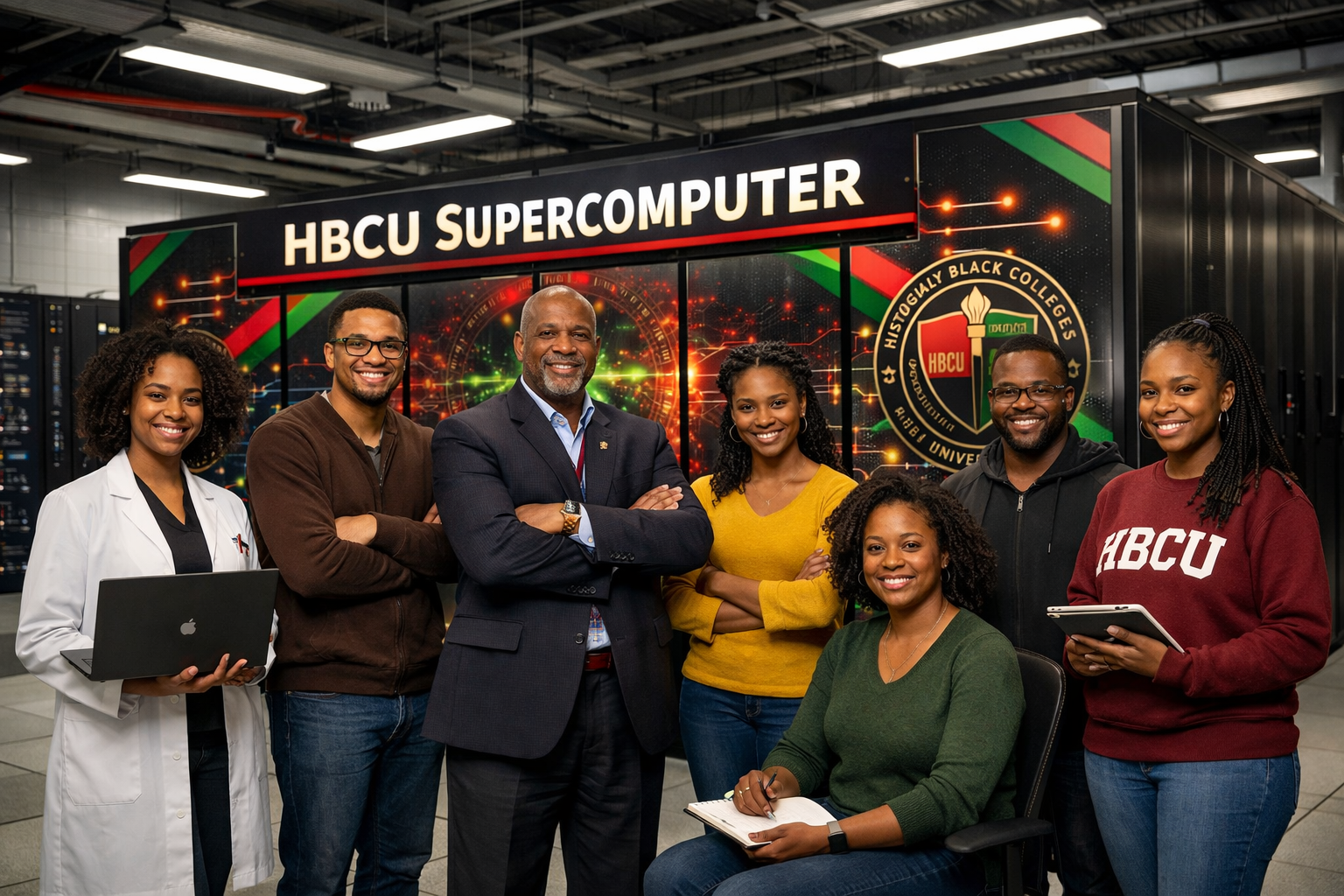
The same institutions that trained Katherine Johnson to calculate trajectories that put Americans on the moon now find themselves locked out of the computational infrastructure powering the next generation of scientific discovery. While Historically Black Colleges and Universities have long punched above their weight in producing Black STEM graduates, they remain systematically excluded from the high-performance computing resources that define cutting-edge research in the new era of AI, quantum computing, and supercomputers. It’s time for HBCUs to stop asking for access and start building their own.
The case for a Pan-HBCU supercomputer and quantum computing initiative is about survival, sovereignty, and strategic positioning in an economy where computational power increasingly determines who owns the future and who rents access to it.
Today’s research landscape is brutally simple: no supercomputer, no competitive research. Climate modeling, drug discovery, materials science, artificial intelligence, genomics, and aerospace engineering all require computational resources that most HBCUs simply cannot access at scale. While predominantly white institutions boast partnerships with national laboratories and billion-dollar computing centers, HBCU researchers often wait in lengthy queues for limited time on shared systems—if they can access them at all.
The numbers tell a stark story. According to the National Science Foundation, the top 50 research universities in computing infrastructure investment include zero HBCUs. Meanwhile, institutions like MIT, Stanford, and Carnegie Mellon operate dedicated supercomputing facilities that give their researchers 24/7 access to the tools that generate patents, publications, and licensing revenue.
This isn’t an accident. It’s the architecture of exclusion, and it’s costing African America billions in lost patents, forfeited breakthroughs, and surrendered market position. Every HBCU chemistry professor who can’t run molecular dynamics simulations is a drug that won’t be discovered. Every computer science department that can’t train large language models is an AI company that won’t be founded. Every physics researcher who can’t process particle collision data is a technology that someone else will own. This is about power—economic power, technological power, the power to shape industries rather than simply participate in them.
If the supercomputing gap is concerning, the emerging quantum divide is existential. Quantum computing represents a fundamental shift in computational paradigms with implications for cryptography, drug design, optimization problems, and artificial intelligence. Nations and corporations are investing billions to establish quantum supremacy, and the institutions that control this technology will own the intellectual property, set the standards, and capture the economic value of the next century of innovation.
HBCUs cannot afford to be spectators in this revolution. The breakthroughs that quantum-accelerated research could deliver everything from targeted therapies for diseases that disproportionately affect Black Americans to predictive models for climate impacts on Southern and coastal Black communities represent billions in economic value. More importantly, they represent the difference between being technology consumers and technology owners. Between licensing other people’s patents and collecting royalties on your own. But only if HBCUs control their own infrastructure. Or better yet, build it collectively.
Imagine a single, HBCU-owned computational facility, a crown jewel of Black academic infrastructure rivaling Los Alamos or Oak Ridge. Not distributed nodes competing for resources, but a unified campus where HBCUs collectively own land, buildings, and the machines that will mint the next generation of Black technological wealth. This is the computational arm of the HBCU Exploration Institute: a physical place where supercomputers hum, quantum processors compute, and HBCU researchers control access rather than beg for it.
The location matters. This facility needs to be somewhere politically friendly to ambitious Black institution-building, with favorable tax treatment, low energy costs, and infrastructure support. Four locations stand out:
New Mexico: Adjacent to Los Alamos and Sandia National Laboratories, with existing fiber infrastructure, favorable renewable energy costs, and a state government actively recruiting research facilities. New Mexico offers technical talent spillover, dry climate ideal for precision equipment, and proximity to Native American sovereign nations experienced in building independent institutions.
Puerto Rico: Tax incentives under Acts 20 and 22 (now Act 60) make it the Caribbean’s premier location for high-tech operations. Abundant renewable energy potential, especially solar, combined with federal research dollars without federal income tax on certain operations. Added benefit: positions HBCUs as bridge between U.S. and Caribbean research ecosystems.
Maine: Northern climate perfect for cooling systems, cheap hydroelectric power, and a state government hungry for high-tech economic development. Access to Canadian research partnerships, Atlantic subsea cable landing stations for data connectivity, and political environment favorable to institutional autonomy.
U.S. Virgin Islands: Caribbean location with full U.S. federal research funding access, generous tax incentives, and positioning as gateway to African and Caribbean collaborations. Year-round operation of field stations and research vessels, with computational infrastructure supporting the marine and atmospheric research missions.
The model is straightforward but transformative. HBCUs contribute capital to the HBCU Exploration Institute to purchase 200-500 acres outright. The land becomes HBCU property that is collectively owned, governed by an HBCU board, generating wealth for HBCU institutions in perpetuity. This isn’t leasing. This is ownership. A single state-of-the-art facility would house exascale supercomputers, quantum processors, AI training clusters, and massive data storage. Economies of scale mean more computing power per dollar than distributed nodes. Concentrated talent means better recruitment and retention. One campus means one set of operating costs, one power bill, one maintenance team.
HBCUs buy in based on their research needs and financial capacity. Larger contributors get more computational allocation and board representation, but every participating HBCU gets guaranteed access. Small institutions pool resources to punch above their weight. Research allocation follows ownership stakes, but the baseline ensures even small HBCUs can run competitive projects. Beyond serving HBCU research, the facility operates as a commercial venture. Lease computational time to corporations, government agencies, and international research collaborations. Host corporate AI training runs. Provide data center services. Every dollar generated flows back to participating HBCUs as dividends proportional to ownership stakes.
Adjacent to the computing facility, housing for rotating cohorts of HBCU researchers, graduate students, and undergraduate fellows creates a research village. Three-month to one-year residencies allow HBCU talent to work on computationally intensive projects while building networks across institutions. This becomes the intellectual hub of HBCU computational science, a place where collaborations form, startups launch, and the next generation of Black tech founders cut their teeth.
The sticker shock of supercomputing infrastructure is real but so is the cost of exclusion. A competitive supercomputing facility costs between $100-200 million to build and $10-30 million annually to operate, depending on scale and capability. Quantum computing infrastructure is still evolving, but meaningful access could require $50-75 million in initial investment. These aren’t small numbers, but they’re achievable through a combination of federal investment, private philanthropy, and strategic partnerships.
The first call should be to African American and Diaspora wealth both domestic and international. High-net-worth Black individuals, African tech billionaires, Caribbean family offices, and Diaspora investment networks represent untapped capital that understands the long-term value of Black institutional ownership. These are investors and philanthropists who won’t demand the same strings or ideological alignment tests that mainstream foundations impose. Traditional foundations like Mellon and Gates may follow once momentum builds, but Diaspora capital should lead. This ensures the vision remains accountable to Black communities rather than foundation program officers.
The priority for corporate partnerships should be African American and Diaspora-owned tech companies and investors who understand the strategic value of Black computational sovereignty. Seek partnerships with Black-led private equity firms, African tech entrepreneurs, and Caribbean technology investors before approaching mainstream tech giants. When engaging with companies like Microsoft, Google, IBM, and NVIDIA, structure deals that provide HBCUs with hardware, software, and expertise in exchange for joint research projects and equity participation but ensure HBCUs retain majority control and IP ownership. The goal is capital and resources, not dependence.
Federal funding streams exist like the CHIPS and Science Act, NSF Major Research Instrumentation grants, Department of Energy computing initiatives, and NASA research infrastructure programs though the current political environment makes federal support uncertain at best. HBCUs should build relationships and develop proposals now, but plan for a future administration more committed to research equity. In the meantime, the strategy must center on private capital and revenue generation that doesn’t depend on federal goodwill. Once operational, the facility could generate substantial revenue through commercial computing services, corporate research partnerships, and federal agency contracts. The University of Texas at Austin’s Texas Advanced Computing Center generates tens of millions annually through exactly this model, money that flows back into research capacity and student support. An HBCU-owned facility would channel those revenues directly to participating institutions as dividends proportional to ownership stakes.
The real value of HBCU-owned computational infrastructure goes far beyond the machines themselves. It’s about training the next generation of computational scientists, quantum engineers, and AI researchers who don’t just work for tech companies but found them, own them, and profit from them. Students at HBCUs with robust computing facilities wouldn’t just learn about supercomputers in textbooks they’d gain hands-on experience optimizing code for parallel processing, debugging quantum algorithms, and managing large-scale computational workflows. These aren’t abstract skills; they’re the exact expertise that tech companies and national laboratories desperately need and are willing to pay premium salaries to acquire. More importantly, they’re the skills that enable students to launch their own computational startups rather than simply joining someone else’s.
Faculty recruitment and retention would transform overnight. Try recruiting a top-tier computational chemist or AI researcher to an institution where they’ll spend half their time begging for computing time elsewhere. Now imagine recruiting that same researcher with the promise of dedicated access to world-class computing infrastructure and a path to commercialize their discoveries. The competitive landscape shifts dramatically.
This proposal aligns seamlessly with emerging initiatives like the HBCU Exploration Institute and the Coleman-McNair HBCU Air & Space Program outlined in recent strategic planning documents. These ambitious programs envision HBCUs leading research expeditions, operating research vessels and aircraft, and conducting aerospace missions. None of this is possible without serious computational infrastructure. Climate modeling for polar expeditions, satellite data processing, aerospace engineering simulations, deep-sea mapping analysis—these all require supercomputing resources. Want to analyze genomic data from newly discovered marine species? Process atmospheric measurements from research aircraft? Model propulsion systems for small satellites? You need computational power, and lots of it.
A Pan-HBCU Computing Consortium wouldn’t just support these exploration initiatives it would accelerate them, turning HBCUs into genuine leaders in exploratory science rather than junior partners dependent on others’ computational generosity. And every discovery, every patent, every breakthrough would belong to HBCU institutions and their researchers.
The window for building this capacity is closing. As quantum computing matures and AI systems become more computationally intensive, the institutions with infrastructure will accelerate away from those without. The gap between computational haves and have-nots will become unbridgeable, and HBCUs will be permanently relegated to second-tier research status which means second-tier revenue, second-tier patents, and second-tier wealth creation.
But it doesn’t have to be this way. The HBCU community has something that other institutions don’t: a shared mission, deep trust networks, and a history of collective action in the face of systemic exclusion. These institutions didn’t wait for permission to educate Black students when others wouldn’t. They didn’t wait for invitations to produce world-class scientists and engineers. They built their own institutions and proved the doubters wrong.
The same spirit that created HBCUs in the first place, the audacious belief that Black excellence could not be contained or denied must now be channeled into building the computational infrastructure these institutions need to compete and win in the 21st century. The question isn’t whether HBCUs can afford to build their own supercomputer and quantum computing infrastructure. The question is whether they can afford not to. In a world where computational power increasingly determines who shapes the future and who profits from it, HBCUs must choose between dependence and ownership.
The choice should be obvious. It’s time to build.
Disclaimer: This article was assisted by ClaudeAI.
In the late 1990s, Bangalore wasn’t just a city—it was a story. A warm, chaotic tapestry of engineers coding in rented apartments, of global tech giants betting on untapped talent, and of policymakers quietly scripting India’s biggest soft power play. Two decades later, the city now dubbed the “Silicon Valley of India” commands global tech respect, home to startups valued in the billions and engineers powering the backends of everything from WhatsApp to NASA’s Mars missions. The rise of Bangalore wasn’t just a fluke of economics—it was a proof of concept.
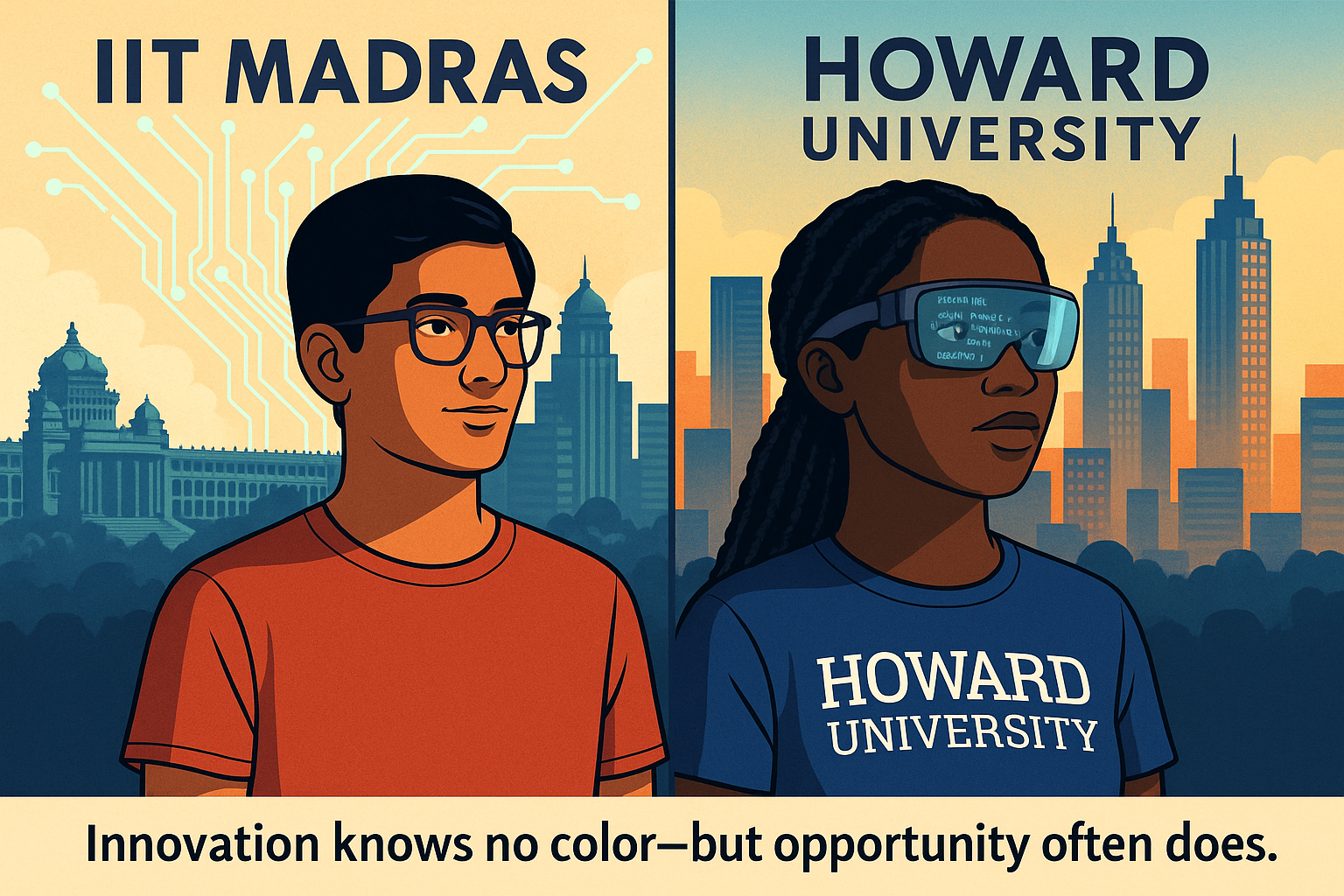
And now, that proof has meaning beyond India. It’s a beacon for another global demographic long denied its shot at innovation supremacy: African America. Specifically, Historically Black Colleges and Universities (HBCUs), and the tech-ready minds they house. What if Atlanta, Raleigh, or Houston could do what Bangalore did? What if the lessons learned across oceans and caste lines could ignite the next Black-led tech renaissance?
It’s easy to forget, in the blinding glow of app IPOs and TED Talks, that Bangalore’s rise began with a simple premise: educate the best minds in technical skill and keep them connected. Post-independence India was dirt poor, but visionary. It seeded a string of engineering temples—the IITs (Indian Institutes of Technology)—and gave them one directive: create elite minds for a future not yet written. By the 1980s, the global economy began tilting toward software, and India’s bet on technical education paid off. Bangalore, strategically located and flush with graduates, attracted IBM, Texas Instruments, and eventually Microsoft and Google. Infrastructure followed policy. Ecosystem followed talent. And Bangalore turned into a tech vortex.
So why hasn’t something similar happened in Black America? In many ways, the African American and Indian narratives share some DNA. Centuries of marginalization. Outsized cultural contributions. Underutilized brainpower. But where India had the state-backed machinery of nation-building, HBCUs were born out of necessity. Underfunded, segregated, and often geographically sidelined, these institutions have long produced brilliance in spite of their conditions—not because of them. Still, the potential is staggering.
HBCUs produce 25% of all African American STEM graduates. Yet, most lack the kind of venture pipelines, incubator culture, and big-tech partnerships that turn skills into unicorns. India’s tech sector shows what happens when education is backed by policy, investment, and cultural mission. That trifecta is what HBCUs need to replicate—on their own terms.
First, HBCU campuses must become startup colonies. India didn’t wait for venture capital to fall from the sky. It built software parks—zones with tax incentives, broadband access, and office infrastructure. These became hotbeds for early startups and outsourcing deals. HBCUs can do the same. Howard’s Innovation Center is one of the few early experiments: a co-working space and incubator embedded on campus. But it’s not enough. Imagine Prairie View A&M spinning up a “Black Code Foundry” with dorm-hackathon hybrids, investor demo days, and embedded alumni venture scouts. Picture Southern University hosting a summer startup accelerator focused on agri-tech for Black farmers. The infrastructure doesn’t need to be perfect—India’s wasn’t—but it needs to exist.
Second, the alumni diaspora must become an angel army. Here’s the dirty secret behind India’s rise: the real money and mentorship came from abroad. Indian engineers who moved to Silicon Valley in the 1980s and 90s didn’t forget home. They wired money, built companies back in India, and sent their kids to the IITs they graduated from. Bangalore became an offshore brain extension of Palo Alto. HBCUs need the same loyalty loop. Black technologists at Google, Meta, and Apple shouldn’t just donate to alma maters—they should embed, invest, and mentor. A reverse brain trust—Black diaspora talent reinvesting in the pipeline they came from—could supercharge the entire system.
Third, code plus culture equals competitive advantage. India’s strength isn’t just in code. It’s in context. The best Indian tech products, from Flipkart to Paytm, were designed for the specific quirks of their users: cash-only commerce, slow networks, multilingual markets. That’s the play for African American tech, too. What if HBCUs trained developers not just in Python, but in designing fintech apps for unbanked Black users? Or telehealth tools for historically underserved zip codes? Black America has problems Silicon Valley doesn’t understand—and that’s a market advantage. Building for community isn’t charity. It’s a trillion-dollar design edge.
Fourth, policy must follow performance. One reason India succeeded is that its government saw tech as national strategy. It rolled out Special Economic Zones, offered tax holidays for startups, and treated engineering education as sacred. African American political leadership must adopt similar postures. Imagine a federal “Black Innovation Act” that grants funding to HBCU-based incubators, supports Black-owned VC firms, and protects patents developed at minority institutions. More tangibly, cities with large Black populations and HBCUs should offer land, broadband, and zero-interest loans to Black founders. If Chattanooga can build a public gigabit network, so can Tuskegee. Policy isn’t optional. It’s foundational.
Fifth, this requires narrative, not charity. India’s rise wasn’t framed as aid—it was ambition. It wasn’t “helping the poor.” It was “backing the next global power.” HBCUs and Black tech should be framed with the same boldness. The next Amazon might come from Alabama A&M. The next Oracle from Morgan State. What’s needed isn’t pity—but placement. African American founders shouldn’t be exceptions—they should be expectations. Tech journalism, film, and digital storytelling can help here. Highlight the successes. Build the lore. Change the perception.
Sidebar: What HBCUs Can Build Now
Move
Description
Potential Impact
Campus Incubators
On-site startup hubs with mentorship and funding access
Trains 1,000+ founders annually
Black Tech Diaspora Network
Online and in-person platform linking alumni with current students
Cross-generational capital + experience
Community-Centric Product Labs
Build tech for African American problems (e.g., finance, health, education)
Monetizes underserved user segments
Policy Consortium
HBCUs jointly lobbying for innovation policy with state + federal officials
Unlocks $1B+ in tech zone funding
Cultural Storytelling Units
Cross-discipline media studios to tell Black tech success stories
Shifts perception of HBCUs from “legacy” to “launchpad”
In a way, India’s tech story was never just about tech. It was about self-respect. About telling the world that brown minds could be global minds. That the future didn’t need to be imported. For African America, the stakes are the same. HBCUs are already proving grounds for cultural genius—music, politics, social theory. Tech should be next. A Black Silicon Valley doesn’t need to mimic the old one. It just needs to learn the playbook, remix the rhythms, and code to its own beat.
The next tech capital might not be in Cupertino or Shenzhen—but in the back streets of Atlanta, lit by the glow of laptop screens in an HBCU dorm room. Because somewhere out there, a kid from Jackson State is already building the future. All they need is the infrastructure—and the imagination—to finish the job. If India’s story is a testament to what happens when a nation believes in its brainpower, then the African American tech future will depend on whether HBCUs and their communities can believe in theirs—loudly, structurally, and unapologetically. Not for permission. But for power.
Disclaimer: This article was assisted by ClaudeAIand ChatGPT
“The future is not a place we are going. It is one we are inventing.” — John Schaar
While many HBCUs still seek validation in a PWI-centered research ecosystem, the University of Texas Medical Branch (UTMB) is doing something more audacious: redefining the rules of engagement. With its inaugural VentureX Summit, UTMB isn’t merely seeking grant money—it’s building an innovation economy. And HBCUs, if bold enough, could do the same.
In a summer dominated by political unrest and macroeconomic uncertainty, the University of Texas Medical Branch (UTMB) in Galveston, Texas, quietly launched what may prove to be one of the most strategically significant higher education events of the decade. The VentureX Summit, hosted on July 17, 2025, marked UTMB’s formal entrance into the growing arena of translational innovation—a sector where science, venture capital, and state-backed institutional development converge to shape the 21st-century economy.
For HBCUs, often relegated to the margins of federal and philanthropic investment in research, the implications of UTMB’s maneuver are profound. Not because UTMB is a peer—it isn’t. But because it offers a roadmap.
UTMB President Dr. Jochen Reiser didn’t mince words in his summit address. Education, research, and patient care were no longer enough. A “fourth pillar”—innovation—was now essential to institutional longevity, impact, and sovereignty. By formally integrating innovation into UTMB’s strategic framework, the institution is doing something few public universities in the South have dared: turning research into economic infrastructure.
This isn’t a rebranding exercise. It’s a full-throated shift in power orientation. UTMB’s Office of Technology Transfer has been reborn as the Office of Innovation & Commercialization, while the Life Science Incubator, adjacent to its research facilities, is being marketed as a landing zone for biotech startups, investors, and licensing agents alike.
Compare this with the strategic inertia found at most HBCUs. While many tout research agendas, few have even minimal infrastructure for commercialization. Fewer still think in terms of venture scalability or intellectual property portfolios. UTMB’s pivot exposes this gap—not as a deficiency of talent, but of institutional courage and vision.
The VentureX Summit focused heavily on kidney therapeutics—a seemingly narrow domain until you recognize that kidney disease costs the U.S. healthcare system nearly $130 billion annually, and disproportionately affects African Americans.
UTMB highlighted three major innovations during the summit: suPAR science, a biomarker-driven immune research platform that reframes the way inflammation and chronic disease are treated; anti-miR-17 for ADPKD, a therapy targeting polycystic kidney disease, recently acquired by Novartis; and Atacicept, a biologic aimed at IgA nephropathy, another major kidney condition with limited treatment options.
Each of these originated at UTMB and moved through stages of clinical validation, patent protection, startup spin-out, and either acquisition or venture partnership. The fact that these stories are not one-off flukes but institutionalized outputs is a direct result of UTMB’s realignment around innovation.
For HBCUs with schools of pharmacy, biology, or public health—particularly those serving communities with high chronic disease rates—this is a flashing neon signal. Owning the intellectual property that treats your community’s disease burden is not just good science. It’s power. It’s capital. It’s destiny.
A painful truth: HBCUs receive less than 1% of NIH research funding. The reasons range from grant-writing disparities and institutional size, to deeper systemic racism in peer review and proposal evaluation.
But what the VentureX Summit revealed is that institutions no longer need to center their R&D portfolios on NIH alone. The venture capital ecosystem—especially in biotech—is beginning to bypass the traditional federal-funding pipeline. Startups and scientists are courting angel investors, family offices, and strategic pharma partnerships earlier than ever.
This trend is significant for HBCUs because it decentralizes capital—opening doors beyond federal gatekeeping; rewards translational impact over pedigree; and allows for mission-aligned ventures—especially in diseases like diabetes, hypertension, and sickle cell that disproportionately affect African Americans.
Imagine a Howard University or Xavier University of Louisiana spinout that secures $5 million in seed capital to develop a culturally tailored mental health AI app. Or a consortium of HBCU researchers patenting an algorithm for early-stage dementia detection among Black elders. With the right infrastructure—IP management, deal-flow coaching, investor networks—this is no longer fantasy. It’s overdue.
That UTMB chose to host VentureX in Galveston, a city more often associated with hurricanes than high finance, is symbolic. It was not at the Texas Medical Center, nor at the flashier campuses of Austin or Dallas. Instead, UTMB used the summit to stake Galveston as a regional biotech innovation node, a move that builds on Houston’s recent success as a Brain Capital hub with Rice University and the Texas Medical Center Innovation Institute.
For HBCUs, particularly in the South, this strategy is critical. The clustering of biomedical and tech innovation around coastal cities like Boston, San Francisco, and Seattle has created access and visibility challenges. But regional clustering, especially when supported by state policy and university systems (as in Texas), creates a new terrain—one that Southern HBCUs like Meharry, Tuskegee, Florida A&M, or Prairie View A&M could dominate.
The key is not just research. It’s the integration of policy, capital, and narrative—what UTMB has shown is possible.
Let’s imagine that a group of HBCUs—say, North Carolina A&T, Howard, Jackson State, and Xavier—joined together to create an annual Black HealthTech Innovation Summit.
Its components could mirror VentureX: showcasing translational research in diabetes, maternal health, cancer, and neurodegeneration; pitch competitions where researchers and student-founders present to Black-owned VCs, foundations, and corporate venture arms; investor speed networking to build relationships beyond the conference walls; and policy roundtables with state legislators to promote technology transfer tax incentives and university IP protections.
This could be rotated annually among campuses, forming the basis of a HBCU Tech Transfer Consortium, modeled after the University of California’s system-wide innovation strategy or Texas’s CPRIT (Cancer Prevention and Research Institute of Texas) fund.
Beyond optics, such a summit would provide a platform to rewrite the power structure of Black health, wealth, and innovation. It would signal to both the federal government and philanthropic sector that HBCUs are not just asking for funding—they are offering investable opportunity.
One of the less discussed but perhaps most important takeaways from UTMB’s summit was the sheer willingness to claim space in the innovation economy. While other universities remain passive, waiting for “innovation” to emerge organically, UTMB made clear that innovation is a designed outcome, not an accidental one.
This is where many HBCUs fall short. The fear of failure, of overreach, of stepping outside the traditional academic role, looms large. But UTMB’s leadership—and the state of Texas—are demonstrating that academic institutions can be architects of economic infrastructure, not just participants.
This is a mindset shift.
For HBCUs to replicate UTMB’s success, they must invest in tech transfer offices staffed with professionals who understand patents, licensing, and venture capital—not just compliance officers; build research parks and incubators that bridge the university with startup ecosystems; champion internal innovation competitions where faculty and students propose scalable solutions to community problems—with funding and follow-up; and cultivate industry partnerships that go beyond recruiting to include co-development and revenue-sharing IP agreements.
The VentureX Summit offered a model of regional self-determination wrapped in a biotech suit. But for African American institutions, it carries heavier implications. Innovation, in this context, is not just about research prestige. It’s about ownership, equity, and the future of Black health and wealth.
Just as land ownership, education, and voting rights were once the battlegrounds of civil rights, ownership of innovation ecosystems must become a new frontline. Because if we are not at the table—writing the patents, launching the startups, leading the trials—then we will once again find ourselves as the subject, not the author, of the future.
HBCUs must now ask: Are we ready to hold a summit of our own? Or will we remain an afterthought in the innovation economy we helped build?


 HBCU Money