Monthly Archives: April 2025

It’s Complicated: The 2019-2020 HBCU Graduate Student Loan Debt Report

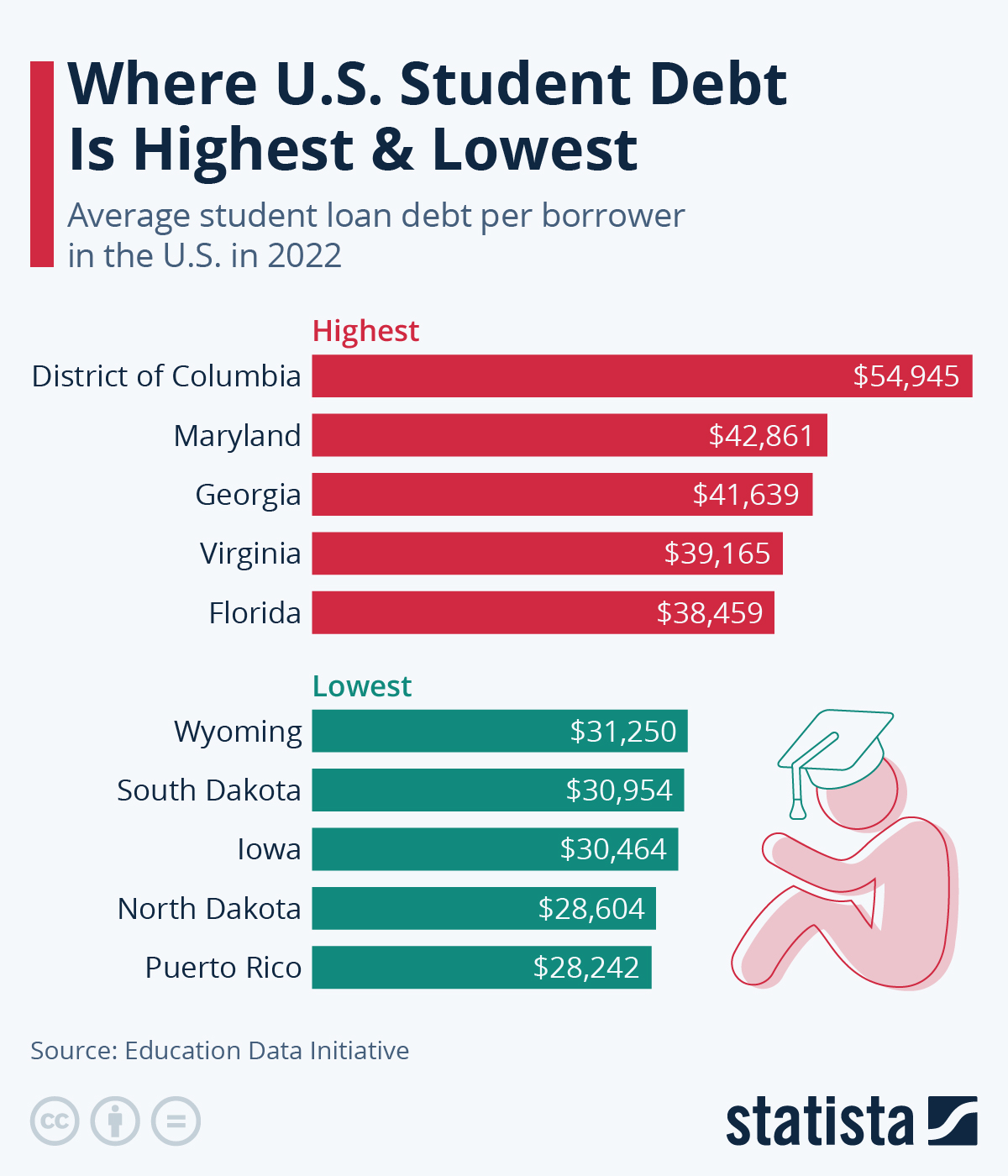
Chart: Where U.S. Student Debt Is Highest & Lowest | Statista

The most recent student loan data is an extremely hard gauge to use given its lag time. This data is the latest data available by ICAS, but also is pre-COVID and pre-George Floyd. The latter in that situation potentially produced a significant increase in student loan debt by students as many sought to help themselves and their families through financial aid refunds. COVID exposed African America’s acute financial fragility through poor health insurance, jobs with high exposure to COVID risk, and more. To the latter, in the post-George Floyd that also occurred where hundreds of millions poured into HBCU coffers led by MacKenzie Scott in levels never seen before and COVID relief funding through the CARES Act to colleges and universities witnessed HBCUs providing an immense amount of financial relief to its students to try and stem the debt tide.

HBCU graduates actually have some good news in that their median debt dropped approximately 8 percent from our last report while their PWI counterparts at major endowed institutions remained virtually unchanged. The bad news is that the percentage of HBCU graduates with debt remains unchanged while their PWI counterparts at major endowed institutions graduating with debt dropped almost 20 percent. This expands the gap of HBCU/PWI students graduating with debt from a previous 46 percentage points difference to now 52 percentage points in this latest report.

Numbers in parentheses shows the comparative results from the universities of the 30 largest endowments:

Median Total Debt of HBCU Graduates – $31,422 ($24,479)

Proportion of HBCU Graduates with debt – 85% (33%)

Median Private Debt of HBCU Graduates – $17,386 ($44,622)

Proportion of HBCU Graduates with private debt – 7% (5%)

Source: The Institute for College Access & Success

Looking at the numbers even further shows that HBCU Graduates debt is almost 30 percent higher than their PWI major endowed counterparts. This despite HBCUs being significantly cheaper, HBCU Graduates suffer from a student body that acutely comes from families that lack family assets and stability to assist. It is highlighted in the private debt component where PWI counterparts have significantly higher amounts of private debt. Potentially speaking to the borrowing power of those PWI families beyond federal financial aid.

It may be a few years before updated data from within the COVID era is available, but basic extrapolation suggest that even with the donations received after George Floyd and the CARES Act that HBCUs simply still lack the endowments to make up for the acute lack of African American household wealth combined with less than 10 percent of African Americans choosing HBCUs. The latter means that HBCUs operate with smaller alumni pools. These smaller pools means a smaller nominal giving of the alumni who do give and a significantly smaller probability that the HBCU can create a percentage of alumni who go onto become wealthy donors.

In the end, HBCU alumni who care about this must make available scholarship to a wider net of HBCU students while in school. Focusing on creating scholarship that is available to every student who is academically eligible and giving less emphasis to GPA. The large majority of any HBCU graduation class has GPAs between 2.0 and 3.0 and are the ones most likely to be left out of having any ability to decrease their student loan burdens making them almost never to be in a position to become donors.

By expanding eligibility requirements, scholarships can provide financial relief to those who need it most—students who are often balancing academics with work, family responsibilities, and other challenges. Many of these students demonstrate resilience, dedication, and a commitment to completing their education, yet traditional scholarship models disproportionately favor high achievers with GPAs above 3.5. While academic excellence should be celebrated, financial aid should not solely be reserved for the top percentage of students.

A broader approach to scholarships will help create a stronger alumni network in the long run, as more graduates will leave school with reduced debt, making them more likely to support their alma mater financially and contribute to future scholarship funds.

Previous HBCU Graduate Student Loan Reports

The 2016-2017 HBCU Graduate Student Loan Report

Good News/Bad News: Percentage Of HBCU Graduates With Debt Drops But Debt Loads Increase

90 Percent of HBCU Graduates Have Student Loan Debt


When the Numbers Don’t Add Up: Shannon Sharpe’s $10 Million Settlement (Offer) and Savannah State University’s $12 Million Endowment

“If we don’t support our own institutions, who will? Our future depends on it.” – Dr. Johnnetta B. Cole

In a society where celebrity controversy often overshadows institutional legacy, the recent $10 million legal settlement offer by Shannon Sharpe is notable not just for its allegations, but for what it inadvertently reveals about the chasm between Black celebrity wealth and the underfunded institutions that shape it.

Sharpe, an NFL Hall of Famer turned sports media luminary, is embroiled in a sexual assault lawsuit in April 2025 that has added fuel to the fodder over his public image for years. The allegations, dating back to 2021, accused him of sexual assault and misconduct. Though the terms of the settlement do not admit guilt, the figure—$10 million—is enough to reverberate well beyond the courtroom. Particularly for Savannah State University, Sharpe’s alma mater, whose entire endowment hovers just north of $12 million.

That a single lawsuit settlement could nearly eclipse the full financial endowment of a university—an institution that has educated generations of Black students since its founding in 1890—demands attention. It is more than legal coincidence; it is cultural commentary. Sharpe’s settlement and Savannah State’s endowment share more than proximity in value—they reflect a profound misalignment between individual Black success and collective Black institutional health.

Celebrity Capitalism vs. Institutional Capital

Sharpe’s alleged settlement offer arrives at a time when he is more visible than ever. From ESPN panels to viral podcast interviews, he has crafted a new media identity grounded in charisma, cultural commentary, and athletic credibility. He is a multimillionaire many times over, and for much of the public, a figure of Black excellence.

And yet, while the scandal has put his reputation into question, the institutional damage is more structural than sensational. Savannah State University, like most HBCUs, remains chronically underfunded. In Georgia, the flagship University of Georgia enjoys an endowment exceeding $1.8 billion. Savannah State’s $12 million looks less like a war chest than a coin jar.

This contrast is not unique. Harvard’s endowment, currently over $50 billion, generates more passive income in a single day than most HBCUs earn annually. Meanwhile, Black cultural, entertainment, and sports figures continue to accumulate individual wealth—largely without corresponding reinvestment in the institutions that launched their journeys.

In Sharpe’s case, it is particularly jarring. He has long spoken with pride about Savannah State, often positioning his ascent from a small HBCU to NFL stardom as proof of grit, talent, and perseverance. But the question remains: can Black America afford to celebrate individual ascent while its institutions struggle to survive?

Institutions as the Forgotten Priority

The logic of endowments is simple: they are long-term capital. Through careful management, they yield investment income that sustains a university’s operations—faculty salaries, scholarships, research grants, infrastructure. A $12 million endowment, assuming a 5% annual drawdown, provides just $600,000 per year. That’s not enough to fund a single major building renovation or hire a cohort of tenure-track faculty.

Yet for a fraction of what he has paid in legal settlements, Sharpe—or any number of successful HBCU alumni—could fundamentally change the trajectory of such institutions. This is not to single out Sharpe, but to highlight the imbalance. In an ideal world, the very wealth that is now being paid out in settlements would be instead building libraries, research labs, and scholarship funds.

This tension is particularly visible among athletes and entertainers. Black America’s most visible ambassadors often emerge from institutions that are themselves invisible in the national philanthropic conversation. According to UNCF, the combined endowments of all HBCUs total less than $5 billion. The Ivies, by contrast, hold over $200 billion in endowment assets.

Culture, Crisis, and the Limits of Individualism

Sharpe’s settlement speaks to more than a personal reckoning—it is a cultural moment. It raises questions about power, accountability, and how society arbitrates guilt and innocence outside the courtroom. But for the Black community, it should also prompt deeper reflection on how fame and fortune are managed—and how institutions are too often left behind.

There is a troubling pattern: institutions that produce Black talent are celebrated in name, while being abandoned in practice. Alumni homecomings become nostalgic affairs, rich in ritual but poor in revenue. HBCUs are used as cultural references in music and fashion, but rarely as investment priorities.

The result is that even as African Americans make gains in representation and cultural power, their institutions remain at risk of irrelevance or collapse. The stakes are not merely educational—they are existential. Without strong institutions, there can be no sustainable community power.

What a $10 Million Gift Would Mean

Imagine instead that $10 million were a donation, not a payout. At Savannah State, that amount would nearly double the endowment overnight. It could launch a center for Black media studies, a school of sports journalism, or fund full scholarships for dozens of students. It could digitize archives, attract talent, and fund study-abroad programs that broaden horizons.

Better yet, it could serve as a challenge grant—a call for other high-profile HBCU alumni to match it, dollar for dollar. Such a campaign could transform the entire financial landscape of HBCUs in a single generation.

There is precedent. Oprah Winfrey’s $13 million donation to Morehouse College, Robert F. Smith’s debt forgiveness gesture at Morehouse’s graduation, and Reed Hastings’ $120 million donation to Spelman, Morehouse, and UNCF during the racial reckoning of 2020 showed what’s possible. But sporadic generosity is not a strategy. What’s needed is a systemic culture of giving—an institutional ethos that reorients Black wealth toward Black infrastructure.

Moving from Scandal to Structure

Sharpe, like many public figures, is navigating a complex personal and professional moment. Settling a case of this magnitude inevitably invites scrutiny. But what comes next is more important. Can this moment be a catalyst—not just for personal reflection, but for public responsibility?

Celebrity scandals are ephemeral. Institutions, if cared for, are permanent. The opportunity now is for Sharpe—and others in similar positions—to pivot toward legacy-building. That means using their platforms not only to defend their names, but to elevate their alma maters. To protect not just brand equity, but intellectual capital. To trade spectacle for structure.

A Future Worth Investing In

Savannah State University is not just a school—it is a symbol of survival, intellect, and potential. Its alumni include judges, scientists, teachers, engineers, and businesspeople. It deserves more than to be a footnote in a celebrity controversy. It deserves capital, vision, and strategic philanthropy.

In the end, the numbers don’t lie. A $10 million lawsuit may capture headlines. But a $12 million endowment defines futures. The question is not what Shannon Sharpe did or didn’t do—but what he and others like him will do next.

If fame is fleeting and fortune unpredictable, then perhaps the wisest investment is the one that cannot be taken away: the institutions that built you.

Student Loans and Tax Credits: A Creative Plan to Solve the Student Loan Crisis

“A hunch is creativity trying to tell you something.” – Frank Capra

Once upon a time in the bustling town of Gradsville, there lived a recent college graduate named Tim. Armed with a shiny diploma and a mountain of student loans, Tim was ready to take on the world, or so he thought. After months of job hunting, he finally landed a gig at a local coffee shop, where he expertly crafted lattes while dreaming of his future as a high-powered executive.

One fateful morning, as he was frothing milk, Tim received an email from his loan servicer. The subject line read: “Your Student Loan Repayment Starts Now!” His heart raced. He opened the email, and there it was: a number so big it could compete with the national debt. Tim squinted at the screen, convinced it was a prank. “This must be a mistake!” he muttered, spilling a little espresso on his apron.

Determined to tackle the situation, he decided to devise a plan. Tim figured if he couldn’t pay his loans, he might as well make the most of his situation. So, he took his trusty old bicycle, painted it bright pink, and outfitted it with a sign reading, “Will Work for Student Loan Payments!” He rode around town, ringing a tiny bell and offering to do odd jobs for anyone willing to pay him in cash.

At first, the townsfolk were amused. Mrs. Jenkins, the elderly lady down the street, hired him to weed her garden. Tim spent hours pulling weeds, but when he presented her with the bill, she handed him a cookie instead. “This is for the effort, dear,” she said sweetly.

Undeterred, Tim pressed on. He mowed lawns, walked dogs, and even became a local celebrity for his “Bicycle Karaoke” sessions, where he belted out off-key renditions of pop songs while pedaling through the park. “I will survive!” he sang, as people threw coins into his basket.

But as the days turned into weeks, Tim realized he was raking in more laughs than cash. One evening, after a particularly exhausting day, he collapsed on his couch, exhausted and broke. Just then, his phone buzzed. It was an alert from his loan servicer: “Your payment is due tomorrow!”

In a moment of desperation, Tim decided to get creative. He hosted a “Loan Repayment Comedy Show” at the coffee shop, charging admission and promising a night of laughter. The townsfolk packed the place, eager to see the local hero make fun of his financial woes. Tim took the stage, and with each joke, he poked fun at his debt, his job, and even his pink bicycle.

By the end of the night, he had raised enough money to make his first payment. The crowd cheered, and Tim realized something important: while student loans were a burden, laughter was the best way to lighten the load.

With a new plan in mind, he turned his bike into a mobile comedy machine, spreading joy and occasionally collecting spare change. And just like that, Tim learned that sometimes, the best way to deal with life’s challenges is to find humor in them—even if it involves a pink bicycle and a lot of bad singing!

In a landscape where the burden of student debt looms over millions of Americans, I offer a glimmer of hope with an innovative proposal. Tax Credits. The creative use of tax credits can be designed to alleviate the financial strain of student loans. 

The cost of higher education continues to soar. As of 2025 higher education costs are nearly $35,000 per year for private institutions and over $10,000 for public universities. Over 45 million borrowers now collectively owe over $1.7 trillion in student debt. This staggering figure has become a significant hurdle for graduates entering the workforce, hindering their ability to invest in homes, start businesses, and contribute to local economies.

What exactly is the problem?

The student loan crisis has reached critical levels. According to the Federal Reserve, approximately one in five borrowers is in default or delinquency, while the average monthly payment for federal student loans hovers around $400. For many, this payment is a substantial chunk of their income, especially for young professionals just starting their careers. The implications extend beyond individual borrowers; they ripple through the economy, stifling growth and innovation. We are currently bordering on student loans reaching levels where they pose systemic risk to the entire system.

The proposed solution is tax credits for individuals and institutions.

To address this escalating issue, a two-pronged solution is proposed: tax credits for individuals repaying student loans and tax credits for institutions that implement aggressive debt reduction initiatives.

1.  Tax Credits for Individuals: This initiative would provide borrowers with a tax credit for every dollar they pay toward their student loans. Currently only student loan interest is tax deductible up to $2,500 per year. Under this new proposal full student loan payments become tax deductible. For example, someone with a $400 a month student loan payment will pay $4,800 in a full tax year. That $4,800 becomes a tax credit that can be used to lower their income tax burden. This would not only ease the financial burden but also encourage timely repayments, ultimately reducing the total outstanding debt. 


2. Additional Tax Credits for Individual payments to the loans of others. Under this new tax provision taxpayers who actively make student loan payments on behalf of other student loan holders can also receive a dollar-for-dollar tax credit.

3. Tax Credits for Private Entities: By aligning private institutional interests with the economic well-being of the public, private institutions would be motivated to contribute to the solution of student loan debt. Imagine Apple or JP Morgan deciding to allocate several billion a year to paying student loans of private citizens in exchange for tax credits. If the top 200 companies in the S&P 500 committed $1 billion each year to paying student loans it would mean that over a 10 year stretch nearly all student loans can be eliminated. Imagine a highly educated populace without the burden of student loan debt.

There are major benefits across the board.

This solution has the potential to benefit various stakeholders, including the wealthy, corporations, higher education institutions and local and state economies.

Wealthy individuals could see tax deductions that encourage more investment into the broader economy with the new capital. Simultaneously they also can benefit from a more educated workforce that drives productivity and innovation into the future.

Corporations would gain from a more skilled labor pool without the financial burden of student debt hindering employees’ productivity. Companies could also leverage tax credits to invest in employee education programs, enhancing workforce skills while reducing tax liabilities.

Higher Education Institutions benefit through potential students and current students now knowing that they can comfortably pursue educational goals without the fear of post graduate debt crippling their ability to perform in the labor force.

Local and state economies would see a revival as graduates with reduced debt would have more disposable income to spend on housing, goods, and services. This consumption can lead to job creation and increased tax revenues, offsetting some of the initial losses from the tax credits.

Like most policy shifts there will be opposition.

Despite its potential benefits, this proposal would likely face opposition from several parties. Conservative fiscal policymakers may argue that tax credits could lead to significant revenue losses for the federal government, exacerbating the national debt.  From a social standpoint there is bound to be criticisms of unfairness from individuals that did not attend college. Additionally, some economists may present a potential moral hazard in the form of people focusing too much on education and delaying real world labor pursuit. This has the potential to slow the proliferation of qualified labor into the workforce.

Estimating Revenue Loss for the Federal Government

Implementing such a tax credit system is not without its costs. Estimates suggest that the federal government could lose approximately $20 billion annually in tax revenue if the credits are widely adopted. This figure reflects both the individual tax relief provided to individuals and the institutional incentives for corporations. While this loss could raise concerns about funding for other critical programs, proponents will likely argue that the long-term economic benefits of a more educated populace and a healthy economy would outweigh the initial financial drawbacks.

In conclusion, the proposal for tax credits aimed at alleviating the student loan crisis presents a promising solution to a pressing problem. By aligning the interests of individuals, corporations, and the economy, this approach could pave the way for a brighter future, where education is an investment rather than a burden. As the conversation around student debt continues, it is crucial to explore innovative solutions that can lead to systemic change.

Could You Spend $30 Million In 30 Days on Us? How Monty Brewster Could Have Spent $30 Million with African American Businesses

“And we’re in the business of being in business, and we’re doin’ business.” – “Monty” Brewster

The 1985 film Brewster’s Millions, starring Richard Pryor as Montgomery “Monty” Brewster, tells the story of a man who must spend $30 million in 30 days without accumulating assets or informing anyone of his goal in order to inherit $300 million. Adjusted for inflation, Brewster’s $30 million would be approximately $85 million in today’s dollars, while the $300 million inheritance would be worth over $850 million. While Monty’s spending spree involved extravagant parties, failed investments, and creative tactics to burn through cash, the film missed an opportunity to showcase meaningful economic empowerment strategies. By directing his wealth toward African American businesses, Monty could have positively impacted communities while still meeting the conditions of the challenge. This article outlines how Brewster could have spent his fortune effectively within the African American business ecosystem.

  1. Investing in Education, Arts, and Wellness for African American Communities ($1.5 million or $4.25 million in today’s dollars)

Monty Brewster could have channeled a portion of his funds toward HBCUs, African American arts organizations, and health initiatives. These institutions play a vital role in developing African American leadership, entrepreneurship, and cultural advancement. Brewster could have funded scholarships, financed infrastructure improvements, or supported specialized academic programs such as business incubation centers. Additionally, Brewster could have become a major patron of African American artists, musicians, and cultural organizations. Funding live performances, commissioning murals and sculptures, or sponsoring large-scale cultural events would have allowed him to inject cash into the creative sector while meeting the requirement to spend without accumulating lasting assets.

Health disparities have historically affected African American communities. Brewster could have supported Black-owned health clinics, funded wellness programs, or launched temporary mental health outreach initiatives. Sponsoring community health fairs and free medical check-up events could have aligned with his spending goals. To adhere to his challenge’s constraints, Brewster is limited charitable giving to $1.5 million. Within that budget, he could have made substantial contributions to civil rights organizations such as the National Center for Black Family Life, Black Teacher Project, and African American Credit Union Coalition. Funding advocacy campaigns, legal defense funds, and educational outreach programs would have ensured his spending aligned with causes that strengthen social equity. By underwriting public awareness campaigns or supporting temporary voter registration drives, he could have spent large sums while advancing civil rights initiatives.

  1. Supporting African American Media Companies ($4 million or $11.3 million in today’s dollars)

The media landscape has historically marginalized African American voices. Brewster could have spend money in Black-owned newspapers, radio stations, and production companies. By purchasing advertising space, sponsoring TV segments, or funding film productions that amplify African American stories, he could have spent millions while strengthening the narrative control of the community. This would have been especially true when he ran for mayor of New York City with his “None Of The Above” campaign which allows him to burn through millions.

  1. Empowering African American-Owned Interior Designers ($3 million or $8.5 million in today’s dollars)

Instead of investing in real estate projects with limited long-term impact, Brewster could have hired African American-owned interior design firms to revamp commercial spaces, restaurants, and event venues. Funding redesigns for offices, galleries, or retail spaces would have allowed him to spend significant amounts quickly while showcasing Black creative talent. Partnering with these designers to create temporary installations, pop-up exhibits, or themed public events would further align with Brewster’s spending objectives.

  1. Supporting Black-Owned Restaurants and Hospitality ($5 million or $14.2 million in today’s dollars)

Instead of squandering money on excessive parties with little social value, Brewster could have organized lavish gatherings catered exclusively by Black-owned restaurants, breweries, and event-planning companies. Hosting galas, networking events, or concerts powered by African American businesses would have rapidly spent millions while empowering these enterprises. Additionally, Brewster could have pre-paid months of reservations at Black-owned hotels for conferences, weddings, and events that celebrate Black culture.

  1. Promoting and Empowering African American Entrepreneurs in Technology ($4 million or $11.3 million in today’s dollars)

During the 1980s, technology was emerging as a transformative industry. Brewster could have directed funds to African American inventors, tech startups, and computer training programs. Sponsoring computer literacy drives in underserved neighborhoods, purchasing computers for community centers, or funding coding boot camps would have injected significant capital into this sector without violating the “no assets” condition. Additionally, Brewster could have launched a series of pitch competitions or startup grant programs to fund Black entrepreneurs. By awarding no-strings-attached grants to aspiring business owners, Brewster could have circulated his funds directly into the hands of innovative minds in the community. Creating a “Brewster’s Millionaire Fund” for new ventures would have established a lasting narrative of empowerment.

  1. Financing Black-Owned Transportation Companies ($4 million or $11.3 million in today’s dollars)

Brewster’s challenge required rapid cash outflows. He could have achieved this by chartering fleets of Black-owned transportation services, including buses, limousines, and taxis. Organizing free ride programs, senior citizen transport services, or back-to-school bus initiatives would have ensured meaningful community impact while fulfilling the spending requirements.

  1. Sponsoring Sports Teams in the African American Community ($4.5 million or $12.7 million in today’s dollars)

In the film, Brewster splurged on funding a struggling baseball team. He could have expanded this vision by sponsoring youth sports leagues, purchasing uniforms from Black-owned apparel companies, and financing travel expenses for underserved teams. By supporting athletics in underserved communities, he would have combined financial impact with social good.

  1. Creating Pop-Up Markets and Retail Experiences ($4 million or $11.3 million in today’s dollars)

To rapidly circulate cash, Brewster could have sponsored temporary markets that featured Black-owned businesses. By covering booth fees, marketing costs, and other overhead expenses, he could have injected cash into dozens of retail entrepreneurs. Such events would celebrate local artisans, designers, and vendors while creating a meaningful economic impact.

Monty Brewster’s dilemma of spending $30 million in 30 days presented a unique opportunity to create lasting change. By investing heavily in African American businesses, nonprofits, and community initiatives, Brewster could have met his goal while strengthening economic power in marginalized communities. Such a storyline would not only have showcased Brewster’s ingenuity but also highlighted the immense potential of targeted investment to uplift communities. If Hollywood ever revisits Brewster’s Millions, perhaps they will reimagine his spending spree as a transformative journey of economic empowerment.

Highest Paying Dividend Index ETFs by Sector (2025 Update)

Investing Together: How Families Can Benefit from a Sector-Based Dividend ETF Portfolio

In an age where financial literacy is just as important as traditional education, building a culture of investing within the family unit can be transformative. A sector-based dividend ETF (Exchange-Traded Fund) portfolio, such as the one recently highlighted in the “Highest Paying Dividend Index ETFs by Sector (2025 Update),” provides not only a reliable source of income through dividends but also a foundational tool for families to grow generational wealth, teach financial principles, and maintain economic resilience across economic cycles.

Why Dividend ETFs?

Dividend ETFs are a type of fund that holds a collection of dividend-paying stocks. Instead of owning individual companies and worrying about the performance of one or two stocks, ETFs give you diversified exposure to many companies within a sector. For example, the Vanguard Real Estate ETF (VNQ) gives investors exposure to real estate investment trusts (REITs), which typically pay higher-than-average dividends. Similarly, Utilities Select Sector SPDR Fund (XLU) provides exposure to utility companies, a sector known for steady performance and consistent dividend payments.

What makes these ETFs especially attractive is their passive income potential. By subtracting expense ratios (i.e., the fees to manage the ETF) from the dividend yield, we calculate the real annual dividend yield—the true income an investor earns. As families build portfolios with these tools, they are effectively laying the groundwork for consistent cash flow, which can be reinvested, used for expenses, or saved for long-term goals.


Benefits to Families

1. Creating a Passive Income Stream

Each ETF in the portfolio provides a small “paycheck” in the form of dividends, typically distributed quarterly. A well-diversified ETF portfolio can yield between 1.10% to nearly 4.00% annually, even after accounting for fees. For families, this means having a source of income that doesn’t rely on active work. Over time, reinvesting those dividends can lead to exponential growth—a concept known as compounding.

Let’s say a family invests $10,000 evenly across the top-performing ETFs like VNQ (3.88%), XLU (3.40%), and XLP (2.40%). Even at a modest return, that’s hundreds of dollars per year generated simply for holding onto investments—funds that could be used for savings, college funds, vacations, or even to reinvest further.

2. Sector Diversification Reduces Risk

This approach spreads investment risk across multiple parts of the economy: healthcare, real estate, technology, consumer goods, industrials, and more. By investing in ETFs that represent different sectors, families protect themselves from being overly exposed to one industry’s downturn. For example, if the technology sector underperforms, the utilities or real estate sectors—known for stability—can balance the portfolio.

This type of diversification is often compared to the phrase: “Don’t put all your eggs in one basket.” It’s especially vital for families who may not have the resources to weather major financial downturns without support.

3. Education and Involvement

Perhaps one of the most overlooked benefits of a family investment strategy is the educational component. Children who grow up in households where investments are discussed openly tend to have a better understanding of money management, risk, and long-term planning. Sitting together to review ETFs, tracking dividends, and discussing financial goals as a family can become a hands-on, real-world economics lesson.

Imagine a young child asking why a utility company pays more in dividends than a tech company. That conversation could spark curiosity that leads to lifelong financial competence.

4. Building Generational Wealth

Families often think of wealth in terms of property or inheritances. However, stock portfolios—especially those that grow with dividends—can quietly become powerful financial legacies. With dividend reinvestment plans (DRIPs), families can automatically reinvest earnings, buying more shares without lifting a finger.

Over 10–20 years, such compounding can result in significant growth—even for modest contributions. A $5,000 investment today in an ETF yielding 3.5% reinvested annually could be worth well over $10,000 within two decades, assuming modest appreciation. Multiply that across several ETFs and contributions over time, and you’re not just saving—you’re building a legacy.


Getting Started

For families interested in building this type of portfolio, consider the following steps:

  1. Start Small: You don’t need thousands of dollars. Most brokers now offer fractional shares. You can start investing with as little as $5 or $10.
  2. Pick Core Sectors: Start with 3-5 sectors that align with long-term stability (e.g., healthcare, utilities, consumer goods).
  3. Set Up a DRIP: Automatically reinvest dividends to maximize compounding over time.
  4. Have Monthly Check-ins: Discuss how the investments are performing, what dividends were earned, and what sectors are thriving. Involve your children if appropriate.
  5. Use Tax-Advantaged Accounts: Consider using Roth IRAs, 529 college savings plans, or custodial accounts to maximize tax efficiency.

Basic Materials

  • ETF: Materials Select Sector SPDR Fund (XLB)
  • Issuer: State Street
  • Dividend Yield: 2.10%
  • Expense Ratio: 0.10%
  • Real Annual Dividend Yield: 2.00%​

Consumer Goods

  • ETF: Consumer Staples Select Sector SPDR Fund (XLP)
  • Issuer: State Street
  • Dividend Yield: 2.50%
  • Expense Ratio: 0.10%
  • Real Annual Dividend Yield: 2.40%​

Financials

  • ETF: Financial Select Sector SPDR Fund (XLF)
  • Issuer: State Street
  • Dividend Yield: 2.30%
  • Expense Ratio: 0.10%
  • Real Annual Dividend Yield: 2.20%​

Healthcare

  • ETF: Health Care Select Sector SPDR Fund (XLV)
  • Issuer: State Street
  • Dividend Yield: 1.60%
  • Expense Ratio: 0.10%
  • Real Annual Dividend Yield: 1.50%​

Industrial Goods

  • ETF: Industrial Select Sector SPDR Fund (XLI)
  • Issuer: State Street
  • Dividend Yield: 1.90%
  • Expense Ratio: 0.10%
  • Real Annual Dividend Yield: 1.80%​

Services (Consumer Discretionary)

  • ETF: Consumer Discretionary Select Sector SPDR Fund (XLY)
  • Issuer: State Street
  • Dividend Yield: 1.20%
  • Expense Ratio: 0.10%
  • Real Annual Dividend Yield: 1.10%​

Technology

  • ETF: Technology Select Sector SPDR Fund (XLK)
  • Issuer: State Street
  • Dividend Yield: 1.30%
  • Expense Ratio: 0.10%
  • Real Annual Dividend Yield: 1.20%​

Utilities

  • ETF: Utilities Select Sector SPDR Fund (XLU)
  • Issuer: State Street
  • Dividend Yield: 3.50%
  • Expense Ratio: 0.10%
  • Real Annual Dividend Yield: 3.40%​

Real Estate

  • ETF: Vanguard Real Estate ETF (VNQ)
  • Issuer: Vanguard
  • Dividend Yield: 4.00%
  • Expense Ratio: 0.12%
  • Real Annual Dividend Yield: 3.88%​

Final Thoughts

Wealth isn’t just about having money—it’s about having the knowledge and structure in place to build and preserve it. A sector-based dividend ETF portfolio provides families a chance to learn together, earn together, and plan together. It turns investing from something abstract into a shared experience with real-life value.

The image of a family gathered around a laptop, reviewing charts and dividend yields, is more than a snapshot—it’s a vision of the future. A future where African American families, and all families, are empowered to take control of their financial destinies one dividend at a time.