
“Does the NFLPA realize that it is only as strong as its weakest link? Because history says it does not, but yet the Universe has handed them a diamond sword on a golden platter. Will they actually use it? Or be the NFLPA we have all comes to continuously be disappointed in.” – William A. Foster, IV
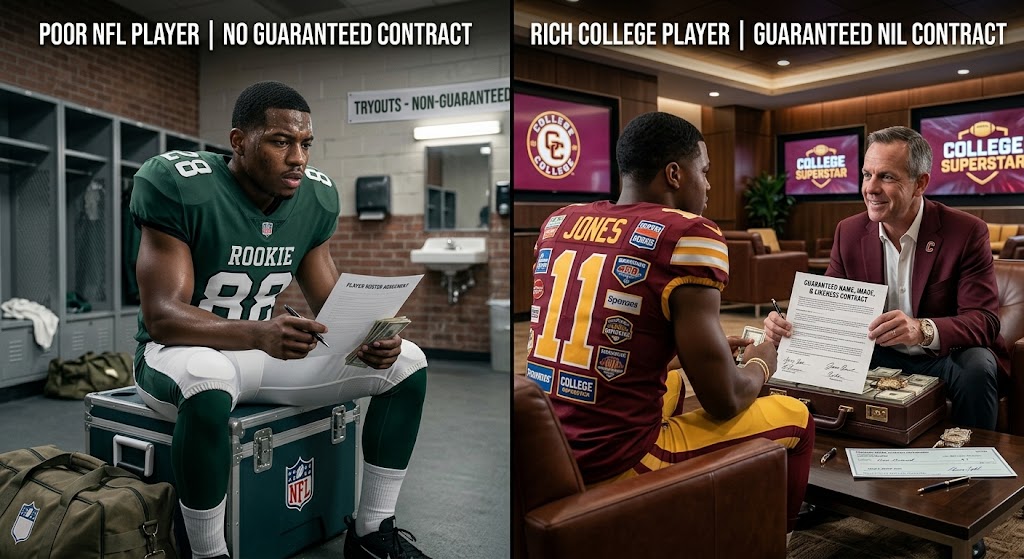
In the summer of 2019, a defensive tackle from a mid-major program signed as an undrafted free agent, reported to a training camp roster of ninety, and understood the arithmetic before anyone told him. He would compete against four other men for one practice squad spot. If he won, his contract would pay him a fraction of what a fourth-round pick made, none of it guaranteed beyond a workout bonus already spent on rent. If he lost, he would be out by Labor Day with no recourse, no severance, and no leverage because there was nowhere else for a healthy twenty-three-year-old with his skill set to go. That absence of an alternative was the entire foundation of his negotiating position, and it was zero. Six years later, that same player would have had a door his predecessor did not: a return to the campus that trained him, a guaranteed check three or four times larger, and a coach fighting to keep him.
That door opened because of an NCAA rule change that had nothing to do with professional football. In June 2026, the NCAA adopted new eligibility rules allowing athletes to play five seasons within a five-year window, a shift that, combined with the maturing NIL and revenue-sharing infrastructure inside major college programs, created something the NFL’s rookie labor market has never had to contend with: a credible outside option for the players at the bottom of its pay scale. The players testing that option this offseason were not marquee names. Dae’Quan Wright signed with Philadelphia as an undrafted free agent out of Mississippi following the draft, while Zxavian Harris signed with New Orleans in May as an undrafted free agent out of Ole Miss, was placed on the non-football injury list, and was waived in August. Both hoped to enroll at LSU. Neither is a household name, and that is precisely the point. This is not a story about stars weighing max contracts against Heisman campaigns. It is a story about the floor of the market; the undrafted free agents, the seventh-round picks, the practice squad rotation, discovering for the first time that the NFL is not the only institution capable of paying them.
The NFL’s institutional response arrived within days, which tells you how seriously the league takes the threat. NFL executive Troy Vincent reiterated at league meetings that players who return to college will be ineligible to play in the NFL during the 2026 season, with any such player becoming a free agent in 2027 rather than re-entering the draft. Conferences moved in parallel: the Southeastern and Big Ten conferences banned players who had been on NFL rosters from playing at their member schools, with the ACC and Big 12 reportedly weighing the same. Cal’s general manager, a former NFL player and coach himself, put the institutional anxiety plainly, saying he was disappointed that people are looking for ways to cheat the system or beat the system. That is the language of an incumbent that has never before had to compete for its own labor supply, and it is worth sitting with why the response was so fast and so coordinated. When two professional and amateur governance structures move in lockstep within a week to close a loophole, the loophole was working.
The economic logic here is not complicated, and it is not new to anyone who studies institutional power rather than individual talent. A market with only one buyer for a given kind of labor is a monopsony, and monopsonies do not need to collude explicitly to suppress wages, the absence of a second buyer does the work for them. The NFL’s rookie wage scale, its unguaranteed contracts for undrafted players, and its practice-squad churn have functioned exactly as classical monopsony theory predicts for decades, because a player cut in September has had no comparable institution willing to pay him market value for his labor before Thanksgiving. What changed in 2026 is that college football, flush with revenue-sharing dollars and NIL capital that now rivals rookie-tier NFL pay, became a second buyer. Not a symbolic one but a real one, offering guaranteed compensation three to four times larger than an unguaranteed rookie free agent deal, backed by a coaching staff with every incentive to win now rather than protect the sanctity of amateurism. The eligibility fight has already established that courts, not the NCAA, would ultimately decide who controls this door, and litigation over the five-year eligibility rule has already moved through federal district court, an appellate stay, and a spreading set of state-level lawsuits, which means the shape of this option is still being fought over in real time rather than settled.
This is where the NFLPA’s strategic error becomes visible, and where the opportunity sits if the union is paying attention. Every previous CBA negotiation between the NFLPA and NFL owners has taken place with the union representing a labor force that had no exit. Guaranteed contracts, practice squad protections, and injury settlements for undrafted and fringe roster players have historically been the weakest planks in every negotiation, not because the union didn’t want them, but because the owners knew there was no alternative employer a rank-and-file player could credibly threaten to join. That asymmetry is what allowed the league to normalize a system where a player can be cut on a Tuesday with no notice and no guaranteed pay beyond what has already been earned. The moment a second buyer exists for that same labor even an imperfect, eligibility-constrained, litigation-dependent buyer; the union’s bargaining position changes, because the owners’ own conduct in trying to shut the door tells you what the option is worth. Sean McVay’s now-widely quoted description of the chaos as feeling like he’d taken a gummy was meant as a joke about confusion; it is better read as an admission that a labor market incumbents assumed was permanently closed had, for one offseason, cracked open.
The durability of this leverage is the real question, and it should not be overstated. The window exists because of a specific, contested legal moment; a rule change that applies cleanly to players who entered college in 2023 or later, a wave of litigation from those excluded by the cutoff, and a scramble by both the NFL and individual conferences to reassert control before the 2027 draft cycle. College football programs are also operating under a 105-man roster limit and an expected revenue-sharing cap, which means the number of return spots any given school can actually offer is finite and shrinking as programs commit more of that cap to their existing rosters. If the NFL, the NCAA, and the conferences succeed in coordinating a permanent closure of this door through eligibility restrictions, roster caps, or simple institutional agreement not to compete for the same players then the outside option disappears as quickly as it appeared, and the leverage evaporates with it. That is exactly why timing matters. An outside option that both incumbents are actively working to eliminate is not a permanent feature of the labor market; it is a narrow, closing window, and it only translates into contract language if the NFLPA uses it at the bargaining table before the door shuts.
Why this particular fight matters more than a typical labor dispute is a question this publication addressed twelve years ago, and the underlying arithmetic has not moved as much as NIL headlines suggest. A short career spread across a full working lifetime produces a much smaller number than the salary figure alone implies, and that basic fact still governs outcomes today. Roughly half of NFL rosters are Black players, with the most methodologically rigorous tracking placing the figure at just over half, which means the players most exposed to unguaranteed, short-tenure contracts are disproportionately the same players the broader wealth-building conversation in Black communities is trying to reach. The average career remains short by any honest measure, commonly cited near three and a half years, and only about 13% of NFL players earn more than $1 million annually, with career earnings across the league averaging roughly $6.4 million (pre-taxes and agent fees) once the outlier mega-contracts are set aside, a figure skewed heavily upward by a small number of stars at the top of the pay scale. NIL money changes the front end of this math for a talented eighteen-year-old, but it does very little for the back end: the salary cap architecture that determines how many roster spots exist, and the pension-vesting rules that determine what a short career yields decades later, are structural features the league controls and has no incentive to alter. Second contracts remain concentrated among early-round picks, which means the players most likely to need this new return option are undrafted free agents and late-round picks facing career spans measured in months, not years are also the players with the least standing to negotiate it for themselves individually. That is a union’s job, and it is exactly the leverage this moment hands them.
The broader lesson is one about institutions rather than individuals, which is where this analysis properly ends. Leverage is not a function of how talented or deserving a worker is — it is a function of how many institutions are willing to compete for what that worker offers. For nearly a century, professional football’s labor market was structured so that no such competition existed for the players at the bottom of the pay scale, and the contract terms available to them reflected that absence precisely. A single offseason of legal and financial disruption in college sports did more to expose that structure than a decade of union rhetoric, because it briefly, concretely gave a subset of players somewhere else to go. Whether the NFLPA converts that exposure into permanent gains: expanded guarantees for practice squad and undrafted contracts, injury protections that survive final cuts, and anti-collusion language preventing the league and conferences from jointly re-closing this option will determine whether 2026 was a one-off anomaly or the moment the union finally understood what its own members were worth.
Disclaimer: This article was assisted by ClaudeAI.

