
In Omaha, Berkshire Hathaway’s cash pile has grown so large that even Wall Street marvels at its inertia. With over $380 billion in cash and short-term Treasuries, the conglomerate is sitting on more dry powder than most central banks. Yet Warren Buffett and his successor, Greg Abel, have long maintained that capital must only move when the odds of permanent capital loss are near zero.
Now, with global markets resetting post-2020 stimulus and inflation anchoring valuations, the question becomes: what could Berkshire buy next that would be both large enough to matter and philosophically sound enough to pass Buffett’s test of simplicity, durability, and trust?
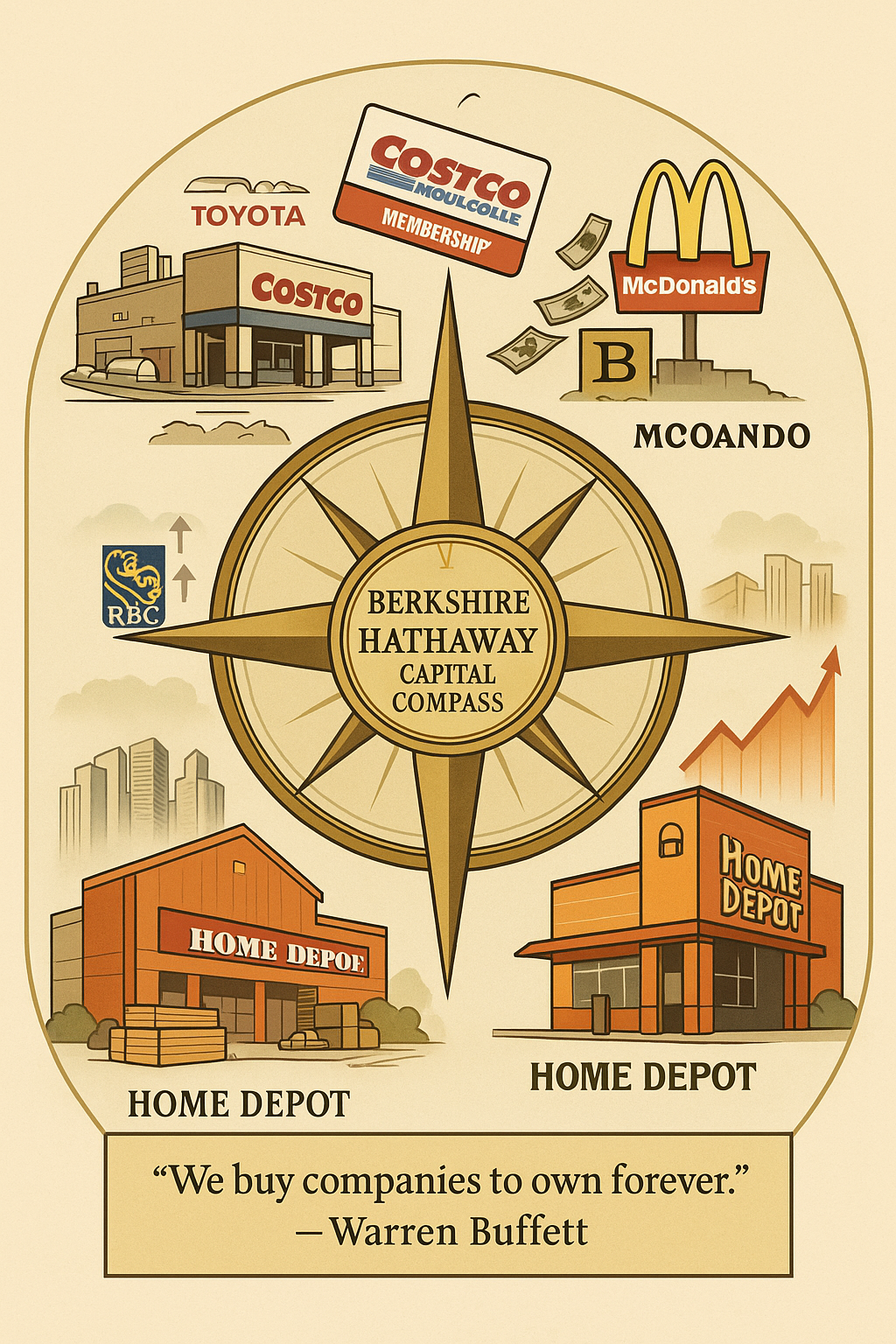
The five most plausible candidates — Costco, McDonald’s, Home Depot, Royal Bank of Canada, and Toyota — each satisfy that mix of prudence, predictability, and permanence that defines Berkshire’s century-long strategy of buying “businesses, not tickers.”
Buffett’s philosophy has been remarkably consistent for over six decades: buy simple, cash-rich, moated businesses led by trustworthy managers. Berkshire’s model of quasi-permanent ownership, decentralized operations, and disciplined capital allocation has made it the corporate equivalent of a sovereign wealth fund — except its sovereign is capitalism itself.
Greg Abel, the man expected to succeed Buffett, has only reinforced this model. Coming from Berkshire Energy, Abel represents the “real economy” side of the house preferring tangible assets, regulated returns, and predictable cash flow over the exuberance of speculative innovation.
Hence, the next Berkshire deal is not likely to be an AI startup or fintech disrupter. It will be a “forever asset” — a company that compounds quietly and defends its margins under any macro regime.
Given Berkshire’s sheer scale of over $1 trillion in market capitalization a target must have an enterprise value north of $200 billion to meaningfully “move the needle.” Anything smaller, and the math of compounding becomes negligible.
🧩 The Berkshire Universe: Themes and Tendencies
Berkshire’s portfolio reads like a map of the American and global economy’s most reliable arteries:
| Category | Core Holdings | Traits |
|---|---|---|
| Financials | AmEx, Bank of America, Moody’s, Chubb | High ROE, capital-light, recurring revenue |
| Consumer Staples | Coca-Cola, Kraft Heinz, Diageo | Global brands, predictable demand |
| Energy / Industrials | Chevron, Occidental, Mitsubishi | Real assets, inflation hedge |
| Technology | Apple, Amazon (small), VeriSign | Cash-rich ecosystems |
| Infrastructure / Insurance | BNSF Railway, BH Reinsurance | Tangible durability, “float” generation |
This structure provides a blueprint for what comes next: reinforcement, not reinvention. Berkshire rarely pivots; it doubles down on what works. It will seek businesses that (1) resemble what it already understands, and (2) offer inflation-protected earnings streams in a world of higher nominal rates.
From the universe of firms valued between $200 billion and $450 billion, only a handful exhibit the balance of predictability, management integrity, and strategic fit Berkshire demands.
A closer look through Buffett’s filters narrows the field to Costco, McDonald’s, Home Depot, Royal Bank of Canada, and Toyota. Each operates in a sector Berkshire already knows and each represents a bridge between the company’s past and its post-Buffett future.
1. Costco Wholesale (Ticker: COST)
The Cult of Value Meets the Culture of Discipline
Buffett has long admired Costco’s operating model. It is a retailer that sells everything from fresh salmon to fine jewelry but in truth, it sells trust. Its membership model generates annuity-like revenue, while its relentless efficiency and scale provide a durable moat against both inflation and digital disruption.
Charlie Munger, Buffett’s late partner, once served on Costco’s board and famously said, “Costco is one of the most admirable capitalistic institutions in the world.” That legacy alone makes a partial acquisition symbolically powerful.
While a full buyout (market cap ≈ $405 billion) may be too expensive, a 20–30% stake would make sense. It would give Berkshire exposure to global consumer spending and provide a stabilizing counterpart to its stake in Apple, a brand built on loyalty, not leverage.
In the age of shrinking retail margins, Costco remains an inflation hedge, its pricing power born from scale, not greed. Buffett has always preferred such quiet dominance.
2. McDonald’s (Ticker: MCD)
Fast Food, Slow Capital
If there were ever a brand that personifies Buffett’s doctrine of “durable competitive advantage,” it is McDonald’s. With over 40,000 locations in 100+ countries and a business model centered on franchised cash flow, McDonald’s is the quintessential predictable earner.
Its asset-light structure means free cash flow margins north of 25%, while its real-estate footprint functions as an embedded REIT. In a world of digital payments, delivery, and global inflation, McDonald’s pricing agility is unmatched. It can raise prices by 5% globally without denting demand, a privilege of brand addiction.
Moreover, McDonald’s cultural synergy with Coca-Cola (another Berkshire cornerstone) cannot be overstated. Both are global empires built on ubiquity, habit, and nostalgia. A merger of ownership philosophy, if not of products, would anchor Berkshire’s consumer-staples dynasty for another half-century.
At ~$218 billion market cap, McDonald’s is one of the few full-scale acquisitions Berkshire could realistically afford outright.
3. Home Depot (Ticker: HD)
Owning the American Rebuild
Buffett once said that he bets on the “resilience of the American homeowner.” Home Depot, valued around $372 billion, is the most efficient expression of that belief.
As infrastructure spending rises and housing shortages intensify, Home Depot sits at the crossroads of construction, repair, and consumer credit. Its business model converts cyclical demand into steady dividend growth. For Berkshire, already owning materials firms and insulation producers, a significant stake in Home Depot would complete a “vertical household economy” from supply chain to consumer.
Its store footprint and brand loyalty parallel BNSF’s railroad network: both are national arteries essential to the domestic economy. Buffett loves owning irreplaceable distribution infrastructure and Home Depot’s logistics system is precisely that.
4. Royal Bank of Canada (Ticker: RY)
The Conservative Bank That Would Make Carnegie Smile
Berkshire’s financial core is deep, but largely American. A Royal Bank of Canada acquisition would expand its footprint across North America’s second-largest and most stable financial system.
RBC’s strengths are conservative underwriting, dominant market share in wealth management, and a culture of steady, compounding profitability which mirror Buffett’s historical love of American Express and Bank of America.
Moreover, Canada’s heavily regulated banking environment protects incumbents from competition. Berkshire thrives in such “wide-moat oligopolies.”
At a market cap of $208 billion, the bank is small enough for a full acquisition but large enough to deploy Berkshire’s idle cash meaningfully. It would also diversify currency exposure and hedge U.S. economic concentration, a quiet, Abel-style move.
5. Toyota Motor Corp. (Ticker: TM)
Japan’s Crown Jewel of Industrial Resilience
Berkshire already owns minority stakes in five major Japanese trading houses, a calculated bet on the nation’s industrial discipline. Extending that strategy into Toyota would be the logical next step.
Toyota’s balance sheet, manufacturing excellence, and hybrid-vehicle leadership make it a quintessential “Buffett business” hidden inside an automaker. Unlike the tech-saturated EV startups, Toyota’s philosophy of gradual innovation, prudence, and reliability mirrors Berkshire’s own.
The two even share a cultural ethos: long-termism over trend-chasing.
At roughly $268 billion market cap, a 10–20% strategic stake would echo Buffett’s Japanese diversification theme without the regulatory complexity of a full acquisition. It would also position Berkshire for the eventual rise of hybrid and hydrogen vehicles in emerging markets, aligning with its energy portfolio’s shift toward renewables.
💰 Financial Feasibility: Deploying $250 Billion Wisely
Even Berkshire’s cash hoard has limits. Deploying $150–$250 billion must pass both the Buffett test (certainty of cash flow) and the Abel test (inflation resilience).
A possible portfolio of acquisitions could look like this:
| Target | Market Cap (USD) | Likely Approach | Strategic Rationale |
|---|---|---|---|
| Costco | $405B | 20–30% stake | Global retail + subscription revenue |
| McDonald’s | $218B | Full acquisition | Cash flow, brand power, inflation hedge |
| Home Depot | $372B | 20–30% stake | U.S. infrastructure exposure |
| Royal Bank of Canada | $208B | Full acquisition | North American financial expansion |
| Toyota | $268B | 10–20% stake | Japan industrial diversification |
In total, such a deployment would utilize around $200 billion, leaving liquidity for buybacks and opportunistic purchases.
This mirrors Berkshire’s historical pattern: buying large minority stakes in global champions, then waiting for market corrections to accumulate more — the “silent control” strategy that has defined its rise.
Strategic Summary: The Post-Buffett Blueprint
The post-Buffett Berkshire era will be one of institutional continuity, not radical change. Greg Abel’s likely leadership ensures that the company remains disciplined, risk-averse, and industrially grounded.
These five potential acquisitions — Costco, McDonald’s, Home Depot, Royal Bank of Canada, and Toyota — collectively represent Berkshire’s five pillars of permanence:
- Consumer Trust (Costco) – Loyalty as an economic moat.
- Everyday Habit (McDonald’s) – Cash flow as culture.
- Infrastructure (Home Depot) – Building the backbone of America.
- Finance (RBC) – Conservative capital compounding.
- Industry (Toyota) – Global operational excellence.
Each adds a layer of diversification without diluting Berkshire’s DNA. Together, they form a defensive fortress against inflation, technological disruption, and economic cycles — precisely the environment Berkshire was built to survive.
For HBCU endowments and African American institutional investors, Berkshire’s approach holds a powerful parallel. The key lesson is patience married to scale. Berkshire’s compounding model demonstrates how disciplined reinvestment — not speculative churn — builds generational wealth.
Like Berkshire, HBCU financial ecosystems can create “institutional compounding engines” by investing in enterprises that share cultural familiarity, operational durability, and intergenerational value. Buffett calls it “the joy of owning good businesses forever.”
For African American institutions, that translates to owning — not merely funding — the infrastructure of our own economies.
Berkshire Hathaway stands at an inflection point. The post-Buffett era will not be about reinvention but reaffirmation — proving that its model of ethical capitalism can persist without its founding prophet.
The five plausible acquisitions ahead — Costco, McDonald’s, Home Depot, Royal Bank of Canada, and Toyota — are not just balance-sheet moves; they are philosophical statements.
Each embodies what Buffett has called the “virtue of patience in a speculative age.” And as markets oscillate between AI euphoria and geopolitical anxiety, Berkshire remains what it has always been: a monument to quiet power and compounding discipline.
For long-term investors — from sovereign funds to HBCU endowments — that discipline remains the truest asset class of all.
Disclaimer: This article was assisted by ChatGPT.
 HBCU Money