
“You can not win a war that you will not acknowledge you are in, and African America refuses to acknowledge it is in a war and therefore has not built the institutional defense necessary to win.” – William A. Foster, IV

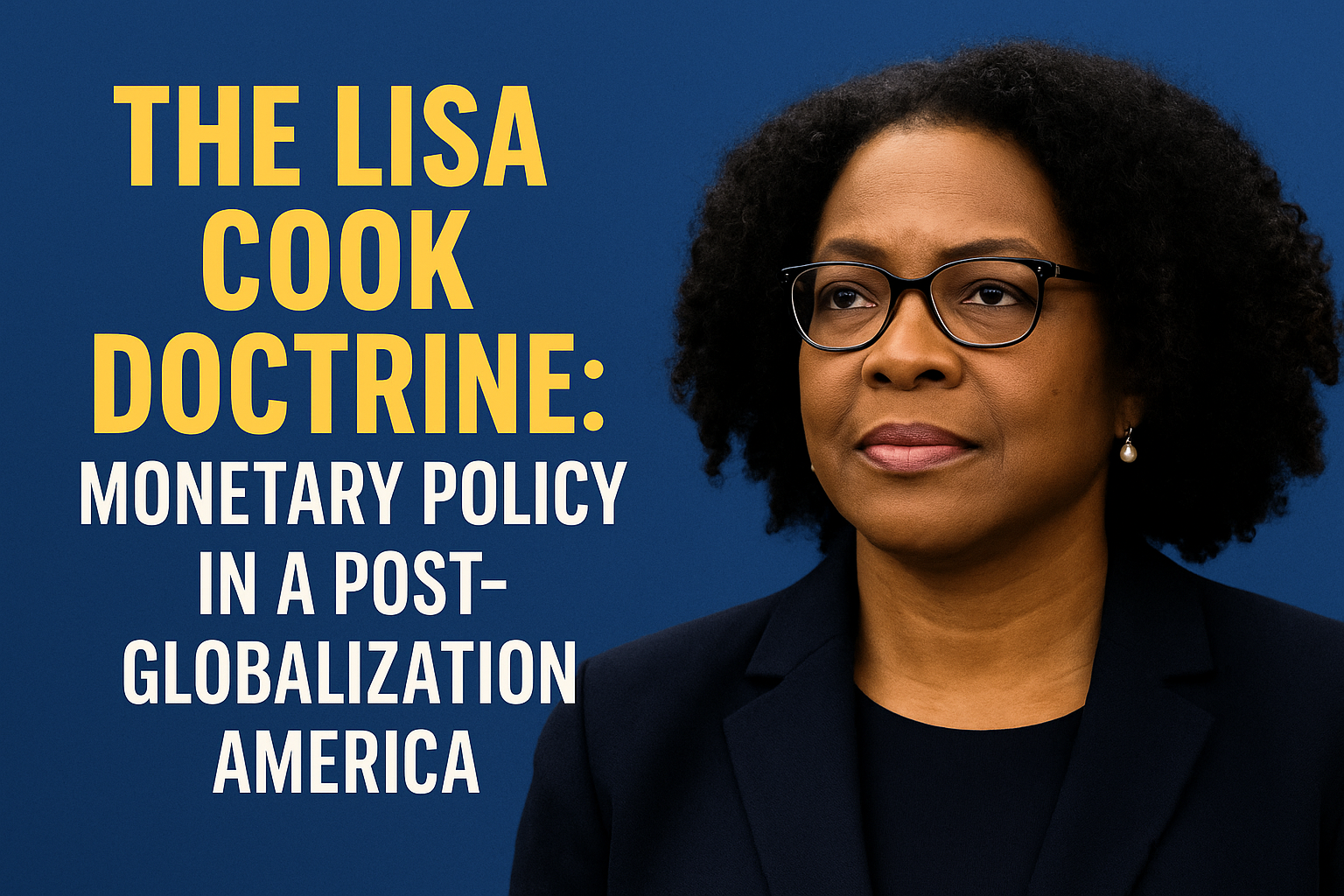
The latest calls for Federal Reserve Governor Lisa D. Cook to resign reveal less about her alleged financial entanglements and more about the precarious place of African American excellence in America’s institutional hierarchy. Cook, an alum of Spelman College—the jewel of the Atlanta University Center—sits as the only Historically Black College and University graduate in the Federal Reserve’s history. Her very presence at the central bank represents a seismic shift in the composition of economic policymaking. It also explains why she has become a lightning rod for partisan attacks.
On August 20, 2025, Donald Trump posted on Truth Social: “Cook must resign, now!!!!” The demand followed remarks from Bill Pulte, the Trump-appointed Director of the Federal Housing Finance Agency, who urged the Department of Justice to probe Cook’s role in allegedly questionable mortgages. What might otherwise be dismissed as yet another skirmish in Washington’s perpetual political warfare assumes broader significance when one considers who Cook is, what she represents, and what she symbolizes to African American institutions.
Lisa Cook’s rise to the Federal Reserve Board of Governors in May 2022 marked a watershed moment. For over a century, the Fed had been populated by a homogenous cadre of policymakers—almost exclusively White men with Ivy League or equivalent pedigrees. Cook, a Black woman educated at Spelman College, Oxford, and the University of California, Berkeley, carved a path through both racial and gendered barriers that have long defined the economics profession. Her scholarship is well known in academic circles: her pioneering work on the relationship between racial violence and African American innovation remains a cornerstone of economic history. By quantifying how lynching and Jim Crow violence curtailed patent activity by African Americans, she exposed a structural mechanism by which systemic racism suppressed not just Black lives but also Black wealth creation. At the Fed, she carried this analytical rigor into debates on labor markets, innovation, and most recently, the economic implications of artificial intelligence. For African America, her appointment was not just symbolic. It was strategic. HBCU graduates have long been overrepresented in producing the nation’s Black professionals—doctors, lawyers, judges, engineers. But in macroeconomic governance, their footprint has been virtually nonexistent. Cook’s ascension offered a foothold in one of the world’s most powerful institutions, where decisions reverberate across global markets, shape credit availability, and indirectly determine whether African American households can access affordable mortgages, student loans, and capital for small businesses.
The ferocity of the attacks against Cook cannot be divorced from her identity. The allegations hinge on supposed mortgage irregularities, amplified by Pulte and weaponized by Trump. Yet, even before these accusations, Cook faced resistance. Her Senate confirmation was one of the narrowest in Fed history, with Republicans uniformly opposed and some explicitly questioning her “fitness” for monetary policy on the grounds that her academic research leaned too heavily into racial economics. This rhetorical sleight-of-hand—dismissing racialized economic analysis as political—is a familiar tactic. It seeks to delegitimize the very work that challenges the dominant narrative. Cook’s critics often sidestep her publications in American Economic Review or her leadership within the American Economic Association, preferring instead to cast her as a “diversity appointment.” The current calls for her resignation escalate this narrative. To remove Cook under a cloud of controversy would not just eliminate a Fed governor. It would roll back the fragile gains of HBCU institutional representation in elite economic policymaking. It would signal, once again, that African American advancement is conditional, fragile, and always subject to reversal.
It is important to situate these attacks in a wider political economy. Trump’s demand is not only about Cook. It is about control of the Federal Reserve itself. The central bank has become increasingly politicized in recent years, with Republicans casting inflation and interest rate policy as partisan issues. To force out Cook would not only weaken President Biden’s appointees but also demoralize constituencies who view her as a critical voice for equity in macroeconomic policy. The Fed has traditionally projected itself as a technocratic, apolitical institution. Yet this veneer has cracked. Appointments are now battlefield contests. Cook’s vulnerability demonstrates that while America’s institutions have formally opened their doors to HBCU graduates, they have not yet fortified protections against political weaponization. This dynamic mirrors a historical pattern. African Americans who rise into positions of structural authority—whether judges, regulators, or corporate executives—often find themselves targets of disproportionate scrutiny. The goal is not merely to unseat them but to delegitimize the institutions that empowered them.
HBCUs stand uniquely implicated in this episode. Spelman College, Cook’s alma mater, is one of the leading producers of Black women in economics and STEM. Yet, despite their track record, HBCUs remain underfunded relative to predominantly White institutions. Cook’s ascent to the Fed was a triumph for the HBCU ecosystem, proof that institutional excellence could translate into influence at the very highest levels. That triumph is now under attack. If Cook were to resign or be forced out under pressure, it would reverberate across HBCUs. It would reinforce perceptions that HBCU alumni, even at their most accomplished, remain vulnerable to political takedowns. For African American students pursuing economics at Howard, Morehouse, or North Carolina A&T, the message would be chilling: success does not guarantee security. From an institutional development standpoint, the HBCU community must interpret this not as an isolated incident but as a case study in institutional fragility. Without strong networks of advocacy, media response, and financial backing, HBCU alumni who enter elite spaces will continue to stand exposed.
Cook’s potential ouster matters beyond symbolism. At a time when the Federal Reserve is grappling with questions of inflation persistence, labor market dynamics, and the disruptive potential of artificial intelligence, her perspective is invaluable. She has consistently foregrounded the idea that innovation is not distributed equally and that policy must account for structural barriers to participation. In her July 2025 speech at the National Bureau of Economic Research, Cook warned that generative AI could entrench inequality if its benefits accrued only to a narrow segment of firms and workers. This perspective matters because it forces the Fed to grapple with the distributional consequences of macroeconomic shifts, not just aggregate averages. Her departure would narrow the intellectual diversity of the Fed at precisely the moment it most needs heterodox insights.
What then must be the response of African American institutions—HBCUs, banks, think tanks, chambers of commerce? Silence cannot be an option. Cook’s defense should not be left to partisan politicians alone. Instead, a coordinated institutional defense is required, one that frames this attack not just as an assault on an individual but as an assault on African American institutional legitimacy. African American-owned banks could highlight the importance of a Fed governor who understands the structural barriers to credit access in Black communities. HBCU presidents could jointly issue statements defending the integrity of their alumna and reminding the public of their role in producing top-tier economists. Think tanks could produce rapid-response analyses showing the economic costs of underrepresentation in monetary policy. The lesson is clear: individual success must be buttressed by institutional power. Without that scaffolding, every Lisa Cook who rises will remain vulnerable to political storms.
Ultimately, the attack on Lisa Cook exemplifies America’s struggle with inclusion at the highest levels of institutional power. It is not enough to allow “firsts” to break through. True inclusion requires protecting them from disproportionate scrutiny, ensuring that they can govern with the same presumption of competence afforded to their peers. For African America, Cook’s ordeal is a reminder that victories in representation must be consolidated by institutional strategy. HBCUs cannot rest on symbolic triumphs; they must translate them into sustained influence, advocacy, and resilience. Otherwise, every gain risks being undone at the first sign of political backlash.
Lisa D. Cook stands at a crossroads. Her presence at the Federal Reserve is not simply about her credentials, which are unimpeachable. It is about what she represents: the intellectual capacity of HBCUs, the resilience of African American scholarship, and the potential for inclusive economic governance. The calls for her resignation are not neutral. They are part of a larger contest over who gets to shape America’s financial architecture. If African American institutions fail to rally, Cook may become another cautionary tale of progress reversed. But if they respond with clarity and force, this moment could mark the beginning of a new era—one in which HBCU alumni are not just present in elite institutions but are protected by a scaffolding of institutional power equal to the challenges they face. Her fate, in many ways, is a referendum on whether African America can defend its foothold in the commanding heights of global economic governance.
Disclaimer: This article was assisted by ChatGPT.
 HBCU Money