“Wealth is created in ownership. If you don’t own, you’re always at someone else’s mercy.” – Robert F. Smith
June 2025’s record-shattering $10 billion sale of the Los Angeles Lakers to Guggenheim Partners chief Mark Walter confirmed what many already suspected: franchise values are rocketing into the financial stratosphere. Yet the deal also spotlighted a harsher truth. After nearly a half-century of hard-court brilliance and gridiron dominance, African Americans are still largely locked out of true ownership power. This article examines why—tracing the structural barriers that keep Black wealth on the playing field instead of in the owner’s suite, and outlining the institutional reforms needed to change the score.
From the Field to the Boardroom: Still a One-Way Street
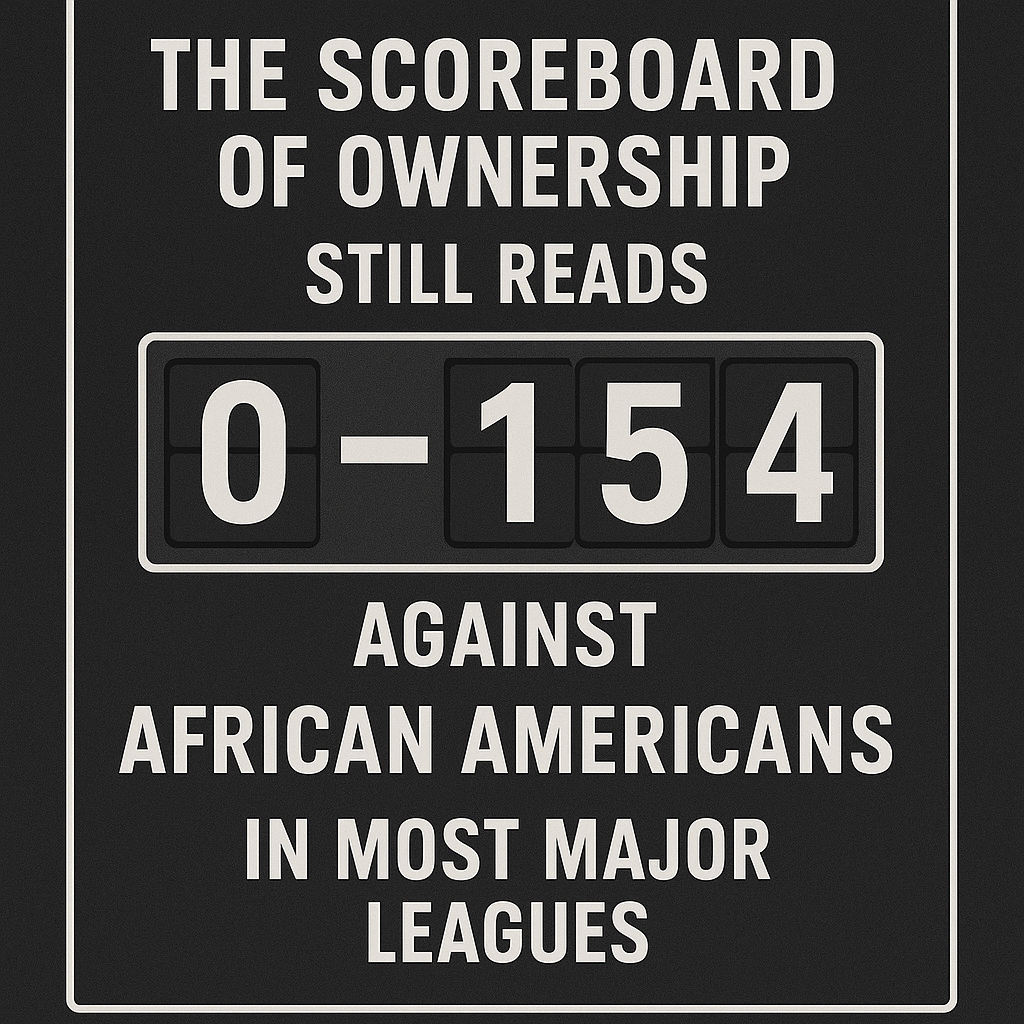
African Americans make up roughly 70–75 percent of NBA players and about 60–65 percent of NFL rosters. In the WNBA, the share is even higher. Yet across 154 combined franchises in the NBA, NFL, MLB, and NHL:
Zero teams are majority-owned by African Americans in the NFL, MLB, or NHL.
Only one historic example (Robert L. Johnson’s Charlotte Bobcats/Hornets) and one recent example (Michael Jordan, 2010–2023) exist in the NBA.
Three forces keep that door shut:
Intergenerational-Wealth Deficit – Most Black athletes are first-generation millionaires, while many current owners are third- or fourth-generation billionaires.
Limited Collective Capital Vehicles – Black-controlled banks and investment firms are few and undercapitalized relative to mainstream counterparts.
Opaque League Gatekeeping – Franchise valuations above $4 billion and insider-driven vetting processes deter new entrants without deep networks.
The Robert L. Johnson Breakthrough—And the Mirage of Progress
On December 18, 2002, BET founder Robert L. Johnson secured the NBA’s Charlotte expansion franchise for $300 million, becoming the first African American majority owner of a modern U.S. pro team. The milestone was historic, but it proved fragile. Lacking a pipeline of Black institutional capital—no HBCU endowment co-investors, no African American businesses or firms operating as minority owners—Johnson operated alone. By 2010 he sold controlling interest to Michael Jordan, whose own 2023 exit returned the league to its status quo: African American talent on the court, minimal African American equity off it. Symbolic breakthroughs absent institutional follow-through do not create sustainable inclusion.
The LeBron Conundrum: Cultural Power Without Governance Leverage
Billion-dollar athlete-entrepreneur LeBron James epitomizes the new Black business titan—owning film studios, apparel lines, and minority stakes in Fenway Sports Group. Yet even LeBron, arguably the most financially astute athlete of his generation, cannot write a solo check for a majority share of an NBA or NFL team. Average franchise prices now exceed $4 billion in the NBA and $6.5 billion in the NFL.
LeBron’s estimated net worth, while staggering at $1.2 billion, pales in comparison to the financial firepower wielded by new Lakers controlling owner Mark Walter, who is worth an estimated $5.5 to $6 billion personally—and controls access to far greater institutional capital. As CEO of Guggenheim Partners, Walter leads a global financial firm with over $345 billion in assets under management (AUM), according to the firm’s own reporting.
That institutional reach gives Walter an unparalleled advantage: the ability to deploy capital at scale, with leverage, and over long time horizons. His 2012 acquisition of the Los Angeles Dodgers for $2 billion was just the beginning. Now, his control over the Lakers reflects how ownership is secured not by personal wealth alone—but by deep institutional infrastructure.
The gap is not merely one of celebrity or business acumen—it is one of capital architecture. LeBron’s wealth is largely rooted in earned income and venture-backed enterprises, while Walter’s access to Guggenheim’s multi-hundred-billion-dollar asset base enables him to execute major acquisitions swiftly and without co-investors.
Until African Americans gain collective control of similar institutional investment vehicles—through private equity firms, pension-managed funds, or bank-led syndicates—Black excellence in sports will continue to be celebrated on the court, but denied authority in the boardroom.
Building a Syndicate That Can Actually Write a Check
If African Americans are to move from the highlight reel to the cap table, the capital stack must shift from aspirational community pooling to institutional syndication—driven by organizations already designed to deploy large checks and assume complex risk. Pragmatism, not idealism, is the order of the day.
Capital Source
Asset Base
Realistic Deployment Rationale
Black-Owned Banks (18 nationwide)
$6.4 billion in assets
FDIC-insured balance sheets, access to low-cost deposits—including the growing wave of Fortune 500 “diversity deposits”—can underwrite debt facilities or pledge Tier 1 capital to a buyout fund.
Black Investment & Private-Equity Firms (e.g., Ariel, Vista, Fairview, RLJ)
$70–90 billion AUM (collectively)
Deep GP/LP relationships with public pensions and foundations; experienced at assembling $100–$500 million special-purpose vehicles (SPVs) around a single asset.
HBCU Endowments (102 institutions)
≈ $5 billion total
Ask for 0.5–1 percent commitments per school—$25–50 million system-wide—providing research access, internships, and brand equity rather than acting as anchors.
Athlete Sidecar Fund
Variable
Structure a managed feeder that lets players co-invest passively (no tithes or self-directing). Capital is professionally deployed—removing behavioral risk.
Corporate & Public Pensions
Trillions
Many plans reserve 5–10 percent for “emerging managers.” A Black-led sports-ownership PE fund fits this mandate.
1. Banks as Capital Bridges Black-owned banks can’t buy teams outright, but they can warehouse capital and extend critical financial infrastructure. By leveraging corporate “diversity deposits” and issuing credit facilities, they can become crucial intermediaries that keep transaction fees and governance influence in Black hands.
2. Investment Firms as Syndicate Architects Black-led PE firms already understand the terrain. By structuring a flagship $400–$600 million sports-focused fund, they can attract institutional LPs and scale their acquisitions from minority WNBA stakes to majority control in emerging or undervalued leagues.
3. HBCUs as Modest Strategic LPs HBCUs should not be burdened with anchoring such funds. Instead, they can contribute symbolic capital, student talent pipelines, and academic value. For example, a 1 percent commitment from Howard or Spelman tied to naming rights or internship guarantees would align mission with opportunity.
4. Athletes & African American Families as Co-Investors, Not Donors A feeder fund with low buy-ins and lock-up periods allows them to invest with institutional support. This protects them from high-risk self-management and ensures alignment with professional fund managers.
5. Execution Timeline
2026–2028: Assemble GP team, secure $150 million from banks and PE partners, with layered support from HBCUs and athlete and African American businesses co-investors.
2028–2032: Close a $500 million Fund I and acquire equity in two WNBA teams and a controlling NWSL stake bundled with real estate.
2032–2037: Launch Fund II at $1 billion, targeting a controlling interest in an MLS or NBA franchise.
2040: Own a major-league asset with governance representation from African American banks, investment firms, and HBCU partners—creating long-term cash flows and intergenerational wealth held by Black institutions.
Media Rights and the Power Gap
Owning teams is only half the battle. The NBA’s next domestic media deal could top $75 billion, and yet no Black-owned network will participate directly in those revenues. Streaming platforms, RSNs, data-analytics firms, and betting partnerships—all profit off Black athletic performance. Until African American institutions enter the media-rights supply chain, the revenue fountainhead remains out of reach.
Cultural Iconography, Financial Dispossession
Hip-hop tracks blare in arenas, sneaker culture drives merchandise sales, and social-media highlights fuel league engagement—but licensing profits flow to predominantly white ownership groups. Careers end; ownership dynasties do not. The average NFL tenure is 3.3 years; Robert Kraft has owned the Patriots for 31 years. Equity compounds; salaries evaporate.
From the Boardroom, Not the Ball Court: Where Owners Really Make Their Money
A glaring misconception is that sports fortunes begin with sports talent. In practice, franchise control stems from non-sports industries:
Owner
Team(s)
Primary Wealth Source
Steve Ballmer
LA Clippers
Microsoft stock
Stan Kroenke
Rams, Nuggets, Arsenal
Real estate / Walmart marital fortune
Robert Kraft
Patriots
Paper & packaging
Mark Cuban
Mavericks
Broadcast.com tech exit
Joe Tsai
Nets, Liberty
Alibaba IPO
Josh Harris
Commanders, 76ers
Apollo Global Mgmt. (private equity)
None earned money playing pro sports; all deployed patient, appreciating, often tax-advantaged capital to buy franchises. In contrast, athlete income is earned, highly taxed, and front-loaded. A $200 million NBA contract, after taxes, agents, and lifestyle inflation, seldom equals the liquidity needed for a $6 billion NFL acquisition.
African Americans dominate labor yet rely on labor income to pursue ownership—an uphill climb when the ownership class uses diversified portfolios, inheritance, and leverage. The gap is not just financial; it’s structural.
A Blueprint Forward
African American banks, PE firms, and institutional investors must build syndicates that mirror the strategies of the existing ownership class—while rooting the returns inside Black institutions.
2026–2030 – Launch a $500 million Fund I with contributions from banks, investment firms, HBCUs, and athletes.
2030–2035 – Acquire multiple minority and controlling stakes in undervalued leagues.
2035–2045 – Expand into media-rights, merchandising, and facilities ownership.
2045–2050 – Control a major-league asset and use it to empower future generations via scholarships, pensions, research grants, and equity reinvestment.
Owning the Game—or Owning What Funds the Game?
The persistent call for African American ownership in major league sports raises a deeper question: Should African Americans even prioritize owning sports franchises, when we remain almost entirely absent from the very industries—technology, finance, energy, real estate—that generate the wealth used to buy these teams in the first place?
Mark Walter didn’t become the Lakers’ majority owner through basketball. He did it through Guggenheim Partners—a financial firm managing $345 billion in assets. Steve Ballmer bought the Clippers not from years of courtside ambition, but from cashing out Microsoft stock. Owners dominate sports not because of athletic brilliance, but because they own pipelines, patents, trading desks, and land—the assets that make sports ownership a byproduct, not a goal.
For African Americans, the concern isn’t just that they don’t own the team. It’s that they don’t own the banks that financed the team, the media companies that broadcast the games, or the tech platforms monetizing fan engagement. It is a misallocation of focus to aim for the outcome—sports ownership—without first entering the industries that produce ownership-level capital.
There’s no harm in wanting a seat in the owner’s box. But the more strategic question is: why not aim to own the entire ecosystem? The scoreboard. The stadium real estate. The ticketing software. The AI that tracks player stats. The advertising networks.
Athletes made sports cool. Billionaires made sports profitable. African America must ask whether it wants symbolic entry into an elite club—or whether it wants to control the industries that fund the club.
The real power isn’t just in the arena. It’s in what surrounds it. And until African Americans own those arenas—of finance, data, infrastructure, and media—they will always be positioned to play the game, but not define it.
Final Whistle
The scoreboard of ownership still reads 0-154 against African Americans in most major leagues. Talent fills highlight reels; equity fills trust funds. The route to flipping that score will not be paved by bigger contracts or more MVP trophies. It will be built through African American banks mobilizing capital, investment firms leading syndicates, and HBCU institutions gaining board seats—not just honorary jerseys.
Athletes have inspired generations. Now, institutions must finance generations.
The next dynasty to celebrate should not just hoist a trophy—it should hold a deed.
The saddest thing in life is wasted talent. – Lorenzo Anello
Somewhere in an alternative universe a call goes out over the hospital intercom, “Paging Dr. James! Dr. James to operating room, please.” Into the operating room walks a 6’8 250 pound surgeon African American man who smiles at his surgical team, but sternly ask, “Has the patient been prepped?” The staff acknowledges to the doctor the patient has and thus the operation begins. For the next few hours it is a battle of skill, touch, and finesse. With nerves of steel it all comes down to a final cut. The doctor steps back, takes a deep breath, and goes in for the final incision. Success! The patient is responding better than expected and the surgeon leaves the room to debrief the family. As he speaks with the family cheers and tears of rejoicing come from the crowd of family and friends gathered.
There are currently 5,005 and 1,015 African American males on college football and basketball Division 1 rosters on any given year, respectively. That means every year over 6,000 African American males believe either in the coming year or in a few years they will be eligible to become a professional athlete. The NCAA itself reports that only 1.7 percent of college football players will go on to play professionally and 1.2 percent of college basketball players will go to the NBA, respectively. That means that in any given year out of those 6,000 plus athletes, less than 100 will actually go pro. However, speaking with an ambassador at a local Division 1 program with around 100 players on their football roster just how many of his players believe they can go pro – he said at least half. Inquiring further how many really have a chance and he said maybe two. How can there be such a gulf between those two viewpoints? Warren Goldstein’s examination of William Rhoden’s book $40 Million Dollar Slaves offers us some insight, “Consequently, most black athletes lost their connection to a “sense of mission . . . of being part of a larger cause. Young athletes, in particular, dropped the thread that joins them to that struggle and became, instead, a “lost tribe,” adrift in the world of white coaches, boosters, agents, club officials, network executives — those profiting from black muscle and skill.”
African America is desperately in need of more doctors. The Agency for Healthcare Research and Quality reports there are 209,000 primary care physicians in the United States, but only 3.9 percent of that number are African American or a pinch over 8,000. An article in the Philadelphia Tribune reports, “Studies also indicate that when minority patients can select a health care professional, they are more likely to choose someone of their own racial and ethnic background.” That means at current, there is 1 African American physician for every 4,938 African Americans, but the nation as a whole has 1 physician for every 1,435 citizens in the United States. In order for African American to reach the national average, there would need to be an increase in the number of African American physicians by over 300 percent. The state of African American males in the medical field is even more acute according to the Journal of Blacks in Higher Education who recently reported, “A new report from the Association of American Medical Colleges (AAMC) finds that the number of Black males who are applying to medical school has not increased since 1978. In 1978, 1,410 Black males applied to U.S. medical schools. In 2014, the figure was 1,337. In 1978, 542 Black men matriculated at U.S. medical schools, compared to 515 in 2014.”
Unfortunately, basketball and football often detour thousands of African American males (those who do manage to escape prison) from childhood where they are warped early with promises of fame and riches with even the slightest hint of athleticism. This is not to say sports can not be a valuable part of a boys’ upbringing, but we have made it their central and primary focal point. With only 2,000 available slots to fill out all NFL and NBA rosters and even with turnover the odds of these young men finding their way onto one is virtually null. However, primary care physicians and dentist comprise 350 000 positions in the country combined and unlike athletics which is not expanding its rosters or number of teams, there is actually a growing demand for more doctors and dentist in the country. As for the pay, pro-rated until age 65, an NFL player makes a median salary of $34,200 and a NBA players makes a median salary of $144,000, while a primary care physician’s median salary is $220,000. And the economic cost to the community because of the physician shortage is $4.4 billion annually in just lost opportunity wages alone. Not including the lost wages our community suffers due to illness and poor access to primary physicians. Health is wealth takes on whole new meanings.
And it is not just the medical field that is suffering from this brain dumbing (drain). At a time when there is an acute need for Civil Rights lawyers’ in African America along with entrepreneurs, farmers, technologist, psychologist, and even those who can fill a myriad of new green vocational and professional jobs on the horizon, we are ghastly underrepresented in matters of the mind and overrepresented in matters of the body. Claims that the K-12 system fails these young boys would be correct, but then again so do the parents who are largely force their sons down these paths as they too believe it is the only option. 247Sports reports, “For the typical (AAU) program that is traveling to two national tournaments and one regional tournaments the costs end up being (approximately) $1,500-$2,000 per player.” Imagine if you will though that same $1,500-$2,000 per player being spent was on supplemental education for the boys in academic development. The current public elementary and secondary spending per student in the United States is $12,401. The use of the amount spent on them traveling alone if diverted to the aforementioned supplemental education would be an increase of 12 to 16 percent in the value of the education they receive annually and may have a significant impact on increasing the abysmal high school graduation rate for African American males which is currently 59 percent. We may not have an abundance of resources, but there needs to be a discussion and critique of how we are using what we have.
The repercussions of the dumbing down of African American males is already being felt through the social fabric of our communities. African America is the only ethnicity where females outnumber males in employment. This has consequences as it relates to marriage, crime, and a host of other social issues, but we are not paying attention to the damage we are doing to our boys often until it is too late. We are hypnotized by the LeBron Jameses as being the rule for our boys instead of realizing the exception. That most of these young men with athletic aspirations will never see a professional athlete’s paycheck and if they do the career’s are often short and communal impact is zero. We can kid ourselves into thinking that these athletes bring something to our community of value, but it is just entertainment and disillusioned opportunity. Nothing more and nothing less. Meanwhile, what happens to the thousands who do not make it, who lack the skills to do anything meaningful and substantive, to become a valuable asset to the social, economic, and political fabric of the building of African America. They fall by the wayside and we pay the brutal cost as a people, but are we not entertained?
For the same amount of money we dedicate to Pop Warner athletics, if we just took half of it and put it toward “Pop Warner” academics, STEM camps, chess clubs, and other initiatives that made little black boys feel that we value their minds just as much as their bodies we would see a paradigm shift in a generation. We lay so much blame on “others” for what is happening to our boys and take very little ownership or onus on ourselves for what is happening to them. Pimping them out for decades of their life with the hope of lottery style “winnings” instead of sustainable life and community development, then look perplexed when they and our communities lack the basic infrastructure to become viable. A wise man once said never put your destiny in the hands of others, yet we continue to do so at the expense of these young boys. We maybe entertained, but we are certainly not fulfilled.
The top ten earning African Americans earned approximately $700 million last year. It should be noted that these are pre-tax and pre-fee earnings. Because the majority of African America’s highest earners still earn their money through sports and entertainment their earnings are considered earned income by IRS definition and taxed at the highest tax rate which this year is almost 40 percent. Couple that with their agent fees (byproduct of being in the entertainment industry is a need for endless amounts of handlers) that average in the range of 10 percent, the group of ten will pay out almost 50 percent of their earnings. Chris Rock is famously quoted as saying “Shaq is rich, the white man who signs his check….is wealthy.” The income disparity between the top ten earning African Americans and European Americans is a staggering $0.07 for every $1.00 while the overall income gap between African Americans is $0.52 and $0.62 versus Asian Americans and European Americans, respectively.
1 – Oprah Winfrey
Salary: $165 million
Source: Ms. Winfrey owns Harpo, Inc. which owns 50 percent of OWN. OWN which has operated in the red since its inception is estimated to break even this fiscal year. Thankfully, Ms. Winfrey still profits greatly from syndicated shows under her company such as Dr. Phil and others.
2 – Andre Young
Salary: $110 million
Source: Better known as Dr. Dre, his place as the number two spot is due to a one-off moment where HTC paid $300 million for a majority stake in the company that operates the headphones that carry his name Beats By Dr. Dre. Mr. Young owned one-third of the company at the time of the sale.


 HBCU Money