Tag Archives: HBCU financial independence

When Intel Leaves: Endowments, NCCU, and the $2.5 Billion NBA Paradox

“I know I got it made while the masses of black people are catchin’ hell, but as long as they ain’t free, I ain’t free.” – Muhammad Ali
The recent news that Intel will discontinue its $1 million annual funding of North Carolina Central University’s (NCCU) Technology Law and Policy Center is more than just a line item in the university’s budget. It is a sharp reminder of how precarious institutional development becomes when African American colleges and universities rely on the European American corporate cycle of generosity and withdrawal. Where is African American corporate philanthropy is a pertinent question, but an article for another day.

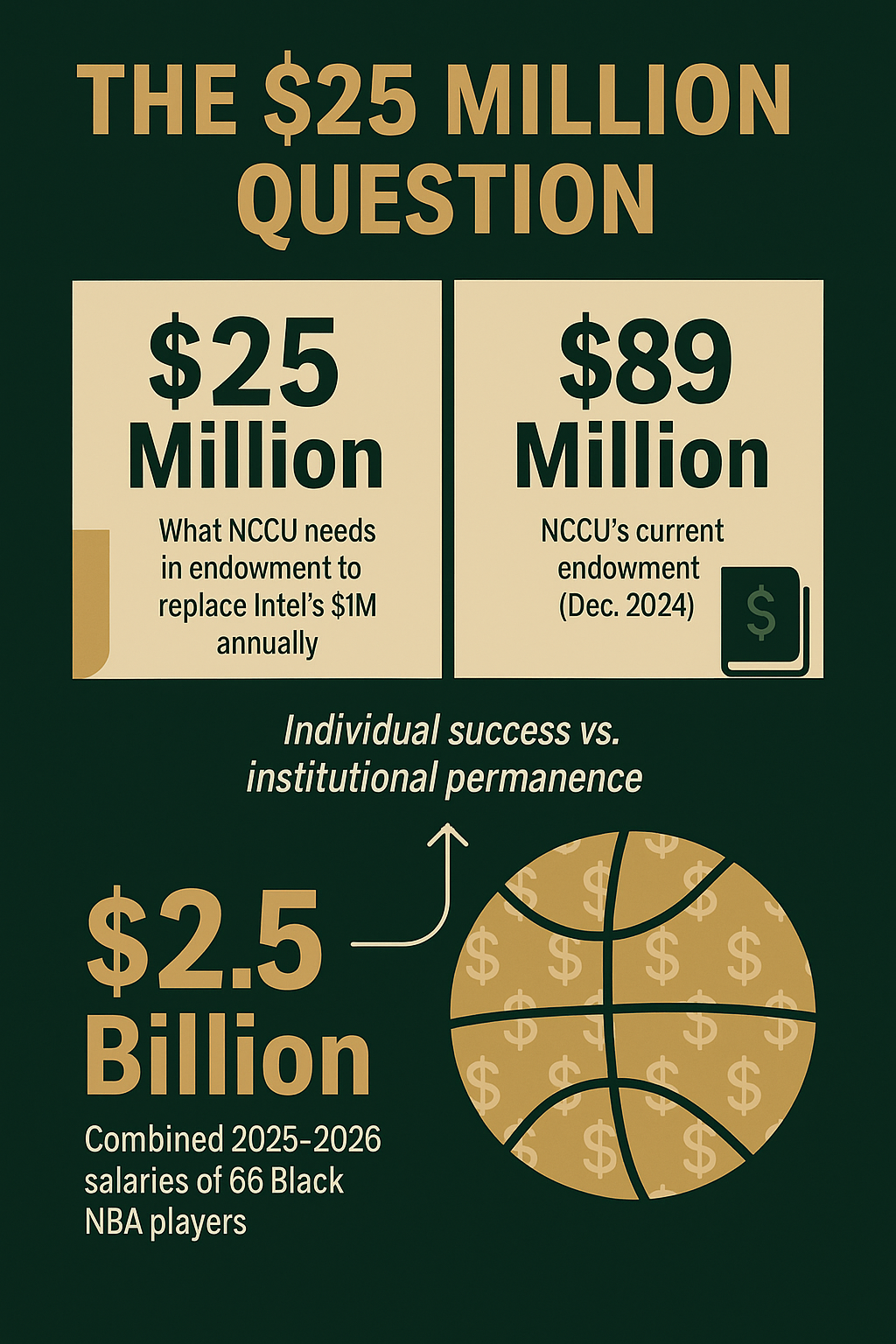
Intel’s departure leaves a gap that must now be filled through other means. But the mathematics of filling it points to a broader truth: without substantial, permanent endowments, HBCUs will remain vulnerable to the political and financial whims of European American corporations. To replace $1 million in annual program funding, NCCU would need to raise between $20 million and $25 million in endowment principal assuming a 4–5% annual spending rate, the standard in higher education finance.

The fact that an entire academic pipeline, designed to produce future African American lawyers and policymakers, can be destabilized by a single corporate decision underscores the fragility of HBCU institutional power. And it raises a haunting contrast: while 66 African American NBA players will together earn $2.5 billion in salaries this upcoming season, not a single African American university controls an endowment robust enough to insulate it from the kind of disruption Intel’s withdrawal has now caused.

The mechanics are straightforward. Endowments work by pooling donated capital, investing it, and spending a sustainable portion of annual returns—usually 4–5%. To replace Intel’s $1 million annual gift, NCCU must therefore build an endowment of $20–25 million. This is not extraordinary by university standards. At most predominantly white institutions (PWIs), a $25 million endowment is considered modest. At Harvard, Yale, or Stanford, it would not even make the footnotes. Yet for NCCU, an institution with an endowment of $89 million as of December 2024, the sudden need for another $20–25 million underscores the gap between HBCUs and their white peers.

The underlying truth is that corporate funding is inherently unstable. It ebbs and flows with market cycles, political administrations, and corporate priorities. Endowments, however, endure across generations. The very act of raising such capital is itself an exercise in institutional power: it demonstrates to the world that the university and its community can stand on their own financial feet.

Intel did not single out NCCU maliciously. The company is undergoing a profound transformation, not least because the U.S. government has become its largest shareholder after a multi-billion-dollar deal with the Trump administration. Like other firms facing political scrutiny, Intel is quietly shedding high-profile DEI commitments. For NCCU, however, the effect is real. The Technology Law and Policy Center was designed to provide African American law students with training in emerging technology and policy—a space historically closed to Black lawyers. It also featured internships at Intel, summer placements, and the now-defunct “Intel Rule,” which required outside law firms to staff diverse teams if they wanted Intel’s business. Now, without a replacement funding mechanism, the Center risks contraction. Students will still enroll. Faculty will still teach. But the acceleration that Intel’s money provided—the ability to recruit nationally, to build cutting-edge programming, to give students exposure to high-tech legal practice—will slow.

Enter the paradox of the NBA’s 66 Black players earning $25 million or more in the upcoming season. Collectively, those 66 players will earn $2.5 billion in salary during the 2025–2026 season. Each of these players individually makes at least what NCCU would need to permanently replace Intel’s $1 million annual commitment through endowment. The collective sum is staggering: $2.5 billion in one season—enough to seed $25 million endowments at 100 HBCUs.

It is not about individual responsibility. No one player can be expected to save an institution. But collectively, the paradox points to the imbalance between African American individual wealth and African American institutional poverty. Even if just 10% of that wealth—$250 million—were organized and directed into HBCU endowments, the result could replace Intel’s contribution not only at NCCU but across multiple campuses. Yet there is no mechanism, no institutional strategy, no coordinated pipeline that directs such flows into African American universities. This is not new. For decades, African American excellence has been harvested at the level of the individual, while African American institutions have remained underfunded. The NBA is simply the latest, most visible example.

The Intel withdrawal reminds us of a hard truth: reliance on outside benevolence is not a strategy for power. It is, at best, a strategy for survival. Corporate giving is always the first budget item to shrink when recession looms or political winds shift. For HBCUs, this means programs rise and fall on decisions made in Silicon Valley or Wall Street boardrooms—far removed from Durham, Tallahassee, Baton Rouge, or Montgomery. The vulnerability is compounded when African American communities assume that the generosity of corporations will substitute for building our own endowments. The danger is not simply financial but cultural: it conditions us to believe that power comes from outside, not from within.

Intel’s $1 million a year was not charity—it was investment. It bought Intel goodwill, a trained pipeline of diverse lawyers, and reputational capital in the DEI era. Now that DEI is politically unpopular, the investment is deemed expendable. This is why endowments matter. They are not subject to the quarterly report or the election cycle. They anchor institutions in the long term.

Let’s be clear about the scale of the challenge. The combined endowments of all HBCUs hover around $4 billion, compared to more than $800 billion at PWIs. Harvard alone has an endowment of nearly $52 billion. NCCU’s endowment stands at $89 million. To raise an additional $20–25 million to replace Intel’s support would represent a 22–28% increase in its current endowment base. Such a leap is achievable—but it requires strategy. It means cultivating alumni giving systematically. It means leveraging African American wealth beyond alumni, drawing in professional athletes, entertainers, and entrepreneurs. It means creating vehicles—donor-advised funds, pooled endowments, institutional investment cooperatives—that make giving both efficient and impactful. Most of all, it means shifting mindset. We must stop thinking of endowments as luxuries reserved for Ivy League institutions. They are necessities. They are the only way to secure institutional independence.

The Intel decision can serve as a turning point, if we are willing to see it clearly. Corporations are not institutional guardians. They may play a role, but they will not underwrite our survival. Their goals are their own. When interests diverge, as they now have, funding vanishes. Individual wealth must be institutionalized. The contrast between NBA salaries and HBCU endowment poverty is not about shaming athletes. It is about building structures that make institutional giving the default, not the exception. Endowments are the only safety net. No government program, no corporate sponsorship, no philanthropic fad can substitute. Only endowments give institutions perpetual capacity to fund themselves.

What would it take, concretely, for NCCU to raise the $25 million needed? A handful of major gifts in the $2–5 million range from alumni, athletes, or African American business leaders could jump-start the campaign. NBA, NFL, and WNBA players could be recruited to create a pooled fund. Instead of individual gifts, imagine a collective “Athletes for HBCU Endowments” initiative. African American foundations and community funds could direct grants toward seed capital, matched by alumni. If every NCCU law graduate gave $1,000 a year for ten years, the cumulative effect would approach the tens of millions. NCCU could also partner with African American-owned banks and investment firms to maximize returns and circulate dollars within the community. The strategy would not only replace Intel but set a precedent: when outside money leaves, we do not shrink. We build.

The broader question is not whether NCCU will survive the loss of Intel’s support. It will. The real question is whether African American institutions will continue to live in the shadow of dependency—or whether we will use moments like this to chart a new course. The paradox of $2.5 billion in NBA salaries versus the need for a $25 million endowment is not just a rhetorical flourish. It is a mirror held up to African America. It asks whether we will continue to celebrate individual wealth while neglecting collective survival.

Every dollar of Intel’s withdrawal can be replaced. But only if African American wealth is organized. Only if alumni, athletes, and entrepreneurs see endowments not as gifts but as obligations. Only if we remember that the true measure of power is not what any one of us earns, but what we can build together.

Intel has reminded us of an uncomfortable truth: corporate giving is temporary. Endowments are permanent. To replace $1 million a year, NCCU needs $25 million in endowment. That number is not insurmountable. It is the equivalent of one NBA salary in a single season. There are 66 African American players earning at least that much this year alone, with combined salaries of $2.5 billion. The juxtaposition is stark: individuals flourish while institutions starve. The future of HBCUs—and the broader African American ecosystem—depends on closing that gap. Until African America learns to institutionalize its wealth, every Intel withdrawal will feel like a crisis. But the day we build our endowments, such exits will be footnotes. And our institutions will finally stand on the firm ground they have always deserved.

Disclaimer: This article was assisted by ChatGPT.

While Howard Is Chasing Harvard, What Public HBCUs Are Chasing UTIMCO?

“I make no apology for the love of competition.” – John Harbaugh

In the world of higher education finance, few numbers turn heads quite like endowment size. It is the ultimate scoreboard for institutional power—a metric that signals not only a university’s wealth but also its capacity to shape research, drive innovation, support students, and influence national policy. In this rarefied air, Howard University has made history, becoming the first Historically Black College or University (HBCU) to surpass the $1 billion endowment mark. According to HBCU Money’s 2024 rankings, Howard’s endowment now stands at $1.03 billion.

Spelman College, long regarded as Howard’s fiercest private competitor, received a record-setting $100 million donation in 2023. Yet even with that windfall, its endowment reached $506.7 million—leaving it more than $500 million behind Howard. Nevertheless, Spelman’s donor base remains one of the strongest in Black higher education, and it may still overtake Howard in the race to $2 billion. But the $1 billion baton has already been passed.

If Howard is chasing Harvard, and Spelman is setting its sights on Yale, then who among public HBCUs dares to chase the Goliath of public university endowments—UTIMCO?

The Silent Behemoth in Texas

UTIMCO—the University of Texas/Texas A&M Investment Management Company—is not just large; it is colossal. As of 2024, UTIMCO manages a staggering $64.3 billion in assets across the University of Texas and Texas A&M university systems. That figure is nearly $15 billion more than Harvard’s own endowment and more than three times the size of the second-largest public university endowment at the University of Michigan.

This financial empire is largely invisible to the public eye. Few outside of elite Texas financial and political circles are even aware of UTIMCO’s existence, let alone its scale. It quietly funds a wide spectrum of research, real estate development, and private equity plays that influence state and national agendas.

If an HBCU—or group of HBCUs—is ever to rival that level of public endowment control, it will not happen by accident. It must be built. And it will most likely be built collectively.

HBCUs and the Endowment Gap

The endowment disparity between HBCUs and Predominantly White Institutions (PWIs) has been well-documented. HBCUs represent around 3% of America’s colleges, yet account for less than 1% of total U.S. endowment wealth. According to a McKinsey report, HBCUs would need $12.5 billion in incremental funding to achieve endowment parity with similarly sized PWIs.

While private HBCUs like Howard and Spelman appear to be making some headway, public HBCUs remain largely behind. Most of them are tethered to state systems that have historically underfunded them and which rarely—if ever—extend the full benefits of their system-wide endowment strategies.

Consider the University of North Carolina System. It includes North Carolina A&T, the largest HBCU by enrollment, and North Carolina Central University. Yet both institutions have endowments under $200 million. Meanwhile, UNC Chapel Hill boasts an endowment exceeding $5.4 billion. Similarly, Florida A&M University has an endowment of less than $200 million, while the University of Florida’s soars above $2 billion.

The Case for a Public HBCU Endowment Challenger

In identifying a public HBCU capable of mounting a challenge to UTIMCO’s financial supremacy, the most promising strategy does not lie in the strength of one institution—but in the collective power of several. States that are home to multiple public HBCUs present the most viable path to establishing a unified, independently managed investment entity that can leverage scale, pooled capital, and institutional collaboration.

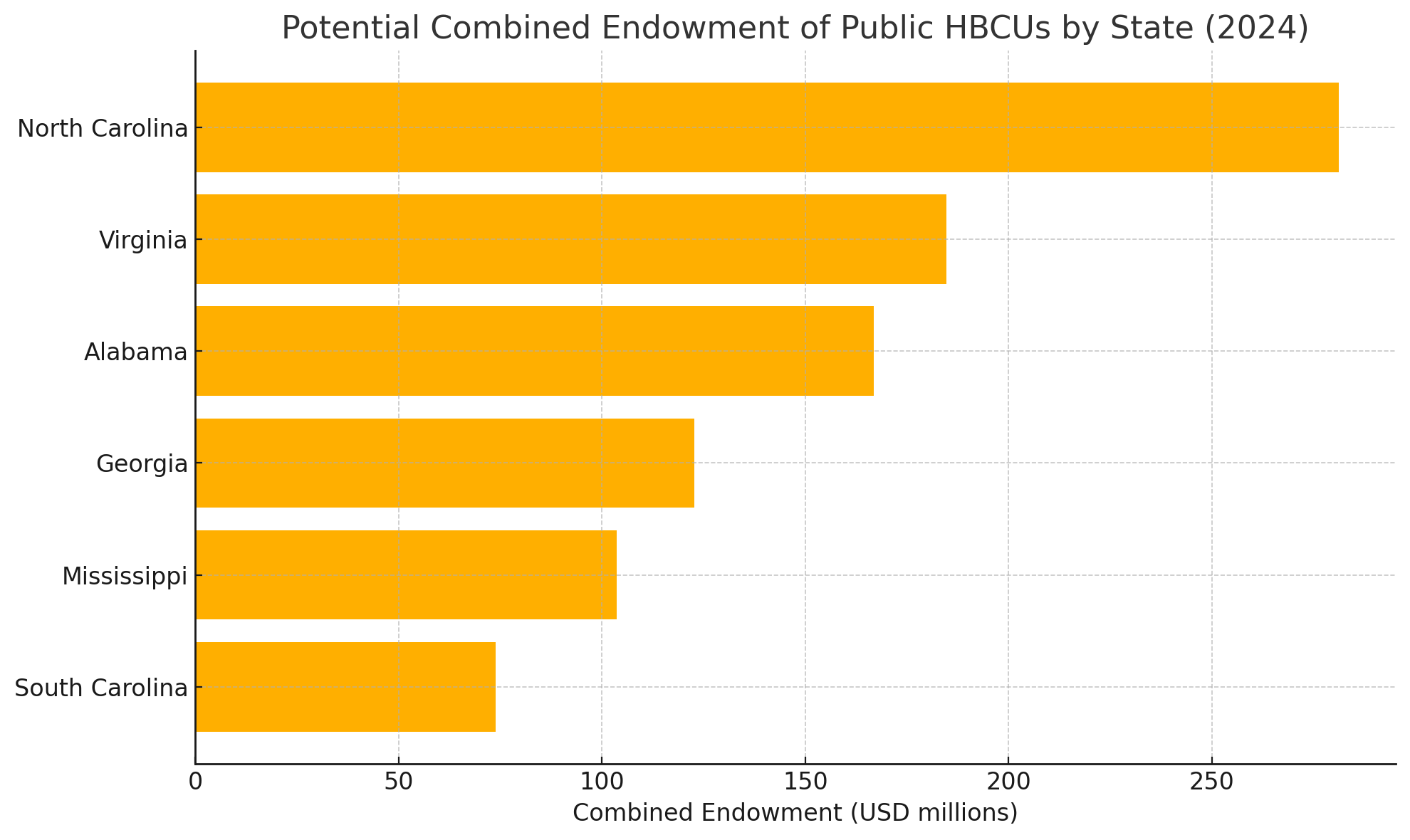
Virginia, Alabama, Georgia, North Carolina, South Carolina, and Mississippi all house two or more public HBCUs, each with proud legacies and strategic regional influence. A coordinated financial framework across these schools could form the foundation of a “Black UTIMCO”—a professionally managed, state-based consortium endowment capable of rivaling small PWI systems in both return and influence.

The most likely candidates must share a few key characteristics:

  1. State-Level Endowment Consortium Model – States with two or more public HBCUs, such as Virginia (Virginia State, Norfolk State), Georgia (Albany State, Fort Valley State, Savannah State), or Alabama (Alabama A&M, Alabama State), are uniquely positioned to pioneer a collective endowment strategy. Rather than relying on marginal support from broader university systems, these HBCUs could form a joint investment vehicle modeled on UTIMCO—pooling their endowments under a professionally managed, independent investment company. Such a fund would enable economies of scale, competitive asset management, and unified long-term planning, boosting their ability to generate investment alpha and philanthropic leverage.
  2. Flagship Status Among HBCUs – Institutions with strong alumni networks, national reputations, and federal research capabilities are better positioned to attract major philanthropy.
  3. Strategic Location – HBCUs located in fast-growing economic zones can leverage regional corporate ties for private partnerships.

However, creating such a financial architecture is not purely a technical endeavor. It is inherently political—and often fraught with social resistance.

The Political Geography of Resistance

Many of the states that host multiple public HBCUs are governed by conservative legislatures and state boards of regents that have long resisted equitable funding for Black institutions. Despite proclamations about diversity, equity, and inclusion, these power structures often withhold support from Black-led entities that could challenge traditional hierarchies.

  • Alabama, with Alabama State and Alabama A&M, underfunded its HBCUs by over $527 million between 1987 and 2020, according to the U.S. Department of Education.
  • Georgia’s consolidation of HBCUs like Albany State into broader system structures has often diluted their financial and governance autonomy.
  • Mississippi has repeatedly neglected basic infrastructure and funding needs at its three public HBCUs—Jackson State, Alcorn State, and Mississippi Valley State—despite allocating surpluses elsewhere. It is also no secret that Mississippi has purposely constructed a singular board of trustees for all of its public higher education institutions across the state with Ole Miss and Mississippi State unabashedly dominating the board.

Even in Virginia, perceived as more moderate, a move by Virginia State University and Norfolk State to pool their endowments might be seen as too bold a play in a state that still subtly resists Black institutional consolidation.

Social Impediments and Institutional Fragmentation

Beyond politics, there are intra-HBCU dynamics that complicate collaboration. These institutions have historically been forced to compete for scraps, which can breed a zero-sum mentality. Trustees, alumni, and administrations often prefer complete local control over modest assets rather than shared governance over substantial ones.

Convincing institutions to pool their endowments requires cultural alignment and a long-term vision of shared prosperity. Donors, too, may resist giving to multi-institutional funds, preferring the emotional appeal of a singular alma mater.

Nonetheless, this mindset must change. The math is clear: five public HBCUs each contributing $100 million can produce a $500 million investment base. That scale opens doors to private equity, hedge funds, and other vehicles that outperform the conservative allocations typically used by smaller institutional portfolios.

Institutions Poised for Leadership

  • North Carolina A&T State University, with an endowment of $201.9 million, remains the largest public HBCU endowment. With deep ties to tech and defense industries, it has both alumni momentum and industry leverage.
  • Florida A&M University, despite setbacks surrounding its pledged $237 million donation, has an official endowment of $124.1 million and stands to benefit immensely from partnership with institutions like Bethune-Cookman or Edward Waters.
  • Virginia State University and Norfolk State University, with $96.5 million and $88.2 million respectively, could combine to form the financial cornerstone of a Virginia HBCU Investment Company—managing nearly $185 million in assets at inception.

The Need for a “Black UTIMCO”

Rather than wait for state systems to share the wealth equitably, some in the HBCU policy space are advocating for the creation of a consortium endowment fund — a kind of “Black UTIMCO.” This collective endowment manager would pool assets from willing HBCUs, allowing them to negotiate better investment terms, lower fees, and generate alpha through scale.

Such an initiative would require governance innovation, donor transparency, and trust between institutions that are often underfunded and overburdened. But it may be the only viable path forward for public HBCUs to compete against mega-managers like UTIMCO, MITIMCo, or the Yale Investments Office.

A $5 billion consortium fund, even divided across 25 HBCUs, would be transformational. It could fund scholarships, capital improvements, faculty chairs, and technology upgrades, while giving HBCUs the financial leverage to attract major federal research grants.

A New Competitive Mindset

In American higher education, the metaphorical arms race is very real. Endowments are the stockpiles. Harvard and Yale are the gold standard in the private arena. UTIMCO is the titan in the public sector. And HBCUs, despite their contributions to Black excellence, continue to be locked out of the upper tier.

John Harbaugh’s quote about competition resonates because it points to a deeper truth: love of competition does not require parity at the outset, only the will to chase. Howard is in the final lap toward $1 billion, setting a new bar for Black institutional capital. Spelman may outdistance them on the next lap to $2 billion. But in the public sphere, the silence is deafening.

Where is the public HBCU that dares to dream of beating Michigan, surpassing UNC, or even challenging UTIMCO?

The Race Begins with Vision

Howard is chasing Harvard. Spelman is perhaps chasing Yale.

But no single public HBCU can chase UTIMCO. The scale is too vast, the machinery too entrenched, and the rules too uneven.

What public HBCUs can do, however, is combine. They can look across their borders, past their rivals, and toward a shared future. They can imagine a world where collective African American endowment power reshapes not just education, but the broader economy and policy landscape.

It is not a failure of ambition that no public HBCU has reached $1 billion. It is a failure of coordination and imagination.

The first African American UTIMCO will not be built by a single school. It will be built by a desire for compeition. A desire to win.