Tag Archives: HBCU entrepreneurship

HBCUs Must Build Their Own Supercomputer: A Blueprint for Computational Sovereignty

We will always have STEM with us. Some things will drop out of the public eye and will go away, but there will always be science, engineering, and technology. And there will always, always be mathematics. – Katherine Johnson
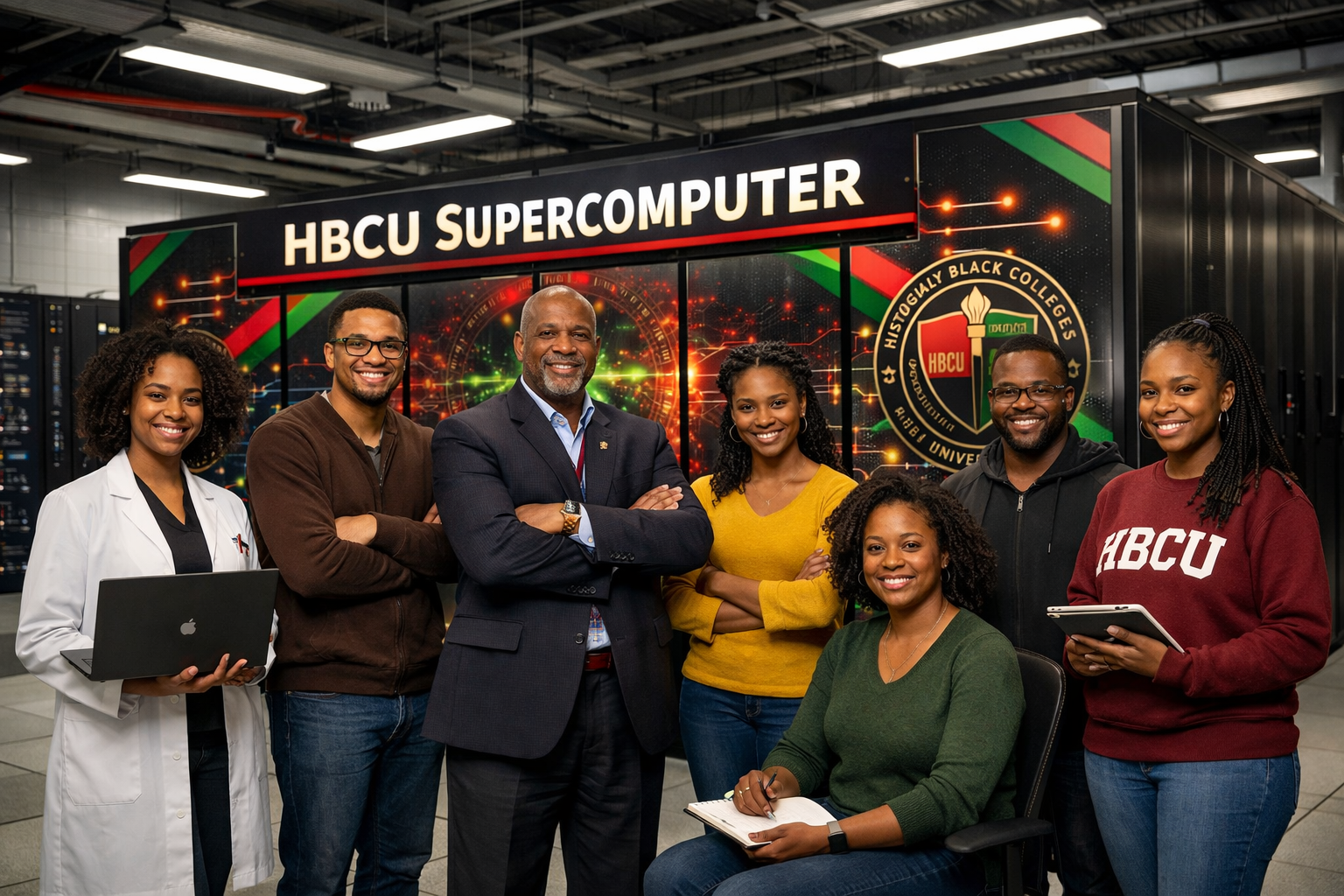
The same institutions that trained Katherine Johnson to calculate trajectories that put Americans on the moon now find themselves locked out of the computational infrastructure powering the next generation of scientific discovery. While Historically Black Colleges and Universities have long punched above their weight in producing Black STEM graduates, they remain systematically excluded from the high-performance computing resources that define cutting-edge research in the new era of AI, quantum computing, and supercomputers. It’s time for HBCUs to stop asking for access and start building their own.

The case for a Pan-HBCU supercomputer and quantum computing initiative is about survival, sovereignty, and strategic positioning in an economy where computational power increasingly determines who owns the future and who rents access to it.

Today’s research landscape is brutally simple: no supercomputer, no competitive research. Climate modeling, drug discovery, materials science, artificial intelligence, genomics, and aerospace engineering all require computational resources that most HBCUs simply cannot access at scale. While predominantly white institutions boast partnerships with national laboratories and billion-dollar computing centers, HBCU researchers often wait in lengthy queues for limited time on shared systems—if they can access them at all.

The numbers tell a stark story. According to the National Science Foundation, the top 50 research universities in computing infrastructure investment include zero HBCUs. Meanwhile, institutions like MIT, Stanford, and Carnegie Mellon operate dedicated supercomputing facilities that give their researchers 24/7 access to the tools that generate patents, publications, and licensing revenue.

This isn’t an accident. It’s the architecture of exclusion, and it’s costing African America billions in lost patents, forfeited breakthroughs, and surrendered market position. Every HBCU chemistry professor who can’t run molecular dynamics simulations is a drug that won’t be discovered. Every computer science department that can’t train large language models is an AI company that won’t be founded. Every physics researcher who can’t process particle collision data is a technology that someone else will own. This is about power—economic power, technological power, the power to shape industries rather than simply participate in them.

If the supercomputing gap is concerning, the emerging quantum divide is existential. Quantum computing represents a fundamental shift in computational paradigms with implications for cryptography, drug design, optimization problems, and artificial intelligence. Nations and corporations are investing billions to establish quantum supremacy, and the institutions that control this technology will own the intellectual property, set the standards, and capture the economic value of the next century of innovation.

HBCUs cannot afford to be spectators in this revolution. The breakthroughs that quantum-accelerated research could deliver everything from targeted therapies for diseases that disproportionately affect Black Americans to predictive models for climate impacts on Southern and coastal Black communities represent billions in economic value. More importantly, they represent the difference between being technology consumers and technology owners. Between licensing other people’s patents and collecting royalties on your own. But only if HBCUs control their own infrastructure. Or better yet, build it collectively.

Imagine a single, HBCU-owned computational facility, a crown jewel of Black academic infrastructure rivaling Los Alamos or Oak Ridge. Not distributed nodes competing for resources, but a unified campus where HBCUs collectively own land, buildings, and the machines that will mint the next generation of Black technological wealth. This is the computational arm of the HBCU Exploration Institute: a physical place where supercomputers hum, quantum processors compute, and HBCU researchers control access rather than beg for it.

The location matters. This facility needs to be somewhere politically friendly to ambitious Black institution-building, with favorable tax treatment, low energy costs, and infrastructure support. Four locations stand out:

New Mexico: Adjacent to Los Alamos and Sandia National Laboratories, with existing fiber infrastructure, favorable renewable energy costs, and a state government actively recruiting research facilities. New Mexico offers technical talent spillover, dry climate ideal for precision equipment, and proximity to Native American sovereign nations experienced in building independent institutions.

Puerto Rico: Tax incentives under Acts 20 and 22 (now Act 60) make it the Caribbean’s premier location for high-tech operations. Abundant renewable energy potential, especially solar, combined with federal research dollars without federal income tax on certain operations. Added benefit: positions HBCUs as bridge between U.S. and Caribbean research ecosystems.

Maine: Northern climate perfect for cooling systems, cheap hydroelectric power, and a state government hungry for high-tech economic development. Access to Canadian research partnerships, Atlantic subsea cable landing stations for data connectivity, and political environment favorable to institutional autonomy.

U.S. Virgin Islands: Caribbean location with full U.S. federal research funding access, generous tax incentives, and positioning as gateway to African and Caribbean collaborations. Year-round operation of field stations and research vessels, with computational infrastructure supporting the marine and atmospheric research missions.

The model is straightforward but transformative. HBCUs contribute capital to the HBCU Exploration Institute to purchase 200-500 acres outright. The land becomes HBCU property that is collectively owned, governed by an HBCU board, generating wealth for HBCU institutions in perpetuity. This isn’t leasing. This is ownership. A single state-of-the-art facility would house exascale supercomputers, quantum processors, AI training clusters, and massive data storage. Economies of scale mean more computing power per dollar than distributed nodes. Concentrated talent means better recruitment and retention. One campus means one set of operating costs, one power bill, one maintenance team.

HBCUs buy in based on their research needs and financial capacity. Larger contributors get more computational allocation and board representation, but every participating HBCU gets guaranteed access. Small institutions pool resources to punch above their weight. Research allocation follows ownership stakes, but the baseline ensures even small HBCUs can run competitive projects. Beyond serving HBCU research, the facility operates as a commercial venture. Lease computational time to corporations, government agencies, and international research collaborations. Host corporate AI training runs. Provide data center services. Every dollar generated flows back to participating HBCUs as dividends proportional to ownership stakes.

Adjacent to the computing facility, housing for rotating cohorts of HBCU researchers, graduate students, and undergraduate fellows creates a research village. Three-month to one-year residencies allow HBCU talent to work on computationally intensive projects while building networks across institutions. This becomes the intellectual hub of HBCU computational science, a place where collaborations form, startups launch, and the next generation of Black tech founders cut their teeth.

The sticker shock of supercomputing infrastructure is real but so is the cost of exclusion. A competitive supercomputing facility costs between $100-200 million to build and $10-30 million annually to operate, depending on scale and capability. Quantum computing infrastructure is still evolving, but meaningful access could require $50-75 million in initial investment. These aren’t small numbers, but they’re achievable through a combination of federal investment, private philanthropy, and strategic partnerships.

The first call should be to African American and Diaspora wealth both domestic and international. High-net-worth Black individuals, African tech billionaires, Caribbean family offices, and Diaspora investment networks represent untapped capital that understands the long-term value of Black institutional ownership. These are investors and philanthropists who won’t demand the same strings or ideological alignment tests that mainstream foundations impose. Traditional foundations like Mellon and Gates may follow once momentum builds, but Diaspora capital should lead. This ensures the vision remains accountable to Black communities rather than foundation program officers.

The priority for corporate partnerships should be African American and Diaspora-owned tech companies and investors who understand the strategic value of Black computational sovereignty. Seek partnerships with Black-led private equity firms, African tech entrepreneurs, and Caribbean technology investors before approaching mainstream tech giants. When engaging with companies like Microsoft, Google, IBM, and NVIDIA, structure deals that provide HBCUs with hardware, software, and expertise in exchange for joint research projects and equity participation but ensure HBCUs retain majority control and IP ownership. The goal is capital and resources, not dependence.

Federal funding streams exist like the CHIPS and Science Act, NSF Major Research Instrumentation grants, Department of Energy computing initiatives, and NASA research infrastructure programs though the current political environment makes federal support uncertain at best. HBCUs should build relationships and develop proposals now, but plan for a future administration more committed to research equity. In the meantime, the strategy must center on private capital and revenue generation that doesn’t depend on federal goodwill. Once operational, the facility could generate substantial revenue through commercial computing services, corporate research partnerships, and federal agency contracts. The University of Texas at Austin’s Texas Advanced Computing Center generates tens of millions annually through exactly this model, money that flows back into research capacity and student support. An HBCU-owned facility would channel those revenues directly to participating institutions as dividends proportional to ownership stakes.

The real value of HBCU-owned computational infrastructure goes far beyond the machines themselves. It’s about training the next generation of computational scientists, quantum engineers, and AI researchers who don’t just work for tech companies but found them, own them, and profit from them. Students at HBCUs with robust computing facilities wouldn’t just learn about supercomputers in textbooks they’d gain hands-on experience optimizing code for parallel processing, debugging quantum algorithms, and managing large-scale computational workflows. These aren’t abstract skills; they’re the exact expertise that tech companies and national laboratories desperately need and are willing to pay premium salaries to acquire. More importantly, they’re the skills that enable students to launch their own computational startups rather than simply joining someone else’s.

Faculty recruitment and retention would transform overnight. Try recruiting a top-tier computational chemist or AI researcher to an institution where they’ll spend half their time begging for computing time elsewhere. Now imagine recruiting that same researcher with the promise of dedicated access to world-class computing infrastructure and a path to commercialize their discoveries. The competitive landscape shifts dramatically.

This proposal aligns seamlessly with emerging initiatives like the HBCU Exploration Institute and the Coleman-McNair HBCU Air & Space Program outlined in recent strategic planning documents. These ambitious programs envision HBCUs leading research expeditions, operating research vessels and aircraft, and conducting aerospace missions. None of this is possible without serious computational infrastructure. Climate modeling for polar expeditions, satellite data processing, aerospace engineering simulations, deep-sea mapping analysis—these all require supercomputing resources. Want to analyze genomic data from newly discovered marine species? Process atmospheric measurements from research aircraft? Model propulsion systems for small satellites? You need computational power, and lots of it.

A Pan-HBCU Computing Consortium wouldn’t just support these exploration initiatives it would accelerate them, turning HBCUs into genuine leaders in exploratory science rather than junior partners dependent on others’ computational generosity. And every discovery, every patent, every breakthrough would belong to HBCU institutions and their researchers.

The window for building this capacity is closing. As quantum computing matures and AI systems become more computationally intensive, the institutions with infrastructure will accelerate away from those without. The gap between computational haves and have-nots will become unbridgeable, and HBCUs will be permanently relegated to second-tier research status which means second-tier revenue, second-tier patents, and second-tier wealth creation.

But it doesn’t have to be this way. The HBCU community has something that other institutions don’t: a shared mission, deep trust networks, and a history of collective action in the face of systemic exclusion. These institutions didn’t wait for permission to educate Black students when others wouldn’t. They didn’t wait for invitations to produce world-class scientists and engineers. They built their own institutions and proved the doubters wrong.

The same spirit that created HBCUs in the first place, the audacious belief that Black excellence could not be contained or denied must now be channeled into building the computational infrastructure these institutions need to compete and win in the 21st century. The question isn’t whether HBCUs can afford to build their own supercomputer and quantum computing infrastructure. The question is whether they can afford not to. In a world where computational power increasingly determines who shapes the future and who profits from it, HBCUs must choose between dependence and ownership.

The choice should be obvious. It’s time to build.

Disclaimer: This article was assisted by ClaudeAI.

From Hillman to the World: How Whitley Gilbert-Wayne Built a Pan-African Art Empire

You can go to school anyplace, but no school will love you, and teach you to love yourself and know yourself like Hillman. – Whitley Gilbert

When Whitley Gilbert-Wayne stepped off the plane in Tokyo alongside her husband Dwayne in the mid-1990s, she had no idea that a chance encounter at a contemporary art exhibition would transform her from a newlywed supporting her engineer husband’s career into one of the most influential voices in Pan-African art acquisition and investment. The former Hillman College art history major known during her undergraduate years for her impeccable style and occasional elitism had matured into a woman with vision that extended far beyond Virginia’s borders. What began as casual gallery visits in Tokyo’s vibrant Roppongi district evolved into a business idea that would eventually connect HBCU endowments, Black corporate America, and emerging artists across the African diaspora.

“I was standing in front of a piece by a Nigerian artist at this small gallery in Harajuku,” Whitley recalls of the moment that changed everything. “The gallery owner mentioned that wealthy Japanese collectors were increasingly investing in African contemporary art, and I realized if they see the value, why aren’t we, as African Americans, building these collections ourselves?” That revelation led Whitley to spend her remaining months in Japan studying the mechanics of art acquisition, investment, and appraisal. She networked with gallery owners, attended auctions, and built relationships with African artists who were making waves in Asia’s art markets. By the time she and Dwayne returned to the United States, she had a business plan, a network of artist contacts spanning three continents, and an unshakeable conviction that Black institutions and families deserved access to culturally relevant art investment opportunities.

Whitley’s first pitch wasn’t to venture capitalists or traditional investors, it was to her Hillman College alumni network. She reached out to former classmates who had established themselves in various industries: Dr. Kimberly Reese and Ron Johnson, the power couple behind the thriving Reese and Johnson Medical Group, Freddie Brooks in entertainment law, and even her college frenemy, Julian Pace, who had made his fortune in tech. “Whitley understood something fundamental,” says Ron Johnson, one of the fund’s founding investors. “She knew that we trusted each other because of our Hillman connection. She wasn’t asking us to just invest in art, she was asking us to invest in our cultural legacy.”

Dr. Kimberly Reese adds, “Ron and I had just completed our first major expansion of the medical group. We were looking for investment opportunities that aligned with our values. When Whitley presented her vision, it was clear this was about more than financial returns, it was about cultural preservation and long-term wealth building for our community.”

The Diaspora Art Investment Fund launched with $500,000 in seed capital from twenty Hillman alumni investors. Whitley’s model was revolutionary in its simplicity: identify emerging and mid-career artists from across the African diaspora from Salvador to Senegal, from Detroit to Durban acquire their works at fair market value, and create investment portfolios that would appreciate while supporting artists directly. Unlike traditional art investment funds that focused solely on returns, Whitley built in a mission-driven component. Ten percent of all profits would be reinvested in arts education programs at HBCUs and Historically Black Boarding Schools, creating a sustainable cycle of cultural wealth building.

Whitley’s most innovative contribution came when she approached her alma mater with an unconventional proposal: What if Hillman College built an art collection as part of its endowment strategy? “Most HBCUs had art on their walls, but it was rarely viewed as an asset class,” explains Dr. Terrence Mathis, Hillman’s Vice President for Advancement. “Whitley showed us that institutions like Yale and Harvard had art holdings worth hundreds of millions. She asked us why Hillman shouldn’t be acquiring works by contemporary Black artists that would appreciate in value while beautifying our campus and inspiring our students.”

Her consulting model for HBCUs was comprehensive. She would assess their existing collections, identify acquisition opportunities aligned with their budgets, negotiate directly with artists and galleries, handle authentication and appraisal, and develop exhibition strategies for campus galleries. Most importantly, she created educational programming that helped students understand art as both cultural expression and financial asset. Within five years, Whitley had consulted with fifteen HBCUs, helping them establish formal art acquisition programs. Texas College, Fisk University, and Savannah State University became early adopters, each building collections that now include works by Kehinde Wiley, Mickalene Thomas, and Wangechi Mutu—pieces that have appreciated significantly in value.

While institutional clients provided prestige, Whitley never forgot that wealth-building needed to extend to individual families. She developed a tiered service model specifically for HBCU alumni families who wanted to begin collecting art but didn’t know where to start. For clients with modest budgets, she offered educational workshops and access to emerging artists whose works started at $2,000-$5,000. For established collectors, she provided comprehensive acquisition services, including attendance at international art fairs, private viewings, and direct studio visits with prominent artists. “Whitley demystified art collecting for people like me,” says Kendra Williams, a North Carolina Central University alumna and corporate attorney. “I thought you needed to be a millionaire to collect meaningful art. She showed me that you could start small, build strategically, and create something beautiful and valuable for your family.” Her family services division has helped over 300 HBCU alumni families build personal collections, with many clients reporting that their acquisitions have tripled in value while providing immeasurable cultural enrichment to their homes.

Among her most enthusiastic clients are Kim and Ron themselves, who have used Whitley’s guidance to build an impressive collection for the Reese and Johnson Medical Group’s multiple locations. “Our patients commented immediately,” Dr. Reese notes. “Seeing artists who look like them, telling stories from our communities it changed the atmosphere of our practice entirely.” Whitley’s highest-profile work came through her corporate art advisory services. As Black-owned businesses expanded and Black executives ascended to C-suite positions across our own corporate African America, many began questioning why their physical spaces didn’t reflect the excellence and cultural richness of the people leading them. “Black CEOs and business owners would call me and say, ‘I just bought this building’ or ‘We’re opening our third location, and I refuse to have my walls look like every other corporate office,'” Whitley explains. “They wanted spaces that celebrated our heritage, that told our stories, that reminded their teams daily of the beauty and brilliance we come from.” Her corporate practice became a who’s who of Black entrepreneurial success from tech startups founded by young Morris College graduates to established manufacturing companies run by second and third-generation business owners. The Reese and Johnson Medical Group became one of her signature projects, transforming their practice locations into galleries that honored African and African American artistic traditions while creating healing, affirming spaces for their patients. As a corporate art broker and adviser, Whitley oversaw complete collection development for these companies, negotiating favorable terms, managing authentication, and ensuring proper insurance and conservation. Her approach combined aesthetic excellence with cultural competency, ensuring that corporate collections reflected the vision and values of Black leadership. “Working with the Reese and Johnson Medical Group was particularly meaningful,” Whitley says. “Here were two of my Hillman classmates who had built this incredible healthcare empire, and they wanted their spaces to reflect the excellence and beauty of Black culture. We curated pieces that spoke to healing, community, and resilience—themes that aligned perfectly with their mission.”

Perhaps Whitley’s most enduring legacy is the Pan-African Art Appraisal joint program she helped establish between Hillman College and the University of Namibia’s Department of Visual and Performing Arts. “Whitley recognized that the art world had a credibility problem when it came to valuing African and diaspora art,” notes Dr. Amara Okafor, program director at UNAM. “Too often, African art was undervalued or misunderstood by appraisers who lacked cultural context. She wanted to train a new generation of appraisers who understood both the technical aspects of valuation and the cultural significance of the works.” The program allows students to split their studies between Hillman’s art history department and UNAM’s Visual and Performing Arts department. Students gain hands-on experience with contemporary African art production, learn from artists addressing social issues through their work, and participate in exhibitions at the National Art Gallery of Namibia. Graduates of the program have gone on to work at major auction houses, establish their own galleries, and serve as in-house appraisers for museums and corporate collections. The program has become a model for other international partnerships, proving that HBCUs can lead in global arts education. The Reese and Johnson Medical Group has become a major supporter of the program, endowing two full scholarships annually for students pursuing careers in art appraisal and healthcare art therapy, a perfect synthesis of the couple’s medical expertise and their passion for the arts.

Today, Whitley maintains offices in New York and Johannesburg, traveling regularly between the continents she’s connected through art. The Diaspora Art Investment Fund manages over $50 million in assets, her consulting firm has worked with thirty HBCUs, and the Hillman-UNAM program graduates twenty-five students annually. But perhaps most telling is her personal collection, which she and Dwayne have assembled over the years. It includes works from artists they discovered in Tokyo decades ago, pieces by Hillman alumni artists, and acquisitions from UNAM student exhibitions. The collection represents not just financial investment, but relationships, memories, and a commitment to the vision that first struck her in that Tokyo gallery.

“I tell young people that building cultural wealth isn’t just about money,” Whitley reflects. “It’s about creating infrastructure, establishing standards, and ensuring that our stories, our beauty, and our creativity are valued literally and figuratively. That’s what I learned at Hillman, and that’s what I’m trying to build for the next generation.” From a student who once measured success by designer labels and social status, Whitley Gilbert-Wayne has become an entrepreneur who measures impact by artists supported, institutions strengthened, and communities empowered. It’s a transformation worthy of the art she champions and one that continues to inspire her fellow Hillman alumni, from the Reese and Johnson Medical Group to boardrooms and galleries across the diaspora.

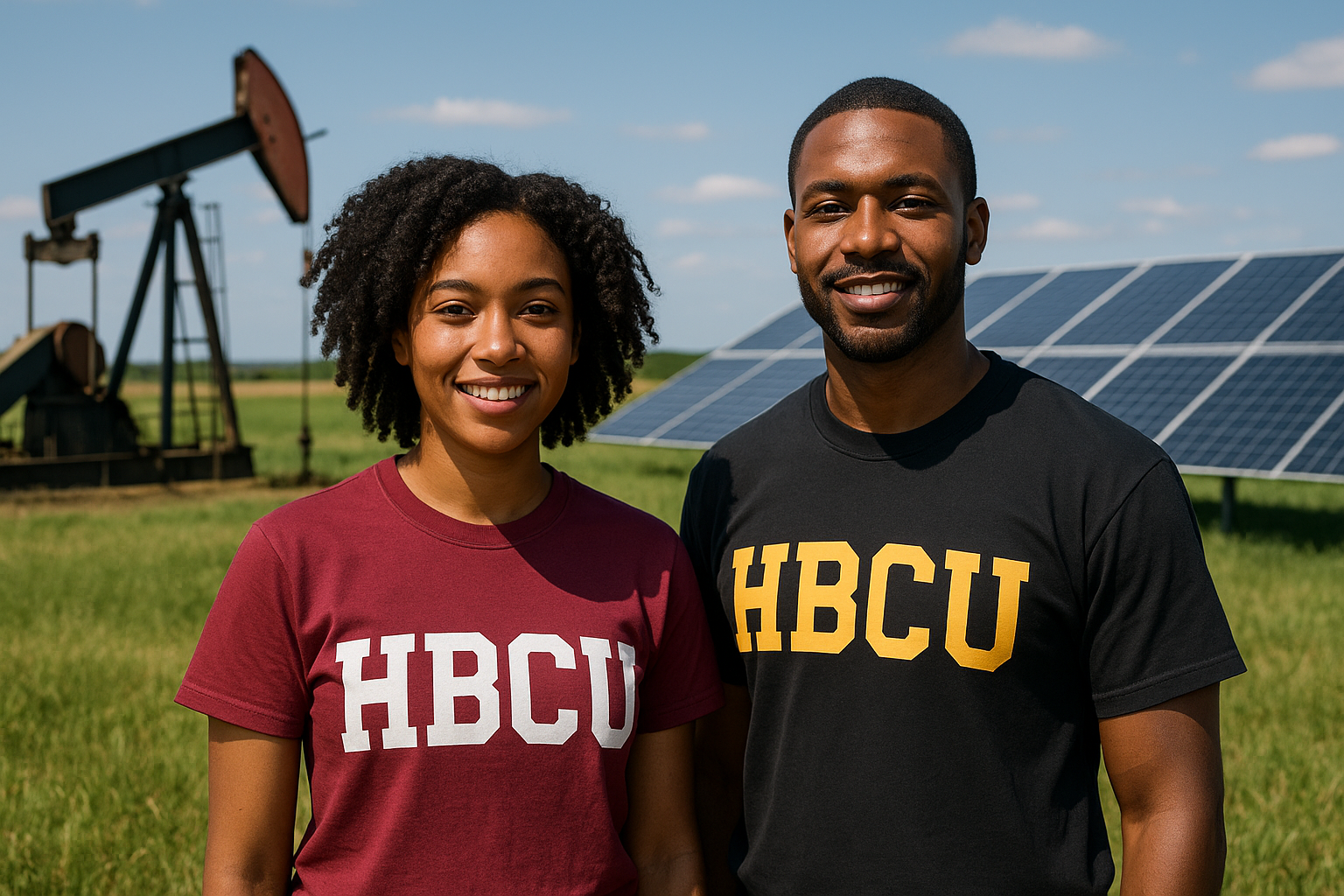
With So Much Oil In HBCU States – Where Are HBCU Alumni Owned Energy Firms?

“If you can provide the funding and you get the leadership, you’ll have a competitive team.” – T. Boone Pickens

The Southern United States is awash in energy. From Texas to Louisiana, Mississippi to Alabama, these states are responsible for the bulk of America’s oil and gas production. They are also home to the vast majority of Historically Black Colleges and Universities (HBCUs), institutions that have graduated generations of African American engineers, scientists, and business professionals. Yet, despite the geographic overlap and the energy sector’s enormous influence, there is an unmistakable void when it comes to HBCU alumni-founded firms in oil, gas, or even renewables. It is a paradox of proximity without participation—resources in abundance, yet ownership remains out of reach.

This disconnect is not simply a function of chance. It is the product of historical exclusion, structural barriers, and decades of capital disinvestment. The energy industry, especially oil and gas, has long been one of the most capital-intensive and closed sectors of the U.S. economy. The upstream business of exploration and drilling is not built for first-time entrepreneurs without deep-pocketed backers, multigenerational industry ties, or significant institutional support. Most HBCU alumni have none of the above.

For much of the 20th century, Black Americans were excluded from both land ownership in oil-rich regions and the educational infrastructure required to engage in the energy economy. HBCUs historically focused on liberal arts, education, and public service—disciplines that addressed urgent post-emancipation needs and segregation-era employment restrictions. Petroleum engineering, energy policy, and oil finance were simply not part of the curriculum. And while HBCUs today have engineering programs, few have the dedicated energy labs, industry partnerships, or commercialization infrastructure that their predominantly white counterparts enjoy. At places like the University of Texas or Texas A&M, oil research institutes, private equity-backed incubators, and billion-dollar endowments serve as launchpads for energy ventures. No HBCU currently operates at that scale.

Then there is the question of capital. Even if an HBCU graduate had the technical know-how and vision to build an energy company, the financing would almost certainly be out of reach. According to the Federal Reserve’s most recent small business credit survey, Black entrepreneurs are more likely to be denied loans, receive lower funding offers, and face higher interest rates. In oil and gas, where drilling a single exploratory well can cost millions, these hurdles become insurmountable. And in the renewable energy space, which requires less upfront capital but still demands serious investment and regulatory navigation, Black founders are still underrepresented. Less than 2% of clean energy businesses are Black-owned, a figure confirmed by data from the Department of Energy and Brookings Institution.

There are, however, rare examples that offer a blueprint for what could be. Volt Energy, a solar development firm founded by HBCU alumnus Gilbert Campbell, has successfully executed projects for corporate and government clients. Its success is owed not just to entrepreneurial grit, but to strategic positioning in the rapidly growing clean energy sector and the willingness of federal partners to prioritize minority-owned firms. Another example is PEER Consultants, founded by Dr. Lilia Abron, an environmental engineering firm that has spent decades advancing sustainability and energy access in underserved communities. These stories are powerful but isolated.

Public and private efforts to address the imbalance are underway, albeit slowly. The Biden Administration’s Justice40 initiative mandates that 40% of certain federal climate investments benefit disadvantaged communities, opening the door for more HBCU-linked projects. The Department of Energy’s HBCU Clean Energy Education Prize, launched in 2023, is another signal of intent. It provides multi-million-dollar funding to HBCUs for curriculum development, student research, and partnerships in clean energy. But such programs are only as impactful as the ecosystems that surround them. Without access to long-term venture funding, procurement opportunities, and business mentorship, their reach will be limited.

Much of the challenge lies within institutional economics. The endowment gap between HBCUs and wealthier PWIs (predominantly white institutions) is massive. The entire HBCU sector holds less than $6 billion in endowment funds. By contrast, the University of Texas system—heavily funded by state oil revenues—controls more than $30 billion through its UTIMCO investment vehicle. These endowments don’t just fund scholarships; they finance research labs, spinouts, and equity investments in faculty or alumni-founded ventures. HBCUs, without comparable financial arms, cannot deploy the same kind of catalytic capital.

In this environment, oil-rich states like Texas, Louisiana, and Mississippi may continue to generate immense wealth from energy while HBCU alumni remain employees at best and consumers at worst. Ownership, the core driver of generational wealth and political leverage, continues to elude them.

But the renewable transition could offer an inflection point. The barriers to entry are lower, the policies more inclusive, and the urgency to diversify the energy economy is real. Solar and battery storage firms don’t require billion-dollar capex or land acquisition. Distributed energy resources, community solar projects, energy efficiency startups, and green construction ventures are all areas where HBCU alumni could lead—if properly funded and supported.

That shift requires vision, not just from government, but also from philanthropists, Black-owned banks, and corporate ESG programs. Capital alone, however, will not solve the problem. HBCUs must also expand their academic footprint into energy entrepreneurship, clean tech commercialization, and regulatory policy. More importantly, HBCU alumni must begin to see energy not just as an employer, but as a domain in which to build power, both economic and political.

The stakes are higher than ever. Energy is not simply about electricity or gasoline—it is about who owns the infrastructure of the future. Whether it’s solar farms, transmission networks, EV charging corridors, or hydrogen production, the assets being built today will define tomorrow’s winners. If HBCU graduates are not in the room now, they risk being locked out of that ownership for another generation.

The irony of standing on land that produces billions of dollars in oil revenues while holding none of the titles is no longer tolerable. The future energy economy must be diverse not only in technology but in ownership. For HBCUs, the time to act is now—not for symbolic inclusion, but for structural participation.

From fossil fuels to photovoltaics, the opportunity exists to move from resource curse to resource empowerment. Whether that opportunity is seized will depend on whether HBCUs, their alumni, and their partners choose to build ownership into the core of their energy future, or remain content with being near power, but never in control of it.

Supporting Data & Charts

1. Oil Production by HBCU States (2023, million barrels):

StateProductionNumber of HBCUs
Texas20,0008
Louisiana4464
Mississippi1136
Alabama2714
Oklahoma1,8301

2. Black-Owned Firms in Energy (2022):

Sector% Black Ownership
Oil & Gas Extraction<1%
Solar Installation1.3%
Energy Consulting2.1%
Utility-Scale Renewables0.5%

3. Endowment Comparison (2024):

Institution/SystemEndowment ($B)
Harvard University53.2
Stanford University37.6
All HBCUs Combined5.2
UTIMCO (Texas System)65.3

Disclaimer: This article was assisted by ChatGPT.