Tag Archives: central state university

Central State’s Water Resources Program: An HBCU Answer to Kabwe’s Lead Poisoning Crisis

“What good are our institutions or our programs if they are not meant for the survival and empowerment of our people? We must be more than job seekers, we must be fighters for the Diaspora. These tools we learn have to be for a greater purpose.” – William A. Foster, IV

In Kabwe, Zambia, a seven-year-old girl named Winfrida sits in a classroom where learning feels like trying to climb a mountain barefoot. Once the site of one of the world’s largest lead mines, Kabwe is now infamous as perhaps the most lead-polluted place on earth. The town’s legacy of extraction has left behind poisoned soil, contaminated water, and a generation of children robbed of potential. At the same time, in Wilberforce, Ohio, a historically Black institution has been quietly developing an expertise that could one day prove critical to Kabwe’s recovery. Central State University, the nation’s only HBCU with a dedicated Water Resources Management program, is uniquely positioned to contribute to addressing this environmental catastrophe. The program’s interdisciplinary curriculum, rooted in both science and community engagement, is precisely the kind of training and research engine needed to tackle a challenge as complex as Kabwe’s. This moment offers a powerful illustration of how HBCUs too often overlooked in global problem-solving can step forward as leaders on the world stage. Central State’s water expertise is not only about classrooms and degrees. It could become an institutional bridge between African America and Africa, uniting technical skill with a shared historical experience of exploitation and resilience.

Kabwe’s crisis is the long shadow of a century of mining. The Broken Hill mine, opened in 1906 under British colonial rule, produced massive quantities of lead and zinc for global markets until it was shuttered in 1994. But its closure did not end the danger. Vast piles of lead-laden tailings remain exposed to the elements. Winds scatter toxic dust into homes, schools, and roads. During the rainy season, contaminated runoff seeps into rivers and groundwater. Decades later, blood-lead levels in Kabwe’s children remain among the highest recorded anywhere in the world. Symptoms range from learning disabilities and behavioral problems to stunted growth and organ damage. Entire generations risk being locked into cycles of poor health and diminished human capital. Remediation efforts have been fragmented. A World Bank-funded project cleaned some homes and public areas, but failed to address the core problem: the giant waste dumps that continue to spread contamination. Meanwhile, informal re-mining of tailings by small operators has created new pathways for lead exposure. Government plans for inter-ministerial action have stalled. The crisis persists.

Central State’s Water Resources Management program, housed in the C.J. McLin International Center for Water Resources Management, stands as a rare jewel in American higher education. Launched in 1987, it remains the only HBCU-based program of its kind, and one of the few nationally that integrates the full spectrum of water and environmental challenges. The program offers both a B.S. degree and a minor, blending coursework in hydrology, environmental law, geology, pollution control, waste management, policy, and economics. Students learn not only how water flows through ecosystems but how laws, institutions, and communities interact with those systems. Its graduates have gone on to positions at the USDA, EPA, and Department of Defense, demonstrating its credibility in shaping professionals who can influence policy and practice. Under the leadership of Dr. Ramanitharan Kandiah, the department has expanded its reach and visibility. His recognition as a Diplomate of the American Water Resources Engineers and as a fellow of the ASCE Environmental & Water Resources Institute affirms the program’s high standing. His research portfolio supported by the NSF, USDA, DoD, and others ranges from groundwater quality and evapotranspiration modeling to water equity and resilience in the face of climate extremes. In short, Central State has the expertise to contribute meaningfully to environmental crises far beyond Ohio. The Kabwe disaster could be the kind of global challenge where an HBCU asserts its value not only to African America but to the African continent.

One of CSU’s greatest strengths is its grounding in interdisciplinary, community-engaged research. Kabwe’s crisis is not just about chemistry and soil samples it is about public health, poverty, governance, and trust. CSU students and faculty could partner with Zambian universities and NGOs to design research that combines hard science with social impact. They could map the spread of lead contamination through GIS and remote sensing, conduct water and soil testing to identify high-risk zones, and collaborate with public health teams to link contamination data to health outcomes in children. Kabwe also requires not only outside expertise but the development of local technical capacity. CSU could establish exchange programs that bring Zambian students and environmental professionals to Wilberforce for intensive training in water resources management, while sending CSU students and faculty to Zambia for fieldwork. Over time, this would build a corps of professionals embedded in Kabwe itself, capable of sustaining remediation and monitoring efforts.

The crisis is as much political as technical. Regulatory failure has allowed unsafe re-mining and inadequate cleanup to persist. CSU’s curriculum in environmental law and policy could help train Zambian regulators, civil servants, and community leaders. Workshops or certificate programs led jointly with Zambian institutions could help build governance capacity around environmental enforcement, licensing, and long-term remediation planning. Central State’s new Research and Demonstration Complex, opening in 2025 with advanced soil and water testing labs, could serve as a hub for innovation in remediation technologies. Pilot projects tested in Ohio could then be adapted to Zambia’s conditions. Techniques such as phytoremediation using plants to extract toxins from soil or low-cost water filtration systems could be developed and deployed. Because CSU is an HBCU, its involvement would carry symbolic weight. African American institutions engaging with African crises offers a model of diaspora solidarity. CSU could partner not only with Zambian universities but also with African American financial institutions, philanthropies, and think tanks to mobilize resources. This would expand the pool of actors beyond the typical World Bank or European NGO model.

The role of HBCUs in international development is rarely discussed. Yet they represent a set of institutions with technical expertise in fields like agriculture, health, and environmental science, a cultural and historical connection to Africa that mainstream U.S. universities lack, and community-based models of engagement rooted in serving marginalized populations. When Kabwe is framed purely as a “developing world” problem to be solved by Western aid agencies, the solutions often miss the nuances of community empowerment and self-determination. When an HBCU steps in, it reframes the issue: this is not charity, it is solidarity. It is institutions of African descent collaborating across the Atlantic to repair the legacies of extraction and neglect.

What might it look like in practice for Central State to become part of the solution in Kabwe? It could mean signing a memorandum of understanding with a Zambian partner university, such as the University of Zambia, focusing on water resources, public health, and environmental law. It could involve joint research grants targeting international funders to support Kabwe remediation studies. It could build a student exchange pipeline bringing Zambian students into CSU’s WRM program, funded by scholarships from African American philanthropic foundations. It could convene technical workshops in Kabwe led by CSU faculty, introducing low-cost soil testing and community monitoring methods. And it could establish an annual Diaspora Conference on Water and Environmental Justice, hosted alternately in Wilberforce and Zambia, convening experts, policymakers, and community activists. Such initiatives would institutionalize the partnership, ensuring it is not a one-off but a long-term bridge.

Of course, such an ambitious agenda faces challenges. CSU itself is a relatively small university with an endowment dwarfed by predominantly White institutions. International partnerships require funding, travel infrastructure, and political will. Zambia’s regulatory environment has historically been weak, and vested interests in re-mining waste piles may resist intervention. Yet these obstacles underscore the importance of approaching the issue institutionally rather than individually. For CSU to engage Kabwe meaningfully, it must do so as part of a larger HBCU and African American institutional ecosystem. This could mean drawing on African American-owned banks and credit unions to structure financing, HBCU consortia to pool faculty expertise, and diaspora philanthropic vehicles, like donor-advised funds, to direct giving toward global environmental justice.

Why should an HBCU in Ohio devote resources to a crisis in Zambia? Because doing so not only aids Kabwe but strengthens HBCUs themselves. By engaging globally, CSU elevates its reputation, attracts research funding, and demonstrates the relevance of HBCU scholarship in solving world problems. Students who participate in such projects gain transformative experiences that prepare them for leadership at home and abroad. Moreover, the symbolism matters. Just as the mine in Kabwe exported lead to the world, the environmental devastation it left behind is a global responsibility. HBCUs, born from a legacy of exclusion and survival, understand better than most what it means to inherit poisoned ground and still create knowledge and opportunity from it. Their engagement reframes Kabwe not as a distant tragedy, but as part of a shared struggle for dignity, health, and justice.

The children of Kabwe cannot wait. Each year of inaction locks in more damage to developing minds and bodies. The town’s soil and water remain a slow-moving disaster. Yet hope lies in partnerships that transcend borders. Central State University’s Water Resources program is not a silver bullet. But it embodies the kind of holistic, interdisciplinary, and justice-oriented approach that Kabwe desperately needs. An HBCU stepping into the breach would demonstrate that solutions to global crises can come not only from the usual centers of power, but from institutions born in the struggle of African America. In Wilberforce and Kabwe alike, the message would be clear: water is life, and the institutions of African people must be at the forefront of protecting it.

Disclaimer: This article was assisted by ChatGPT.

What If Bronny James Were A Doctor?

“Our children can’t be what they can’t see.” — Marian Wright Edelman

In August 2015, HBCU Money asked a provocative question: What if LeBron James were a doctor? It was more than a hypothetical. It was a cultural critique of how African American communities disproportionately invest their most visible male potential into athletics rather than professions like medicine, law, or academia. The premise was simple: what if the best of us were guided toward healing rather than hoops?

At that time, Bronny James was only 10 years old. He was already receiving national media coverage and projected to follow in the footsteps of his famous father. Ten years later, we know how the story unfolded: Bronny James is now 20 years old, an NBA player for the Los Angeles Lakers, having been selected 55th overall in the 2024 NBA Draft. He and LeBron have made history as the NBA’s first active father–son duo. But as we revisit that original question, we offer a new one for this moment:

What if Bronny James were a doctor?

The Pipeline That Still Leaks

In the decade since the original article, the numbers have moved very little. Black men remain just 2.9% of medical school applicants in the United States. While the total percentage of Black physicians has risen slightly to 5.2%, Black male doctors remain critically underrepresented in the field. The pipeline is still broken—too narrow, too leaky, and too unprotected.

Meanwhile, sports pipelines are expanding. Black male participation in college athletics remains high: 44% in NCAA Division I basketball and 40% in football. Yet only a fraction make it to the pros, and even fewer achieve career longevity. While Bronny James may earn an estimated $33 million over five years in the NBA, that sum when spread over a lifetime equates to about $750,000 annually pro-rated from age 21 to 65. By contrast, a primary care physician earning $280,000 annually over a 35-year career will earn nearly $10 million, with the added benefits of job security, community impact, and longevity.

Imagining Dr. Bronny James

What if Bronny James had chosen to study medicine instead of basketball?

He would now be entering his second year of medical school, perhaps at Morehouse, Howard, or Meharry. He would be poring over medical textbooks, studying cardiovascular anatomy, shadowing trauma surgeons, and preparing for his USMLE Step 1 exam. Instead of prepping for NBA Summer League, he’d be interning at the Cleveland Clinic or doing a rural health rotation through an HBCU pipeline program.

Bronny would not trend on Twitter. He would not have endorsement deals. But one day, he would help save lives. He might build a medical clinic in Akron, establish scholarships for Black boys in pre-med tracks, or serve as a thought leader in health equity. His white coat would carry power every bit as influential as his jersey and perhaps more transformative.

Investing in the Wrong Dream?

The culture of African American investment in financial, emotional, and institutional remains lopsided. Parents spend thousands each year on club sports, trainers, uniforms, and travel tournaments. The AAU circuit is a multi-billion-dollar enterprise. But few parents are encouraged or supported to invest similarly in chess clubs, science fairs, or summer medical programs. The problem isn’t sports. The problem is singularity. We teach Black boys to put all their ambition into the least likely path to success. That is not empowerment it is misallocation.

Sports should be one of the dreams. Not the dream.

And cultural influencers like celebrities, churches, schools, and even HBCUs must widen the lens of what is considered aspirational. Because when African American boys only see themselves celebrated on the court or field, they are conditioned to believe that’s the only route to greatness.

The Hospital That Could Change Everything

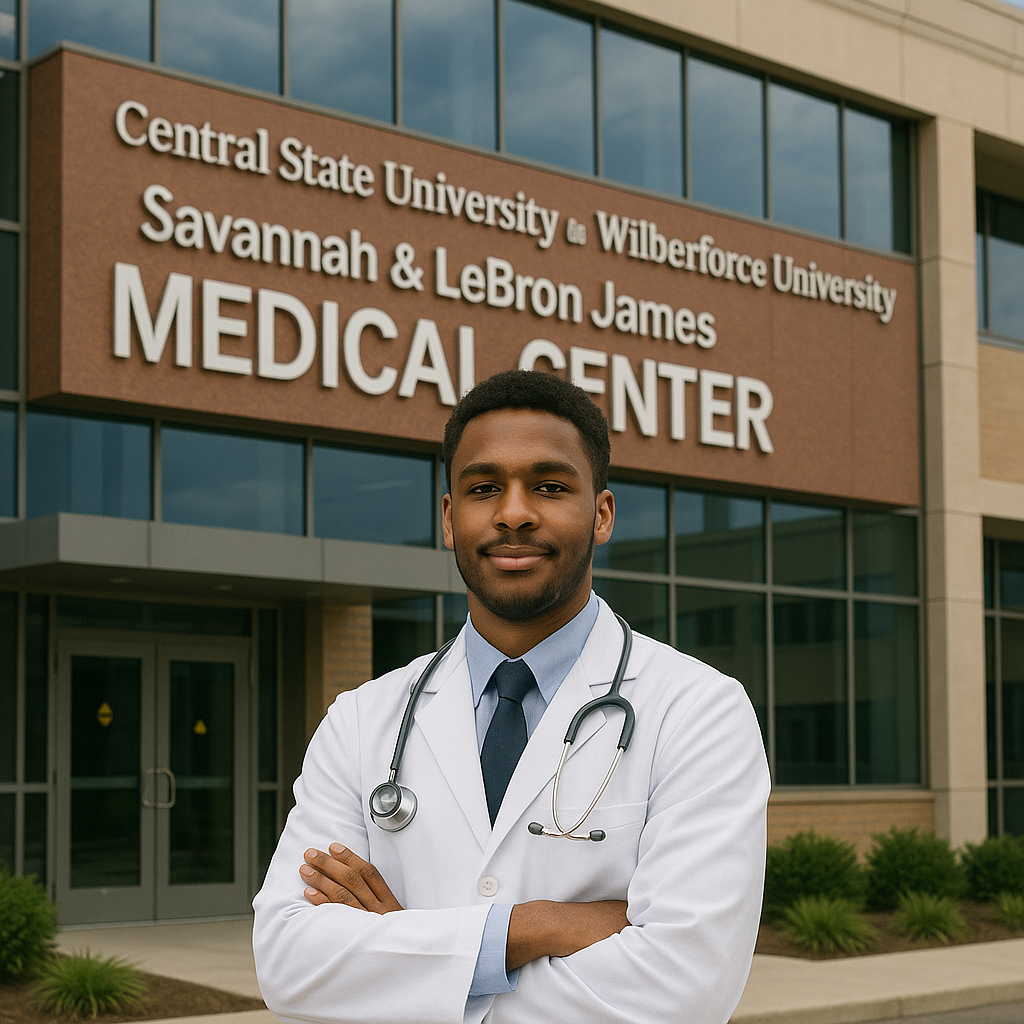
Now imagine a future where LeBron and Savannah James decide to reshape the health destiny of Black Ohio not just through education, but through medicine. In partnership with Central State University and Wilberforce University, the James family announces the creation of the Savannah & LeBron James Medical Center, a state-of-the-art teaching and research hospital in Dayton, Ohio. The hospital would be co-owned by the two HBCUs, offering an unprecedented model of HBCU institutional control and healthcare delivery.

At its helm? Dr. Bronny James, a board-certified trauma surgeon and hospital executive, returned from medical training with a mission not just to serve, but to system-build. Through a strategic pipeline, students from the I PROMISE School in Akron, established by the James family, would be funneled into dual-admissions programs at Wilberforce and Central State, beginning in middle school. African American students interested in health sciences would receive mentorship, MCAT preparation, research internships, and full scholarships in exchange for a five-year service commitment at the hospital.

The hospital would:

  • Serve as a Level 1 trauma center for the Midwest Black Belt.
  • Anchor a Black-owned HMO focused on preventive care and wellness.
  • House medical research departments focused on sickle cell, hypertension, and diabetes, disproportionately affecting Black populations.
  • Be staffed by a growing cadre of Black doctors, nurses, and technicians, trained from within the HBCU system.

It would be the first modern, Black-owned academic medical center in America in over a century.

Not just a facility but a movement.

HBCUs as Healthcare Engines

This is the next evolution for HBCUs. No longer content to only educate they must now employ, own, and lead. Currently, Meharry, Howard, and Morehouse are the most visible HBCU medical institutions, but they are not sufficient to serve a national population. HBCUs like Central State and Wilberforce can and should partner with philanthropists to enter the healthcare delivery space. Hospitals, urgent care clinics, dental schools, nursing programs—these are all industries HBCUs can lead, if given the capital and political will.

The Savannah & LeBron James Medical Center would become a model for how celebrity philanthropy can shift from access to ownership. The James family has built schools. Now they can build systems. Systems that outlast careers. Systems that create intergenerational empowerment. And Dr. Bronny James? He would not just be a doctor. He would be a symbol of new possibilities.

Culture, Media, and The Battle for Imagination

The Bronny we know exists because the culture invested in him—from trainers to scouts to sports media coverage. But imagine if that same investment were redirected into medicine.

What if:

  • ESPN tracked the top Black high school biology students?
  • SpringHill Company aired a documentary series on Black med students at HBCUs?
  • Nike sponsored lab coats instead of just sneakers?

Culture tells children what to value. The question is whether we value Black intellect enough to mass-produce it.

Father–Son Legacy: A New Kind of First

LeBron and Bronny made history as the NBA’s first active father-son duo. But what if they made history again this time as a father-son pair who reshaped African American health care? Imagine LeBron standing beside Bronny at the ribbon-cutting of the James Medical Center. One created legacy through sport. The other, through healing. That is a legacy few families could rival. That is the kind of dynasty African America needs now.

Final Thoughts: From Possibility to Policy

“What if Bronny James were a doctor?” is no longer a question about a single person. It is a challenge to families, schools, HBCUs, and philanthropists. It is a policy challenge: to build educational pipelines, mentorship structures, and HBCU-led medical institutions that keep Black talent from slipping through the cracks. It is a cultural challenge: to celebrate and invest in intellect and professionalism with the same intensity we invest in athletics. It is a power challenge: to shift from participation to ownership in one of the most critical sectors of our economy health care. The original article asked the question. Now, let us answer it—with vision, capital, and courage. Because if Bronny James were a doctor—and led a Black-owned hospital rooted in HBCU strength we would not just be saving lives.

We would be saving futures.

Ohio’s Unclaimed Billions Could Empower Central State and Wilberforce Instead of Enriching the NFL

You can’t have political power unless you have economic power. You can’t have economic power unless you own something. — Dr. Claud Anderson

In the quiet towns of Wilberforce, Ohio, two institutions — Central State University and Wilberforce University — have stood for generations as monuments of African American intellectual resilience and historical fortitude. Founded in eras when the very idea of African American higher education was radical, both institutions have graduated engineers, entrepreneurs, theologians, and teachers who seeded entire Black communities with knowledge and leadership. Yet, in 2025, they remain financially fragile — their endowments barely grazing the thresholds needed for robust institutional health.

Meanwhile, Governor Mike DeWine just approved $600 million in state funds — sourced from Ohio’s $4.8 billion in unclaimed assets — to support the Cleveland Browns’ new domed stadium in Brook Park, an NFL franchise owned by billionaires. The Haslam Sports Group, the Browns’ owners, is contributing an additional $1.2 billion to the project, and Cuyahoga County is expected to round out the financing with another $600 million. The stadium, estimated at $2.4 billion, is framed as a jobs and tourism engine — the typical rationale for professional sports subsidies. But beneath the surface lies a deeply racialized economic pattern: Black bodies as capital, Black institutions as afterthoughts.

Let us state this plainly — $200 million in endowment funding (split between Central State and Wilberforce University) would account for just 4.17% of the $4.8 billion in unclaimed assets Ohio plans to repurpose. Yet it would transform the future of two of America’s most storied HBCUs, whose total combined endowments likely do not reach even $20 million today.

The $200 Million That Could Rebuild Black Educational Futures

An endowment is the economic engine of institutional independence. It enables faculty hiring, scholarships, research labs, infrastructure repair, and the kind of multi-generational planning that insulates a university from the unpredictable winds of politics and philanthropy.

  • Central State University, Ohio’s only public HBCU, receives state support — but suffers from persistent underfunding compared to Ohio’s predominantly white public institutions.
  • Wilberforce University, a private HBCU affiliated with the African Methodist Episcopal Church and the first college owned and operated by African Americans, has been in survival mode for decades, enduring accreditation threats and enrollment declines — largely due to chronic financial starvation.

A $100 million endowment per institution, conservatively managed with a 5% annual drawdown, would provide each HBCU with $5 million per year in perpetuity. That’s enough to:

  • Offer full-ride scholarships to dozens, if not hundreds, of students.
  • Endow faculty chairs in business, STEM, and African American studies.
  • Fund campus maintenance and restoration for aging facilities.
  • Launch centers focused on African American policy, agriculture, or entrepreneurship.
  • Reduce reliance on tuition and thus open doors to more low-income students.

In short, it would empower these institutions to build, not just survive.

Meanwhile, the Billionaire NFL Franchise Gets a Taxpayer Bailout

The Cleveland Browns’ new stadium is not just an economic development plan — it’s a public-funded monument to private wealth. Let us remember: The NFL is a tax-exempt cartel whose franchises are operated by billionaires and whose profits — through broadcast rights, luxury boxes, and merchandise — soar year after year.

The public rationale for subsidizing stadiums is that they will generate jobs, tourism, and long-term economic vitality. Yet, study after study from economists across ideological spectrums consistently shows that these promises are overstated or entirely unfounded. Most NFL stadiums create a short-term construction boom, followed by long-term debt and opportunity costs.

But perhaps more galling is this: the economic lifeblood of the NFL is disproportionately Black men. While roughly 13% of the U.S. population is Black, nearly 60% of NFL players are African American. These players, often trained in underfunded high schools, many from single-parent households and first-generation college trajectories, generate billions — yet the communities and institutions from which they originate remain underdeveloped and neglected.

It is a grotesque inversion: Black talent builds white wealth, while Black institutions remain marginal.

Black Athletes, White Wealth, and the Poverty of Institutional Ownership

The NFL, and by extension the Cleveland Browns, benefits from a system where the labor is Black, but the ownership is almost entirely white. Out of 32 NFL teams, only one have non-white principal owners: Shahid Khan, a Pakistani-American who owns the Jacksonville Jaguars.

Meanwhile, no HBCU alum holds equity in any major professional sports franchise, despite HBCUs being core contributors to the American athletic pipeline that fuels leagues like the NFL and NBA.

Despite producing generations of elite athletes, coaches, and sports executives, no collective of HBCU alumni has leveraged its wealth or influence to acquire equity in a major professional sports franchise, leaving the economic rewards of Black athletic labor concentrated elsewhere.

Imagine a model where Ohio had used even half of the $600 million to create a Black Education & Sports Endowment, partially controlled by a consortium of HBCUs, Black public schools, and community development organizations. The returns from that endowment could support thousands of students, community health centers, literacy programs, and STEM labs for generations.

Instead, we see yet another example of extractive economics, where African American physical, cultural, and intellectual capital is used to build empires for others, while Black institutions — including HBCUs — remain dependent on begging, philanthropy, and hope.

Why Unclaimed Funds Should Serve The Forgotten

Ohio’s decision to redirect $1.7 billion in unclaimed funds to cover state expenditures is fiscally creative — but morally questionable. These are not “free” funds. They are monies left in dormant bank accounts, uncashed checks, unclaimed insurance payouts — many of which disproportionately belong to low-income individuals who lacked the resources or knowledge to retrieve them.

Data suggests that Black Americans are disproportionately represented among unclaimed property holders — in part due to higher levels of economic displacement, address changes, and financial exclusion. Redirecting these funds to subsidize an NFL franchise, instead of redressing the institutional and educational gaps that created that unclaimed status, is a betrayal.

Ohio could have:

  • Created a permanent Black Higher Education Trust, benefiting Central State and Wilberforce.
  • Used 5% of unclaimed funds — about $240 million — to fund Black-led public health initiatives in underserved areas.
  • Directed even 1% of those funds — roughly $48 million — to finance land acquisition and economic development for Black-owned businesses.

Instead, we’ve chosen to rescue billionaires from spending their own money.

HBCU Endowments Are An Economic Empowerment Issue — And the Gateway to Political Power

Endowments are more than just financial assets. They are strategic tools of power — insulating institutions from political winds, enabling bold experimentation, and giving their stakeholders the leverage to influence policy, not just plead for it.

For African America, the chronic undercapitalization of HBCUs is not merely a funding gap — it is an economic power vacuum that undercuts the entire community’s ability to advocate effectively for systemic redress.

While Williams College and Bowdoin College — small liberal arts schools with fewer than 2,500 students — boast endowments of $3.7 billion and $2.58 billion respectively, many HBCUs operate with endowments under $50 million, and some under $10 million. This discrepancy is not accidental. It is the compounding result of centuries of exclusion from generational wealth accumulation, philanthropic networks, and public investment.

Until African American institutions — especially HBCUs — are armed with independent and sizable capital, they will remain vulnerable to the whims of legislatures, accreditation bodies, and philanthropic trends. Worse, they will lack the institutional might to challenge inequity in courtrooms, boardrooms, and ballot boxes.

The fight for reparations, education equity, health justice, and fair housing requires leverage — and leverage requires capital. Political power without economic power is temporary and transactional. But economic power institutionalized through endowments can translate into permanent seats at the table, not just access to it.

Endowing HBCUs, then, is not a charitable gesture. It is a foundational strategy for African American sovereignty and redress. Without institutions that are capable of outlasting election cycles and media trends, African America will continue fighting uphill with borrowed tools and limited voice.

Ohio had a chance to fund that future. Instead, it chose to subsidize a stadium — once again reminding us: until we build our own institutions, we will always be asked to cheer from the stands while others profit from our play.merican educational infrastructure for the next 100 years. Instead, he invested in a stadium with a 20-year shelf life.

Choose the Future You Fund

In 2029, a new domed stadium will open in Brook Park. It will gleam with LED lights and imported steel. It will be filled with cheering fans on Sundays and concerts on Saturdays. The Browns may even win a playoff game or two.

But just 50 miles away, on the campuses of Wilberforce and Central State, students will still walk cracked sidewalks. Professors will still work on contracts. Students will still withdraw for financial reasons.

Unless Ohio chooses to invest in the institutions that nurture and protect Black futures, those futures will continue to be harvested but never planted.

This is not just about football. It is about the future of Black Ohio. And whether our institutions will ever be allowed to rise beyond survival — and into sovereignty.

Disclaimer: This article was assisted by ChatGPT.

Donate To Every School In The CIAA/SIAC Challenge

How many HBCUs have you donated money too? Below are the jump pages for every CIAA/SIAC school and/or foundation’s giving page. We challenge HBCU alumni to give to their own and as many HBCUs as possible.

There are 25 HBCUs between the CIAA and SIAC with approximately 75,000 students. The two historic HBCU conferences cover a lot of geography from the Midwest to the Southeast and up the eastern coast.

Albany State University Give Now

Albany State University Foundation

Benedict College Give Now

Bowie State University Give Now

Bowie State University Foundation

Central State University Give Now

Central State University Foundation

Claflin University Give Now

Clark Atlanta University Give Now

Elizabeth City State University Give Now

Elizabeth City State University Foundation

Fayetteville State University Give Now

Fort Valley State University Give Now

Fort Valley State University Foundation

Johnson C. Smith University Give Now

Kentucky State University Give Now

Kentucky State University Foundation

Lane College Give Now

LeMoyne-Owen College Give Now

Lincoln University Give Now

The Lincoln Fund

Livingstone College Give Now

Miles College Give Now

Morehouse College Give Now

Paine College Give Now

Saint Augustine’s University Give Now

Savannah State University Give Now

Savannah State University Foundation

Tuskegee University Give Now

Virginia State University Give Now

Virginia State University Foundation

Virginia Union University Give Now

Winston-Salem State University Give Now

Winston-Salem State University Foundation

The HBCU Endowment Feature – Central State University

School Name: Central State University

Median Cost of Attendance: $16 470

Undergraduate Population: 2 458

Endowment Needed: $809 665 200

Analysis: Central State University needs approximately $810 million to produce enough annual income to ensure all of its students attend school debt free. The school’s current endowment is $2.1 million or about 0.26% of what would be needed. Marauder nation is one of a small handful of Midwest HBCUs and as such has an opportunity to really dominate their geographical region. Obviously, as one examines one of the hindrances that the school has is a small population especially for a state school. It must look to grow itself especially on the graduate level where research can be leveraged to build the African American economy in Ohio and Midwest to make it a vital cog in region’s overall development. Its only real competition in that arena is Chicago State University the other major Midwest HBCU with a graduate school proponent. Central State University is a rural school however and should continue to focus its efforts there and dominating opportunities through agriculture.  In a state so vital to politics especially the “big” one that happens every four years the school would do well to find ways to leverage the attention the state receives during this period as a means of bringing fundraising attention and building political capital beyond its state borders. It will take a much stronger endowment than what it currently operates with, which is will below the median HBCU endowment of $6 million. A school with much promise, notable but underused alumni, and important geography is definitely one to watch in the coming decade.

As always it should be noted that endowments provide a myriad of subsidies to the university for everything from scholarship, faculty & administration salaries, research, and much more.