
The Shake Up At OWN

By William A. Foster, IV

In great attempts, it is glorious even to fail. – Cassius Longinus

There appears to be a storm brewing on the horizons at OWN. Maybe, it could even be described as a hurricane. SNL Kagan yesterday reported that OWN, the 50/50 partnership between Oprah Winfrey’s HARPO & Discovery Communications, is hemorrhaging money. In 2011, the network posted a loss of $107 million and is expecting to post a 2012 loss north of $142 million. It is cliche but “OWN, we have a problem.”

OWN this week shook the place up by releasing 30 people and letting go of Rosie O’Donnell. This probably still won’t resolve OWN’s ratings issues. Oprah Winfrey is learning that there is a ocean of difference between operating a one hour program and being responsible for twenty-four hours of programming. The short-term answer has been more Oprah. She has been interviewing the likes of Lady Gaga and Bobbi Kristina Houston. The latter coming shortly after her mother’s death which seemed to leave a bit of a bad taste in some people’s minds and leaving the network still searching for its strategical footing.

It appears both HARPO and Discovery overestimated just how much Oprah Winfrey people really wanted. There is the reality that when Oprah Winfrey backed Presidential Candidate Barack Obama and promoted a controversial religious book that her ratings started a steady decline among her conservative viewership. Ms. Winfrey and Discovery were banking that she would be riding a wave of popularity into their new partnership. Her decision to abandon her apolitical and neutral stances on political and religious topics apparently cost her more viewers than they thought. Up until that point she was essentially Teflon on sensitive issues but those issues were rarely if ever political or religious, which are more divisive than your typical hot button issues.

I’ve made the argument previously that Oprah Winfrey would do well to become a NFL Owner and work out a deal to feature her team on OWN. Whatever the solution is however, let’s hope the leadership at HARPO figures it out quickly or we could see Discovery dissolve the partnership and network. HARPO’s ownership at 50% is the largest current African American owned stake in a network and its potential failure would be a serious setback in our need for more not less institutional ownership.

Disclaimer: There is no ownership of Discover Communications by myself, my business, or my family as of this article’s publishing.

Mr. Foster is the Interim Executive Director of HBCU Endowment Foundation, sits on the board of directors at the Center for HBCU Media Advocacy, & President of AK, Inc. A former banker & financial analyst who earned his bachelor’s degree in Economics & Finance from Virginia State University as well his master’s degree in Community Development & Urban Planning from Prairie View A&M University. Publishing research on the agriculture economics of food waste as well as writing articles for other African American media outlets.
HBCU Money™ B-School: Federally Funded Research & Development Centers

Federally funded research and development centers, or FFRDCs, are unique independent nonprofit entities sponsored and funded by the U.S. government to meet specific long-term technical needs that cannot be met by any other single organization. FFRDCs typically assist government agencies with scientific research and analysis, systems development, and systems acquisition. They bring together the expertise and outlook of government, industry, and academia to solve complex technical problems.

FFRDCs work in the public interest and operate as strategic partners with their sponsoring government agencies to ensure the highest levels of objectivity and technical excellence. They are typically managed by a university or nonprofit parent organization in accordance with statutory and regulatory rules.

First established during World War II, FFRDCs operate in the industries of defense, energy, aviation, space, health and human services, and tax administration. There are currently more than 40 different FFRDCs funded by the government.

Source: The Aerospace Corporation

Dell Buys Research In Motion – In My Dreams

William A. Foster, IV

All is for the best in the best of possible worlds.  — Voltaire

On Friday we watched the Apple (AAPL) insanity behind the IPad 3 consume the world. In New York it was reported a man flew from Brazil and waited 30 hours in line to buy his IPad 3 because they would not be released in Brazil for another 2 months. I would love for someone to name me the last time any sense of this type of excitement or euphoria surrounded a Dell (DELL) product or Research In Motion’s (RIMM) release of a Blackberry. I dare say waiting on that answer might require me to as the Snickers commercial says “Not going anywhere for awhile?”

There are so many issues for both of these companies that its honestly scary to even try and begin to name them. The people at Dell can’t possibly tell me that they have not observed how a company like Apple, once on the brink of collapse, has not only surpassed them but is now worth —- wait for it —- a market cap 18 times Dell and is now the world’s most valuable company at over half a trillion dollars. I can’t even remember the last time anyone told me they were considering buying a Dell. To say Michael Dell is no Steve Jobs is like saying Evander Holyfield is no Muhammad Ali. On the other side the Research In Motion leadership does not want to accept that its strategy and course of action simply isn’t working, flawed, misguided, and a number of other adjectives that all lead to the same place. Research In Motion made the fatal mistake believing it needed to get into the consumer/retail to compete with Apple and other smart phone makers instead of securing its place in the small business and enterprise (SBE) sector. It also failed to invest in a processor that provides a much faster interaction with the Blackberry device.

Both Dell and Research In Motion missed a great opportunity to create the cult and vertical integration in the small business and enterprise sector that Apple has created on the consumer side. A merger would really allow an exciting and global opportunity to vertically integrate the SBE sector onto the Research In Motion platform for its mobile device and Playbook tablet which could be transferred onto the Dell desktop and laptop systems.  This in turn would allow Dell to get out of the consumer and retail business itself and have both companies focus on serving the SBE sector solely and be a leader in emerging markets like China, India, and Africa who are experiencing booms in business creation. Dell could break itself of the Windows platform and the new company could then focus its R&D on the Blackberry processor which greatly needs improvement and marketing in which it could sell itself as the most secure SBE hardware company on the planet based on the Blackberry platform which could be implemented into Dell’s hardware.

These two companies could create the SBE sector version of Apple. Fully integrated with customers who want the complete ecosystem of products within it and pander for release of the next product that makes their lives easier as business people. Unfortunately, I’m not sure that the leadership at either company would be creative enough to create exciting new business products anymore than I believe they’d have enough imagination to see why they need each other and are destined to become relics in their industries. They’ll continue to try and be jack of all trades companies attempting to appease both consumer and SBE customers and masters of neither.

Disclaimer: There is no ownership of Apple, Dell, or Research In Motion by myself, my business, or my family as of this article’s publishing.

Mr. Foster is the Interim Executive Director of HBCU Endowment Foundation, sits on the board of directors at the Center for HBCU Media Advocacy, & President of AK, Inc. A former banker & financial analyst who earned his bachelor’s degree in Economics & Finance from Virginia State University as well his master’s degree in Community Development & Urban Planning from Prairie View A&M University. Publishing research on the agriculture economics of food waste as well as writing articles for other African American media outlets.

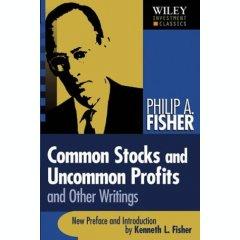
HBCU Money™ Business Book Feature – Common Stocks and Uncommon Profits and Other Writings

Widely respected and admired, Philip Fisher is among the most influential investors of all time. His investment philosophies, introduced almost forty years ago, are not only studied and applied by today’s financiers and investors, but are also regarded by many as gospel. This book is invaluable reading and has been since it was first published in 1958. The updated paperback retains the investment wisdom of the original edition and includes the perspectives of the author’s son Ken Fisher, an investment guru in his own right in an expanded preface and introduction.
“I sought out Phil Fisher after reading his Common Stocks and Uncommon Profits…A thorough understanding of the business, obtained by using Phil’s techniques…enables one to make intelligent investment commitments.” – Warren Buffet

2011’s Top 10 HBCU Endowments

2011’s Top HBCU Endowments

You’ll notice some schools missing from the 2010 list. This is a result of not responding to NACUBO’s survey in time for its publishing and not so much them dropping out of the top 10 by actual value. Even with that we see a $200 million increase in the top 10 list from 2010. A number that must be vastly improved to say the least (The Standford Challenge raised $6.2 billion over 5 years which is 4 times the size of our top 10 endowments combined over 100 plus years). A good sign is the 2011 list comprises five schools in the $100 million plus club versus only three from 2010. Make sure you know your HBCU’s endowment even if its not in the top 10. This is information you can request from your administration’s Chief Financial Officer. And as always if you don’t see your school here – INVEST.

Endowment (in millions) l Investment Return %

1. Howard University

$539,316 l 17.3%

2. Spelman College

$326,929 l 10.7%

3. Hampton University 

$240,014 l 12.8%

4. Florida A&M University

$111,516 l 16.0%

5. Meharry Medical College

$107,529 l 18.6%

6. Morehouse School of Medicine

$72,916 l 15.8%

7. Bethune Cookman University

$42,487 l 24.8%

8. Tennessee State University

$38,130 l 22.2%

9. Texas Southern University

$36,194 l 19.7%

10. Winston-Salem State University

$25,323 l 16.6%

Take a look at how an endowment works. Not only scholarships but research, recruiting talented faculty & students, faculty salaries, and a host of other things can be paid for through a strong endowment. It ultimately is the lifeblood of a college or university.

Additional Notes:
NACUBO Average Endowment – $497.3 million (17.8%)
NACUBO Median Endowment – $93.4 million (20.0%)
Top 10 HWCU Endowments combined – $141.1 billion
Top 10 HBCU Endowments combined – $1.5 billion
Source: National Association of College & University Business Officers