The HBCU Money™ Weekly Market Watch

Our Money Matters /\ November 8, 2013

A weekly snapshot of African American owned public companies and HBCU Money™ tracked African stock exchanges.

NAME TICKER PRICE (GAIN/LOSS %)

African American Publicly Traded Companies

Citizens Bancshares Georgia (CZBS) $5.61 (0.00% UNCH)

M&F Bancorp (MFBP) $3.35 (1.47% DN)

Radio One (ROIA) $3.20 (3.23% UP)

African Stock Exchanges

Bourse Regionale des Valeurs Mobilieres (BRVM)  216.40 (1.03% UP)

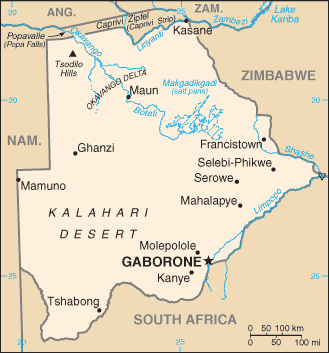
Botswana Stock Exchange (BSE)  8 768.25 (0.04% UP)

Ghana Stock Exchange (GSE)  2 135.51 (78.00% UP)*

Nairobi Stock Exchange (NSE)  134.71 (N/A)

Johannesburg Stock Exchange (JSE) 45 481.19 (1.27% DN)

International Stock Exchanges

New York Stock Exchange (NYSE) 10 002.97 (0.79% UP)

London Stock Exchange (LSE)  3 570.33 (0.04% DN)

Tokyo Stock Exchange (TOPIX)  1 176.42 (0.70% DN)

Commodities

Gold 1 283.60 (1.90% DN)

Oil 94.34 (0.15% UP)

*Ghana Stock Exchange shows current year to date movement. All others daily.

All quotes reported as of 2:00 PM Eastern Time Zone

Twitter’s IPO – African America Creates Billionaires, Just Not Themselves

To be thrown upon one’s own resources, is to be cast in the very lap of fortune. – Benjamin Franklin

tweet_grad-248x248_sq-6fb492867ca7533a1e1003e6a2ade57001b3a109-s6-c30

At this very moment, I am watching the Twitter IPO and there is money flowing into the streets. The company’s initial IPO price was set to be $15-17, then rose to $25-27 on the eve of its IPO, and upon its actual first trade opened at $45.10. Seventy million shares just went from a value of $1 billion to over $2 billion. Evan Williams, co-founder and largest shareholder, just saw his net worth climb by $2.5 billion. Goldman Sachs, the lead investment bank for Twitter’s IPO, is set to take home almost $30 million of the $60 million in fees this IPO generated. The New York Stock Exchange lands a coup for pulling a major tech IPO from under NASDAQ’s nose after their Facebook debacle. What is not in any of that money? African America. Well, sort of.

African America’s presence is in Twitter from the place it typically is – as a consumer. While African Americans account for 13 percent of the United States population, we account for 22 percent of Twitter users. In terms of daily usage, we account for 11 percent, while European Americans usage is 4 times less than that. To say we have a dominant presence on Twitter would be something of an understatement. If African Americans left Twitter in mass, investors would be clamoring for bomb shelters as the stock would probably fall a part. So why are we not present where it matters most? Do we even know where it matters most?

When it comes to the capital markets picture of Twitter, we are completely absent. There were no African American underwriters present on the company’s S-1 filing. Again, part of that $60 million dollar pie in fees. In terms of early money or venture capital, there were no African Americans with significant investment in the company. Although, it is at least rumored that P. Diddy at one point tried to buy the company. Commendable on one hand and laughable on the other given his financial worth. By the time this company would have even been on Diddy’s radar it was already being valued at upwards of $1 billion – twice his net worth. As Chris Rock often reminds us there is a difference between rich and wealthy.

Sadly, this IPO highlights an all too often reality in African America’s economic behavior. We often are the suppliers of the content, but rarely if ever control the mediums of distribution. We often consume the product, but rarely are we the finance or investment behind its creation. Much of what I am saying here is repeated old hat, but it is worth repeating over and over again until the mindset and behavior indicates some movement of change. These are just some things to ponder the next time you are sending out your next 140 characters.

HBCU Money™ Histronomics: Booker T. Washington’s Atlanta Compromise

Booker_T._Washington_Lecture,_1906

Mr. President and gentlemen of the Board of Directors and citizens. One third of the population of the South is of the Negro race. No enterprise seeking the material, civil, or moral welfare of this section can disregard this element of our population and reach the highest success. I must convey to you, Mr. President and Directors, and Secretaries and masses of my race, when I say that in no way have the value and manhood of the American Negro been more fittingly and generously recognized, than by the managers of this magnificent exposition at every stage of its progress. It is a recognition that will do more to cement the friendship of the two races than any occurrence since the dawn of our freedom. Not only this, but the opportunities here afforded will awaken among us a new era of industrial progress.

Ignorant and inexperienced, it is not strange that in the first years of our new life we began at the top instead of the bottom, that a seat in Congress or the state legislature was more sought than real estate or industrial skill, that the political convention of some teaching had more attraction than starting a dairy farm or a stockyard.

A ship lost at sea for many days suddenly sighted a friendly vessel. From the mast of the unfortunate vessel was seen a signal: “Water, water. We die of thirst.” The answer from the friendly vessel at once came back: “Cast down your bucket where you are.” A second time, the signal, “Water, send us water!” went up from the distressed vessel. And was answered: “Cast down your bucket where you are.” A third and fourth signal for water was answered: “Cast down your bucket where you are.” The captain of the distressed vessel, at last heeding the injunction, cast down his bucket and it came up full of fresh, sparkling water from the mouth of the Amazon River.

To those of my race who depend on bettering their condition in a foreign land, or who underestimate the importance of preservating friendly relations with the southern white man who is their next door neighbor, I would say: “Cast down your bucket where you are.” Cast it down, making friends in every manly way of the people of all races, by whom you are surrounded.

To those of the white race who look to the incoming of those of foreign birth and strange tongue and habits for the prosperity of the South, were I permitted, I would repeat what I have said to my own race: “Cast down your bucket where you are.” Cast it down among the eight millions of Negroes whose habits you know, whose fidelity and love you have tested in days when to have proved treacherous meant the ruin of your fireside. Cast down your bucket among these people who have without strikes and labor wars tilled your fields, cleared your forests, builded your railroads and cities, brought forth treasures from the bowels of the earth, just to make possible this magnificent representation of the progress of the South.

Currencies Of The African Diaspora – Benin

The economy of Benin remains underdeveloped and dependent on subsistence agriculture, cotton production, and regional trade. Growth in real output had averaged almost 4% before the global recession and it has returned to roughly that level in 2011-12. Inflation has subsided over the past several years. In order to raise growth, Benin plans to attract more foreign investment, place more emphasis on tourism, facilitate the development of new food processing systems and agricultural products, and encourage new information and communication technology. Specific projects to improve the business climate by reforms to the land tenure system, the commercial justice system, and the financial sector were included in Benin’s $307 million Millennium Challenge Account grant signed in February 2006. The 2001 privatization policy continues in telecommunications, water, electricity, and agriculture. The Paris Club and bilateral creditors have eased the external debt situation with Benin benefiting from a G-8 debt reduction announced in July 2005, while pressing for more rapid structural reforms. An insufficient electrical supply continues to adversely affect Benin’s economic growth though the government recently has taken steps to increase domestic power production. Private foreign direct investment is small, and foreign aid accounts for the majority of investment in infrastructure projects. Cotton, a key export, suffered from flooding in 2010-11, but high prices supported export earnings. The government agreed to a 25% increase in civil servant salaries in 2011, following a series of strikes, increasing pressure on the national budget. Benin has appealed for international assistance to mitigate piracy against commercial shipping in its territory.

Benin tourism destinations

WAS207B

WAS208B

WAS215B

ben-200f

Source: Economy overview provided by CIA Factbook

Hip-Hop, Philanthropy, & HBCUs – An Interview With Mississippi’s Own Young Malice & CHMA’s Jarrett Carter

It is often talked about the close relationship of HBCUs and hip-hop in the past. During the late 80s and 90s it was not uncommon to see hip-hop artist sporting HBCU gear. However, that time period seems like a distant memory and with the donation by Dr. Dre to the University of Southern California coupled with an editorial response by Dr. Walter Kimbrough of Dillard University essentially pointing out that if the $35 million he donated had been evenly spread across all 100 plus HBCUs it would have made a prodigious institutional impact. So what is the relationship of HBCUs and African American hip-hop artist today? Can a relationship be forged to raise much-needed funds and awareness? We sat down with two influential minds of hip-hop and philanthropy to get their thoughts on creating a more mutually beneficial relationship for HBCUs: Young Malice, a Jackson, Mississippi native, hip-hop artist, entrepreneur, and avid HBCU supporter. Jarrett Carter, executive director of the Center for HBCU Media Advocacy and owner of Carter Media Enterprises. We probed their thoughts on where we go from here.

We are sure both of you in some way or another heard, read, or talked about the Dr. Dre donation to the University of Southern California, which many in the HBCU community were not happy with it. What were your thoughts on the donation?

Young Malice: I heard about the donation and I think that a man’s earnings and what he chooses to do with them are HIS/HER business. He obviously had a reason, whatever that reason maybe and why he chose to give such a large amount to an institute, which is already one of the wealthier in the nation. There’s more to it than what meets the eye though, I can guarantee THAT. Headphone sales must be going well for Dre huh?! *laughs*

Jarrett Carter: It was disappointing, but not because he gave the money to a predominantly white college near where he grew up and lives; but disappointing in that we thought Dr. Dre somehow betrayed the HBCU community. I don’t know how many development officers have reached out to Dr. Dre or other rappers, athletes or actors, but the truth is that we have to reach out to young wealthy African Americans as our first and best targets for financial support. Many of these individuals have some connection to an HBCU – a relative or a friend, chances are, have been at or graduated from an HBCU. Being black is no longer a qualifier for attending or supporting an HBCU, and we would be wise to recognize this reality, expeditiously.

Do you believe there is disconnect between African American hip-hop artist and HBCUs? If there is disconnect, what could be done to fix it? If not, what could be done to strengthen the relationship? 

Young Malice: Well, there’s definitely a disconnect but like most problems in life we encounter it can be FIXED. As an artist, I’m forced to be capable of placing myself in another’s shoes and seeing ALL angles and not just my own view on things. With this being the case, I can understand why this “disconnect” between HBCUs and hip hop artists exists. I think that the HBCUs within our nation have worked so hard to shed this negative image, which has plagued us as black people for SO LONG that when anything or anyone does not conform to the standards that have been implemented they tend to be shunned. It’s deeply rooted and it will take a lot of work to understand and meet at a “common ground”.

Jarrett Carter: Absolutely. I think somewhere between controversial lyrics and the typical Ivory Tower arrogance mixed with the cultural obligation to “show others how to do better,” we totally ignored and ostracized hip-hop from HBCU culture. Which is particularly weird, since we have no problem inviting some of the more profane and controversial artists to campus to help sell homecoming concert tickets. The quickest way to build relationships with hip-hop is by genuinely drawing upon their skills and interests within the campus environment. How do you standout from others in the effort to be signed? (Career development) How do you market a product to vastly different audiences? (Personal branding) How do you stay grounded while financing so many people to manage your career? (Community empowerment) There are so many lessons to be learned from young sisters and brothers in the hip-hop community, if only we didn’t see ourselves as better or more enlightened then they are.

Some believe that hip-hop artist love HBCUs from a distance because the majority of the fans that buy the music are not African American and therefore do not want to alienate them. Do you believe this to be the case? Or misunderstanding?

Young Malice: Maybe some artists feel like they won’t be accepted by HBCUs and then again, maybe some desire no acceptance at all. I can recall many instances that shows that were booked at predominantly black colleges were canceled at the last minute mysteriously. It’s because certain artists represent EVERYTHING that the HBCUs are AGAINST…and that’s just the truth of the matter…period. It’s deeper than records sales and fans. End of the day, you just ARE who you ARE. I love my HBCUs from up close, never at a distance…but the relationships need work.

As someone who grew up in Mississippi you have a ground view of the history between HBCUs and TWIs in the state. The discrepancy between Alcorn State, Jackson State, and Mississippi Valley State (combined endowments of $23 million) versus Mississippi State, Ole Miss, and Southern Mississippi (combined endowments of $876 million) is overwhelming. It is hard to imagine institutional reparations being given by the Mississippi legislature but do you believe it is worth pursuing to even the field? Or do you see other ways HBCUs could even the resource playing field allowing them to effectively compete?

Young Malice: There won’t be any reparations. I have no complaints about growing up in Mississippi, because this place taught me so much. People will do whatever you LET them do and that’s my view on it. The HBCUs here have withstood the test of time, kept their dignity and class…even in the midst of blatant underfunding and being overlooked time and time again. Each one of those historically black colleges you named previously has something VERY special about them! I’ve visited them all and each has it’s own unique feel. You can feel the LOVE…and that’s something that money CAN’T buy. We know why the bigger colleges get the bigger funding. It’s not a hidden injustice, especially in Mississippi. The agenda is CLEAR and in your face. Time to come together – HBCUs and the hip-hop community…it’s bigger than US!

There are some who would say that because some of the negativity in the mainstream media about the images of hip-hop at times as violent and misogynistic that HBCU leaderships tend to prefer to not view these artist as potential donors or partners despite the potential impact it could have institutionally. Would you say that is an accurate statement?

Jarrett Carter: I think that is accurate, but if it is accurate, have HBCUs as the hubs of academic and cultural development reached out to these artists to give them new perspective on their artistry? Have we given them opportunities to travel, exposure to scholarly works and cultural information that helps them to grow?

Aside from the obvious financial support what are some ways that you believe hip-hop artist and the genre could best serve HBCUs philanthropically?

Jarrett Carter: I believe that before money, hip-hop artists could be some of our greatest and most influential brand ambassadors. By just wearing hats and t-shirts, or namedropping campuses in their songs, or consistently promoting their time spent on HBCU campuses, we could engage a totally new generation of HBCU enthusiasts across racial and economic lines.

What advice would you give to hip-hop donors new to the world of philanthropy?

Jarrett Carter: I would encourage hip-hop artists and executives to be open to hearing from HBCUs about opportunities for visiting lecture, specific opportunities to fund programmatic projects and initiatives, and to avail themselves to students working to enter fields of study in the performing arts – theater, opera, jazz, etc – thereby making themselves benefactors of historic and culturally important Black art forms.

In 2012, Forbes reported the top 20 earners in hip-hop pulled in an estimated $415 million in earnings and possibly hundreds of millions more by artist who choose to keep their earnings more private. All 100 plus HBCU endowments combined have combined endowments of only an estimated $2 billion with some HBCUs having no endowment at all. What do you envision being a win-win relationship between hip-hop and HBCUs that could see some of these earnings finding their way to HBCUs?

 Young Malice: I would say EMBRACE the hip-hop community or just try to embrace the elements of the culture that you are most comfortable with. Some artists tend to be a bit more extreme than others but then again so are some actors. If you wouldn’t turn Denzel Washington or Samuel L. Jackson away from your doors, then try to understand that most artists are just attempting to paint a picture…just so happens to be that it’s through your stereo. If the MONEY is good enough to be embraced, then the individual should be also. In my opinion – EMBRACE the hip-hop community with open arms – don’t be so quick to “judge”.

Jarrett Carter: In my mind, a mutually beneficial opportunity for HBCUs and hip-hop is if rappers are recording and publishing music from HBCU campuses with shared publishing and distribution rights. That students are involved in every step of a produced project – from A&R, to production, to marketing, to distribution. This ensures that the artist can build individual wealth, and that the schools can build endowments and scholarship opportunities.

In closing, both of you grew up as the rise of hip-hop was taking place. What was your favorite hip-hop memory as it related to an HBCU?

Young Malice: My favorite moments will be when I rock the HBCU crowds around the nation!

Jarrett Carter: The legend of Jay Z being scheduled to perform at Morgan’s homecoming concert in 1996, showing up late, and upon arriving, saying into the microphone, “I’m not coming out until ya’ll pay me my f*cking money.”

Thank you to Mr. Young Malice and Mr. Jarrett Carter for participating in this interview.