The function of education is to teach one to think intensively and to think critically. Intelligence plus character — that is the goal of true education. — Dr. Martin Luther King Jr., civil rights leader.
In the heart of Black America, Historically Black Colleges and Universities (HBCUs) have long stood as bastions of culture, scholarship, and legacy. For over a century, they have been the educators of Black doctors, lawyers, artists, and entrepreneurs producing alumni who carry the spirit of service, resilience, and community into the wider world. But as the demographics of their faculty, administrators, and staff begin to shift away from their original mission, a cultural crisis looms. HBCUs are in danger of just becoming a diet version of PWIs. They are in danger of becoming Others’ institutions and no longer higher education institutions that represent the interests of African America and the larger Diaspora.
Today, fewer African American professors walk HBCU halls. Fewer Black deans shape curriculum rooted in our lived experience. And fewer culturally attuned staff members guide students with the kind of ancestral understanding that once made HBCUs more than just institutions they were safe havens.
We are witnessing a troubling erosion of what might best be described as the Cultural IQ of HBCUs. And at the center of this storm is a vanishing pipeline of HBCU alumni becoming the very educators and institutional leaders these colleges desperately need.
The data tell a sobering story. While overall enrollment at many HBCUs is stable or growing, the number of African American faculty and administrators is not keeping pace. According to a 2023 report by the National Center for Education Statistics, less than 55% of full-time faculty at HBCUs are African American, a decline from decades prior. The leadership picture is even more stark: several prominent HBCUs have seen key leadership roles—presidents, provosts, department chairs—filled by individuals with little to no HBCU or African American cultural background.
This is not a conversation about exclusion. It’s a conversation about preservation. Cultural IQ, the lived experience, emotional intelligence, and intergenerational memory that African American faculty bring to campus is vital to the mission of HBCUs.
“Our institutions are continuing their academic strength but becoming culturally unrecognizable,” says William A. Foster, IV, an economist, financier, and HBCU alumnus. “What happens when the very people who carry the oral and spiritual history of our schools are no longer the ones teaching and leading?”
From Alumni to Architects: Building a Faculty Pipeline
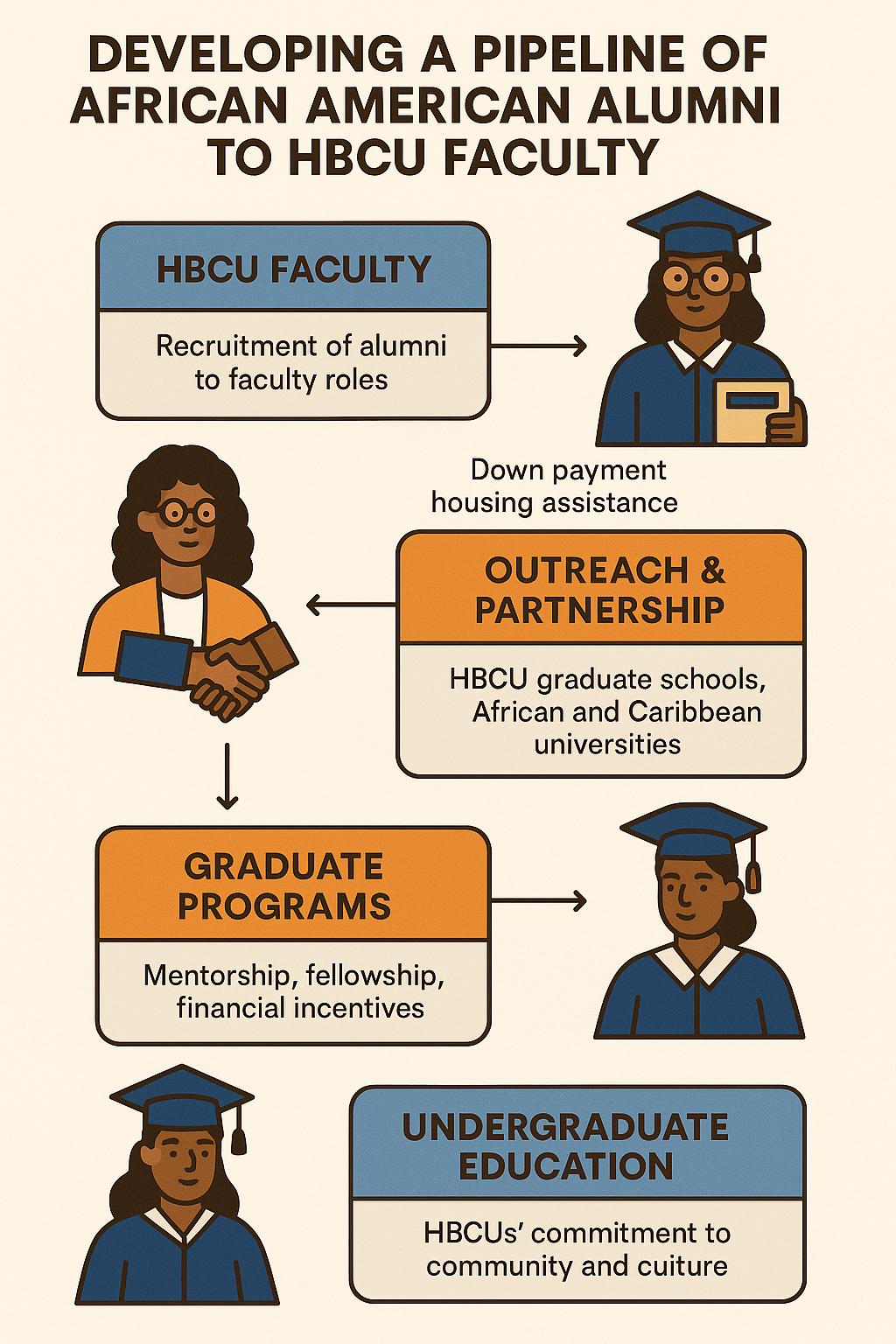
One of the most promising ways to reverse this trend is to create a clear, intentional pipeline for HBCU alumni to return as faculty, staff, and administrators. Many graduates of HBCUs would jump at the opportunity to come back but financial, professional, and institutional roadblocks often get in the way.
This is where the HBCU Faculty Development Network (HBCU-FDN) comes in. Founded to support faculty at HBCUs through professional development, mentoring, and pedagogical innovation, the Network is uniquely positioned to become the heartbeat of a renewed talent pipeline. But it needs more support and visibility.
Imagine a structured, inter-HBCU program, one backed by governmental and philanthropic dollars that identifies promising undergraduates, supports them through HBCU graduate programs, places them in teaching assistantships, connects them to mentors through HBCU-FDN, and then guarantees interviews at HBCU campuses upon graduation. It’s time to rethink what faculty development means. We’re not just developing skills we’re preserving cultural continuity. HBCU graduate schools are uniquely situated to be the breeding ground for the next generation of African American faculty. From Howard’s School of Divinity to Florida A&M’s College of Pharmacy and Pharmaceutical Sciences, graduate students often come with a mix of cultural knowledge and scholarly ambition. But they need a system that encourages them to stay within the ecosystem.
Too often, HBCU graduate students are trained at their alma maters and then “exported” to majority-white institutions, both due to higher pay and limited on-campus faculty opportunities. A shift in strategy backed by deliberate investment could change this. Graduate assistantships that offer teaching experience, tuition remission, and research mentorships tied to HBCU-FDN could create a self-sustaining culture of scholarship. And importantly, HBCUs need to offer competitive packages to attract their own graduates back. There’s a deep emotional pull when you think about teaching where you were taught. But they have student loans to consider and cannot afford to come back just for nostalgia. This is where material incentives must meet mission.
Faculty retention is not just about recruitment it’s about creating lives worth living. For many HBCU alumni, particularly those returning to rural or economically challenged towns, the prospect of moving back to teach is made harder by financial instability. Housing support could be a game-changer.
Down payment assistance, low-interest home loans, and first-time buyer programs tied to faculty appointments would not only attract alumni but anchor them in the communities they serve. This model, successfully piloted in other sectors such as medicine and public education, could be expanded through HUD-HBCU partnerships, regional banks, or even campus-based community development funds.
“If you can give a medical school grad incentives to work in underserved areas, why not do the same for faculty at Black colleges?” argues Mr. Foster, who researches institutional economics and ecosystems. “The social return on investment is enormous.” Indeed, an HBCU that retains a culturally informed faculty member for 20 years gains more than a teacher, it gains a historian, a mentor, a surrogate parent, and a living curriculum.
Rebuilding the HBCU pipeline cannot be confined to American borders. HBCUs have a powerful opportunity to collaborate with African and Caribbean colleges and universities to build transnational faculty exchange programs, joint doctoral degrees, and even faculty credentialing pathways.
Imagine a Nigerian Ph.D. student at the University of Lagos who teaches for a semester at Tuskegee University as part of a diaspora exchange program. Or a Caribbean education scholar completing a visiting professorship at Southern University while collaborating on curriculum development. These aren’t flights of fancy they are strategic partnerships waiting to be forged.
The Pan-African intellectual tradition is our superpower. By partnering with African and Caribbean institutions, we infuse our campuses with a broader Black experience and build networks that empower all of us. Such partnerships could be coordinated through consortia like the Association of Caribbean Higher Education Administrators or the African Research Universities Alliance.
Cultural IQ is not just about familiarity with Black history. It’s about understanding how trauma, family structures, faith, language, resistance, and joy show up in the classroom. It’s about knowing why a student may resist authority or thrive under communal support. It’s about understanding the subtext behind silence or the significance of the Black church in a student’s worldview.
When HBCUs lose this kind of faculty wisdom, they risk becoming hollowed-out shells. Institutions may remain, but their souls quietly disappear. African American faculty are more likely to mentor Black students, use culturally relevant pedagogy, and engage in community-based scholarship. When that faculty is missing, students often feel less seen, less supported, and less likely to persist. In other words: retention of culturally attuned faculty improves student retention. To build this pipeline, bold philanthropy and supportive policy must go hand in hand.
Foundations like Mellon, Lumina, and the United Negro College Fund have already shown interest in faculty development. What’s needed now is alignment tying funding to long-term pipeline outcomes, incentivizing inter-HBCU faculty mobility, and supporting research programs that keep Black scholars engaged.
On the policy side, state legislatures and the federal government can expand Title III funding specifically for faculty recruitment and retention. The Department of Education could support teaching fellowships for HBCU alumni. And Congress could pilot a Faculty Forgiveness Program, where a portion of student loans is forgiven for each year of service at an HBCU. It is important to design anything in a politically strategic way that can survive political variances. This is about reparative investment. HBCUs gave so much with so little. The least we can do is fund the future of their faculties.
This isn’t just an institutional problem it’s a community imperative. If you’re an HBCU alum, consider returning to teach. If you’re a philanthropist, invest in the cultural stewards of our classrooms. If you’re a student, imagine yourself not just graduating but returning to guide the next class.
Reclaiming the Cultural IQ of HBCUs is not a luxury—it’s a necessity. Because no one can teach us like us.
Sidebar: What Is Cultural IQ?
Cultural IQ refers to the depth of understanding, sensitivity, and emotional intelligence that individuals bring to cultural experiences. At HBCUs, it’s the instinct to uplift, contextualize, and nurture Black students with care, rigor, and rooted knowledge. Faculty with high Cultural IQ don’t just teach Black students—they teach to them, for them, and with them.
Sidebar: The HBCU Faculty Development Network
HBCU-FDN is a nonprofit consortium of HBCUs dedicated to enhancing teaching effectiveness and professional development. The Network holds annual conferences, offers mentorship programs, and supports curriculum innovation across more than 100 institutions.
“It is disappointing that HBCUs and any African American institution for that matter have not figured out yet that the circulation of our social, economic, and political capital with each other at the institutional level is where the acute crisis of closing the wealth gap truly lies. Yet, we still chase colder ice.” – William A. Foster, IV
The percentage of PWI dollars that flow into African American owned businesses is likely limited to catering a social event. Beyond that, their dollar never even likely floats pass an African American business. However, HBCUs certainly cannot say the same. HBCU capital leaving the African American financial ecosystem looks like every dam on Earth broke at the same time.
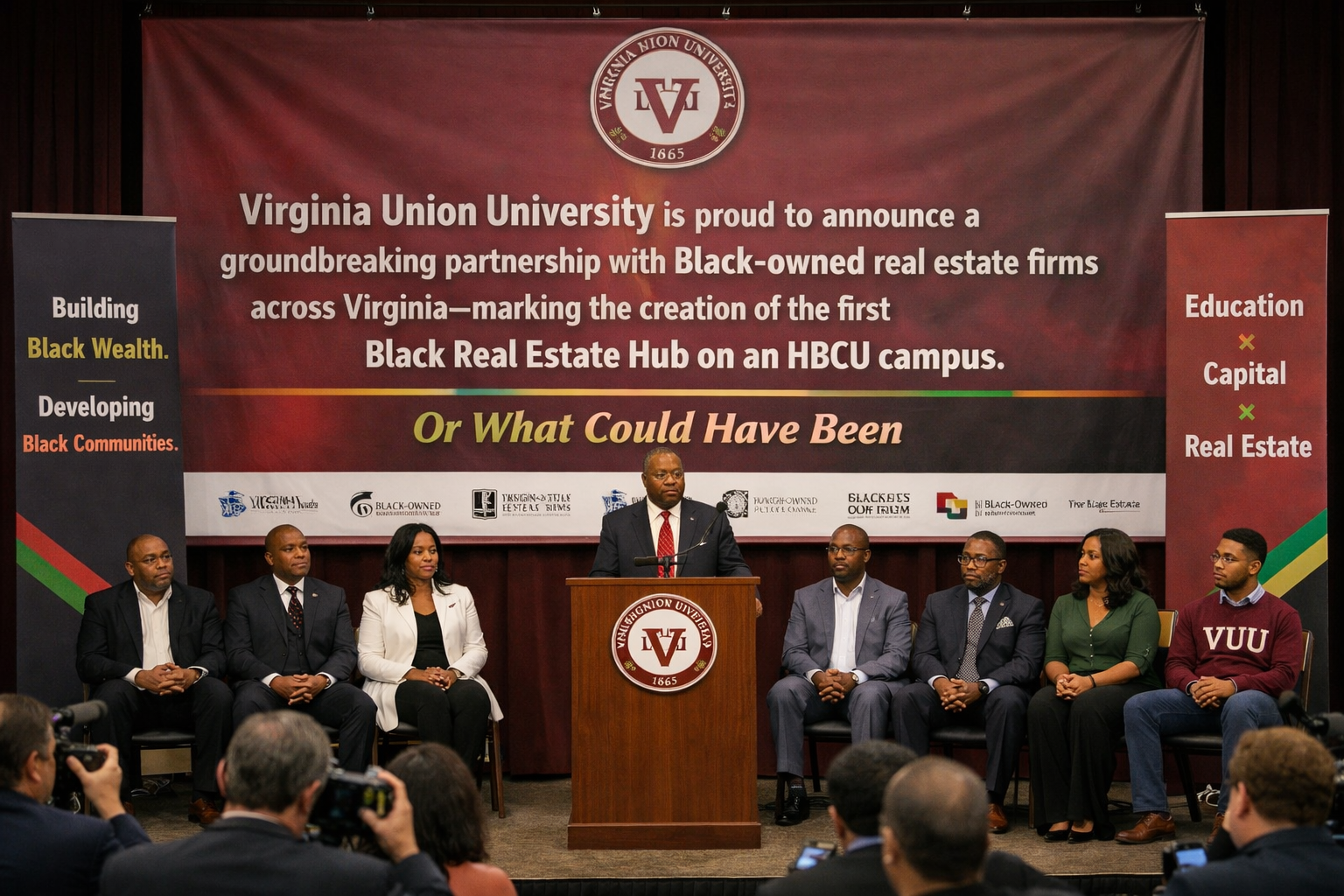
Virginia Union University’s recent announcement of a partnership with Keller Williams Richmond West represents a familiar pattern in HBCU decision-making, one that undermines the very mission these institutions claim to champion. While VUU proudly touts this collaboration as “groundbreaking” and positions it as a pathway to “closing the racial wealth gap,” the partnership reveals a fundamental misunderstanding of how wealth gaps are actually closed. The reality is stark: you cannot close a racial wealth gap by systematically excluding institutions from your own community from the economic opportunities your institution creates.
When HBCUs partner exclusively with non-Black institutions, they create what economists call a “leaky bucket” effect. The money, talent, and social capital generated by these historically Black institutions flow outward to other communities rather than circulating within the African American ecosystem. Every dollar spent with a non-Black vendor, every partnership signed with a non-Black firm, every opportunity directed away from Black-owned businesses represents wealth that could have been building generational prosperity in Black communities—but instead enriches other groups. This is where the fundamental disconnect lies: HBCUs understand the importance of encouraging individual African Americans to support Black-owned businesses, yet these same institutions fail to apply this principle at the institutional level where the real economic power resides.
The conversation about the circulation of the African American dollar has historically focused on individual consumer behavior. We’ve heard for decades about the need for Black consumers to shop at Black-owned stores, bank with Black-owned financial institutions, and hire Black-owned service providers. Studies have shown that a dollar circulates in Asian communities for approximately thirty days, in Jewish communities for around twenty days, in white communities for seventeen days, but in Black communities for only six hours before leaving. This abysmal circulation rate is correctly identified as a critical factor in the persistent wealth gap. But what these discussions almost always miss is that individual consumer behavior, while important, pales in comparison to institutional spending power.
When Virginia Union University signs a multiyear partnership with Keller Williams, it’s not spending a few hundred or even a few thousand dollars. Institutional partnerships involve hundreds of thousands or millions of dollars in direct and indirect economic benefits—facility usage, marketing exposure, student referrals, commission opportunities, and brand association. A single institutional partnership can equal the spending power of hundreds or thousands of individual consumers. Yet HBCUs consistently fail to recognize that their institutional spending decisions have exponentially more impact on wealth circulation than any individual consumer choice their students or alumni might make.
VUU’s partnership with Keller Williams is particularly emblematic of this pattern. According to the announcement, this collaboration will create “the first Keller Williams Real Estate Hub on an HBCU campus in Virginia” and will be “designed to bridge education, entrepreneurship, and real estate into one powerful ecosystem.” The goals are admirable: career readiness, economic mobility, wealth-building opportunities through real estate education and professional pathways. The partnership is positioned as being co-led by members of Delta Sigma Theta Sorority, Incorporated, with explicit language about sisterhood, brotherhood, and service in action. But here’s the question VUU administrators apparently didn’t ask: Why not create this “powerful ecosystem” with a Black-owned real estate company?
The assumption underlying most HBCU partnerships with non-Black firms seems to be that suitable Black-owned alternatives don’t exist. This assumption is demonstrably false. Black-owned real estate companies operate throughout the United States, including in Virginia and the Richmond area. These firms possess the expertise, resources, and commitment to serve HBCU students and alumni. United Real Estate Richmond, which describes itself as the largest Black-owned real estate firm in the Mid-Atlantic region, operates right in VUU’s backyard. CTI Real Estate is a Black-owned, woman-owned firm serving Virginia and Maryland. Nationally, companies like Braden Real Estate Group—a Black-owned Houston-based brokerage co-founded by Prairie View A&M University graduate Nicole Braden Handy—demonstrate the success of HBCU alumni in building substantial real estate businesses. H.J. Russell & Company, founded in 1952, stands as one of the largest minority-owned real estate firms in the United States. These Black-owned firms have proven track records of success, deep community connections, and explicit missions to build wealth in African American communities. These firms could provide the same—or better—opportunities that Keller Williams offers, with the added benefit of keeping wealth circulating in the Black community.
The difference would be transformative. A partnership with a Black-owned real estate firm would actually contribute to closing the wealth gap. It would demonstrate to students what Black excellence in business looks like. It would create mentorship opportunities with professionals who understand the unique challenges and opportunities facing Black Americans in real estate. It would ensure that the commissions, fees, and other economic benefits generated by the partnership stay within the African American economic ecosystem. Most importantly, it would model the institutional behavior necessary for true wealth accumulation—showing students that circulation of Black dollars must happen at every level, not just in their personal spending habits.
But to truly understand what institutional circulation looks like, consider this scenario: An African American real estate investment firm—owned by an HBCU alumnus and employing HBCU graduates as project managers, analysts, and development specialists—decides to develop a mixed-use building in Richmond. The firm uses Braden Real Estate Group to acquire the land. They secure financing from an African American bank like OneUnited Bank or Liberty Bank, supplemented by an investment syndicate of African American investors. The construction is handled by an African American-owned construction company like H.J. Russell & Company. When the transaction closes, it’s processed through Answer Title & Escrow LLC, the Black-owned title company founded by University of the District of Columbia alumna Donna Shuler. The property management contract goes to another Black-owned firm. The legal work is handled by Black attorneys. The accounting is done by a Black-owned firm.
This is what institutional circulation actually looks like. In this single development project, wealth circulates through multiple Black-owned institutions at every stage of the transaction. The bank earns interest income that it can then lend to other Black businesses and homeowners. The title company generates revenue that allows it to hire more staff and take on larger projects. The construction company builds its portfolio and capacity to compete for even bigger developments. The real estate investment firm creates returns for its Black investors and proves the viability of Black-owned development companies. The project managers and analysts gain experience that prepares them to start their own firms. Every single point in the transaction keeps wealth circulating within the African American economic ecosystem, building institutional capacity, creating jobs, generating returns, and proving that Black-owned institutions can handle sophisticated, large-scale projects.
Now contrast that with what happens when VUU partners with Keller Williams. Students may get training and even jobs as real estate agents, but the institutional wealth flows to Keller Williams—a non-Black company. The commissions generated by VUU-affiliated agents enrich Keller Williams’ franchise system. The brand association benefits Keller Williams’ reputation. The networking opportunities primarily connect students to Keller Williams’ existing (predominantly non-Black) networks. And when these students eventually facilitate property transactions, the ancillary services—financing, title work, legal services—typically flow to whatever institutions Keller Williams recommends, which are unlikely to be Black-owned.
The VUU-Keller Williams partnership might help individual Black students enter the real estate industry, but it does absolutely nothing to build the Black-owned institutional infrastructure necessary for true wealth building. In fact, it actively undermines that infrastructure by directing institutional resources and opportunities away from Black-owned firms. VUU essentially takes Black talent, students who could be building careers with Black-owned firms, and channels them into a non-Black institution, teaching them that Black institutions aren’t capable of providing the same opportunities.
This is the critical insight that HBCUs continue to miss: institutional circulation of capital is what builds lasting economic power. When individual Black consumers support Black businesses, they create important but limited impact. One person shopping at a Black-owned grocery store or banking with a Black-owned bank makes a difference, but a small one. When Black institutions support Black businesses, they create transformative, generational impact. An HBCU that partners with Black-owned banks, construction companies, real estate firms, technology providers, and service companies doesn’t just create individual transactions it builds an entire ecosystem of mutually reinforcing institutions that grow stronger together. This institutional ecosystem then has the power to compete with non-Black institutions, create opportunities at scale, and genuinely close wealth gaps.
Think about what would happen if every HBCU made a commitment to work exclusively with Black-owned institutions whenever viable alternatives exist. Imagine if all 101 HBCUs banked with Black-owned banks, used Black-owned construction companies for campus buildings, partnered with Black-owned real estate firms for student housing and community development, contracted with Black-owned technology companies for IT services, and hired Black-owned firms for legal, accounting, and consulting work. The combined institutional spending power of HBCUs would transform the Black business landscape. Black-owned banks would have hundreds of millions in deposits, allowing them to make larger loans and compete for more business. Black-owned construction companies would have steady revenue streams that would allow them to invest in equipment, hire skilled workers, and bid on larger projects. Black-owned real estate firms would have the institutional backing to compete for major developments. Black-owned technology companies would have the resources to innovate and scale.
But beyond the immediate economic impact, this institutional circulation would create something even more valuable: proof of concept. When Alabama State University chooses a Black-owned bank to handle a $125 million transaction, it proves that Black-owned financial institutions can handle sophisticated, large-scale deals. When VUU partners with a Black-owned real estate firm to create a campus-based real estate hub, it proves that Black-owned companies can deliver the same quality and scale as non-Black competitors. When HBCUs consistently work with Black-owned construction companies, law firms, accounting firms, and consulting companies, they build a track record of success that these firms can point to when competing for other major contracts. This institutional validation is precisely what Black-owned businesses need to break through the barriers that have historically excluded them from large-scale opportunities.
VUU’s partnership is not an isolated incident, it’s part of a troubling pattern. As HBCU Money has documented, only two HBCUs are believed to bank with Black-owned banks, meaning well over 90 percent of HBCUs do not bank with African American-owned financial institutions. This mirrors the broader pattern where over 90 percent of African Americans who attend college choose non-HBCUs, and in both cases, neither Black-owned banks nor HBCUs are able to fulfill their potential without the patronage and investment of those they were built to serve. Alabama State University’s $125 million decision to partner with a non-Black financial institution exemplifies what can be called “Island Mentality”—the failure of HBCUs to connect with and support the African American private sector. When Alabama State University had the opportunity to work with Black-owned banks and financial institutions, they chose to look elsewhere. Consider the irony: Howard University, African America’s flagship HBCU, partnered with PNC Bank, a Pittsburgh-based institution with over $550 billion in assets, more than 100 times the combined assets of all remaining Black-owned banks to create a $3.4 million annual entrepreneurship center. Meanwhile, Industrial Bank, a Black-owned institution with $723 million in assets, operates right in Howard’s backyard. PNC Bank’s executive team commanded $81 million in compensation in 2022 alone, while only one Black-owned bank in America has assets exceeding $1 billion. These decisions, like VUU’s partnership with Keller Williams, send a devastating message: even historically Black institutions don’t believe Black-owned businesses are worthy of their partnership.
The impact extends beyond symbolism. Every time an HBCU chooses a non-Black partner when Black alternatives exist, it represents lost revenue for Black-owned businesses that could have grown stronger, hired HBCU graduates, and created more opportunities. It represents missed networking opportunities for students who could have built relationships with Black business leaders. It represents weakened community ties that could have been strengthened through institutional support. It represents reduced political capital for the Black business community, which needs institutional backing to compete for larger contracts. And it perpetuates stereotypes about the capability and reliability of Black-owned businesses.
Let’s be clear about what “closing the wealth gap” actually requires. According to the Federal Reserve’s Survey of Consumer Finances, the median wealth of white families is approximately ten times greater than that of Black families. This gap didn’t emerge overnight, and it won’t close through symbolic gestures or partnerships that funnel Black talent and capital into non-Black institutions. Closing the wealth gap requires wealth creation within the Black community through business ownership and entrepreneurship. It requires wealth circulation that keeps dollars moving through Black-owned businesses before leaving the community. It requires wealth accumulation through strategic investments in Black-owned assets. And it requires wealth transfer across generations through education, mentorship, and institutional support.
When VUU partners with Keller Williams instead of a Black-owned real estate company, it fails on every single one of these requirements. The wealth created by student success in real estate will flow to Keller Williams and its predominantly non-Black agents. The circulation of capital will happen outside the Black community. The accumulation will benefit non-Black wealth holders. And the transfer of knowledge and opportunity will lack the cultural competency and community commitment that comes from working with Black-owned institutions. Most critically, VUU misses the opportunity to demonstrate to its students how institutional circulation of capital works, teaching them instead that even Black institutions should look outside their community for partnerships when it matters most.
The example of what institutional circulation could look like in real estate development isn’t theoretical it’s entirely possible right now with existing Black-owned institutions. When Donna Shuler founded Answer Title & Escrow LLC as a University of the District of Columbia alumna, she created exactly the kind of institutional capacity that makes the full-circle Black real estate ecosystem viable. As she explained in her interview with HBCU Money, title companies play a crucial role in every real estate transaction—they ensure clear ownership, coordinate closings, prepare legal documents, collect funds, and issue title insurance. Having a Black-owned title company means that millions of dollars in fees and service charges stay within the Black community rather than flowing out. Combined with Black-owned banks providing financing, Black-owned real estate firms handling acquisitions, Black-owned construction companies building the projects, and Black-owned development firms managing the entire process, you create a complete ecosystem where institutional wealth circulates multiple times before leaving the community.
This is what VUU could have created with its real estate initiative but chose not to. Instead of building an ecosystem where Black institutions strengthen each other, VUU created a pipeline that extracts Black talent and channels it into a non-Black institution. Students will learn real estate from Keller Williams, make connections through Keller Williams networks, and likely facilitate transactions that benefit Keller Williams and its associated service providers. The institutional wealth created by VUU’s endorsement and student pipeline flows entirely out of the Black community.
HBCUs often justify these partnerships by arguing that non-Black firms offer broader networks, more resources, or greater reach. This argument is both self-fulfilling and self-defeating. It’s self-fulfilling because when HBCUs consistently choose non-Black partners, they ensure that Black-owned businesses never gain the institutional backing needed to compete at scale. How can Black-owned real estate companies build the same networks as Keller Williams when HBCUs, the institutions that should be their natural partners, consistently choose their competitors? It’s self-defeating because it undermines the very purpose of HBCUs. These institutions were created because the existing educational ecosystem excluded Black Americans. They thrived by building their own networks, creating their own opportunities, and supporting each other. The suggestion that HBCUs now need to partner with non-Black institutions to succeed represents a fundamental abandonment of the HBCU mission and the institutional circulation principle that should guide their operations.
Imagine if VUU had instead announced a partnership with a coalition of Black-owned real estate companies. The announcement might have read: “Virginia Union University is proud to announce a groundbreaking partnership with Black-owned real estate firms across Virginia marking the creation of the first Black Real Estate Hub on an HBCU campus. This collaboration goes beyond sponsorship to create career readiness, economic mobility, and wealth-building opportunities for VUU students, alumni, and the Richmond community through real estate education, entrepreneurship, and professional pathways led by successful Black business owners including HBCU alumni. Students will learn not just how to sell houses, but how to build generational wealth through development, investment, and institutional deal-making within the Black business ecosystem. They will receive training from firms like United Real Estate Richmond, Braden Real Estate Group, and other Black-owned companies, with pathways to internships and employment that keep talent and capital circulating within the African American community. The initiative will explicitly connect students with Black-owned banks for financing education, Black-owned title companies for transaction processing, and Black-owned development firms for career opportunities in the full spectrum of real estate activities.”
Such a partnership would demonstrate commitment to the Black business community, create mentorship pipelines between Black students and Black business leaders, build economic power by concentrating resources in Black-owned institutions, establish replicable models for other HBCUs to follow, and generate authentic wealth-building that actually closes gaps rather than widening them. It would teach students the most important lesson about wealth building: that institutional circulation of capital within your community is what creates lasting prosperity, not individual success stories that extract value from the community.
Beyond economics, these partnership decisions carry enormous social and political implications. When HBCUs choose non-Black partners, they signal to their students, alumni, and communities that Black-owned businesses are insufficient, unreliable, or less capable. This message has devastating ripple effects. Students at HBCUs should graduate believing they can build successful businesses that serve their communities and compete at the highest levels. They should see their institutions modeling the behavior they’re encouraged to adopt. Instead, they witness their own universities choosing non-Black partners, learning an implicit lesson about the supposed superiority of non-Black institutions. They learn that while individual Black consumers should support Black businesses, institutions don’t have to follow the same principle. This creates a fundamental contradiction that undermines the economic empowerment message entirely.
Consider the message VUU sends with its Keller Williams partnership: “We’ll teach you to be real estate professionals, but we don’t believe Black-owned real estate companies are good enough to partner with us.” What are students supposed to take from that? That they should aspire to work for Black-owned firms, or that they should aim for the “real” opportunities at non-Black companies? That Black businesses can compete at the highest levels, or that even Black institutions don’t really believe that? The implicit message is devastating, and it’s reinforced every time an HBCU makes a major partnership announcement with a non-Black firm when Black alternatives exist.
This dynamic also weakens the political capital of the Black business community. When even HBCUs won’t support Black-owned businesses, it becomes nearly impossible for these firms to argue they deserve a seat at the table for major contracts, government partnerships, or policy decisions. If historically Black institutions don’t believe Black businesses are capable of handling significant partnerships, why would predominantly white institutions, corporations, or government agencies think differently? HBCUs, by failing to partner with Black-owned institutions, actively undermine the credibility and viability of the very businesses that could drive wealth creation in African American communities.
The solution isn’t complicated, though it requires courage and commitment. HBCUs must conduct systematic audits of all major partnerships and vendor relationships to identify where Black-owned alternatives exist. They must establish procurement policies that prioritize Black-owned businesses when quality and capability are equivalent. They should create development programs to help emerging Black-owned businesses build the capacity to serve as HBCU partners. They need to build collaborative networks connecting HBCUs with Black-owned banks, real estate firms, construction companies, technology providers, and other businesses. They must measure and report on the percentage of institutional spending directed to Black-owned businesses, creating transparency and accountability. And they need to educate all stakeholders—boards, administrators, faculty, students, and alumni—about why these partnerships matter for wealth gap closure and why institutional circulation of capital is the key to building lasting economic power.
Some will argue this approach is discriminatory or inefficient. This objection ignores history and reality. HBCUs exist because discrimination created the need for separate Black institutions. Having addressed educational exclusion by building their own colleges, it’s logical and necessary to address economic exclusion by building supportive business ecosystems. The focus on institutional circulation isn’t about excluding others; it’s about finally including Black-owned institutions in the economic opportunities that Black institutions create. It’s about recognizing that the same principle we apply to individual consumer behavior of circulate dollars in your community applies with exponentially greater impact at the institutional level.
The choice facing HBCUs is stark: continue operating as isolated islands that happen to serve Black students, or become integral parts of a thriving African American institutional ecosystem that builds collective power and prosperity. Virginia Union University’s partnership with Keller Williams, like Alabama State University’s financial decisions before it, represents the island mentality. These institutions take Black talent, Black energy, and Black resources, then channel them into non-Black institutions that have no structural commitment to Black community wealth-building. They preach to students about supporting Black businesses while their own institutional dollars flow to non-Black partners.
The real estate development scenario described earlier where an HBCU alumnus-owned development firm works with Braden Real Estate Group, Answer Title, a Black-owned bank, and a Black-owned construction company isn’t a fantasy. All of these institutions exist right now. The only thing preventing this kind of institutional circulation from becoming the norm rather than the exception is the willingness of HBCUs to make it a priority. When HBCUs choose to partner with Black-owned institutions, they don’t just create individual transactions they validate and strengthen an entire ecosystem of Black-owned businesses that can then compete for even larger opportunities.
True wealth gap closure requires HBCUs to fundamentally reimagine their role. They must see themselves not as individual institutions competing for resources and prestige, but as anchor institutions responsible for building and sustaining a broader African American economic ecosystem. This means prioritizing partnerships with Black-owned banks, real estate companies, construction firms, technology providers, and other businesses even when doing so requires more effort, more creativity, or more patience. It means recognizing that institutional circulation of capital is what transforms individual Black success stories into generational Black wealth accumulation. It means understanding that HBCUs have the power to create the very ecosystem they claim doesn’t exist by directing their substantial institutional resources to Black-owned businesses.
The question isn’t whether Black-owned alternatives exist. They do. The question is whether HBCU leaders have the vision, courage, and commitment to build an economic ecosystem that actually closes the wealth gap rather than simply talking about it. Until HBCUs make this fundamental shift, until they recognize that institutional circulation of capital is the key to wealth building and start directing their partnerships, contracts, and spending to Black-owned institutions these announcements about “groundbreaking partnerships” that close the wealth gap will remain what they are today: well-intentioned rhetoric that masks the continued extraction of Black wealth and talent for the benefit of other communities.
Individual African Americans can only do so much with their consumer dollars. The six-hour circulation rate in Black communities is a problem, but it’s a problem that individual behavior alone cannot solve. The real power lies at the institutional level. When an HBCU spends $10 million on a construction project with a Black-owned firm, that’s not the equivalent of 10,000 individual consumers each spending $1,000—it’s exponentially more powerful because institutional spending validates capacity, builds track records, creates jobs at scale, and proves viability in ways that individual transactions never can. But HBCUs, with their millions in institutional spending power, their influence over thousands of students and alumni, and their role as anchor institutions in Black communities, have the power to transform the economic landscape. They just need to recognize that the principle of dollar circulation they teach their students applies with even greater force to their own institutional behavior.
Until HBCUs start practicing institutional circulation of capital, until they recognize that every major partnership, every significant contract, and every spending decision is an opportunity to strengthen Black-owned institutions and build the ecosystem necessary for true wealth creation they will continue to be part of the problem rather than the solution to the wealth gap they claim to want to close. The infrastructure exists. The capable Black-owned businesses exist. The only thing missing is the institutional will to make Black economic ecosystem-building a priority over convenience, familiarity, or the perceived prestige of partnering with established non-Black firms. The choice is clear: HBCUs can continue channeling Black talent and capital out of the community, or they can finally commit to the institutional circulation that makes wealth gap closure actually possible.
Disclaimer: This article was assisted by ClaudeAI.
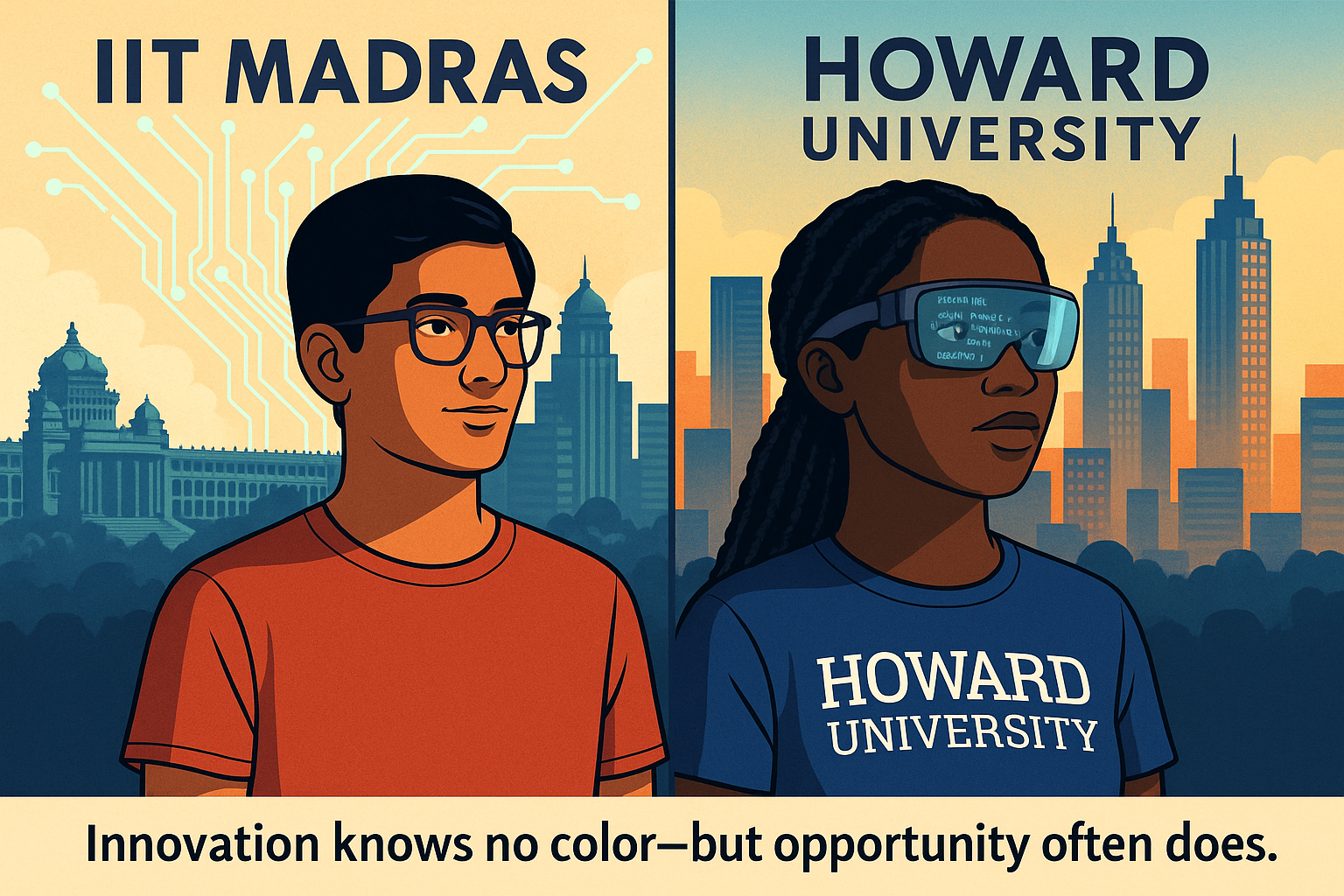
In the late 1990s, Bangalore wasn’t just a city—it was a story. A warm, chaotic tapestry of engineers coding in rented apartments, of global tech giants betting on untapped talent, and of policymakers quietly scripting India’s biggest soft power play. Two decades later, the city now dubbed the “Silicon Valley of India” commands global tech respect, home to startups valued in the billions and engineers powering the backends of everything from WhatsApp to NASA’s Mars missions. The rise of Bangalore wasn’t just a fluke of economics—it was a proof of concept.
And now, that proof has meaning beyond India. It’s a beacon for another global demographic long denied its shot at innovation supremacy: African America. Specifically, Historically Black Colleges and Universities (HBCUs), and the tech-ready minds they house. What if Atlanta, Raleigh, or Houston could do what Bangalore did? What if the lessons learned across oceans and caste lines could ignite the next Black-led tech renaissance?
It’s easy to forget, in the blinding glow of app IPOs and TED Talks, that Bangalore’s rise began with a simple premise: educate the best minds in technical skill and keep them connected. Post-independence India was dirt poor, but visionary. It seeded a string of engineering temples—the IITs (Indian Institutes of Technology)—and gave them one directive: create elite minds for a future not yet written. By the 1980s, the global economy began tilting toward software, and India’s bet on technical education paid off. Bangalore, strategically located and flush with graduates, attracted IBM, Texas Instruments, and eventually Microsoft and Google. Infrastructure followed policy. Ecosystem followed talent. And Bangalore turned into a tech vortex.
So why hasn’t something similar happened in Black America? In many ways, the African American and Indian narratives share some DNA. Centuries of marginalization. Outsized cultural contributions. Underutilized brainpower. But where India had the state-backed machinery of nation-building, HBCUs were born out of necessity. Underfunded, segregated, and often geographically sidelined, these institutions have long produced brilliance in spite of their conditions—not because of them. Still, the potential is staggering.
HBCUs produce 25% of all African American STEM graduates. Yet, most lack the kind of venture pipelines, incubator culture, and big-tech partnerships that turn skills into unicorns. India’s tech sector shows what happens when education is backed by policy, investment, and cultural mission. That trifecta is what HBCUs need to replicate—on their own terms.
First, HBCU campuses must become startup colonies. India didn’t wait for venture capital to fall from the sky. It built software parks—zones with tax incentives, broadband access, and office infrastructure. These became hotbeds for early startups and outsourcing deals. HBCUs can do the same. Howard’s Innovation Center is one of the few early experiments: a co-working space and incubator embedded on campus. But it’s not enough. Imagine Prairie View A&M spinning up a “Black Code Foundry” with dorm-hackathon hybrids, investor demo days, and embedded alumni venture scouts. Picture Southern University hosting a summer startup accelerator focused on agri-tech for Black farmers. The infrastructure doesn’t need to be perfect—India’s wasn’t—but it needs to exist.
Second, the alumni diaspora must become an angel army. Here’s the dirty secret behind India’s rise: the real money and mentorship came from abroad. Indian engineers who moved to Silicon Valley in the 1980s and 90s didn’t forget home. They wired money, built companies back in India, and sent their kids to the IITs they graduated from. Bangalore became an offshore brain extension of Palo Alto. HBCUs need the same loyalty loop. Black technologists at Google, Meta, and Apple shouldn’t just donate to alma maters—they should embed, invest, and mentor. A reverse brain trust—Black diaspora talent reinvesting in the pipeline they came from—could supercharge the entire system.
Third, code plus culture equals competitive advantage. India’s strength isn’t just in code. It’s in context. The best Indian tech products, from Flipkart to Paytm, were designed for the specific quirks of their users: cash-only commerce, slow networks, multilingual markets. That’s the play for African American tech, too. What if HBCUs trained developers not just in Python, but in designing fintech apps for unbanked Black users? Or telehealth tools for historically underserved zip codes? Black America has problems Silicon Valley doesn’t understand—and that’s a market advantage. Building for community isn’t charity. It’s a trillion-dollar design edge.
Fourth, policy must follow performance. One reason India succeeded is that its government saw tech as national strategy. It rolled out Special Economic Zones, offered tax holidays for startups, and treated engineering education as sacred. African American political leadership must adopt similar postures. Imagine a federal “Black Innovation Act” that grants funding to HBCU-based incubators, supports Black-owned VC firms, and protects patents developed at minority institutions. More tangibly, cities with large Black populations and HBCUs should offer land, broadband, and zero-interest loans to Black founders. If Chattanooga can build a public gigabit network, so can Tuskegee. Policy isn’t optional. It’s foundational.
Fifth, this requires narrative, not charity. India’s rise wasn’t framed as aid—it was ambition. It wasn’t “helping the poor.” It was “backing the next global power.” HBCUs and Black tech should be framed with the same boldness. The next Amazon might come from Alabama A&M. The next Oracle from Morgan State. What’s needed isn’t pity—but placement. African American founders shouldn’t be exceptions—they should be expectations. Tech journalism, film, and digital storytelling can help here. Highlight the successes. Build the lore. Change the perception.
Sidebar: What HBCUs Can Build Now
Move
Description
Potential Impact
Campus Incubators
On-site startup hubs with mentorship and funding access
Trains 1,000+ founders annually
Black Tech Diaspora Network
Online and in-person platform linking alumni with current students
Cross-generational capital + experience
Community-Centric Product Labs
Build tech for African American problems (e.g., finance, health, education)
Monetizes underserved user segments
Policy Consortium
HBCUs jointly lobbying for innovation policy with state + federal officials
Unlocks $1B+ in tech zone funding
Cultural Storytelling Units
Cross-discipline media studios to tell Black tech success stories
Shifts perception of HBCUs from “legacy” to “launchpad”
In a way, India’s tech story was never just about tech. It was about self-respect. About telling the world that brown minds could be global minds. That the future didn’t need to be imported. For African America, the stakes are the same. HBCUs are already proving grounds for cultural genius—music, politics, social theory. Tech should be next. A Black Silicon Valley doesn’t need to mimic the old one. It just needs to learn the playbook, remix the rhythms, and code to its own beat.
The next tech capital might not be in Cupertino or Shenzhen—but in the back streets of Atlanta, lit by the glow of laptop screens in an HBCU dorm room. Because somewhere out there, a kid from Jackson State is already building the future. All they need is the infrastructure—and the imagination—to finish the job. If India’s story is a testament to what happens when a nation believes in its brainpower, then the African American tech future will depend on whether HBCUs and their communities can believe in theirs—loudly, structurally, and unapologetically. Not for permission. But for power.
Disclaimer: This article was assisted by ClaudeAIand ChatGPT
Our credit system, like almost institutional reality we have is very much dependent on Others. Until we realize and work towards infrastructure of our own institutional ownership within the credit landscape, then we will continue to be prey for predators and subsidizers that enriches others and their institutions. – William A. Foster, IV
When President Donald Trump announced a proposed 10% cap on credit card interest rates in January 2026, most Americans greeted the news with skeptical hope. The move seemed like a potential lifeline for families struggling with debt burdens and interest rates that often exceed 20%, even as many questioned whether it could actually happen. But for African American households, this well-intentioned policy could become another barrier in a financial system that has historically excluded and disadvantaged them.
The challenge lies not in the intention behind rate caps, but in their likely consequences. While lower interest rates sound beneficial on the surface, the economic reality of credit markets means that banks facing reduced profitability will respond by restricting who can access credit in the first place. For African American families already fighting against systemic barriers to financial services, this could close doors that were only partially open to begin with.
African American households face dramatically different credit market realities than their white counterparts. According to the FDIC’s 2023 survey, more than 10% of Black Americans lack access to basic checking or savings accounts, compared to just 2% of white Americans. This banking gap represents more than inconvenience it fundamentally limits the ability to build the credit history that determines access to affordable loans, mortgages, and yes, credit cards.
The wealth disparity tells an even starker story. The median net worth of white households stands at approximately $188,200, nearly eight times the $24,100 median for Black households. This gap isn’t accidental it’s the product of generations of discriminatory policies from redlining to predatory lending, compounded by the deterioration of African American-owned banks and credit unions. As Black ownership of financial institutions has declined, the community has become more reliant on external institutions for credit, creating conditions that invited more predatory lending into African American neighborhoods. When African Americans do access credit, they consistently face higher interest rates than white borrowers with similar incomes. High-income Black homeowners, for instance, receive mortgage rates comparable to low-income white homeowners.
The dependence on consumer credit has reached critical levels in African American households. Recent analysis from HBCU Money’s 2024 African America Annual Wealth Report reveals that consumer credit has surged to $740 billion, now representing nearly half of all African American household debt and approaching parity with home mortgage obligations of $780 billion. This near 1:1 ratio between consumer credit and mortgage debt represents a fundamental inversion of healthy household finance. For white households, the ratio stands at approximately 3:1 in favor of mortgage debt over consumer credit. The African American community stands alone in this precarious position, where high-interest, unsecured borrowing rivals the debt secured by appreciating assets.
These disparities matter enormously when considering how banks will respond to rate caps. Credit card companies operate on risk-based pricing models, charging higher rates to borrowers they perceive as riskier based on credit scores, income stability, and banking relationships. African American borrowers, because of structural disadvantages in each of these areas, already cluster in categories that receive higher interest rates. When banks can no longer charge those rates, they will simply stop offering credit to these borrowers entirely.
The banking industry’s response to Trump’s proposal has been swift and unequivocal: a 10% interest rate cap would force them to dramatically restrict credit availability. Analysis from the American Bankers Association suggests that nearly 95% of subprime borrowers, those with credit scores below 680 would lose access to credit cards under even a 15% cap. With rates currently averaging around 20%, a 10% ceiling would affect even more borrowers. Industry analysts estimate that between 82% and 88% of credit cardholders could see their cards eliminated or their credit limits drastically reduced. The Electronic Payments Coalition warns that low to moderate income consumers would be hit hardest, precisely the demographic where African American households are disproportionately represented.
This isn’t just industry fearmongering. Historical evidence supports these concerns. When Illinois implemented a 36% APR cap on all borrowing, lending to subprime borrowers plummeted. Similar patterns emerged from 19th-century usury laws and research on payday loan restrictions. The consistent pattern is clear: when rate caps make lending unprofitable, lenders exit the market or tighten requirements. For African American households, this creates a devastating catch-22. They’re more likely to need credit due to lower wealth levels and less access to family financial support. Yet they’re also more likely to be denied that credit or pushed into predatory alternatives when traditional sources dry up.
The credit card industry categorizes borrowers by risk, with subprime borrowers facing the highest rates but also the greatest need for access to credit. African American consumers are overrepresented in subprime categories, not because of personal failing but because of systemic factors that suppress credit scores. Historical discrimination in housing, employment, and lending created wealth gaps that persist through generations. Lower wealth means less ability to weather financial shocks, leading to missed payments that damage credit scores.
When major banks stop serving subprime borrowers, those families don’t suddenly stop needing credit. They turn to alternative sources and here’s where the rate cap could cause real harm. Payday lenders, pawn shops, auto title loans, and other fringe financial services often charge effective annual percentage rates far exceeding credit card rates, sometimes reaching 300% to 400% or higher. These services operate in a less regulated space where consumer protections are weaker and predatory practices more common.
African American neighborhoods already contain disproportionately high concentrations of these alternative lenders, a modern echo of historical redlining patterns. Bank branches are scarce in many predominantly Black communities, while check-cashing outlets and payday loan storefronts proliferate. A rate cap that drives more families into this unregulated market would exacerbate existing inequities. The irony is profound. A policy designed to protect consumers from high interest rates could push vulnerable families toward even higher costs and fewer protections. JPMorgan analysts warned that the rate cap could redirect borrowing away from regulated banks toward pawn shops and non-bank consumer lenders, increasing risks for consumers already under financial strain.
The consequences of restricted credit access extend far beyond the immediate inability to make purchases. Credit cards serve as emergency funds for families without substantial savings, a category that includes a disproportionate number of African American households. For many Black families facing persistent income gaps, credit cards function not just as a convenience but as an income supplemental tool, helping to bridge the gap between earnings and the actual cost of living. When a car breaks down, a medical bill arrives, or a job loss creates temporary income disruption, credit cards can mean the difference between weathering the storm and falling into a debt spiral that damages credit for years.
The reality is that consumer credit has become essential infrastructure for African American household finance. With consumer credit growing by 10.4% in 2024, more than double the 4.0% growth in mortgage debt, Black families are increasingly dependent on expensive borrowing to maintain living standards. This isn’t a choice so much as a structural reality of trying to survive on incomes that remain roughly 60% of median white household income while facing higher costs for everything from insurance to groceries in predominantly Black neighborhoods.
Small business ownership represents another critical pathway to wealth building where African Americans face systemic barriers. Black entrepreneurs already struggle to access business loans, with approval rates significantly lower than for white business owners with similar qualifications, another systemic issue from African American banks and credit unions having limited deposits and being unable to extend loans and credit. Many small business owners use personal credit cards to fund startup costs, inventory purchases, and cash flow gaps. Restricting credit card access would eliminate this crucial financing option for aspiring Black entrepreneurs.
The rewards and benefits ecosystem could also shift dramatically. Banks have indicated they would likely reduce or eliminate rewards programs to offset lost interest income from rate caps. While this might seem minor compared to interest savings, rewards programs have become an important tool for building value, particularly for higher-credit consumers who pay balances in full monthly. The Vanderbilt Policy Accelerator research found that borrowers with credit scores of 760 or lower would see reductions in credit card rewards under a rate cap. Perhaps most concerning is the potential for credit scoring and financial history deterioration. When credit lines are closed or limits reduced, credit utilization ratios increase, which damages credit scores. This creates a downward spiral where reduced access leads to worse credit, which leads to further reduced access. For African American families working to build credit and financial stability, this could set progress back by years.
The genuine problem of high credit card interest rates and mounting consumer debt deserves serious policy attention. But effective solutions must account for how credit markets actually function and who would be most affected by reduced access. Rather than interest rate caps, policymakers should consider approaches that expand access while addressing affordability. Strengthening African American-owned banks, credit unions, and community development financial institutions would restore economic self-determination to communities that once had thriving financial ecosystems. These institutions don’t just serve African American communities they’re owned by them, led by them, and invested in their long-term prosperity. Historically, Black-owned banks have proven they can maintain sound lending practices while understanding the full context of their customers’ financial lives in ways that large, distant institutions simply cannot.
Currently, there are only 18 Black or African American owned banks with combined assets of just $6.4 billion, a tiny fraction of the industry. The absence of robust Black-owned financial institutions means that virtually all of the $740 billion in consumer credit carried by African American households flows to institutions outside the community. With African American-owned banks holding assets equivalent to less than 1% of Black household debt, the overwhelming majority of interest payments—potentially $120 billion annually—enriches predominantly white-owned institutions with no vested interest in Black wealth creation or community reinvestment. This extraction mechanism operates continuously, draining capital that could otherwise be intermediated through Black-owned institutions to support local lending and community development.
Strengthening requirements for transparent pricing, fee limitations, and responsible lending standards could protect consumers without eliminating credit availability. Regulators could mandate clearer disclosure of total costs, limit penalty fees that disproportionately burden those already struggling, and establish guardrails against predatory terms while preserving access to credit itself. Yet even these modest reforms face an uphill battle in the current political climate. The reality is that meaningful policy solutions require political will that simply doesn’t exist right now for addressing racial economic disparities directly. This makes the unintended consequences of blunt instruments like interest rate caps even more dangerous—they can restrict credit access under the banner of consumer protection while offering no viable alternatives.
The fundamental reality is clear: waiting for federal policy to solve credit access problems is a losing strategy. African American households face a specific set of economic challenges rooted in a specific history, and the solutions must be equally specific not generic approaches that treat all groups the same. The path forward requires African American communities to build their own financial infrastructure. This means capitalizing and expanding Black-owned banks and credit unions that can offer credit products designed for the actual economic realities of their customers, not risk models built on white wealth patterns. It means creating community-based lending circles and cooperative credit arrangements that leverage collective resources. It means developing alternative credit scoring systems that account for rent payments, utility bills, and other financial behaviors that traditional models ignore.
Rebuilding this sector isn’t about charity or inclusion; it’s about economic self-determination. Black-owned financial institutions have historically understood that a credit score doesn’t tell the whole story of a person’s creditworthiness, and they’ve made sound lending decisions based on relationship banking and community knowledge that large institutions can’t replicate. The challenge isn’t convincing European American owned banks to be fairer, it’s building the capacity to not need them as much. When African American communities had stronger networks of Black-owned banks, insurance companies, and credit unions, they had more options and more power. Rebuilding that infrastructure, combined with individual financial strategies that emphasize building assets and reducing dependence on consumer credit, offers a more sustainable path than hoping for beneficial federal intervention.
A 10% interest rate cap might sound appealing in the abstract, but for African American households, it likely means one thing: less access to the credit system entirely. The question then becomes not whether mainstream banks will treat Black borrowers fairly, but how communities can create their own credit access systems that serve their actual needs. That’s not a policy problem it’s a community capacity problem, and it requires community-driven solutions.
Disclaimer: This article was assisted by ClaudeAI.
The four-year graduation rate is often presented as a benign statistic tucked inside higher education reports, but for institutions serving African America, it is not benign at all. It is the lever on which long-term wealth, institutional survival, and multigenerational stability subtly depend. Wealthy universities treat the four-year graduation rate not as an outcome but as an engineered product, backed by endowment might, operational discipline, and capital-rich ecosystems. Their students finish on time because the institution ensures they are shielded from interruption. Meanwhile, HBCUs navigate a different reality: the same students who possess the intellectual capacity to thrive are too often delayed not by academics but by the economic turbulence that disproportionately defines their journey. It is here between the idea of talent and the machinery of capital that the four-year graduation rate becomes a revealing measure of African America’s structural position in the American economic hierarchy.
A delayed degree carries a cost structure that compounds aggressively. Extra semesters are not simply tuition bills; they are opportunity-cost accelerants. A student who graduates at 22 enters the workforce two to three years ahead of a peer who reaches the finish line at 24 or 25. Those early earnings fund retirement accounts earlier, compound longer, support earlier homeownership, and create the financial runway that future philanthropy relies upon. For African American students who statistically begin college with fewer financial reserves and exit with higher student debt those lost years are wealth years. They represent not only diminished individual prosperity but the slowed creation of a donor class that HBCUs and other African American institutions depend on to build endowment strength and institutional sovereignty.
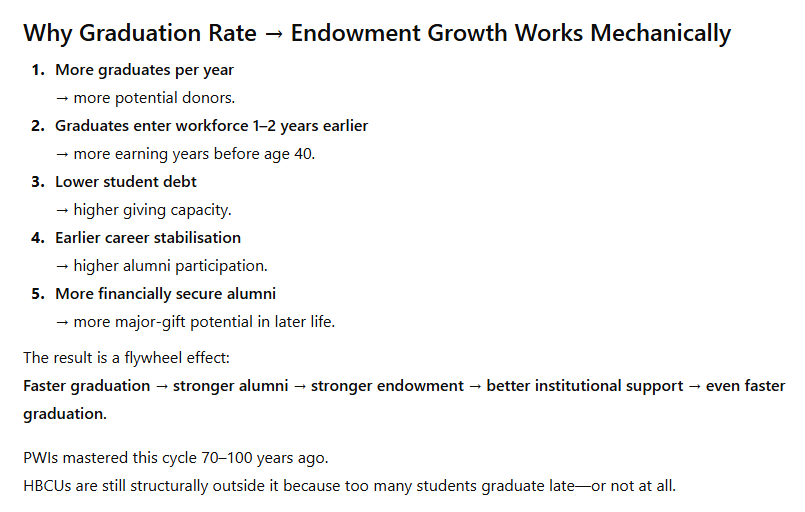
Endowments, which serve as the economic lungs of a university, breathe differently depending on how quickly their alumni progress into stable earning years. A university that graduates students in four years rather than six gains an alumni base that stabilizes earlier, saves earlier, invests earlier, and gives earlier. A philanthropic ecosystem is essentially a long-term consequence of time management: the more years an alumnus spends debt-free and employed, the more predictable their giving pattern becomes. Elite institutions leverage this fact elegantly. HBCUs, despite producing extraordinary alumni under significantly harsher financial conditions, remain constrained by the delayed timelines imposed by student financial fragility.
Financial fragility is a central explanatory variable in the HBCU graduation gap. It is not uncommon for a student to miss a semester because of a $300 balance or a transportation breakdown that derails their schedule. In the broader American economic system, such modest shocks rarely jeopardize a wealthy student’s trajectory. But within the HBCU ecosystem, they represent the sharp edges of institutional undercapitalization meeting the exposed nerves of household vulnerability. The four-year graduation rate is therefore not simply a metric of academic navigation but a map of where the Black household economy intersects with American higher education’s structural inequities.
This makes alumni involvement not a sentimental tradition but an economic necessity. Alumni can narrow the financial fragility gap more efficiently than any other stakeholder group. Microgrant funds, even modestly capitalized, are capable of eliminating the most common disruptions that extend time-to-degree. A $250 emergency grant can protect $25,000 in long-term student debt. A $500 intervention can guard a student’s four-year trajectory and thus preserve two additional years of post-graduation earnings that ultimately benefit both the graduate and the institution’s future endowment. Alumni-funded tutoring, advising enhancements, STEM support programmes, and paid internships create artificial endowment-like effects: stabilizing student progression even when the institutional endowment itself is undersized.
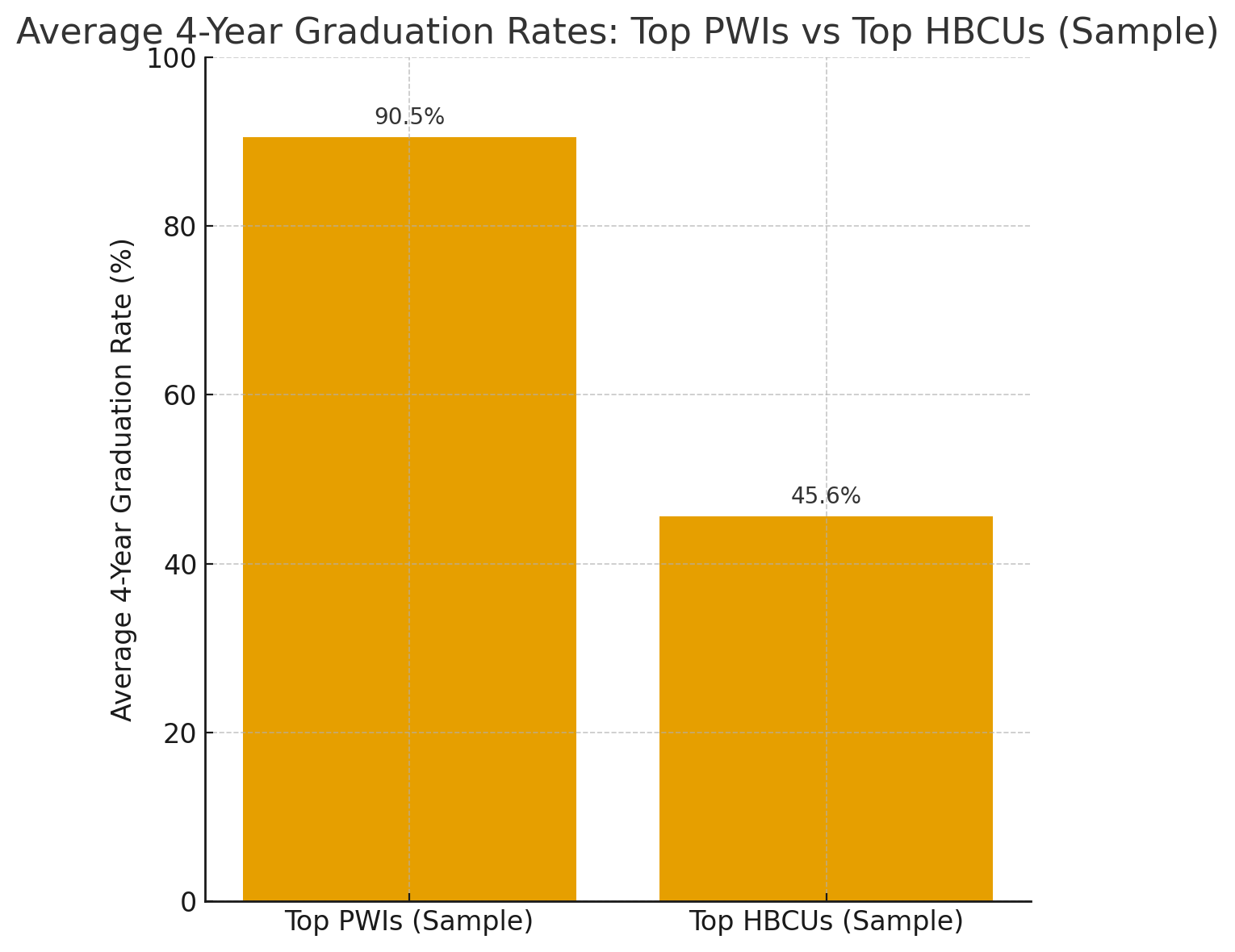
Yet HBCU alumni cannot focus solely on the university years if the goal is a structurally higher four-year graduation rate. The process begins far earlier within K–12 systems that shape academic readiness long before students set foot on campus. The elite institutions that boast 85–95 percent on-time graduation rates are drawing from K–12 ecosystems with intense capital saturation: high-quality teachers, advanced coursework, stable households, well-funded enrichment programmes, and neighborhoods that function as multipliers of academic preparedness. HBCU alumni have an opportunity to influence this pipeline through investments that are often modest in individual scope but transformational in aggregate impact. Funding reading centres, coding clubs, college-prep academies, robotics labs, literacy coaches, and after-school tutoring programmes plants the seeds of future four-year graduates years before college entry.
Indeed, a strong K–12 foundation reduces the need for remedial coursework, accelerates major declaration, strengthens performance in gateway courses like calculus and biology, and diminishes the likelihood that students need extra semesters to satisfy graduation requirements. When alumni support dual-enrollment initiatives, sponsor early-college programmes, or build partnerships between HBCUs and local school districts, they enlarge the pool of college-ready students whose likelihood of completing on time is structurally higher. In this sense, investing in K–12 is not philanthropy it is pre-endowment development.
The economic implications of strengthening both ends of the education pipeline are enormous. A 20–30 percentage-point improvement in four-year completion rates across the HBCU ecosystem would reduce student loan debt burdens by billions, accelerate African American household wealth accumulation, raise the number of alumni earning six-figure incomes before age 30, and increase the philanthropic participation rate across Black institutions. Over decades, such shifts ripple outward: stronger alumni lead to stronger HBCUs, which lead to stronger civic, cultural, and economic institutions in African American communities, which themselves create more stable families, more prepared K–12 students, and more future college graduates. The system feeds itself when time is efficiently managed.
In the HBCU Money worldview, where institutional power is the only reliable safeguard against structural marginalization, time-to-degree represents one of the clearest and most overlooked levers of collective economic advancement. In a Financial Times context, the four-year graduation rate appears as a liquidity indicator—showing how quickly an institution converts educational investment into economic output. In The Economist’s framing, it reveals the mismatched capital structures between wealthy universities and historically underfunded ones, and how those mismatches reproduce inequality in slow, quiet, compounding increments.
For African America, the conclusion is unmistakable. The four-year graduation rate is not merely a statistic. It is a wealth mechanism. It is an endowment accelerator. It is an institutional survival tool. And it is a community-level economic strategy that begins in kindergarten and culminates with a diploma. If HBCU alumni wish to see their institutions strengthen, their communities accumulate wealth, and their young people enter the economy with maximum velocity, then they must make both K–12 investment and four-year graduation obsession-level priorities. Institutions rise with the financial stability of their graduates. Ensuring those graduates complete degrees on time is one of the most effective—and least discussed—strategies available for building African American institutional power across generations.
A Tale of Two Virginias:
A revealing contrast in American higher education can be observed by examining two institutions that sit just 120 miles apart: Virginia State University (VSU) and the University of Virginia (UVA). NACUBO estimates VSU’s endowment at approximately $100 million for around 5,000 students, producing an endowment-per-student of roughly $20,000. According to U.S. News, VSU graduates 27% of its students in four years. UVA, one of the most heavily capitalized public universities in the world, possesses an endowment of roughly $10.2 billion for about 25,000 students, an endowment-per-student of approximately $410,000, more than twenty times the capital density VSU can deploy. Its four-year graduation rate stands at 92%.
The gulf between the two institutions reflects not a difference in student talent but a difference in institutional resource density and shock absorption capacity. A VSU student must personally carry far more academic and financial fragility. A single $300 expense can knock them off their semester plan. A delayed prerequisite can add a year to their degree. Limited advising bandwidth means problems are often discovered only after they have already extended time-to-degree. UVA faces the same categories of issues, but its endowment, staffing, and operating budgets act as buffers absorbing shocks before they disrupt academic progress.
Endowment-per-student, therefore, is not merely a balance-sheet statistic; it is a proxy for how much risk the institution can carry on behalf of its students. UVA carries most of the risk. VSU students carry most of their own. UVA’s 92% four-year graduation rate is a reflection of institutional cushioning. VSU’s 27% rate reflects its absence.
Yet to understand the true economic cost of the graduation gap, it is useful to model what would happen if VSU improved its four-year graduation rate—first to a plausible mid-term target such as 50%, and then to a UVA-like 90%. Both scenarios dramatically change the trajectory of the institution.
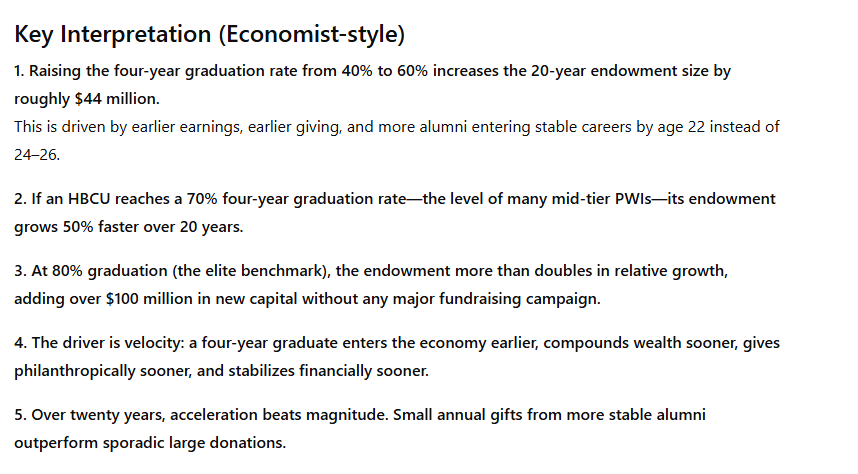
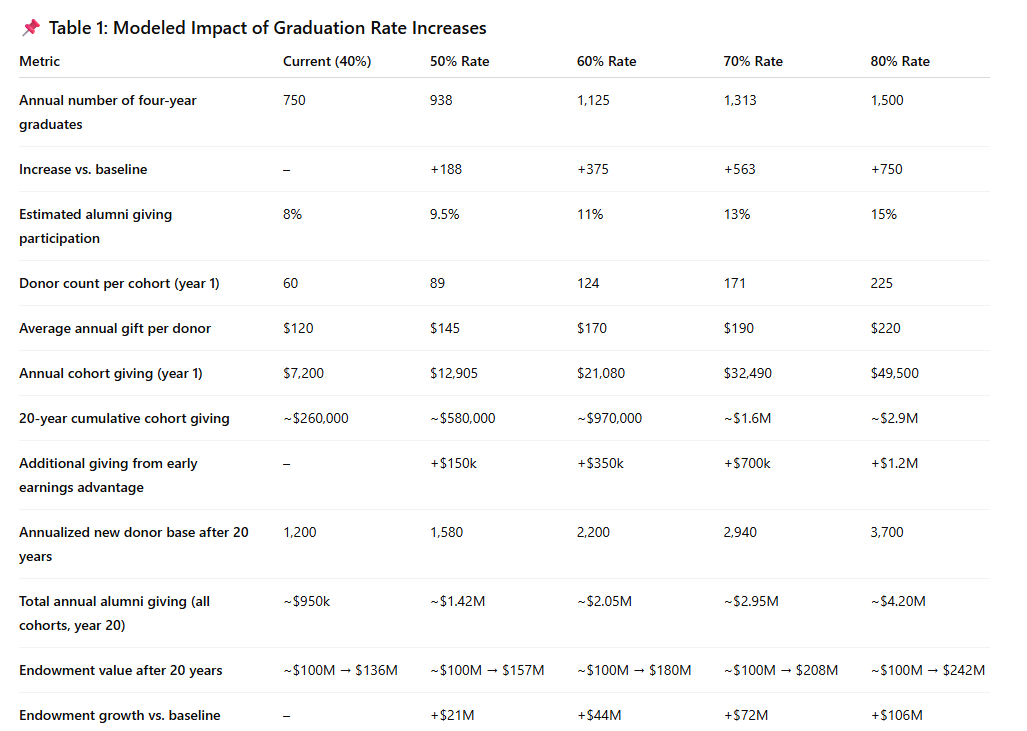
Assume that VSU today produces roughly 1,350 graduates every four years (based on a 27% rate). If it increased its four-year graduation rate to 50%, VSU would instead graduate 2,500 students every four years, an increase of 1,150 additional on-time graduates, each entering the workforce two years earlier, with lower student debt, earlier retirement contributions, earlier homeownership, and earlier philanthropic capacity. Even if only a modest fraction of these additional graduates contributed $50–$150 annually to VSU’s endowment, the compounding effect across 20 years would be substantial. Under conservative assumptions with basic donor participation growth and average returns of 7% VSU’s endowment could plausibly grow from $100 million to $155–$170 million over two decades, powered largely by the increased velocity and increased number of earning alumni.
Now consider the UVA-like scenario. A four-year graduation rate of 90% at VSU would mean roughly 4,500 on-time graduates every four years or over three times the current output. This scale of early, debt-lighter graduates would fundamentally transform VSU’s financial ecosystem. Even minimal alumni participation say, 12–15% giving $100–$200 annually would translate into millions in annual recurring contributions. Over two decades, with investment returns compounding, VSU’s endowment could grow not to $150 million but potentially to $300–$400 million, depending on participation rates and gift sizes. That would triple the institution’s financial capacity without a single major donor campaign, capital campaign, or extraordinary windfall. The key variable is simply graduation velocity.
This comparison illustrates a broader truth: endowment growth is not just a function of investment strategy but of how quickly a university converts students into earning alumni. A student who graduates at 22 gives for 40–50 years. A student who graduates at 25 gives for 30–35 years. A student who drops out does not give at all. VSU’s current 27% four-year graduation rate is not merely an academic statistic—it is an endowment drag factor. UVA’s 92% rate is an endowment accelerant.
The financial distance between the two universities appears vast, but it is governed by a formula that HBCUs can influence: more on-time graduates → more early earners → more consistent donors → more endowment growth → more institutional cushioning → more on-time graduates. VSU today sits at the fragile end of this cycle. A graduation-rate increase to 50% would move it into a position of stability. A leap to 90% would place it into an entirely different institutional category—one where it begins to accumulate capital in the same compounding manner that allows institutions like UVA to weather downturns, attract top faculty, and protect students from the shocks that so often derail academic momentum.
VSU cannot replicate UVA’s wealth in the short term. But by increasing on-time graduation, it can replicate the mechanism through which wealthy universities become wealthier. And that mechanism—graduation velocity—is one of the few levers fully within reach of alumni, leadership, and institutional partners.
Here are four strategic, high-impact actions HBCU alumni associations or chapters can take to directly raise four-year graduation rates and strengthen institutional wealth:
1. Create a Permanent Emergency Microgrant Fund (The “$300 Fund”)
Most delays in graduation arise from small financial shocks: balances under $500, transportation failures, book costs, or housing gaps.
Alumni chapters can formalize a permanent, locally governed microgrant fund offering rapid-response support (48–72 hours).
A chapter raising just $25,000 per year can prevent dozens of delays, each shielding students from additional semesters of debt and protecting the institution’s future alumni giving pipeline.
This is low-cost, high-yield institutional intervention.
2. Fund Paid Internships and Alumni-Mentored Work Opportunities
Students who work long hours off campus are more likely to fall behind academically, switch majors repeatedly, or extend enrollment.
Alumni chapters can create paid internships, stipends, or alumni-hosted part-time roles tied directly to students’ majors.
Each position:
reduces the student’s financial burden
keeps them academically aligned
accelerates pathways to stable post-graduate employment
This lifts graduation rates and increases alumni earnings—expanding the future donor base.
3. Build K–12 Pipelines in Local Cities That Feed Directly Into HBCUs
Four-year graduation begins long before freshman year.
Alumni chapters can adopt 2–3 local schools and support:
literacy acceleration programs
SAT/ACT prep
dual enrollment partnerships
STEM and robotics clubs
early-college summer institutes hosted by their own HBCUs
Better-prepared students require fewer remedial courses, retain majors longer, and graduate on schedule, raising institutional performance and future endowment sustainability.
This is pre-investment in the future alumni base.
4. Pay for Summer Courses After Freshmen Year to Build Early Credit Momentum
After their first year, many students fall off the four-year pace due to light credit loads, failed gateway courses, or sequencing issues that a single summer class could easily correct. Yet for many HBCU students, summer tuition—often just one or two courses—is financially out of reach.
Alumni chapters can establish a Freshman Summer Acceleration Grant to pay for up to two summer course immediately after freshman year, allowing students to:
close early credit gaps,
retake or accelerate critical prerequisites,
reduce future semester overloads,
create a credit cushion for unexpected disruptions,
stay aligned with four-year degree maps.
A small investment of summer tuition produces an outsized institutional return: students enter sophomore year on pace, avoid bottlenecks in upper-level coursework, and dramatically increase their likelihood of graduating in four years. This is an early-stage compounding effect—protecting momentum before delays become expensive and permanent.