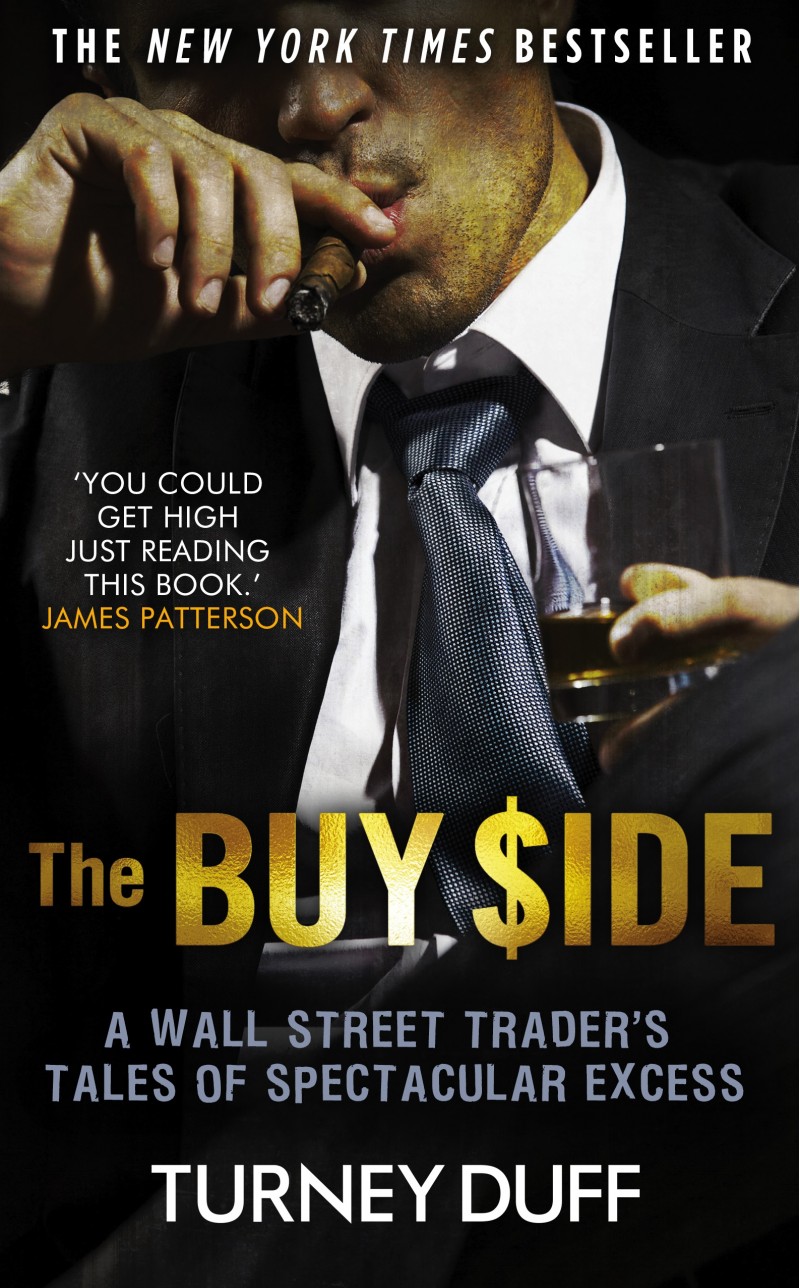
HBCU Money™ Business Book Feature – The Buy Side: A Wall Street Trader’s Tale of Spectacular Excess

9781472112385

The Buy Side, by former Galleon Group trader Turney Duff, portrays an after-hours Wall Street culture where drugs and sex are rampant and billions in trading commissions flow to those who dangle the most enticements.  A remarkable writing debut, filled with indelible moments, The Buy Side shows as no book ever has the rewards – and dizzying temptations – of making a living on the Street.

Growing up in the 1980’s Turney Duff was your average kid from Kennebunk, Maine, eager to expand his horizons. After trying – and failing – to land a job as a journalist, he secured a trainee position at Morgan Stanley and got his first feel for the pecking order that exists in the trading pits.  Those on the “buy side,” the traders who make large bets on whether a stock will rise or fall, are the “alphas” and those on the “sell side,” the brokers who handle their business, are eager to please.

How eager to please was brought home stunningly to Turney in 1999 when he arrived at the Galleon Group, a colossal hedge-fund management firm run by secretive founder Raj Rajaratnam.  Finally in a position to trade on his own, Turney was encouraged to socialize with the sell side and siphon from his new broker friends as much information as possible.  Soon he was not just vacuuming up valuable tips but also being lured into a variety of hedonistic pursuits.  Naïve enough to believe he could keep up the lifestyle without paying a price, he managed to keep an eye on his buy-and-sell charts and, meanwhile, pondered the strange goings on at Galleon, where tens of millions were being made each week in sometimes mysterious ways.

At his next positions, at Argus Partners and J.L. Berkowitz, Turney climbed to even higher heights – and, as it turned out, plummeted to even lower depths – as, by day, he solidified his reputation one of the Street’s most powerful healthcare traders, and by night, he blazed a path through the city’s nightclubs, showing off his social genius and voraciously inhaling any drug that would fill the void he felt inside.

A mesmerizingly immersive journey through Wall Street’s first millennial decade, and a poignant self portrait by a young man who surely would have destroyed himself were it not for his decision to walk away from a seven-figure annual income, The Buy Side is one of the best coming-of-age-on-the-Street books ever written.

HBCU Money™ Dozen 7/21 – 7/25

12_oclock

Did you miss HBCU Money™ Dozen via Twitter? No worry. We are now putting them on the site for you to visit at your leisure. We have made some changes here at HBCU Money™ Dozen. We are now solely focused on research and central bank articles from the previous week.

Research

Inside the quantum experiment that splits reality l New Scientist http://ow.ly/zxFM2

California sees IT shifting to IBM-built cloud l Computerworld http://ow.ly/zyALv

5 Ways to Use Social Media to Boost Your Career Prospects l CIOonline http://trib.al/fnfnDOy

Apple is losing its grip as the top tablet company l Computerworld http://ow.ly/zyB14

Business Leaders Know: Let in the Smartphones, Tablets, Laptops l CIOonlinehttp://trib.al/K90QMwF

Once a National Security Mandate, Now a National Asset, too l Livermore Labhttp://bit.ly/WKvrBe

Federal Reserve, Central Banks, & Financial Departments

Read about opportunities and challenges for U.S. businesses in Latin America l St. Louis Fed

Lifting ban on crude oil exports could lower U.S. pump prices l Dallas Fed http://bit.ly/1pgUnqA

Want to know more about prepaid cards? Read this Personal Finance 101 l Econ Lowdown http://bit.ly/VzTdiO

Federal Reserve Payments Study Provides Further Details on Domestic Payments l Federal Reserve http://go.usa.gov/5ywG

1 in 6 homes still seriously underwater as home price growth slows l Housing Wire http://hwi.re/6PtzlD

Personal finance and economics teachers: We have lessons, videos and more l Econ Lowdown http://bit.ly/1ufDYFE

Thank you as always for joining us on Saturday for HBCU Money™ Dozen. The 12 most important research and finance articles of the week.

The HBCU Money™ Weekly Market Watch

Our Money Matters /\ July 25, 2014

A weekly snapshot of African American owned public companies and HBCU Money™ tracked African stock exchanges.

NAME TICKER PRICE (GAIN/LOSS %)

African American Publicly Traded Companies

Citizens Bancshares Georgia (CZBS) $8.78 (0.92% UP)

M&F Bancorp (MFBP) $5.00 (2.04% UP)

Radio One (ROIA) $4.75 (2.06% DN)

African Stock Exchanges

Bourse Regionale des Valeurs Mobilieres (BRVM)  237.26 (0.48% DN)

Botswana Stock Exchange (BSE)  9 223.87 (0.09% UP)

Ghana Stock Exchange (GSE)  2 294.03 (6.94% UP)*

Nairobi Stock Exchange (NSE)  151.42 (N/A)

Johannesburg Stock Exchange (JSE) 51 550.17 (0.14% DN)

International Stock Exchanges

New York Stock Exchange (NYSE) 10 982.51 (0.51% DN)

London Stock Exchange (LSE)  3 619.34 (0.42% DN)

Tokyo Stock Exchange (TOPIX)  1 281.35 (0.90% UP)

Commodities

Screen Shot 2014-07-25 at 2.22.32 PM


10 People We Wish Were HBCU Presidents

With so many HBCU presidents resigning and retiring we thought it would be a good idea to put together a list of people we here at HBCU Money would like to see take the helm as an HBCU president. HBCUs have been notorious for recycling presidents and thinking very inside the box when it comes to choosing leadership. Our list is anything but inside the box. The criteria for our list included a mixture of strong organization leadership and management, network access that they could tap into for fundraising and policy influence, high achievement background, and ultimately the ability to take our institutions to new plateaus of connectivity to the African Diaspora. Who are some that you would like to see lead an HBCU and why?

MR. KOFI ANNAN – The former secretary general of the United Nations from Ghana served two full terms as the man in charge of the organization that oversees the world’s nations. Needless to say he has the pedigree and connections that an HBCU would drool over. It takes a powerful and humble person to balance the needs, interest, and egos of countries. He would instantly raise the global profile of any HBCU he took the helm of and his strong connections on the continent of Africa would be an amazing asset for building the institutional bridge for HBCUs to Africa.

MS. KIMBERLY BRYANT  – If the early 20th century was the industrial revolution, then the early 21st century will be known as the technological revolution. In an effort to ensure African Americans do not miss out on it there might not be a more important voice than the founder of Black Girls Code. Teach the babies is always a resounding mantra among African American activist, but this is real activism. The doer she is has African American girls coding and engaging the STEM field on a level unmatched. Her connections and understanding of building a strong organization from the ground up and technology connections make her a powerful leader than an HBCU could use.

MR. FRED SWANIKER – Another Ghanian making waves. His pedigree alone as a McKinsey alum makes means he could probably fix or accelerate any HBCU in five minutes (hyperbole intended). Coming from arguably the world’s most prominent consulting firm he is use to solving problems and implementing sound long-term strategy. He has also been a serial entrepreneur and founded the African Leadership Academy, a boarding school in South Africa. Did we mention he is only 34?

DR. CONDOLEEZA RICE – By far the most controversial choice on our list. She was HBCU Digest founder J.L. Carter, Sr’s choice for the next president of Howard in an editorial piece for the publication. Whether it is Howard or another HBCU there is no denying Dr. Rice’s network. Put the politics aside, she is a brilliant woman who has ascended to powerful positions in ways that very few African Americans have under not one, but two presidents. She has a global profile and is an expert on Russia, which would come in handy for any HBCU looking to develop its international programs.

MRS. TERI WILLIAMS COHEE – The co-founder, chief operating office and senior vice president at the nation’s largest African American owned bank. After taking over a small Boston bank she helped build OneUnited bank into the only African American bank with a national footprint. She understands the importance of tying African American institutions together. Currently, there are only two HBCUs (Roxbury Community College & Florida Memorial University – both with OneUnited) that bank with African American owned banks. We are sure this would change in a hurry with Mrs. Cohee at the helm of an HBCU. She has a rich financial background and would certainly have any HBCU she is at the reigns of in top financial shape – even the financial aid department.

DR. NEIL DEGRASSE TYSON – STEM here, STEM there, STEM everywhere. We have already mentioned how important STEM has become and there might not be a higher profile African American in STEM than Dr. Tyson. He has spoken before congress on numerous occasions to increase funding to NASA programs and other STEM R&D programs. An opportunity to create an elite research program, recruit and develop strong STEM faculty, and develop cutting edge programs would definitely be to any HBCU’s favor.

MR. DAVID LAMMY – Here come the British. The first of two Afro-Britons make our list. In 2008, he was considered the eighth most powerful Afro-Briton male. At one point he was the UK’s Minister for Innovation, Universities, and Skills. He could open up recruitment for an HBCU to tap into the recruitment of Afro-Briton pipeline. Also, he founded and chairs programs to address improvement and development of black fatherhood initiatives. Bringing such an initiative here with his connections could bring in much needed research funding to an HBCU focused on community and social development.

LADY PATRICIA SCOTLAND – Our second Afro-Briton on the list and at one time the Guardian’s most powerful black woman in the UK. She has strong connections in the Caribbean where her family has a rich land ownership history. Her background as a family law attorney and judge in the UK has allowed her to rub elbows with Britain’s affluent, which would bring in much needed funding to an HBCU that she presided over. Her time as a minister of state like the aforementioned Mr. Lammy gives her strong organizational management skills to oversee a college and give it direction.

LT. GENERAL THOMAS BOSTICK – The head of almost 37 000 civilian and military engineers just may know how to run a high pressured organization. That is what Lt. General Bostick does as the head of Army Corps Engineers. The ACE has a R&D division meaning it is constantly trying to remain at the cutting edge of engineering development. Any HBCU with a strong engineering history or wanting to develop one should put in a call. Having access to funding from the department of defense would not hurt either.

DR. MICHAEL BLAKEY – Having oversaw the African Burial Ground National Monument project where they discovered the remains of 400 men and women and traditions associated with West Africa while at Howard University. He knows, loves, and appreciates the HBCU culture, but recognizes that there are changes that need and must be made to ensure HBCUs are at the forefront of the next generation.

HBCU Money™ Business Book Feature – W. Arthur Lewis and the Birth of Development Economics

k8045

W. Arthur Lewis was one of the foremost intellectuals, economists, and political activists of the twentieth century. In this book, the first intellectual biography of Lewis, Robert Tignor traces Lewis’s life from its beginnings on the small island of St. Lucia to Lewis’s arrival at Princeton University in the early 1960s. A chronicle of Lewis’s unfailing efforts to promote racial justice and decolonization, it provides a history of development economics as seen through the life of one of its most important founders.

If there were a record for the number of “firsts” achieved by one man during his lifetime, Lewis would be a contender. He was the first black professor in a British university and also at Princeton University and the first person of African descent to win a Nobel Prize in a field other than literature or peace. His writings, which included his book The Theory of Economic Growth, were among the first to describe the field of development economics.

Quickly gaining the attention of the leadership of colonized territories, he helped develop blueprints for the changing relationship between the former colonies and their former rulers. He made significant contributions to Ghana’s quest for economic growth and the West Indies’ desire to create a first-class institution of higher learning serving all of the Anglophone territories in the Caribbean.

This book, based on Lewis’s personal papers, provides a new view of this renowned economist and his impact on economic growth in the twentieth century. It will intrigue not only students of development economics but also anyone interested in colonialism and decolonization, and justice for the poor in third-world countries.