Category Archives: Lists

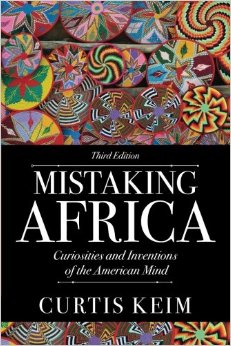
HBCU Money™ Business Book Feature – Mistaking Africa: Curiosities and Inventions of the American Mind

51V36fu133L._SY344_BO1,204,203,200_

For many Americans the mention of Africa immediately conjures up images of safaris, ferocious animals, strangely dressed “tribesmen,” and impenetrable jungles. Although the occasional newspaper headline mentions genocide, AIDS, malaria, or civil war in Africa, the collective American consciousness still carries strong mental images of Africa that are reflected in advertising, movies, amusement parks, cartoons, and many other corners of society. Few think to question these perceptions or how they came to be so deeply lodged in American minds. Curtis Keim’s Mistaking Africa looks at the historical evolution of this mind-set and examines the role that popular media plays in its creation. Keim addresses the most prevalent myths and preconceptions and demonstrates how these prevent a true understanding of the enormously diverse peoples and cultures of Africa.

Updated throughout, the third edition includes a new chapter, “Where Is the Real Africa,” discussing the multifaceted nature of the question and the importance of not grasping onto stereotypes of Africa’s mythical past. Keim also includes new examples and new images to expand the visual narrative of western views about Africa. Mistaking Africa is an important book for African studies courses and for anyone interested in unraveling American misperceptions about the continent.

HBCU Money’s 2014 Top 10 HBCU Endowments

piggy-bank-with-glasses-m

The keyword for  2014’s HBCU endowments – disappointing. In the past twelve months, HBCU’s top ten endowments added $200 million to its coffers. So why is this disappointing? The S&P 500 over the past year had returns of 13.4 percent. The benchmark by which we measure endowment return success. Given many of the tax and capital advantages that college and university endowments have it takes quite a bit of effort to underperform the market. This year only six out of ten HBCU endowments outperformed the market, while HWCU counterparts clocked in at nine out of ten. This has allowed the institutional wealth gap between top 10 HWCU/HBCU endowments to balloon from 103:1 to 106:1 the past twelve months. 

This year was fairly standard with no real changes except one among the top ten, but what a change it was. The University of the Virgin Islands unseats Winston-Salem State University in the ten spot from last year after an unprecedented change in market value of 48.5 percent. A performance that not only led all HBCUs, but was fifth among the 851 American and Canadian endowments reporting. However, there is still real concern about the lack of HBCUs with at least $100 million endowments. Notable absences are Morehouse and Tuskegee who do not report. Even including these two, it would mean only approximately 7 percent of HBCUs are above this mark. This is concerning because even schools with only a $100 million endowment that achieved a market return of 13 percent leaves the school roughly $6.5 million to potentially to work with. Showing that HBCUs are still highly dependent and vulnerable to tuition revenue. A matter we saw continuously pop up after the Parent Plus Loan debacle that sent many HBCUers home. HBCU endowments should have been there to lessen the blow, but again given 93 percent of HBCUs are at $50 million or less it shows the vulnerability most are facing. The MEAC continues its dominance of the top ten HBCU endowments with four institutions present.

As always if you do not see your HBCU in the top 10 – DONATE!

Endowment in millions $000 (Change in Market Value*)

1. Howard University – $586 104 (14.0%)

2. Spelman College – $367 037 (12.2%)

3. Hampton University – $288 370 (13.5%)

4. Meharry Medical College – $136 975 (9.6%)

5. Florida A&M University – $127 186 (10.3%)

6. Tennessee State University – $50 492 (17.5%)

7. Texas Southern University – $46 577 (10.4%)

8. Virginia State University – $45 145 (18.6%)

9. North Carolina A&T State University – $43 785 (17.3%)

10. University of the Virgin Islands – $38 184 (48.5%)

Take a look at how an endowment works. Not only scholarships to reduce the student debt burden but research, recruiting talented faculty & students, faculty salaries, and a host of other things can be paid for through a strong endowment. It ultimately is the lifeblood of a college or university to ensure its success generation after generation.

endowment

*Note: The change in market value does NOT represent the rate of return for the institution’s investments. Rather, the change in the market value of an endowment from FY2013 to FY2014 reflects the net impact of: 1) withdrawals to fund institutional operations and capital expenses; 2) the payment of endowment management and investment fees; 3) additions from donor gifts and other contributions; and 4) investment gains or losses.

Additional Notes:
NACUBO Average Endowment – $616 188 (15.0%)
NACUBO Median Endowment – $112 967 (16.3%)
Top 10 HWCU Endowments combined – $180.3 billion
Top 10 HBCU Endowments combined – $1.7 billion
Source: National Association of College & University Business Officers

HBCU Money™ Business Book Feature – The Business of Black Power

51xxf9Od1YL._SY344_BO1,204,203,200_

The Business of Black Power emphasizes the centrality of economic goals to the larger black freedom movement and explores the myriad forms of business development in the Black power era. This volume charts a new course for Black power studies and business history, exploring both the business ventures that Black power fostered and the impact of Black power on the nation’s business world. Black activists pressed business leaders, corporations, and various levels of government into supporting a range of economic development ventures, from Black entrepreneurship, to grassroots experiments in economic self-determination, to indigenous attempts to rebuild inner-city markets in the wake of disinvestment. They pioneered new economic and development strategies, often in concert with corporate executives and public officials. Yet these same actors also engaged in fierce debates over the role of business in strengthening the movement, and some African Americans outright rejected capitalism or collaboration with business. The seven scholars in this collection bring fresh analysis to this complex intersection of African American and business history to reveal how Black power advocates, or those purporting a Black power agenda, engaged business to advance their economic, political, and social goals. They show the business of Black power taking place in the streets, boardrooms, journals and periodicals, corporations, courts, and housing projects of America. In short, few were left untouched by the influence of this movement.

HBCU Money™ B-School: How To Start An Airline

Boeing_787

How many HBCU owned airlines are there in America? Zero. How many African American owned airlines are there in America? Zero. In Africa, the story is quite different with a number of airlines popping up over the past five years in the ownership hands of native Africans. So it appears we have some catching up to do with our brethren in the motherland. Given HBCUs are often flush with engineering talent, one HBCU owned airline alone could create massive job opportunities. Jet Blue employs almost 14 000 people and is one of the smallest low fare regional airlines, while one of the bigger regional players Southwest Airlines employs almost 50 000.

However, starting an airline is not for the faint of heart and maybe one of the hardest entrepreneurial challenges one can take on. Boeing’s airline startup page says, “Few businesses have as many variables and challenges as airlines. They are capital-intensive. Competition is fierce. Airlines are fossil fuel dependent and often at the mercy of fuel price volatility. Operations are labor intensive and subject to government control and political influence. And a lot depends on the weather.” However, if you are up to the challenge of finding a niche in the space, then you are on your way to creating a multi-billion company since the industry average of value is $2.7 billion (below) according to Yahoo Finance.

Screen Shot 2015-01-10 at 1.39.04 PM

So visit Startup Boeing’s website here and as the Nat King Cole song says and quoted in the Tuskegee Airmen movie of 1995, “Straighten up and fly right.”

HBCU Money™ Business Book Feature – Ebony & Ivy: Race, Slavery, & the Troubled History of America’s Universities

512ekThWQUL

A 2006 report commissioned by Brown University revealed that institution’s complex and contested involvement in slavery—setting off a controversy that leapt from the ivory tower to make headlines across the country. But Brown’s troubling past was far from unique. In Ebony and Ivy, Craig Steven Wilder, a rising star in the profession of history, lays bare uncomfortable truths about race, slavery, and the American academy.

Many of America’s revered colleges and universities—from Harvard, Yale, and Princeton to Rutgers, Williams College, and UNC—were soaked in the sweat, the tears, and sometimes the blood of people of color. The earliest academies proclaimed their mission to Christianize the savages of North America, and played a key role in white conquest. Later, the slave economy and higher education grew up together, each nurturing the other. Slavery funded colleges, built campuses, and paid the wages of professors. Enslaved Americans waited on faculty and students; academic leaders aggressively courted the support of slave owners and slave traders. Significantly, as Wilder shows, our leading universities, dependent on human bondage, became breeding grounds for the racist ideas that sustained them.

Ebony and Ivy is a powerful and propulsive study and the first of its kind, revealing a history of oppression behind the institutions usually considered the cradle of liberal politics.