Category Archives: Editorial

Magic Johnson & Russell Simmons Join The Ranks of Predatory Financial Services To African Americans

Man, biologically considered, and whatever else he may be into the bargain, is the most formidable of all beasts of prey, and indeed, the only one who preys systematically on his own species. — William James

hqdefault[1]

It is one thing in a war when the enemy is shooting at you. This is an expected part of war. It is a whole other thing when your own fellow soldier turns towards you and starts shooting at you while yelling at you saying he is trying to help you. That scene in essence describes the behavior of Earvin “Magic” Johnson and Russell Simmons prepaid card offerings and the focus of these products on the African American community.

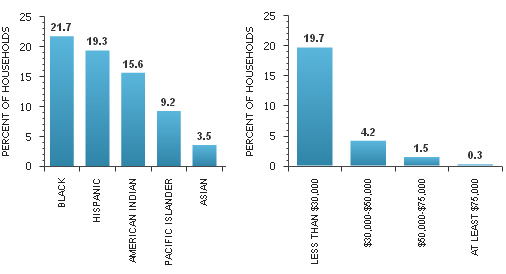
BOOM! That sound you just heard is the prepaid card explosion according to the Network Branded Prepaid Card Association. In 2009, Americans spent roughly $18 billion on prepaid cards and just three short years later that number had doubled to $37 billion. Prepaid is booming and everyone wants a slice. That boom has been especially present in African America as the past 20 years have not been kind to African American owned banks seeing their ranks dropped by over 50 percent  and a rise of payday loans & check cashing businesses take their place in African American communities. This has led to a daunting crisis in the number of African Americans that are unbanked/underbanked. The FDIC reports the nation’s unbanked percentage is 7.7 percent, while African America is three times that average at well over 20 percent (graph below). In terms of the underbanked, the national average is 17.9 percent, while African America comes in at a staggering 31.6 percent, almost double the national average. However, the $1.1 trillion in African American buying power has to go somewhere. That somewhere appears to be a growing opportunity in the prepaid debit card space and the Dutch Shultzes of finance have taken notice.

bankraceincome

As a former banker myself, the biggest way that individuals were able to gain access to capital and credit was a premise long ago quoted by J.P. Morgan and it has come to define the modern era of banking, “A man I do not trust could not get money from me on all the bonds in Christendom.” Today, we would call it relationship banking. Great credit is wonderful, lots of money in the bank never hurts, but character and relationship is what most often defines when bankers will give that extra push to someone to ensure they have enough access to capital and credit to make their venture worthwhile. Relationship building requires just what it implies. A longstanding healthy relationship between the client and bank. Unfortunately, shadow banking (i.e. prepaid debit cards, payday loans, etc.) has actually undermined real relationship banking and thus created a lot of the Ike & Tina relationship banking African Americans have with financial services.

The estimated net worth of Mr. Johnson and Mr. Simmons is a combined $840 million dollars. By no means even close to the transformative upper echelon of wealth but certainly not peanuts either. These two could have easily joined together and formed a small bank or credit union that offered no fee debit cards in exchange for direct deposit banking. They could have strengthened the 21 African American owned banks we have left. In either case, it would have allowed them to generate a profit, which is clearly what they are in it for despite their “altruistic” preachings about their cards, and allowed African Americans to keep more of their money while building a relationship with a financial institution. That is what they could have done. Instead, they chose to shuck and jive as front men for companies whose predatory practices leave them looking like the Uncle Ruckuses of financial services to anyone who understands the purpose of financial institutions purpose for assisting in economic progress for communities.

So who are the people and companies really profiting from the Magic and Rush prepaid cards? In Mr. Johnson’s case, OneWest Bank of Pasadena, California. OneWest Bank is formerly the very controversial IndyMac bank that collapsed during the financial crisis in 2008 where thousands of everyday savers were at risk of losing much of their lifetime savings. OneWest Bank is owned primarily by three hedge fund managers, two of whom are the legendary in financial circles. There is George Soros, the man who famously broke the British Pound on Black Wednesday. The other legend is John Paulson, who made $4 billion in 2007 by shorting subprime debt and then followed up an even more impressive performance in 2010 earning $5 billion. Yes, those figures are for one year of earnings. Lastly, the man who brought them all together was Steven Mnunchin, a former Goldman Sachs VP and hedge fund manger himself. The former IndyMac now OneWest bank made thousands of people lose much of their life savings along with predatory short sales and foreclosures now has reopened under another name, new management, and the smiling face of Earvin Johnson to help it generate predatory fees from financially illiterate African Americans. Poof,  consumer money is being drained by hidden fees just like magic. As for the RushCard fronted by Russell Simmons, it is actually owned by The Bancorp Inc. which is headquartered in Wilmington, Delaware. The company is publicly traded but it is controlled by its founder Betsy Cohen. Apparently, Mr. Simmons has a thing for going into businesses with Cohens.

The sad thing is prepaid cards have their place. They are actually great for traveling abroad to limit your financial risk and some forms of budgeting. Realistically, the underbanked/unbanked are not the demographic traveling abroad. That these cards are being presented as a primary form of banking is what is most disturbing. A very costly primary way of primary banking at that. Some even believe that they are building their credit by using these cards. Further speaking to the lack of financial aptitude about financial services. They are doing more to undermine financial growth in our community than help it grow and progress.

It is very unfortunate that these two men who are so idolized in the African American community are doing so much harm to it. Pimping out a celebrity idol culture to drain an already poor and struggling African America of its pennies. Predatory financial services continues to leave African America vulnerable to a disproportionate amount of subprime lending, gentrification of our neighborhoods, and the ability to generate wealth. In large part this occurs because we refuse to recognize that ownership of our own financial institutions and services within our communities greatly reduces the risk of predatory behavior and raises insitutional accountability. It is highly unlikely that either of these gentleman use prepaid cards or would recommend anyone they care about to use it. If actions speak louder than words, then their actions indicate to me that they simply do not care at all.

HBCU Presidential Opening? Hire Neil deGrasse Tyson

If you want to build a ship, don’t drum up people to collect wood and don’t assign them tasks and work, but rather teach them to long for the endless immensity of the sea. – Antoine de Saint-Exupery

neil-degrasse-tyson-with-telescope-rocket

I will admit that while I respect a great many of the new and rising leadership at HBCUs I still feel as if there is a secret sauce missing. We often still mentally box what we view leadership must be like to lead our colleges and universities. They are often from traditional African American disciplines or professions. That is not meant to be a slight at them because they are what they are. Those disciplines are needed but sometimes you need different. That difference could be the missing sauce to make this new hamburger we are building or re-building standout (depending on how one looks at it). To make it dynamic.

After watching Dr. Tyson speak before the Commerce, Science, and Transportation Committee it became clear to me that this is someone who could lead the STEM and research revolution amongst HBCUs. There is currently no more prominent of an African American face associated with STEM. Would it cost to get him? Yes. Is he interested in an HBCU? As often the case we will not know unless we ask. The real question is what board or alumni would be creative and aggressive enough to pursue someone like Dr. Tyson. If we want to improve our place in STEM then we need someone who understands it intimately on a structural level and on a public relations level.

Currently, HBCUs as a whole do about $600 million combined annually in research expenditures. On the surface while that sounds like a lot, it would not make the list of top 30 list of  research budgets at colleges and universities across the nation. Yes, there are 30 plus institutions that do over $600 million individually annually in research. Florida A&M, who led HBCUs in research in 2012, is doing only $53.5 million. The top of the heap continues to be John Hopkins University who conducts $2.1 billion annually in research by itself. It also would potentially create avenues that could allow HBCUs to become more competitive among the minefield that is the National Science Foundation and its questionable grant disbursements. Historically, HBCUs have received inadequate research funding from even the NSF and while President Obama has promised HBCUs $850 million over 10 years it would be much nicer if HBCUs were in position to receive the over $1 billion annually that the NSF hands out to the top tier research institutions.

If we need a reminder of why research is important then we just need to look at the economic state of our communities and our institutions. My favorite example of just what research on college campuses can produce is Google. It was developed at Stanford University while the two founders were PhD graduate students. An issue of HBCUs further developing their graduate programs and keeping their most talented within HBCU institutions is another article itself. The search engine that is now a verb currently employs 50 000 people. That is equivalent to 1/6th of the entire current HBCU student population. That is just ONE company whose co-founders have a combined net worth of $52 billion. There are thousands of other companies who have emerged as a result of STEM research on college campuses. The impact is so profound that the Kauffman Foundation’s study shows that MIT created companies alone would be the 17th largest economy in the world if they were their own nation. Unfortunately, due to a number of different reasons – a scientific vision not least among them – HBCUs have been slow to re-embrace its strong research heritage of the late 19th and early 20th century when men like George Washington Carver and others were transforming the American way of life through scientific research on HBCU campuses.

Dr. Neil deGrasse Tyson could provide a necessary spark to bring attention and resources to an HBCU willing to make the commitment. His presence would certainly make many gifted African Americans interested in STEM potentially pause and consider an HBCU. A school like Morris Brown, St. Paul’s, or Lewis College of Business who want to transform themselves could become the HBCU Institute of Technology. If we want to reach for the stars just maybe it is time we give leadership to someone who knows literally where to find them.

2013’s 25 Highest Paid Hedge Fund Managers – No African Americans

By William A. Foster, IV

Wealth will set us fucking free, okay? ‘Cause wealth is empowering, wealth can uplift communities from poverty, okay? – Chris Rock

This past week Institutional Investor’s released its annual ‘Rich List’ of highest paid hedge fund managers of 2013. These 25 gentleman earned a combined $14.14 billion in 2012. Yes, that was billion with a B. Just to make the list a hedge fund manager had to make $200 million in the recorded fiscal year. The median earning according to Institutional Investor was $350 million. The king of the list was David Tepper, the hedge fund manager who once in 2011 accidentally left his ATM receipt (shown below) showing $100 million in his savings account, earned $2.2 billion. Yes, in one year David Tepper earned more money than what is in the combined coffers of all 100 plus HBCU endowments. Yet, the list in its twelve years has never had an African American present on the list.

TepperATM_receipt

What is a hedge fund? According to Investopedia, it is an aggressively managed portfolio of investments that uses advanced investment strategies such as leveraged, long, short and derivative positions in both domestic and international markets with the goal of generating high returns. Legally, hedge funds are most often set up as private investment partnerships that are open to a limited number of investors and require a very large initial minimum investment. Investments in hedge funds are illiquid as they often require investors keep their money in the fund for at least one year.

The minimum investment most hedge funds require varies between $500 000 to $1 million. More established hedge funds can have even higher minimums. Hedge fund managers are able to make a tremendous amount of money because of the industry unwritten rule called 2 and 20. This refers to hedge fund managers charging a 2 percent fee on investments in the hedge fund and receiving a 20 percent cut of all profits generated by the fund. To say this is a lucrative rule, one only needs to look at the list of earning by the top hedge fund managers. If a hedge fund gets 10 investors (individuals or institutions) to invest $1 million each to create a $10 million pool before any investments are even made the 2 percent rule has generated $200 000 in fees for the manager. Assuming the fund turns than $10 million into $110 million then the hedge fund manager would receive $20 million for a total of $20.2 million in earnings. As long as the hedge fund produces its promised returns then investors will continue to pour money into it.

African America’s top ten earners from 2012 were in the fields of sports and entertainment combing to earn approximately $700 million or an average of $70 million a piece. Meanwhile, the top ten earners for hedge fund managers over that same period earned a combined $10.1 billion or an average of $1 billion a piece. This means that the income gap that exist between African America exist even in the upper echelons. In this case, African America’s top ten earned $0.07 for every $1.00 European America’s top ten earned.

The reality that all of African America’s top earners are still represented by being labor of the sports and entertainment industry (minus Oprah Winfrey) continues to highlight some very disturbing social trends and economic miseducation of what really constitutes wealth and power. Hedge fund managers not only control their own wealth but often the wealth of families, other wealthy individuals, institutions (like college endowments), and the ability to dictate the actions and operations of entire companies. If they miss a proverbial “shot” it can wipe out entire communities and families. Therefore, they are afforded a great deal of power within the realms of finance and society. On the other hand if LeBron James misses the game winning shot in the 7th game of the NBA championship its impact is minute at best.

It is time we become more strategic and provocative about our placement of our intellectual capital versus physical capital. We promote education and intellectual development as our upliftment and yet at the apex we continue to see those who will entertain in different forms and fashions reaping rewards whose ripple in terms of power for the African American community is miniscule at best. If there is an assumption that we are closing the gap it is because we would rather put on rose colored glasses than look at the reality – one man makes 300 percent of our ten highest earners. Unfortunately, even roses have thorns.

HBCU Money™ Turns One Year Old

By William A. Foster, IV

“I am not afraid of tomorrow, for I have seen yesterday and I love today. ” — William Allen Whit

To start a financial journalism company is no light-hearted task. Yet, one year ago today after much preparation that is exactly what was done by AK, Inc, the investment and operations firm that wholly-owns HBCU Money™. It has been an amazing year full of accomplishments, long nights, and revelations. HBCU Money’s biggest success over the past year I believe was expanding our coverage into the country of Ghana. We are and will continue to be focused on financial journalism from an African Diaspora point of view. It is the culture and purpose for which we were founded. Many say that there is a distrust from the African American and Diaspora community towards the world of economics, finance, and investment. I believe there is just lack of information from a point of view that says not only do we operate in the financial world but there is much to be done, to be built, and it is vital to our Diaspora’s infrastructure that we do so. There is much more to be done at HBCU Money™ and I expect year two will be an even bigger year than our first as we find our proper footing and place within the world of HBCU owned media. Again, I want to say thank you to all who have supported us because there are too many to name. Check out some of the highlights from our first 365 days in business.

  • If every person who reached the top of Mt. Everest viewed this site, it would have taken 13 years to get that many views.
  • The busiest day of the year was November 28th. The most popular article that day was 2011’s Top 10 HBCU Endowments.
  • There were visitors from 75 countries in all! Most visitors came from The United States. Canada & The United Kingdom were not far behind.

It has been a honor to serve as Editor-In-Chief of HBCU Money™ this past year and look forward continuing to do so. There is no time to rest. Enjoy the moment. Now let us get back to work because as our motto states “Our Money Matters”.

President Obama Mural At HBCU Business In Houston Defamed – AGAIN

By William A. Foster, IV

The power of the white world is threatened whenever a black man refuses to accept the white world’s definitions. – James Baldwin

obamapaint

There is something to be said for African Americans. We are some of the most forgiving and oft as Dr. John Henrik Clarke said naive – socially and politically – of the rationale behind the behavior of other groups in their interaction with us. Our desire for acceptance (see assimilation) into the mainstream of America society sometimes makes us accept behavior from others that pushses against our own economic, political, and in this case social interest.

After picking up a friend last night, I headed towards home and we passed one of Houston’s most respected and renowned eateries, The Breakfast Klub. Located in Midtown, an area of Houston which was gentrified and was formerly a combination of the city’s Third and Fourth Wards. That in and of itself could require an entire article to be written but I digress. I glanced over and noticed the mural of President Obama, commissioned by the restaurant’s owners Marcus and Melvinie Davis, to show their immense respect and support for the president had been annihilated with swaths of paint. Mr. and Mrs. Davis are an HBCU family and Mr. Davis proudly and oftly shows his support for his alma mater Texas Southern University for which he also serves as the alumni association’s president.

The mural as I recall was originally put up about four years ago during the now president’s time as a candidate. Even then I recall it being vandalized on numerous occasions with one particular incident involving what appeared to be red paint balls shot toward President Obama’s head in the mural. These acts are brazen to say the least as the owners’ went so far to implement security cameras around it. To say that President Obama has been polarizing and an uncomfortable presidency for America would be an understatement. The image of a powerful African American family has even been polarizing for many and responses to such have ranged from outright threatening to veil undertones of menace. Vandalizing a mural is more than just saying you do not like the president. You can do that on blogs, television shows, twitter, and even in an article. I have even been firmly against some of the president’s policies as they relate to African American development and overall economics. However, I show the office of the president respect whomever is in it, which we know is not a simple or easy job and I show an African American man who is a husband, father, and striving for an ambition beyond himself respect. Something some of our combatants do not seem to want to do. Many in the African American community were not fans of the Bush family. However, you never saw effigies burned in our community towards any of the men holding the office of president no matter how much we disliked them.

Maybe it is our fault that these things continue to happen because there is no consequence to the harming of anything we possess and hold dear when stamped and trampled on by others – not even our very lives. We are always ready to forgive. We are always ready to march. We are never ready to act in self-defense or even take an offensive to show we are not doormats. If anything were to happen to an images or statues of Washington, Reagan, even dare I say Clinton – there would be a call to arms about the sanctity of respecting the institution of the presidency of the United States. Yet, we concede to disrespectful behavior after a few cries and whimpers about not being treated fairly.

This morning after taking another drive past the mural it appears that the owners’ have either decided they have had enough or that they will repaint it better and bolder. It is yet to be determined as they have painted over the entire mural in white paint and in doing so erasing the vandalism and the President’s picture. There is much irony in that prior sentence when one examines it. In the end, I believe they should have left it up for awhile. To send a reminder to African America that if you believe we have arrived because there is an African American president you truly do not understand the war you are beholden in. We have turned both cheeks and even dropped our trousers and had those slapped. Our institutions come under fire and asked if they are relevant. Our citizens from babies sleep in Detroit to men the night before their wedding day in New York day shot down by police and “police” citizens. Our social fabric attacked at every waking and sleeping moment by others.  Will we ever respond or continue to cower our social interest again and again and again for the sake of “peace” and “unity” while our humanity is disrespected and trampled upon?