Category Archives: Editorial

Family Matters: Since A Different World, Fictional African American Families All Go PWI

“If you can control a man’s thinking you do not have to worry about his action. When you determine what a man shall think you do not have to concern yourself about what he will do. If you make a man feel that he is inferior, you do not have to compel him to accept an inferior status, for he will seek it himself. If you make a man think that he is justly an outcast, you do not have to order him to the back door. He will go without being told; and if there is no back door, his very nature will demand one.” – Carter Godwin WoodsonThe Mis-Education of the Negro

When Whitley Gilbert left Hillman College to marry Dwayne Wayne, a generation of Black America cried, laughed, and dreamed in unison. For six seasons, A Different World gave us a vision of what it meant to grow intellectually, emotionally, and culturally at a Historically Black College or University (HBCU). Hillman wasn’t just a fictional school — it was a cultural landmark, a stand-in for the pride, politics, and promise of Black higher education.

But somewhere along the way, the narrative shifted. Fast-forward thirty years, and the children of Cliff and Clair Huxtable, Uncle Phil and Aunt Viv, or Dre and Rainbow Johnson are not headed to Hillman or Howard — they’re off to Ivy League PWIs or West Coast elite universities that barely acknowledge the HBCU ecosystem. On screen, Black excellence has become synonymous with integration, not institution-building.

What happened?

The Fade of Hillman: Why Representation Matters

To understand the cultural loss, we must understand what was gained when A Different World aired. Created as a spin-off from The Cosby Show, the series debuted in 1987 and eventually found its voice under the direction of Debbie Allen, a real-life HBCU graduate from Howard University. Allen infused the series with storylines rooted in the authentic experiences of Black students at Black schools — tackling topics like apartheid, colorism, student activism, Black love, and the sacredness of community.

The result? A nationwide spike in interest and applications to HBCUs. According to a 1992 report from the National Center for Education Statistics, Black college enrollment rose dramatically in the years A Different World aired — and many credit the show directly. The series normalized Black educational excellence, not through assimilation, but through self-determination.

In contrast, today’s TV shows treat HBCUs like cultural relics or, worse, invisible.

Fictional Families, Real Cultural Drift

In the post-Different World era, shows featuring Black families are more likely to send their children to predominantly white institutions (PWIs). On Black-ish, Dre and Rainbow’s son, Junior, eventually enrolls at a PWI despite an entire episode wrestling with the idea of going to Howard. In Grown-ish, Zoey Johnson attends the fictional California University, an obvious PWI stand-in, where the HBCU experience is nearly absent except when stereotypically contrasted for “wokeness” or culture clashes.

Even the reboot of Bel-Air, which offered a chance to lean into the richness of Black institutions, leans hard into elite whiteness. The Banks children navigate high schools and social spaces that echo white privilege, and the specter of HBCUs exists only in passing remarks — not as anchors of identity or aspiration.

On-screen, Blackness now often arrives pre-approved, curated for corporate palatability. Gone is the unapologetic emphasis on Black space and self-definition. The message is subtle but clear: assimilation is the prize; institution-building is passé.

Where Are the HBCU Families?

It is not just that fictional African American families aren’t choosing HBCUs — it’s that HBCUs don’t seem to exist in their world at all. Despite the fact that over 100 HBCUs operate in the United States — from Morehouse and Spelman in Atlanta, to Prairie View in Texas, to North Carolina A&T and Virginia State — they rarely show up in the stories told to us about our own families.

This erasure is not accidental. It reflects the broader cultural currents in which HBCUs have been strategically underfunded, disrespected by mainstream rankings, and underrepresented in media. And when art imitates life — or vice versa — the omission becomes part of a feedback loop: if HBCUs aren’t shown on TV, they seem less relevant; if they seem less relevant, fewer students apply; fewer students mean less alumni giving, and the cycle of marginalization continues.

Consider this: how many Black TV writers, producers, and showrunners today are HBCU alumni? How many even mention their HBCU pride in interviews, bios, or creative work?

The cultural pipeline has cracked — and the representation on screen reflects that fracture.

Assimilation as a Storyline — And a Trap

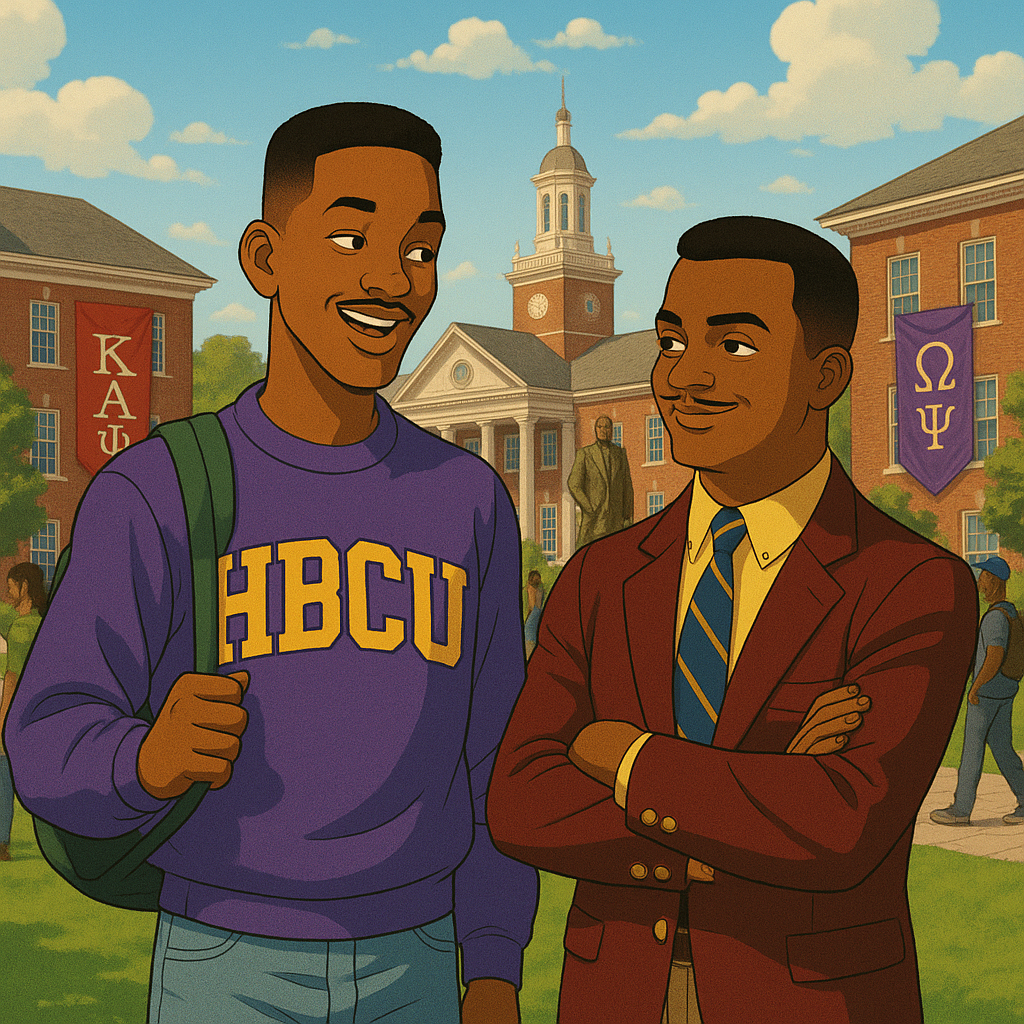
There’s a reason The Fresh Prince of Bel-Air worked so well. Will’s Philadelphia-born charisma collided with Carlton’s prep-school privilege, creating a comedy of contrasts rooted in class, code-switching, and internalized white gaze. But even then, Will and Carlton both eventually attended the fictional ULA — another HBCU stand-in — and the show made space to honor Black institutions. In today’s remakes and reboots, the goalpost has moved. The tension no longer lies in navigating Blackness within Black spaces — it’s about achieving acceptance in white ones.

That’s dangerous.

When every fictional Black success story leads to a PWI, the message isn’t just one of educational preference — it’s a silent endorsement of the idea that Black excellence only matters when validated by white institutions. It undermines the legacy of HBCUs and implicitly suggests that the spaces Black people built for themselves are less worthy of screen time or societal investment.

The Stakes Are Real

This is more than a cultural critique. It’s an economic, social, and political issue. HBCUs graduate 80% of Black judges, 50% of Black lawyers, 40% of Black engineers, and 40% of Black Members of Congress. They are engines of Black leadership — and media has the power to either support or suppress that momentum.

Shows like A Different World didn’t just entertain — they built pipelines. They encouraged enrollment, boosted donations, and sparked policy conversations. At their best, they acted as visual endowments, depositing cultural capital into communities that needed it most.

When those narratives disappear, so does the incentive for viewers to value or invest in HBCUs. Worse, it renders the very idea of building Black institutions obsolete in the cultural imagination.

Why The Writers’ Room Needs HBCUs

The disappearance of HBCUs from fictional family life is also a commentary on who’s writing the stories. As Hollywood grapples with diversity, equity, and inclusion, it continues to rely heavily on Ivy League or top PWI talent pipelines. While some HBCU alumni are breaking through — such as Lena Waithe (Columbia College Chicago, but often a supporter of HBCUs) and Taraji P. Henson (Howard University) — there is still no wide-scale industry embrace of HBCU-trained writers, producers, or creatives.

This matters.

Representation isn’t just about who’s on screen — it’s about who decides what stories are told, who centers the cultural context, and who gets to be the architect of Black futures.

The Cultural Cost of Being “The Only One”

There’s a deep psychological tax in being “the only one” — a familiar theme in shows that send Black characters to elite PWIs. Whether it’s Zoey Johnson navigating white professors or Carlton Banks handling racial profiling by the police, these storylines, while real, often celebrate survival rather than thriving. They portray success as proximity to whiteness rather than mastery of one’s own.

Contrast this with Hillman, where students struggled, triumphed, fell in love, challenged politics, and made mistakes — all within a culturally affirming environment. The campus was Black. The professors were Black. The rules, norms, and traditions were Black.

That distinction is powerful.

In a world increasingly shaped by algorithms, streaming wars, and performative diversity, where we imagine Black life unfolding — especially for fictional families — is just as important as what happens.

Black-Owned Media: The New Front Line of Cultural Restoration

If the absence of HBCUs from our screens reflects a loss of cultural focus, then the solution lies not just in pleading for more representation — but in owning the means of production, distribution, and storytelling. For generations, Black-owned media has served as a counterbalance to the marginalization found in mainstream outlets. But today, especially in an era defined by digital platforms, there’s a new frontier of opportunity — and HBCUs are uniquely positioned to lead.

To change the narrative, we must also change the narrators.

HBCUs as Incubators for Black Media Ownership

HBCUs are not just educational institutions — they are cultural laboratories. Schools like Howard University, Florida A&M, and North Carolina A&T have produced a long lineage of journalists, filmmakers, producers, broadcasters, and business leaders in media. Cathy Hughes, the founder of Urban One (formerly Radio One), the largest African American-owned broadcasting company in the U.S., began her media career at Howard. Her success is not the exception — it’s the proof of concept.

What if more HBCUs developed cross-disciplinary media programs that fused journalism, film production, and business with a distinctly Afrocentric and institution-building ethos? Imagine an HBCU student graduating not just with a film degree, but with the rights to a series developed in a campus-run studio, ready to be licensed to a Black-owned distribution network. Imagine HBCUs running their own content incubators — writing rooms, studios, streaming apps — where the next A Different World is created by us, for us.

Building Our Own Pipelines: From Classroom to Platform

For too long, Black creatives have had to depend on mainstream networks or streaming services to greenlight their work. This gatekeeping often results in sanitized or stereotyped representations, with HBCUs either ignored or distorted. But what if HBCUs created their own media pipelines — complete with production houses, content libraries, and distribution partnerships?

Howard University already owns WHUR 96.3, a powerhouse urban radio station in Washington, D.C. Florida A&M operates WANM, its campus radio station. Spelman and Morehouse have nurtured partnerships with media production companies. These are the seeds of a broader media ecosystem.

Now imagine:

  • HBCU Streaming Networks: Think “HBCUflix,” operated by a consortium of HBCUs with a content catalog drawn from student filmmakers, professors, and alumni creatives.
  • Campus-Controlled Local TV Stations: Using FCC-designated low-power TV station licenses to broadcast HBCU sports, lectures, news, and entertainment to local communities.
  • Black-Owned Newsrooms: Reviving the tradition of the Chicago Defender or Pittsburgh Courier in digital form, anchored by HBCU journalism schools.

This isn’t hypothetical. It’s blueprint-ready. What’s required is a collective investment of time, capital, and institutional will — plus alumni and philanthropic backing — to scale these models.

In the evolving landscape of Black-owned media, DeShuna Spencer stands out as a visionary force. As the founder and CEO of kweliTV, Spencer has created a platform that not only amplifies Black voices but also serves as a blueprint for how Historically Black Colleges and Universities (HBCUs) can reclaim and reshape cultural narratives through media ownership and innovation.

DeShuna Spencer and the Birth of kweliTV

DeShuna Spencer, a Memphis native and Jackson State University alumna, launched kweliTV out of a desire to see authentic Black stories represented in media. Frustrated by the lack of diverse and accurate portrayals of Black life on mainstream platforms, she envisioned a space where the global Black experience could be celebrated in its entirety. “Kweli” means “truth” in Swahili, reflecting the platform’s mission to present honest and multifaceted narratives of the African diaspora.

kweliTV curates a vast library of over 800 indie films, documentaries, web series, children’s programming, and more, sourced from North America, Africa, Latin America, the Caribbean, Europe, and Australia. The platform emphasizes content that has been recognized at film festivals, with 98% of its films having premiered at such events and 65% earning prestigious awards.

A Platform for Empowerment and Education

Beyond entertainment, kweliTV serves as an educational tool and a catalyst for social change. The platform’s mission is rooted in the belief that storytelling can drive activism, connect communities, and spark meaningful conversations . By showcasing content that delves into topics like racial equality, Black history, political activism, and wellness, kweliTV provides viewers with narratives that challenge stereotypes and promote understanding.

Recognizing the importance of education, Spencer has expanded kweliTV’s reach into academic institutions. The platform’s EDU component offers campus-wide subscriptions, delivering culturally rich content to schools and libraries. This initiative aims to shift the Black narrative, dismantle implicit bias, and address the erasure of Black history in education.

Supporting Black Creators

kweliTV is committed to economic inclusion and the empowerment of Black creatives. The platform collaborates with over 450 filmmakers worldwide, with 91% of them being of African descent and 50% women. Notably, 60% of subscription revenue is allocated to these creators, ensuring that they are compensated for their work and can continue producing impactful content.

In a move to further support its community, kweliTV launched kweliFUND, a crowdfunding platform designed exclusively for its creators. This initiative allows filmmakers to raise funds for their projects directly from the platform’s audience, fostering a sense of community and collaboration between creators and viewers.

A Model for HBCUs and Black-Owned Media

Spencer’s work with kweliTV offers a compelling model for how HBCUs can engage in media ownership and content creation. By establishing their own media platforms, HBCUs can provide students with hands-on experience in storytelling, production, and distribution, while also ensuring that Black narratives are told authentically and with nuance.

Furthermore, partnerships between HBCUs and platforms like kweliTV can facilitate the sharing of resources, expertise, and content, amplifying the reach and impact of Black stories. Such collaborations can also lead to the development of new media ventures, including streaming services, radio stations, and digital publications, all rooted in the rich cultural heritage of HBCUs.

Looking Ahead

DeShuna Spencer’s journey with kweliTV underscores the transformative power of media ownership in shaping cultural narratives. By prioritizing authenticity, education, and empowerment, Spencer has created a platform that not only entertains but also enlightens and inspires.

As HBCUs and Black-owned media entities look to the future, the example set by Spencer and kweliTV serves as a beacon, illustrating the profound impact that intentional storytelling and media ownership can have on communities and the broader cultural landscape.

For more information about kweliTV and its mission, visit kweli.tv.

Creating a Cultural Distribution Infrastructure

Ownership is not just about creating content; it’s about controlling how, when, and where that content reaches audiences. This is where distribution — the final, and often most powerful leg of the media supply chain — comes into play.

We’ve seen what happens when Black creators rely on platforms like Netflix, Amazon Prime, or Hulu: their content is subject to algorithmic bias, buried under trending categories that don’t serve Black audiences, or removed altogether without explanation.

The answer? HBCUs and Black-owned media must move to own the pipes — the literal and digital infrastructure of cultural delivery:

  • OTT Streaming Platforms: Develop Roku, Fire TV, and mobile app channels focused on HBCU-produced content, from sitcoms to documentaries to sports coverage.
  • Podcasting Networks: Establish campus-based podcast studios and national syndication pipelines, building on the success of Black podcasting voices in culture, politics, and mental health.
  • Media Training & Ownership Programs: Create degree and certificate programs focused specifically on media ownership, policy, and digital rights — the business side of the content coin.

These systems not only decentralize media control, but they also re-center HBCUs as hubs of cultural production and protection.

Reinforcing a Narrative of Sovereignty

This shift is not just about representation; it’s about sovereignty. Black-owned media — especially when powered by HBCUs — doesn’t just offer us better stories. It offers us control over how Black futures are imagined. It allows for stories where our children attend HBCUs not as exceptions but as norms, where our families are not defined by white validation but by Black institutions and Black love.

It also allows us to engage intergenerationally. Grandparents who once watched A Different World could stream its spiritual successor with their grandkids — not waiting on NBC, but logging into a platform built by us. The message? Black stories, Black education, and Black institutions still matter — and we’ll tell that truth ourselves.

A Call to Action: HBCUs, It’s Time

The time has come for HBCUs to formally declare themselves cultural content producers — not just pipelines to jobs in someone else’s newsroom, but architects of our own. This means:

  • Partnering with Black venture capitalists and philanthropists to fund media tech.
  • Creating cross-campus media alliances to pool talent and resources.
  • Reaching out to Black celebrities and alumni for licensing deals, co-productions, and endorsements.

We already have the minds. We have the stories. We have the history. Now we need to build the systems.

Because until we do, our children on screen will keep walking through Ivy-covered gates that never reflect the richness of the Black experience — and the cultural erasure will quietly continue.

But when we own the studio, the mic, and the means of distribution — Hillman will return, and this time, it won’t just be a different world.

Bringing Hillman Back: What’s Next?

It’s time for another renaissance.

There’s an opportunity here for Black creators, networks, and communities to reclaim HBCUs as vital to the cultural conversation. Imagine:

  • A new series that follows a multi-generational HBCU family through decades of change.
  • A young adult drama centered on students at Spelman, Morehouse, or Hampton navigating climate change, cancel culture, and campus love.
  • A sci-fi thriller set at a fictional HBCU where Black inventors and scientists are the last hope for humanity.

These aren’t pipe dreams. They are possible — and necessary.

Because culture moves policy. Culture shapes perception. And culture, at its best, reminds us of who we are and what we’re worth.

Final Word: Hillman Wasn’t Just a Show

Hillman was a blueprint. It showed us that we don’t need to ask permission to be excellent. That we can build institutions where our children are seen, heard, and nurtured. That we don’t have to shrink to fit someone else’s standard.

Today, as fictional African American families continue to send their children to PWIs — with barely a nod to the institutions that made their very existence possible — we must ask ourselves what kind of future we’re imagining.

Because if we don’t see HBCUs on our screens, in our scripts, and in our stories, we risk losing them in real life.

And that’s a different world we cannot afford.

Disclaimer: This article was assisted by ChatGPT.

The Lost Generation: How Gen X Inherited the Collapse of Black Institutions

“We were sold the idea that the institutions that our great-grandparents built after enslavement, the institutitons that their blood, sweat, tears, and far too often their lives were sacrificed for no longer mattered. The institutions that protected our grandparents and parents no longer mattered. That we had no obligation, no duty to uphold them, strengthen them, defend them – and it may ultimately be our downfall.” – William A. Foster, IV

African America’s Generation X came of age in the shadow of promises made but never fulfilled. Born after the civil-rights movement and the legislative victories of the 1960s, they were told they were heirs to a new world of possibility. Yet for most, the landscape they entered was not one of expanding opportunity but of institutional decline. Gen X did not inherit the wealth of their White peers, nor did they inherit the institutional foundations that could have shielded them from the widening chasm of inequality. Instead, they became the “lost generation” of African America—not because they lacked talent or will, but because they were asked to build lives in the absence of functioning institutions.

The story is one of numbers as much as narratives. At mid-century, African Americans could point to over 134 banks, more than 500 hospitals, and a dense ecosystem of schools, businesses, and mutual-aid societies that created scaffolding for resilience. By the time Gen X came of age in the 1980s and 1990s, the majority of those institutions had collapsed. Today, fewer than 20 African American banks remain. The hospitals, once numbering in the hundreds, have shrunk to just one. The erasure of these structures left Gen X to navigate adulthood without the community-owned institutions that had once provided both opportunity and insulation.

This institutional decline coincided with the hardening of social and economic divides. African American median household wealth remains below $20,000, compared to more than $180,000 for White households. Home-ownership rates hover around 44 percent, far below the 73 percent enjoyed by Whites. Poverty, unemployment, and health disparities disproportionately fell on African American Gen X families, erasing many of the gains their parents’ generation had fought for. In health, the loss of African American hospitals meant fewer spaces for culturally competent care and fewer pathways for African American doctors, nurses, and administrators to train and serve their communities. In finance, the disappearance of banks meant fewer loans for businesses and homes, ensuring that the dollar cycled out of the community faster than it could ever build generational stability.

By the 1980s, when many Gen Xers were entering high school, even the educational system that had once cultivated excellence for African American children was being dismantled. A century earlier, African American boarding schools—descendants of Reconstruction-era self-help institutions—had trained teachers, scientists, craftsmen, and entrepreneurs. Schools such as Piney Woods, Laurinburg, and Pine Forge stood as examples of self-contained learning environments that instilled discipline and race pride. By 2014, only four remained. Their decline, chronicled in The Final Four: African American Boarding Schools on the Verge of Extinction, symbolized the erosion of intellectual infrastructure that once undergirded the Black middle class. These schools had produced generations of college-ready youth who often went on to HBCUs and then into the professions. When they withered, so did a crucial pipeline.

Their demise reflected not a lack of academic excellence but the disintegration of a supportive ecosystem. As integration policies shifted resources away from Black-controlled schools, and as affluent African American families pursued suburban acceptance, the boarding schools were left with dwindling endowments and shrinking enrollments. Their survival required a collective sense of purpose that the Gen X era—steeped in the illusion of individual advancement—could no longer muster. The extinction of these schools mirrored the broader trajectory of African American institutions: erasure through neglect, assimilation, and the seductive myth that success could be purely personal.

The same cultural dissonance emerged in the world of entertainment and higher education. On television, Gen X watched A Different World, a fictional HBCU experience that inspired a generation but also unintentionally reflected a pivot. The series’ most memorable duo, Dwayne Wayne and Ron Johnson, captured the promise and pitfalls of the Gen X mindset. As HBCU Money’s essay Dwayne Wayne & Ron Johnson Dropped the Ball: HBCUpreneurship observed, the show chronicled two brilliant young men who graduated not to build companies or institutions, but to take jobs inside someone else’s. Their story became emblematic of a generation encouraged to chase credentials rather than ownership.

Gen X was the first to be told that integration was complete, that they could “make it” anywhere. But what they were rarely told was that making it individually often meant abandoning the collective scaffolding their grandparents had built. The very concept of the HBCU as a launch pad for entrepreneurship faded into nostalgia. Dwayne and Ron’s missed opportunity was not fictional; it mirrored the real-world drift of African American college graduates into corporate dependency, even as those corporations benefited from their creativity without reinvesting in African American communities.

The consequences were measurable. While White entrepreneurial ecosystems flourished in the 1990s with the rise of venture capital and tech startups, African American business formation lagged far behind. Few HBCUs established business incubators, angel networks, or venture funds that could capture their graduates’ ingenuity. Gen X, trained to seek jobs rather than ownership, lacked both the financing structures and the cultural reinforcement to build enduring enterprises. The very generation that watched the digital revolution unfold found itself on the consumer end rather than the ownership end of that transformation.

In this sense, the decline of African American institutions was not merely physical but philosophical. The idea that collective power could yield freedom gave way to the belief that individual success was freedom itself. This ideological shift—fed by television, politics, and the allure of assimilation—eroded the cooperative ethos that once sustained Black Wall Streets and mutual-aid societies. Where earlier generations might have pooled resources to open a bank, Gen X was taught to seek a mortgage from Wells Fargo. Where their ancestors founded hospitals like Provident and Homer G. Phillips, Gen X looked to be admitted to the best White medical schools rather than to revive their own.

The paradox of Gen X is that they were told they had arrived at a moment of inclusion—seen in the growth of African American representation in politics, sports, entertainment, and corporate America—while the ground beneath them was collapsing. Symbolic milestones such as the first African American CEOs of Fortune 500 companies or the growing ranks of African American elected officials did not offset the fact that the ecosystem of African American hospitals, banks, and businesses was being erased. Gen X bore the brunt of this contradiction: celebrated for individual achievement while collectively stripped of institutional power.

The American economy of the 1980s and 1990s was primed for wealth building. Deregulation, real-estate booms, and the rise of the stock market created enormous opportunities for asset accumulation. Yet African American Gen Xers, lacking access to capital and institutional mentorship, were largely excluded. The few who broke through—whether in entertainment or professional fields—were exceptional precisely because the system offered so little support. They became proof of possibility for a generation starved of infrastructure, even as their fame obscured the underlying erosion.

By the early 2000s, as Gen X entered its peak earning years, the effects of institutional loss were unmistakable. The community’s wealth gap widened even as educational attainment rose. African American college-graduation rates climbed, but the payoff was smaller salaries, heavier debt, and less wealth accumulation. Without community-controlled banks or credit unions, they faced higher borrowing costs. Without business investment networks, they relied on personal savings to launch ventures, limiting scale and sustainability. Without hospitals and schools owned by the community, the circulation of dollars—once measured in weeks—shrank to hours.

The collapse of the boarding schools and the failure of HBCUpreneurship are not side stories; they are the connective tissue of this larger decline. Each represented a node of self-determination that could have anchored Gen X’s ascent. When those nodes vanished, Gen X’s trajectory became fragmented—brilliant individuals floating in isolation, disconnected from the institutional gravity that sustains a people. The lesson from the Final Four and from Dwayne Wayne and Ron Johnson is that without institutional continuity, culture becomes performance, not power.

The irony is that Gen X still carried the memory of what once was. Many were raised by grandparents who remembered owning land, operating local businesses, or attending all-Black schools where teachers lived in their neighborhoods. They inherited stories of collective pride, but not the structures that produced it. And because their own formative years coincided with mass media’s rise, those stories were often drowned out by consumer culture’s narrative of individual aspiration. Success became synonymous with escaping one’s community rather than empowering it.

That shift in imagination may be Gen X’s greatest tragedy. A people’s future is determined as much by what they believe is possible as by what they own. When the imagination of ownership fades, dependency becomes normalized. African America’s Gen X did not choose dependency; they adapted to a system that rewarded proximity to White institutions while punishing independent Black ones. Government contracts, corporate partnerships, and philanthropic grants replaced the cooperative economics of earlier eras. The result was a generation of professionals with unprecedented credentials but limited leverage.

Still, within this loss lies instruction. Gen X’s struggle clarifies that talent alone does not equal power. Communities achieve permanence only when they own the institutions that convert talent into infrastructure. The hospitals, banks, and boarding schools were not merely service providers—they were instruments of sovereignty. Their disappearance left African America reliant on external validation and vulnerable to the volatility of goodwill.

Oprah Winfrey, Michael Jordan, and Barack Obama stand as icons of Gen X achievement, but their presence cannot replace the 500 hospitals or 100 banks that once supported African American communities. Institutions are what allow success to scale beyond the individual. Without them, every victory is fleeting, every gain precarious. The Gen X dream of being “the first” often became a cycle of isolation: the first in the boardroom, the first on the cover, the first to arrive—but rarely the architect of a system that ensured there would be a second.

As Millennials and Gen Z inherit the debris of that collapse, they confront the same choice: to celebrate representation or to rebuild capacity. The wealth and power gaps remain staggering. African Americans are still nearly twice as likely to live in poverty and hold only about four percent of America’s small-business assets despite comprising thirteen percent of its population. The absence of institutions guarantees these outcomes; their reconstruction could begin to reverse them.

Rebuilding will require the mindset Gen X was never taught—to treat institutions as the truest form of freedom. That means HBCUs creating venture capital funds that invest in their graduates. It means restoring the legacy of African American boarding schools as incubators of discipline and intellect. It means reviving credit unions and community banks that finance local ownership. It means rediscovering that the measure of progress is not how many individuals cross the threshold of another people’s institutions, but how many institutions one’s own people can build and sustain.

Gen X stands, then, as both victim and warning: the generation that inherited the death of African American institutions and the collapse of mobility. Their story illustrates that the survival of a people rests not on individual ascent but on collective infrastructure. Without it, the next generation risks becoming lost as well. The lost generation’s greatest gift may be its clarity—the understanding that brilliance without ownership is bondage, and that no degree, celebrity, or salary can substitute for a hospital, a bank, a school, or a business owned in the name of one’s community.

Disclaimer: This article was assisted by ChatGPT.

Mobilizing HBCU Strength in the Wake of Hurricane Melissa

Support Jamaica – Official Disaster Relief & Recovery Portal

“The building of the bridge of the Diaspora is prioritizing each other, being there for each other, and knowing we will be there for each other.” – William A. Foster, IV

Hurricane Melissa has carved a path of devastation across the Caribbean, making landfall in Jamaica as one of the most powerful storms ever recorded in the region. With winds exceeding 185 miles per hour, rain measured in feet rather than inches, and storm surges that swallowed entire communities, the destruction is overwhelming. Roads have vanished under mudslides, homes are washed away, and entire regions remain without power or communication. As the world watches, the human cost mounts and with it, the need for coordinated, long-term recovery efforts that go beyond the headlines and hashtags.

This is precisely the kind of moment that calls for the leadership, creativity, and moral authority of America’s historically Black colleges and universities (HBCUs) and their alumni associations. Few institutional communities possess such a powerful combination of service tradition, intellectual capital, and global Diaspora reach. For nearly two centuries, HBCUs have served as centers of self-help and social infrastructure for African America and beyond educating generations to serve, rebuild, and lead. The aftermath of Hurricane Melissa offers a new test of that legacy, one that extends far beyond U.S. borders.

HBCUs have a deep connection to the Caribbean through students, faculty, and alumni whose roots reach into Jamaica, Haiti, the Bahamas, and other island nations. That Diaspora connection creates a moral and practical bridge for mobilization. Alumni associations in particular can move faster than the institutions themselves, deploying funding, volunteers, and networks within days, while universities align longer-term commitments around research, innovation, and academic exchange. This dual structure, the institution and the alumni, makes HBCUs uniquely suited to play both first responder and long-term architect in disaster recovery.

In the immediate term, alumni associations can serve as rapid-response centers. Even as the storm continues, alumni chapters across the United States should already be coordinating with established relief through the Support Jamaica from the Government of Jamaica. The goal should not be to duplicate existing efforts but to amplify them by channeling alumni donations, collecting verified supply lists, and matching HBCU expertise to specific needs on the ground. An engineering professor can offer structural assessments remotely. A nursing department can send medical students on rotation to assist clinics in Jamaica or the Caymans. A business school can help small entrepreneurs rebuild supply chains once ports reopen. HBCU students are not bystanders to crisis they are trained to serve.

Beyond the initial relief period, HBCUs can deploy their research and applied-learning capabilities to support the complex rebuilding process that will follow. Public-health schools can collect data on water contamination, agricultural programs can study soil and crop recovery, and construction-management students can join design labs that focus on modular, hurricane-resistant housing. These engagements would not only meet immediate needs but also serve as living classrooms and turning recovery into an educational mission. When coordinated through alumni networks and Caribbean universities, such projects could lay the foundation for a sustained partnership that lasts long after the disaster fades from public view.

In the longer arc of rebuilding, HBCUs have an opportunity to link disaster recovery to economic and institutional power. This means using their foundations and alumni associations as development engines by building endowment-style disaster funds, supporting Caribbean student scholarships, and creating revolving loan funds for small business recovery. These are not acts of charity; they are investments in diasporic resilience and self-reliance. Each project funded, each student supported, and each home rebuilt becomes a demonstration of how African-descended institutions can act globally in solidarity with one another.

Such engagement also strengthens the HBCUs themselves. It raises institutional visibility, attracts research partnerships, and generates new funding streams from government, philanthropic, and private-sector actors who increasingly view climate resilience as one of the century’s defining challenges. HBCUs that position themselves as centers of innovation for the global South studying, designing, and implementing community-based adaptation strategies can expand their mission without abandoning their core. As the climate crisis accelerates, the world will need institutions that not only understand the technical side of disasters but the human and cultural dimensions of recovery. HBCUs are built on exactly that intersection.

Alumni associations have an equally vital role to play as connectors and funders. Their members sit in corporations, government agencies, and nonprofits that have the capacity to provide logistical and financial support. They can organize micro-campaigns like “HBCUs for Jamaica,” “Panthers for the Caribbean,” “Aggies for Melissa Relief” that use institutional pride to drive real impact. Alumni-owned businesses in logistics, energy, or construction can be contracted to support the rebuild, keeping dollars circulating within African-descended enterprise networks. In doing so, these associations reaffirm the idea that solidarity among African Americans and the wider African Diaspora is not a sentiment, it is an economic system waiting to be mobilized.

This storm also calls for humility and partnership. Local Caribbean organizations must remain at the center of planning and execution. HBCUs and their alumni can amplify those efforts, but not override them. Genuine cooperation requires listening to local leaders, integrating their priorities, and avoiding the paternalistic model that often defines international relief work. The goal is not to arrive as saviors but to stand as equals offering capacity, knowledge, and connection while respecting local sovereignty.

HBCU presidents should begin by issuing joint statements of solidarity, coordinating through existing networks such as the Thurgood Marshall College Fund, UNCF, and the 1890 Universities Foundation. Together, they can create a unified HBCU Hurricane Melissa Relief Fund with transparent governance and regular public reporting. At the same time, they can encourage their student governments and alumni bodies to organize locally: donation drives, digital campaigns, and academic forums on climate justice and resilience. Even modest efforts can have exponential effects when multiplied across more than one hundred campuses and hundreds of thousands of alumni.

The larger opportunity lies in transforming response into strategy. The Caribbean sits on the frontlines of the climate crisis. Hurricanes like Melissa will not be rare; they will be recurring. HBCUs can help shape the next generation of professionals such as engineers, urban planners, policymakers who understand that climate adaptation is not only a technical challenge but a social one. They can develop academic exchanges with Caribbean universities, establish resilience research centers, and convene annual symposia on diasporic disaster recovery. The intellectual capital of the HBCU system should not remain confined to domestic boundaries.

This is also a call for new kinds of philanthropy. African American institutions cannot rely on federal agencies or large international NGOs to prioritize the needs of predominantly Black regions. Our own institutions must cultivate endowments and funds capable of responding independently. Alumni foundations could dedicate a percentage of annual giving to a “Diaspora Relief Reserve,” allowing immediate deployment of resources when crises arise. Partnerships with African and Caribbean banks could provide low-interest credit to affected small businesses. Technology departments could create open-source digital platforms connecting donors to verified local projects. Each initiative strengthens both the giver and the receiver, building an economic loop within the diaspora.

To many, these storms seem like acts of nature. To those of us who understand history, they are also acts of policy from decades of neglect, inequality, and extractive development have left Caribbean nations exposed. HBCUs have always existed to correct structural inequities through education, cooperation, and leadership. Extending that mission across borders is not charity; it is continuation. The same spirit that built schools out of Freedmen’s churches after the Civil War can now help rebuild villages along Jamaica’s coast.

For generations, HBCUs have asked their students to “enter to learn, depart to serve.” Service now means something larger: serving not only one’s neighborhood or state but one’s global kinship. The aftermath of Hurricane Melissa offers a moment to operationalize that ideal to move from inspiration to institution, from sentiment to structure.

Five-Point Plan for HBCU and Alumni Action After Hurricane Melissa

  1. Create the HBCU Hurricane Melissa Relief Fund. A coordinated fund governed by representatives from multiple HBCUs and alumni associations, dedicated to immediate aid and long-term rebuilding.
  2. Deploy Expertise and Volunteers. Mobilize faculty, students, and alumni in engineering, health sciences, business, and agriculture to assist recovery efforts both on-site and virtually.
  3. Establish a Caribbean Resilience Fellowship. Provide scholarships and research opportunities for students from affected regions to study at HBCUs, focusing on climate adaptation and sustainable development.
  4. Develop Long-Term Economic Partnerships. Use alumni business networks to invest in reconstruction, renewable energy, and small-enterprise recovery in the Caribbean, ensuring diaspora capital builds diaspora resilience.
  5. Institutionalize Climate and Disaster Studies. Embed disaster-resilience curricula and global-south research collaborations across HBCUs, positioning them as leaders in climate-justice education and innovation.

HBCUs were born out of catastrophe, out of the wreckage of enslavement and the broken promises of Reconstruction. Their survival and success have always depended on collective strength and the willingness to build when others turned away. Now, as Hurricane Melissa devastates our brothers and sisters in the Caribbean, those same instincts are needed again. If HBCUs and their alumni act with urgency, strategy, and unity, they can transform this tragedy into a living testament to what diasporic institutions can achieve when they take responsibility for one another’s future.

Disclaimer: This article was assisted by ChatGPT.

China v. United States Is Not The Only Great Power Competition – Make No Mistake About It, HBCUs v. PWIs Are At War

“Today, the United States and China, often with Russia at its side, are competing to shape security architectures, as well as norms and practices worldwide, including trade and investment regimes and the development and regulation of new technological infrastructures. These frictions will play out over decades, not only in Beijing, Washington, and Moscow, but in Africa and Europe, the Arctic, outer space, and cyberspace.” – The Wilson Center

There are no African or Caribbean countries considered to be part of the Great Power Competition, only pawns in it. – William A. Foster, IV

In global affairs, the geopolitical rivalry between the United States and China captures headlines as the preeminent competition shaping the 21st century. However, closer to home, another fierce contest is unfolding—one that, while lacking the military and economic ramifications of the U.S.-China rivalry, is no less significant in the battle for resources, prestige, and influence. This is the ongoing conflict between Historically Black Colleges and Universities (HBCUs) and Predominantly White Institutions (PWIs). This battle is not just about educational preference; it is a struggle for survival, legacy, and the future of Black intellectualism and empowerment in America.

The Historical Context: Foundations of an Educational Divide

HBCUs were born out of necessity in an era when Black students were systematically excluded from white institutions due to segregation and racism. Established primarily in the late 19th and early 20th centuries, HBCUs provided a sanctuary for Black education and upliftment. Schools such as Howard University, Morehouse College, and Spelman College became powerhouses in producing Black professionals, thinkers, and leaders, who otherwise would have been denied access to quality education.

In contrast, PWIs, traditionally serving white students, eventually opened their doors to Black students following the Civil Rights Movement and the dismantling of Jim Crow laws. Integration, while a monumental victory, led to unintended consequences for HBCUs, including a decline in enrollment as Black students increasingly sought the prestige, resources, and opportunities associated with PWIs. The playing field, however, was never level. PWIs had centuries of endowments, expansive alumni networks, and government backing, whereas HBCUs remained underfunded and underappreciated.

The War Over Resources

One of the most glaring disparities in the HBCU vs. PWI competition is financial resources. The average endowment of an HBCU pales in comparison to that of even a mid-tier PWI. Take, for example, Harvard University, whose endowment surpasses $50 billion, while the combined endowments of all HBCUs struggle to reach a fraction of that amount.

This disparity has real consequences: outdated facilities, limited scholarships, fewer research opportunities, and struggles in faculty retention. Meanwhile, PWIs attract Black students with lucrative scholarships, state-of-the-art facilities, and networking opportunities that are difficult to resist. The financial battle is one that HBCUs, despite their resilience, continue to fight uphill.

Cultural Significance: A Battle for Identity

Beyond money, the HBCU vs. PWI war is a cultural one. HBCUs offer a unique and nurturing environment where Black students can thrive without the pressures of being minorities in predominantly white spaces. The culture of HBCUs is rich with tradition, homecomings, Greek life, and an emphasis on communal upliftment. These institutions foster Black pride, empowerment, and a curriculum centered around Black history and achievement.

PWIs, on the other hand, often relegate Black culture to a sub-narrative. While diversity and inclusion initiatives have increased, many Black students at PWIs report feeling isolated, encountering microaggressions, and struggling to find representation among faculty and administration. However, PWIs offer certain advantages—larger research budgets, extensive alumni networks, and higher-ranked programs—which make them attractive options for students seeking a competitive edge in the job market.

The Sports Arena: Where the Battle is Most Visible

Athletics is one of the most publicized battlegrounds in the HBCU vs. PWI war. For decades, Black athletes from HBCUs like Grambling State, Jackson State, and Southern University dominated professional sports. However, the integration of PWIs led to the siphoning of Black athletic talent away from HBCUs. Today, powerhouse programs at schools like Alabama, Ohio State, and Duke recruit Black athletes with multi-million dollar facilities, exposure, and professional pipeline programs that HBCUs struggle to match.

The recent resurgence of attention toward HBCU sports—highlighted by figures like Deion Sanders coaching at Jackson State—signals a potential shift in the paradigm. Sanders’ tenure not only brought visibility but also reignited discussions about the significance of Black athletes playing at HBCUs rather than generating billions of dollars for PWIs, which often fail to reinvest in Black communities.

The Corporate and Political Battlefield

Beyond academia and sports, HBCUs and PWIs compete in the corporate and political realms. HBCU graduates have historically faced challenges breaking into elite circles of power, where PWIs hold dominance. Fortune 500 companies and government institutions have historically recruited from Ivy League and top-tier PWIs, often overlooking the rich talent pools at HBCUs.

One of the starkest indicators of racial economic disparity is the near-total absence of Black-owned Fortune 500 companies. As of recent years, there have been fewer than five Black CEOs in the entire Fortune 500, and the number of Black-owned companies on the list is virtually nonexistent. Systemic barriers, including access to capital, investor bias, and exclusion from influential business networks, continue to hinder Black entrepreneurs from scaling their enterprises to the level of major corporate giants.

The lack of Black-owned Fortune 500 companies is particularly concerning when viewed against the backdrop of political and economic shifts. The rise of Donald Trump and his brand of economic nationalism underscored a shift toward policies that often ignored or outright disadvantaged minority-owned businesses. Trump’s tax policies largely benefited large corporations and the wealthiest Americans, while minority entrepreneurs saw little in the way of targeted support. His administration’s rollback of diversity initiatives in government and business further exacerbated the existing racial wealth gap.

However, recent movements advocating for diversity and equity have shifted some focus back to HBCUs. The Biden administration’s historic investment in HBCUs, as well as corporate pledges following the George Floyd protests, indicate an acknowledgment of these institutions’ significance. Still, whether these commitments translate into long-term systemic changes remains uncertain.

The Future of the Battle

The war between HBCUs and PWIs is not one of violence but of strategy, resilience, and adaptation. HBCUs must innovate, leveraging their cultural significance and legacy to attract top Black talent. Alumni engagement, corporate partnerships, and increased state funding are crucial to leveling the playing field. Simultaneously, Black students and families must weigh the long-term benefits of choosing an HBCU over a PWI, recognizing that their decision impacts the future viability of these historic institutions.

PWIs, while dominant in many areas, must confront their own racial disparities and reckon with their histories of exclusion. Recruiting Black students without providing adequate support systems leads to high dropout rates and dissatisfaction. For genuine equity, PWIs must go beyond optics and foster environments where Black students can thrive academically, culturally, and socially.

Conclusion: A War for Legacy

The United States and China battle for global supremacy in economics, technology, and military might. But within the U.S., the war between HBCUs and PWIs is a struggle for Black excellence, institutional power, and legacy. The outcome of this battle will determine the future of Black education and leadership. Will HBCUs regain their prominence and secure the funding and recognition they deserve? Or will PWIs continue to dominate, drawing Black talent into historically exclusive spaces while leaving HBCUs to struggle?

Make no mistake about it—this is a war. And like all wars, the victors will shape history. The question is: who will ensure that Black institutions not only survive but thrive in the centuries to come?

Can Military Strategy Save HBCUs? “The Estimate of the Situation” Approach

Strike an enemy once and for all. Let him cease to exist as a tribe or he will live to fly in your throat again. – Shaka Zulu, Advice to King Dingiswayo on the treatment of the defeated Ndwanwes

The Battle for the Black Mind

At the beginning of the 20th century, African American higher education was a mission of survival. By the end of the century, it had become a struggle for relevance. Today, the nation’s Historically Black Colleges and Universities (HBCUs) face a different kind of warfare—one not waged on battlefields but in boardrooms, budget hearings, and data dashboards. Declining endowments, limited research funding, a shrinking pool of Black male students, and encroachment by Predominantly White Institutions (PWIs) on their traditional demographic base has left many HBCUs strategically adrift.

But what if the remedy lies not in education reform think tanks or philanthropic patchwork, but in the unlikeliest of quarters—military strategy?

In the art of war, commanders engage in a disciplined process known as the “Estimate of the Situation.” Codified in U.S. military doctrine, this method assesses terrain, adversaries, capabilities, and courses of action before deciding how to marshal forces to achieve objectives. It is a doctrine of clarity, decisiveness, and ruthless prioritization—traits HBCUs, long forced into reactive postures, desperately need. If deployed correctly, it may offer a blueprint for survival and supremacy.

Terrain and Threat Assessment

The educational terrain for HBCUs is marked by systemic deprivation. While the Ivies and flagship publics boast endowments in the billions—Harvard’s at over $50 billion and the University of Texas System’s UTIMCO fund at $66 billion—only a handful of HBCUs cross the $100 million threshold. In 2024, Howard University led with a $908 million endowment, trailed by Spelman College ($569 million) and Hampton University ($379 million). By contrast, many HBCUs hover in the single-digit millions, dependent on volatile tuition revenue and susceptible to enrollment shocks.

Their adversaries are both external and internal. PWIs, emboldened by racial reckoning post-George Floyd, have launched aggressive DEI (Diversity, Equity, and Inclusion) marketing campaigns targeting high-achieving Black students, faculty, and even entire academic programs traditionally incubated within HBCUs. These institutions are mimicking HBCU cultural strengths while wielding superior infrastructure, funding, and media amplification.

Internally, decades of underfunding by state legislatures, inconsistent leadership pipelines, and fractured alumni giving have made coordination among HBCUs difficult. Public HBCUs often answer to politically hostile boards or governors who see their growth as optional, not imperative. In some Southern states, Black institutions are funded at levels far below their white counterparts, even while serving disproportionately more first-generation and low-income students.

The question then is: what does victory look like?

Mission Analysis: Existential or Expansionist?

In military parlance, the mission must be clear: is it to survive or to dominate? Too many HBCUs adopt a minimalist, survivalist mindset—hoping to keep doors open, retain accreditation, and attract enough enrollment to balance the books. But such passivity is tantamount to strategic surrender. If the mission is redefined as expansionist—growing endowments, poaching research talent, building technology hubs, or acquiring other institutions—then a different posture is required. One of preemption, consolidation, and power projection.

The underlying assumption should be this: the war for Black minds will intensify in the next decade as the U.S. becomes more diverse and the global competition for brainpower increases. If HBCUs do not act like insurgent militaries—nimbly, strategically, and with unified doctrine—they risk being romantic relics rather than revolutionary institutions.

Center of Gravity: The Black Intellectual Capital Base

In military strategy, the “center of gravity” is the source of an entity’s strength. For HBCUs, that center is their unparalleled social trust within the African American community and their historical mandate to serve as the custodians of Black intellectual capital.

Every great military power identifies its core asset. Rome had its legions. Britain its navy. The Soviet Union its armored divisions. For HBCUs, it is their alumni networks, faculty thought leadership, and cultural currency. But this center is fragile—threatened by underinvestment and neglect.

HBCUs should protect and project this strength. This means doubling down on producing future Black PhDs, engineers, doctors, and diplomats not as an accidental byproduct, but as a stated national security imperative for Black America. It also means developing internal think tanks and war colleges of their own—places where institutional planning, scenario modeling, and leadership development are continuous and sophisticated.

Logistics and Lines of Communication: The Endowment as Supply Chain

No army survives without logistics. In the higher education battlefield, the logistics trail is the endowment. It funds scholarships, shields against state austerity, allows for faculty recruitment, and finances long-term infrastructure. Currently, the Black educational front is malnourished.

A military-style “Operation Supply Line” could change this. Instead of chasing microgrants from corporations and philanthropies, a war doctrine would focus on concentrated, large-scale capital campaigns to create state-level or regional endowment federations.

Imagine, for example, if North Carolina’s five public HBCUs—North Carolina A&T, Fayetteville State, Elizabeth City State, Winston-Salem State, and North Carolina Central—pooled assets and donor bases into a centralized fund similar to UTIMCO. This would enable sophisticated portfolio strategies, risk mitigation, and scale advantages. Donors could give once, and see those funds managed professionally and distributed strategically.

The same could apply to private HBCUs, with alliances organized around geographic or academic complementarities. But like military alliances, these federations must be underpinned by mutual accountability and binding mission coherence.

Command Structure and Unity of Effort

Another hallmark of successful military strategy is clarity of command. At present, the HBCU landscape resembles a coalition of militias—each acting autonomously, sometimes duplicating efforts or even competing for the same resources. This is operationally inefficient.

There is precedent for unity. During World War II, Allied forces coordinated through joint command centers and mission directives despite national differences. HBCUs must do the same, perhaps through the reimagining of the Thurgood Marshall College Fund and UNCF as strategic command centers with teeth—not just fundraising conduits but institutions empowered to set joint priorities, coordinate lobbying efforts, and deploy institutional reinforcements to weaker allies.

This would mean acting less like separate colleges and more like battalions of a unified liberation force. Leadership exchanges, shared procurement, collaborative curriculum design, and a universal strategic plan should all be part of the doctrine.

War Games: Scenario Planning for a Disruptive Future

In military planning, exercises and simulations are key to testing preparedness. HBCUs need war games of their own—scenarios that model enrollment collapse, cyberattacks, political defunding, or rival university encroachments.

How would an HBCU survive if its primary state funding was cut 30% overnight? What if a prominent PWI began offering free tuition to Black students within its region? Could it recruit, retrain, and digitally educate at scale in response?

Scenario planning should not be theoretical. HBCUs could embed these exercises into board retreats, trustee meetings, and presidential onboarding. Just as generals must war-game an invasion, university leaders must anticipate disruption and know their mobilization plans.

Counteroffensive: Reclaiming the Intellectual Offensive

Finally, no military campaign is complete without a counteroffensive. HBCUs must stop playing defense. They should reclaim the offensive by launching campaigns that define what Black excellence is—not as an assimilationist ideal, but as an autonomous civilization-building agenda.

This could include opening campuses abroad in Africa and the Caribbean, creating a Black Fulbright equivalent to rotate scholars through HBCU-led global programs, or establishing “colonies of influence” in major American cities through cultural centers and satellite campuses.

The ultimate strategic goal is deterrence: to make it clear to the philanthropic sector, the corporate elite, and rival institutions that HBCUs are not simply cultural landmarks but geopolitical actors in the knowledge economy. Their preservation, therefore, is not charity—it is strategic alignment with the future.

Final Estimate: Can Military Strategy Save HBCUs?

The Estimate of the Situation is a cold, analytical process. It recognizes no nostalgia, entertains no sentimentality. It demands clarity, precision, and ruthless self-appraisal. For HBCUs, the time for reactive strategies and wistful memory is over. What is required is a war doctrine.

The adversaries are organized. The battlefield is asymmetric. And time is not on the side of the disorganized.

Yet, there is hope. Unlike in war, HBCUs do not need to annihilate their enemies. They need only to out-strategize them. With the right command structure, pooled resources, rigorous planning, and cultural clarity, they can turn the tide.

As Shaka Zulu warned: to spare a weakened enemy is to invite a future war. For HBCUs, the weakened enemy is irrelevance—and they must strike now to ensure it never flies at their throat again.