You can go to school anyplace, but no school will love you, and teach you to love yourself and know yourself like Hillman. – Whitley Gilbert
When Whitley Gilbert-Wayne stepped off the plane in Tokyo alongside her husband Dwayne in the mid-1990s, she had no idea that a chance encounter at a contemporary art exhibition would transform her from a newlywed supporting her engineer husband’s career into one of the most influential voices in Pan-African art acquisition and investment. The former Hillman College art history major known during her undergraduate years for her impeccable style and occasional elitism had matured into a woman with vision that extended far beyond Virginia’s borders. What began as casual gallery visits in Tokyo’s vibrant Roppongi district evolved into a business idea that would eventually connect HBCU endowments, Black corporate America, and emerging artists across the African diaspora.
“I was standing in front of a piece by a Nigerian artist at this small gallery in Harajuku,” Whitley recalls of the moment that changed everything. “The gallery owner mentioned that wealthy Japanese collectors were increasingly investing in African contemporary art, and I realized if they see the value, why aren’t we, as African Americans, building these collections ourselves?” That revelation led Whitley to spend her remaining months in Japan studying the mechanics of art acquisition, investment, and appraisal. She networked with gallery owners, attended auctions, and built relationships with African artists who were making waves in Asia’s art markets. By the time she and Dwayne returned to the United States, she had a business plan, a network of artist contacts spanning three continents, and an unshakeable conviction that Black institutions and families deserved access to culturally relevant art investment opportunities.
Whitley’s first pitch wasn’t to venture capitalists or traditional investors, it was to her Hillman College alumni network. She reached out to former classmates who had established themselves in various industries: Dr. Kimberly Reese and Ron Johnson, the power couple behind the thriving Reese and Johnson Medical Group, Freddie Brooks in entertainment law, and even her college frenemy, Julian Pace, who had made his fortune in tech. “Whitley understood something fundamental,” says Ron Johnson, one of the fund’s founding investors. “She knew that we trusted each other because of our Hillman connection. She wasn’t asking us to just invest in art, she was asking us to invest in our cultural legacy.”
Dr. Kimberly Reese adds, “Ron and I had just completed our first major expansion of the medical group. We were looking for investment opportunities that aligned with our values. When Whitley presented her vision, it was clear this was about more than financial returns, it was about cultural preservation and long-term wealth building for our community.”
The Diaspora Art Investment Fund launched with $500,000 in seed capital from twenty Hillman alumni investors. Whitley’s model was revolutionary in its simplicity: identify emerging and mid-career artists from across the African diaspora from Salvador to Senegal, from Detroit to Durban acquire their works at fair market value, and create investment portfolios that would appreciate while supporting artists directly. Unlike traditional art investment funds that focused solely on returns, Whitley built in a mission-driven component. Ten percent of all profits would be reinvested in arts education programs at HBCUs and Historically Black Boarding Schools, creating a sustainable cycle of cultural wealth building.
Whitley’s most innovative contribution came when she approached her alma mater with an unconventional proposal: What if Hillman College built an art collection as part of its endowment strategy? “Most HBCUs had art on their walls, but it was rarely viewed as an asset class,” explains Dr. Terrence Mathis, Hillman’s Vice President for Advancement. “Whitley showed us that institutions like Yale and Harvard had art holdings worth hundreds of millions. She asked us why Hillman shouldn’t be acquiring works by contemporary Black artists that would appreciate in value while beautifying our campus and inspiring our students.”
Her consulting model for HBCUs was comprehensive. She would assess their existing collections, identify acquisition opportunities aligned with their budgets, negotiate directly with artists and galleries, handle authentication and appraisal, and develop exhibition strategies for campus galleries. Most importantly, she created educational programming that helped students understand art as both cultural expression and financial asset. Within five years, Whitley had consulted with fifteen HBCUs, helping them establish formal art acquisition programs. Texas College, Fisk University, and Savannah State University became early adopters, each building collections that now include works by Kehinde Wiley, Mickalene Thomas, and Wangechi Mutu—pieces that have appreciated significantly in value.
While institutional clients provided prestige, Whitley never forgot that wealth-building needed to extend to individual families. She developed a tiered service model specifically for HBCU alumni families who wanted to begin collecting art but didn’t know where to start. For clients with modest budgets, she offered educational workshops and access to emerging artists whose works started at $2,000-$5,000. For established collectors, she provided comprehensive acquisition services, including attendance at international art fairs, private viewings, and direct studio visits with prominent artists. “Whitley demystified art collecting for people like me,” says Kendra Williams, a North Carolina Central University alumna and corporate attorney. “I thought you needed to be a millionaire to collect meaningful art. She showed me that you could start small, build strategically, and create something beautiful and valuable for your family.” Her family services division has helped over 300 HBCU alumni families build personal collections, with many clients reporting that their acquisitions have tripled in value while providing immeasurable cultural enrichment to their homes.
Among her most enthusiastic clients are Kim and Ron themselves, who have used Whitley’s guidance to build an impressive collection for the Reese and Johnson Medical Group’s multiple locations. “Our patients commented immediately,” Dr. Reese notes. “Seeing artists who look like them, telling stories from our communities it changed the atmosphere of our practice entirely.” Whitley’s highest-profile work came through her corporate art advisory services. As Black-owned businesses expanded and Black executives ascended to C-suite positions across our own corporate African America, many began questioning why their physical spaces didn’t reflect the excellence and cultural richness of the people leading them. “Black CEOs and business owners would call me and say, ‘I just bought this building’ or ‘We’re opening our third location, and I refuse to have my walls look like every other corporate office,'” Whitley explains. “They wanted spaces that celebrated our heritage, that told our stories, that reminded their teams daily of the beauty and brilliance we come from.” Her corporate practice became a who’s who of Black entrepreneurial success from tech startups founded by young Morris College graduates to established manufacturing companies run by second and third-generation business owners. The Reese and Johnson Medical Group became one of her signature projects, transforming their practice locations into galleries that honored African and African American artistic traditions while creating healing, affirming spaces for their patients. As a corporate art broker and adviser, Whitley oversaw complete collection development for these companies, negotiating favorable terms, managing authentication, and ensuring proper insurance and conservation. Her approach combined aesthetic excellence with cultural competency, ensuring that corporate collections reflected the vision and values of Black leadership. “Working with the Reese and Johnson Medical Group was particularly meaningful,” Whitley says. “Here were two of my Hillman classmates who had built this incredible healthcare empire, and they wanted their spaces to reflect the excellence and beauty of Black culture. We curated pieces that spoke to healing, community, and resilience—themes that aligned perfectly with their mission.”
Perhaps Whitley’s most enduring legacy is the Pan-African Art Appraisal joint program she helped establish between Hillman College and the University of Namibia’s Department of Visual and Performing Arts. “Whitley recognized that the art world had a credibility problem when it came to valuing African and diaspora art,” notes Dr. Amara Okafor, program director at UNAM. “Too often, African art was undervalued or misunderstood by appraisers who lacked cultural context. She wanted to train a new generation of appraisers who understood both the technical aspects of valuation and the cultural significance of the works.” The program allows students to split their studies between Hillman’s art history department and UNAM’s Visual and Performing Arts department. Students gain hands-on experience with contemporary African art production, learn from artists addressing social issues through their work, and participate in exhibitions at the National Art Gallery of Namibia. Graduates of the program have gone on to work at major auction houses, establish their own galleries, and serve as in-house appraisers for museums and corporate collections. The program has become a model for other international partnerships, proving that HBCUs can lead in global arts education. The Reese and Johnson Medical Group has become a major supporter of the program, endowing two full scholarships annually for students pursuing careers in art appraisal and healthcare art therapy, a perfect synthesis of the couple’s medical expertise and their passion for the arts.
Today, Whitley maintains offices in New York and Johannesburg, traveling regularly between the continents she’s connected through art. The Diaspora Art Investment Fund manages over $50 million in assets, her consulting firm has worked with thirty HBCUs, and the Hillman-UNAM program graduates twenty-five students annually. But perhaps most telling is her personal collection, which she and Dwayne have assembled over the years. It includes works from artists they discovered in Tokyo decades ago, pieces by Hillman alumni artists, and acquisitions from UNAM student exhibitions. The collection represents not just financial investment, but relationships, memories, and a commitment to the vision that first struck her in that Tokyo gallery.
“I tell young people that building cultural wealth isn’t just about money,” Whitley reflects. “It’s about creating infrastructure, establishing standards, and ensuring that our stories, our beauty, and our creativity are valued literally and figuratively. That’s what I learned at Hillman, and that’s what I’m trying to build for the next generation.” From a student who once measured success by designer labels and social status, Whitley Gilbert-Wayne has become an entrepreneur who measures impact by artists supported, institutions strengthened, and communities empowered. It’s a transformation worthy of the art she champions and one that continues to inspire her fellow Hillman alumni, from the Reese and Johnson Medical Group to boardrooms and galleries across the diaspora.
We went from bartering to dollars. We can go from capitalism to whatever may come next. But without institutional ownership of the institutions that control the circulation of the medium, without the institutional ownership that protects our economic interest, and without the institutional ownership that reduces financial risk in our community, then power and empowerment will always be reduced to the fantasy of freedom we tell ourselves with raised fists. – William A. Foster, IV
There is a financial story unfolding across the historically Black college and university landscape that is not receiving nearly enough attention. It is not a story about endowments, donor campaigns, or legislative funding fights — though it touches all of those. It is a story about credit unions: small, member-owned financial institutions that were once tethered to HBCUs as a gateway to financial inclusion for Black students, faculty, and alumni. One by one, they are disappearing. And the speed with which they have vanished over the past five years should alarm anyone who has spent even a passing moment thinking about African American wealth-building.
In 2020, HBCU Money published a comprehensive directory of all eleven HBCU-based credit unions in the country. The list was not long to begin with. Eleven institutions, spread across the nation, collectively holding $88.7 million in total assets and serving roughly 14,953 members. Those numbers were already modest bordering on fragile but they represented something tangible: a constellation of Black-controlled financial institutions with deep roots in the communities they served.
Today, that number has dropped to six.
Five HBCU-based credit unions have either closed or been acquired since that 2020 snapshot. Howard University Employees Federal Credit Union in Washington, D.C., which held $10.1 million in assets making it the fourth-largest in the group is no longer operational as an independent institution. Savannah State Teachers Federal Credit Union in Georgia, Tennessee State University’s credit union, and Shaw University’s federal credit union in Raleigh, North Carolina, the smallest of the group at just $400,000 in assets, have all ceased to exist as independent entities.
And then there is Prairie View A&M University Federal Credit Union, a case study in how these institutions disappear not with a clean closure, but with an acquisition that raises questions nobody seems willing to ask out loud. Prairie View FCU, which held $3.7 million in assets as of 2020, was absorbed by Cy-Fair Federal Credit Union, the credit union tied to Cypress-Fairbanks Independent School District in the Houston suburbs. Prairie View FCU now operates as a division of Cy-Fair FCU, retaining its name and its single location at the foot of the PVAMU campus but operating entirely under Cy-Fair’s infrastructure, branding, and control. The Cy-Fair FCU website frames the arrangement in the warmest possible terms celebrating PVFCU’s “remarkable 85-year history” and its founding in 1937 by sixteen pioneers who created a financial institution to serve employees of what was then Texas’s first state-supported college for African Americans. The language is reverent. The reality is that an 85-year-old Black institution, one built by and for a Black community, is now a subsidiary of a school district credit union. This in and of itself should be acutely embarrassing to the HBCU community. A school district lording over a higher education institution community’s financial interest.
The choice of Cy-Fair FCU as the acquiring institution deserves scrutiny. Cypress-Fairbanks ISD is the third-largest school district in Texas, but its relationship with its Black community has been, to put it charitably, troubled. In 2020, the district was forced to confront documented racial disparities in its own student discipline where African American students made up 18.5 percent of enrollment but accounted for 38.7 percent of suspensions in the 2018-19 school year. The district commissioned an equity audit, and the results confirmed what critics had long alleged: districtwide discrepancies in academics, discipline, and staff representation along racial lines. White students consistently outperformed Black peers on standardized tests and graduated at higher rates, while the teaching staff remained overwhelmingly white — 66 percent white in 2019-20, even as the student body had become far more diverse.
The situation reached a national flashpoint in January 2022 when Cy-Fair ISD trustee Scott Henry, who had won his seat on a platform centered on opposing critical race theory, made remarks at a board work session that were widely condemned as racist. Henry openly questioned the value of hiring more Black teachers, pointing to Houston ISD’s higher percentage of Black educators and linking it to that district’s dropout rate — a claim that multiple studies and education researchers have thoroughly debunked. Harris County Judge Lina Hidalgo, then Houston Mayor Sylvester Turner, the NAACP, and the ACLU of Texas all called for his resignation. Henry was fired from his position at software company Splunk but, because he was elected, could not be removed from the board by his colleagues. His remarks, and the social media trail of racially charged posts that preceded them, painted a portrait of the ideological environment within Cy-Fair ISD’s governance.
It is into this environment that Prairie View FCU, an institution founded specifically to serve a historically Black university community was folded. The Cy-Fair FCU website does not dwell on any of this context. It offers a “Panther Card” debit card that channels a portion of spending back to PVAMU athletics, and it lists enhanced services like video banking and remote deposit. These are not trivial upgrades for an institution that previously lacked basic digital banking capabilities. But the upgrades come at a cost: Prairie View FCU’s independence, its board, and its autonomy as a Black-controlled financial institution are gone. What remains is a branding exercise — a name on a building, a division page on someone else’s website.
Five institutions, gone in roughly four years. What remains is a smaller, more concentrated group of survivors. According to 2025 data from the National Credit Union Administration, the six remaining HBCU-based credit unions now hold a combined $76.8 million in total assets and serve 11,588 members. Southern Teachers & Parents Federal Credit Union in Baton Rouge, Louisiana, leads the group at $28.9 million in assets. Florida A&M University Federal Credit Union in Tallahassee follows closely at $28.5 million. Virginia State University Federal Credit Union in South Chesterfield, Virginia, has seen meaningful growth, reaching $13.3 million in assets, a 54.4 percent increase since 2016. Councill Credit Union at Alabama A&M in Normal, Alabama, clocks in at $2.5 million, though it has lost roughly 28 percent of its assets over the same period. Arkansas A&M College Federal Credit Union in Pine Bluff holds $1.9 million, and Xavier University’s Credit Union in New Orleans, one of the smallest surviving institutions, manages $1.7 million.
The trajectory is not encouraging. Even among the survivors, total membership has declined by more than seven percent since 2016, dropping from 12,467 members to 11,588. The average assets per member across the group have risen — from $5,189 to $5,611 — but that figure is almost entirely a function of assets outpacing a shrinking membership base, not a sign of organic financial health or deepening engagement. These are institutions hemorrhaging members even as they struggle to grow. And that hemorrhaging did not catch everyone off guard. Back in February 2012, HBCU Money published a detailed proposal outlining a path forward for these credit unions — not as isolated, single-branch institutions stumbling through each academic year, but as a unified financial force. The concept was straightforward in theory: consolidate the eleven HBCU-based credit unions into a single national institution, or at the very least forge a formal alliance that would pool resources, share technology infrastructure, and create economies of scale.
The 2012 proposal painted a picture of what that consolidated institution could look like. With access to the combined workforce of HBCUs — roughly 180,000 full and part-time employees — along with approximately 400,000 students, over a million alumni, the endowments of more than a hundred institutions, and the financial ecosystems of the communities surrounding each campus, a unified HBCU credit union would have been one of the most significant African American-controlled financial institutions in the country. It would have had the scale to offer affordable mortgages, student loans, small business financing, and a suite of services that, individually, none of these credit unions could ever dream of providing.
That merger never materialized. The alliance was never formed. And the consequences of that inaction are now playing out in real time as institutions that might have been strengthened by consolidation instead fold into obscurity. The reasons for the failure are familiar and deeply structural. HBCU administrations have historically been risk-averse when it comes to financial innovation, partly because of the precarious funding environments many of these schools operate in, and partly because of a broader cultural reluctance to prioritize financial infrastructure as a strategic institutional asset. The credit unions themselves lacked the technological sophistication and institutional support needed to compete in a rapidly evolving financial services landscape. Many of them did not have functional websites, mobile apps, or even basic debit card programs, amenities that any modern financial institution would consider non-negotiable. As the 2020 directory noted, the most glaring deficiency was a lack of FinTech investment. Without it, these credit unions were structurally incapable of retaining members whose financial needs matured beyond what a single-branch, limited-service institution could offer.
To understand just how far behind HBCU-based credit unions have fallen, it helps to look at what a university-based credit union can become when it is given the institutional support, technological investment, and long-term strategic commitment to grow. Michigan State University Federal Credit Union — MSUFCU — is that example. And the comparison is, frankly, staggering. MSUFCU, headquartered in East Lansing, Michigan, is the largest university-based credit union in the world. Founded in 1937 by eight faculty and staff members — its earliest records were kept in a desk drawer, it has grown into a financial powerhouse that, as of 2025, serves over 367,000 members and holds $8.26 billion in assets. It operates out of more than 30 branches across Michigan, has expanded into the Chicago metropolitan area, and employs over 1,300 people. It is not just a credit union; it is a regional financial institution by any standard measure.
Put that number next to the combined assets of every African American credit union in the country including the six remaining HBCU-based credit unions and the disparity becomes almost difficult to articulate. The six surviving HBCU-based credit unions hold, collectively, $76.8 million in assets. MSUFCU holds $8.26 billion. That means a single predominantly white university credit union holds more than 107 times the combined assets of every HBCU-based credit union still in existence. MSUFCU’s assets are not just larger than the combined total of HBCU credit unions they exceed the total assets of virtually all African American credit unions in the country. The gap is not a crack. It is a canyon.
MSUFCU did not arrive at this scale through magic or accident. It grew because Michigan State University invested in it. It grew because the institution was given the runway to expand its membership base from employees to students to alumni and to build out the technological and physical infrastructure that a modern credit union requires. It grew because it had the institutional backing to pursue mergers and acquisitions, absorbing smaller credit unions and even banks as it expanded its geographic footprint. Every strategic move MSUFCU has made over the past several decades — the branch expansions, the technology partnerships, the acquisition of McHenry Savings Bank and Algonquin State Bank in the Chicago area — reflects a long-term institutional vision that HBCU-based credit unions have never had the support or the organizational will to pursue. The contrast is not merely about money. It is about institutional commitment. It is about whether a university sees its credit union as a strategic asset, a vehicle for building generational wealth among its community or as an afterthought, a small office on the edge of campus that serves a fraction of the student body and operates with minimal oversight and fewer resources.
The 2025 NCUA data on the six surviving HBCU-based credit unions tells a story of incremental progress layered on top of structural decline. Virginia State University Federal Credit Union is the clearest success story in the group, growing its assets by 54.4 percent since 2016 from $8.6 million to $13.3 million and increasing its assets per member by 87.1 percent, from $3,742 to $7,001. Florida A&M University Federal Credit Union has also seen solid growth, with total assets rising 41.3 percent to $28.5 million, and membership expanding by 16.5 percent to 3,918 members. But these gains are exceptions, not the rule. Southern Teachers & Parents Federal Credit Union in Baton Rouge, the largest in the group, has grown its assets by only 2 percent since 2016, and its membership has fallen by 15.6 percent, dropping from 5,124 members to 4,326. It is holding steady on assets while quietly bleeding its membership base. Councill Credit Union at Alabama A&M has seen its assets shrink by nearly 28 percent since 2016, and its membership has fallen by over 30 percent. Arkansas A&M College Federal Credit Union has lost 22.7 percent of its assets. Xavier University’s credit union has contracted by 36.3 percent in assets and lost 5 percent of its membership. Across the group, the median asset change since 2016 is negative 10.3 percent. The median membership change is negative 10.3 percent as well. For every Virginia State that is growing, there are two or three institutions quietly shrinking toward irrelevance.
The average assets per member across all six institutions now stands at $5,611, up from $5,189 in 2016. That is a 12.5 percent increase — a number that sounds encouraging until you consider that MSUFCU’s assets per member, calculated from its $8.26 billion in assets and 367,000 members, comes to approximately $22,500. HBCU credit union members hold, on average, roughly one-quarter of the per-member asset value that an MSU credit union member does. The wealth-building capacity of these institutions is simply not comparable.
The collapse of five HBCU-based credit unions between 2020 and 2025 is not an isolated event. It is a symptom of a larger pattern in African American financial infrastructure one in which institutions that could, in theory, serve as engines of wealth circulation and community investment instead wither from neglect, underfunding, and a failure of institutional imagination. The 2012 proposal for a consolidated HBCU credit union was not a radical idea. It was a practical one. Credit union mergers are common across the industry. MSUFCU itself has pursued multiple mergers and acquisitions as a core part of its growth strategy. The tools, the regulatory framework, and the precedent all exist. What has been missing is the will on the part of HBCU administrations, alumni networks, and the broader African American institutional ecosystem to treat financial infrastructure with the same urgency that is applied to endowment campaigns or facility renovations.
The #BankBlack movement that surged during the social justice awakening of 2020 brought renewed attention to African American financial institutions, including credit unions. But attention without structural investment is temporary. The members who were inspired to open accounts at HBCU credit unions during that period appear, in many cases, to have drifted away once the cultural moment passed, a pattern visible in the continued membership declines across the group.
If the remaining six HBCU-based credit unions are to survive and if the broader ecosystem of African American credit unions is to grow rather than contract the conversation must shift from nostalgia to strategy. That means revisiting the merger and alliance models that were proposed over a decade ago. It means demanding that HBCUs treat their credit unions as institutional priorities, not afterthoughts. It means investing in the technological infrastructure that members now expect as a baseline. And it means reckoning honestly with the fact that, while MSUFCU serves as an aspirational model, it did not build $8.26 billion in assets overnight. It built them over nearly ninety years of sustained, intentional institutional support.
The clock is not on HBCU credit unions’ side. The five that have already closed will not reopen. But the six that remain still hold something valuable: a foothold. The question is whether the institutions and communities they serve will invest in preserving it or whether the quiet collapse will simply continue, one credit union at a time, until there are none left to save.
Disclaimer: This article was assisted by ClaudeAI.
“It is disappointing that HBCUs and any African American institution for that matter have not figured out yet that the circulation of our social, economic, and political capital with each other at the institutional level is where the acute crisis of closing the wealth gap truly lies. Yet, we still chase colder ice.” – William A. Foster, IV
The percentage of PWI dollars that flow into African American owned businesses is likely limited to catering a social event. Beyond that, their dollar never even likely floats pass an African American business. However, HBCUs certainly cannot say the same. HBCU capital leaving the African American financial ecosystem looks like every dam on Earth broke at the same time.
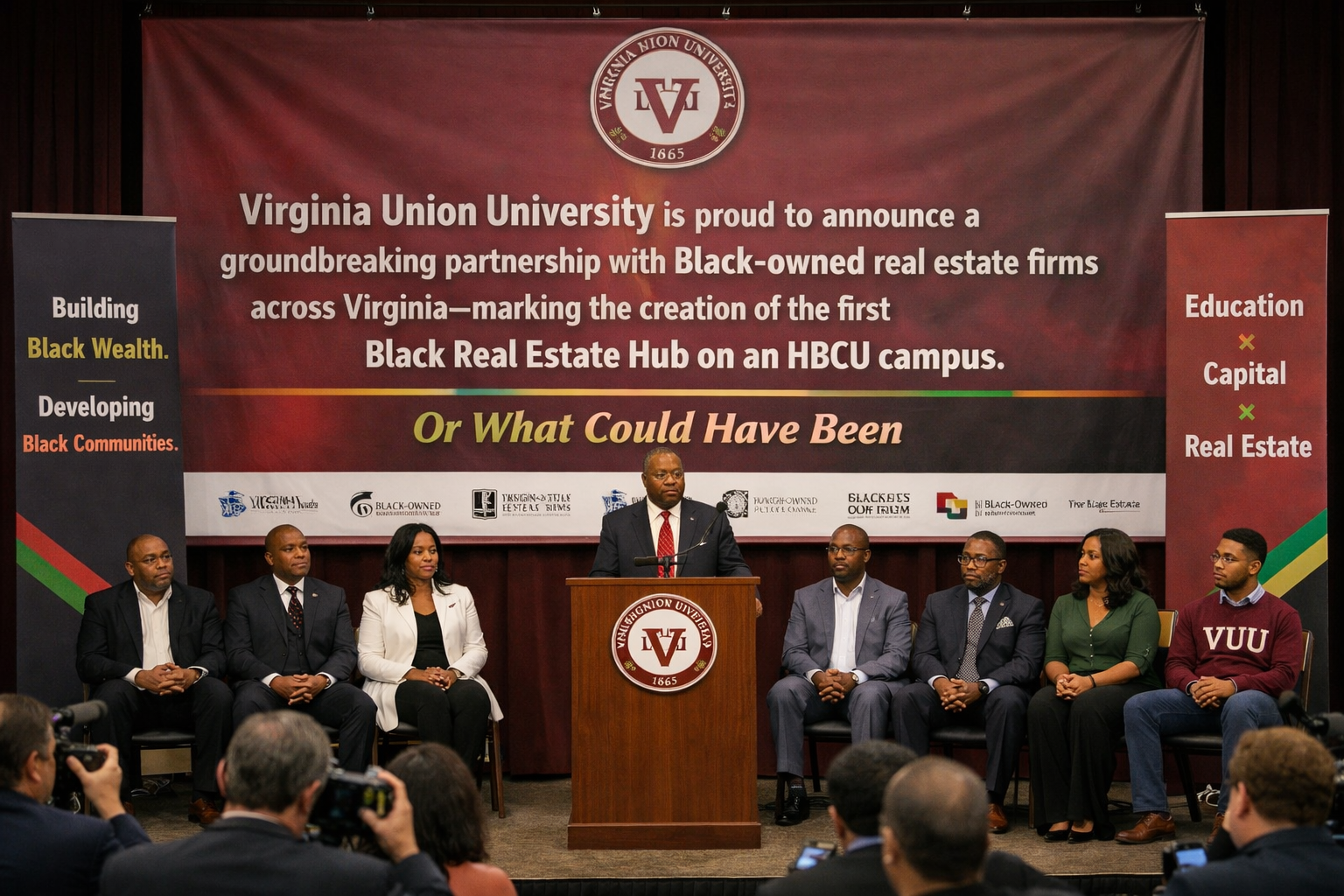
Virginia Union University’s recent announcement of a partnership with Keller Williams Richmond West represents a familiar pattern in HBCU decision-making, one that undermines the very mission these institutions claim to champion. While VUU proudly touts this collaboration as “groundbreaking” and positions it as a pathway to “closing the racial wealth gap,” the partnership reveals a fundamental misunderstanding of how wealth gaps are actually closed. The reality is stark: you cannot close a racial wealth gap by systematically excluding institutions from your own community from the economic opportunities your institution creates.
When HBCUs partner exclusively with non-Black institutions, they create what economists call a “leaky bucket” effect. The money, talent, and social capital generated by these historically Black institutions flow outward to other communities rather than circulating within the African American ecosystem. Every dollar spent with a non-Black vendor, every partnership signed with a non-Black firm, every opportunity directed away from Black-owned businesses represents wealth that could have been building generational prosperity in Black communities—but instead enriches other groups. This is where the fundamental disconnect lies: HBCUs understand the importance of encouraging individual African Americans to support Black-owned businesses, yet these same institutions fail to apply this principle at the institutional level where the real economic power resides.
The conversation about the circulation of the African American dollar has historically focused on individual consumer behavior. We’ve heard for decades about the need for Black consumers to shop at Black-owned stores, bank with Black-owned financial institutions, and hire Black-owned service providers. Studies have shown that a dollar circulates in Asian communities for approximately thirty days, in Jewish communities for around twenty days, in white communities for seventeen days, but in Black communities for only six hours before leaving. This abysmal circulation rate is correctly identified as a critical factor in the persistent wealth gap. But what these discussions almost always miss is that individual consumer behavior, while important, pales in comparison to institutional spending power.
When Virginia Union University signs a multiyear partnership with Keller Williams, it’s not spending a few hundred or even a few thousand dollars. Institutional partnerships involve hundreds of thousands or millions of dollars in direct and indirect economic benefits—facility usage, marketing exposure, student referrals, commission opportunities, and brand association. A single institutional partnership can equal the spending power of hundreds or thousands of individual consumers. Yet HBCUs consistently fail to recognize that their institutional spending decisions have exponentially more impact on wealth circulation than any individual consumer choice their students or alumni might make.
VUU’s partnership with Keller Williams is particularly emblematic of this pattern. According to the announcement, this collaboration will create “the first Keller Williams Real Estate Hub on an HBCU campus in Virginia” and will be “designed to bridge education, entrepreneurship, and real estate into one powerful ecosystem.” The goals are admirable: career readiness, economic mobility, wealth-building opportunities through real estate education and professional pathways. The partnership is positioned as being co-led by members of Delta Sigma Theta Sorority, Incorporated, with explicit language about sisterhood, brotherhood, and service in action. But here’s the question VUU administrators apparently didn’t ask: Why not create this “powerful ecosystem” with a Black-owned real estate company?
The assumption underlying most HBCU partnerships with non-Black firms seems to be that suitable Black-owned alternatives don’t exist. This assumption is demonstrably false. Black-owned real estate companies operate throughout the United States, including in Virginia and the Richmond area. These firms possess the expertise, resources, and commitment to serve HBCU students and alumni. United Real Estate Richmond, which describes itself as the largest Black-owned real estate firm in the Mid-Atlantic region, operates right in VUU’s backyard. CTI Real Estate is a Black-owned, woman-owned firm serving Virginia and Maryland. Nationally, companies like Braden Real Estate Group—a Black-owned Houston-based brokerage co-founded by Prairie View A&M University graduate Nicole Braden Handy—demonstrate the success of HBCU alumni in building substantial real estate businesses. H.J. Russell & Company, founded in 1952, stands as one of the largest minority-owned real estate firms in the United States. These Black-owned firms have proven track records of success, deep community connections, and explicit missions to build wealth in African American communities. These firms could provide the same—or better—opportunities that Keller Williams offers, with the added benefit of keeping wealth circulating in the Black community.
The difference would be transformative. A partnership with a Black-owned real estate firm would actually contribute to closing the wealth gap. It would demonstrate to students what Black excellence in business looks like. It would create mentorship opportunities with professionals who understand the unique challenges and opportunities facing Black Americans in real estate. It would ensure that the commissions, fees, and other economic benefits generated by the partnership stay within the African American economic ecosystem. Most importantly, it would model the institutional behavior necessary for true wealth accumulation—showing students that circulation of Black dollars must happen at every level, not just in their personal spending habits.
But to truly understand what institutional circulation looks like, consider this scenario: An African American real estate investment firm—owned by an HBCU alumnus and employing HBCU graduates as project managers, analysts, and development specialists—decides to develop a mixed-use building in Richmond. The firm uses Braden Real Estate Group to acquire the land. They secure financing from an African American bank like OneUnited Bank or Liberty Bank, supplemented by an investment syndicate of African American investors. The construction is handled by an African American-owned construction company like H.J. Russell & Company. When the transaction closes, it’s processed through Answer Title & Escrow LLC, the Black-owned title company founded by University of the District of Columbia alumna Donna Shuler. The property management contract goes to another Black-owned firm. The legal work is handled by Black attorneys. The accounting is done by a Black-owned firm.
This is what institutional circulation actually looks like. In this single development project, wealth circulates through multiple Black-owned institutions at every stage of the transaction. The bank earns interest income that it can then lend to other Black businesses and homeowners. The title company generates revenue that allows it to hire more staff and take on larger projects. The construction company builds its portfolio and capacity to compete for even bigger developments. The real estate investment firm creates returns for its Black investors and proves the viability of Black-owned development companies. The project managers and analysts gain experience that prepares them to start their own firms. Every single point in the transaction keeps wealth circulating within the African American economic ecosystem, building institutional capacity, creating jobs, generating returns, and proving that Black-owned institutions can handle sophisticated, large-scale projects.
Now contrast that with what happens when VUU partners with Keller Williams. Students may get training and even jobs as real estate agents, but the institutional wealth flows to Keller Williams—a non-Black company. The commissions generated by VUU-affiliated agents enrich Keller Williams’ franchise system. The brand association benefits Keller Williams’ reputation. The networking opportunities primarily connect students to Keller Williams’ existing (predominantly non-Black) networks. And when these students eventually facilitate property transactions, the ancillary services—financing, title work, legal services—typically flow to whatever institutions Keller Williams recommends, which are unlikely to be Black-owned.
The VUU-Keller Williams partnership might help individual Black students enter the real estate industry, but it does absolutely nothing to build the Black-owned institutional infrastructure necessary for true wealth building. In fact, it actively undermines that infrastructure by directing institutional resources and opportunities away from Black-owned firms. VUU essentially takes Black talent, students who could be building careers with Black-owned firms, and channels them into a non-Black institution, teaching them that Black institutions aren’t capable of providing the same opportunities.
This is the critical insight that HBCUs continue to miss: institutional circulation of capital is what builds lasting economic power. When individual Black consumers support Black businesses, they create important but limited impact. One person shopping at a Black-owned grocery store or banking with a Black-owned bank makes a difference, but a small one. When Black institutions support Black businesses, they create transformative, generational impact. An HBCU that partners with Black-owned banks, construction companies, real estate firms, technology providers, and service companies doesn’t just create individual transactions it builds an entire ecosystem of mutually reinforcing institutions that grow stronger together. This institutional ecosystem then has the power to compete with non-Black institutions, create opportunities at scale, and genuinely close wealth gaps.
Think about what would happen if every HBCU made a commitment to work exclusively with Black-owned institutions whenever viable alternatives exist. Imagine if all 101 HBCUs banked with Black-owned banks, used Black-owned construction companies for campus buildings, partnered with Black-owned real estate firms for student housing and community development, contracted with Black-owned technology companies for IT services, and hired Black-owned firms for legal, accounting, and consulting work. The combined institutional spending power of HBCUs would transform the Black business landscape. Black-owned banks would have hundreds of millions in deposits, allowing them to make larger loans and compete for more business. Black-owned construction companies would have steady revenue streams that would allow them to invest in equipment, hire skilled workers, and bid on larger projects. Black-owned real estate firms would have the institutional backing to compete for major developments. Black-owned technology companies would have the resources to innovate and scale.
But beyond the immediate economic impact, this institutional circulation would create something even more valuable: proof of concept. When Alabama State University chooses a Black-owned bank to handle a $125 million transaction, it proves that Black-owned financial institutions can handle sophisticated, large-scale deals. When VUU partners with a Black-owned real estate firm to create a campus-based real estate hub, it proves that Black-owned companies can deliver the same quality and scale as non-Black competitors. When HBCUs consistently work with Black-owned construction companies, law firms, accounting firms, and consulting companies, they build a track record of success that these firms can point to when competing for other major contracts. This institutional validation is precisely what Black-owned businesses need to break through the barriers that have historically excluded them from large-scale opportunities.
VUU’s partnership is not an isolated incident, it’s part of a troubling pattern. As HBCU Money has documented, only two HBCUs are believed to bank with Black-owned banks, meaning well over 90 percent of HBCUs do not bank with African American-owned financial institutions. This mirrors the broader pattern where over 90 percent of African Americans who attend college choose non-HBCUs, and in both cases, neither Black-owned banks nor HBCUs are able to fulfill their potential without the patronage and investment of those they were built to serve. Alabama State University’s $125 million decision to partner with a non-Black financial institution exemplifies what can be called “Island Mentality”—the failure of HBCUs to connect with and support the African American private sector. When Alabama State University had the opportunity to work with Black-owned banks and financial institutions, they chose to look elsewhere. Consider the irony: Howard University, African America’s flagship HBCU, partnered with PNC Bank, a Pittsburgh-based institution with over $550 billion in assets, more than 100 times the combined assets of all remaining Black-owned banks to create a $3.4 million annual entrepreneurship center. Meanwhile, Industrial Bank, a Black-owned institution with $723 million in assets, operates right in Howard’s backyard. PNC Bank’s executive team commanded $81 million in compensation in 2022 alone, while only one Black-owned bank in America has assets exceeding $1 billion. These decisions, like VUU’s partnership with Keller Williams, send a devastating message: even historically Black institutions don’t believe Black-owned businesses are worthy of their partnership.
The impact extends beyond symbolism. Every time an HBCU chooses a non-Black partner when Black alternatives exist, it represents lost revenue for Black-owned businesses that could have grown stronger, hired HBCU graduates, and created more opportunities. It represents missed networking opportunities for students who could have built relationships with Black business leaders. It represents weakened community ties that could have been strengthened through institutional support. It represents reduced political capital for the Black business community, which needs institutional backing to compete for larger contracts. And it perpetuates stereotypes about the capability and reliability of Black-owned businesses.
Let’s be clear about what “closing the wealth gap” actually requires. According to the Federal Reserve’s Survey of Consumer Finances, the median wealth of white families is approximately ten times greater than that of Black families. This gap didn’t emerge overnight, and it won’t close through symbolic gestures or partnerships that funnel Black talent and capital into non-Black institutions. Closing the wealth gap requires wealth creation within the Black community through business ownership and entrepreneurship. It requires wealth circulation that keeps dollars moving through Black-owned businesses before leaving the community. It requires wealth accumulation through strategic investments in Black-owned assets. And it requires wealth transfer across generations through education, mentorship, and institutional support.
When VUU partners with Keller Williams instead of a Black-owned real estate company, it fails on every single one of these requirements. The wealth created by student success in real estate will flow to Keller Williams and its predominantly non-Black agents. The circulation of capital will happen outside the Black community. The accumulation will benefit non-Black wealth holders. And the transfer of knowledge and opportunity will lack the cultural competency and community commitment that comes from working with Black-owned institutions. Most critically, VUU misses the opportunity to demonstrate to its students how institutional circulation of capital works, teaching them instead that even Black institutions should look outside their community for partnerships when it matters most.
The example of what institutional circulation could look like in real estate development isn’t theoretical it’s entirely possible right now with existing Black-owned institutions. When Donna Shuler founded Answer Title & Escrow LLC as a University of the District of Columbia alumna, she created exactly the kind of institutional capacity that makes the full-circle Black real estate ecosystem viable. As she explained in her interview with HBCU Money, title companies play a crucial role in every real estate transaction—they ensure clear ownership, coordinate closings, prepare legal documents, collect funds, and issue title insurance. Having a Black-owned title company means that millions of dollars in fees and service charges stay within the Black community rather than flowing out. Combined with Black-owned banks providing financing, Black-owned real estate firms handling acquisitions, Black-owned construction companies building the projects, and Black-owned development firms managing the entire process, you create a complete ecosystem where institutional wealth circulates multiple times before leaving the community.
This is what VUU could have created with its real estate initiative but chose not to. Instead of building an ecosystem where Black institutions strengthen each other, VUU created a pipeline that extracts Black talent and channels it into a non-Black institution. Students will learn real estate from Keller Williams, make connections through Keller Williams networks, and likely facilitate transactions that benefit Keller Williams and its associated service providers. The institutional wealth created by VUU’s endorsement and student pipeline flows entirely out of the Black community.
HBCUs often justify these partnerships by arguing that non-Black firms offer broader networks, more resources, or greater reach. This argument is both self-fulfilling and self-defeating. It’s self-fulfilling because when HBCUs consistently choose non-Black partners, they ensure that Black-owned businesses never gain the institutional backing needed to compete at scale. How can Black-owned real estate companies build the same networks as Keller Williams when HBCUs, the institutions that should be their natural partners, consistently choose their competitors? It’s self-defeating because it undermines the very purpose of HBCUs. These institutions were created because the existing educational ecosystem excluded Black Americans. They thrived by building their own networks, creating their own opportunities, and supporting each other. The suggestion that HBCUs now need to partner with non-Black institutions to succeed represents a fundamental abandonment of the HBCU mission and the institutional circulation principle that should guide their operations.
Imagine if VUU had instead announced a partnership with a coalition of Black-owned real estate companies. The announcement might have read: “Virginia Union University is proud to announce a groundbreaking partnership with Black-owned real estate firms across Virginia marking the creation of the first Black Real Estate Hub on an HBCU campus. This collaboration goes beyond sponsorship to create career readiness, economic mobility, and wealth-building opportunities for VUU students, alumni, and the Richmond community through real estate education, entrepreneurship, and professional pathways led by successful Black business owners including HBCU alumni. Students will learn not just how to sell houses, but how to build generational wealth through development, investment, and institutional deal-making within the Black business ecosystem. They will receive training from firms like United Real Estate Richmond, Braden Real Estate Group, and other Black-owned companies, with pathways to internships and employment that keep talent and capital circulating within the African American community. The initiative will explicitly connect students with Black-owned banks for financing education, Black-owned title companies for transaction processing, and Black-owned development firms for career opportunities in the full spectrum of real estate activities.”
Such a partnership would demonstrate commitment to the Black business community, create mentorship pipelines between Black students and Black business leaders, build economic power by concentrating resources in Black-owned institutions, establish replicable models for other HBCUs to follow, and generate authentic wealth-building that actually closes gaps rather than widening them. It would teach students the most important lesson about wealth building: that institutional circulation of capital within your community is what creates lasting prosperity, not individual success stories that extract value from the community.
Beyond economics, these partnership decisions carry enormous social and political implications. When HBCUs choose non-Black partners, they signal to their students, alumni, and communities that Black-owned businesses are insufficient, unreliable, or less capable. This message has devastating ripple effects. Students at HBCUs should graduate believing they can build successful businesses that serve their communities and compete at the highest levels. They should see their institutions modeling the behavior they’re encouraged to adopt. Instead, they witness their own universities choosing non-Black partners, learning an implicit lesson about the supposed superiority of non-Black institutions. They learn that while individual Black consumers should support Black businesses, institutions don’t have to follow the same principle. This creates a fundamental contradiction that undermines the economic empowerment message entirely.
Consider the message VUU sends with its Keller Williams partnership: “We’ll teach you to be real estate professionals, but we don’t believe Black-owned real estate companies are good enough to partner with us.” What are students supposed to take from that? That they should aspire to work for Black-owned firms, or that they should aim for the “real” opportunities at non-Black companies? That Black businesses can compete at the highest levels, or that even Black institutions don’t really believe that? The implicit message is devastating, and it’s reinforced every time an HBCU makes a major partnership announcement with a non-Black firm when Black alternatives exist.
This dynamic also weakens the political capital of the Black business community. When even HBCUs won’t support Black-owned businesses, it becomes nearly impossible for these firms to argue they deserve a seat at the table for major contracts, government partnerships, or policy decisions. If historically Black institutions don’t believe Black businesses are capable of handling significant partnerships, why would predominantly white institutions, corporations, or government agencies think differently? HBCUs, by failing to partner with Black-owned institutions, actively undermine the credibility and viability of the very businesses that could drive wealth creation in African American communities.
The solution isn’t complicated, though it requires courage and commitment. HBCUs must conduct systematic audits of all major partnerships and vendor relationships to identify where Black-owned alternatives exist. They must establish procurement policies that prioritize Black-owned businesses when quality and capability are equivalent. They should create development programs to help emerging Black-owned businesses build the capacity to serve as HBCU partners. They need to build collaborative networks connecting HBCUs with Black-owned banks, real estate firms, construction companies, technology providers, and other businesses. They must measure and report on the percentage of institutional spending directed to Black-owned businesses, creating transparency and accountability. And they need to educate all stakeholders—boards, administrators, faculty, students, and alumni—about why these partnerships matter for wealth gap closure and why institutional circulation of capital is the key to building lasting economic power.
Some will argue this approach is discriminatory or inefficient. This objection ignores history and reality. HBCUs exist because discrimination created the need for separate Black institutions. Having addressed educational exclusion by building their own colleges, it’s logical and necessary to address economic exclusion by building supportive business ecosystems. The focus on institutional circulation isn’t about excluding others; it’s about finally including Black-owned institutions in the economic opportunities that Black institutions create. It’s about recognizing that the same principle we apply to individual consumer behavior of circulate dollars in your community applies with exponentially greater impact at the institutional level.
The choice facing HBCUs is stark: continue operating as isolated islands that happen to serve Black students, or become integral parts of a thriving African American institutional ecosystem that builds collective power and prosperity. Virginia Union University’s partnership with Keller Williams, like Alabama State University’s financial decisions before it, represents the island mentality. These institutions take Black talent, Black energy, and Black resources, then channel them into non-Black institutions that have no structural commitment to Black community wealth-building. They preach to students about supporting Black businesses while their own institutional dollars flow to non-Black partners.
The real estate development scenario described earlier where an HBCU alumnus-owned development firm works with Braden Real Estate Group, Answer Title, a Black-owned bank, and a Black-owned construction company isn’t a fantasy. All of these institutions exist right now. The only thing preventing this kind of institutional circulation from becoming the norm rather than the exception is the willingness of HBCUs to make it a priority. When HBCUs choose to partner with Black-owned institutions, they don’t just create individual transactions they validate and strengthen an entire ecosystem of Black-owned businesses that can then compete for even larger opportunities.
True wealth gap closure requires HBCUs to fundamentally reimagine their role. They must see themselves not as individual institutions competing for resources and prestige, but as anchor institutions responsible for building and sustaining a broader African American economic ecosystem. This means prioritizing partnerships with Black-owned banks, real estate companies, construction firms, technology providers, and other businesses even when doing so requires more effort, more creativity, or more patience. It means recognizing that institutional circulation of capital is what transforms individual Black success stories into generational Black wealth accumulation. It means understanding that HBCUs have the power to create the very ecosystem they claim doesn’t exist by directing their substantial institutional resources to Black-owned businesses.
The question isn’t whether Black-owned alternatives exist. They do. The question is whether HBCU leaders have the vision, courage, and commitment to build an economic ecosystem that actually closes the wealth gap rather than simply talking about it. Until HBCUs make this fundamental shift, until they recognize that institutional circulation of capital is the key to wealth building and start directing their partnerships, contracts, and spending to Black-owned institutions these announcements about “groundbreaking partnerships” that close the wealth gap will remain what they are today: well-intentioned rhetoric that masks the continued extraction of Black wealth and talent for the benefit of other communities.
Individual African Americans can only do so much with their consumer dollars. The six-hour circulation rate in Black communities is a problem, but it’s a problem that individual behavior alone cannot solve. The real power lies at the institutional level. When an HBCU spends $10 million on a construction project with a Black-owned firm, that’s not the equivalent of 10,000 individual consumers each spending $1,000—it’s exponentially more powerful because institutional spending validates capacity, builds track records, creates jobs at scale, and proves viability in ways that individual transactions never can. But HBCUs, with their millions in institutional spending power, their influence over thousands of students and alumni, and their role as anchor institutions in Black communities, have the power to transform the economic landscape. They just need to recognize that the principle of dollar circulation they teach their students applies with even greater force to their own institutional behavior.
Until HBCUs start practicing institutional circulation of capital, until they recognize that every major partnership, every significant contract, and every spending decision is an opportunity to strengthen Black-owned institutions and build the ecosystem necessary for true wealth creation they will continue to be part of the problem rather than the solution to the wealth gap they claim to want to close. The infrastructure exists. The capable Black-owned businesses exist. The only thing missing is the institutional will to make Black economic ecosystem-building a priority over convenience, familiarity, or the perceived prestige of partnering with established non-Black firms. The choice is clear: HBCUs can continue channeling Black talent and capital out of the community, or they can finally commit to the institutional circulation that makes wealth gap closure actually possible.
Disclaimer: This article was assisted by ClaudeAI.
In the late 1990s, Bangalore wasn’t just a city—it was a story. A warm, chaotic tapestry of engineers coding in rented apartments, of global tech giants betting on untapped talent, and of policymakers quietly scripting India’s biggest soft power play. Two decades later, the city now dubbed the “Silicon Valley of India” commands global tech respect, home to startups valued in the billions and engineers powering the backends of everything from WhatsApp to NASA’s Mars missions. The rise of Bangalore wasn’t just a fluke of economics—it was a proof of concept.
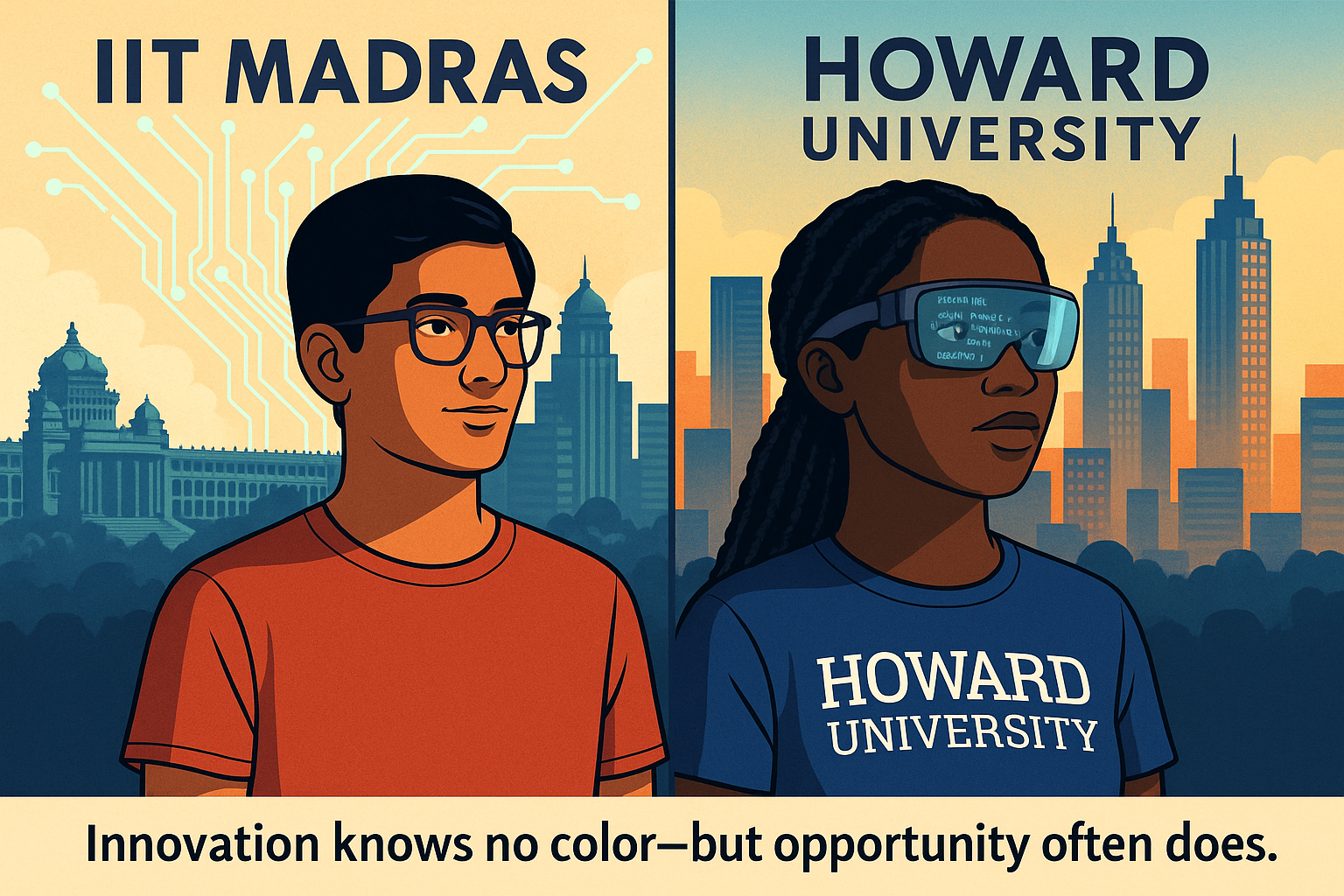
And now, that proof has meaning beyond India. It’s a beacon for another global demographic long denied its shot at innovation supremacy: African America. Specifically, Historically Black Colleges and Universities (HBCUs), and the tech-ready minds they house. What if Atlanta, Raleigh, or Houston could do what Bangalore did? What if the lessons learned across oceans and caste lines could ignite the next Black-led tech renaissance?
It’s easy to forget, in the blinding glow of app IPOs and TED Talks, that Bangalore’s rise began with a simple premise: educate the best minds in technical skill and keep them connected. Post-independence India was dirt poor, but visionary. It seeded a string of engineering temples—the IITs (Indian Institutes of Technology)—and gave them one directive: create elite minds for a future not yet written. By the 1980s, the global economy began tilting toward software, and India’s bet on technical education paid off. Bangalore, strategically located and flush with graduates, attracted IBM, Texas Instruments, and eventually Microsoft and Google. Infrastructure followed policy. Ecosystem followed talent. And Bangalore turned into a tech vortex.
So why hasn’t something similar happened in Black America? In many ways, the African American and Indian narratives share some DNA. Centuries of marginalization. Outsized cultural contributions. Underutilized brainpower. But where India had the state-backed machinery of nation-building, HBCUs were born out of necessity. Underfunded, segregated, and often geographically sidelined, these institutions have long produced brilliance in spite of their conditions—not because of them. Still, the potential is staggering.
HBCUs produce 25% of all African American STEM graduates. Yet, most lack the kind of venture pipelines, incubator culture, and big-tech partnerships that turn skills into unicorns. India’s tech sector shows what happens when education is backed by policy, investment, and cultural mission. That trifecta is what HBCUs need to replicate—on their own terms.
First, HBCU campuses must become startup colonies. India didn’t wait for venture capital to fall from the sky. It built software parks—zones with tax incentives, broadband access, and office infrastructure. These became hotbeds for early startups and outsourcing deals. HBCUs can do the same. Howard’s Innovation Center is one of the few early experiments: a co-working space and incubator embedded on campus. But it’s not enough. Imagine Prairie View A&M spinning up a “Black Code Foundry” with dorm-hackathon hybrids, investor demo days, and embedded alumni venture scouts. Picture Southern University hosting a summer startup accelerator focused on agri-tech for Black farmers. The infrastructure doesn’t need to be perfect—India’s wasn’t—but it needs to exist.
Second, the alumni diaspora must become an angel army. Here’s the dirty secret behind India’s rise: the real money and mentorship came from abroad. Indian engineers who moved to Silicon Valley in the 1980s and 90s didn’t forget home. They wired money, built companies back in India, and sent their kids to the IITs they graduated from. Bangalore became an offshore brain extension of Palo Alto. HBCUs need the same loyalty loop. Black technologists at Google, Meta, and Apple shouldn’t just donate to alma maters—they should embed, invest, and mentor. A reverse brain trust—Black diaspora talent reinvesting in the pipeline they came from—could supercharge the entire system.
Third, code plus culture equals competitive advantage. India’s strength isn’t just in code. It’s in context. The best Indian tech products, from Flipkart to Paytm, were designed for the specific quirks of their users: cash-only commerce, slow networks, multilingual markets. That’s the play for African American tech, too. What if HBCUs trained developers not just in Python, but in designing fintech apps for unbanked Black users? Or telehealth tools for historically underserved zip codes? Black America has problems Silicon Valley doesn’t understand—and that’s a market advantage. Building for community isn’t charity. It’s a trillion-dollar design edge.
Fourth, policy must follow performance. One reason India succeeded is that its government saw tech as national strategy. It rolled out Special Economic Zones, offered tax holidays for startups, and treated engineering education as sacred. African American political leadership must adopt similar postures. Imagine a federal “Black Innovation Act” that grants funding to HBCU-based incubators, supports Black-owned VC firms, and protects patents developed at minority institutions. More tangibly, cities with large Black populations and HBCUs should offer land, broadband, and zero-interest loans to Black founders. If Chattanooga can build a public gigabit network, so can Tuskegee. Policy isn’t optional. It’s foundational.
Fifth, this requires narrative, not charity. India’s rise wasn’t framed as aid—it was ambition. It wasn’t “helping the poor.” It was “backing the next global power.” HBCUs and Black tech should be framed with the same boldness. The next Amazon might come from Alabama A&M. The next Oracle from Morgan State. What’s needed isn’t pity—but placement. African American founders shouldn’t be exceptions—they should be expectations. Tech journalism, film, and digital storytelling can help here. Highlight the successes. Build the lore. Change the perception.
Sidebar: What HBCUs Can Build Now
Move
Description
Potential Impact
Campus Incubators
On-site startup hubs with mentorship and funding access
Trains 1,000+ founders annually
Black Tech Diaspora Network
Online and in-person platform linking alumni with current students
Cross-generational capital + experience
Community-Centric Product Labs
Build tech for African American problems (e.g., finance, health, education)
Monetizes underserved user segments
Policy Consortium
HBCUs jointly lobbying for innovation policy with state + federal officials
Unlocks $1B+ in tech zone funding
Cultural Storytelling Units
Cross-discipline media studios to tell Black tech success stories
Shifts perception of HBCUs from “legacy” to “launchpad”
In a way, India’s tech story was never just about tech. It was about self-respect. About telling the world that brown minds could be global minds. That the future didn’t need to be imported. For African America, the stakes are the same. HBCUs are already proving grounds for cultural genius—music, politics, social theory. Tech should be next. A Black Silicon Valley doesn’t need to mimic the old one. It just needs to learn the playbook, remix the rhythms, and code to its own beat.
The next tech capital might not be in Cupertino or Shenzhen—but in the back streets of Atlanta, lit by the glow of laptop screens in an HBCU dorm room. Because somewhere out there, a kid from Jackson State is already building the future. All they need is the infrastructure—and the imagination—to finish the job. If India’s story is a testament to what happens when a nation believes in its brainpower, then the African American tech future will depend on whether HBCUs and their communities can believe in theirs—loudly, structurally, and unapologetically. Not for permission. But for power.
Disclaimer: This article was assisted by ClaudeAIand ChatGPT
Our credit system, like almost institutional reality we have is very much dependent on Others. Until we realize and work towards infrastructure of our own institutional ownership within the credit landscape, then we will continue to be prey for predators and subsidizers that enriches others and their institutions. – William A. Foster, IV
When President Donald Trump announced a proposed 10% cap on credit card interest rates in January 2026, most Americans greeted the news with skeptical hope. The move seemed like a potential lifeline for families struggling with debt burdens and interest rates that often exceed 20%, even as many questioned whether it could actually happen. But for African American households, this well-intentioned policy could become another barrier in a financial system that has historically excluded and disadvantaged them.
The challenge lies not in the intention behind rate caps, but in their likely consequences. While lower interest rates sound beneficial on the surface, the economic reality of credit markets means that banks facing reduced profitability will respond by restricting who can access credit in the first place. For African American families already fighting against systemic barriers to financial services, this could close doors that were only partially open to begin with.
African American households face dramatically different credit market realities than their white counterparts. According to the FDIC’s 2023 survey, more than 10% of Black Americans lack access to basic checking or savings accounts, compared to just 2% of white Americans. This banking gap represents more than inconvenience it fundamentally limits the ability to build the credit history that determines access to affordable loans, mortgages, and yes, credit cards.
The wealth disparity tells an even starker story. The median net worth of white households stands at approximately $188,200, nearly eight times the $24,100 median for Black households. This gap isn’t accidental it’s the product of generations of discriminatory policies from redlining to predatory lending, compounded by the deterioration of African American-owned banks and credit unions. As Black ownership of financial institutions has declined, the community has become more reliant on external institutions for credit, creating conditions that invited more predatory lending into African American neighborhoods. When African Americans do access credit, they consistently face higher interest rates than white borrowers with similar incomes. High-income Black homeowners, for instance, receive mortgage rates comparable to low-income white homeowners.
The dependence on consumer credit has reached critical levels in African American households. Recent analysis from HBCU Money’s 2024 African America Annual Wealth Report reveals that consumer credit has surged to $740 billion, now representing nearly half of all African American household debt and approaching parity with home mortgage obligations of $780 billion. This near 1:1 ratio between consumer credit and mortgage debt represents a fundamental inversion of healthy household finance. For white households, the ratio stands at approximately 3:1 in favor of mortgage debt over consumer credit. The African American community stands alone in this precarious position, where high-interest, unsecured borrowing rivals the debt secured by appreciating assets.
These disparities matter enormously when considering how banks will respond to rate caps. Credit card companies operate on risk-based pricing models, charging higher rates to borrowers they perceive as riskier based on credit scores, income stability, and banking relationships. African American borrowers, because of structural disadvantages in each of these areas, already cluster in categories that receive higher interest rates. When banks can no longer charge those rates, they will simply stop offering credit to these borrowers entirely.
The banking industry’s response to Trump’s proposal has been swift and unequivocal: a 10% interest rate cap would force them to dramatically restrict credit availability. Analysis from the American Bankers Association suggests that nearly 95% of subprime borrowers, those with credit scores below 680 would lose access to credit cards under even a 15% cap. With rates currently averaging around 20%, a 10% ceiling would affect even more borrowers. Industry analysts estimate that between 82% and 88% of credit cardholders could see their cards eliminated or their credit limits drastically reduced. The Electronic Payments Coalition warns that low to moderate income consumers would be hit hardest, precisely the demographic where African American households are disproportionately represented.
This isn’t just industry fearmongering. Historical evidence supports these concerns. When Illinois implemented a 36% APR cap on all borrowing, lending to subprime borrowers plummeted. Similar patterns emerged from 19th-century usury laws and research on payday loan restrictions. The consistent pattern is clear: when rate caps make lending unprofitable, lenders exit the market or tighten requirements. For African American households, this creates a devastating catch-22. They’re more likely to need credit due to lower wealth levels and less access to family financial support. Yet they’re also more likely to be denied that credit or pushed into predatory alternatives when traditional sources dry up.
The credit card industry categorizes borrowers by risk, with subprime borrowers facing the highest rates but also the greatest need for access to credit. African American consumers are overrepresented in subprime categories, not because of personal failing but because of systemic factors that suppress credit scores. Historical discrimination in housing, employment, and lending created wealth gaps that persist through generations. Lower wealth means less ability to weather financial shocks, leading to missed payments that damage credit scores.
When major banks stop serving subprime borrowers, those families don’t suddenly stop needing credit. They turn to alternative sources and here’s where the rate cap could cause real harm. Payday lenders, pawn shops, auto title loans, and other fringe financial services often charge effective annual percentage rates far exceeding credit card rates, sometimes reaching 300% to 400% or higher. These services operate in a less regulated space where consumer protections are weaker and predatory practices more common.
African American neighborhoods already contain disproportionately high concentrations of these alternative lenders, a modern echo of historical redlining patterns. Bank branches are scarce in many predominantly Black communities, while check-cashing outlets and payday loan storefronts proliferate. A rate cap that drives more families into this unregulated market would exacerbate existing inequities. The irony is profound. A policy designed to protect consumers from high interest rates could push vulnerable families toward even higher costs and fewer protections. JPMorgan analysts warned that the rate cap could redirect borrowing away from regulated banks toward pawn shops and non-bank consumer lenders, increasing risks for consumers already under financial strain.
The consequences of restricted credit access extend far beyond the immediate inability to make purchases. Credit cards serve as emergency funds for families without substantial savings, a category that includes a disproportionate number of African American households. For many Black families facing persistent income gaps, credit cards function not just as a convenience but as an income supplemental tool, helping to bridge the gap between earnings and the actual cost of living. When a car breaks down, a medical bill arrives, or a job loss creates temporary income disruption, credit cards can mean the difference between weathering the storm and falling into a debt spiral that damages credit for years.
The reality is that consumer credit has become essential infrastructure for African American household finance. With consumer credit growing by 10.4% in 2024, more than double the 4.0% growth in mortgage debt, Black families are increasingly dependent on expensive borrowing to maintain living standards. This isn’t a choice so much as a structural reality of trying to survive on incomes that remain roughly 60% of median white household income while facing higher costs for everything from insurance to groceries in predominantly Black neighborhoods.
Small business ownership represents another critical pathway to wealth building where African Americans face systemic barriers. Black entrepreneurs already struggle to access business loans, with approval rates significantly lower than for white business owners with similar qualifications, another systemic issue from African American banks and credit unions having limited deposits and being unable to extend loans and credit. Many small business owners use personal credit cards to fund startup costs, inventory purchases, and cash flow gaps. Restricting credit card access would eliminate this crucial financing option for aspiring Black entrepreneurs.
The rewards and benefits ecosystem could also shift dramatically. Banks have indicated they would likely reduce or eliminate rewards programs to offset lost interest income from rate caps. While this might seem minor compared to interest savings, rewards programs have become an important tool for building value, particularly for higher-credit consumers who pay balances in full monthly. The Vanderbilt Policy Accelerator research found that borrowers with credit scores of 760 or lower would see reductions in credit card rewards under a rate cap. Perhaps most concerning is the potential for credit scoring and financial history deterioration. When credit lines are closed or limits reduced, credit utilization ratios increase, which damages credit scores. This creates a downward spiral where reduced access leads to worse credit, which leads to further reduced access. For African American families working to build credit and financial stability, this could set progress back by years.
The genuine problem of high credit card interest rates and mounting consumer debt deserves serious policy attention. But effective solutions must account for how credit markets actually function and who would be most affected by reduced access. Rather than interest rate caps, policymakers should consider approaches that expand access while addressing affordability. Strengthening African American-owned banks, credit unions, and community development financial institutions would restore economic self-determination to communities that once had thriving financial ecosystems. These institutions don’t just serve African American communities they’re owned by them, led by them, and invested in their long-term prosperity. Historically, Black-owned banks have proven they can maintain sound lending practices while understanding the full context of their customers’ financial lives in ways that large, distant institutions simply cannot.
Currently, there are only 18 Black or African American owned banks with combined assets of just $6.4 billion, a tiny fraction of the industry. The absence of robust Black-owned financial institutions means that virtually all of the $740 billion in consumer credit carried by African American households flows to institutions outside the community. With African American-owned banks holding assets equivalent to less than 1% of Black household debt, the overwhelming majority of interest payments—potentially $120 billion annually—enriches predominantly white-owned institutions with no vested interest in Black wealth creation or community reinvestment. This extraction mechanism operates continuously, draining capital that could otherwise be intermediated through Black-owned institutions to support local lending and community development.
Strengthening requirements for transparent pricing, fee limitations, and responsible lending standards could protect consumers without eliminating credit availability. Regulators could mandate clearer disclosure of total costs, limit penalty fees that disproportionately burden those already struggling, and establish guardrails against predatory terms while preserving access to credit itself. Yet even these modest reforms face an uphill battle in the current political climate. The reality is that meaningful policy solutions require political will that simply doesn’t exist right now for addressing racial economic disparities directly. This makes the unintended consequences of blunt instruments like interest rate caps even more dangerous—they can restrict credit access under the banner of consumer protection while offering no viable alternatives.
The fundamental reality is clear: waiting for federal policy to solve credit access problems is a losing strategy. African American households face a specific set of economic challenges rooted in a specific history, and the solutions must be equally specific not generic approaches that treat all groups the same. The path forward requires African American communities to build their own financial infrastructure. This means capitalizing and expanding Black-owned banks and credit unions that can offer credit products designed for the actual economic realities of their customers, not risk models built on white wealth patterns. It means creating community-based lending circles and cooperative credit arrangements that leverage collective resources. It means developing alternative credit scoring systems that account for rent payments, utility bills, and other financial behaviors that traditional models ignore.
Rebuilding this sector isn’t about charity or inclusion; it’s about economic self-determination. Black-owned financial institutions have historically understood that a credit score doesn’t tell the whole story of a person’s creditworthiness, and they’ve made sound lending decisions based on relationship banking and community knowledge that large institutions can’t replicate. The challenge isn’t convincing European American owned banks to be fairer, it’s building the capacity to not need them as much. When African American communities had stronger networks of Black-owned banks, insurance companies, and credit unions, they had more options and more power. Rebuilding that infrastructure, combined with individual financial strategies that emphasize building assets and reducing dependence on consumer credit, offers a more sustainable path than hoping for beneficial federal intervention.
A 10% interest rate cap might sound appealing in the abstract, but for African American households, it likely means one thing: less access to the credit system entirely. The question then becomes not whether mainstream banks will treat Black borrowers fairly, but how communities can create their own credit access systems that serve their actual needs. That’s not a policy problem it’s a community capacity problem, and it requires community-driven solutions.
Disclaimer: This article was assisted by ClaudeAI.