
LeBron James net worth is equivalent to the assets of our largest African American owned bank. There is no other world where that would be imaginable for any other group. Elon Musk will never be worth J.P. Morgan Chase. Ever. – William A. Foster, IV
Martin Luther King Jr. delivered his final address in Memphis naming specific Black banks and calling for an insurance-in movement. Fifty-eight years later, a billionaire athlete complained about the hotel. The distance between those two moments is not irony — it is a measure of strategic retreat.
On the night of April 3, 1968, Martin Luther King Jr. stood at Bishop Charles Mason Temple in Memphis, exhausted and battling a sore throat, and delivered one of the most emotionally charged and rhetorically brilliant speeches of his life. He had come to the city in solidarity with sanitation workers striking for basic economic dignity. Despite death threats that had delayed his flight from Atlanta that morning, he spoke for more than forty minutes, warning of difficult days ahead and closing with the declaration that he had been to the mountaintop and seen the Promised Land. He was assassinated the following evening.
What is rarely quoted from that speech and what HBCU Money has taken care to preserve is the passage in which King made his economic program for Memphis concrete, specific, and institutional. He did not speak in generalities. He called on the audience to take their money out of downtown banks and deposit it in Tri-State Bank. He called for a “bank-in” movement in Memphis. He directed people to the city’s Black-owned savings and loan associations and noted that the SCLC itself already held an account there. He named six or seven Black insurance companies operating in Memphis and called for an “insurance-in.” He framed the entire program within a broader economic argument: that while African Americans were poor individually measured against white America, collectively they were richer than all but nine nations on earth, and that collective wealth, if pooled through Black institutions, constituted power.
That passage is not rhetorical flourish. It is an operational directive, delivered the night before King’s assassination, in the specific city where he was killed, naming a specific bank by name. It is the most concrete institutional economic program King ever publicly offered, and it has been almost entirely displaced in public memory by the prophetic closing of the same speech. The selective amnesia is itself diagnostic. America, including much of Black America, prefers the King who stood on the mountaintop to the King who told people where to put their deposits. This matters enormously for understanding what Memphis is, what it has failed to become, and what the periodic celebrity dismissal of the city — most recently by LeBron James — reveals about the distance between that 1968 directive and present institutional reality.
In early April 2026, James used an appearance on the YouTube program “Bob Does Sports” to suggest that the Memphis Grizzlies ought to relocate to Nashville, citing that city’s stadium infrastructure and general amenities, and subsequently doubled down, declaring Memphis one of two cities he does not enjoy visiting. The civic response became an invitation from the mayor, social media indignation, bruised local pride was understandable and structurally irrelevant. The relevant question is not whether LeBron James respects Memphis. It is whether the institutional ecosystem King described in April 1968, and specified with operational precision, has been built. The answer, measured against King’s own program, is complicated by a history that is both more painful and more instructive than simple failure.
Before arriving at that history, however, the LeBron episode demands one additional layer of analysis because it does not stand alone. In 2018, Fox News host Laura Ingraham went on air to rebuke James for his political commentary, instructing him to stay out of politics and stick to basketball, insisting it was “always unwise to seek political advice from someone who gets paid $100 million a year to bounce a ball.” The backlash was swift, and James’s response was pointed. He declared he would not simply shut up and dribble, and went on to open the I Promise School in his hometown of Akron, Ohio — a public school providing comprehensive support for at-risk students, funded through his foundation. James was right to refuse Ingraham’s framing. The “shut up and dribble” directive is the cultural expression of what William C. Rhoden, in Forty Million Dollar Slaves, identifies as the plantation logic of professional sports: the athlete as performer whose value is purely athletic, whose civic commitments are unwelcome, and whose wealth exists to flow outward from the community rather than back into it.
The irony that must be named directly is this: James rejected that logic when it was applied to him, and built an institution in response. He did not extend the same institutional orientation to Memphis. The city that “disappointed” him because of the hotel, the road game, the general atmosphere of a random Thursday is a majority-Black city with 135 years of planned African American homeownership, a 164-year-old HBCU, and the institutional legacy of a bank that King named from the pulpit on the last night of his life. None of that was visible to James from the Hyatt Centric. The “shut up and dribble” framework, rejected rightly when applied to James himself, describes with some precision what James did to Memphis: reduced it to its surface entertainment value and found it wanting, without asking the institutional questions that actually matter. An African American with resources disparaging an African American city instead of embracing it and understanding the institutional opportunity to enhance African America’s collective power cannot be understated. It highlights an all too common theme of individual African Americans who have “made it” without recognizing they are outliers, and that for success to be the rule for the community, institutions must be invested in, supported, and prioritized.
This is not a personal indictment of LeBron James — Mis-education of the Negro by Dr. Carter G. Woodson should be required reading, though. It is a structural observation about the orientation that Rhoden’s analysis predicts: individual Black wealth, generated within systems designed to extract it from communities, does not automatically produce institutional investment in those communities even when the individual is as civic-minded as James demonstrably is in his own city. The I Promise School is real. The Akron commitment is genuine. And Memphis remains, from that same individual’s perspective, a hotel problem rather than an institutional opportunity. Rhoden’s central argument is not that Black millionaires are individually responsible for community disinvestment — it is that the systems through which Black wealth flows are designed to produce individual prosperity that exits the community rather than institutional investment that stays within it. Nothing in the architecture of the NBA, the endorsement economy, or the entertainment industry creates an incentive for a traveling athlete to evaluate a city’s HBCU endowment or the lending capacity of its Black-owned bank.
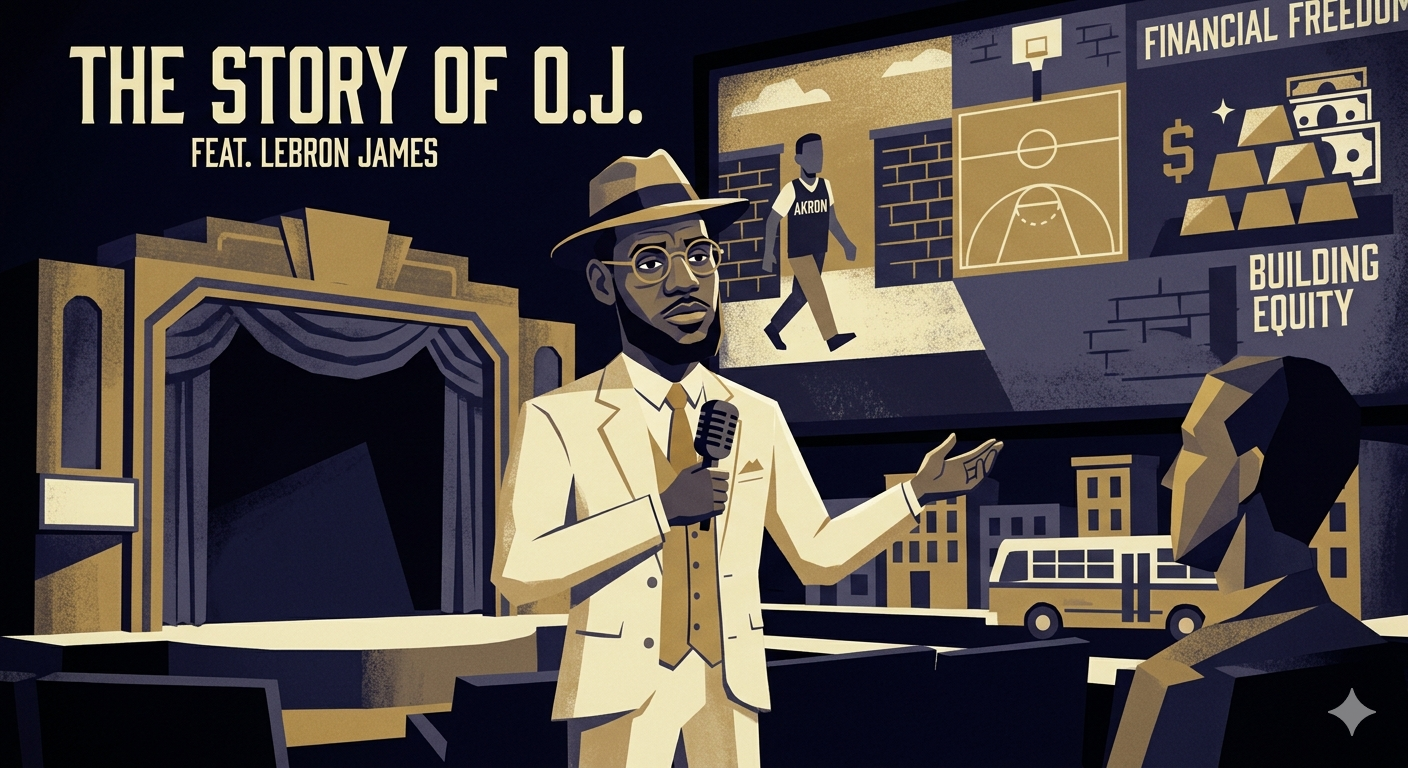
Jay-Z mapped the same structural condition in “The Story of O.J.,” building the song around the observation that individual wealth and celebrity do not insulate Black Americans from structural racial economic realities, and advancing the argument that credit, property ownership, and collective capital formation are the mechanisms through which communities build power that persists across generations. The song’s target is the O.J. Simpson logic — the belief that sufficient individual success creates an exemption from collective vulnerability, or to put it more bluntly, when African Americans find success in Others’ institutions and firms and mistake that for African America building institutional power of its own that provides success to the entire community at scale. Its prescription is identical to what King stated in Memphis in 1968: pool the money, build the institutions, acquire the land. What neither Jay-Z’s song nor King’s speech can do is execute that program on behalf of communities that have chosen, generation by generation, not to execute it themselves.
The organizational failure in Memphis and in Detroit, Baltimore, New Orleans, and every other majority-Black American city watching its Black-owned financial institutions contract or disappear is not simply a matter of external pressure or historical exclusion. It is a behavioral pattern: African Americans depositing at Bank of America, insuring with non-African American insurance carriers, mortgaging through institutions that redlined their grandparents’ neighborhoods, and then lamenting the absence of viable Black banks as though those banks failed through no fault of the community they exist to serve.
Nowhere is this contradiction more visible, or more consequential, than among the Black athletes and entertainers whose wealth is large enough to move institutional needles. LeBron James is worth an estimated billion dollars. It is a reasonable question and one that no interviewer has thought to ask whether any meaningful portion of that wealth is deposited in, invested through, or intermediated by an African American-owned bank. Whether his production companies bank with OneUnited. Whether his real estate holdings are financed through Liberty Bank. Whether his foundation’s assets are custodied at Citizens Trust. The answer, in all statistical likelihood, is no because the architecture of wealth management at that scale routes capital through JPMorgan Private Bank, Goldman Sachs, and their institutional counterparts, none of which are African American-owned, and none of which recirculate deposits as loans into majority-Black communities at any meaningful rate. James built the I Promise School, which is genuine and admirable. The banking relationship is, by all available evidence, with institutions that have never demonstrated a reciprocal commitment to the communities James claims as his own.
Whether Jay-Z has made that commitment privately is unknown, though the fact that his sister-in-law Solange Knowles publicly announced she was banking Black suggests that the institutional consciousness exists within that immediate circle, making a private commitment at least plausible. No such contextual evidence exists for LeBron James, which is precisely what makes him the more instructive figure for this argument rather than the more culpable one. He is not an outlier. He is the norm. The forty million dollar slave who purchases his freedom and then banks with his former master is not a villain. He is a product of a system designed to make that outcome feel like financial prudence rather than institutional abandonment.
This is the sharpest edge of the Rhoden argument, and the one most carefully avoided in polite discourse about Black wealth. The community cannot simultaneously produce billionaires who manage their wealth through the same white-owned institutional infrastructure that has extracted capital from Black communities for a century, and expect Black-owned banks to remain solvent, competitive, and present. Tri-State Bank did not shrink to a single branch because white Memphis abandoned it. It shrank because the people with the most capacity to fund it including every Black professional, entertainer, and athlete who passed through Memphis, earned in Memphis, or claimed solidarity with Memphis did not route their financial relationships through it at the scale its survival required. At any given time this NBA season alone, a handful of African American players with combined salaries over $750 million passed through Memphis. King named Tri-State Bank from the pulpit because he understood that the institution’s viability was a function of community behavior, not community sentiment. The athlete who dismisses Memphis from a hotel room while banking at JPMorgan is not an outside critic. He is a participant in the condition he is describing. Sentiment without deposits is eulogy, not economics.
Tri-State Bank of Memphis was founded in 1946 by Dr. J.E. Walker and his son A. Maceo Walker, men who dreamed of a bank that would constructively change community conditions. It was that institution, built by that family, serving that city, that King named from the pulpit on April 3, 1968. Tri-State was not a symbol. It was a functioning financial intermediary, the circulatory infrastructure of Black Memphis’s economic life. It survived King. It survived the upheaval of the late twentieth century. And then, in 2021, it ceased to exist as an independent institution.
In October 2021, Tri-State Bank of Memphis completed its merger with New Orleans-based Liberty Bank and Trust Company, the largest African American-owned financial institution in the United States. Under the merger, the Tri-State name — long synonymous with providing financial opportunities for African Americans in Memphis — was retired. At the time of the acquisition, Tri-State was operating through a single office with approximately $105 million in assets and $95 million in deposits. LeBron James earns a reported $80–90 million a year in salary and endorsements, for perspective. The institution King had named from the pulpit, which had once operated through multiple locations across the city, had contracted to a single branch before being absorbed into a larger regional institution.
The acquisition was framed by both parties as a constructive consolidation, and in important respects it was. The merger created a financial institution with more than $1 billion in combined assets operating across ten states, and it expanded Liberty Bank’s lending limit for qualified borrowers from approximately $1.2 million to $5 million — a meaningful increase in the institution’s capacity to serve business borrowers in the Memphis market. Tri-State’s chairman acknowledged that the bank had reached a strategic crossroads: it either had to grow substantially or partner with another institution, and the board determined that combining forces with another Black-owned bank was preferable to remaining at a scale that limited its capacity to serve the community. That reasoning is correct as institutional strategy. Scale matters in banking. A $105 million community bank cannot make the same commercial loans, offer the same technology platforms, or absorb the same regulatory compliance costs as a $1 billion institution.
The consolidation logic King’s program implicitly required — pool the resources, aggregate the power — was ultimately what produced the Liberty-Tri-State merger. The irony is that the pooling King called for in 1968 happened in 2021, but through absorption rather than expansion. The result is that Memphis has African American banking infrastructure — Liberty Bank’s Memphis branch continues to operate — but no longer has a locally-rooted, locally-led African American-owned bank that has grown from and with the specific community it serves. That distinction is not trivial. Local institutional ownership generates a different quality of community investment than branch banking, however well-intentioned the parent institution.
According to the 2020 United States Census, Memphis is the second-largest majority-Black city in America, with over 400,000 Black residents constituting approximately 63 percent of its total population of 633,000. It is, by any demographic measure, an African American city. And yet the entire ecosystem of African American-owned banks in the United States holds approximately $6.7 billion in assets — 0.027 percent of total American bank assets — down from a peak of 0.2 percent in 1926, a tenfold relative decline. There are only 17 African American-owned banks remaining nationwide, and no new African American-owned bank has been started in 26 years. Memphis’s own trajectory from Tri-State’s founding in 1946 to its contraction to a single branch to its ultimate absorption in 2021 is a microcosm of that national decline, rendered in the specific city where King named the institution as the anchor of his economic program.
LeBron James’s Memphis comments are useful precisely because they dramatize the Rhoden-Jay-Z diagnosis without apparently being aware of it. James doubled down on his assessment that Memphis is a city he does not enjoy visiting, framing his evaluation entirely around the quality of his hotel accommodations and the general travel experience of a 41-year-old on a long NBA season. That is a consumer’s evaluation. He did not mention Tri-State Bank, which King named from the pulpit. He did not mention LeMoyne-Owen College, which has anchored Black Memphis educationally since 1862. He did not mention Orange Mound, the oldest planned African American community in the United States. He mentioned the Hyatt Centric.
That is precisely why institutional strategy cannot depend on individual millionaire consciousness. King’s program in Memphis named institutions, not individuals. He did not ask wealthy Black Memphians to feel differently about the city. He told the congregation where to put their deposits. The distinction between those two orientations — institutional strategy versus individual consciousness-raising — is the difference between building durable economic power and producing temporary cultural solidarity.
Orange Mound’s history illustrates the same principle from a neighborhood scale. Founded in 1890 as the nation’s first subdivision planned specifically for African Americans, it became one of the most economically and culturally dense Black communities in the United States by mid-century comparable, in the assessments of contemporaries, to Harlem. Its power derived not from the wealth of any individual resident but from the institutional density of the whole: homeownership, churches, schools, professional networks, entertainment venues, and commerce all operating within a self-reinforcing economic circuit. When that circuit broke in the 1960s and 1970s as younger residents and professionals migrated out in search of broader opportunity, the neighborhood’s cultural identity survived but its economic sovereignty did not. Homeownership declined, blight accumulated, and the institutional density that had made Orange Mound exceptional dissipated.
The Tri-State story is Orange Mound at the banking scale: an institution of extraordinary historical significance, built by the community, serving the community, that contracted over decades as the economic circuit it depended upon broke — professionals moving their banking relationships to larger downtown institutions, businesses unable to access the capital they needed at the scale they required, the deposit base shrinking until the bank could no longer sustain independent operations at the level the community needed. The merger with Liberty preserved the function — Black-owned banking in Memphis continues through Liberty’s local branch — but the local rootedness, the institutional identity, the specific claim to Memphis that Tri-State represented, was retired.
LeMoyne-Owen College, Memphis’s sole HBCU, has served the community as a source of academic formation and civic leadership since 1862 and it now carries, in institutional terms, a weight that Tri-State’s absorption makes heavier. An HBCU in a majority-Black city is not merely an educational institution. It is a potential anchor for an economic development strategy that could encompass workforce pipelines into Memphis’s anchored industries, research partnerships with FedEx and other major employers, real estate development in surrounding neighborhoods, and capital formation infrastructure serving the broader African American institutional ecosystem. Memphis is among the most important logistics hubs in the world. The economic activity that flows through it is enormous. The share of that activity intermediated through Black-owned institutions is a fraction of what it was when King named Tri-State from the pulpit.
King calculated that collectively, African Americans commanded an annual income exceeding thirty billion dollars more than the entire national budget of Canada at the time and argued that this collective wealth, if pooled through Black institutions, was power waiting to be activated. Adjusted for today’s figures, African American collective purchasing power exceeds 1.9 trillion dollars annually. The institutional infrastructure to capture even a meaningful fraction of that flow through Black-owned banks, HBCU endowments, Black-owned real estate, insurance, and investment structures is a fraction of what it was in 1926 by relative measure, and is shrinking in absolute terms as institutions like Tri-State are retired rather than expanded.
The Liberty-Tri-State merger was not a failure. It was a rational institutional response to a strategic dilemma that should never have been allowed to develop; the dilemma of a community bank that served an African American majority city but could not grow its deposit base or lending capacity fast enough to remain independently competitive. The correct lesson from that merger is not that Black banks are unviable but that building them requires the same coordinated community investment King outlined in 1968, and that no subsequent generation has executed at scale. The bank-in King called for was not a gesture. It was a funding strategy. Had it been executed and sustained across the decades since King’s assassination, Tri-State might have been the institution that acquired smaller banks rather than the institution that was absorbed.
King came to Memphis for sanitation workers earning $1.70 an hour. He was not interested in whether the city impressed visiting athletes. He was interested in whether working people could build organizations powerful enough to negotiate the terms of their own economic existence and he named specific institutions, by name, through which that power could be built. The institution he named is now a branch of another African American-owned bank. The city has a 164-year-old HBCU, the nation’s oldest planned African American subdivision, a 63 percent Black population, and one of the most strategically located economies in the United States. The Promised Land, King said, was visible from the mountaintop. Fifty-eight years later, the work of getting there remains, in Memphis and in every majority-Black American city facing the same structural gap, largely undone.
Editor’s Note
While the debate over LeBron James’s hotel preferences consumed Black social media for a news cycle, a more consequential assault on Memphis was advancing through federal court with considerably less celebrity attention. On April 15, 2026 days after James’s comments ignited civic indignation — the NAACP filed a federal lawsuit against Elon Musk’s xAI, alleging that the company had been operating 27 unpermitted gas turbines in Southaven, Mississippi, a suburb of Memphis, since at least August 2025, pumping formaldehyde, nitrogen oxides, fine particulate matter, and carbon monoxide into Black communities that already carry a cancer risk four times the national average. The power plant, built to feed xAI’s Colossus 2 data center complex, is projected to become the largest industrial source of nitrogen oxides in the greater Memphis area. Residents in the 38109 ZIP code described the situation without euphemism: living there was already a death sentence for Black Memphians before Musk’s machine arrived. xAI simply accelerated the sentencing.
Here is what that means in institutional terms. Elon Musk did not locate his unpermitted turbines in East Memphis or in the suburbs where his engineers live. He located them in Black Memphis, in communities that his lawyers, his lobbyists, and his political access calculated would lack the institutional firepower to stop him. That calculation was correct. The NAACP had to file a federal lawsuit. Earthjustice had to intervene. Organizations funded by donations and foundation grants had to carry the legal weight that a community with $1.9 trillion in collective annual purchasing power could not marshal on its own behalf, because that purchasing power has never been routed through the institutions that would have built the legal infrastructure to wield it. xAI is not an outlier. It is the logical endpoint of a century-long pattern in which majority-Black communities are treated as sacrifice zones precisely because their institutional circuits: the banks, the law firms, the political action committees, the endowed research centers have been allowed to atrophy while the wealth generated by and within those communities flows elsewhere.
LeBron James is worth an estimated billion dollars. His business partners, his fellow athletes, and the constellation of Black entertainers and executives who constitute the top percentile of African American individual wealth represent, in aggregate, a capital base that could fund a network of Black-owned environmental law firms, civil rights litigation shops, community development financial institutions, and HBCU-anchored research centers capable of meeting Elon Musk in federal court before the turbines are ever switched on not after months of illegal operation. That is not a fantasy. That is arithmetic. It is also a choice, and it is a choice that has not been made. Instead, Black Memphis fights for its institutional and environmental life with the resources of nonprofits and civil rights organizations while the men and women with the most capacity to change that calculus debate hotel quality on YouTube. King stood in Memphis and named a bank because he understood that the fight for economic dignity and the fight against environmental predation and the fight for political power are not separate fights. They are one fight, waged through institutions, sustained by capital, and won or lost on the strength of the infrastructure a community builds to wage it. Memphis is losing that fight right now not because its people lack courage or clarity, but because the institutional infrastructure King called into being was never fully built, and the generation with the greatest individual wealth in African American history has not yet decided to build it. The hotel was fine. The city is on fire.
Disclaimer: This article was assisted by ClaudeAI.

