Author Archives: hbcumoney

The HBCU Endowment Feature – Elizabeth City State University

Ecsu_seal

School Name: Elizabeth City State University

Median Cost of Attendance: $18 786

Undergraduate Population: 2 760

Endowment Needed: $1 036 972 320

Analysis: Elizabeth City State University needs approximately a $1 billion endowment for all of its undergraduates to attend debt free. The university is located in the northeast part of North Carolina. In a state with an abundance of higher education institutions it can be extremely difficult to standout. It also does not help that ECSU is not on the HBCU “corridor” of I-85/I-95 going through the states of North Carolina and Virginia. The northeast part of North Carolina is a more isolated geography of the state. As in most cases like this there is a bit of the gift and the curse attached to such a reality. By being isolated it can have an intimate advantage in recruitment in the northeast part of North Carolina and very rural parts of southeastern Virginia. The disadvantage of course is beyond those areas it will have a difficult time not being in the HBCU corridor, and therefore will have a hard time getting students outside of its most intimate regions. A cause for concern given the drop in enrollment the school has seen lately. As noted with public university endowments, the size of the alumni base is a mixture of student body size and graduation rates. This formula plays an integral role in the health of the endowment. A declining student body size is a danger to the long term financial stability of a college’s endowment primarily because historically only 10-15 percent of alumni give back nationally. The number is even smaller among HBCUs. Currently, Elizabeth City State University is reported to have a $4.5 million endowment or equal to 0.45 percent of its needed endowment. A serious red flag for long-term stability which lends to some of the issues of the school’s current financial issues. The school has an opportunity to reduce itself down to a healthier size that could allow it could to obtain the financial health it needs to potentially grow at a more steadied pace. It also much find a way to infuse itself along the state’s coastline African American population. The real question is will that be enough. Ideally, ECSU needs to have a student body at least triple its current size if it wants to seriously expand its alumni base within the coming decade.  It is clear they are going to have to pick up the pace of their endowment and capital campaigning to survive tomorrow, otherwise we could be seeing some of the turmoil in Virginia spillover into North Carolina with Elizabeth City State University potentially being the first casualty.

As always it should be noted that endowments provide a myriad of subsidies to the university for everything from scholarship, faculty & administration salaries, research, and much more.

HBCU Money™ Business Book Feature – The Bankers’ New Clothes: What’s Wrong with Banking and What to Do about It

9780691156842_custom-d3bef61dfc417520f7138615aa7416726c5b9699-s6-c30

What is wrong with today’s banking system? The past few years have shown that risks in banking can impose significant costs on the economy. Many claim, however, that a safer banking system would require sacrificing lending and economic growth. The Bankers’ New Clothes examines this claim and the narratives used by bankers, politicians, and regulators to rationalize the lack of reform, exposing them as invalid.

Admati and Hellwig argue we can have a safer and healthier banking system without sacrificing any of the benefits of the system, and at essentially no cost to society. They show that banks are as fragile as they are not because they must be, but because they want to be–and they get away with it. Whereas this situation benefits bankers, it distorts the economy and exposes the public to unnecessary risks. Weak regulation and ineffective enforcement allowed the buildup of risks that ushered in the financial crisis of 2007-2009. Much can be done to create a better system and prevent crises. Yet the lessons from the crisis have not been learned.

Admati and Hellwig seek to engage the broader public in the debate by cutting through the jargon of banking, clearing the fog of confusion, and presenting the issues in simple and accessible terms. The Bankers’ New Clothes calls for ambitious reform and outlines specific and highly beneficial steps that can be taken immediately.

HBCU Money™ Dozen Links 9/9 – 9/13

12

Did you miss HBCU Money™ Dozen via Twitter? No worry. We are now putting them on the site for you to visit at your leisure. We have made some changes here at HBCU Money™ Dozen. We are now solely focused on research and central bank articles from the previous week.

Research

14 Things You Need to Know About Data Storage Management l ComputerWorld

Voyager has left the system. “NASA Says Voyager 1 Is Now Officially in Interstellar Space” l Wired Science

Geothermal Power Used In British Columbia Residential Development l Clean Technica

Aquaculture a growing industry in the Midwest l IL-IN Sea Grant

FBI issues advisory to financial institutions, but customers should take notice too l ComputerWorld

Frack away, UK, it’s carbon neutral. Sort of l New Scientist

Federal Reserve, Central Banks, & Financial Departments

See the latest data on tax collections by your state l St. Louis Fed

Economics: the most under-taught subject in America? l CEE

GOP to push bill restoring work requirement for food stamps l Floor Action

Housing inventory grew in August l Housing Wire

The vulnerabilty of American families: 40% cannot come up with $2,000 in 30 days l FINRA

All 12 presidents submit joint letter to SEC encouraging money market mutual fund reform l Boston Fed

Thank you as always for joining us on Saturday for HBCU Money™ Dozen. The 12 most important research and finance articles of the week.

The HBCU Money™ Weekly Market Watch

Our Money Matters /\ September 13, 2013

A weekly snapshot of African American owned public companies and HBCU Money™ tracked African stock exchanges.

NAME TICKER PRICE (GAIN/LOSS %)

African American Publicly Traded Companies

Citizens Bancshares Georgia (CZBS) $5.65 (5.83% DN)

Radio One (ROIA) $2.55 (4.08% UP)

African Stock Exchanges

Bourse Regionale des Valeurs Mobilieres (BRVM)  204.92 (0.74% UP)

Botswana Stock Exchange (BSE)  8 575.95 (0.19% UP)

Ghana Stock Exchange (GSE)  2 012.38 (67.74% UP)*

Nairobi Stock Exchange (NSE)  122.86 (N/A)

Johannesburg Stock Exchange (JSE) 43 602.64 (0.34% DN)

International Stock Exchanges

New York Stock Exchange (NYSE) 9 630.32 (0.24% UP)

London Stock Exchange (LSE)  3 507.89 (0.03% DN)

Tokyo Stock Exchange (TOPIX)  1 185.28 (0.08% UP)

Commodities

Gold 1 308.40 (1.65% DN)

Oil 108.39 (0.19% DN)

*Ghana Stock Exchange shows current year to date movement. All others daily.

All quotes reported as of 4:00 PM Eastern Time Zone

Without Intervention, Syria Could Raise African American Unemployment

By William A. Foster, IV

Employment, which Galen calls nature’s physician, is so essential to human happiness that indolence is justly considered as the mother of misery. – Burton

I have often contended that African Americans struggle to look at things from their own interest. It is no secret that when most of America catches the proverbial cold, we seem to catch pneumonia as the saying goes. Often what is good for other communities is bad for us and vice versa, and what is bad for other communities can sometimes be worse for us. The latter seems to be the case of what will happen if America does not intervene in Syria.

Many African Americans are anti-war because of America’s history of imperialism. These concerns are justified but also misled. Nobody has suffered from America’s imperialism domestically more than African Americans. However, America’s ability to be so prosperous is its ability to control much of the resources around the world either through soft or hard power. While this leaves many chastising American policy abroad, rarely is anyone willing to give up their cushion way of American life. Even for African Americans we enjoy a way of life that many around the world wished they had and that we so often still try to integrate ourselves into. Things like running water, electricity, cheaper gas, and many other basic necessities.This happens because American power allows for the scales to be tilted in the favor of American citizens and their institutions. Unfortunately, we control and own very few of these institutions and tend to end up with the leftovers and scraps instead of the main meals of prosperity.

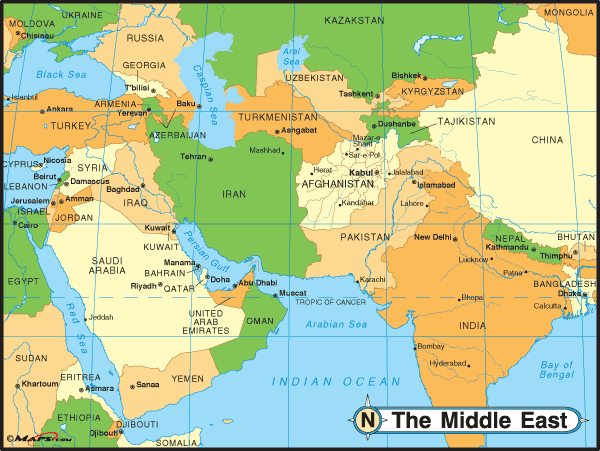
The current African American unemployment rate is 13.0 percent. If the Strait of Hormuz, where 20 percent of the world oil goes through and 35 percent of seaborne traded oil flows, expect American companies to react accordingly. An instant spike of product cost and transportation would most likely lead many companies to cutting labor to deal with the new expenses. Given our history of last hired and first fired due to our dependency on European American owned multinational companies, it would not be hard to imagine that many jobs that we hold in private companies would be in danger upon disruption of the oil supply.

middle_east

Syria on its face is not a major oil supplier and is fairly inconsequential to the actual global oil supply. Timothy Gardener from Reuters in a recent article points out, “Syria has not exported any oil since late 2011, when international sanctions came into force. Prior to the sanctions Syria produced 370,000 barrels per day (bpd), roughly 0.4 percent of global supplies, and exported less than 150,000 bpd, mainly to Europe.” The problem as it were with the Syria situation is just how quickly the situation could be prone to spread to other countries. This possibility alone has caused oil prices to spike more than $8 per barrel since the beginning of August. The many factions at play between Sunni/Shiite groups within Syria and outside influences like Al-qadea, Iran, and others make a complicated matter even more so.

In the end, African America will continue to push the flag of human rights and equality because it is a social value we hold dear in our community. The economic reality for us is another matter in itself and with August numbers showing African American employment at its worst in the past five months the situation in Syria could expedite the downward spiral. Many analyst have already predicted that a U.S. strike could bring oil prices back down. If we want to truly be beholden to our value of human rights, then we ourselves must obtain the economic independence to do so. Whether we like it or not for now, our  economic fate is indeed tied to America’s foreign policy.