Monthly Archives: January 2026

You Want a Bigger HBCU Endowment? Graduate Students in Four Years—and HBCU Alumni Must Make That Happen

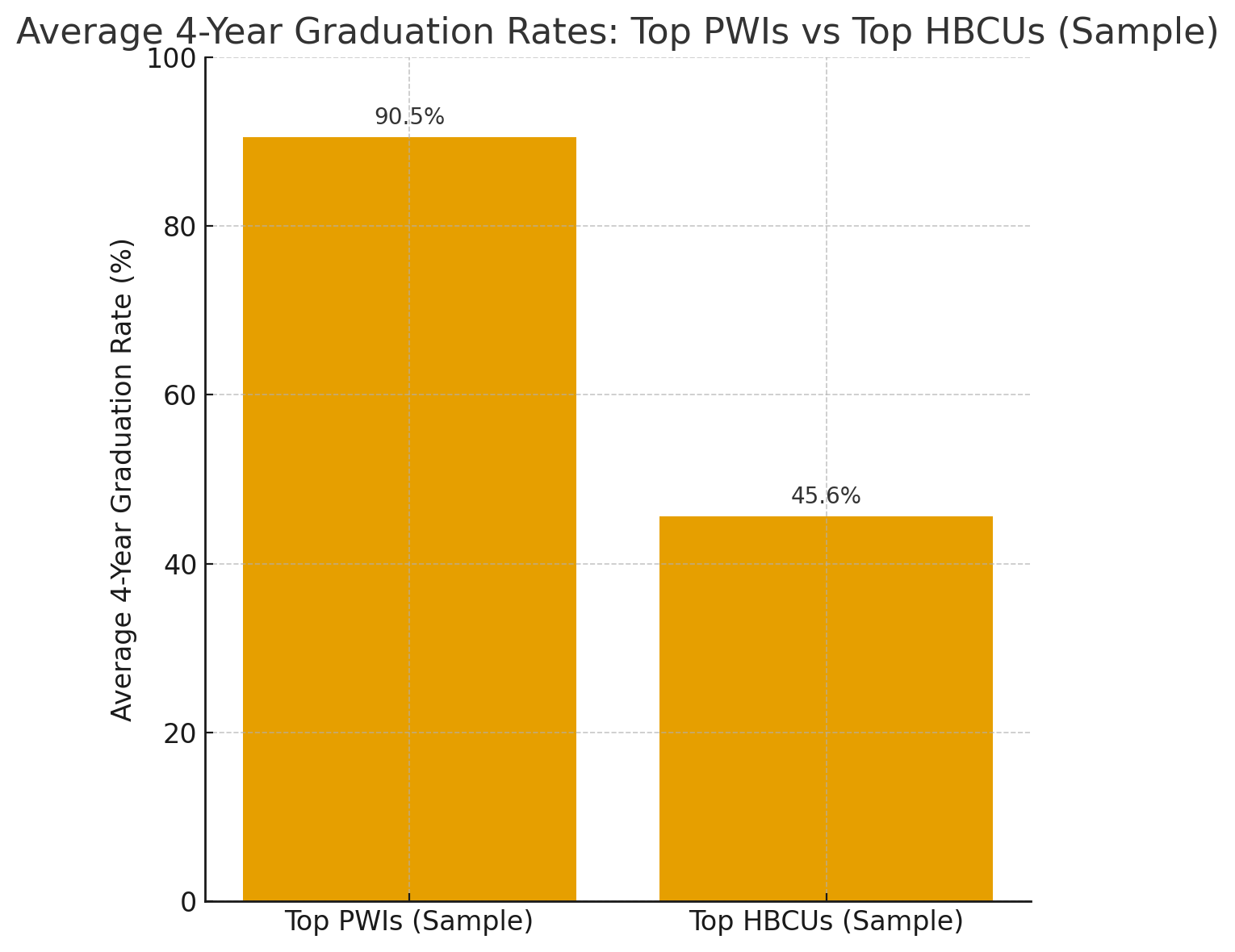
The four-year graduation rate is often presented as a benign statistic tucked inside higher education reports, but for institutions serving African America, it is not benign at all. It is the lever on which long-term wealth, institutional survival, and multigenerational stability subtly depend. Wealthy universities treat the four-year graduation rate not as an outcome but as an engineered product, backed by endowment might, operational discipline, and capital-rich ecosystems. Their students finish on time because the institution ensures they are shielded from interruption. Meanwhile, HBCUs navigate a different reality: the same students who possess the intellectual capacity to thrive are too often delayed not by academics but by the economic turbulence that disproportionately defines their journey. It is here between the idea of talent and the machinery of capital that the four-year graduation rate becomes a revealing measure of African America’s structural position in the American economic hierarchy.

A delayed degree carries a cost structure that compounds aggressively. Extra semesters are not simply tuition bills; they are opportunity-cost accelerants. A student who graduates at 22 enters the workforce two to three years ahead of a peer who reaches the finish line at 24 or 25. Those early earnings fund retirement accounts earlier, compound longer, support earlier homeownership, and create the financial runway that future philanthropy relies upon. For African American students who statistically begin college with fewer financial reserves and exit with higher student debt those lost years are wealth years. They represent not only diminished individual prosperity but the slowed creation of a donor class that HBCUs and other African American institutions depend on to build endowment strength and institutional sovereignty.
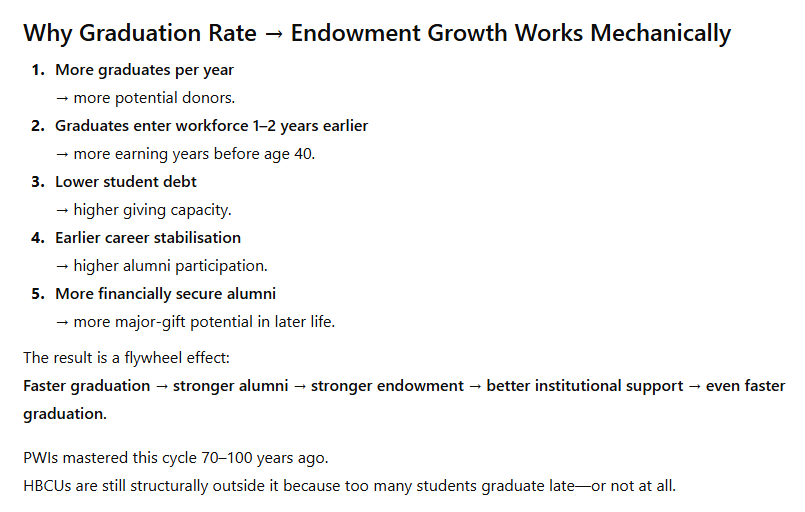
Endowments, which serve as the economic lungs of a university, breathe differently depending on how quickly their alumni progress into stable earning years. A university that graduates students in four years rather than six gains an alumni base that stabilizes earlier, saves earlier, invests earlier, and gives earlier. A philanthropic ecosystem is essentially a long-term consequence of time management: the more years an alumnus spends debt-free and employed, the more predictable their giving pattern becomes. Elite institutions leverage this fact elegantly. HBCUs, despite producing extraordinary alumni under significantly harsher financial conditions, remain constrained by the delayed timelines imposed by student financial fragility.

Financial fragility is a central explanatory variable in the HBCU graduation gap. It is not uncommon for a student to miss a semester because of a $300 balance or a transportation breakdown that derails their schedule. In the broader American economic system, such modest shocks rarely jeopardize a wealthy student’s trajectory. But within the HBCU ecosystem, they represent the sharp edges of institutional undercapitalization meeting the exposed nerves of household vulnerability. The four-year graduation rate is therefore not simply a metric of academic navigation but a map of where the Black household economy intersects with American higher education’s structural inequities.

This makes alumni involvement not a sentimental tradition but an economic necessity. Alumni can narrow the financial fragility gap more efficiently than any other stakeholder group. Microgrant funds, even modestly capitalized, are capable of eliminating the most common disruptions that extend time-to-degree. A $250 emergency grant can protect $25,000 in long-term student debt. A $500 intervention can guard a student’s four-year trajectory and thus preserve two additional years of post-graduation earnings that ultimately benefit both the graduate and the institution’s future endowment. Alumni-funded tutoring, advising enhancements, STEM support programmes, and paid internships create artificial endowment-like effects: stabilizing student progression even when the institutional endowment itself is undersized.
Yet HBCU alumni cannot focus solely on the university years if the goal is a structurally higher four-year graduation rate. The process begins far earlier within K–12 systems that shape academic readiness long before students set foot on campus. The elite institutions that boast 85–95 percent on-time graduation rates are drawing from K–12 ecosystems with intense capital saturation: high-quality teachers, advanced coursework, stable households, well-funded enrichment programmes, and neighborhoods that function as multipliers of academic preparedness. HBCU alumni have an opportunity to influence this pipeline through investments that are often modest in individual scope but transformational in aggregate impact. Funding reading centres, coding clubs, college-prep academies, robotics labs, literacy coaches, and after-school tutoring programmes plants the seeds of future four-year graduates years before college entry.

Indeed, a strong K–12 foundation reduces the need for remedial coursework, accelerates major declaration, strengthens performance in gateway courses like calculus and biology, and diminishes the likelihood that students need extra semesters to satisfy graduation requirements. When alumni support dual-enrollment initiatives, sponsor early-college programmes, or build partnerships between HBCUs and local school districts, they enlarge the pool of college-ready students whose likelihood of completing on time is structurally higher. In this sense, investing in K–12 is not philanthropy it is pre-endowment development.

The economic implications of strengthening both ends of the education pipeline are enormous. A 20–30 percentage-point improvement in four-year completion rates across the HBCU ecosystem would reduce student loan debt burdens by billions, accelerate African American household wealth accumulation, raise the number of alumni earning six-figure incomes before age 30, and increase the philanthropic participation rate across Black institutions. Over decades, such shifts ripple outward: stronger alumni lead to stronger HBCUs, which lead to stronger civic, cultural, and economic institutions in African American communities, which themselves create more stable families, more prepared K–12 students, and more future college graduates. The system feeds itself when time is efficiently managed.
In the HBCU Money worldview, where institutional power is the only reliable safeguard against structural marginalization, time-to-degree represents one of the clearest and most overlooked levers of collective economic advancement. In a Financial Times context, the four-year graduation rate appears as a liquidity indicator—showing how quickly an institution converts educational investment into economic output. In The Economist’s framing, it reveals the mismatched capital structures between wealthy universities and historically underfunded ones, and how those mismatches reproduce inequality in slow, quiet, compounding increments.

For African America, the conclusion is unmistakable. The four-year graduation rate is not merely a statistic. It is a wealth mechanism. It is an endowment accelerator. It is an institutional survival tool. And it is a community-level economic strategy that begins in kindergarten and culminates with a diploma. If HBCU alumni wish to see their institutions strengthen, their communities accumulate wealth, and their young people enter the economy with maximum velocity, then they must make both K–12 investment and four-year graduation obsession-level priorities. Institutions rise with the financial stability of their graduates. Ensuring those graduates complete degrees on time is one of the most effective—and least discussed—strategies available for building African American institutional power across generations.

A Tale of Two Virginias:

A revealing contrast in American higher education can be observed by examining two institutions that sit just 120 miles apart: Virginia State University (VSU) and the University of Virginia (UVA). NACUBO estimates VSU’s endowment at approximately $100 million for around 5,000 students, producing an endowment-per-student of roughly $20,000. According to U.S. News, VSU graduates 27% of its students in four years. UVA, one of the most heavily capitalized public universities in the world, possesses an endowment of roughly $10.2 billion for about 25,000 students, an endowment-per-student of approximately $410,000, more than twenty times the capital density VSU can deploy. Its four-year graduation rate stands at 92%.

The gulf between the two institutions reflects not a difference in student talent but a difference in institutional resource density and shock absorption capacity. A VSU student must personally carry far more academic and financial fragility. A single $300 expense can knock them off their semester plan. A delayed prerequisite can add a year to their degree. Limited advising bandwidth means problems are often discovered only after they have already extended time-to-degree. UVA faces the same categories of issues, but its endowment, staffing, and operating budgets act as buffers absorbing shocks before they disrupt academic progress.

Endowment-per-student, therefore, is not merely a balance-sheet statistic; it is a proxy for how much risk the institution can carry on behalf of its students. UVA carries most of the risk. VSU students carry most of their own. UVA’s 92% four-year graduation rate is a reflection of institutional cushioning. VSU’s 27% rate reflects its absence.

Yet to understand the true economic cost of the graduation gap, it is useful to model what would happen if VSU improved its four-year graduation rate—first to a plausible mid-term target such as 50%, and then to a UVA-like 90%. Both scenarios dramatically change the trajectory of the institution.

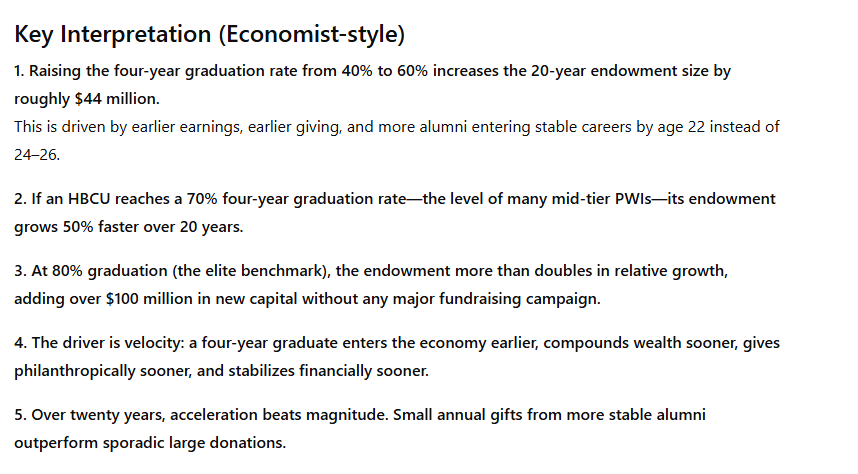
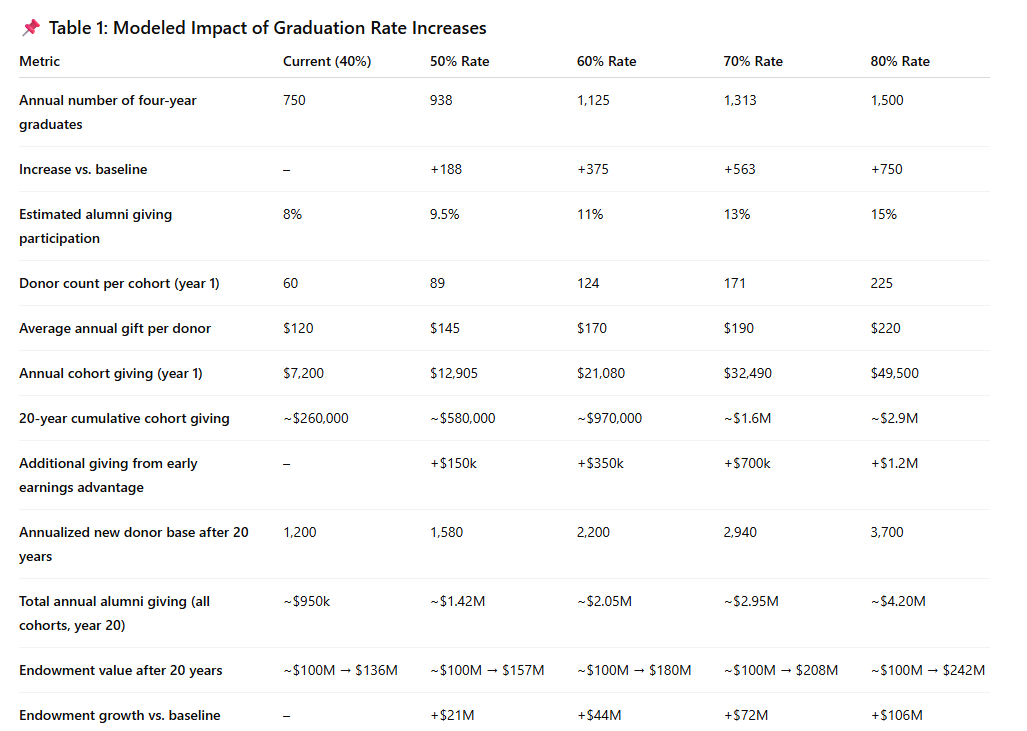
Assume that VSU today produces roughly 1,350 graduates every four years (based on a 27% rate). If it increased its four-year graduation rate to 50%, VSU would instead graduate 2,500 students every four years, an increase of 1,150 additional on-time graduates, each entering the workforce two years earlier, with lower student debt, earlier retirement contributions, earlier homeownership, and earlier philanthropic capacity. Even if only a modest fraction of these additional graduates contributed $50–$150 annually to VSU’s endowment, the compounding effect across 20 years would be substantial. Under conservative assumptions with basic donor participation growth and average returns of 7% VSU’s endowment could plausibly grow from $100 million to $155–$170 million over two decades, powered largely by the increased velocity and increased number of earning alumni.

Now consider the UVA-like scenario. A four-year graduation rate of 90% at VSU would mean roughly 4,500 on-time graduates every four years or over three times the current output. This scale of early, debt-lighter graduates would fundamentally transform VSU’s financial ecosystem. Even minimal alumni participation say, 12–15% giving $100–$200 annually would translate into millions in annual recurring contributions. Over two decades, with investment returns compounding, VSU’s endowment could grow not to $150 million but potentially to $300–$400 million, depending on participation rates and gift sizes. That would triple the institution’s financial capacity without a single major donor campaign, capital campaign, or extraordinary windfall. The key variable is simply graduation velocity.

This comparison illustrates a broader truth: endowment growth is not just a function of investment strategy but of how quickly a university converts students into earning alumni. A student who graduates at 22 gives for 40–50 years. A student who graduates at 25 gives for 30–35 years. A student who drops out does not give at all. VSU’s current 27% four-year graduation rate is not merely an academic statistic—it is an endowment drag factor. UVA’s 92% rate is an endowment accelerant.

The financial distance between the two universities appears vast, but it is governed by a formula that HBCUs can influence: more on-time graduates → more early earners → more consistent donors → more endowment growth → more institutional cushioning → more on-time graduates. VSU today sits at the fragile end of this cycle. A graduation-rate increase to 50% would move it into a position of stability. A leap to 90% would place it into an entirely different institutional category—one where it begins to accumulate capital in the same compounding manner that allows institutions like UVA to weather downturns, attract top faculty, and protect students from the shocks that so often derail academic momentum.

VSU cannot replicate UVA’s wealth in the short term. But by increasing on-time graduation, it can replicate the mechanism through which wealthy universities become wealthier. And that mechanism—graduation velocity—is one of the few levers fully within reach of alumni, leadership, and institutional partners.

Here are four strategic, high-impact actions HBCU alumni associations or chapters can take to directly raise four-year graduation rates and strengthen institutional wealth:

1. Create a Permanent Emergency Microgrant Fund (The “$300 Fund”)

Most delays in graduation arise from small financial shocks:
balances under $500, transportation failures, book costs, or housing gaps.

Alumni chapters can formalize a permanent, locally governed microgrant fund offering rapid-response support (48–72 hours).

A chapter raising just $25,000 per year can prevent dozens of delays, each shielding students from additional semesters of debt and protecting the institution’s future alumni giving pipeline.

This is low-cost, high-yield institutional intervention.

2. Fund Paid Internships and Alumni-Mentored Work Opportunities

Students who work long hours off campus are more likely to fall behind academically, switch majors repeatedly, or extend enrollment.

Alumni chapters can create paid internships, stipends, or alumni-hosted part-time roles tied directly to students’ majors.

Each position:

  • reduces the student’s financial burden
  • keeps them academically aligned
  • accelerates pathways to stable post-graduate employment

This lifts graduation rates and increases alumni earnings—expanding the future donor base.

3. Build K–12 Pipelines in Local Cities That Feed Directly Into HBCUs

Four-year graduation begins long before freshman year.

Alumni chapters can adopt 2–3 local schools and support:

  • literacy acceleration programs
  • SAT/ACT prep
  • dual enrollment partnerships
  • STEM and robotics clubs
  • early-college summer institutes hosted by their own HBCUs

Better-prepared students require fewer remedial courses, retain majors longer, and graduate on schedule, raising institutional performance and future endowment sustainability.

This is pre-investment in the future alumni base.

4. Pay for Summer Courses After Freshmen Year to Build Early Credit Momentum

After their first year, many students fall off the four-year pace due to light credit loads, failed gateway courses, or sequencing issues that a single summer class could easily correct. Yet for many HBCU students, summer tuition—often just one or two courses—is financially out of reach.

Alumni chapters can establish a Freshman Summer Acceleration Grant to pay for up to two summer course immediately after freshman year, allowing students to:

close early credit gaps,

retake or accelerate critical prerequisites,

reduce future semester overloads,

create a credit cushion for unexpected disruptions,

stay aligned with four-year degree maps.

A small investment of summer tuition produces an outsized institutional return: students enter sophomore year on pace, avoid bottlenecks in upper-level coursework, and dramatically increase their likelihood of graduating in four years. This is an early-stage compounding effect—protecting momentum before delays become expensive and permanent.

Disclaimer: This article was assisted by ChatGPT.
The PWI Myth Of Inclusion: Disparity Between African American State Population and Enrollment at Flagship PWIs

In the name of the greatest people that have ever trod this earth, I draw the line in the dust and toss the gauntlet before the feet of tyranny, and I say segregation now, segregation tomorrow, segregation forever. – George Wallace

Predominantly White Institutions (PWIs) often claim to prioritize diversity, inclusion, and equity in their admissions policies and campus environments. However, a critical examination of African American student representation at flagship public PWIs compared to the percentage of African Americans in their respective states tells a different story. Despite efforts to appear inclusive, many of these institutions enroll disproportionately low percentages of African American students relative to the overall demographics of their state populations. The reality that PWIs and the power brokers that run them highlight how they create systemic barriers, and the commitment of PWIs to fostering racial equity in higher education is more for show than substance. African America should take note and stop attempting to convince others they belong and instead focus on the development and strengthening of their own institutions – HBCUs.

The Disparity Between African American State Population and Enrollment at Flagship PWIs

State flagship PWIs are presented to the public as the premier public institutions within their states, receiving disproportionate funding and often representing the highest level of academic prestige that money can buy. Given their status as public institutions, they are expected to reflect the demographics of their states to some degree. However, data consistently show that African American students remain underrepresented at these institutions.

For example:

  • The University of Alabama, the state’s flagship university, enrolls an African American undergraduate population of approximately 10%, despite the state’s African American population being around 27%.
  • The University of Georgia has an African American undergraduate population of about 8%, whereas the state’s African American population stands at 33%.
  • The University of Texas at Austin enrolls about 5-6% African American students, while the state’s African American population is around 13%.
  • The University of Florida enrolls approximately 6% African American undergraduates, while the state’s African American population is around 17%.
  • The University of North Carolina at Chapel Hill has an African American student population of about 8%, whereas the state’s African American population is roughly 22%.

These figures highlight a significant gap between state demographics and flagship university enrollments. Several systemic barriers contribute to the underrepresentation of African American students at flagship PWIs.

Many flagship PWIs place a heavy emphasis on standardized test scores (SAT/ACT) in admissions decisions, despite substantial evidence showing these tests are biased against African American students. Socioeconomic disparities, unequal access to test preparation resources, and systemic inequities in K-12 education result in lower average test scores for African American students compared to their white counterparts. As a result, high-achieving Black students may be disproportionately excluded from flagship PWIs due to rigid admissions criteria.

Legacy admissions provide an advantage to applicants with family members who previously attended the institution. Since many flagship PWIs historically excluded African American students or only began admitting them in significant numbers in the latter half of the 20th century, Black students are less likely to benefit from legacy admissions. This perpetuates a cycle of exclusion where African American students face an inherent disadvantage in the admissions process.

Although flagship PWIs receive public funding, tuition and associated costs can still be prohibitively expensive for many African American students, particularly those from low-income backgrounds. Additionally, African American students are more likely to face financial hurdles, such as difficulty securing loans, lack of generational wealth, and limited access to scholarships. While some flagship PWIs offer financial aid, it is often insufficient to offset these disparities, leading many African American students to opt for more affordable options, such as community colleges or Historically Black Colleges and Universities (HBCUs).

Even when African American students are admitted to flagship PWIs, many report experiencing feelings of isolation, discrimination, and a lack of support. The low percentage of Black students contributes to a campus climate where they often feel like outsiders. Additionally, microaggressions, racial incidents, and a lack of Black faculty and administrators further reinforce the notion that these institutions are not fully committed to inclusion.

In response to criticisms about their lack of diversity, many flagship PWIs have implemented diversity initiatives, such as targeted recruitment efforts, scholarships for minority students, and cultural centers. While these initiatives are often marketed as evidence of inclusion, their impact remains limited. For example, recruitment efforts often focus on highly competitive African American students who may already be considering elite private universities or HBCUs, rather than addressing broader systemic access issues. Similarly, scholarships for minority students are frequently underfunded and do not significantly increase African American enrollment. Additionally, cultural centers, while important, do not solve the root problem of African American underrepresentation.

However, even if flagship PWIs were to become more welcoming and genuinely inclusive environments for African American students, this would not necessarily serve African American institutional interests. The success of the African American community depends not only on individual educational attainment but also on the strength and sustainability of Black institutions. When high-achieving African American students disproportionately attend PWIs, this can drain resources, talent, and community investment away from HBCUs and other Black institutions that have historically served as engines of African American progress and cultural preservation. The vitality of HBCUs is essential for maintaining institutional autonomy, cultivating Black leadership, and ensuring that the African American community retains control over its own educational narratives and priorities. Therefore, the question is not simply whether PWIs can be made more accessible, but whether funneling African American students into predominantly white institutions ultimately serves the collective interests of the Black community.

Historically Black Colleges and Universities (HBCUs) continue to play a crucial role in providing access to higher education for African American students. Despite being underfunded relative to flagship PWIs, HBCUs enroll a disproportionate percentage of African American students and produce a significant number of Black professionals, particularly in fields like STEM, law, and medicine. The success of HBCUs underscores the failure of flagship PWIs to effectively recruit, retain, and support African American students, while also demonstrating the unique value that Black-controlled institutions bring to the African American community.

Given the ongoing disparities at flagship PWIs and the broader institutional interests of the African American community, HBCUs have a unique opportunity to attract and enroll more African American students. HBCUs can expand their outreach to high school students by increasing their presence at college fairs, strengthening partnerships with predominantly Black high schools, and offering pre-college programs that expose students to campus life and academic offerings. Many African American students opt for PWIs due to financial aid packages, so HBCUs should seek additional funding sources, including partnerships with private donors and corporations, to increase the number of merit- and need-based scholarships. HBCUs offer a culturally affirming experience that fosters a sense of belonging and empowerment. Highlighting this unique aspect through marketing campaigns, alumni success stories, and campus visit programs can attract students seeking a supportive environment. By offering more flexible learning formats, such as online and hybrid programs, HBCUs can attract working adults and non-traditional students who may not be able to relocate or attend full-time. HBCUs should continue expanding their STEM, business, and professional degree offerings to appeal to students looking for strong career preparation. Partnering with industry leaders for internships and job placement programs can also enhance their value proposition.

The myth of inclusion at flagship public PWIs is exposed when analyzing the disparity between African American student enrollment and state demographics. Despite public funding and diversity rhetoric, many of these institutions fail to adequately reflect their states’ racial diversity. Systemic barriers in admissions, financial access, and campus climate continue to limit African American representation. Yet even if these barriers were removed, the deeper question remains whether increased African American enrollment at PWIs serves the collective institutional interests of the Black community or merely disperses talent and resources away from institutions that have historically empowered African Americans. HBCUs provide a proven model for success and have an opportunity to further capitalize on their unique position by enhancing recruitment, financial aid, and academic programming. With strategic efforts, HBCUs can continue to serve as a beacon of opportunity for African American students while strengthening the institutional foundation of the African American community.

Disclaimer: This article was assisted by ChatGPT and ClaudeAI.

The Federal Reserve: Democracy’s Unexpected Guardian

Let us never forget that government is ourselves and not an alien power over us. The ultimate rulers of our democracy are not a President and senators and congressmen and government officials, but the voters of this country. – President Franklin D. Roosevelt

On January 11, 2026, Federal Reserve Chair Jerome Powell delivered a stunning statement that crystallized a question many Americans may not realize they should be asking: Is the Federal Reserve the last major institution genuinely defending democratic principles in America?

Standing before cameras, Powell revealed that the Department of Justice had served the Fed with grand jury subpoenas threatening criminal indictment. The ostensible reason was his testimony to Congress about renovating Federal Reserve buildings. But Powell was direct about what was really happening: “This is about whether the Fed will be able to continue to set interest rates based on evidence and economic conditions or whether instead monetary policy will be directed by political pressure or intimidation.”

In that moment, the central bank of the United States became something more than a monetary policy institution. It became a test case for whether any American institution can resist President Trump’s political coercion over the next few years.

To understand why Powell’s statement matters, consider the landscape of American institutions today. The Supreme Court faces credibility challenges stemming from ethics controversies and a perceived ideological realignment. Congress operates in near-permanent partisan gridlock, struggling with basic functions like confirming appointments and passing budgets on time. State legislatures engage in aggressive gerrymandering and voting restrictions that challenge principles of equal representation. Executive power has expanded while norms of restraint have weakened across administrations.

Against this backdrop, the Federal Reserve maintained something increasingly rare: independence grounded in technical expertise and insulated from short-term political calculations. When President Trump repeatedly demanded interest rate cuts to boost the economy ahead of elections, the Fed held firm. When President Biden faced criticism over inflation, he publicly respected institutional boundaries. The Fed’s dual mandate of maximum employment and stable prices has required it to balance competing interests across the entire economy, forcing decisions that prioritize collective welfare over partisan advantage. Until now, that independence seemed relatively secure. Powell’s statement reveals it may be more fragile than Americans realized.

Powell’s January 11th statement is remarkable for several reasons. First, he explicitly connected the threat of criminal charges to the Fed’s monetary policy independence. He didn’t hide behind legal technicalities or bureaucratic language. He stated plainly that prosecution threats stem from the Fed “setting interest rates based on our best assessment of what will serve the public, rather than following the preferences of the President.” This is extraordinary transparency from an institution that typically communicates through carefully calibrated economic language. Powell used simple, direct terms: political pressure, intimidation, threats. He acknowledged that the ostensible reason for the subpoenas—his testimony about building renovations—was a pretext. He named what was happening.

Second, Powell invoked a principle larger than monetary policy: “Public service sometimes requires standing firm in the face of threats.” This isn’t the language of a central banker defending technical autonomy. It’s the language of someone defending an essential democratic principle, that institutions making decisions affecting all Americans should operate based on evidence and expertise, not political coercion. Third, Powell explicitly committed to continuing his work “with integrity and a commitment to serving the American people.” By framing his resistance as service to the public rather than institutional turf protection, he positioned the Fed’s independence as a democratic value rather than a technocratic privilege.

The Federal Reserve’s independence isn’t just about optimal interest rates or inflation targets. It represents a broader principle: that some decisions require insulation from short-term political calculations to serve long-term public welfare. When the Fed raises interest rates to combat inflation, it often creates short-term pain such as slower job growth, reduced business expansion, lower stock prices. Politicians facing elections have strong incentives to prioritize short-term stimulus over long-term stability. An independent Fed can make unpopular decisions that serve the country’s economic health over time.

This principle extends beyond economics. Independent courts can rule against popular sentiment to protect constitutional rights. Professional civil servants can implement policies based on expertise rather than political expediency. Scientists at government agencies can report findings that contradict administration positions. These institutional arrangements aren’t perfect, but they represent democracy’s attempt to balance popular sovereignty with expert judgment and long-term thinking. Powell’s statement suggests this balance is under direct assault, with the Fed potentially the last major holdout.

The Department of Justice subpoenas nominally concern Powell’s congressional testimony about Federal Reserve building renovations. Powell addressed this directly, noting that “the Fed through testimony and other public disclosures made every effort to keep Congress informed about the renovation project.” The suggestion that criminal charges might stem from routine congressional oversight testimony is itself remarkable, it criminalizes normal interaction between the legislative and executive branches. But Powell identified this as a pretext. The real issue is monetary policy that doesn’t align with presidential preferences.

This pattern using nominally legitimate legal mechanisms to pressure institutions making independent decisions represents a sophisticated form of institutional capture. It’s not crude interference like simply firing an agency head. It’s using the threat of criminal prosecution to reshape institutional behavior. The sophistication makes it more dangerous. It creates plausible deniability while achieving the same result: institutions become reluctant to make decisions contrary to executive preferences if doing so might expose their leaders to criminal investigation.

The Federal Reserve operates with more structural independence than most government institutions. Fed chairs serve fixed four-year terms that don’t align with presidential terms. Board members serve 14-year terms, ensuring continuity across administrations. The regional Federal Reserve bank structure distributes power geographically. These design features were intended to insulate monetary policy from political interference. If these protections prove insufficient—if the threat of criminal prosecution can bend the Fed to executive will then institutions with less structural independence have little chance of resisting similar pressure.

What happens to agencies making environmental regulations? To prosecutors deciding which cases to pursue? To intelligence agencies providing threat assessments? Democracy requires institutions that can tell truth to power. When the Environmental Protection Agency assesses climate risks, it needs to report findings honestly regardless of administration preferences. When the Congressional Budget Office scores legislation, it needs to provide accurate projections even if they contradict political claims. When courts rule on executive actions, they need to follow legal principles rather than political convenience. The Federal Reserve’s resistance to political pressure on monetary policy is part of this broader ecosystem of institutional independence. Its vulnerability suggests the entire ecosystem is at risk.

Jerome Powell cannot save American democracy alone. Even if the Federal Reserve maintains its independence on monetary policy, that doesn’t address court packing, voting restrictions, gerrymandering, or executive overreach in other domains. One institution resisting political capture doesn’t reverse broader democratic backsliding. Moreover, there are real tensions in celebrating the Fed as democracy’s guardian. The Federal Reserve is run by unelected officials making decisions with enormous consequences for ordinary Americans. Its most powerful body, the Federal Open Market Committee, operates with limited direct accountability. Unelected experts making consequential decisions without popular input can itself become anti-democratic.

The fact that we’re looking to an unelected central bank to defend democratic principles reveals how far other institutions have fallen. In a healthy democracy, Congress would check executive overreach, courts would protect institutional independence, and the civil service would resist improper political interference. That the Fed appears to be the last institution willing to publicly resist political coercion is an indictment of American governance, not just a testament to the Fed’s courage.

Powell’s statement creates several possible trajectories. The administration could back down (unlikely), recognizing that overtly criminalizing central bank independence would damage financial markets and America’s international credibility. Financial markets depend on confidence that U.S. monetary policy follows economic logic rather than political whim. International investors might flee dollar-denominated assets if they believe the Fed operates under political control. Alternatively, the administration could proceed with prosecution, testing whether public opinion, financial markets, or congressional action provide sufficient backstop to preserve Fed independence. This would transform an implicit crisis into an explicit constitutional confrontation. A third possibility is the subtler one: continued pressure without formal prosecution, creating uncertainty that gradually shapes Fed behavior. Board members might resign rather than face investigation. Future Fed chairs might be selected for political pliability. The institution might remain nominally independent while becoming practically captured.

The Federal Reserve’s independence ultimately depends on public support for the principle that some decisions should be insulated from short-term political pressure. Most Americans don’t follow monetary policy debates closely. But the principle that institutions should operate based on evidence rather than political coercion resonates beyond economics. Powell’s statement was unusually direct in part because he’s appealing beyond financial markets and policy experts to a broader public. He’s asking Americans whether they want institutions that can resist political intimidation or whether all government functions should answer directly to executive power.

This framing matters. If defending institutional independence becomes a partisan issue with one side supporting independent institutions and the other demanding political control then institutional independence has already lost. The Fed’s independence has survived because both parties recognized long-term benefits from monetary policy insulated from electoral cycles. Powell’s challenge is maintaining this bipartisan consensus at a moment when partisanship dominates and institutional norms have weakened.

There’s something appropriate in the Federal Reserve potentially becoming democracy’s last institutional defender. Central banks are unglamorous, technical, deliberately boring institutions. They don’t inspire passion or generate headlines under normal circumstances. They’re staffed by economists and lawyers making incremental decisions based on data and models. But democracy often depends on exactly these kinds of institutions. Not dramatic moments of resistance but everyday functioning of agencies that do their jobs professionally regardless of political pressure. Not heroic stands but consistent application of expertise and judgment independent of partisan considerations.

Powell’s statement was dramatic because it made explicit what usually remains implicit: that institutional independence requires constant defense, that political pressure is always present, and that resistance sometimes demands personal courage and public confrontation. The Federal Reserve may be the last institution defending these principles not because it’s special but because it’s one of the few with sufficient structural independence and public credibility to mount visible resistance. Its fight is everyone’s fight. If the Fed falls to political capture, the precedent suggests no institution is safe.

January 11, 2026 may be remembered as the day the question became explicit: Can American democratic institutions survive sustained pressure from political leaders willing to use criminal prosecution as a tool of institutional capture? Jerome Powell’s statement doesn’t answer that question. It simply acknowledges the question exists and declares his intention to resist. Whether that resistance succeeds depends on factors beyond the Federal Reserve—on Congress, courts, financial markets, public opinion, and the willingness of other institutional leaders to stand alongside the Fed in defending independence.

The Federal Reserve isn’t democracy’s savior. But in making public the political pressure it faces and explicitly refusing to capitulate, it’s doing what democratic institutions must do: operating based on evidence and principle rather than political intimidation. Whether other institutions find similar courage may determine whether American democracy survives its current crisis of institutional legitimacy. For now, the central bank stands. How long it can stand alone remains to be seen.

Disclaimer: This article was assisted by ClaudeAI.

Who Helps You With Personal Finance Decisions? How And Who To Choose For Your Financial Circle

“The nice thing about teamwork is that you always have others on your side.” – Margaret Carty

Family protected by their financial “bodyguards”.

The majority of how people make financial decisions both big and small is often with the best of intentions, but as most of us know, that is also where the road to hell was paved.

In the realm of personal finance, intentions without information can be dangerous. Every day, millions make financial decisions that shape their futures from picking a credit card, accepting a student loan, buying a car, or investing in a 401(k). Yet, especially within African American households, these decisions are frequently made with limited knowledge, access, or trusted advisors. Generational poverty, systemic exclusion, and inconsistent education have all contributed to a reality where financial literacy remains low, and bad financial advice can sometimes pass for tradition.

The statistics are sobering: According to a 2022 FINRA study, only 34% of African Americans could correctly answer four out of five basic financial literacy questions, compared to 55% of whites. This gap is more than academic it’s economic. Financial illiteracy compounds over time. It creates debt spirals, stifles homeownership, delays retirement planning, and weakens intergenerational wealth transfers. It also helps explain why the median Black household wealth remains only a fraction of that of white households.

So, if you’re navigating this landscape, how do you get the advice you need especially when your circle may not have the right information either?

Let’s explore how to build a financial circle of influence and more importantly, how to choose the right voices to include.

In far too many cases, personal finance education starts after the mistakes are made such as missed student loan payments, wrecked credit scores, or maxed-out credit cards. Even institutions designed to uplift like Historically Black Colleges and Universities (HBCUs) have been slow to require financial literacy as a foundational component of their curricula.

Imagine if every incoming freshman at an HBCU were required to complete a month-long intensive in budgeting, credit, and financial aid before stepping foot on campus. Not only that, but if financial education were embedded into their collegiate journey; customized to their majors, infused with real-world applications, and rooted in African American economic history and philanthropy the results could be transformative. Courses in credit management, entrepreneurship within your field, the basics of investing, and even African American economic institutions (from mutual aid societies to credit unions) could help create a generation that thinks differently and acts differently about money. Until that infrastructure exists consistently, however, students and families are often left to fend for themselves, relying on informal networks, questionable online advice, or predatory “wealth influencers.” That’s why building your own financial circle is more important than ever.

Your financial circle isn’t just about having a stock tip group chat. It’s your personal advisory board: a small group of 3 to 5 people you trust to help you make decisions ranging from the everyday to the existential.

Think of them as your informal “board of directors.” You don’t need them to be millionaires or financial advisors (though one or two wouldn’t hurt). But you do need them to be:

  • Financially aware: They have a basic grasp of sound financial practices.
  • Ethical: They’re not trying to sell you anything or exploit your trust.
  • Supportive: They understand your goals and will offer guidance in your best interest, not theirs.
  • Diverse in expertise: Ideally, each brings a different angle—entrepreneurship, investing, real estate, credit, budgeting, etc.

The value in this diversity is simple: no one person has all the answers. An investor might advise risk, while a credit specialist might urge caution. You need to weigh both perspectives to make the right decision for you.

Who Belongs in Your Circle?

There are five archetypes worth considering:

1. The Budget Master

This person might not have flashy investments or a six-figure salary, but they manage what they have with laser precision. They know how to stretch a dollar, pay off debt, and stick to a plan. They understand discipline and sacrifice—essential traits in building wealth, not just income.

Why you need them: For insight into monthly budgeting, avoiding lifestyle creep, and making responsible day-to-day decisions.

2. The Wealth Builder

This is your investor friend. Maybe they dabble in the stock market, own real estate, or have a retirement plan that’s growing nicely. They’ve made mistakes, but they’ve learned from them and they’re willing to share.

Why you need them: They help you think long-term. They understand compound interest, asset allocation, and the psychology of investing.

3. The Entrepreneur

Whether it’s a side hustle or a full-time enterprise, this person knows what it means to take calculated risks. They can offer insight into taxes, business credit, scaling a company, or diversifying income streams.

Why you need them: Because job security is not what it used to be and entrepreneurial skills are often the key to economic mobility.

4. The Credit Whisperer

This person has mastered the FICO system, understands debt instruments, and knows how to use credit to their advantage. They’re also likely well-versed in financial regulations and tools like balance transfers, refinancing, and consolidation.

Why you need them: To help you avoid common traps and use credit as a tool, not a trap.

5. The Cultural Capitalist

This person is grounded in the historical and cultural aspects of Black economic life. They can talk about Black Wall Street, the role of Black banks, and how to give back without going broke. They remind you that financial decisions aren’t just about you—they’re about us.

Why you need them: To stay grounded in your values and understand how your success contributes to a broader community legacy.

How to Choose the Right People

The first step to building a financial circle is intentionality. Here are a few principles:

1. Don’t Confuse Proximity with Expertise

Just because someone is family or close doesn’t mean they’re qualified to advise you. Seek out people who have demonstrated results such as consistent savings, strong credit, a stable business not just opinions.

2. Look Beyond Titles

A financial advisor with a fancy office isn’t necessarily better than your aunt who retired early on a teacher’s pension. The best advisors aren’t always licensed—they’re often experienced, candid, and care about your outcomes.

3. Vet for Integrity

Before you invite someone into your financial circle, ask: Are they selling me something? Are they pushing an agenda? Can I trust them to tell me the truth—even when it’s uncomfortable?

4. Value Perspective over Perfection

Your circle doesn’t have to be made up of financial rockstars. It has to be honest, dependable, and thoughtful. Sometimes the best advice comes from someone who made a mistake and is willing to share the lesson.

Here are a few places to start identifying people for your financial circle:

  • Community and alumni networks (especially HBCU alumni groups)
  • Professional associations (Black MBA, Black CPA organizations)
  • Libraries (many now offer financial literacy sections)
  • Local credit unions and Black-owned banks (many host workshops or financial education seminars)

And yes, if you can afford one, a certified financial planner (CFP) can be a game-changer. But even that relationship should be approached with due diligence and comparison—interview multiple advisors, ask for their fiduciary status, and never be afraid to walk away if the fit doesn’t feel right. Verify an individuals’s CFP certification and background at https://www.cfp.net/verify-a-cfp-professional.

Until institutions mandate courses, you’ll have to become your own professor. Here’s a four-year self-guided plan:

YearTopicsResources
Year 1Budgeting & Credit BasicsYour Money or Your Life, NerdWallet, Experian Boost
Year 2Investing 101The Simple Path to Wealth, Morningstar, Robinhood Learn, Bogleheads
Year 3EntrepreneurshipThe Lean Startup, SBA.gov, Score Mentors
Year 4Philanthropy & Estate PlanningDecolonizing Wealth by Edgar Villanueva, NAACP Legacy Programs

Add to that regular podcasts (The Economist, Financial Times), YouTube channels (like Minority Mindset), and community financial challenges (like savings goals, no-spend months, or stock clubs), and you’ll be ahead of the curve.

There’s a subtle but powerful difference between advice and empowerment. Advice tells you what to do. Empowerment teaches you how to think.

Your financial circle should do both but lean into the latter. The best financial guidance is that which helps you ask better questions, weigh competing options, and make decisions aligned with your values and goals.

Ultimately, the journey to financial health isn’t just about tools, apps, or strategies—it’s about relationships. And the most important one is the one you build with your future self.

So, who helps you with personal finance decisions? The better question might be: Who will you invite to help you get where you want to go?

Choose wisely.

Disclaimer: This article was assisted by ChatGPT.

Have HBCUs Given Up On Recruiting African American Students?

“Change will not come if we wait for some other person or some other time. We are the ones we’ve been waiting for. We are the change that we seek.” – Barack Obama

It almost seems like an absurd question to ask, but…

in 2025, the idea that Historically Black Colleges and Universities (HBCUs) are no longer focused on recruiting African American students is not as far-fetched as it sounds. It’s a question whispered in alumni boardrooms, discussed in quiet conversations among concerned parents, and pondered in the minds of young Black students as they decide where to apply. While HBCUs remain vital institutions for the Black community, the numbers and decisions behind closed doors suggest that a shift is underway—one that demands scrutiny, reflection, and action.

In the decades since desegregation opened the doors of Predominantly White Institutions (PWIs) to Black students, the role and mission of HBCUs have been evolving. According to data from the Pew Research Center, Black student enrollment at HBCUs increased by just 15% from 1976 to 2022. Meanwhile, enrollment of students from other racial and ethnic groups rose by a staggering 117% during the same period. In 1976, Black students made up 85% of HBCU enrollment. By 2022, that number had dropped to 76%. That means nearly one in four HBCU students today is not Black. At at least five HBCUs, such as Bluefield State University, Lincoln University (MO), and West Virginia State University, White students now comprise the majority. While some view this as a testament to progress and inclusion, others see it as a troubling signal that the core mission of HBCUs, educating and empowering African American students, their families, and ultimately the social, economic, and political interest of African America, may be slipping.

Nowhere is this shift more alarming than in the enrollment of Black male students. In 1976, Black men made up 38% of students at HBCUs. By 2022, that number had fallen to just 26%. The decline is not only concerning it is an existential threat to the cultural and academic ecosystem of HBCUs, which once produced the very architects of Black political, business, and religious life. Many HBCUs now boast majority-female student bodies, a testament to the resilience and commitment of Black girls, but also a glaring reflection of systemic failure to support Black boys in education from kindergarten through college. The disappearance of Black young men from HBCU campuses must be seen for what it is: a crisis.

Some of the explanations are economic. Many HBCUs struggle with limited financial resources. According to HBCU Money’s 2024 endowment rankings, only one HBCU, Howard University, has an endowment exceeding $1 billion. Most HBCUs operate with endowments below $100 million, leaving them vulnerable to financial pressures that force them to make difficult choices. In that context, expanding recruitment to non-Black students may seem like a pragmatic strategy to increase tuition revenue, especially when those students are attracted by athletic scholarships in sports like soccer, baseball, and tennis—sports where African American participation is historically underrepresented. But when HBCUs prioritize this kind of recruitment while failing to maintain deep engagement with the Black communities that birthed them, they risk trading mission for margin.

The situation has also been shaped by the recruitment arms race. PWIs now actively recruit top Black students with full-ride scholarships, aggressive outreach, and promises of diversity and inclusion. For many Black high schoolers, a name-brand PWI with a large endowment and impressive campus facilities appears more appealing and more financially accessible than an underfunded HBCU. This has contributed to an image crisis for many HBCUs. Once the first choice for Black excellence, some HBCUs are increasingly viewed as a second-tier option, even among Black students themselves. This perception isn’t entirely fair, but it’s not without basis. Fewer in-person recruitment visits, fewer marketing campaigns that center Black identity, and an overreliance on digital outreach have all contributed to HBCUs becoming less visible in the spaces that matter most.

And yet, 2023 may have marked an inflection point. When the U.S. Supreme Court struck down race-conscious admissions at PWIs, many Black students and families began rethinking their college plans. In the aftermath of the ruling, applications to HBCUs surged. According to Inside Higher Ed, institutions such as Howard University, Florida A&M University, and North Carolina A&T reported double-digit increases in applications in 2024. These students, disillusioned by the erasure of diversity efforts at mainstream universities, began looking again to HBCUs as spaces where their identities were affirmed, not tolerated. This renewed interest is an opportunity, but also a test. Will HBCUs meet the moment?

To do so, recruitment must become intentional again not just broad-based or reactive. The recruitment of African American students, especially Black male students, needs to return to being a top institutional priority. That means more than sending emails or relying on the Common Black College Application. It means going into Black neighborhoods, hosting HBCU nights at community centers and churches, building relationships with high school counselors, and creating early K-8 pipeline programs. It means building community and cultural trust. The reality is, many Black high school students no longer have any personal connection to an HBCU. They may not know an alum. They may never have stepped on a campus. For HBCUs to thrive, they must reintroduce themselves.

And this is where alumni become vital. HBCU alumni are among the most loyal in the nation, but they are too often treated only as sources of homecoming participants. In truth, they are the best ambassadors. Empowering alumni to lead recruitment efforts, fund scholarships, and bring HBCU visibility to their local schools is an untapped strategy with enormous potential. HBCUs must support this with resources and coordination, not just hope.

The work also includes tackling affordability. More than 70% of HBCU students are Pell Grant eligible, compared to just 39% of students nationally. That means HBCUs disproportionately serve low-income, first-generation college students. For these students, even small gaps in aid can become barriers. Innovations like the reduced tuition and work-study model at Paul Quinn College show that reimagining cost structures is possible. Institutions that find ways to lower costs, provide housing and food support, and prioritize need-based aid will be the ones that retain and graduate more Black students.

At a deeper level, this conversation is not just about numbers. It’s about identity. The cultural mission of HBCUs cannot be outsourced. HBCUs are sacred institutions, repositories of Black intellectualism, resistance, and imagination. When they drift too far from that mission, they risk becoming something entirely different. Diversity should be additive, not dilutive. To serve the world, HBCUs must first continue serving the people who built them.

This doesn’t mean rejecting change. It means anchoring change in purpose. HBCUs can welcome diversity without losing their soul. But to do so, they must recommit to the hard, intentional work of finding and lifting up Black students not just those with 4.0 GPAs and high SAT scores, but also the creative thinkers, the late bloomers, the future leaders hiding in overlooked ZIP codes. These students may not be polished when they arrive, but neither were the trailblazers who founded these institutions. We owe them the same belief.

In the end, the question “Have HBCUs given up on recruiting African American students?” is not an accusation it is a call. A call to reignite the radical vision that gave birth to these schools in the first place. A call to remember that every Black student recruited to an HBCU is a declaration of faith in Black futures. A call to stop letting budget constraints dictate who gets to belong in spaces we built. And a call to Black America to advocate, to donate, to volunteer, and to remind our youth that these institutions are not relics of the past. They are sanctuaries for tomorrow. A fort of many that protects the social, economic, and political interest of African America.

In the words of Zora Neale Hurston, “There are years that ask questions and years that answer.” This year, the question has been asked. What comes next is up to all of us.


Sidebar Feature: Black Male Enrollment Crisis

  • In 2022, only 26% of HBCU students were Black men.
  • Compare that to 38% in 1976.
  • Solutions include mentorship pipelines, mental health support, re-entry programs for formerly incarcerated youth, and dedicated Black male scholarships.

HBCU Money Action Items: How You Can Help (K-8 Focused)

1. The HBCU Express: Mobile Campus Experience

Transform a retired school bus into a rolling HBCU ambassador painted in your school’s colors, filled with college memorabilia, yearbooks, and screens showing campus life. Drive it to elementary schools during lunch or after school, let kids climb aboard, sit in “college seats,” and take photos. Make it an event kids talk about for weeks.

Bonus: Offer free rides to campus tours for families.

2. Saturday HBCU Youth Academies (On-Campus or Virtual)

Host monthly Saturday programs where K-8 students take classes taught by alumni and current students—coding, dance, robotics, creative writing, step team, debate. For chapters near campus, hold sessions in campus facilities with meals in the dining hall. For distant chapters (like a New York chapter for a Virginia HBCU), run virtual sessions where kids still see campus backgrounds, hear from current students, and feel connected to the institution. Hybrid models work too—virtual learning followed by an annual in-person campus visit.

3. HBCU Summer Day Camp Scholarships & Sponsorships

If the HBCU already runs summer day camps for ages 8-14, alumni chapters can fund full or partial scholarships so more K-8 students from underserved communities can attend for free. Chapters can also sponsor transportation (charter buses from their city to campus), provide camp supplies, fund field trips, or endow specific camp programs (STEM lab, arts workshop, sports clinic). For distant chapters, sponsor a group of local kids to travel to campus for the week-long experience—cover registration, travel, and meals. This removes financial barriers and gets more Black children on campus during formative years.

4. Adopt-a-School Family Weekends

Alumni chapters “adopt” local elementary or middle schools and sponsor quarterly weekend campus visits for groups of families with K-8 children. Time visits around campus events—football or basketball games, step shows, concert series, or even quiet weekends when students are just hanging out on the yard. Provide transportation, cover game tickets or event admission, and assign each family a paid student tour guide who walks them through dorms, the student center, dining halls, and academic buildings.

Let kids eat campus food, sit in lecture halls, and watch college students in their natural environment. Parents see the affordability, safety, and culture while kids fall in love with the energy. End with a family cookout or pizza party where alumni share their stories and parents ask real questions about financial aid, academics, and campus life. You’re selling the parents on the investment and indoctrinating the kids with belonging. Make it so memorable that families go home and tell everyone about “their weekend at the HBCU.”

5. HBCU Junior Homecoming

Create a “Little Yard Fest” during homecoming week specifically for K-8 students—kid-friendly step show performances, band practice visits, meet-and-greets with the mascot, face painting in school colors, and a mini parade. Let children experience the joy, pride, and cultural richness of HBCU homecoming. Give every child a “Future Class of 20XX” t-shirt. When homecoming becomes their childhood memory, attending becomes their teenage dream.

6. Community-Based Tutoring & Enrichment Centers

Alumni chapters establish free after-school and weekend tutoring programs in their local communities—at libraries, community centers, churches, or alumni members’ offices. Offer homework help, test prep, reading circles, and subject-specific support led by alumni volunteers. Decorate spaces with HBCU banners, pennants, and imagery. Kids get academic support while being surrounded by HBCU pride. Current college students can join virtually to provide tutoring, creating direct peer connections across distances.

7. HBCU Family Culture Days at Museums & Theaters

Partner with local museums, science centers, theaters, or cultural institutions to sponsor “HBCU Family Days” where alumni associations buy out tickets so parents and guardians can bring their K-8 children for free. Brand it visibly with school colors, have alumni volunteers greet families wearing HBCU gear, distribute information packets about the school, and create photo opportunities. Follow up with invitations to visit campus. It positions the HBCU as an institution invested in Black family enrichment and intellectual development.

8. Live Virtual Campus Walks & Class Sit-Ins

Alumni chapters coordinate with student organizations (SGA, fraternities, sororities, academic clubs) to host live virtual campus tours where current students walk K-8 children through campus via smartphone or camera—showing dorms, the yard, dining halls, the library, labs, and student hangout spots. Go beyond static tours: arrange for interested students to virtually “sit in” on actual college classes, club meetings, or rehearsals. Let them see what college life really looks like in real-time. Schedule Q&A sessions where kids can ask current students anything. This works for any chapter regardless of geographic distance and makes the campus feel accessible and alive.


The goal: Make HBCU campuses feel like second homes before kids even reach high school. When college decisions come, they won’t be choosing the unknown—they’ll be coming home.

Disclaimer: This article was assisted by ChatGPT and ClaudeAI.