Monthly Archives: October 2025

Pan-African Capital: HBCU Endowments, African American Banks, and Kenya’s Growth Story

“When HBCU endowments and African American banks act together, they stop being small players. They become a financial force that nations must reckon with.” – HBCU Money Editorial Board
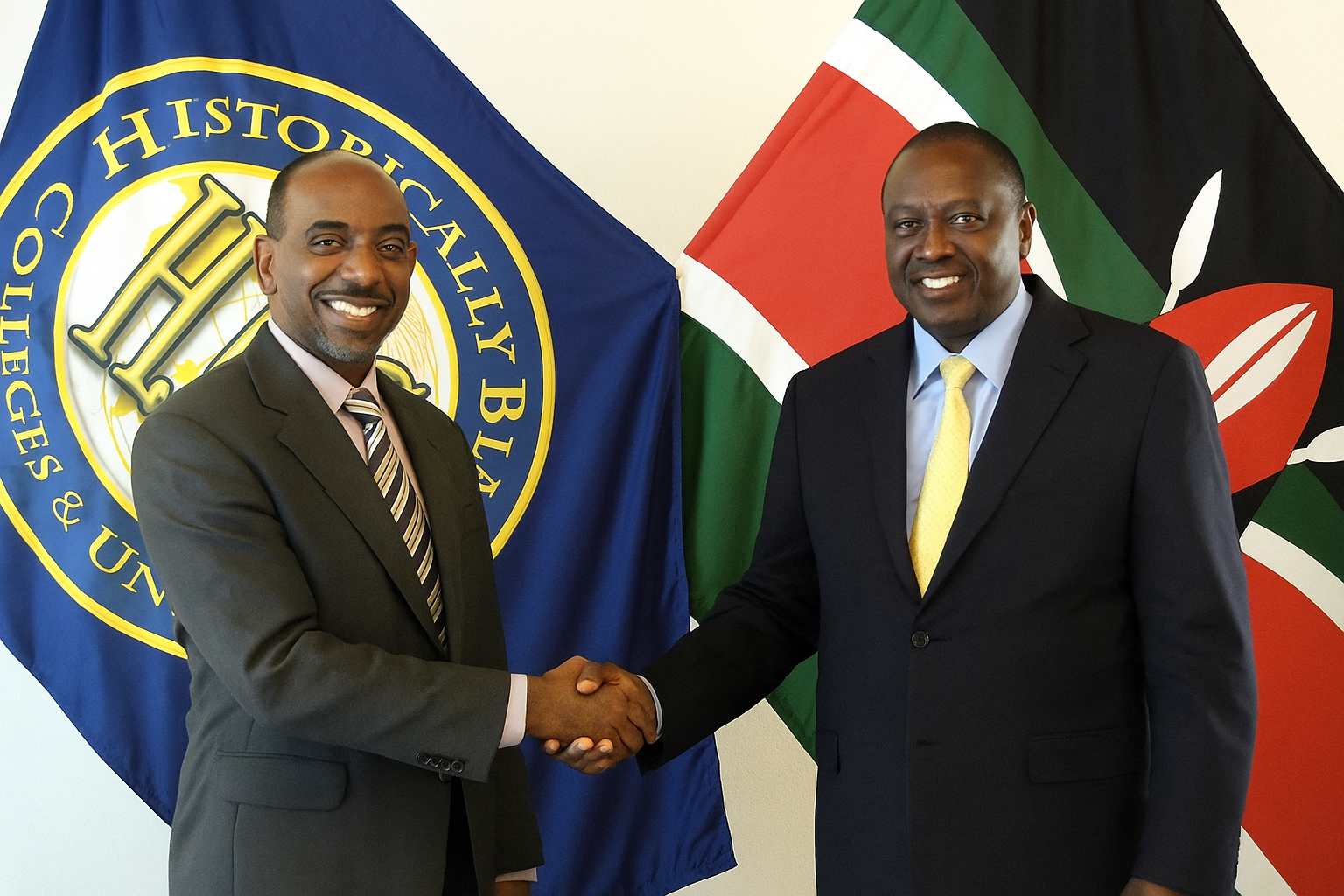
In the next several decades, the fault lines of global growth will not run through New York or London but through Nairobi, Lagos, and Accra. Kenya, sitting at the intersection of East Africa’s financial corridor and global trade routes, has become a laboratory for innovation in fintech, agriculture, and infrastructure. Yet despite centuries of cultural, spiritual, and blood connections, African America remains structurally absent from this new frontier of opportunity. Our financial institutions and HBCU endowments are under-leveraged in international markets, particularly in Africa, even as Asian, European, and Middle Eastern investors carve out dominant positions. For African American financial institutions and HBCU endowments, Kenya represents more than just an emerging market. It is a strategic stage for institutional wealth-building, geopolitical leverage, and reconnecting the African Diaspora through shared prosperity. The opportunity lies not simply in making isolated investments but in creating transatlantic joint ventures that bring together capital, expertise, and institutional strategy.

Kenya is more than safari brochures and tourist postcards. Its economy has quietly matured into one of Africa’s most diversified. With a GDP of over $110 billion and growth rates consistently outperforming many global peers, Kenya is often referred to as East Africa’s economic anchor. Nairobi has developed into the region’s financial hub, hosting multinational headquarters, stock exchange operations, and a robust startup ecosystem. Agriculture remains central, with Kenya exporting coffee, tea, and horticultural products while seeking to expand into value-addition agribusiness. Technology is another frontier, with Nairobi’s “Silicon Savannah” serving as a magnet for fintech, led by the global success of M-Pesa. Rapid urbanization fuels infrastructure and real estate demand, while Kenya’s leadership in geothermal and renewable energy has made it a global model. For African American institutions, the attraction lies not only in the growth metrics but in the alignment of needs: Kenya seeks patient capital, educational partnerships, and trusted diaspora allies, while African American institutions seek diversification, higher yields, and independence from U.S.-centric markets.

Despite African America’s aggregate $1.8 trillion in consumer spending, the community’s institutional capital remains modest. Only a handful of Black-owned banks, credit unions, and venture firms exist, and most hold under $1 billion in assets. HBCU endowments combined are less than $4 billion—an amount dwarfed by single Ivy League endowments. Yet within these constraints lies enormous potential. African American financial institutions already possess the regulatory infrastructure to pool and allocate capital, while HBCU endowments, though smaller in scale, carry moral weight and symbolic capital that can unlock global partnerships. Together, these institutions can create vehicles for international deployment of African American wealth, something that has been absent throughout our history. Imagine a pooled investment fund where Howard University, Spelman College, and Florida A&M commit $25 million collectively, matched by $25 million from Black-owned banks. That $50 million fund could be deployed into Kenyan agritech ventures, renewable energy projects, or commercial real estate. The collaboration would be historic: an African Diaspora financial ecosystem investing directly in Africa’s future.

The reasons to prioritize such engagement are strategic. Diversification is one. U.S. capital markets are increasingly low-yield for small institutional investors, while African markets offer higher growth potential and uncorrelated returns. Another is first-mover advantage. Unlike European or Asian investors, African American institutions do not carry the baggage of colonial relationships, which makes trust-based partnerships more viable. Transnational investment also provides institutional leverage. Just as Jewish, Irish, and Italian communities have leveraged diaspora ties for economic and political power, African Americans can build similar networks of influence. Beyond finance, there is the educational pipeline. HBCUs can link faculty, students, and alumni into research, study abroad, and entrepreneurial ventures tied to investments in Kenya. And finally, there is legacy. These investments address the absence of transgenerational institutional wealth that has long defined the African American economic condition.

The structures to achieve this vision can be diverse. A Diaspora investment fund pooling capital from HBCU endowments, Black-owned banks, and other African American institutions could professionally manage investments in Kenya. Public-private partnerships could align capital with Kenya’s infrastructure push in transport, energy, and housing. Venture capital and startup accelerators in Nairobi could connect HBCU students with Africa’s entrepreneurial scene while generating equity returns. Real estate investment trusts, driven by Nairobi’s urbanization, could provide stable income streams. Even education-linked ventures in e-learning and vocational training could generate both profit and intellectual reciprocity.

The barriers are real but not insurmountable. Kenya requires foreign investors to comply with incorporation, licensing, and work permit laws, which demand careful navigation. Currency risk from fluctuations in the Kenyan shilling must be hedged. Information gaps are wide, with many African American institutions unfamiliar with African business environments, highlighting the need for trusted partnerships and research. The relatively small scale of HBCU endowments makes collaboration indispensable. Above all, transparent governance and professional management are critical to avoid reputational risk. Yet none of these barriers are unique. European, Asian, and African investors face them daily and manage to thrive.

This is not only an economic project but a political one. The creation of a formal African American–Kenya Investment Council, for example, could coordinate through the Four Points Chamber of Commerce, HBCUs, and Kenyan universities to advocate for favorable treaties, tax incentives, and research collaborations. African American institutions investing abroad alter the narrative at home: no longer just a constituency asking for inclusion, but a global economic player with interests that stretch across the Atlantic. Such evolution creates leverage in Washington, Wall Street, and international forums.

Take agritech as a concrete example. Kenya’s agricultural sector employs over 60 percent of its labor force, yet productivity remains limited by technology and infrastructure. African American banks could co-finance ventures in irrigation, cold storage, and logistics platforms. HBCUs such as Tuskegee and Prairie View A&M could supply expertise in agricultural science and training. The returns could be strong, while the ventures also address food security and climate resilience—issues central to Africa’s stability. This is an example of investment tied not only to financial return but to global relevance.

The deeper point is that these ventures embed African American institutions into Africa’s growth story. They create a new narrative where HBCU students intern at Nairobi startups, Kenyan entrepreneurs raise capital from African American banks, and families on both sides of the Atlantic see tangible proof that the Diaspora is not fragmented but interwoven. In a world where capital dictates influence, these ties are transformative. They represent not just diversification but restoration, an opportunity to re-knit the fabric of a dispersed people through shared prosperity.

The cost of inaction is steep. China has entrenched itself in Kenya and across Africa through the Belt and Road Initiative. Gulf states are investing heavily in energy and real estate. European firms continue to capture opportunities in agriculture and infrastructure. If African American institutions remain passive, they will again watch as others define Africa’s economic trajectory, forfeiting both profits and influence. Worse, they will remain locked in a domestic cycle of undercapitalization and marginalization, failing to establish the transatlantic presence that could transform their institutional standing.

For too long, African America has celebrated individual success while neglecting institutional power. The result has been wealth without leverage and influence without permanence. Kenya and the wider African continent present a chance to reverse this trajectory. African American financial institutions and HBCU endowments can seize the opportunity by building joint investment vehicles that are ambitious, strategic, and collaborative. To invest in Kenya is to invest not only in profitable ventures but in the future of a Diaspora united by shared capital, shared strategy, and shared destiny. The transatlantic bridge is waiting to be built. The question is whether African America will summon the courage, coordination, and vision to cross it.

Step-by-step practical framework that African American financial institutions and HBCU endowments could follow to launch their first $50 million joint Kenya investment fund:

Imagine a handful of African American bank CEOs and HBCU endowment chiefs sitting together in a boardroom. The room is filled with cautious optimism. They know that together, they control billions in assets. What they don’t yet have is a proven model for working together to extend institutional power abroad. That meeting marks the first step: the coalition. A steering committee is formed, with voices from banking, academia, and outside advisors who know Kenya’s economic landscape. Their mandate is clear—launch a fund that delivers returns, but also anchors a new Pan-African economic relationship.

Step 1: Establish a Foundational Coalition

  • Identify core partners: Secure commitments from 3–5 African American banks and 5–7 HBCUs with at least $50M in combined investable capital.
  • Set up a steering committee: Include representatives from bank leadership, HBCU endowment managers, and external advisors with Africa market expertise.
  • Define purpose: Clearly state the dual mission: generating strong financial returns while building a bridge for institutional Pan-African economic partnerships.

The first order of business is to commission a feasibility study. Consultants with expertise in Kenya’s political economy, regulatory framework, and sector opportunities are hired. They map out the terrain: Kenya’s fast-growing fintech sector, renewable energy projects feeding off abundant solar and wind, agribusiness tied to both domestic and export markets, and logistics hubs serving East Africa’s gateway economy. Risks are weighed—currency volatility, regulatory hurdles, political cycles—but so are opportunities. The committee sees promise.

Step 2: Commission a Feasibility Study

  • Hire consultants with Kenya expertise: Legal, financial, and political economy experts based in both the U.S. and Kenya.
  • Sector focus analysis: Prioritize sectors Kenya is inviting foreign direct investment into—agriculture, fintech, renewable energy, real estate, and logistics.
  • Risk assessment: Evaluate currency volatility, repatriation policies, political stability, and regulatory compliance.

Next, the legal and financial scaffolding of the fund takes shape. They agree on a traditional GP/LP structure based in the U.S. for investor familiarity, with a Kenyan arm for local operations. Banks pledge their first tranches—perhaps $5M each. HBCUs, with smaller endowments but a deep sense of mission, contribute $2–3M apiece. Collectively, the first commitments reach $30M, enough to begin building credibility. The remaining capital will come from outside partners.

Step 3: Create the Legal & Financial Structure

  • Fund structure: Decide whether the vehicle will be a private equity fund, venture fund, or blended finance model.
  • Jurisdiction: Likely establish a U.S.-based LP/GP model for investor confidence, with a Kenyan subsidiary or partnership entity.
  • Capital commitments: Each bank and HBCU pledges proportional investments. Example: 3 banks commit $5M each, 7 HBCUs commit $2–3M each, plus matching funds from development finance institutions.

Those partners are cultivated carefully. Calls are made to the African Development Bank, IFC, and the U.S. International Development Finance Corporation. Each sees value in a diaspora-led fund connecting capital from the African American community to African markets. Meanwhile, Kenyan pension funds and cooperatives are invited to co-invest. Diaspora high-net-worth individuals are offered side-car vehicles. With these anchor and matching partners, the fund’s $50M target is within reach.

Step 4: Secure Anchor & Matching Partners

  • DFIs and multilaterals: Approach institutions like African Development Bank (AfDB), U.S. International Development Finance Corporation (DFC), and IFC for co-investments.
  • Kenyan institutions: Partner with local pension funds, cooperatives (SACCOs), or universities to establish local credibility and co-ownership.
  • Diaspora investors: Offer side-car investment vehicles for African American and African diaspora high-net-worth individuals.

Governance is another priority. The steering committee transforms into an investment committee, balanced between African American institutional leaders and Kenyan business experts. An advisory board is established with specialists in agriculture, energy, real estate, and fintech. Transparency is emphasized—annual impact reports will detail not only financial returns, but jobs created, student exchanges launched, and trade flows increased.

Step 5: Build Governance & Accountability Mechanisms

  • Investment committee: Balance between African American institutional reps and Kenyan business leaders.
  • Advisory board: Include sector specialists in agriculture, energy, fintech, etc.
  • Transparency: Publish annual reports and impact metrics, not just financial returns, but job creation and trade flows between HBCUs and Kenya.

Deal flow comes next. Nairobi-based investment professionals are hired to scout opportunities, vet local entrepreneurs, and structure partnerships. At the same time, HBCUs begin linking their own academic programs—business schools, agricultural research centers, and engineering departments—into the fund’s sector priorities. Student projects and faculty research now have real-world investment applications in Kenya.

Step 6: Develop Pipeline & Deal Flow

  • Partnership with Kenyan government: Leverage incentives offered to foreign investors, including tax breaks and special economic zones.
  • Local deal scouts: Hire Nairobi-based professionals to source deals in priority sectors.
  • HBCU connections: Link research and student projects to sectors targeted by the fund (e.g., agricultural science programs tied to Kenyan agribusiness investments).

With structure, governance, and deal flow in place, the fund launches its pilot tranche. $10M is deployed across two or three projects. A solar mini-grid company extending power to rural communities. A fintech platform simplifying mobile payments. A mid-sized agribusiness processing exports for global markets. These are not moonshots—they are solid, scalable enterprises that demonstrate both impact and return. The performance of this pilot will be watched closely. If successful, it will unlock the remainder of the $50M and set the stage for larger ambitions.

Step 7: Launch Pilot Investments ($10M tranche)

  • Start small within the $50M: Deploy $10M across 2–3 companies/projects.
  • Focus on scalable businesses: Renewable energy mini-grids, fintech payment platforms, or agri-processing facilities.
  • Monitor performance closely: Use pilot results to refine risk models, build confidence among stakeholders, and attract more investors.

Within 18 months, the pilot investments begin to show results. Jobs are created. Returns begin to flow. Confidence builds. The remaining capital is deployed, spreading across a diversified portfolio. HBCUs launch student and faculty exchanges with Kenyan institutions tied to the fund’s sectors. African American banks begin opening lines of credit to U.S. businesses interested in exporting to East Africa. The fund is no longer just an experiment—it is an institution in itself.

Step 8: Expand and Institutionalize

  • Scale to full $50M deployment: After 12–18 months of pilot success, release additional tranches.
  • Knowledge transfer: Create HBCU student and faculty exchange programs tied to investments.
  • Secondary fundraising: Use strong pilot performance to raise an additional $100M+ follow-on fund.

As momentum grows, the fund takes steps toward permanence. A Nairobi office is established, staffed by African American and Kenyan professionals alike. Training programs create a pipeline for HBCU students to intern in Kenya and Kenyan students to study at HBCUs. Over time, this exchange deepens the cultural and economic ties the fund was designed to spark.

Step 9: Create Long-Term Infrastructure

  • Permanent office in Nairobi: Establish a joint African American–Kenyan fund management company.
  • Training & pipeline development: Develop internship pipelines for HBCU students in Kenya, and Kenyan students at HBCUs.
  • Institutional trust: Turn the fund into a long-term institutional asset class for African American banks and HBCUs.

After five years, success is measured in multiple ways. Financially, the fund delivers returns in line with its targets—perhaps 12–15% IRR. Institutionally, it has created a precedent: HBCUs and African American banks can collaborate on global investments. Socially, it has created jobs in Kenya, exported knowledge and partnerships, and brought students and faculty into real-world economic diplomacy. Most importantly, it has built trust. Trust between African American institutions and African markets. Trust that this model can be scaled.

Step 10: Measure Success & Reinvest

  • Financial benchmarks: Target 12–15% IRR across diversified investments.
  • Social impact: Jobs created in Kenya, number of HBCU students/faculty involved, new African American businesses entering African markets.
  • Recycling capital: Reinvest returns into next-generation funds, building compounding institutional wealth.

With trust comes ambition. A second fund is planned—this time $100M, then $500M. The coalition envisions a Pan-African investment platform, deploying billions across sectors and countries. HBCUs, once thought of only as educational institutions, now sit at the table of international finance. African American banks, once dismissed as niche, now act as global intermediaries for diaspora capital.

The $50M Kenya fund was never just about money. It was about proving the power of joint institutionalism. It was about showing that African American capital, when organized and directed abroad, can generate wealth, influence, and opportunity for generations. And it was about establishing a roadmap that others can follow—a playbook for diaspora-led investment that starts in Kenya but could extend across the African continent.

Disclaimer: This article was assisted by ChatGPT.

Bringing New Faces to the Global Shipping Industry: A Nod to Garvey & Black Star Line

“A ship in harbor is safe, but that is not what ships are for.” – Grace Hopper

The global shipping industry moves more than 11 billion tons of goods annually, connects every major economy on earth, and generates revenues that rival the GDP of mid-sized nations. It is the physical infrastructure through which international trade operates and one of the largest, most capital-intensive industries in the world in which Black institutional investment is effectively absent. For an institutional ecosystem that has spent decades debating how to build endowments, retain capital, and create durable economic power, the maritime and logistics sector represents a strategic gap that deserves a different kind of attention than it has historically received.

The financial architecture of global shipping is worth understanding on its own terms. Shipbuilding, vessel ownership, port concession agreements, freight brokerage, marine insurance, and logistics technology together constitute a market measured in the trillions. The industry’s current moment is one of structural transition: decarbonization mandates from the International Maritime Organization require the sector to cut greenhouse gas emissions by 50 percent by 2050, a timeline that will require massive capital reallocation into new propulsion technologies, alternative fuels, and port electrification. Simultaneously, the supply chain disruptions of the pandemic era exposed the fragility of concentrated logistics infrastructure and accelerated investment in logistics technology, automation, and supply chain resilience platforms. Sectors undergoing this kind of capital transition are, historically, where new institutional investors gain footholds. The question for Black financial institutions and HBCU-connected capital networks is whether they will be positioned to participate.

The honest answer, at present, is no and the reasons are structural rather than incidental. Black-owned banks and credit unions have been constrained for most of their history to community-scale lending, a function of the capital limitations imposed by generations of exclusion from wealth-building and from the correspondent banking relationships that give larger institutions access to wholesale capital markets. OneUnited Bank, Liberty Bank and Trust, and the broader network of African American financial institutions have performed an essential function in their communities, but maritime investment which requires patient capital at scale, tolerance for long asset cycles, and technical underwriting expertise has not been within their practical reach. HBCU endowments face a related constraint: the median HBCU endowment remains obtuse relative to peer institutions, and the alternative investment allocations that would position endowments for exposure to infrastructure and maritime assets require a scale of assets under management that most HBCUs have not yet achieved. These are real constraints. They are also not permanent ones.

The green finance transition creates a specific opening. The capital flowing into sustainable infrastructure globally through multilateral development banks, sovereign wealth funds, ESG-mandate institutional investors, and government climate programs is actively seeking deployment vehicles. Green shipping bonds, port electrification project finance, and sustainable logistics funds are emerging as asset classes precisely because the capital needs of the maritime decarbonization transition outstrip the existing investor base. A consortium vehicle, structured to aggregate capital from HBCU endowments, Black-owned financial institutions, and Black individual investors through accessible feeder structures could take meaningful positions in these vehicles without requiring any single institution to carry the exposure alone. The coordination problem is not trivial, but it is the kind of problem that structured institutional cooperation can solve. What it requires is a decision to treat maritime finance as a priority rather than an afterthought.

The talent pipeline is the other side of the capital equation, and here HBCUs have an underleveraged asset. Howard University, Tuskegee University, Morgan State University, and other HBCU engineering programs produce graduates capable of competing at the highest levels of technical industries. The shipping sector’s accelerating demand for engineers in automation, sustainable vessel design, and digital logistics systems is a structural labor demand, not a cyclical one. A 2020 analysis by the International Transport Workers Federation identified a growing technical workforce gap precisely as digitalization reshapes the industry’s operational requirements. HBCU engineering graduates can fill that gap but program development matters. Specialized maritime engineering tracks, logistics systems coursework, and industry partnership agreements with shipping firms and port operators are the institutional investments that convert general engineering capacity into sector-specific human capital. Human capital, in turn, is the pathway through which institutional networks develop the industry knowledge and relationships that make investment activity possible. Communities that produce the engineers and executives of an industry also tend to produce its investors and owners. The sequencing is not automatic, but it is not accidental either.

The Sub-Saharan Africa dimension of this analysis is where the economic opportunity becomes most significant for Black institutional capital specifically. African nations collectively possess more than 30,000 kilometers of coastline and sit astride maritime routes of growing strategic importance as intra-African trade expands under the African Continental Free Trade Area framework. Yet African shipping economies remain dramatically underdeveloped relative to this geographic endowment. Port concession revenues flow predominantly to European and Asian operators. Container shipping fees represent a substantial transfer of value out of African export earnings. African merchant fleets are negligible. The practical result is that shipping functions as one of the primary extraction mechanisms in the African trade economy, a structural condition that the AfCFTA’s ambition of expanding intra-African commerce will eventually force a reckoning with, because a trade integration project cannot achieve its potential if its members remain permanently dependent on foreign-controlled shipping infrastructure.

For Black American institutional capital, this is not primarily a philanthropic observation. African port modernization, fleet development, and logistics infrastructure represent investable opportunities ones that carry both financial return potential and the kind of strategic alignment with diaspora economic development that distinguishes mission-driven institutional investing from pure financial allocation. The African Development Bank and various national development finance institutions across Sub-Saharan Africa are actively seeking co-investment partners for infrastructure projects, including maritime infrastructure. HBCU-connected capital networks, properly structured and capitalized, are natural partners for these vehicles. The relationship capital already exists, the alumni and faculty networks connecting HBCUs to African institutions and governments are historically grounded and institutionally real. What is required is the financial architecture to convert relationship capital into investment capital.

The HBCU Money framework of capital retention, institutional investment, economic sovereignty applies directly to the maritime sector, even though the sector has not typically appeared in conversations about Black economic development. The industries most worth entering are often the ones where Black institutional presence is lowest and where structural transition is underway, because those are the conditions in which deliberate, coordinated entry carries the highest potential return. Shipping is a sector where the engineering talent exists at HBCUs, where the capital coordination problem is solvable, where green finance mechanisms are creating new entry points, and where diaspora relationships with Africa create a differentiated strategic position unavailable to most other potential investors. Building an institutional presence in global shipping will not happen through individual career success or episodic philanthropy. It will require endowments that allocate deliberately, financial institutions that develop maritime underwriting capacity, engineering programs that build industry-specific pipelines, and alumni networks that function as deal flow and relationship infrastructure. That is an institutional coordination project. It is also, measured against the scale of the industry and the length of the strategic horizon, one of the more consequential economic development bets available to the Black institutional ecosystem right now.

Disclaimer: This article was assisted by ClaudeAI.

Schools For Husbands and Wives: Preparing African American Couples for Partnership and Institutional Power

“The family is the nucleus of civilization.” — Will Durant

When news broke from Senegal that so-called “schools for husbands” were being used to lower maternal and newborn mortality rates, the headlines focused on the novelty of men being taught to wash dishes, attend prenatal visits, and support women’s healthcare. Yet beneath the surface, Senegal’s program is not just about chores or even just about health, it is about reshaping cultural norms so that households operate as functional units rather than fractured spaces of authority and neglect. In a country where patriarchal structures often keep women from making life-saving decisions without a man’s permission, Senegal’s government and community leaders recognized that sustainable change had to address the power imbalance between men and women.

This insight carries an important lesson for African America. The African American family is facing a structural crisis. Only 38 percent of African American children grow up in two-parent households compared to 78 percent of white children, and the numbers are even more stark when considering households of generational stability, wealth accumulation, and transmission of institutional knowledge. The decline of the two-parent household in African America has had profound consequences not just for children, but for adults who often enter adulthood without ever having witnessed sustained partnership between equals.

What if African America had its own version of Senegal’s schools expanded to include both husbands and wives, and designed for straight couples and LGBTQ couples alike? A “School for Husbands and Wives” could become a powerful cultural and institutional lever, equipping African Americans with the skills, expectations, and frameworks to build households that are not only emotionally healthy but also institutionally productive.

Why African America Needs Schools for Husbands and Wives

African Americans live in a paradox: on the one hand, they are among the most religiously active groups in the country, with churches historically serving as community hubs. On the other hand, African American households are disproportionately fragmented. The reasons are historical and structural—slavery destroyed family continuity, Jim Crow restricted marriage rights, mass incarceration and discriminatory welfare policies tore apart families, and modern labor and housing policies continue to erode family stability.

The consequence is that too many African Americans enter relationships without having observed healthy models of partnership. This absence manifests itself in multiple ways:

  • Gender distrust: Many African American men and women view each other as competitors rather than partners, shaped by economic inequality and media stereotypes.
  • Power imbalances: Without clarity on roles, relationships often collapse under stress: financial, emotional, or social.
  • Institutional gaps: Families are the basic units of institutions. When African American families are weak, African American institutions remain undercapitalized and undercoordinated.

This reality is not confined to heterosexual couples. LGBTQ African Americans, who face both external discrimination and internal cultural tension, often have even fewer family blueprints to draw upon. Whether in straight or queer relationships, the challenge remains: how do two people form a sustainable partnership when their models are fragmented, mistrust abounds, and institutional frameworks are weak?

A School for Husbands and Wives would take on this challenge directly, teaching the mechanics of partnership in the same way Senegal’s program teaches men the mechanics of maternal health support. But instead of focusing solely on chores or permissions, the African American model would expand to include economics, conflict resolution, institution building, and cultural grounding.

The Senegalese Model: A Starting Point

Senegal’s schools for husbands use respected community figures like imams, former soldiers, and elders to teach men about women’s rights, maternal health, and shared responsibilities. The success lies in reframing: chores are not humiliating, they are acts of love; women’s health decisions are not threats, they are family investments; shared authority is not weakness, it is strength.

For African Americans, a School for Husbands and Wives could use a similar approach: respected voices drawn from the community like professors, entrepreneurs, cultural leaders, and married couples who have sustained long-term partnerships would teach relationship and family skills as community investments. The aim would be to destigmatize conversations about partnership and create new models where none exist.

Curriculum for Partnership

What would a School for Husbands and Wives look like in African America?

  1. Economics of Partnership
    • Teaching couples how to pool resources effectively, manage debt, invest in assets, and prioritize institutional wealth over individual consumption.
    • Lessons on real estate, life insurance, trusts, and estate planning—so that households become wealth anchors, not debt traps.
  2. Conflict Resolution and Communication
    • Many couples replicate cycles of mistrust they observed growing up. Training in conflict resolution, active listening, and equitable compromise would be central.
    • Both straight and LGBTQ couples would benefit from structured conversations on navigating cultural stigma, managing extended family expectations, and sustaining emotional intimacy.
  3. Household Labor Distribution
    • Senegal emphasizes men helping with chores to reduce women’s burdens. In African America, the conversation must extend further: both partners share responsibility for cooking, cleaning, parenting, and professional ambitions.
    • The school would also address how unpaid labor at home directly connects to economic outcomes, productivity, and career success for both partners.
  4. Cultural and Historical Grounding
    • African American couples would be taught the history of the African American family as an institution under assault—from slavery to mass incarceration.
    • By understanding the intentionality of these assaults, couples would better grasp the importance of intentional partnership as resistance.
  5. Parenting as Institutional Strategy
    • Children should be raised not just with love, but with strategy: to become contributors to African American institutional wealth and culture.
    • Parents would learn to combine elements of “tiger” and “gentle” parenting—discipline and nurture balanced toward the goal of institutional power.

Straight and LGBTQ Couples Together

Too often, discussions of African American family structure exclude LGBTQ couples, reinforcing division where there should be solidarity. A School for Husbands and Wives would explicitly include both straight and LGBTQ couples, recognizing that the core challenges of partnership communication, trust, economic strategy, cultural grounding are universal.

In fact, LGBTQ couples often demonstrate resilience in building intentional families under hostile conditions, a skillset that all African Americans can learn from. By including diverse couple models, the school would normalize different family structures while emphasizing the shared goal: strong, functioning partnerships that build institutions.

Institutional Implications

African American institutions such as HBCUs, banks, businesses, nonprofits are only as strong as the families that sustain them. Wealth is built in households before it is transferred to institutions. If African American households remain fragmented, then institutions will remain weak.

A School for Husbands and Wives could therefore be sponsored or housed by HBCUs, serving both as a community program and as a research lab. Partnerships with African American financial institutions could integrate financial literacy into the curriculum. Faith institutions, cultural centers, and civic organizations could all play roles in teaching and sustaining graduates of the program.

The benefits would ripple:

  • Higher marriage stability rates among African Americans.
  • Greater pooling of household income, increasing wealth accumulation.
  • Stronger parenting, producing children with higher educational attainment and cultural grounding.
  • Increased institutional giving and investment, as families with stability contribute more to churches, HBCUs, and community organizations.

Policy and Public Health Dimensions

A School for Husbands and Wives should not be seen only as a cultural innovation, but also as a public health and policy strategy. The lack of stable households directly correlates with higher rates of poverty, incarceration, and health disparities. Policymakers could frame such schools as preventative investments, much like job training or nutrition programs.

Public funding, alongside philanthropic investment from African American institutions, could help establish pilot programs in cities with large African American populations. These schools could even be tied to existing healthcare infrastructure such as community health clinics so that relationship education is linked to wellness checkups, parenting support, and financial literacy programs.

If Senegal can link male training to maternal survival, African America can link couple training to family survival.

Lessons from Senegal’s Caution

Senegal’s experience shows that change is incremental and contested. Some men embrace new roles; others resist. Likewise, in African America, not everyone will accept the idea of formal schools for partnership. Some will argue that love is natural and cannot be taught. Others will resist LGBTQ inclusion. Some will see the program as unnecessary “therapy culture.”

But institutions are built through intentionality, not accident. Just as one studies law to become a lawyer or finance to become a banker, so too must African Americans study partnership if they are to build families that function as institutional engines.

A Vision Forward

Imagine a future where every African American couple, before or after marriage, participates in a School for Husbands and Wives. They leave not only with a deeper love for each other but with tools for building wealth, resolving conflict, and raising children with purpose. They learn to see themselves as not just individuals, but as co-founders of a household institution.

The Senegalese model shows us that cultural change is possible when men are trained to view equality as strength. African America can expand that vision: training both husbands and wives, straight and queer, to view partnership as the foundation of institutional survival.

Just as Senegal’s schools for husbands aim to save lives, African America’s schools for husbands and wives would aim to save legacies.ve legacies.

Disclaimer: This article was assisted by ChatGPT

China v. United States Is Not The Only Great Power Competition – Make No Mistake About It, HBCUs v. PWIs Are At War

“Today, the United States and China, often with Russia at its side, are competing to shape security architectures, as well as norms and practices worldwide, including trade and investment regimes and the development and regulation of new technological infrastructures. These frictions will play out over decades, not only in Beijing, Washington, and Moscow, but in Africa and Europe, the Arctic, outer space, and cyberspace.” – The Wilson Center

There are no African or Caribbean countries considered to be part of the Great Power Competition, only pawns in it. – William A. Foster, IV

In global affairs, the geopolitical rivalry between the United States and China captures headlines as the preeminent competition shaping the 21st century. However, closer to home, another fierce contest is unfolding—one that, while lacking the military and economic ramifications of the U.S.-China rivalry, is no less significant in the battle for resources, prestige, and influence. This is the ongoing conflict between Historically Black Colleges and Universities (HBCUs) and Predominantly White Institutions (PWIs). This battle is not just about educational preference; it is a struggle for survival, legacy, and the future of Black intellectualism and empowerment in America.

The Historical Context: Foundations of an Educational Divide

HBCUs were born out of necessity in an era when Black students were systematically excluded from white institutions due to segregation and racism. Established primarily in the late 19th and early 20th centuries, HBCUs provided a sanctuary for Black education and upliftment. Schools such as Howard University, Morehouse College, and Spelman College became powerhouses in producing Black professionals, thinkers, and leaders, who otherwise would have been denied access to quality education.

In contrast, PWIs, traditionally serving white students, eventually opened their doors to Black students following the Civil Rights Movement and the dismantling of Jim Crow laws. Integration, while a monumental victory, led to unintended consequences for HBCUs, including a decline in enrollment as Black students increasingly sought the prestige, resources, and opportunities associated with PWIs. The playing field, however, was never level. PWIs had centuries of endowments, expansive alumni networks, and government backing, whereas HBCUs remained underfunded and underappreciated.

The War Over Resources

One of the most glaring disparities in the HBCU vs. PWI competition is financial resources. The average endowment of an HBCU pales in comparison to that of even a mid-tier PWI. Take, for example, Harvard University, whose endowment surpasses $50 billion, while the combined endowments of all HBCUs struggle to reach a fraction of that amount.

This disparity has real consequences: outdated facilities, limited scholarships, fewer research opportunities, and struggles in faculty retention. Meanwhile, PWIs attract Black students with lucrative scholarships, state-of-the-art facilities, and networking opportunities that are difficult to resist. The financial battle is one that HBCUs, despite their resilience, continue to fight uphill.

Cultural Significance: A Battle for Identity

Beyond money, the HBCU vs. PWI war is a cultural one. HBCUs offer a unique and nurturing environment where Black students can thrive without the pressures of being minorities in predominantly white spaces. The culture of HBCUs is rich with tradition, homecomings, Greek life, and an emphasis on communal upliftment. These institutions foster Black pride, empowerment, and a curriculum centered around Black history and achievement.

PWIs, on the other hand, often relegate Black culture to a sub-narrative. While diversity and inclusion initiatives have increased, many Black students at PWIs report feeling isolated, encountering microaggressions, and struggling to find representation among faculty and administration. However, PWIs offer certain advantages—larger research budgets, extensive alumni networks, and higher-ranked programs—which make them attractive options for students seeking a competitive edge in the job market.

The Sports Arena: Where the Battle is Most Visible

Athletics is one of the most publicized battlegrounds in the HBCU vs. PWI war. For decades, Black athletes from HBCUs like Grambling State, Jackson State, and Southern University dominated professional sports. However, the integration of PWIs led to the siphoning of Black athletic talent away from HBCUs. Today, powerhouse programs at schools like Alabama, Ohio State, and Duke recruit Black athletes with multi-million dollar facilities, exposure, and professional pipeline programs that HBCUs struggle to match.

The recent resurgence of attention toward HBCU sports—highlighted by figures like Deion Sanders coaching at Jackson State—signals a potential shift in the paradigm. Sanders’ tenure not only brought visibility but also reignited discussions about the significance of Black athletes playing at HBCUs rather than generating billions of dollars for PWIs, which often fail to reinvest in Black communities.

The Corporate and Political Battlefield

Beyond academia and sports, HBCUs and PWIs compete in the corporate and political realms. HBCU graduates have historically faced challenges breaking into elite circles of power, where PWIs hold dominance. Fortune 500 companies and government institutions have historically recruited from Ivy League and top-tier PWIs, often overlooking the rich talent pools at HBCUs.

One of the starkest indicators of racial economic disparity is the near-total absence of Black-owned Fortune 500 companies. As of recent years, there have been fewer than five Black CEOs in the entire Fortune 500, and the number of Black-owned companies on the list is virtually nonexistent. Systemic barriers, including access to capital, investor bias, and exclusion from influential business networks, continue to hinder Black entrepreneurs from scaling their enterprises to the level of major corporate giants.

The lack of Black-owned Fortune 500 companies is particularly concerning when viewed against the backdrop of political and economic shifts. The rise of Donald Trump and his brand of economic nationalism underscored a shift toward policies that often ignored or outright disadvantaged minority-owned businesses. Trump’s tax policies largely benefited large corporations and the wealthiest Americans, while minority entrepreneurs saw little in the way of targeted support. His administration’s rollback of diversity initiatives in government and business further exacerbated the existing racial wealth gap.

However, recent movements advocating for diversity and equity have shifted some focus back to HBCUs. The Biden administration’s historic investment in HBCUs, as well as corporate pledges following the George Floyd protests, indicate an acknowledgment of these institutions’ significance. Still, whether these commitments translate into long-term systemic changes remains uncertain.

The Future of the Battle

The war between HBCUs and PWIs is not one of violence but of strategy, resilience, and adaptation. HBCUs must innovate, leveraging their cultural significance and legacy to attract top Black talent. Alumni engagement, corporate partnerships, and increased state funding are crucial to leveling the playing field. Simultaneously, Black students and families must weigh the long-term benefits of choosing an HBCU over a PWI, recognizing that their decision impacts the future viability of these historic institutions.

PWIs, while dominant in many areas, must confront their own racial disparities and reckon with their histories of exclusion. Recruiting Black students without providing adequate support systems leads to high dropout rates and dissatisfaction. For genuine equity, PWIs must go beyond optics and foster environments where Black students can thrive academically, culturally, and socially.

Conclusion: A War for Legacy

The United States and China battle for global supremacy in economics, technology, and military might. But within the U.S., the war between HBCUs and PWIs is a struggle for Black excellence, institutional power, and legacy. The outcome of this battle will determine the future of Black education and leadership. Will HBCUs regain their prominence and secure the funding and recognition they deserve? Or will PWIs continue to dominate, drawing Black talent into historically exclusive spaces while leaving HBCUs to struggle?

Make no mistake about it—this is a war. And like all wars, the victors will shape history. The question is: who will ensure that Black institutions not only survive but thrive in the centuries to come?

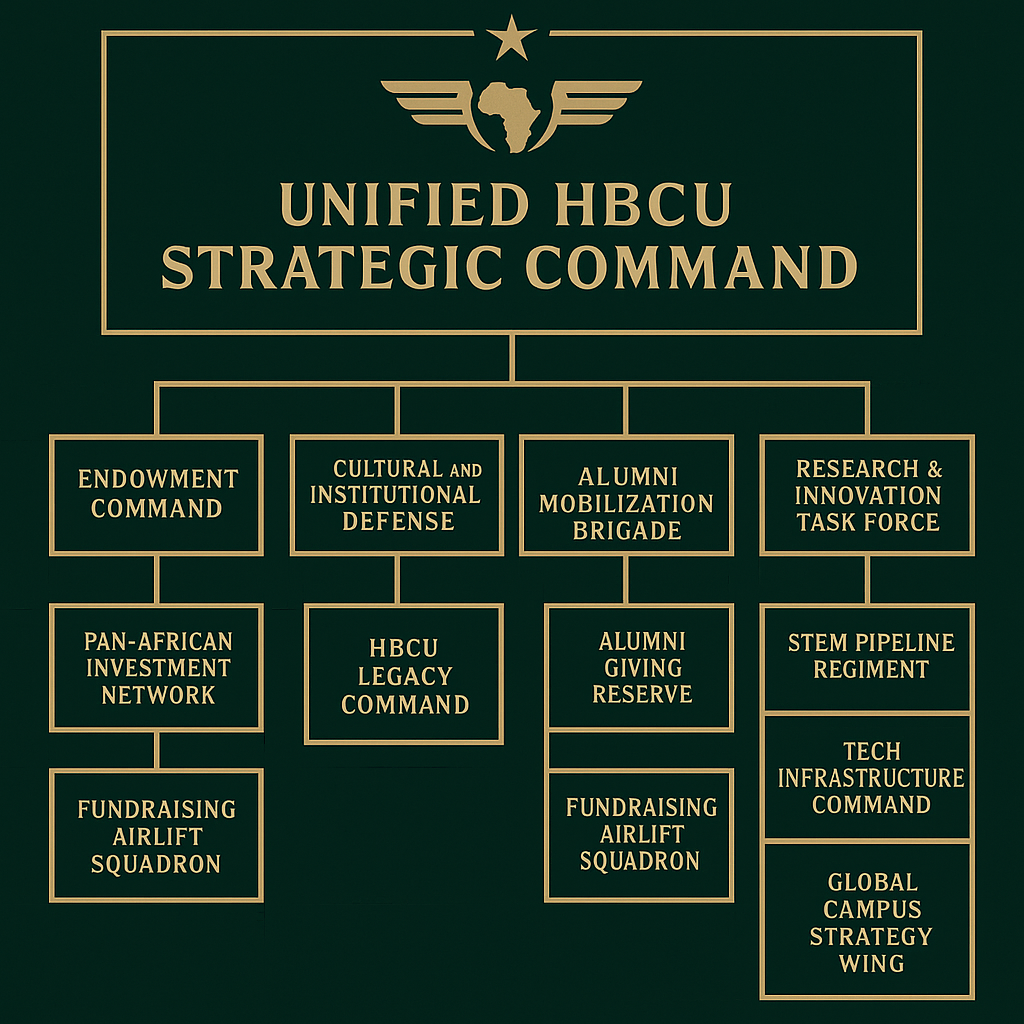
Can Military Strategy Save HBCUs? “The Estimate of the Situation” Approach

Strike an enemy once and for all. Let him cease to exist as a tribe or he will live to fly in your throat again. – Shaka Zulu, Advice to King Dingiswayo on the treatment of the defeated Ndwanwes

The Battle for the Black Mind

At the beginning of the 20th century, African American higher education was a mission of survival. By the end of the century, it had become a struggle for relevance. Today, the nation’s Historically Black Colleges and Universities (HBCUs) face a different kind of warfare—one not waged on battlefields but in boardrooms, budget hearings, and data dashboards. Declining endowments, limited research funding, a shrinking pool of Black male students, and encroachment by Predominantly White Institutions (PWIs) on their traditional demographic base has left many HBCUs strategically adrift.

But what if the remedy lies not in education reform think tanks or philanthropic patchwork, but in the unlikeliest of quarters—military strategy?

In the art of war, commanders engage in a disciplined process known as the “Estimate of the Situation.” Codified in U.S. military doctrine, this method assesses terrain, adversaries, capabilities, and courses of action before deciding how to marshal forces to achieve objectives. It is a doctrine of clarity, decisiveness, and ruthless prioritization—traits HBCUs, long forced into reactive postures, desperately need. If deployed correctly, it may offer a blueprint for survival and supremacy.

Terrain and Threat Assessment

The educational terrain for HBCUs is marked by systemic deprivation. While the Ivies and flagship publics boast endowments in the billions—Harvard’s at over $50 billion and the University of Texas System’s UTIMCO fund at $66 billion—only a handful of HBCUs cross the $100 million threshold. In 2024, Howard University led with a $908 million endowment, trailed by Spelman College ($569 million) and Hampton University ($379 million). By contrast, many HBCUs hover in the single-digit millions, dependent on volatile tuition revenue and susceptible to enrollment shocks.

Their adversaries are both external and internal. PWIs, emboldened by racial reckoning post-George Floyd, have launched aggressive DEI (Diversity, Equity, and Inclusion) marketing campaigns targeting high-achieving Black students, faculty, and even entire academic programs traditionally incubated within HBCUs. These institutions are mimicking HBCU cultural strengths while wielding superior infrastructure, funding, and media amplification.

Internally, decades of underfunding by state legislatures, inconsistent leadership pipelines, and fractured alumni giving have made coordination among HBCUs difficult. Public HBCUs often answer to politically hostile boards or governors who see their growth as optional, not imperative. In some Southern states, Black institutions are funded at levels far below their white counterparts, even while serving disproportionately more first-generation and low-income students.

The question then is: what does victory look like?

Mission Analysis: Existential or Expansionist?

In military parlance, the mission must be clear: is it to survive or to dominate? Too many HBCUs adopt a minimalist, survivalist mindset—hoping to keep doors open, retain accreditation, and attract enough enrollment to balance the books. But such passivity is tantamount to strategic surrender. If the mission is redefined as expansionist—growing endowments, poaching research talent, building technology hubs, or acquiring other institutions—then a different posture is required. One of preemption, consolidation, and power projection.

The underlying assumption should be this: the war for Black minds will intensify in the next decade as the U.S. becomes more diverse and the global competition for brainpower increases. If HBCUs do not act like insurgent militaries—nimbly, strategically, and with unified doctrine—they risk being romantic relics rather than revolutionary institutions.

Center of Gravity: The Black Intellectual Capital Base

In military strategy, the “center of gravity” is the source of an entity’s strength. For HBCUs, that center is their unparalleled social trust within the African American community and their historical mandate to serve as the custodians of Black intellectual capital.

Every great military power identifies its core asset. Rome had its legions. Britain its navy. The Soviet Union its armored divisions. For HBCUs, it is their alumni networks, faculty thought leadership, and cultural currency. But this center is fragile—threatened by underinvestment and neglect.

HBCUs should protect and project this strength. This means doubling down on producing future Black PhDs, engineers, doctors, and diplomats not as an accidental byproduct, but as a stated national security imperative for Black America. It also means developing internal think tanks and war colleges of their own—places where institutional planning, scenario modeling, and leadership development are continuous and sophisticated.

Logistics and Lines of Communication: The Endowment as Supply Chain

No army survives without logistics. In the higher education battlefield, the logistics trail is the endowment. It funds scholarships, shields against state austerity, allows for faculty recruitment, and finances long-term infrastructure. Currently, the Black educational front is malnourished.

A military-style “Operation Supply Line” could change this. Instead of chasing microgrants from corporations and philanthropies, a war doctrine would focus on concentrated, large-scale capital campaigns to create state-level or regional endowment federations.

Imagine, for example, if North Carolina’s five public HBCUs—North Carolina A&T, Fayetteville State, Elizabeth City State, Winston-Salem State, and North Carolina Central—pooled assets and donor bases into a centralized fund similar to UTIMCO. This would enable sophisticated portfolio strategies, risk mitigation, and scale advantages. Donors could give once, and see those funds managed professionally and distributed strategically.

The same could apply to private HBCUs, with alliances organized around geographic or academic complementarities. But like military alliances, these federations must be underpinned by mutual accountability and binding mission coherence.

Command Structure and Unity of Effort

Another hallmark of successful military strategy is clarity of command. At present, the HBCU landscape resembles a coalition of militias—each acting autonomously, sometimes duplicating efforts or even competing for the same resources. This is operationally inefficient.

There is precedent for unity. During World War II, Allied forces coordinated through joint command centers and mission directives despite national differences. HBCUs must do the same, perhaps through the reimagining of the Thurgood Marshall College Fund and UNCF as strategic command centers with teeth—not just fundraising conduits but institutions empowered to set joint priorities, coordinate lobbying efforts, and deploy institutional reinforcements to weaker allies.

This would mean acting less like separate colleges and more like battalions of a unified liberation force. Leadership exchanges, shared procurement, collaborative curriculum design, and a universal strategic plan should all be part of the doctrine.

War Games: Scenario Planning for a Disruptive Future

In military planning, exercises and simulations are key to testing preparedness. HBCUs need war games of their own—scenarios that model enrollment collapse, cyberattacks, political defunding, or rival university encroachments.

How would an HBCU survive if its primary state funding was cut 30% overnight? What if a prominent PWI began offering free tuition to Black students within its region? Could it recruit, retrain, and digitally educate at scale in response?

Scenario planning should not be theoretical. HBCUs could embed these exercises into board retreats, trustee meetings, and presidential onboarding. Just as generals must war-game an invasion, university leaders must anticipate disruption and know their mobilization plans.

Counteroffensive: Reclaiming the Intellectual Offensive

Finally, no military campaign is complete without a counteroffensive. HBCUs must stop playing defense. They should reclaim the offensive by launching campaigns that define what Black excellence is—not as an assimilationist ideal, but as an autonomous civilization-building agenda.

This could include opening campuses abroad in Africa and the Caribbean, creating a Black Fulbright equivalent to rotate scholars through HBCU-led global programs, or establishing “colonies of influence” in major American cities through cultural centers and satellite campuses.

The ultimate strategic goal is deterrence: to make it clear to the philanthropic sector, the corporate elite, and rival institutions that HBCUs are not simply cultural landmarks but geopolitical actors in the knowledge economy. Their preservation, therefore, is not charity—it is strategic alignment with the future.

Final Estimate: Can Military Strategy Save HBCUs?

The Estimate of the Situation is a cold, analytical process. It recognizes no nostalgia, entertains no sentimentality. It demands clarity, precision, and ruthless self-appraisal. For HBCUs, the time for reactive strategies and wistful memory is over. What is required is a war doctrine.

The adversaries are organized. The battlefield is asymmetric. And time is not on the side of the disorganized.

Yet, there is hope. Unlike in war, HBCUs do not need to annihilate their enemies. They need only to out-strategize them. With the right command structure, pooled resources, rigorous planning, and cultural clarity, they can turn the tide.

As Shaka Zulu warned: to spare a weakened enemy is to invite a future war. For HBCUs, the weakened enemy is irrelevance—and they must strike now to ensure it never flies at their throat again.