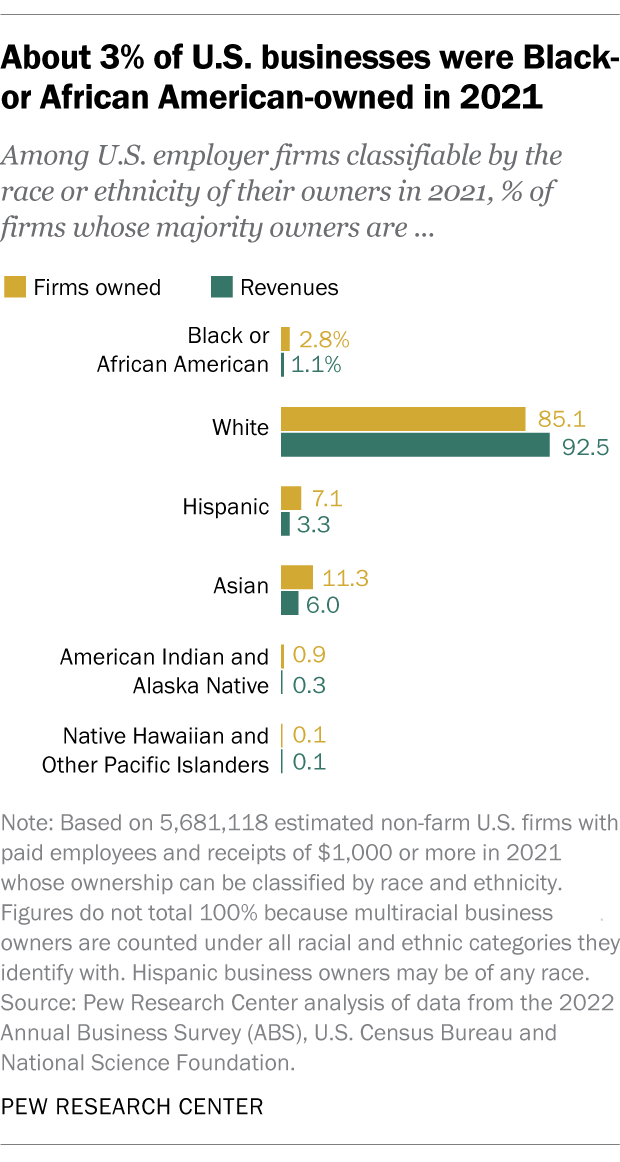
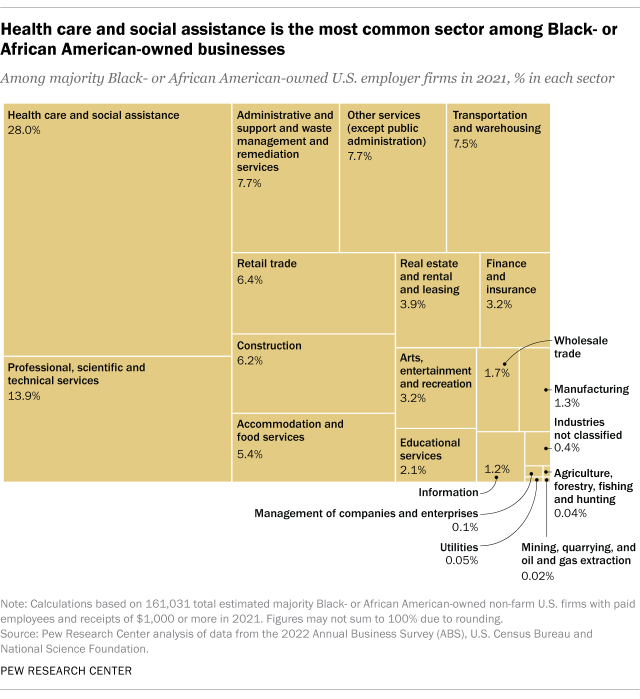
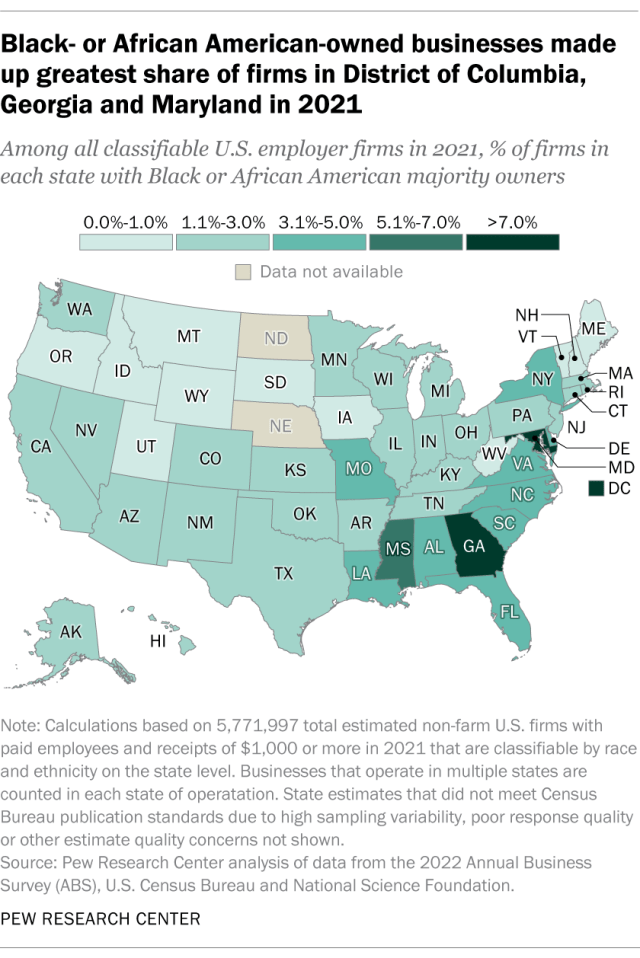
Pew Research Center highlights a look at the 161,031 U.S. firms with majority African American ownership as of 2021. Below are a few of the highlighted graphs that Pew Research showed in their report with HBCU Money commentary.
According to the SBA there were approximately 3.2 million African American-owned businesses as of 2018, but that is just the top layer. When you dig into the numbers by the Census of how many of those 3.2 million African American-owned businesses actually have paid employees and receipts exceeding $1,000 that number plummets to the previously mentioned 161,031 or only 5 percent of total African American-owned businesses.
African American businesses are highly concentrated in health care and social assistance. Businesses that often have low scale potential and high risk often times due their clients being predominantly African American and higher probability of being uninsured. Where are the African American-owned energy companies? Manufacturing companies? Multinational firms? These are the questions that need to be asked, considered, and discussed by HBCU business schools and African American organizations like the HBCU Chamber of Commerce.
It is no surprise that the highest concentration of African American-owned businesses are in locations with higher African American density populations and high concentrations of HBCUs. HBCUs and HBCU alumni unfortunately are not doing enough to create investment infrastructure to ensure the businesses are able to go into less explored and more profitable areas as the aforementioned graph highlighted.
For the full Pew Research Center report click here.
“Good morning, Revolution: You’re the very best friend I ever had. We gonna pal around together from now on.” – Langston Hughes
The year is 1938 in Harlem, New York and an entrepreneur and his son are about to make themselves and their six lieutenants’ families 86 years later the wealthiest African American families that nobody has ever heard of. Their fortune as a group is estimated to be worth a minimum $4.4 billion and upwards of $36 billion. How did it happen you ask? Some would say it was the result of a robbery 86 years ago and others would say it was restitution due.
IMDb’s summary of Harlem Nights goes as follows: “Sugar” Ray is the owner of an illegal casino, who contends with the pressures of vicious gangsters and corrupt policemen who want to see him go out of business. In the world of organized crime and police corruption in the 1930s, any dastardly trick is fair.” A bit more detail to the story (spoiler alert) is that as the European American mafia uses violence and police corruption to destroy “Sugar” Ray’s club, he then gets revenge by robbing the betting houses of the mafia and blowing up their most profitable club in the process. “Sugar” Ray promises each of his six most trusted employees turned lieutenants $50,000 a piece (equal to $1.1 million in 2024 dollars) for their participation in the caper. The group initially believes that there will be approximately $750,000 (equal to $16 million in 2024 dollars) in those betting houses, but through a bit of misdirection on the group’s part they get the mafia boss himself to unexpectedly add another $500,000 (equal to $10.7 million in 2024 dollars) of his own money into the stash for a total of $1.25 million (equal to $26.7 million in 2024 dollars). Beyond the group, there are two additional participants who play a vital but small role in the caper and are handsomely rewarded for it. It is not clear on how much, but just to keep the numbers clean let us assume they gave each a lesser amount and yet still quite significant of $25,000 a piece (equal to $532,500 in 2024 dollars). Enough to ensure their full silence forever on the matter certainly. With the robbery/restitution complete, exactly how does that turn their family lineages into billionaires 86 years later?
The Club Sugar Ray 8 consist of “Sugar Ray” Brown (Richard Pryor), Vernest “Quick” Brown (Eddie Murphy), Bennie Wilson (Redd Foxx), Vera Walker (Della Reese), Willie (Ray Murphy), Jerome (Robin Harris), and Jimmy (Charlie Murphy) who have $1.2 million left among them. As promised by “Sugar Ray” and “Quick” each of the six receive $50,000 a piece and the remaining $900,000 (equal to $19.1 million in 2024 dollars) is retained by father and son. The group decides to form the Sugar Hill Trust, an ode to the African American neighborhood in Harlem that was the heartbeat of the Harlem Renaissance during the 1920s, and deposits half of each of their proceeds into it which amounts to $600,000 (equal to $12.8 million in 2024 dollars) to be invested into the 15 year old S&P 500 which ended February 1939 trading at 281.79 (as of March 9, 2024 it was trading at 5,123.69). They agree that Sugar Hill Trust will invest in this and reinvest all dividends. By doing so, by February 2024, that initial $600,000 is now valued at $4.4 billion (see above) and producing annual dividends for the Sugar Hill Trust of $58.5 million. The next phase of their wealth follows the advice of Sugar Ray from dinner one evening when he says, “Yeah, you know that’s where its at – the gambling. If we make that move we should concentrate on that. Give up the joy houses, after hours spots, concentrate on gambling.”
This leads to the creation and founding of the Harlem Nights Corporation (ala Las Vegas Sands). According to Forbes, “Las Vegas Sands Corp. engages in the development of destination properties. Its properties feature accommodations, gaming, entertainment and retail, convention and exhibition facilities, celebrity chef restaurants, and other amenities. It operates through the following geographic segments: Macao, Singapore, and United States. The Macao segment handles the operations of The Venetian Macao; Sands Cotai Central; The Parisian Macao; The Plaza Macao and Four Seasons Hotel Macao; and Sands Macao. The Singapore segment includes the Marina Bay Sands. The United States segment consists of Las Vegas Operating Properties and Sands Bethlehem.” As of March 9, 2024 market close, Las Vegas Sands had a market capitalization of approximately $39 billion. The Adelson family, which founded the company, currently controls and owns 57 percent of the firm and has a net worth of approximately $32 billion controlled by its matriarch, Miriam Adelson. Instead of the company being named Las Vegas Sands and controlled by the Adelson Family, it is instead aptly named Harlem Nights Corporation and controlled by the lineages of the Sugar Hill Trust bringing its value to $36.4 billion when you include the $4.4 billion of S&P 500 holdings. In addition, Harlem Nights Corporation annual dividend pays Sugar Hill Trust $342.6 million which combined with their S&P 500 dividend gives the families an annual income of $401.1 million among them. The complexities by which the family may access that income is far too complex to get into in this article, but it is worth reading up on the strategy called ‘Buy, Borrow, Die’ if the reader should be so inclined.
In the years following, Bennie marries Vera and they become the patriarch and matriarch of the eight, “Sugar” Ray marries Annie, and “Quick” marries Sunshine who have children and begin the foundation of the legacy that transforms African American institutions near and far. They are a quiet force that is felt, but rarely heard. “Sugar” Ray and A.G. Gaston are friends and their friendship and business dealings together help A.G. Gaston’s bank, Citizens Federal Savings Bank, transform over time into one of the nation’s largest banks, which leads to African American homeownership skyrocketing after World War II despite African American soldiers being largely left out of the G.I. Bill. There is massive entrepreneurship expansion, African American towns like Rosewood and Tulsa are able to rebuild after long hard fought roads from their attempted massacres, HBCUs having endowments that are among the largest in the country, and ultimately a stability in African America that seems almost unimaginable to many of us today. It simply takes a few to be committed feverishly to the building of the institutions and the empowerment of a people. To imagine such a world would be as “Sugar” Ray Brown’s last words before leaving New York, “sweet as sugar.”
Bonus History: In one of Harlem Nights’ last scenes where “Sugar” Ray and “Quick” enter an abandoned bank building there is a sign above that says Dunbar National Bank as they enter. Sergeant Phil Cantone, a crooked cop who works for Bugsy Calhoun, ask “Sugar” Ray and “Quick” why they were breaking into a bank that has been closed for five years. According to Harlem World Magazine, “The Dunbar National Bank was the first bank in Harlem to be managed and staffed by African-Americans. The Dunbar National Bank was funded byJohn Davison Rockefeller Jr., specifically for the population of Harlem. The president of the Bank was Joseph D. Higgins, 36 years a banker, onetime Federal Reservist, former vice president of the American Exchange-Irving Trust Company.”
Analysis: European Americans saw no change in their unemployment rate from March for the third straight month. Asian and Latino Americans saw an decrease of 90 basis points and 50 basis points, respectively. African Americans had an increase in their unemployment rate of 80 basis points for March.
AFRICAN AMERICAN UNEMPLOYMENT RATE BY GENDER & AGE
AFRICAN AMERICAN MEN: 6.2%
AFRICAN AMERICAN WOMEN: 5.6%
AFRICAN AMERICAN TEENAGERS: 20.1%
AFRICAN AMERICAN PARTICIPATION BY GENDER & AGE
AFRICAN AMERICAN MEN: 69.6%
AFRICAN AMERICAN WOMEN: 63.0%
AFRICAN AMERICAN TEENAGERS: 32.8%
Analysis: African American Men saw an increase in their unemployment rate by 10 basis points and African American Women increased by 120 basis points. African American Men and Women decreased their participation rate in March by 20 basis points and 40 basis points, respectively. African American Teenagers unemployment rate jumps by 470 basis points and 850 basis points over the past two months as their volatility continues. African American Teenagers also had their participation rate increase by 210 basis points up to their highest participation rate over the past five months.
African American Men-Women Job Gap: African American Women currently have 710,000 more jobs than African American Men in March. This is an decrease from 859,000 in February.
CONCLUSION: The overall economy added 303,000 jobs in February while African America lost 204,000 jobs. From CNBC, “This is another really strong report,” said Lauren Goodwin, economist and chief market strategist at New York Life Investments. “This report and the February report showed some broadening in terms of job creation, which is a very good sign.”



 HBCU Money