“Wealth is created in ownership. If you don’t own, you’re always at someone else’s mercy.” – Robert F. Smith
June 2025’s record-shattering $10 billion sale of the Los Angeles Lakers to Guggenheim Partners chief Mark Walter confirmed what many already suspected: franchise values are rocketing into the financial stratosphere. Yet the deal also spotlighted a harsher truth. After nearly a half-century of hard-court brilliance and gridiron dominance, African Americans are still largely locked out of true ownership power. This article examines why—tracing the structural barriers that keep Black wealth on the playing field instead of in the owner’s suite, and outlining the institutional reforms needed to change the score.
From the Field to the Boardroom: Still a One-Way Street
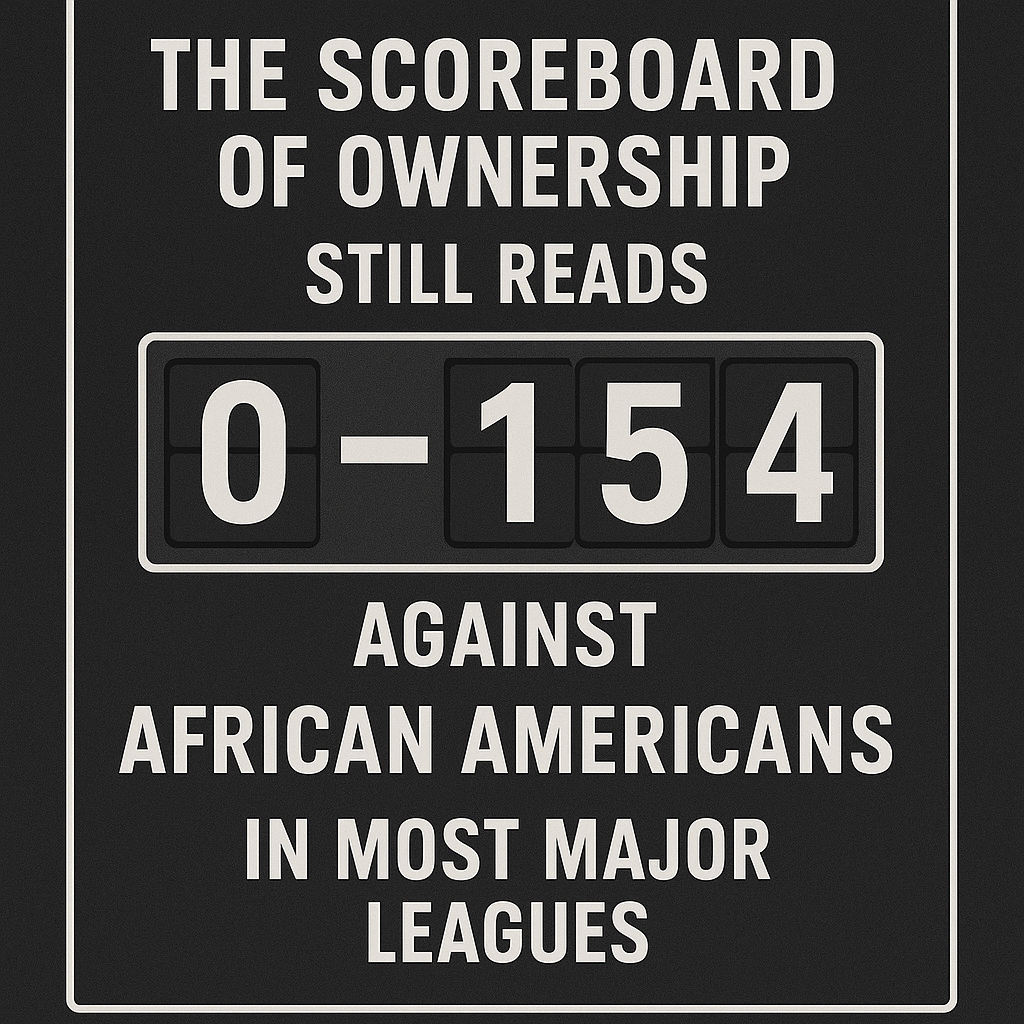
African Americans make up roughly 70–75 percent of NBA players and about 60–65 percent of NFL rosters. In the WNBA, the share is even higher. Yet across 154 combined franchises in the NBA, NFL, MLB, and NHL:
Zero teams are majority-owned by African Americans in the NFL, MLB, or NHL.
Only one historic example (Robert L. Johnson’s Charlotte Bobcats/Hornets) and one recent example (Michael Jordan, 2010–2023) exist in the NBA.
Three forces keep that door shut:
Intergenerational-Wealth Deficit – Most Black athletes are first-generation millionaires, while many current owners are third- or fourth-generation billionaires.
Limited Collective Capital Vehicles – Black-controlled banks and investment firms are few and undercapitalized relative to mainstream counterparts.
Opaque League Gatekeeping – Franchise valuations above $4 billion and insider-driven vetting processes deter new entrants without deep networks.
The Robert L. Johnson Breakthrough—And the Mirage of Progress
On December 18, 2002, BET founder Robert L. Johnson secured the NBA’s Charlotte expansion franchise for $300 million, becoming the first African American majority owner of a modern U.S. pro team. The milestone was historic, but it proved fragile. Lacking a pipeline of Black institutional capital—no HBCU endowment co-investors, no African American businesses or firms operating as minority owners—Johnson operated alone. By 2010 he sold controlling interest to Michael Jordan, whose own 2023 exit returned the league to its status quo: African American talent on the court, minimal African American equity off it. Symbolic breakthroughs absent institutional follow-through do not create sustainable inclusion.
The LeBron Conundrum: Cultural Power Without Governance Leverage
Billion-dollar athlete-entrepreneur LeBron James epitomizes the new Black business titan—owning film studios, apparel lines, and minority stakes in Fenway Sports Group. Yet even LeBron, arguably the most financially astute athlete of his generation, cannot write a solo check for a majority share of an NBA or NFL team. Average franchise prices now exceed $4 billion in the NBA and $6.5 billion in the NFL.
LeBron’s estimated net worth, while staggering at $1.2 billion, pales in comparison to the financial firepower wielded by new Lakers controlling owner Mark Walter, who is worth an estimated $5.5 to $6 billion personally—and controls access to far greater institutional capital. As CEO of Guggenheim Partners, Walter leads a global financial firm with over $345 billion in assets under management (AUM), according to the firm’s own reporting.
That institutional reach gives Walter an unparalleled advantage: the ability to deploy capital at scale, with leverage, and over long time horizons. His 2012 acquisition of the Los Angeles Dodgers for $2 billion was just the beginning. Now, his control over the Lakers reflects how ownership is secured not by personal wealth alone—but by deep institutional infrastructure.
The gap is not merely one of celebrity or business acumen—it is one of capital architecture. LeBron’s wealth is largely rooted in earned income and venture-backed enterprises, while Walter’s access to Guggenheim’s multi-hundred-billion-dollar asset base enables him to execute major acquisitions swiftly and without co-investors.
Until African Americans gain collective control of similar institutional investment vehicles—through private equity firms, pension-managed funds, or bank-led syndicates—Black excellence in sports will continue to be celebrated on the court, but denied authority in the boardroom.
Building a Syndicate That Can Actually Write a Check
If African Americans are to move from the highlight reel to the cap table, the capital stack must shift from aspirational community pooling to institutional syndication—driven by organizations already designed to deploy large checks and assume complex risk. Pragmatism, not idealism, is the order of the day.
Capital Source
Asset Base
Realistic Deployment Rationale
Black-Owned Banks (18 nationwide)
$6.4 billion in assets
FDIC-insured balance sheets, access to low-cost deposits—including the growing wave of Fortune 500 “diversity deposits”—can underwrite debt facilities or pledge Tier 1 capital to a buyout fund.
Black Investment & Private-Equity Firms (e.g., Ariel, Vista, Fairview, RLJ)
$70–90 billion AUM (collectively)
Deep GP/LP relationships with public pensions and foundations; experienced at assembling $100–$500 million special-purpose vehicles (SPVs) around a single asset.
HBCU Endowments (102 institutions)
≈ $5 billion total
Ask for 0.5–1 percent commitments per school—$25–50 million system-wide—providing research access, internships, and brand equity rather than acting as anchors.
Athlete Sidecar Fund
Variable
Structure a managed feeder that lets players co-invest passively (no tithes or self-directing). Capital is professionally deployed—removing behavioral risk.
Corporate & Public Pensions
Trillions
Many plans reserve 5–10 percent for “emerging managers.” A Black-led sports-ownership PE fund fits this mandate.
1. Banks as Capital Bridges Black-owned banks can’t buy teams outright, but they can warehouse capital and extend critical financial infrastructure. By leveraging corporate “diversity deposits” and issuing credit facilities, they can become crucial intermediaries that keep transaction fees and governance influence in Black hands.
2. Investment Firms as Syndicate Architects Black-led PE firms already understand the terrain. By structuring a flagship $400–$600 million sports-focused fund, they can attract institutional LPs and scale their acquisitions from minority WNBA stakes to majority control in emerging or undervalued leagues.
3. HBCUs as Modest Strategic LPs HBCUs should not be burdened with anchoring such funds. Instead, they can contribute symbolic capital, student talent pipelines, and academic value. For example, a 1 percent commitment from Howard or Spelman tied to naming rights or internship guarantees would align mission with opportunity.
4. Athletes & African American Families as Co-Investors, Not Donors A feeder fund with low buy-ins and lock-up periods allows them to invest with institutional support. This protects them from high-risk self-management and ensures alignment with professional fund managers.
5. Execution Timeline
2026–2028: Assemble GP team, secure $150 million from banks and PE partners, with layered support from HBCUs and athlete and African American businesses co-investors.
2028–2032: Close a $500 million Fund I and acquire equity in two WNBA teams and a controlling NWSL stake bundled with real estate.
2032–2037: Launch Fund II at $1 billion, targeting a controlling interest in an MLS or NBA franchise.
2040: Own a major-league asset with governance representation from African American banks, investment firms, and HBCU partners—creating long-term cash flows and intergenerational wealth held by Black institutions.
Media Rights and the Power Gap
Owning teams is only half the battle. The NBA’s next domestic media deal could top $75 billion, and yet no Black-owned network will participate directly in those revenues. Streaming platforms, RSNs, data-analytics firms, and betting partnerships—all profit off Black athletic performance. Until African American institutions enter the media-rights supply chain, the revenue fountainhead remains out of reach.
Cultural Iconography, Financial Dispossession
Hip-hop tracks blare in arenas, sneaker culture drives merchandise sales, and social-media highlights fuel league engagement—but licensing profits flow to predominantly white ownership groups. Careers end; ownership dynasties do not. The average NFL tenure is 3.3 years; Robert Kraft has owned the Patriots for 31 years. Equity compounds; salaries evaporate.
From the Boardroom, Not the Ball Court: Where Owners Really Make Their Money
A glaring misconception is that sports fortunes begin with sports talent. In practice, franchise control stems from non-sports industries:
Owner
Team(s)
Primary Wealth Source
Steve Ballmer
LA Clippers
Microsoft stock
Stan Kroenke
Rams, Nuggets, Arsenal
Real estate / Walmart marital fortune
Robert Kraft
Patriots
Paper & packaging
Mark Cuban
Mavericks
Broadcast.com tech exit
Joe Tsai
Nets, Liberty
Alibaba IPO
Josh Harris
Commanders, 76ers
Apollo Global Mgmt. (private equity)
None earned money playing pro sports; all deployed patient, appreciating, often tax-advantaged capital to buy franchises. In contrast, athlete income is earned, highly taxed, and front-loaded. A $200 million NBA contract, after taxes, agents, and lifestyle inflation, seldom equals the liquidity needed for a $6 billion NFL acquisition.
African Americans dominate labor yet rely on labor income to pursue ownership—an uphill climb when the ownership class uses diversified portfolios, inheritance, and leverage. The gap is not just financial; it’s structural.
A Blueprint Forward
African American banks, PE firms, and institutional investors must build syndicates that mirror the strategies of the existing ownership class—while rooting the returns inside Black institutions.
2026–2030 – Launch a $500 million Fund I with contributions from banks, investment firms, HBCUs, and athletes.
2030–2035 – Acquire multiple minority and controlling stakes in undervalued leagues.
2035–2045 – Expand into media-rights, merchandising, and facilities ownership.
2045–2050 – Control a major-league asset and use it to empower future generations via scholarships, pensions, research grants, and equity reinvestment.
Owning the Game—or Owning What Funds the Game?
The persistent call for African American ownership in major league sports raises a deeper question: Should African Americans even prioritize owning sports franchises, when we remain almost entirely absent from the very industries—technology, finance, energy, real estate—that generate the wealth used to buy these teams in the first place?
Mark Walter didn’t become the Lakers’ majority owner through basketball. He did it through Guggenheim Partners—a financial firm managing $345 billion in assets. Steve Ballmer bought the Clippers not from years of courtside ambition, but from cashing out Microsoft stock. Owners dominate sports not because of athletic brilliance, but because they own pipelines, patents, trading desks, and land—the assets that make sports ownership a byproduct, not a goal.
For African Americans, the concern isn’t just that they don’t own the team. It’s that they don’t own the banks that financed the team, the media companies that broadcast the games, or the tech platforms monetizing fan engagement. It is a misallocation of focus to aim for the outcome—sports ownership—without first entering the industries that produce ownership-level capital.
There’s no harm in wanting a seat in the owner’s box. But the more strategic question is: why not aim to own the entire ecosystem? The scoreboard. The stadium real estate. The ticketing software. The AI that tracks player stats. The advertising networks.
Athletes made sports cool. Billionaires made sports profitable. African America must ask whether it wants symbolic entry into an elite club—or whether it wants to control the industries that fund the club.
The real power isn’t just in the arena. It’s in what surrounds it. And until African Americans own those arenas—of finance, data, infrastructure, and media—they will always be positioned to play the game, but not define it.
Final Whistle
The scoreboard of ownership still reads 0-154 against African Americans in most major leagues. Talent fills highlight reels; equity fills trust funds. The route to flipping that score will not be paved by bigger contracts or more MVP trophies. It will be built through African American banks mobilizing capital, investment firms leading syndicates, and HBCU institutions gaining board seats—not just honorary jerseys.
Athletes have inspired generations. Now, institutions must finance generations.
The next dynasty to celebrate should not just hoist a trophy—it should hold a deed.
“Every day is a new opportunity. You can build on yesterday’s success or put its failures behind and start over again. That’s the way life is, with a new game every day, and that’s the way baseball is.” – Bob Feller
It sometimes feels like there is no more irrational sector of HBCUs than athletics when it comes to HBCU alumni bases and administrations. We want to buy the Empire State Building, but barely have money for a night at Motel 6. If you have watched ESPN’s 30 for 30: The Pony Express and The U, then you probably do not need to go further in this article. For those who have not watched either, please do so immediately and continue to read. If cheap shots on the field bother you, then you are not at all ready for the brutality of what happens outside the lines and behind closed doors. College athletics is a contact sport, a dirty business, not for the faint of heart, and the cost associated with it remind us just how huge the institutional wealth gap is between HBCUs and our counterparts.
In 2014, HBCU Money produced an article that showed the SWAC/MEAC conferences were losing a combined $130 million in their member athletic programs. Two years later, that number had skyrocketed to $147 million. The members of the two conferences had combined expenses of approximately $194.1 million while revenues without subsidies were a meager $47 million. Of course most alumni have no idea that the subsidies that we speak of are primarily student fees. These subsidies accounted for a staggering $142.5 million or 75 percent of the athletic revenues that the SWAC/MEAC generated if you can call it such a thing. Subsidies or allocated as defined by the NCAA and others consider student fees, direct and indirect institutional support and state money “allocated,” or everything not generated by the department’s athletics functions. It is not clear however by the NCAA definition if booster giving is considered a subsidy or athletic functions. However at 75 percent of revenues what is clear is that it is not ticket sales, sponsorships, merchandise sales, media deals, etc., but primarily student fees driving HBCU athletic revenue.
For the majority of our students, that means additional cost onto their cost of attendance which is largely financed through – you guessed it – student loans. Essentially what rabid HBCU alumni and administrations have done is asked students to take out a loan for sports. A predatory payday loan at that. The irony is that even with the subsidies the two conferences still were losing money, approximately $5 million, meaning HBCU boosters were not even giving enough to breakeven. Many HBCU alumni hold dear to the belief that if you build it they will come (eventually), they being the abundance of riches that African American athletes pour into our white counterparts and if they return to HBCUs the power will tilt and so will the finances of sports back into our favor making our programs profitable and financially abundant. Never mind the harsh reality those mega television contracts we read about to the Power 5 have little to do with the athletes on the field and more about the fans in the seats and audience nationwide. Outside of the Bayou Classic, there is not one HBCU football or basketball game that could bring over 70,000 (Superdome’s capacity) to it and millions of viewers on television. The latter mainly due to it being a Thanksgiving weekend game and the game itself almost became something of a staple to watch in many African American households. Fan bases care about having the best players because they care about beating their rivals. Coaches care about having the best players because they want to keep their job. The fact that they are African Americans is a byproduct of a game played almost 50 years ago when USC beat Alabama with a young African American kid named Sam “Bam” Cunningham who “Bear” Bryant’s all-white team had no answer for so in true fashion they went out and got a few of their own. And the rest as they say is history, but the past echoing into the present is very real and the present’s echo into the future is also very real.
The question is as educated and critically thinking capable alumni, why are we not able to examine this subject in a rational and objective manner? Why are we not able to devise an actual plan that does not involve breaking the backs of our students? African Americans are already the poorest group by median income ($40,258 vs. $61,372 for all races) and median wealth ($11,030 vs. $134,230 for European Americans) in America and we want to make it that much harder for our graduates to become financially stable and wealthy in exchange for sports? Primarily, this accusation is lobbed at football and men’s basketball and the black financial holes that they are to the majority of the nation’s colleges. By far, they are the two costliest sports on any college campus, black or white.
Schools like the SWAC’s Prairie View A&M built a $60 million stadium and new athletic complex (uncertainty as to whether the school’s current renovation of their basketball arena is included or not) and Jackson State University at one point even had the gall to suggest a $200 million domed stadium complex. Yet, without subsidies Prairie View’s program lost $13.1 million in 2016-2017 and Jackson State lost $5.4 million. Meanwhile, Spelman College scrapped its athletic program six years ago. The former president, Dr. Beverly Tatum, “When considering our options, I learned that we only had 80 student-athletes and the cost of our program was approaching $1 million per year.” This against a reality of serving a college of African American women and as an ESPN article noted, “49 percent of African-American women over the age of 20 had heart diseases, and were twice as likely to develop Type 2 diabetes as non-Hispanic white women. The health issues that black women faced, including those at Spelman, were very much linked to diet and a lack of physical activity.” Spelman and its leadership wanted alumni to be healthy now and for the future. Health builds wealth is not just a saying but a real reality. Less days missed at work means more income earned, more money saved and invested, more wealth created, and more opportunity to give back to your alma mater. This is not even getting into the costs that many African Americans suffer from later in life because of poor lifestyle and diet which becomes so costly that there is little left at the end of life to even leave behind to their HBCU. Is Spelman sacrificing their athletic program today so that they can have wealthier alumni tomorrow who would be able to bring back the program and truly have it be sustainable? How much of a donation would it take to endow the $1 million annually to bring back their athletic program? Approximately $15-25 million.
Are we suggesting that all HBCUs follow Spleman’s lead? No, certainly not. There can be a happy medium, but first HBCU alumni need to truly understand the cost associated with major college sports, primarily football and men’s basketball. The harsh reality is that these are the only two sports at the college level that currently generate any significant revenue for colleges and unfortunately the cost to recruit in these two sports starts far before an athlete even gets to college. Recruiting for prized college basketball players for many college coaches starts in AAU middle school. Coaches from the basketball Power 5 conferences are constantly traveling year round and scouting talent that will not be college ready for four to five years in many instances. To say it is costly to follow an 8th grader around is an understatement, but if you do not do it, then you have almost no chance at seriously recruiting them (or their family) later on. HBCU alumni are not sponsoring or even mildly impacting the AAU financial machine, which can cost a family upwards of $5,000 for summer play and often times those costs are absorbed by a benefactor who maybe more akin to the Godfather and wants you to remember the favor he did for you later. Google AAU bribes and Google almost has a heart attack returning the amount of searches on the subject. When it comes to football, the situation has become just as complicated with the advent of the 7 on 7 leagues that have popped up all over the country. The cost spent on developing and “steering” young black boys as athletes begins early and costs tens of of millions annually – and we have not even gotten to the programs themselves yet. There is an enormous amount of dark money that is spent by athletic companies like Nike, Reebok, Adidas, etc. to ensure that the pup stars in both sports go to schools where they can maximize the exposure of the next superstar wearing their apparel. Of course, high school and AAU coaches receive perks for being the “voice of reason” to help influence many young men and advise their families on where would be best for them. Again, HBCU alumni and boosters barely have money to give to their own athletic programs, let alone “lobbying” to high school coaches with no guarantee of payoffs, but mandatory if you want to even be in the conversation. Then there are the facilities.
While Prairie View A&M spent $60 million on a stadium and athletic complex a few years ago, the University of Oregon was spending $68 million on a football performance center. Yes, Oregon built a building dedicated entirely to their football program and the state of Oregon changed the laws to accommodate the building that ran afoul of building codes because of the influence of Phil Knight, the founder and largest shareholder of Nike and the University of Oregon’s biggest booster. According to Oregon Live it includes, “offices, team video theaters, offensive and defensive strategy rooms, a coaching conference suite, a video editing center, a dining hall and a weight room.” Again, just for football. The Darth Vader to Prairie View A&M University’s Luke Skywalker for good measure, Texas A&M University, spent $450 million on a stadium renovation or eight times what the entirety of Prairie View’s athletic complex cost for a renovation to its stadium and now seats over 102,000 people. It has taken some HBCUs over 30 years to raise the money for even moderate renovations to their HBCU athletic facilities. Many are still waiting and some tired of waiting, increased student fees to redirect toward athletics. Colleges have to have the latest and greatest to attract the best athletes who are being treated as deities before even stepping foot on a college campus. College athletics has become an arms race of new facilities, high-paid coaches, under the table bags of money to recruits and so much more that spiral the cost beyond many of our wildest dreams. The rabbit hole is deep.
A few names and numbers:
Al Dunlap – $15 million. Paul Bryant, Jr. – $20 million. Phil Knight – $300 million. Christy Gaylord Everest – $18 million. Drayton McLane – $200 million. Herb Kohl – $25 million. Jack Vanier – $20 million. These are just six boosters that Mother Jones reported were major college boosters in an article in 2014. The six donations account for almost $600 million, an amount that is four times the size of the losses the SWAC/MEAC losses account for just a few years prior. Need even more perspective on how big these donations are? Aside from Prairie View A&M’s $17.9 million in expenses, those donations could cover the expenses of any SWAC or MEAC school in their singular. Phil Knight’s giving to the University of Oregon (since 2014 he has given another $200 million to Oregon) or Drayton McLane’s giving to Baylor University could cover the cost of every school in the SWAC and MEAC ($194.1 million) with money left over in the bank – by themselves. In comparison, HBCU Gameday recently reported that Winston-Salem State University was in the midst of a $250,000 athletic capital campaign with major donors coming from ESPN and WSSU alumnus, Stephen A. Smith, with a gift of $50,000 and Chris Paul, an NBA player whose 2018 salary was $25 million, giving a gift of $25,000. Large donations in HBCU athletic circles indeed, but making HBCUs competitive in recruitment among blue chips – not so much.
Unfortunately, there is no real repository of data on booster giving among colleges. Most of the information on the aforementioned boosters is from press clippings where donations to Power 5 conferences make headlines. In fact, a lot of giving becomes very opaque if we factor in boosters who provide jobs to athletes’ family members (remember Reggie Bush?) and the like. For the HBCU 5 conferences, there are not even press clippings, although if HBCU athletic and development departments wanted to disclose how much in donations were directed toward athletic programs from alumni it would be acutely helpful or create a database that sites like HBCU Money could use to give a fair analysis of the giving that is happening in HBCU athletic programs it would be greatly appreciated. However, again when 75 percent of the revenues come from student fees, it is not hard to know those numbers would be embarrassing and minuscule at best. And that brings us back to our problem of HBCU alumni who seem to be delusional about the true cost for building the type of athletic programs that can be self-sustaining and not breaking the back of students who in the future will not be able to give like they could and creating a vicious cycle of under giving to the institutions as a whole – all for the sake of sports.
The HBCU 5 athletic programs based on the SWAC and MEAC’s numbers, being Division 1 programs makes them inherently more expensive, brings all five conferences (SWAC, MEAC, CIAA, SIAC, & GCAC) total expenses to around an estimated $300 million annually. There are only two HBCUs with endowments above $300 million and we are possibly still a decade away from Howard University becoming the first HBCU to a $1 billion endowment. There are over 100 HWCUs with endowments over $1 billion. Around 90 percent of HBCUs do not even have endowments of $50 million. A startling statistic when you have schools trying to run athletic programs that cost $10 million plus annually. If HBCU alumni who truly cared about sports wanted to endow HBCU athletic programs with enough to generate the $300 million annually they would need to raise between $4 to $6 billion and hope they can find returns of almost 10 percent annually in an economic environment that is giving out low to mid single digit returns far more commonly. At 5 percent annual return, it would take $6 billion for HBCUs to get HBCU athletic programs off the backs and out of the pockets of its students and help reduce student debt loads. Almost 9 out of 10 HBCU graduates will finish with debt, 32 percent higher than the national average and a median debt load that is 40 percent higher than their counterparts at Top 50 endowed HWCUs. Is it worth it is a question any HBCU alumni and athletic boosters must ask themselves who cares about our institutions and the students who matriculate through them.
Wayne Gretzky is famously quoted as saying he was great because he skated where the puck was going not where it has been. HBCU alumni are bent on doing the exact opposite when it comes to athletics. Even if HBCU alumni could raise the $6 billion, it would be a fools’ decision to spend it on sports, mainly again football and men’s basketball. So why is an HBCU like Florida Memorial University selling $100 t-shirts to bring back its football program? Is it pressure from alumni? Is it an administration that wants it to be part of their legacy? The long-term implications of fielding a football program when Florida Memorial was moving towards a future of profitable athletic sports is baffling to say the least.
Little League sports statistics show that soccer is the future in this country, baseball is seeing a resurgence, and women’s sports is just scratching the surface of its potential globally. David Beckham, an international soccer megastar in his day and now the owner of the Miami MLS franchise, spent time at Florida Memorial just five years ago. Beckham’s is a relationship that should be leaned into and nurtured to put it mildly. Meanwhile, the pipeline for football is dwindling rapidly due to society’s fears over health concerns and yet, less than twenty HBCUs have soccer teams. HBCUs have all but abandoned baseball despite its resurgence in America and globally. Again, where the puck is and where is it going. This is to say nothing of the infancy that Esports is in, an industry that is estimated to breach a value of $1 billion in the next year according to the World Economic Forum coupled with prize money as high as $1 million for gamers in some tournaments and what feels like an exponential growth in sponsorships and endorsements. Esports is picking up so much steam it is being introduced in high school athletic programs and even some colleges are starting to offer Esports scholarships. There is not one of us who is over the age of 35 and under the age of 50 that does not remember a Madden tournament in the dorms of our HBCUs. We were early as we usually are, but completely missing the opportunity to leverage and be ahead of the curve.
HBCU alumni and athletic boosters need to have tougher conversations with themselves and with administrations. Read your HBCU’s financial reports for starters. A lot of this is poor financial literacy in that we do not know the cost of running our institutions, growing endowments, and sustaining an athletic program. We simply can not afford to buy high and sell low with HBCU athletics anymore. There is a happy medium and we need to have a honest conversation about it. Alumni and boosters need to understand the true cost of running our programs (something administrations need to be more transparent about) and not continue with the pie in the sky hope that African American high school athletes are just going to miraculously pick us. Zion Williamson, who had two parents attend Livingstone College still chose Duke University. There is a moat around football and men’s basketball and we need to accept that, but those two sports will not be the fountain of prosperity forever. Malcolm X said the future belongs to those who prepare for it today and it is time for us to start preparing like we need to cram for a final exam in the morning and our graduation depends on it.

 HBCU Money