Tag Archives: Historically Black Colleges and Universities

Have HBCUs Given Up On Recruiting African American Students?

“Change will not come if we wait for some other person or some other time. We are the ones we’ve been waiting for. We are the change that we seek.” – Barack Obama
It almost seems like an absurd question to ask, but…

in 2025, the idea that Historically Black Colleges and Universities (HBCUs) are no longer focused on recruiting African American students is not as far-fetched as it sounds. It’s a question whispered in alumni boardrooms, discussed in quiet conversations among concerned parents, and pondered in the minds of young Black students as they decide where to apply. While HBCUs remain vital institutions for the Black community, the numbers and decisions behind closed doors suggest that a shift is underway—one that demands scrutiny, reflection, and action.

In the decades since desegregation opened the doors of Predominantly White Institutions (PWIs) to Black students, the role and mission of HBCUs have been evolving. According to data from the Pew Research Center, Black student enrollment at HBCUs increased by just 15% from 1976 to 2022. Meanwhile, enrollment of students from other racial and ethnic groups rose by a staggering 117% during the same period. In 1976, Black students made up 85% of HBCU enrollment. By 2022, that number had dropped to 76%. That means nearly one in four HBCU students today is not Black. At at least five HBCUs, such as Bluefield State University, Lincoln University (MO), and West Virginia State University, White students now comprise the majority. While some view this as a testament to progress and inclusion, others see it as a troubling signal that the core mission of HBCUs, educating and empowering African American students, their families, and ultimately the social, economic, and political interest of African America, may be slipping.

Nowhere is this shift more alarming than in the enrollment of Black male students. In 1976, Black men made up 38% of students at HBCUs. By 2022, that number had fallen to just 26%. The decline is not only concerning it is an existential threat to the cultural and academic ecosystem of HBCUs, which once produced the very architects of Black political, business, and religious life. Many HBCUs now boast majority-female student bodies, a testament to the resilience and commitment of Black girls, but also a glaring reflection of systemic failure to support Black boys in education from kindergarten through college. The disappearance of Black young men from HBCU campuses must be seen for what it is: a crisis.

Some of the explanations are economic. Many HBCUs struggle with limited financial resources. According to HBCU Money’s 2024 endowment rankings, only one HBCU, Howard University, has an endowment exceeding $1 billion. Most HBCUs operate with endowments below $100 million, leaving them vulnerable to financial pressures that force them to make difficult choices. In that context, expanding recruitment to non-Black students may seem like a pragmatic strategy to increase tuition revenue, especially when those students are attracted by athletic scholarships in sports like soccer, baseball, and tennis—sports where African American participation is historically underrepresented. But when HBCUs prioritize this kind of recruitment while failing to maintain deep engagement with the Black communities that birthed them, they risk trading mission for margin.

The situation has also been shaped by the recruitment arms race. PWIs now actively recruit top Black students with full-ride scholarships, aggressive outreach, and promises of diversity and inclusion. For many Black high schoolers, a name-brand PWI with a large endowment and impressive campus facilities appears more appealing and more financially accessible than an underfunded HBCU. This has contributed to an image crisis for many HBCUs. Once the first choice for Black excellence, some HBCUs are increasingly viewed as a second-tier option, even among Black students themselves. This perception isn’t entirely fair, but it’s not without basis. Fewer in-person recruitment visits, fewer marketing campaigns that center Black identity, and an overreliance on digital outreach have all contributed to HBCUs becoming less visible in the spaces that matter most.

And yet, 2023 may have marked an inflection point. When the U.S. Supreme Court struck down race-conscious admissions at PWIs, many Black students and families began rethinking their college plans. In the aftermath of the ruling, applications to HBCUs surged. According to Inside Higher Ed, institutions such as Howard University, Florida A&M University, and North Carolina A&T reported double-digit increases in applications in 2024. These students, disillusioned by the erasure of diversity efforts at mainstream universities, began looking again to HBCUs as spaces where their identities were affirmed, not tolerated. This renewed interest is an opportunity, but also a test. Will HBCUs meet the moment?

To do so, recruitment must become intentional again not just broad-based or reactive. The recruitment of African American students, especially Black male students, needs to return to being a top institutional priority. That means more than sending emails or relying on the Common Black College Application. It means going into Black neighborhoods, hosting HBCU nights at community centers and churches, building relationships with high school counselors, and creating early K-8 pipeline programs. It means building community and cultural trust. The reality is, many Black high school students no longer have any personal connection to an HBCU. They may not know an alum. They may never have stepped on a campus. For HBCUs to thrive, they must reintroduce themselves.

And this is where alumni become vital. HBCU alumni are among the most loyal in the nation, but they are too often treated only as sources of homecoming participants. In truth, they are the best ambassadors. Empowering alumni to lead recruitment efforts, fund scholarships, and bring HBCU visibility to their local schools is an untapped strategy with enormous potential. HBCUs must support this with resources and coordination, not just hope.

The work also includes tackling affordability. More than 70% of HBCU students are Pell Grant eligible, compared to just 39% of students nationally. That means HBCUs disproportionately serve low-income, first-generation college students. For these students, even small gaps in aid can become barriers. Innovations like the reduced tuition and work-study model at Paul Quinn College show that reimagining cost structures is possible. Institutions that find ways to lower costs, provide housing and food support, and prioritize need-based aid will be the ones that retain and graduate more Black students.

At a deeper level, this conversation is not just about numbers. It’s about identity. The cultural mission of HBCUs cannot be outsourced. HBCUs are sacred institutions, repositories of Black intellectualism, resistance, and imagination. When they drift too far from that mission, they risk becoming something entirely different. Diversity should be additive, not dilutive. To serve the world, HBCUs must first continue serving the people who built them.

This doesn’t mean rejecting change. It means anchoring change in purpose. HBCUs can welcome diversity without losing their soul. But to do so, they must recommit to the hard, intentional work of finding and lifting up Black students not just those with 4.0 GPAs and high SAT scores, but also the creative thinkers, the late bloomers, the future leaders hiding in overlooked ZIP codes. These students may not be polished when they arrive, but neither were the trailblazers who founded these institutions. We owe them the same belief.
In the end, the question “Have HBCUs given up on recruiting African American students?” is not an accusation it is a call. A call to reignite the radical vision that gave birth to these schools in the first place. A call to remember that every Black student recruited to an HBCU is a declaration of faith in Black futures. A call to stop letting budget constraints dictate who gets to belong in spaces we built. And a call to Black America to advocate, to donate, to volunteer, and to remind our youth that these institutions are not relics of the past. They are sanctuaries for tomorrow. A fort of many that protects the social, economic, and political interest of African America.

In the words of Zora Neale Hurston, “There are years that ask questions and years that answer.” This year, the question has been asked. What comes next is up to all of us.


Sidebar Feature: Black Male Enrollment Crisis

  • In 2022, only 26% of HBCU students were Black men.
  • Compare that to 38% in 1976.
  • Solutions include mentorship pipelines, mental health support, re-entry programs for formerly incarcerated youth, and dedicated Black male scholarships.

HBCU Money Action Items: How You Can Help (K-8 Focused)

1. The HBCU Express: Mobile Campus Experience

Transform a retired school bus into a rolling HBCU ambassador painted in your school’s colors, filled with college memorabilia, yearbooks, and screens showing campus life. Drive it to elementary schools during lunch or after school, let kids climb aboard, sit in “college seats,” and take photos. Make it an event kids talk about for weeks. Bonus: Offer free rides to campus tours for families.

2. Saturday HBCU Youth Academies (On-Campus or Virtual)

Host monthly Saturday programs where K-8 students take classes taught by alumni and current students—coding, dance, robotics, creative writing, step team, debate. For chapters near campus, hold sessions in campus facilities with meals in the dining hall. For distant chapters (like a New York chapter for a Virginia HBCU), run virtual sessions where kids still see campus backgrounds, hear from current students, and feel connected to the institution. Hybrid models work too—virtual learning followed by an annual in-person campus visit.

3. HBCU Summer Day Camp Scholarships & Sponsorships

If the HBCU already runs summer day camps for ages 8-14, alumni chapters can fund full or partial scholarships so more K-8 students from underserved communities can attend for free. Chapters can also sponsor transportation (charter buses from their city to campus), provide camp supplies, fund field trips, or endow specific camp programs (STEM lab, arts workshop, sports clinic). For distant chapters, sponsor a group of local kids to travel to campus for the week-long experience—cover registration, travel, and meals. This removes financial barriers and gets more Black children on campus during formative years.

4. Adopt-a-School Family Weekends

Alumni chapters “adopt” local elementary or middle schools and sponsor quarterly weekend campus visits for groups of families with K-8 children. Time visits around campus events—football or basketball games, step shows, concert series, or even quiet weekends when students are just hanging out on the yard. Provide transportation, cover game tickets or event admission, and assign each family a paid student tour guide who walks them through dorms, the student center, dining halls, and academic buildings. Let kids eat campus food, sit in lecture halls, and watch college students in their natural environment. Parents see the affordability, safety, and culture while kids fall in love with the energy. End with a family cookout or pizza party where alumni share their stories and parents ask real questions about financial aid, academics, and campus life. You’re selling the parents on the investment and indoctrinating the kids with belonging. Make it so memorable that families go home and tell everyone about “their weekend at the HBCU.”

5. HBCU Junior Homecoming

Create a “Little Yard Fest” during homecoming week specifically for K-8 students—kid-friendly step show performances, band practice visits, meet-and-greets with the mascot, face painting in school colors, and a mini parade. Let children experience the joy, pride, and cultural richness of HBCU homecoming. Give every child an “Future Class of 20XX” t-shirt. When homecoming becomes their childhood memory, attending becomes their teenage dream.

6. Community-Based Tutoring & Enrichment Centers

Alumni chapters establish free after-school and weekend tutoring programs in their local communities—at libraries, community centers, churches, or alumni members’ offices. Offer homework help, test prep, reading circles, and subject-specific support led by alumni volunteers. Decorate spaces with HBCU banners, pennants, and imagery. Kids get academic support while being surrounded by HBCU pride. Current college students can join virtually to provide tutoring, creating direct peer connections across distances.

7. HBCU Family Culture Days at Museums & Theaters

Partner with local museums, science centers, theaters, or cultural institutions to sponsor “HBCU Family Days” where alumni associations buy out tickets so parents and guardians can bring their K-8 children for free. Brand it visibly with school colors, have alumni volunteers greet families wearing HBCU gear, distribute information packets about the school, and create photo opportunities. Follow up with invitations to visit campus. It positions the HBCU as an institution invested in Black family enrichment and intellectual development.

8. Live Virtual Campus Walks & Class Sit-Ins

Alumni chapters coordinate with student organizations (SGA, fraternities, sororities, academic clubs) to host live virtual campus tours where current students walk K-8 children through campus via smartphone or camera—showing dorms, the yard, dining halls, the library, labs, and student hangout spots. Go beyond static tours: arrange for interested students to virtually “sit in” on actual college classes, club meetings, or rehearsals. Let them see what college life really looks like in real-time. Schedule Q&A sessions where kids can ask current students anything. This works for any chapter regardless of geographic distance and makes the campus feel accessible and alive.

The goal: make HBCU campuses feel like second homes before kids even reach high school. When college decisions come, they won’t be choosing the unknown—they’ll be coming home.

Disclaimer: This article was assisted by ChatGPT and ClaudeAI.

HBCUs Can Fill the Void: How America’s Retreat from Polar Research Creates an Unprecedented Opportunity for Black Academic Leadership

“When I’m asked about the relevance to Black people of what I do, I take that as an affront. It presupposes that Black people have never been involved in exploring the heavens, but this is not so. Ancient African empires – Mali, Songhai, Egypt – had scientists, astronomers. The fact is that space and its resources belong to us, not to any one group.” – Mae Jemison

The United States government’s recent decision to withdraw its only research vessel from Antarctica represents more than a logistical setback for American science it signals a historic opportunity for Historically Black Colleges and Universities to claim leadership in one of the world’s most critical research frontiers.

When scientists like Alison Murray learned their Antarctic diving research would be indefinitely postponed due to the vessel withdrawal, it exposed a troubling reality: America is ceding scientific leadership in polar regions at precisely the moment when climate research has become existentially urgent. Yet within this crisis lies an opening that forward-thinking HBCU leaders and initiatives like the proposed HBCU Exploration Institute (HEI) should seize immediately.

The withdrawal of U.S. research capabilities from Antarctica isn’t happening in isolation. It reflects broader federal retreat from exploratory science across multiple domains from deep-sea mapping to atmospheric research to space exploration. As scientists told The Washington Post, building a replacement vessel could take years, leaving a generation of young researchers without access to critical field sites and diminishing American influence on a continent where geopolitical and scientific stakes are rising rapidly.

Currently, only a handful of nations operate dedicated Antarctic vessels capable of navigating the continent’s treacherous ice-choked waters. As America pulls back, countries including China, Russia, and even smaller nations are expanding their polar research fleets and infrastructure. This isn’t merely about scientific prestige it’s about who shapes climate policy, who controls access to research sites, who sets international standards for environmental stewardship, and ultimately, who benefits from discoveries made in these frontier regions.

For HBCUs, this federal abandonment creates a three-fold opportunity: to fill genuine research gaps with immediate societal value, to establish institutional leadership in high-stakes scientific domains, and to fundamentally reframe the narrative about who leads exploration and discovery in the 21st century.

The HBCU Exploration Institute concept outlined in its founding business plan isn’t simply about participating in exploration it’s about transforming who controls the means of discovery. The proposed organization would operate research vessels, aircraft, field stations, and space payloads governed and staffed by HBCU talent, creating a parallel infrastructure to traditional federal research systems. This model offers several strategic advantages in the current moment. First, HBCUs can move with greater institutional agility than large federal bureaucracies. While government agencies debate budget allocations and political appointees shift priorities with each administration, a Pan-African, HBCU-led exploration organization could secure diverse funding streams—from philanthropic foundations to international partnerships to corporate sponsors—that insulate research from political winds.

HBCUs bring essential perspectives to exploration science that mainstream institutions have historically marginalized. The concept of “exploration power” examining whose data is gathered, who gathers it, and who benefits is central to HEI’s mission. This isn’t abstract ethics; it’s practical strategy. Research conducted in partnership with African and Caribbean institutions, for example, can build diplomatic relationships and shared intellectual property frameworks that strengthen both African American and African Diaspora scientific capacity. The HBCU network represents untapped human capital. Talented Black students and faculty have faced persistent barriers to entry in traditional exploration fields, from oceanography to aerospace. An HBCU-led initiative could create direct pipelines from undergraduate research to polar expeditions to faculty positions, bypassing gatekeeping mechanisms that have kept exploration science predominantly white and economically privileged.

Perhaps most significantly, launching an HBCU exploration initiative at this moment positions these institutions as leaders not just in American higher education, but within the global African diaspora’s intellectual ecosystem. African and Caribbean nations are rapidly expanding their own scientific capabilities. The African Union Space Agency, launched in recent years, coordinates satellite programs and space research across the continent. Caribbean nations are investing in climate resilience research essential to their survival. Yet many of these institutions lack the infrastructure, funding, and international partnerships that even modestly-resourced American HBCUs can access.

An HBCU Exploration Institute operating polar icebreakers, conducting deep-sea research, and launching satellite payloads wouldn’t just advance American science it would establish HBCUs as anchor institutions for Pan-African scientific collaboration. Imagine Howard University leading joint oceanographic research with the University of Ghana, or Spelman College coordinating atmospheric monitoring stations across the Caribbean. The reputational gains would be transformative. This matters for recruitment, fundraising, and influence. Prospective students choosing between HBCUs v. PWIs would see real HBCU ships, real HBCU expeditions, and real HBCU career pathways into exploration science. Donors and foundations seeking to support climate research and diversity initiatives simultaneously would find a natural home. And HBCU presidents would have new platforms for thought leadership on issues from climate power to space policy to scientific diplomacy.

Here’s an uncomfortable truth: this initiative will only succeed if HBCU alumni associations mobilize with the same intensity, pride, and financial commitment they bring to homecoming football games and basketball tournaments. Every fall, HBCU alumni pour millions into athletics for season tickets, tailgate sponsorships, facility upgrades, coaching staff salaries. Alumni associations organize elaborate events, coordinate donor campaigns, and celebrate athletic achievements with genuine institutional pride. The Battle of the Real HU generates more alumni engagement and media attention than most academic programs receive in a decade. That energy, that organizational capacity, that willingness to invest must now be redirected toward exploration science with the same fervor.

Imagine if Howard University’s alumni association launched a “Name a Research Station” campaign with the same production value as a homecoming concert. Picture Spelman graduates organizing Antarctic expedition watch parties with the same enthusiasm as NCAA tournament viewing events. Envision FAMU’s National Alumni Association creating an “Explorers Circle” giving society that receives the same social prestige as premium athletic booster clubs. This isn’t criticism of HBCU athletics culture it’s a call to expand that culture to encompass scientific exploration. The infrastructure already exists. Alumni associations know how to run capital campaigns, coordinate reunion giving, leverage social networks, and create moments of collective pride. These skills transfer directly to funding research vessels and field stations.

The proposed HBCU Exploration Institute requires $102 million over three years. That sounds daunting until you consider that HBCU athletic programs collectively generate hundreds of millions annually, most of it from student fees. A coordinated campaign across major HBCU alumni networks—Howard, Spelman, Morehouse, Hampton, Tuskegee, FAMU, North Carolina A&T, Southern, Jackson State, Prairie View A&M—could realistically raise $25-30 million in year one if alumni leadership treats this with athletic-level urgency. Some institutions have already demonstrated this model. When North Carolina A&T needed to upgrade its engineering facilities, alumni responded with major gifts because they understood engineering excellence as core to institutional identity. Spelman’s alumni have funded science facilities and research programs. But these efforts have remained institution-specific and episodic. What’s needed now is collective, sustained mobilization.

Alumni associations must take several concrete actions immediately. First, every major HBCU alumni organization should establish an Exploration Science Committee with the same organizational status as athletic support committees. These groups would coordinate giving campaigns, identify potential major donors from alumni ranks, and create visibility for exploration research. Second, alumni homecoming and reunion events must begin celebrating scientific exploration with the same pageantry as athletics. Feature returning researchers presenting expedition findings. Honor alumni working in climate science, oceanography, and aerospace with the same recognition as athletic hall of fame inductees. Create traditions around scientific achievement that become part of institutional identity.

Third, alumni networks must leverage their professional positions to open doors. HBCU graduates work throughout corporate America, foundation leadership, and government agencies. An organized alumni effort could secure corporate sponsorships, foundation meetings, and federal partnership discussions that individual institutions struggle to access. When Hampton alumni at NASA advocate for HBCU partnerships, or Spelman graduates at the Mellon Foundation champion exploration science grants, institutional barriers dissolve. Fourth, alumni giving must be restructured to prioritize exploration infrastructure. Many alumni give to scholarship funds or general operating budgets, which is valuable but doesn’t build transformative capacity. Alumni associations should create specific endowments for vessel operations, expedition funding, and fellowship programs—tangible assets that generate sustained visibility and research output.

The cultural shift required is significant but not unprecedented. HBCU alumni already understand institutional pride, collective identity, and the power of coordinated action. They’ve built that culture around athletics because athletics has been positioned as central to HBCU identity and excellence. Exploration science must now be positioned the same way. This means changing the narrative from “HBCUs need better STEM programs” to “HBCUs will lead humanity’s next era of discovery.” It means alumni bragging about their school’s Antarctic expedition with the same pride they show for conference championships. It means young alumni seeing paths to exploration careers at their alma maters, not just at mainstream institutions.

The financial model becomes achievable when viewed through this lens. If each of the top 20 HBCU alumni associations committed to raising just $5 million over three years for exploration science—less than many spend on athletic facility upgrades—the startup capital is secured. Add foundation grants and federal partnerships, and the budget is covered. But more than money, alumni provide legitimacy, momentum, and accountability. When alumni demand progress on exploration science initiatives with the same intensity they demand winning seasons, institutional leadership responds. When alumni celebrate research expeditions with the same enthusiasm as rivalry games, prospective students take notice. When alumni networks coordinate giving and advocacy, transformation becomes possible.

The HEI business plan proposes a $102 million startup budget over three years to acquire vessels, establish field stations, fund expeditions, and build fellowship programs. That’s substantial, but it’s also achievable given current philanthropic interest in both climate research and HBCU development. The Bezos Earth Fund has committed billions to climate research. The Mellon Foundation has prioritized HBCU infrastructure investment. NASA and NOAA, despite federal constraints, actively seek diverse institutional partnerships. A well-organized HBCU consortium could secure multi-year commitments from these sources, particularly by framing the initiative as addressing federal research gaps.

The immediate focus should be marine research, where the vessel shortage is acute. Acquiring or leasing even one ocean-capable research ship—potentially a refitted commercial vessel—would allow HBCUs to begin Antarctic and Arctic research within two years rather than waiting for federal capacity to rebuild. Partnering with international research programs could offset operational costs while building the diplomatic relationships that strengthen HBCU global standing. Field stations in strategic locations like the Gulf Coast, Alaska, Ghana, the U.S. Virgin Islands would serve multiple functions: research platforms, student training sites, and hubs for international collaboration. These don’t require massive funding; even modest facilities become transformative when they provide HBCU students access to environments and equipment unavailable on their home campuses.

The fellowship and expedition programs are equally critical. Summer research academies focusing on polar, marine, and aerospace exploration would create immediate visibility and impact. Graduate fellowships with guaranteed expedition participation would attract top-tier students who might otherwise choose mainstream programs. Faculty sabbaticals at international field sites would bring research capacity and publications that elevate institutional rankings.

Predictable objections will emerge: HBCUs lack the expertise, the infrastructure, the established research networks. But these arguments mistake historical exclusion for inherent incapacity. HBCUs have produced astronauts, oceanographers, and polar scientists they’ve simply done so while their parent institutions received minimal support for exploration science infrastructure. Moreover, the proposed model explicitly builds on existing strengths. Many HBCUs have robust Earth science, environmental science, and physics programs that lack only field research opportunities. The institute wouldn’t create scientific capacity from nothing; it would provide the ships, stations, and funding to activate capacity that already exists but remains underutilized. The real risk isn’t that HBCUs might fail at exploration science it’s that by not trying, they’ll watch other institutions and nations claim leadership in domains that will define 21st-century research prestige and funding.

Federal withdrawal from Antarctic research won’t reverse quickly. Budget constraints, political dysfunction, and competing priorities mean the vessel gap could persist for a decade or more. That timeline perfectly matches the HEI five-year development plan, which envisions operational vessels and field stations by year three and landmark research publications by year four. HBCUs face a choice. They can wait for federal capacity to rebuild, competing for scarce berths on research vessels if and when they return to service. Or they can recognize this moment as the opportunity it is: a chance to build independent exploration infrastructure, establish diaspora research leadership, and fundamentally shift the narrative about who belongs in humanity’s most ambitious scientific endeavors.

But this choice isn’t just for presidents and administrators it’s for the millions of HBCU alumni whose collective power remains largely untapped for scientific advancement. The same alumni networks that fill stadiums, fund athletic scholarships, and travel across the country for homecoming games must now channel that organizational capacity toward building research fleets and exploration programs. The motto proposed for the HBCU Exploration Institute is “To Discover, To Lead, To Belong.” That sequence matters. Discovery creates the intellectual foundation. Leadership transforms institutions and influences policy. But belonging establishing permanent presence in exploration science requires infrastructure, commitment, and the willingness to act when opportunities emerge.

America’s retreat from Antarctica isn’t just a setback for researchers like Alison Murray. It’s an invitation for institutions that have been systematically excluded from exploration science to step forward and claim the leadership role they’ve always been capable of holding. The question is whether HBCU leaders and, crucially, whether HBCU alumni will recognize this moment and seize it before it passes. The energy, pride, and resources are already there mobilized. Now they must be redirected toward putting HBCU names on research vessels sailing to Antarctica, field stations conducting climate research, and satellite payloads orbiting Earth. That’s a legacy worth more than any championship trophy.

Leave The Bands At Home: HBCU Football Should Leave Their Bands Behind For Road Games

“Pragmatism is good prevention for problems.” – Amit Kalantri

The unspeakable may be the fiscally responsible

It seems almost unthinkable. An HBCU football game without BOTH bands at halftime. It has happened before, though only in exceptional cases: an emergency back home, a suspended band, or budgetary chaos. But to purposely and preemptively not take one’s band on the road? In HBCU culture, it feels akin to breaking the thirteenth commandment—Thou Shall Not Not Make ‘Em Dance—or committing some kind of cultural apostasy. Yet, for all its sacredness, perhaps it is time to break the spell.

At the core of this radical idea lies a rather mundane but pressing question: money. Football remains a major cost centre for most HBCUs. Marching bands, while sources of school pride and cultural magnetism, are not cheap to move. Between buses, meals, lodging, uniforms, and instrument logistics, taking a full band of 150+ members on the road can easily cost upwards of $50,000 per trip—especially if the destination is cross-country or involves air travel. Multiply that over several away games and a program could be looking at a mid-six-figure expenditure for the season. For many financially struggling HBCUs, this is no longer tenable.

The Holy Trifecta: Football, Bands, and Black Culture

At HBCUs, the band is often a co-headliner alongside the football team. In fact, at many institutions, the halftime show garners more social media views than the football game itself. The human formations, the drumline cadences, the high-stepping majorettes—it is part performance art, part cultural ritual. This makes the suggestion to leave bands behind feel almost blasphemous. It would strip the game of a vital sensory component, some argue, and deflate the inter-institutional competition that thrives on the duality of football and music.

Yet, it is precisely because of the power and prestige of the band that its role should be more strategically deployed. Bands are brand equity, not just background music. And that equity can be preserved—even enhanced—by rationing its presence and reallocating its costs.

Opportunity Cost and the Marching Million

Take the example of a mid-tier HBCU football program with four away games and a 160-member band. Transporting that band to all four games (via coach buses and lodging in modest hotels) might cost around $45,000 per game, or $180,000 total. Now imagine what else $180,000 could fund:

  • A student internship fund supporting 60 summer internships with $3,000 stipends;
  • A marketing campaign aimed at boosting out-of-state recruitment;
  • Repairs to the music department’s aging instruments and facilities;
  • A reserve fund for the band itself, to increase scholarships or buy newer uniforms.

The fact that this trade-off rarely enters the conversation reflects how entrenched the band has become as a required amenity for HBCU athletics. But institutions facing increasing competition for enrollment, state budget cuts, and inflationary pressure must start examining what truly maximizes impact—and what has become tradition for tradition’s sake.

Enter the Bandlight Policy

A “Bandlight” policy—where the band does not travel to away games unless deemed a high-profile or high-impact matchup (such as classics or homecoming of an opposing school)—could preserve institutional pride while enabling budget reprioritization. To soften the cultural blow, this policy could be paired with livestreamed pregame performances from home, aired during halftime of away games, or partnerships with local high schools or community colleges to fill the halftime slot. In effect, HBCUs would still “show up” culturally—just not logistically.

Moreover, rival institutions could enter into alternating-year agreements where only one band travels per year to the same matchup, thereby cutting costs in half while preserving some tradition. Or the entire conference could collectively implement policies to standardize expectations.

Revenue Substitutes: Making Absence Profitable

There is also the question of replacement: if the band is not traveling, what can be put in its place—socially and economically?

  1. High School Recruitment Fairs: Away games, especially those in recruiting hotbeds like Atlanta, Dallas, or Memphis, could feature pre-game recruitment fairs or pop-up university expos that target prospective students. Hosted in the parking lots or auxiliary spaces near stadiums, these expos would draw interest beyond the usual alumni tailgating crowds and create a broader community impact.
  2. Alumni Investment Summits: Rather than just tailgates and chants, HBCUs could host micro-investment forums or alumni networking mixers tied to away games. These could feature information on planned giving, institutional capital needs, and legacy endowments. Such events reinforce the university’s brand as an enduring institution—not just a weekend pastime.
  3. Cultural Diplomacy Exchange: At many PWIs (Predominantly White Institutions), the visiting HBCU band often provides the primary Black cultural presence on campus. By not sending the band, HBCUs could instead host curated cultural experiences: pop-up film screenings of Black directors, panel discussions on African American history, or mini art exhibitions. These events would still showcase the university’s heritage—just in a different form.
  4. Digital Monetization: Finally, there is room for digital alternatives. Bands could record exclusive halftime content back on campus for broadcast during away game livestreams. With the right sponsorship and media packaging, this could even generate revenue—especially if made accessible to the broader HBCU diaspora via streaming platforms or partnerships with outlets like HBCU Go or KweliTV.

Making Room for Exceptions: The Classics, Championships, and Cultural Diplomacy

No policy should be absolute, and the “Bandlight” approach must leave room for strategic exceptions. Certain games carry weight not just in terms of school pride, but institutional visibility, alumni engagement, and revenue generation. These events—such as the Bayou Classic, Magic City Classic, Florida Classic, or Celebration Bowl—should remain exempt from the policy due to their national reach and cultural cachet.

In these cases, the financial and branding benefits of both bands being present far outweigh the costs. These events are often broadcast on national television, command six- or seven-figure sponsorships, and serve as major alumni gathering points. Not showing up in full force—band and all—would send the wrong message about the value of HBCU pageantry.

Similarly, championship games or playoffs should remain occasions where bands accompany the team, reinforcing institutional pride at the highest level of competition.

Lastly, special exceptions could be granted for “Cultural Diplomacy Games,” where HBCUs play PWIs in regions with limited exposure to African American cultural institutions. These matchups offer an opportunity to expand HBCU brand identity and cultural influence—missions that justify a larger financial investment.

By clearly defining such exceptions, institutions can retain flexibility without undermining the integrity of a more fiscally responsible standard for regular-season games.

From Brass to Bank: Strengthening Endowments Through Smart Savings

Perhaps the most compelling reason to consider limiting band travel is the long-term impact it could have on strengthening HBCU endowments—a chronic weakness in the financial armor of most historically Black colleges and universities. Endowments are not merely rainy-day funds; they are the bedrock of institutional independence, providing reliable income streams for scholarships, faculty retention, infrastructure improvements, and strategic initiatives. Yet, the vast majority of HBCUs remain dangerously undercapitalized.

As of 2024, only one HBCU—Howard University—has an endowment exceeding $1 billion. By comparison, over 50 predominantly white institutions boast endowments larger than $1 billion, and the average Ivy League endowment surpasses $10 billion. The gap in financial flexibility means that most HBCUs remain reliant on tuition, federal grants, and unpredictable philanthropic cycles. Closing this endowment divide must be a generational project—and rethinking every cost center, including football and band logistics, is a prudent step.

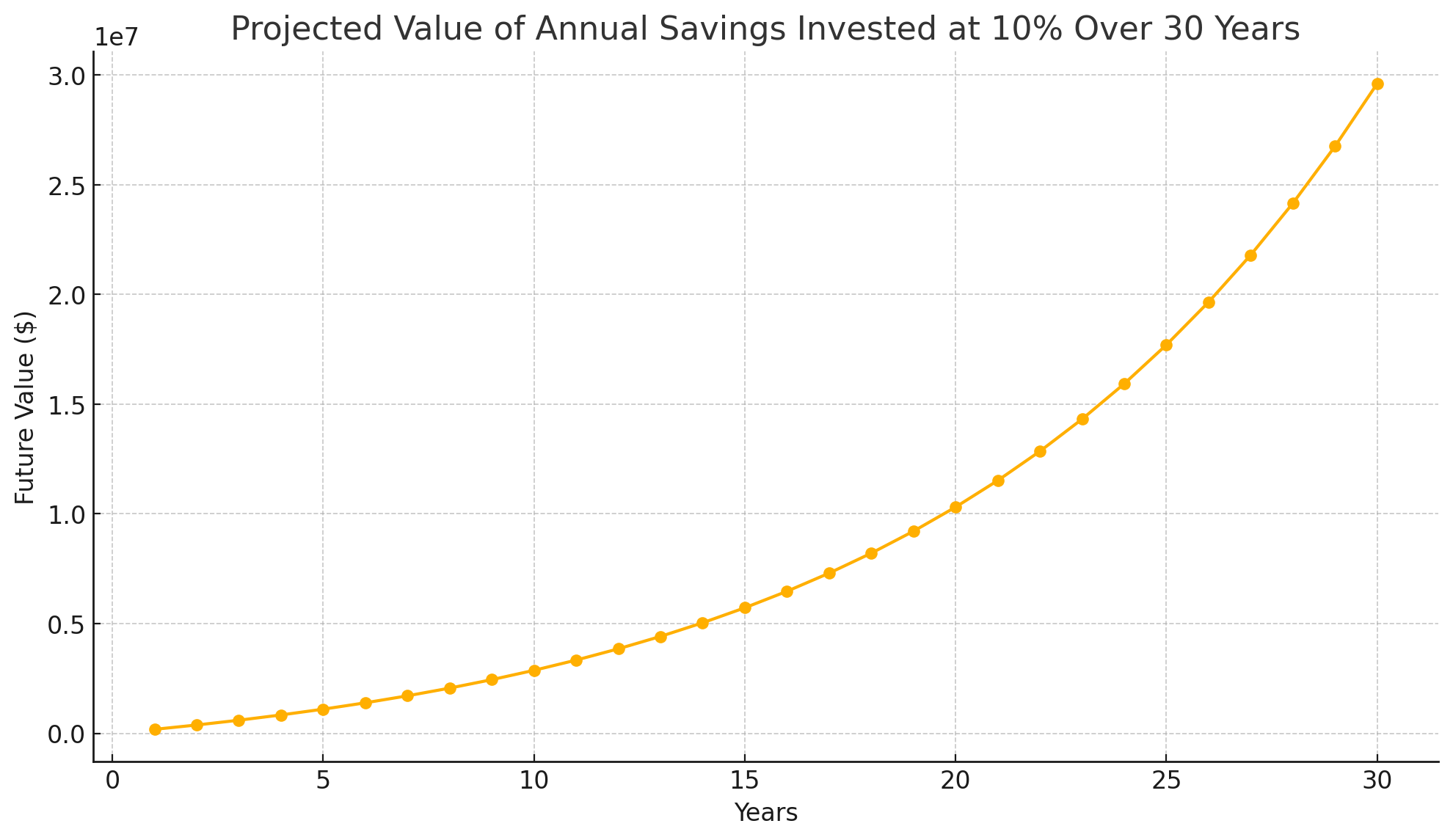
Let us revisit the travel cost scenario: an HBCU saves $180,000 annually by not sending its marching band to four away games. If that amount were instead directed into an endowment or investment fund yielding a 10% annual return, compounded over 30 years, the return on the first year’s investment alone would grow to approximately $3.1 million. But in practice, this contribution would not be a one-time deposit—it would be made every year for 30 years.

Each $180,000 annual deposit would compound over a different span of time—from 30 years down to 1 year for the final contribution. When we sum the compounded growth of all 30 annual contributions, the total value by year 30 is not merely $3.1 million, but a remarkable $32.6 million.

This is the true power of consistent, disciplined investing. What might seem like a relatively small annual sacrifice—foregoing band travel to four away games—can, when reinvested wisely, build a financial pillar for an HBCU that could support hundreds of scholarships, faculty lines, or capital improvements. Across multiple institutions, such strategy would not just close the endowment gap—it could transform it into a long-term competitive advantage. Using the future value formula:

FV = P × [(1 + r)^t – 1] / r
FV = $180,000 × [(1.10)^30 – 1] / 0.10
FV ≈ $3.1 million

Now imagine 40 HBCUs adopting this policy. If each institution redirected $180,000 annually into an endowment with a 10% annual return, the combined value of those contributions over 30 years would grow to an extraordinary $1.3 billion.

This isn’t speculative—it is mathematical certainty backed by compounding returns. What begins as a quiet cost-saving measure becomes a billion-dollar transformation of Black institutional capital. It is the kind of long-term vision HBCUs need to build financial independence and power. Leaving the bands at home, selectively and strategically, could finance a future where they never again play second fiddle to structural underfunding.

Such funds could be reserved for band scholarships, new instruments, music department endowments, or general institutional advancement. Equally important, this shift demonstrates fiscal maturity to large philanthropic donors who seek assurance of sustainability and capital stewardship. In this light, the silence of a band on one Saturday becomes a long crescendo toward institutional resilience.

Band Camp Economics and Reallocation Potential

Consider also the economic pressures on the bands themselves. Marching bands at HBCUs are often underfunded even as they serve as ambassadors and talent pipelines. Travel budgets could be redirected internally:

  • Higher stipends for band scholarships, which could attract more top talent;
  • Expanded outreach to middle and high school band programs to sustain the pipeline;
  • Better faculty-to-student ratios for music education;
  • New instrument purchases, particularly for percussion and brass sections, which endure high wear and tear.

An internal reallocation of $150,000–$250,000 annually per school could mean the difference between merely surviving and thriving for a band program.

The Cultural Blowback—and Counterarguments

Naturally, such a policy will meet resistance—not only from fans but from within. Band members may feel shortchanged on travel experiences. Alumni may bristle at what they see as a cultural dilution. Game promoters may worry about reduced ticket sales if the bands are not both present.

But it is precisely because bands matter so much that they should be protected from burnout and underinvestment. If leaving them home three or four times per year increases their overall budget, performance level, and recruitment reach, is that not a worthy trade?

Besides, culture evolves. Just as HBCUs have moved from AM radio to YouTube, from pamphlets to TikTok, so too can band culture adapt to a new hybrid reality—where physical presence is not the only measure of visibility or power.

A Conference-Wide Model: The SWAC and MEAC Could Lead

If this is to be implemented, it would ideally not be school by school, but as a conference-wide reform. Both the Southwestern Athletic Conference (SWAC) and the Mid-Eastern Athletic Conference (MEAC) could establish guidelines that limit band travel to key games while preserving equity among member institutions.

Such a policy might include:

  • A rotating system where each team brings its band to only half of its away games;
  • Revenue-sharing from livestreamed halftime performances;
  • Incentives for home teams to offer cultural hospitality to offset the absence of the visiting band.

It would also open new possibilities for sponsorship. Corporate partners who understand the influence of HBCU bands could be enlisted to underwrite digital halftime content or band scholarships—an easier pitch if funds are not being spent on transport and logistics.

March Differently, Spend Smarter

Culture is not weakened by strategy. In fact, when deployed wisely, it is made more resilient. Leaving the bands at home for select away games is not a betrayal of HBCU tradition—it is a restructuring of it to survive and thrive in a new era.

In a time when HBCUs are asked to do more with less, the question is not whether the bands should still matter. Of course they do. The question is whether they should have to march themselves into financial depletion to prove it.

Better to let them rest, regroup—and when they do appear, make it unforgettable.

Disclaimer: This article was assisted by ChatGPT.

China v. United States Is Not The Only Great Power Competition – Make No Mistake About It, HBCUs v. PWIs Are At War

“Today, the United States and China, often with Russia at its side, are competing to shape security architectures, as well as norms and practices worldwide, including trade and investment regimes and the development and regulation of new technological infrastructures. These frictions will play out over decades, not only in Beijing, Washington, and Moscow, but in Africa and Europe, the Arctic, outer space, and cyberspace.” – The Wilson Center

There are no African or Caribbean countries considered to be part of the Great Power Competition, only pawns in it. – William A. Foster, IV

In global affairs, the geopolitical rivalry between the United States and China captures headlines as the preeminent competition shaping the 21st century. However, closer to home, another fierce contest is unfolding—one that, while lacking the military and economic ramifications of the U.S.-China rivalry, is no less significant in the battle for resources, prestige, and influence. This is the ongoing conflict between Historically Black Colleges and Universities (HBCUs) and Predominantly White Institutions (PWIs). This battle is not just about educational preference; it is a struggle for survival, legacy, and the future of Black intellectualism and empowerment in America.

The Historical Context: Foundations of an Educational Divide

HBCUs were born out of necessity in an era when Black students were systematically excluded from white institutions due to segregation and racism. Established primarily in the late 19th and early 20th centuries, HBCUs provided a sanctuary for Black education and upliftment. Schools such as Howard University, Morehouse College, and Spelman College became powerhouses in producing Black professionals, thinkers, and leaders, who otherwise would have been denied access to quality education.

In contrast, PWIs, traditionally serving white students, eventually opened their doors to Black students following the Civil Rights Movement and the dismantling of Jim Crow laws. Integration, while a monumental victory, led to unintended consequences for HBCUs, including a decline in enrollment as Black students increasingly sought the prestige, resources, and opportunities associated with PWIs. The playing field, however, was never level. PWIs had centuries of endowments, expansive alumni networks, and government backing, whereas HBCUs remained underfunded and underappreciated.

The War Over Resources

One of the most glaring disparities in the HBCU vs. PWI competition is financial resources. The average endowment of an HBCU pales in comparison to that of even a mid-tier PWI. Take, for example, Harvard University, whose endowment surpasses $50 billion, while the combined endowments of all HBCUs struggle to reach a fraction of that amount.

This disparity has real consequences: outdated facilities, limited scholarships, fewer research opportunities, and struggles in faculty retention. Meanwhile, PWIs attract Black students with lucrative scholarships, state-of-the-art facilities, and networking opportunities that are difficult to resist. The financial battle is one that HBCUs, despite their resilience, continue to fight uphill.

Cultural Significance: A Battle for Identity

Beyond money, the HBCU vs. PWI war is a cultural one. HBCUs offer a unique and nurturing environment where Black students can thrive without the pressures of being minorities in predominantly white spaces. The culture of HBCUs is rich with tradition, homecomings, Greek life, and an emphasis on communal upliftment. These institutions foster Black pride, empowerment, and a curriculum centered around Black history and achievement.

PWIs, on the other hand, often relegate Black culture to a sub-narrative. While diversity and inclusion initiatives have increased, many Black students at PWIs report feeling isolated, encountering microaggressions, and struggling to find representation among faculty and administration. However, PWIs offer certain advantages—larger research budgets, extensive alumni networks, and higher-ranked programs—which make them attractive options for students seeking a competitive edge in the job market.

The Sports Arena: Where the Battle is Most Visible

Athletics is one of the most publicized battlegrounds in the HBCU vs. PWI war. For decades, Black athletes from HBCUs like Grambling State, Jackson State, and Southern University dominated professional sports. However, the integration of PWIs led to the siphoning of Black athletic talent away from HBCUs. Today, powerhouse programs at schools like Alabama, Ohio State, and Duke recruit Black athletes with multi-million dollar facilities, exposure, and professional pipeline programs that HBCUs struggle to match.

The recent resurgence of attention toward HBCU sports—highlighted by figures like Deion Sanders coaching at Jackson State—signals a potential shift in the paradigm. Sanders’ tenure not only brought visibility but also reignited discussions about the significance of Black athletes playing at HBCUs rather than generating billions of dollars for PWIs, which often fail to reinvest in Black communities.

The Corporate and Political Battlefield

Beyond academia and sports, HBCUs and PWIs compete in the corporate and political realms. HBCU graduates have historically faced challenges breaking into elite circles of power, where PWIs hold dominance. Fortune 500 companies and government institutions have historically recruited from Ivy League and top-tier PWIs, often overlooking the rich talent pools at HBCUs.

One of the starkest indicators of racial economic disparity is the near-total absence of Black-owned Fortune 500 companies. As of recent years, there have been fewer than five Black CEOs in the entire Fortune 500, and the number of Black-owned companies on the list is virtually nonexistent. Systemic barriers, including access to capital, investor bias, and exclusion from influential business networks, continue to hinder Black entrepreneurs from scaling their enterprises to the level of major corporate giants.

The lack of Black-owned Fortune 500 companies is particularly concerning when viewed against the backdrop of political and economic shifts. The rise of Donald Trump and his brand of economic nationalism underscored a shift toward policies that often ignored or outright disadvantaged minority-owned businesses. Trump’s tax policies largely benefited large corporations and the wealthiest Americans, while minority entrepreneurs saw little in the way of targeted support. His administration’s rollback of diversity initiatives in government and business further exacerbated the existing racial wealth gap.

However, recent movements advocating for diversity and equity have shifted some focus back to HBCUs. The Biden administration’s historic investment in HBCUs, as well as corporate pledges following the George Floyd protests, indicate an acknowledgment of these institutions’ significance. Still, whether these commitments translate into long-term systemic changes remains uncertain.

The Future of the Battle

The war between HBCUs and PWIs is not one of violence but of strategy, resilience, and adaptation. HBCUs must innovate, leveraging their cultural significance and legacy to attract top Black talent. Alumni engagement, corporate partnerships, and increased state funding are crucial to leveling the playing field. Simultaneously, Black students and families must weigh the long-term benefits of choosing an HBCU over a PWI, recognizing that their decision impacts the future viability of these historic institutions.

PWIs, while dominant in many areas, must confront their own racial disparities and reckon with their histories of exclusion. Recruiting Black students without providing adequate support systems leads to high dropout rates and dissatisfaction. For genuine equity, PWIs must go beyond optics and foster environments where Black students can thrive academically, culturally, and socially.

Conclusion: A War for Legacy

The United States and China battle for global supremacy in economics, technology, and military might. But within the U.S., the war between HBCUs and PWIs is a struggle for Black excellence, institutional power, and legacy. The outcome of this battle will determine the future of Black education and leadership. Will HBCUs regain their prominence and secure the funding and recognition they deserve? Or will PWIs continue to dominate, drawing Black talent into historically exclusive spaces while leaving HBCUs to struggle?

Make no mistake about it—this is a war. And like all wars, the victors will shape history. The question is: who will ensure that Black institutions not only survive but thrive in the centuries to come?