Tag Archives: african currencies

Currencies Of The African Diaspora – Burundi

by-map

Burundi is a landlocked, resource-poor country with an underdeveloped manufacturing sector. The economy is predominantly agricultural; agriculture accounts for just over 30% of GDP and employs more than 90% of the population. Burundi’s primary exports are coffee and tea, which account for 90% of foreign exchange earnings, though exports are a relatively small share of GDP. Burundi’s export earnings – and its ability to pay for imports – rests primarily on weather conditions and international coffee and tea prices. An ethnic-based war that lasted for over a decade resulted in more than 200,000 deaths, forced more than 48,000 refugees into Tanzania, and displaced 140,000 others internally. Only one in two children go to school, and approximately one in 15 adults has HIV/AIDS. Food, medicine, and electricity remain in short supply. Less than 2% of the population has electricity in its homes. Burundi’s GDP grew around 4% annually in 2006-12. Political stability and the end of the civil war have improved aid flows and economic activity has increased, but underlying weaknesses – a high poverty rate, poor education rates, a weak legal system, a poor transportation network, overburdened utilities, and low administrative capacity – risk undermining planned economic reforms. The purchasing power of most Burundians has decreased as wage increases have not kept up with inflation. Burundi will remain heavily dependent on aid from bilateral and multilateral donors – foreign aid represents 42% of Burundi”s national income, the second highest rate in Sub-Saharan Africa. Burundi joined the East African Community in 2009, which should boost Burundi’s regional trade ties, and also in 2009 received $700 million in debt relief. Government corruption is hindering the development of a healthy private sector as companies seek to navigate an environment with ever changing rules.
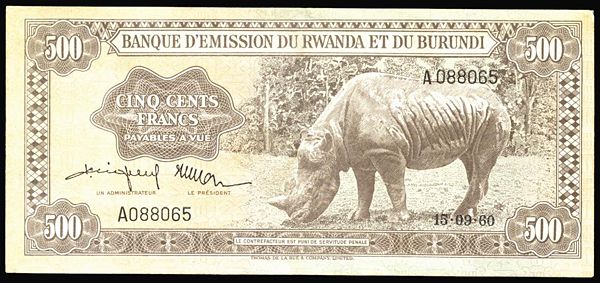
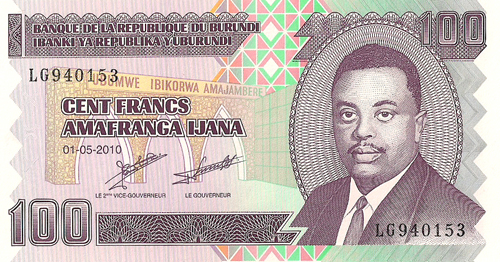
600px-Rwanda-Burundi_1960_500_francs_obv_Ponterio_151-7053

d22119

BI30

bif-20-burundi-francs-2

burundi-2006-circulating-coins

Source: Economy overview provided by CIA Factbook

Currencies Of The African Diaspora – Burkina Faso

uv-map

Burkina Faso is a poor, landlocked country that relies heavily on cotton and gold exports for revenue. The country has few natural resources and a weak industrial base. About 90% of the population is engaged in subsistence agriculture, which is vulnerable to periodic drought. Cotton is the main cash crop. Since 1998, Burkina Faso has embarked upon a gradual privatization of state-owned enterprises and in 2004 revised its investment code to attract foreign investment. As a result of this new code and other legislation favoring the mining sector, the country has seen an upswing in gold exploration and production. By 2010, gold had become the main source of export revenue. Gold mining production doubled between 2009 and 2010. Two new mining projects were launched in the third quarter of 2011. Local community conflict persists in the mining and cotton sectors, but the Prime Minister has made efforts to defuse some of the economic cause of public discontent, including announcing income tax reductions, reparations for looting victims, and subsidies for basic food items and fertilizer. An IMF mission to Burkina Faso in October 2011 expressed general satisfaction with the measures. The risk of a mass exodus of the 3 to 4 million Burinabe who live and work in Cote d’Ivoire has dissipated, and trade, power, and transport links are being restored. Burkina Faso experienced a severe drought in 2011, which decimated grazing land and decreased harvests, creating food insecurity and damaging the country’s agricultural base.

WAS303C

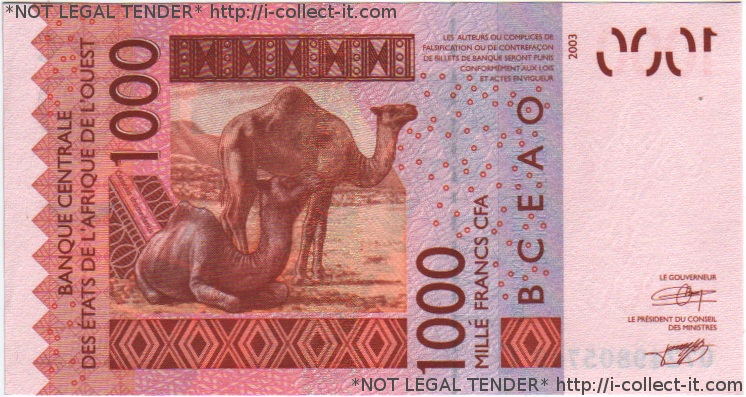
Burkina Faso 1000 Franc 2003.300dpi

images

Movement Picture

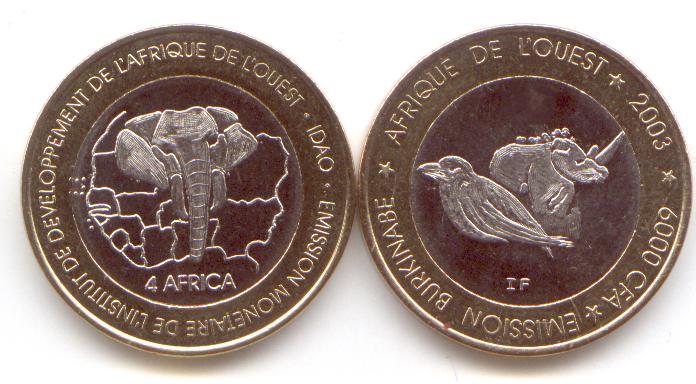
buf-6000

Source: Economy overview provided by CIA Factbook

Currencies Of The African Diaspora – Botswana

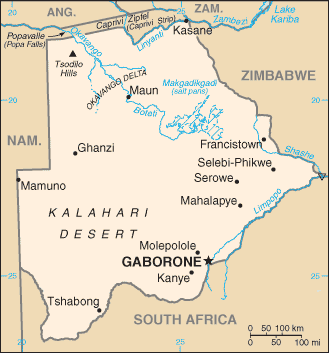
bc-map

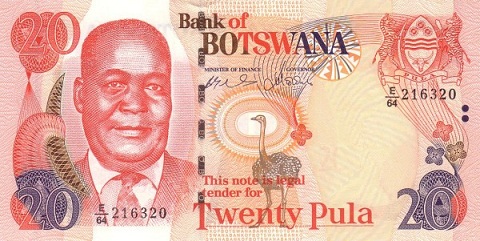
Botswana has maintained one of the world’s highest economic growth rates since independence in 1966. However, economic growth was negative in 2009, with the industrial sector shrinking by 30%, after the global crisis reduced demand for Botswana’s diamonds. Although the economy recovered in 2010, GDP growth has again slowed. Through fiscal discipline and sound management, Botswana transformed itself from one of the poorest countries in the world to a middle-income country with a per capita GDP of $16,800 in 2012. Two major investment services rank Botswana as the best credit risk in Africa. Diamond mining has fueled much of the expansion and currently accounts for more than one-third of GDP, 70-80% of export earnings, and about one-third of the government’s revenues. Botswana’s heavy reliance on a single luxury export was a critical factor in the sharp economic contraction of 2009. Tourism, financial services, subsistence farming, and cattle raising are other key sectors. According to official government statistics, unemployment reached 17.8% in 2009, but unofficial estimates run much higher. The prevalence of HIV/AIDS is second highest in the world and threatens Botswana’s impressive economic gains. An expected leveling off in diamond production within the next two decades overshadows long-term prospects. A major international diamond company signed a 10-year deal with Botswana in 2012 to move its rough stone sorting and trading division from London to Gaborone by the end of 2013. The move may support Botswana’s downstream diamond industry.

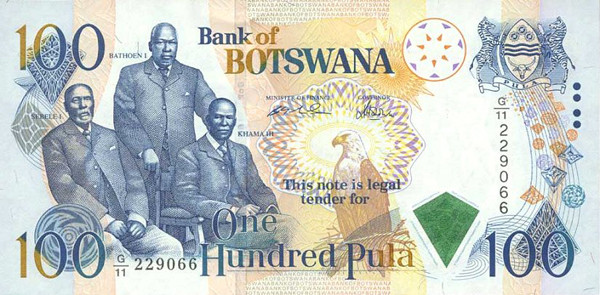
bwp-100-botswana-pulas-2

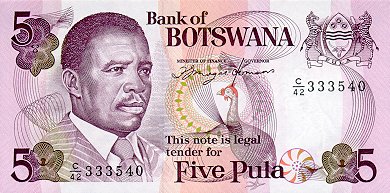
Botswana5Pula92

Botswana tourism destinations

Botswana_money_coins

Source: Economy overview provided by CIA Factbook
Currencies Of The African Diaspora – Benin

The economy of Benin remains underdeveloped and dependent on subsistence agriculture, cotton production, and regional trade. Growth in real output had averaged almost 4% before the global recession and it has returned to roughly that level in 2011-12. Inflation has subsided over the past several years. In order to raise growth, Benin plans to attract more foreign investment, place more emphasis on tourism, facilitate the development of new food processing systems and agricultural products, and encourage new information and communication technology. Specific projects to improve the business climate by reforms to the land tenure system, the commercial justice system, and the financial sector were included in Benin’s $307 million Millennium Challenge Account grant signed in February 2006. The 2001 privatization policy continues in telecommunications, water, electricity, and agriculture. The Paris Club and bilateral creditors have eased the external debt situation with Benin benefiting from a G-8 debt reduction announced in July 2005, while pressing for more rapid structural reforms. An insufficient electrical supply continues to adversely affect Benin’s economic growth though the government recently has taken steps to increase domestic power production. Private foreign direct investment is small, and foreign aid accounts for the majority of investment in infrastructure projects. Cotton, a key export, suffered from flooding in 2010-11, but high prices supported export earnings. The government agreed to a 25% increase in civil servant salaries in 2011, following a series of strikes, increasing pressure on the national budget. Benin has appealed for international assistance to mitigate piracy against commercial shipping in its territory.

Benin tourism destinations

WAS207B

WAS208B

WAS215B

ben-200f

Source: Economy overview provided by CIA Factbook
Currencies Of The African Diaspora – Angola

Angola’s high growth rate in recent years was driven by high international prices for its oil. Angola became a member of OPEC in late 2006 and its current assigned a production quota of 1.65 million barrels a day (bbl/day). Oil production and its supporting activities contribute about 85% of GDP. Diamond exports contribute an additional 5%. Subsistence agriculture provides the main livelihood for most of the people, but half of the country’s food is still imported. Increased oil production supported growth averaging more than 17% per year from 2004 to 2008. A postwar reconstruction boom and resettlement of displaced persons has led to high rates of growth in construction and agriculture as well. Much of the country’s infrastructure is still damaged or undeveloped from the 27-year-long civil war. Land mines left from the war still mar the countryside, even though peace was established after the death of rebel leader Jonas SAVIMBI in February 2002. Since 2005, the government has used billions of dollars in credit lines from China, Brazil, Portugal, Germany, Spain, and the EU to rebuild Angola’s public infrastructure. The global recession that started in 2008 temporarily stalled economic growth. Lower prices for oil and diamonds during the global recession slowed GDP growth to 2.4% in 2009, and many construction projects stopped because Luanda accrued $9 billion in arrears to foreign construction companies when government revenue fell in 2008 and 2009. Angola abandoned its currency peg in 2009, and in November 2009 signed onto an IMF Stand-By Arrangement loan of $1.4 billion to rebuild international reserves. Consumer inflation declined from 325% in 2000 to about 10% in 2012. Higher oil prices have helped Angola turn a budget deficit of 8.6% of GDP in 2009 into an surplus of 12% of GDP in 2012. Corruption, especially in the extractive sectors, also is a major challenge.

Angola tourism destinations

angola-114

AO139

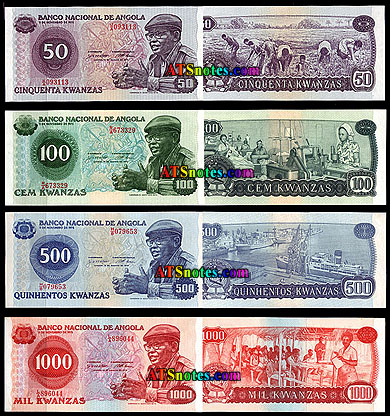
AngolaKwanzas1995

ang-5-99

Source: Economy overview provided by CIA Factbook