
Wealth will set us fucking free, okay? ‘Cause wealth is empowering, wealth can uplift communities from poverty, okay? – Chris Rock

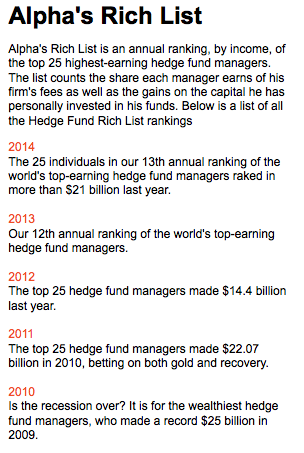
On May 6th, Institutional Investors’ released its 13th annual ‘Rich List’ highlighting the top 25 earning hedge fund managers. The 2014 list saw a combined earnings of $21 billion, an increase of 50 percent from the prior year, but still comes in as only the fourth highest total in the list 13 years. This year’s list required a minimum earnings of $300 million also a 50 percent increase over last year’s minimum, had an average earnings of $846 million per manager, and saw four hedge fund managers clear the $1 billion earnings mark. The back to back champion is David Tepper, founder of Appaloosa Management, earned $3.5 billion in 2013. To put in perspective just how much he earned, Lee Hawkins reported in 2007 that all African American professional athletes in the NFL, NBA, and MLB combined earned $4 billion. A look at more recent numbers show that the top ten earning African American athletes earned $383.2 million, meanwhile the top ten hedge fund managers brought in $15.7 billion or the athletes earned $0.02 for every $1.00 the hedge fund managers earned.
A few of these hedge fund managers also left their mark in college philanthropy. Paul Tudor Jones and his wife donated $12 million to the University of Virginia according to Philanthropy.com to “create the Contemplative Sciences Center to explore the intersection between modern science and the classical medical and contemplative traditions of Tibet.” Leon Cooperman and his wife made a $25 million donation to Hunter College for their library renovations and to seed a scholarship fund. David Tepper donated $67 million to Carnegie Mellon’s business school in 2013 and Kenneth Griffin, ranked number five on the Rich List, donated $150 million to Harvard College for scholarships, the largest ever donation in the school’s history. These four donations alone in the past 12 months are equivalent to over 12 percent of all HBCU endowments combined. The $254 million between these four donations if they were their own HBCU endowment would rank tied for third among HBCU endowments and equal to almost half of Howard University’s total endowment. Yes, just these four donations.
The key thing to remember about all of these hedge fund managers is they founded and own their company. Yes, it is finance and investments, but it is also understanding that entrepreneurship and risk taking is what gets rewarded in this economic system. Far too many of us are still thinking in terms of labor and not enough of us are thinking in terms of ownership regardless of the industry. We want to graduate and get a “good” job. Nor does the business if you decide to start one have to be some social business that changes the world. The president of Hampton University owns a bottling company. It is not sexy, but it does employ a great deal of people and allows him and his wife to be financially generous to Hampton time and time again.
Our intellectual capital continues to be poorly distributed as a community. It often seems the only thing that little African American boys and girls believe they can do is entertain others. We are either singing and dancing or chasing a ball of some sort. The lack of hedge fund managers (among a great many other professions) continues to highlight our perplexing relationship to finance. We like the perks of consumption which requires money, but adverse to the real building of wealth and the vehicles like hedge funds that can create paradigm shifts. It is clear we are playing the game, unfortunately we seem to currently be playing it to lose.


 HBCU Money