Tag Archives: african american banks

Citicorp, JPMorgan Chase, And Others Plead Guilty – African American Banking Opportunity?

It isn’t the size of the dog in the fight, but the size of the fight in the dog that counts. – Woody Hayes

Wells-Fargo

I have to say if I was CEO at an African American owned bank or credit union right now I would be salivating at the news where two of America’s largest banks plead guilty to felony charges for manipulating currencies and rigging interest rates. Citibank and J.P. Morgan Chase control a combined $2.3 trillion in deposits worldwide. For perspective, total bank deposits in the United States total $9.3 trillion. This provides an opportunity to give a new narrative to African American communities about the value of banking with someone they know and trust. A bank/credit union owned by and for their community. Although not charged, I would also lump Bank of America and Wells Fargo into my attack, which given their recent settlements for predatory lending towards African American communities would not be a reach at all.

NPR reports, “Citicorp, JPMorgan Chase, Barclays, The Royal Bank of Scotland and UBS AG have agreed to plead guilty to felony charges and pay billions in criminal fines, the Department of Justice says. The offenses range from manipulating the value of dollars and euros to rigging interest rates.” The banks charged will be paying a $5.6 billion in fines combined, with Citigroup and J.P. Morgan Chase paying $1.26 billion and $892 million, respectively. Despite the heavy fines, no one will face actual criminal chargers. Bear in mind for perspective that Citigroup and J.P. Morgan Chase had 2014 net income of $7.3 billion and $21.8 billion, respectively. In other words, Citigroup will be paying 17.3 percent of its net income (profits) and J.P. Morgan Chase will pay 4.1 percent of its net income (profits). It is not clear however if they have to pay the fine at once or have been put on a payment plan.

By now, we have all heard the number – $1.1 trillion. That is the buying power of African America, but what we rarely hear is that less than 1 percent of that buying power sits in African American banks and credit unions (AABCUs). This continuously leaves African America in dire straits needing access to capital, but putting non-AABCUs like Citigroup, JP Morgan, Wells Fargo, and Bank of America in a position to take our money and then use it as a predatory weapon against our communities. One of a bank’s objectives is move the risk from those that own it onto other groups. The aforementioned banks not owned by us are doing their job and doing it well. We just keep aiding them by giving them a larger deposit base which in turn gets loaned back to us at predatory rates so that the owners can secure loans at discounted rates. Our communities pay more so that their communities can pay less. In other words, we deposit $1.00 in the bank and they deposit $1.00 in the bank. The bank now has $2.00 it can lend out. They will borrow $0.50 at 4 percent and our community borrows $0.25 (but needs $0.50) at 8 percent. But why have AABCUs not take advantage of this telling this narrative?

African American banks and credit unions have as a collective not done a good job of expounding their benefits to the communities they are in. Not nearly enough community outreach or customer acquisition investment has been done by African American owned financial institutions. The question if its the chicken or the egg in this case remains in flux. Do you spend limited resources to market to get deposits or do you wait for deposits then market to get more customers? Whichever approach is taken, it must be done with resolute commitment to increasing the AABCUs deposit hold within our communities.  It baffles me the number of AABCUs who are not even on social media. Are you kidding me? It is FREE. If AABCUs created internships for HBCU marketing and communication majors each semester they could have a millennial team of four or five students rotating every three to four months. And while many do not like them, I would hire club promoters and street teams to get the word out. Incentivize the community to become your word of mouth advertising in exchange for perks. In an interview I did with Donna Shuler, co-founder of Answer Title in Washington D.C. and former bank CEO, she said, “More community outreach starting when students are still in school. Banks and agents should use more images of African Americans in their marketing.” One thing that continues to plague African American organizations and firms is the copycat complex that ignores cultural differences between the way our community consumes products and services and the way other communities do. We do this despite Nielsen, an American global information and measurement company, having an entire site dedicated to the African American consumer trends and behavior.

We also have to stop being afraid to use what in hip-hop is known as “beef” with our counterparts. This is a competition after all. My marketing campaign would go something like this – “You know who has NOT  been fined for predatory practices against African Americans – (insert AABCU name).” Or I would have a list of the non-AABCUs who have been fined for their practices against our community and call it a public service announcement. People love a good guy, bad guy scenario. A mentor always said to me once to use what you have. Whatever it is that draws people to you – use it. In AABCUs case, it is using what the others have done to our community to your advantage of getting those deposits to switch institutions. It is also being more engaged in community activities where you can have the captive attention to get financial literacy and marketing message out.

African Americans continue to lose ground in wealth accumulation, our communities and neighborhoods continue to be at risk of gentrification because of lack of development and access to capital, and these are all a reflection of a weak banking system. We know what happened to Harlem and what is happening to places like Third Ward in Houston  among other places. This latest behavior by the non-AABCUs is just a long list of a wedge that AABCUs should be using to distinguish themselves among their core consumer demographic. They have given more than an inch to exploit and it is time we take the mile.

Are African American Churches Derailing African America’s Economic Progress?

“You know our people, they want their leaders to be prosperous. One hand washes the other.” – Brother Baines (character from Malcolm X)

black-church-inc

Recently in Third Ward, an area rich with historic significance to the city’s African American population there was a battle being engaged between the neighborhood of Oak Manor University Woods and their “neighbor” Wheeler Avenue Baptist Church. WABC had already purchased one entire street of forty some homes in the neighborhood and was in the process of expanding once again as its membership had swelled. The church for all intentions appears on its way to becoming one of Houston’s mega-churches. For Oak Manor University Woods, they seemed to be getting closed in on all sides. The current president of the Oak Manor University Woods Civic Club Bettie Patterson said, “I thought the University of Houston would be our albatross, not Wheeler Avenue.” She was referring to the University of Houston’s presence in Third Ward, which itself has spurred a great deal of the rise in gentrification in the area as the school’s profile as a tier one university has attracted a lot of redevelopment in the area. Many homes in the neighborhood on the tax roles see their lots valued for more than the actual homes themselves. Inside Houston’s Inner Loop, land and affordable housing have become something of an oxymoron. Houston, the fourth largest city in the United States, has been booming with high oil prices spurring most of that boom. Unfortunately, African Americans inside the loop have been the primary victims of that boom. Sitting on what has been historically underdeveloped and depressed land and neighborhoods, many developers (or churches) come in and offer many African American home and landowners under market value prices to scoop up the land. Most lack the financial aptitude or savviness to deal with these fast talking developers or churchmen claiming to be doing God’s work and end up selling their land and homes. In the aftermath, they are not able to afford to stay in their community or forced to sell as taxes have skyrocketed due to rising values and payments they can not maintain, with many of the community’s senior citizens on fixed income. In the Oak Manor University Woods and Wheeler Avenue Baptist case, where the church could be working with the neighborhood to build affordable housing, it is instead engaged in battle that will eventually lead to over sixty homes being demolished and over 200 potential African Americans not in the area. The irony, those 200 may drive from some distance to attend the church and after church if they intend to eat or do any shopping, virtually none of the stores will be owned by African Americans in the area or community. It appears we have pushed all of our chips in on the church, and if it can not save us, then we do not want to be saved.

In some ways, I feel sorry for the African American church. It is essentially being asked to be everything institutionally in the development cycle for African America. Every institution whether it is a neighborhood, church, bank, lobbying group, etc. falls under one of three institutional categories of social, economic, or political. The SEP cycle of development follows that exact order in fact. Social institutional development comes first, then economic institutional development, and lastly political institutional development. A church, by its very nature, is suppose to be a social institution. It is a place where social norms and cultural capital is circulated amongst a community. Other social institutions are things like families, neighborhoods, and schools. All circulating a particular a set of norms and values. Economic institutions are businesses, investors, and even banks. The latter has the unique charge of helping circulate capital and exporting financial risk from the community that owns it onto other communities. An acute problem African Americans experience with predatory financial services from institutions like Wells Fargo who just settled for $175 million with the Department of Justice for its predatory behavior with African Americans. Political institution examples are political parties, lobbyist, and PACs. The institutional cycle always follows the same pattern. Currently, the black church though is being asked to be all three. A feat that no institution can pull off. College and universities are social institutions that often serve the needs of economic and political institutional development through their research, but ultimately are still social institutions. The last I checked, there is no research being conducted in the halls of black churches.

Yet, African America has put all of its stock into this institution and starving the independent development of a strong economic and political institutional development. Although many churches are profitable like businesses, they often lack the serious institutional infrastructure or aptitude to operate as such. Last year, HBCU Money’s first ever African American Credit Union Directory in 2014 uncovered some startling findings about the church’s role in African America’s economic institutional landscape. Religious affiliated credit union make up 5.6 percent of US credit unions, while African American religious affiliated credit unions comprise approximately one-third of all African American credit unions and almost one-fourth of all US religious affiliated credit unions. In California, all seven African American credit unions in 2014 were religious affiliated. The sensible thing for them to do would have been if they absolutely had to form their own (as opposed to banking at an African American owned bank or credit union) was for all seven to form one and call it the “Insert famous African-American religious figure from California” of California Federal Credit Union. It would have been a credit union with seven branches, 1 485 members, and $1.7 million in assets. Instead, the median membership and assets among the seven separately was 152 and $165 000, respectively. In other words, not worth the paperwork it probably took to form them and likely limited opportunity for any real scalability or sustainability.

unbanked_large_cities

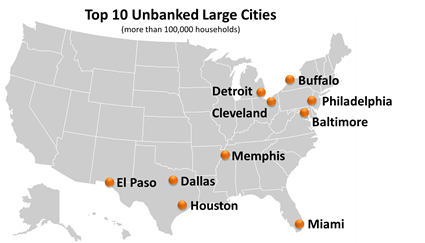
It is both a gift and curse that one-third of African American credit unions are religious based. The gift is that any opportunity for African Americans that increases financial engagement is a benefit. The Center for American Progress reports, “For African Americans, the unbanked rate declined slightly from 21.4 percent in 2011 to 20.5 percent in 2013, and the underbanked rate decreased from 33.9 percent to 33.1 percent.” Nationally, the figure for unbanked and underbanked was 7.7 percent and 20 percent, respectively. Having more financial institution options is a good thing. The presence of credit unions, be they religious or not, in African America decreases the probability of predatory financial services like payday loans that are often prevalent in our community coming in to fill the void. However, the problem for having such a disproportionate amount of credit unions being religious based is that these credit unions have no ability to scale as the aforementioned example in California showed, which further means they are limited in the types and number of financial services and products they can offer. The reality is that churches are not equipped to be financial institutions and religious based credit unions are limited to the size of their congregation to their growth potential. They also tend to lack the intellectual expertise to grow and perform the functions that provide for stability of operation for their members and the communities they are in. Often times, these religious based credit unions come across as nothing more than the ability for the church to control more of and keep an eye on the congregation’s purse strings to make sure they are getting their cut. This is problematic after reporting two African American banks closed their doors to start 2015, thereby reducing the number of African American banks to twenty-three. A far cry from the 1990s, when there were over fifty African American owned banks.

African American churches are also siphoning off much needed capital from other institutions within the community where capital is vitally needed. Recently, an example of this was shared by Jarrett Carter, Sr. in an editorial for HBCU Digest where he shared, “Last year, I gave more than $10,000 to my church, $1,500 to Alpha Phi Alpha Fraternity Inc., and $150 dollars to my alma mater.” In a 1987 study by Emmett Carson for Joint Center for Political Studies reported, “Over two-thirds (68 percent) of all dollars that are contributed by blacks to charity go to the church.” A figure at the time that was higher than the national average of 46.9 percent. It is hard to imagine that although the study is almost thirty years old that much has changed given the disclosure by Mr. Carter. Some may argue that it has in fact gotten worse. Unfortunately, such a disproportionate amount being given to churches with our limited income leaves little for investment in the rest of African America’s institutions. Over the past 100 years African American owned hospitals have decreased from 500 to 1, African American boarding schools have decreased from 100 to 4, the institutional gap in HWCU/HBCU endowments has grown from 46:1 to 106:1 over the past 20 years, HWCU/HBCU research expenditures gap is 30:1, Harlem and countless other African American communities have been gentrified, and the wealth gap among all other groups (except Native Americans) and African Americans continues to severely widen. Yet, the African American church continues to be a booming industry. As a result we see even the African American non-religous based credit unions and banks anchoring their “business” products to churches.

Let me be clear, I am not against the African American church. It has been a vital institution in our community. Its history and place in our communities is important, but it can not and should not be asked to solve all of our problems. A religious institution is there to be part of our community’s social institutional fabric, but it is not there to enrich and strengthen us economically or politically. Each institution in a community has a purpose and function. None more important than the other and all are needed. The acute investment that African America has put into its churches though has created a situation where all others starve and this has created an ongoing crisis that is on the brink of disaster. Church based credit unions are not setup to make small business loans, which are vitally needed to created more African American businesses and create jobs in our communities. They are not setup to decide which STEM and humanities research should be given grants that can one day be turned into private application or help shape policy, and nor should they be. That is not what their purpose is or ever was intended to be.

620-FF-download

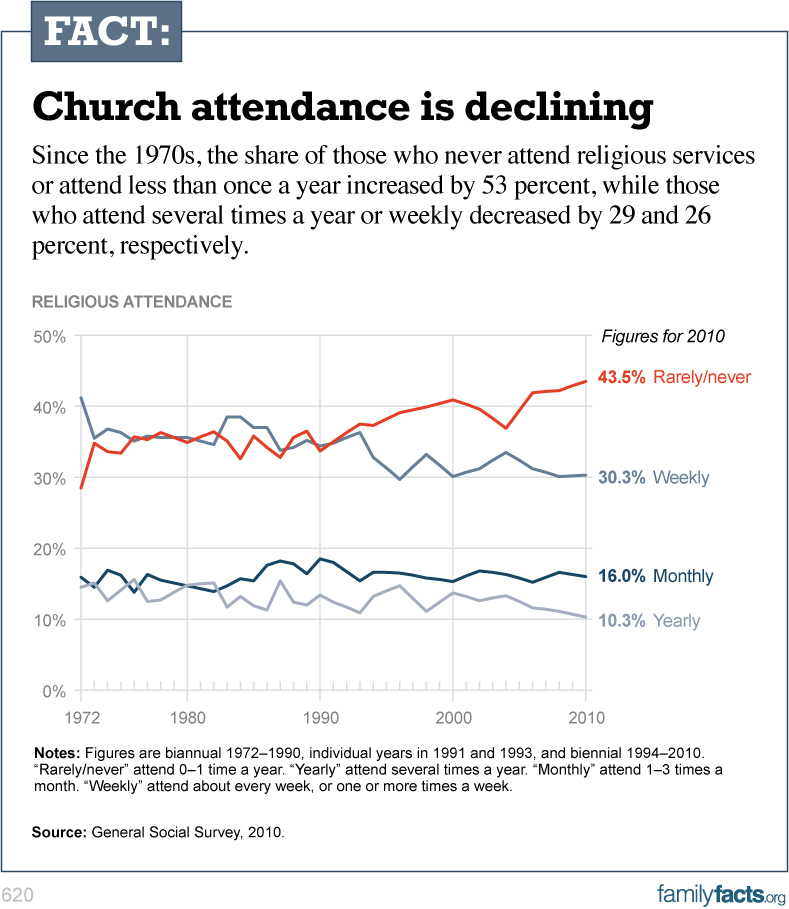
Overall, church attendance in America is declining (above) and has been for the past sixty years, and as is often the case we are behind the curve of change. This despite African American men and Millennials being one of the fastest declining groups in church attendance. African American men are almost twice as likely as African American women to not attend church. Financially, this is not so much of an issue for the church, since African American women lead virtually in every economic category. African America is the only group where the women outnumber the men in employment and are predominantly head of households. The irony if there is any, is that the vast majority of African American churches are still headed by men, but that is another article for another time. African American women hold the proverbial purse strings and they are in the church.

If African America is to ever progress economically, then it needs a lesson in portfolio diversification also known as do not put all your eggs in one basket, one stock, or one institution. Right now, we are overweight in church “stock”. For which I can already hear the rebuttal of, “You can never be to overweight in the Lord!”, but I did not say overweight in your spirituality. I said overweight in the church, and one does not beget the other despite how much we try to convince ourselves otherwise. In an interview on HBCU Digest by the aforementioned Jarrett Carter, I was asked if African America was culturally adverse to economies of scale and I believed then and I believe now that the answer is a resounding no. However, I also remember hearing Tavis Smiley speak once and he said there is a difference between hope and optimism. Hope much like faith does not have to be grounded in anything, but optimism has to be grounded in facts that show a favorable trend. I am hoping for some reason to be optimistic about our economic progress soon, but that will not happen until we decrease what we give and expect from our churches and increase investment into our other institutions, like our banks and credit unions, that are built to serve the purpose of our economic progress. I better pray.

HBCU Money’s 2014 African American Owned Bank Directory

For the most current African American Owned Bank Directory visit the 2022 link by clicking here.

All banks are listed in alphabetical order. In order to be listed in our directory the bank must have at least 51 percent African American ownership. You can click on the bank name to go directly to their website.

blackbank

There are 25 African American owned banks with assets totaling approximately $5.1 billion in assets or approximately 0.46 percent of African America’s $1.1 trillion in buying power.

OTHER KEY FINDINGS:

  • AAOBs are in 17 states. Key states absent are Florida, Mississippi, New York, and Ohio.
  • Alabama, Georgia, and Illinois lead the way with 3 AAOBs each.
  • Median AAOBs Aseets: $117 869 000
  • Average AAOBs Assets: $206 932 000
  • AAOBs control 0.03 percent of All American Bank Owned Assets
  • AAOBs control 2.8 percent of FDIC designated Minority-Owned Bank Assets
  • In 2013, there were 21 AAOBs, this year sees 25 or an increase of almost 25 percent.
  • Only 6 of 2013’s 21 AAOBs saw increases in assets.
  • For comparison, Asian American Owned Banks have approximately $43 billion in assets spread over 78 institutions. They control 6 percent of Asian America’s buying power.

ALAMERICA BANK

Location: Birmingham, Alabama

Founded: January 28, 2000

FDIC Region: Atlanta

Assets: $36 715 000

Asset Change (2013): Up 3.7%

BROADWAY FEDERAL BANK FSB

Location: Los Angeles, California

Founded: February 26, 1947

FDIC Region: San Francisco

Assets: $345 574 000

Asset Change (2013): Down 10.3%

CAPITAL CITY BANK & TRUST COMPANY

Location: Atlanta, Georgia

Founded: October 3, 1994

FDIC Region: Atlanta

Assets: $291 266 000

Asset Change (2013): Down 1.1%

CARVER STATE BANK

Location: Savannah, Georgia

Founded: January 1, 1927

FDIC Region: Atlanta

Assets: $40 790 000

Asset Change (2013): Down 1.9%

CITIZENS SAVINGS B&T COMPANY

Location: Nashville, Tennessee

Founded: January 4, 1904

FDIC Region: Dallas

Assets: $97 201 000

Asset Change (2013): N/A

CITIZENS TRUST BANK

Location: Atlanta, Georgia

Founded: June 18, 1921

FDIC Region: Atlanta

Assets: $391 647 000

Asset Change (2013): Down 0.2%

CITY NB OF NEW JERSEY

Location: Newark, New Jersey

Founded: June 11, 1973

FDIC Region: New York

Assets: $313 355 000

Asset Change (2013): Down 7.9%

COLUMBIA SAVINGS & LOAN ASSOCIATION (No Website)

Location: Milwaukee, Wisconsin

Founded: January 1, 1924

FDIC Region: Chicago

Assets: $24 136 000

Asset Change (2013): N/A

COMMONWEALTH NATIONAL BANK

Location: Mobile, Alabama

Founded: February 19, 1976

FDIC Region: Atlanta

Assets: $59 455 000

Asset Change (2013): Down 6.0%

FIRST INDEPENDENCE BANK

Location: Detroit, Michigan

Founded: May 14, 1970

FDIC Region: Chicago

Assets: $231 547 000

Asset Change (2013): Up 7.2%

FIRST STATE BANK

Location: Danville, Virginia

Founded: September 08, 1919

FDIC Region: Atlanta

Assets: $38 784 000

Asset Change (2013): Down 0.3%

FIRST TUSKEGEE BANK

Location: Tuskegee, Alabama

Founded: October 11, 1991

FDIC Region: Atlanta

Assets: $63 127 000

Asset Change (2013): Down 6.2%

HARBOR BANK OF MARYLAND

Location: Baltimore, Maryland

Founded: September 13, 1982

FDIC Region: New York

Assets: $242 628 000

Asset Change (2013): N/A

HIGHLAND COMMUNITY BANK

Location: Chicago, Illinois

Founded: November 09, 1970

FDIC Region: Chicago

Assets: $73 375 000

Asset Change (2013): Down 13.6%

ILLINOIS SERVICE FEDERAL SAVINGS & LOAN

Location: Chicago, Illinois

Founded: January 01, 1934

FDIC Region: Chicago

Assets: $117 869 000

Asset Change (2013): Down 15.9%

INDUSTRIAL BANK

Location: Washington, DC

Founded: August 18, 1934

FDIC Region: New York

Assets: $342 524 00

Asset Change (2013): Up 3.3%

LIBERTY BANK & TRUST COMPANY

Location: New Orleans, Louisiana

Founded: November 16, 1972

FDIC Region: Dallas

Assets: $562 046 000

Asset Change (2013): Up 3.1%

MECHANICS & FARMERS BANK

Location: Durham, North Carolina

Founded: March 01, 1908

FDIC Region: Atlanta

Assets: $291 792 000

Asset Change (2013): Down 4.3%

NORTH MILWAUKEE STATE BANK

Location: Milwaukee, Wisconsin

Founded: February 12, 1971

FDIC Region: Chicago

Assets: $86 806 000

Asset Change (2013): Down 5.1%

ONEUNITED BANK

Location: Boston, Massachusetts

Founded: August 02, 1982

FDIC Region: New York

Assets: $612 624 000

Asset Change (2013): Up 3.7%

SEAWAY BANK & TRUST COMPANY

Location: Chicago, Illinois

Founded: January 02, 1965

FDIC Region: Chicago

Assets: $550 720 000

Asset Change (2013): Down 3.9%

SOUTH CAROLINA COMMUNITY BANK

Location: Columbia, South Carolina

Founded: March 26, 1999

FDIC Region: Atlanta

Assets: $69 613 000

Asset Change (2013): N/A

TRI-STATE BANK OF MEMPHIS

Location: Memphis, Tennessee

Founded: December 16, 1946

FDIC Region: Dallas

Assets: $150 270 000

Asset Change (2013): N/A

UNITED BANK OF PHILADELPHIA

Location: Philadelphia, Pennsylvania

Founded: March 23, 1992

FDIC Region: New York

Assets: $62 453 000

Asset Change (2013): Down 8.1%

UNITY NB OF HOUSTON

Location: Houston, Texas

Founded: August 01, 1985

FDIC Region: Dallas

Assets: $69 813 000

Asset Change (2013): Up 2.5%

HBCU Money™ Histronomics: The 1st African American Started & Owned Bank – Capital Savings Bank

Washington1890

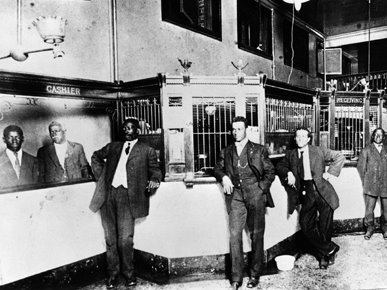
After the demise of Freedman’s Savings and Trust Company, it would take 14 years for African Americans to rally behind another bank. The first bank organized and operated by African Americans was Capital Savings Bank in Washington, D.C. Just four years after it opened, its deposits had grown to over $300,000.

Capital Savings Bank provided the capital essential to the growth of black businesses, capital that white-owned banks were unwilling to lend. The community proudly deposited its money in Capital Savings Bank. The public’s confidence in Capital was rock solid in the early days, enabling the bank to exert a strong, positive economic impact on the community it served. During the Panic of 1893, the bank rode out the tide and was able to honor every obligation on demand. Capital Savings Bank helped many African-American businesses and property owners until it closed in 1902.

Early on, African Americans realized the necessity of accumulating wealth and the subsequent benefits of collective financial security. The Free African Society, the Free Labor Bank, and the Freedman’s Savings and Trust Company laid the groundwork for black capitalism in America. Capital Savings Bank gave African Americans a venue in which to learn about and participate in the business of banking. It was set up to reach all classes of the community so that everyone could learn the valuable economic lessons of being industrious, seeking employment, saving their money, and getting homes.

African-American churches and fraternal organizations built further on that foundation by serving as pooling places for the capital needed to open a bank that was sensitive to the needs of the African-American community. Between 1888 and 1934, 134 black banks were established, while from 1867 through 1917, the number of black businesses increased from 4,000 to 50,000.

Source: Fedpartnership.gov