-
Recent Posts
- Two Pillars Fall: The Loss of Columbia Savings and Adelphi Bank and What It Means for African American Communities
- HBCU Money’s 2025 African American Owned Bank Directory
- Mapping the Gap: The Geography of African American Banks and Credit Unions in 2025
- The Fairy Tale That Wasn’t Meant for Everyone: Pretty Woman and the Racialized Grace Denied to Black Women
- Public Transportation & Infrastructure: Apple Should Help Kill The Car Not Invest In It
Archives
- March 2026
- February 2026
- January 2026
- December 2025
- November 2025
- October 2025
- September 2025
- August 2025
- July 2025
- June 2025
- May 2025
- April 2025
- March 2025
- February 2025
- January 2025
- December 2024
- October 2024
- August 2024
- July 2024
- June 2024
- May 2024
- April 2024
- March 2024
- February 2024
- January 2024
- December 2023
- November 2023
- October 2023
- September 2023
- August 2023
- July 2023
- June 2023
- May 2023
- April 2023
- March 2023
- February 2023
- January 2023
- December 2022
- November 2022
- October 2022
- September 2022
- August 2022
- June 2022
- May 2022
- April 2022
- March 2022
- January 2022
- November 2021
- October 2021
- May 2021
- March 2021
- February 2021
- January 2021
- December 2020
- November 2020
- September 2020
- August 2020
- July 2020
- June 2020
- May 2020
- April 2020
- February 2020
- December 2019
- November 2019
- October 2019
- September 2019
- August 2019
- July 2019
- June 2019
- May 2019
- April 2019
- March 2019
- February 2019
- January 2019
- December 2018
- November 2018
- October 2018
- September 2018
- August 2018
- June 2018
- April 2018
- March 2018
- February 2018
- October 2017
- September 2017
- August 2017
- July 2017
- June 2017
- May 2017
- April 2017
- March 2017
- February 2017
- January 2017
- December 2016
- November 2016
- October 2016
- September 2016
- August 2016
- July 2016
- June 2016
- May 2016
- April 2016
- March 2016
- February 2016
- December 2015
- November 2015
- October 2015
- September 2015
- August 2015
- July 2015
- June 2015
- May 2015
- April 2015
- March 2015
- February 2015
- January 2015
- December 2014
- November 2014
- October 2014
- September 2014
- August 2014
- July 2014
- June 2014
- May 2014
- April 2014
- March 2014
- February 2014
- January 2014
- December 2013
- November 2013
- October 2013
- September 2013
- August 2013
- July 2013
- June 2013
- May 2013
- April 2013
- March 2013
- February 2013
- January 2013
- December 2012
- November 2012
- October 2012
- September 2012
- August 2012
- July 2012
- June 2012
- May 2012
- April 2012
- March 2012
- February 2012
- December 2011
- November 2011
Categories
Meta
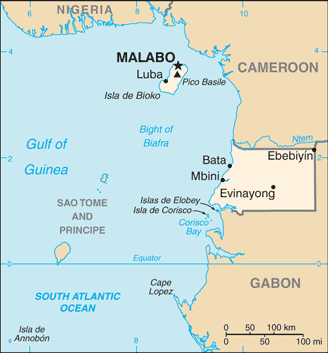
Currencies Of The African Diaspora – Equatorial Guinea
Exploitation of oil and gas deposits, beginning in the 1990s, has driven economic growth in Equatorial Guinea, allowing per capita GDP to rise to over $29,000 in 2014. Forestry and farming are minor components of GDP. Although preindependence Equatorial Guinea counted on cocoa production for hard currency earnings, the neglect of the rural economy since independence has diminished the potential for agriculture-led growth. Subsistence farming is the dominant form of livelihood. Declining revenue from hydrocarbon production, high levels of infrastructure expenditures, lack of economic diversification, and corruption have pushed the economy into decline in recent years and led to limited improvements in the general population’s living conditions.
Foreign assistance programs by the World Bank and the IMF have been cut since 1993 because of corruption and mismanagement, and as a middle income country Equatorial Guinea is now ineligible for most donor assistance. The government has been widely criticized for its lack of transparency and misuse of oil revenues and has attempted to address this issue by working towards compliance with the Extractive Industries Transparency Initiative. US foreign assistance to Equatorial Guinea is limited in part because of US restrictions pursuant to the Trafficking Victims Protection Act.
Equatorial Guinea hosted two economic diversification symposia in 2014 that focused on attracting investment in five sectors: agriculture and animal ranching, fishing, mining and petrochemicals, tourism, and financial services. Undeveloped mineral resources include gold, zinc, diamonds, columbite-tantalite, and other base metals.
Source: Economy provided by CIA World Factbook Africa
HBCU Money™ Business Book Feature – Quench Your Own Thirst: Business Lessons Learned Over a Beer or Two
Founder of The Boston Beer Company, brewer of Samuel Adams Boston Lager, and a key catalyst of the American craft beer revolution, Jim Koch offers his unique perspective when it comes to business, beer, and turning your passion into a successful company or career.
In 1984, it looked like an unwinnable David and Goliath struggle: one guy against the mammoth American beer industry. When others scoffed at Jim Koch’s plan to leave his consulting job and start a brewery that would challenge American palates, he chose a nineteenth-century family recipe and launched Samuel Adams. Now one of America’s leading craft breweries, Samuel Adams has redefined the way Americans think about beer and helped spur a craft beer revolution.
In Quench Your Own Thirst, Koch offers unprecedented insights into the whirlwind ride from scrappy start-up to thriving public company. His innovative business model and refreshingly frank stories offer counterintuitive lessons that you can apply to business and to life.
Koch covers everything from finding your own Yoda to his theory on how a piece of string can teach you the most important lesson you’ll ever learn about business. He also has surprising advice on sales, marketing, hiring, and company culture. Koch’s anecdotes, quirky musings, and bits of wisdom go far beyond brewing. A fun, engaging guide for building a career or launching a successful business based on your passions, Quench Your Own Thirst is the key to the ultimate dream: being successful while doing what you love.
The Finance & Tech Week In Review – 2/18/17
Every Saturday the HBCU Money staff picks ten articles they were intrigued by and think you will enjoy for some weekend reading impacting finance and tech.
Nearly half of current jobs could be automated by 2055, according to a new report / WEF wef.ch/2k6MGrw
Individuals tend to invest in assets that have recently done well. What about institutions? / St. Louis Fed bit.ly/2lnjyAT
Coping with the loss of a spouse? Avoid these mistakes & manage your money through your grief. / FINRA ow.ly/CKeu3094YD3
Want to give your brain a boost? Running may be the answer / WEF wef.ch/2lnje5Z
Here’s why we’re happier as we get older / WEF wef.ch/2kREFv8
Massachusetts Lawmakers Propose Goal of 100 Percent Renewable Energy by 2050 / Renewable Cities buff.ly/2lYSHrZ
Here’s how the US government can bolster cybersecurity / CIOonline ow.ly/9KfO3097BUg
Once, up to 60 million buffalo roamed US. Yellowstone now holds 5000 – and some say it’s too many / New Scientist bit.ly/2kGqrsW
Microsoft app helps people with ALS speak using just their eyes / New Scientist bit.ly/2kHICOS
70% Of Trump Voters Want Clean Energy To Make America Great Again / Clean Technica ow.ly/Fnf33097BzC
Posted in Finance & Tech Review
Tagged buffalo, clean energy, renewable energy, yellowstone
The Vernon Johns Story: Money Is Power Scene
In the Vernon Johns story, this powerful scene shows Reverend Johns trying to explain to his congregation the economic power they can wield in building a strong and vibrant community if they build and own their own institutions. A sentiment that would later be echoed by Martin Luther King, Jr. as he directed African American to move its money into African American owned banks. He also points out the disdain that many communities had (and continue) to have for African Americans, but have no disdain in taking our money. Can we become a self-sufficient people? Just how many things can we not purchase from an African American (Diaspora) company? The scene is powerful and the message still rings as true today as it did then.
Posted in Histronomics
Tagged African American, community building, entrepreneurship, vernon johns
The HBCUpreneur Corner – Tuskegee University’s Kalauna Carter & Kolors By K
Name: Kalauna Carter
Alma Mater: Tuskegee University
Business Name & Description: KolorsbyK is an environmentally friendly, FDA approved Nail Polish Company whose mission is empowering all women from the outside in, one Kolor at a time. A Kolor for each mood, occasion or simply just because, from Bright and Bold, Heavy Metals or Soft Pastels, we at KolorsbyK have the perfect Kolors for you. Each bottle of nail polish as well as the Kolor is handmade and 5 FREE of: Camphor, Toulene, Formaldehyde, Formaldehyde Resins, and Dibutyl Phthalate (DBP) all of which are non-environmentally friendly and cancer causing chemicals. ALL products are cruelty free and are NOT TESTED on animals.
What year did you found your company? 2016; I founded the company the summer shortly after graduating.
What has been the most exciting and/or fearful moment during your HBCUpreneur career? Overall, this has been such a rewarding experience. I have learned so much about the whole concept of how being a business woman works and I am still learning. This entire process thus far has shown me my strengths and weaknesses. I have received so much support. In the beginning, I remember feeling fearful that I would fail or none of my polish would sale, but I remember my parents and my cousin Teresa encouraging me every step of the way.
What made you want to start your own company? The passion behind starting my business was based on the strong connection I have to the environment and its connection to us. I wanted to do something that could be beneficial to all communities and further help us become healthier with the products we select to use on bodies, specifically as women on our nails.
How do you handle complex problems? In situations where complex problems could take place, I try to think with as much logic as I can. First, I think to myself can I fix this and/or if it is out my control. Then, I try to make the best of the complex problem and create a plan on how to avoid it in the future.
Who was the most influential person/people for you during your time in college? The most influential person for me while I was in college was my big sister Kaleah. Growing up she was the most beautiful and smartest girl I knew and I was lucky enough to call her my sister. She was involved in her church, achieved good grades, and still managed her personal life. I admired her for her ability to balance and maintain and I remember telling myself I would do the same when I got the opportunity to go to college as well.
What is something you wish you had known prior to starting your company? The one thing I wish I had been prepared for when starting my company was the bad days, the slow days. Everything is all good when you are doing big numbers, but when things slow down and then the days where you don’t have any sales. Those are days I wish I had been better prepared prior too.
How is vegan nail polish made, and what separates it in particular from traditionally made nail polish? Environmentally friendly nail polish leaves out several chemicals. In regards to KolorsbyK, it is handmade made without the use of animal byproducts making it vegan and without camphor, formaldehyde or formaldehyde resins, Dibutyl Phthalate and Toulene. All of which are prone to cause cancer. Vegan polish is made without the use of animal byproducts.
Technology seems to be disrupting every industry, but most nail services, social media aside, seems largely untouched by technology over the past few decades. Do you see technology disrupting the industry in the near future? If so, in what ways? In regards to technology, I don’t see it disrupting the nail industry in the near future.
In terms of distribution, is Kolors By K focused more on direct to consumer or direct to professionals or mixture of both? Why was that strategy chosen? Being a one woman business, I tend to focus on the direct to consumer sales, but I have had the opportunity to sale a few of my collections to Lavish Nails and Spa in Vancouver, WA and currently have some other opportunities in the works.
According to Nail Magazine, over 75 percent of the approximately 130,000 nail salons as of 2015 in the US were located in states with HBCUs and major African American population centers like California, New York, Illinois, and Massachusetts. The nail industry as a whole is an almost $9 billion a year industry, but African Americans have largely been resigned to consumers. Despite this, very few are owned by African Americans. Why do you believe so few of us have tried our hand at this ownership given its large economic presence in many of our communities? I honestly believe that many of us have not tried our hand at this ownership given its large economic presence in our communities primarily because we don’t have the access to the resources to do so. It will be just that, it will take us HBCUpreneurs to open those doors and create opportunities for those within our own community.

What do you believe HBCUs can do to spur more innovation and entrepreneurship while their students are in school either as undergraduate or graduate students? I believe that HBCUs can hold workshops and small business classes to spark the flame in students and instill in them how important their degree (paper) is, but it is just an important to invest in yourself. It’s fine to work for someone else, but think how much more rewarding it would be to work for yourself when you have the opportunity to do so.
How do you deal with rejection? I deal with rejection from this standpoint “What God has for me, is for me and no man can or will get in the way of that. Whatever doesn’t come to me, was not meant for me.”
When you have down time how do you like to spend it? I like to spend my downtime brainstorming new ideas for KolorsbyK, reading and working out.
What was your most memorable HBCU memory? My most memorable HBCU memory was being able to speak alongside the Madam First Lady, Mrs. Obama at the 2015 Spring Commencement at Tuskegee University. I had to opportunity to speak with her and she gave me some amazing advice that motivated me to start KolorsbyK.
In leaving is there any advice you have for budding HBCUpreneurs? Pray and GO FOR IT. The only thing in YOUR way is YOU.
Website: kolorsbyk.bigcartel.com
Facebook: kolorsbyk
Instagram: @KolorsbyK

Posted in Entrepreneurs
Tagged hbcupreneur, hbcupreneurship, kalauna carter, kolors by k, nail industry, nail salons