Category Archives: Lists

HBCU Money™ Business Book Featuere – Who Rules America? Challenges to Corporate and Class Dominance

254509

Drawing from a power elite perspective and the latest empirical data, this classic text is an invaluable tool for teaching students about how power operates in U.S. society. Domhoff argues that the owners and top-level managers in large income-producing properties are far and away the dominant figures in the U.S. Their corporations, banks, and agribusinesses come together as a corporate community that dominates the federal government in Washington and their real estate, construction, and land development companies form growth coalitions that dominate most local governments. By providing empirical evidence for his argument, Domhoff encourages students to think critically about the power structure in American society and its implications for our democracy.

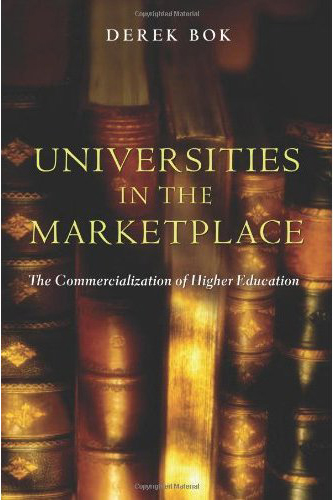
HBCU Money™ Business Book Feature – Universities in the Marketplace

Universities in the Marketplace

Is everything in a university for sale if the price is right? In this book, one of America’s leading educators cautions that the answer is all too often “yes.” Taking the first comprehensive look at the growing commercialization of our academic institutions, Derek Bok probes the efforts on campus to profit financially not only from athletics but increasingly, from education and research as well. He shows how such ventures are undermining core academic values and what universities can do to limit the damage.

Commercialization has many causes, but it could never have grown to its present state had it not been for the recent, rapid growth of money-making opportunities in a more technologically complex, knowledge-based economy. A brave new world has now emerged in which university presidents, enterprising professors, and even administrative staff can all find seductive opportunities to turn specialized knowledge into profit.

Bok argues that universities, faced with these temptations, are jeopardizing their fundamental mission in their eagerness to make money by agreeing to more and more compromises with basic academic values. He discusses the dangers posed by increased secrecy in corporate-funded research, for-profit Internet companies funded by venture capitalists, industry-subsidized educational programs for physicians, conflicts of interest in research on human subjects, and other questionable activities.

While entrepreneurial universities may occasionally succeed in the short term, reasons Bok, only those institutions that vigorously uphold academic values, even at the cost of a few lucrative ventures, will win public trust and retain the respect of faculty and students. Candid, evenhanded, and eminently readable, Universities in the Marketplace will be widely debated by all those concerned with the future of higher education in America and beyond.

HBCU Money™ Business Book Feature – Chicago Defender (Images of America)

9780738561240_p0_v1_s260x420

In 1905, what was to be the largest and most influential black newspaper in the country was born. The Chicago Defender began as a weekly newspaper and led an entire race to leave the oppressive South for a better life in the North. At the helm was one man with a vision and purpose and a slogan that said it all: American race prejudice must be destroyed. Robert Sengstacke Abbott began the Chicago Defender with 25¢ and a dream in his landladys kitchen. The Defender boasted a circulation of more than 230,000 nationally as the newspaper was secretly delivered by Pullman porters to cities everywhere. Almost overnight, Abbott became one of the few black millionaires of his time. By 1920, the Defender tagline was the Worlds Greatest Weekly. The story of the Defender is one of inspiration, struggles, and triumphs and of dreams coming true. It became a beacon and voice for those who for years had no voice. The Defender produced talents such as Langston Hughes, Gwendolyn Brooks, and W. E. B. DuBois. In 1940, Abbotts nephew John H. H. Sengstacke took over as publisher, and by 1956, the Defender was a daily newspaper.

2012’s Top Ten Earning African Americans

oprah_winfrey_amazon_kindle

The top ten earning African Americans earned approximately $700 million last year. It should be noted that these are pre-tax and pre-fee earnings. Because the majority of African America’s highest earners still earn their money through sports and entertainment their earnings are considered earned income by IRS definition and taxed at the highest tax rate which this year is almost 40 percent. Couple that with their agent fees (byproduct of being in the entertainment industry is a need for endless amounts of handlers) that average in the range of 10 percent, the group of ten will pay out almost 50 percent of their earnings. Chris Rock is famously quoted as saying “Shaq is rich, the white man who signs his check….is wealthy.” The income disparity between the top ten earning African Americans and European Americans is a staggering $0.07 for every $1.00 while the overall income gap between African Americans is $0.52 and $0.62 versus Asian Americans and European Americans, respectively.

1 – Oprah Winfrey

Salary: $165 million

Source: Ms. Winfrey owns Harpo, Inc. which owns 50 percent of OWN. OWN which has operated in the red since its inception is estimated to break even this fiscal year. Thankfully, Ms. Winfrey still profits greatly from syndicated shows under her company such as Dr. Phil and others.

2 – Andre Young

Salary: $110 million

Source: Better known as Dr. Dre, his place as the number two spot is due to a one-off moment where HTC paid $300 million for a majority stake in the company that operates the headphones that carry his name Beats By Dr. Dre. Mr. Young owned one-third of the company at the time of the sale.

3 – Tyler Perry

Salary: $105 million

Source: Movies

4 – LeBron James

Salary: $53 million

Source: Miami Heat and endorsements

5 – R. Rihanna Fenty

Salary: $53 million

Source: Music and endorsements

6- Kobe Bryant

Salary: $50 million

Source: Los Angeles Lakers and endorsements

7 – Sean Combs

Salary: $45 million

Source: Endorsements, Clothing, Marketing

8 – Floyd Mayweather

Salary: $40 million

Source: Boxing

9 – Beyonce Carter

Salary: $40 million

Source: Music, endorsements, clothing

10 – Shawn Carter

Salary: $38 million

Source: Music, endorsements, marketing, invest

Source: Forbes

Student Debt Profile By Conference (School By School) – The GCAC

GCAC-logo

Dillard University

Average debt of graduates, 2011 – $36 241

Proportion of graduates with debt, 2011 – 96%

Nonfederal debt, % of total debt of graduates, 2011 – 18%

2010-11 Pell Grant recipients – 67%

Edward Waters College

Average debt of graduates, 2011 – N/A

Proportion of graduates with debt, 2011 – N/A

Nonfederal debt, % of total debt of graduates, 2011 – N/A

2010-11 Pell Grant recipients – 83%

Fisk University

Average debt of graduates, 2011 – $27 345

Proportion of graduates with debt, 2011 – 77%

Nonfederal debt, % of total debt of graduates, 2011 – 37%

2010-11 Pell Grant recipients – 59%

Philander Smith University

Average debt of graduates, 2011 – $35 000

Proportion of graduates with debt, 2011 – 96%

Nonfederal debt, % of total debt of graduates, 2011 – 0%

2010-11 Pell Grant recipients – 76%

Southern University at New Orleans

Average debt of graduates, 2011 – N/A

Proportion of graduates with debt, 2011 – N/A

Nonfederal debt, % of total debt of graduates, 2011 – N/A

2010-11 Pell Grant recipients – 83%

Talladega College

Average debt of graduates, 2011 – N/A

Proportion of graduates with debt, 2011 – N/A

Nonfederal debt, % of total debt of graduates, 2011 – N/A

2010-11 Pell Grant recipients – 85%

Tougaloo College

Average debt of graduates, 2011 – N/A

Proportion of graduates with debt, 2011 – N/A

Nonfederal debt, % of total debt of graduates, 2011 – N/A

2010-11 Pell Grant recipients – 77%

Xavier University of Louisiana

Average debt of graduates, 2011 – $26 106

Proportion of graduates with debt, 2011 – 83%

Nonfederal debt, % of total debt of graduates, 2011 – 25%

2010-11 Pell Grant recipients – 59%

Source: Project on Student Debt