
Category Archives: Books

HBCU Money™ Business Book Feature – The Business of Black Power

51xxf9Od1YL._SY344_BO1,204,203,200_

The Business of Black Power emphasizes the centrality of economic goals to the larger black freedom movement and explores the myriad forms of business development in the Black power era. This volume charts a new course for Black power studies and business history, exploring both the business ventures that Black power fostered and the impact of Black power on the nation’s business world. Black activists pressed business leaders, corporations, and various levels of government into supporting a range of economic development ventures, from Black entrepreneurship, to grassroots experiments in economic self-determination, to indigenous attempts to rebuild inner-city markets in the wake of disinvestment. They pioneered new economic and development strategies, often in concert with corporate executives and public officials. Yet these same actors also engaged in fierce debates over the role of business in strengthening the movement, and some African Americans outright rejected capitalism or collaboration with business. The seven scholars in this collection bring fresh analysis to this complex intersection of African American and business history to reveal how Black power advocates, or those purporting a Black power agenda, engaged business to advance their economic, political, and social goals. They show the business of Black power taking place in the streets, boardrooms, journals and periodicals, corporations, courts, and housing projects of America. In short, few were left untouched by the influence of this movement.

HBCU Money™ Business Book Feature – Ebony & Ivy: Race, Slavery, & the Troubled History of America’s Universities

512ekThWQUL

A 2006 report commissioned by Brown University revealed that institution’s complex and contested involvement in slavery—setting off a controversy that leapt from the ivory tower to make headlines across the country. But Brown’s troubling past was far from unique. In Ebony and Ivy, Craig Steven Wilder, a rising star in the profession of history, lays bare uncomfortable truths about race, slavery, and the American academy.

Many of America’s revered colleges and universities—from Harvard, Yale, and Princeton to Rutgers, Williams College, and UNC—were soaked in the sweat, the tears, and sometimes the blood of people of color. The earliest academies proclaimed their mission to Christianize the savages of North America, and played a key role in white conquest. Later, the slave economy and higher education grew up together, each nurturing the other. Slavery funded colleges, built campuses, and paid the wages of professors. Enslaved Americans waited on faculty and students; academic leaders aggressively courted the support of slave owners and slave traders. Significantly, as Wilder shows, our leading universities, dependent on human bondage, became breeding grounds for the racist ideas that sustained them.

Ebony and Ivy is a powerful and propulsive study and the first of its kind, revealing a history of oppression behind the institutions usually considered the cradle of liberal politics.

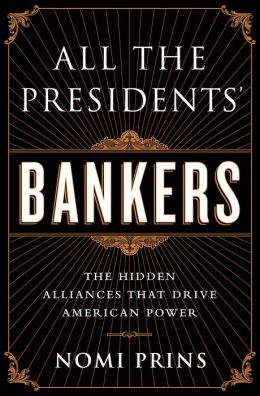
HBCU Money™ Business Book Feature – All the Presidents’ Bankers: The Hidden Alliances that Drive American Power

9781568587493_p0_v3_s260x420

Who rules America?

All the Presidents’ Bankers is a groundbreaking narrative of how an elite group of men transformed the American economy and government, dictated foreign and domestic policy, and shaped world history.

Culled from original presidential archival documents, All the Presidents’ Bankers delivers an explosive account of the hundred-year interdependence between the White House and Wall Street that transcends a simple analysis of money driving politics—or greed driving bankers.

Prins ushers us into the intimate world of exclusive clubs, vacation spots, and Ivy League universities that binds presidents and financiers. She unravels the multi-generational blood, intermarriage, and protégé relationships that have confined national influence to a privileged cluster of people. These families and individuals recycle their power through elected office and private channels in Washington, DC.

All the Presidents’ Bankers sheds new light on pivotal historic events—such as why, after the Panic of 1907, America’s dominant bankers convened to fashion the Federal Reserve System; how J. P. Morgan’s ambitions motivated President Wilson during World War I; how Chase and National City Bank chairmen worked secretly with President Roosevelt to rescue capitalism during the Great Depression while J.P. Morgan Jr. invited Roosevelt’s son yachting; and how American financiers collaborated with President Truman to construct the World Bank and IMF after World War II.

Prins divulges how, through the Cold War and Vietnam era, presidents and bankers pushed America’s superpower status and expansion abroad, while promoting broadly democratic values and social welfare at home. But from the 1970s, Wall Street’s rush to secure Middle East oil profits altered the nature of political-financial alliances. Bankers’ profit motive trumped heritage and allegiance to public service, while presidents lost control over the economy—as was dramatically evident in the financial crisis of 2008.

This unprecedented history of American power illuminates how the same financiers retained their authoritative position through history, swaying presidents regardless of party affiliation. All the Presidents’ Bankers explores the alarming global repercussions of a system lacking barriers between public office and private power. Prins leaves us with an ominous choice: either we break the alliances of the power elite, or they will break us.

HBCU Money™ Business Book Feature – The Little Book of Common Sense Investing

LittleBookBogle

Investing is all about common sense. Owning a diversified portfolio of stocks and holding it for the long term is a winner’s game. Trying to beat the stock market is theoretically a zero-sum game (for every winner, there must be a loser), but after the substantial costs of investing are deducted, it becomes a loser’s game. Common sense tells us—and history confirms—that the simplest and most efficient investment strategy is to buy and hold all of the nation’s publicly held businesses at very low cost. The classic index fund that owns this market portfolio is the only investment that guarantees you with your fair share of stock market returns.

To learn how to make index investing work for you, there’s no better mentor than legendary mutual fund industry veteran John C. Bogle. Over the course of his long career, Bogle—founder of the Vanguard Group and creator of the world’s first index mutual fund—has relied primarily on index investing to help Vanguard’s clients build substantial wealth. Now, with The Little Book of Common Sense Investing, he wants to help you do the same.

Filled with in-depth insights and practical advice, The Little Book of Common Sense Investing will show you how to incorporate this proven investment strategy into your portfolio. It will also change the very way you think about investing. Successful investing is not easy. (It requires discipline and patience.) But it is simple. For it’s all about common sense.

With The Little Book of Common Sense Investing as your guide, you’ll discover how to make investing a winner’s game:

  • Why business reality—dividend yields and earnings growth—is more important than market expectations
  • How to overcome the powerful impact of investment costs, taxes, and inflation
  • How the magic of compounding returns is overwhelmed by the tyranny of compounding costs
  • What expert investors and brilliant academics—from Warren Buffett and Benjamin Graham to Paul Samuelson and Burton Malkiel—have to say about index investing
  • And much more

You’ll also find warnings about investment fads and fashions, including the recent stampede into exchange traded funds and the rise of indexing gimmickry. The real formula for investment success is to own the entire market, while significantly minimizing the costs of financial intermediation. That’s what index investing is all about. And that’s what this book is all about.

HBCU Money™ Business Book Feature – Buying And Selling Timber And Timberland

91W1+LBXHhL._SL1500_

The 500 million acres of United States timberland isn’t just owned by foresters and paper companies. Increasing amounts have been bought by private investors (often buying just a few hundred acres), hedge funds, and big institutions. Why the sudden interest in one of the world’s oldest industries?

We live in a world where the S%P 500 can lose over half its value in 15 months, where home values recently tumbled by more than 30% nationwide (immediately after reaching record highs), and even “safe” municipal bonds returning just 3% are at risk of default. In contrast, timberland returns have been relatively stable over time, offer unique tax advantages, and function both as a hedge against inflation and a return producing investment.

The author (a private investor) has dedicated significant time and resources to researching the details of timberland ownership and shares his research and insights – both for individuals interested in purchasing timberland as well as those managing the forested lands they already own.