Category Archives: Histronomics

HBCU Money™ Histronomics: New Mexico’s 1st African American Town Was Founded By An HBCU Couple In 1903

“Up, you mighty race, accomplish what you will.” – Marcus Garvey

“Frank attended Morehouse College and Fisk University. While in school he learned about homesteading and its requirements. While working as a teacher in Georgia, he married Ella Louise McGruder. Ella was also a well-educated teacher, a graduate from the Haines Institute.

After he was threatened by the Ku Klux Klan, Frank’s father encouraged him to move West. Frank’s father was a Buffalo Soldier during the Mexican-American War. As a child he heard stories about New Mexico from his father. Boyer and two of his students traveled to New Mexico Territory in 1896. He arrived in the Pecos River Valley in 1898 near the community of Roswell, where he worked in the courts. In 1901 Ella and their four children joined him in New Mexico.” – National Park Service

New Mexico jointed the United States as the 47th state in the United States on January 6, 1912. It is currently home to approximately 2.1 million people with almost 40,000 African Americans across the state’s population. In 1999, the state established the Office of African American Affairs that has been tasked with assisting the interests of the state’s African American population. Blackdom’s legacy is still profound among the residents of the state and still signifies the power of building institutions and community that look to empower people of African descent. New Mexico PBS in 2010 produced a documentary detailing the story of a time not so long ago and the impact it still carries today. The story of how an HBCU couple changed the landscape of the Southwest forever and added to the rich history of African Americans place throughout.
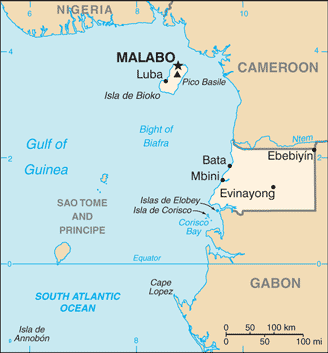
Currencies Of The African Diaspora – Equatorial Guinea

ek-map
Exploitation of oil and gas deposits, beginning in the 1990s, has driven economic growth in Equatorial Guinea, allowing per capita GDP to rise to over $29,000 in 2014. Forestry and farming are minor components of GDP. Although preindependence Equatorial Guinea counted on cocoa production for hard currency earnings, the neglect of the rural economy since independence has diminished the potential for agriculture-led growth. Subsistence farming is the dominant form of livelihood. Declining revenue from hydrocarbon production, high levels of infrastructure expenditures, lack of economic diversification, and corruption have pushed the economy into decline in recent years and led to limited improvements in the general population’s living conditions.
Foreign assistance programs by the World Bank and the IMF have been cut since 1993 because of corruption and mismanagement, and as a middle income country Equatorial Guinea is now ineligible for most donor assistance. The government has been widely criticized for its lack of transparency and misuse of oil revenues and has attempted to address this issue by working towards compliance with the Extractive Industries Transparency Initiative. US foreign assistance to Equatorial Guinea is limited in part because of US restrictions pursuant to the Trafficking Victims Protection Act.
Equatorial Guinea hosted two economic diversification symposia in 2014 that focused on attracting investment in five sectors: agriculture and animal ranching, fishing, mining and petrochemicals, tourism, and financial services. Undeveloped mineral resources include gold, zinc, diamonds, columbite-tantalite, and other base metals.

equatorial-guinea-currency-central-african-cfa-franc-hd-photo-14

Equatorial Guinea

Equatorial Guinea

equatorial-guinea-currency-central-african-cfa-franc-hd-photo-15-300x200
Source: Economy provided by CIA World Factbook Africa

The Vernon Johns Story: Money Is Power Scene

In the Vernon Johns story, this powerful scene shows Reverend Johns trying to explain to his congregation the economic power they can wield in building a strong and vibrant community if they build and own their own institutions. A sentiment that would later be echoed by Martin Luther King, Jr. as he directed African American to move its money into African American owned banks. He also points out the disdain that many communities had (and continue) to have for African Americans, but have no disdain in taking our money. Can we become a self-sufficient people? Just how many things can we not purchase from an African American (Diaspora) company? The scene is powerful and the message still rings as true today as it did then.

Currencies Of The African Diaspora – Egypt

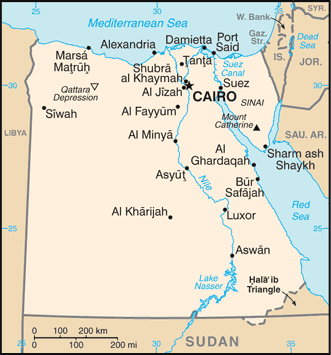
eg-map

Occupying the northeast corner of the African continent, Egypt is bisected by the highly fertile Nile valley, where most economic activity takes place. Egypt’s economy was highly centralized during the rule of former President Gamal Abdel NASSER but opened up considerably under former Presidents Anwar EL-SADAT and Mohamed Hosni MUBARAK. Cairo from 2004 to 2008 pursued business climate reforms to attract foreign investment and facilitate growth. Poor living conditions and limited job opportunities for the average Egyptian contribute to public discontent, a major factor leading to the January 2011 revolution that ousted Mubarak. The uncertain political, security, and policy environment since 2011 caused economic growth to slow significantly, hurting tourism, manufacturing, and other sectors and pushing up unemployment. Weak growth and limited foreign exchange earnings have made public finances unsustainable, leaving authorities dependent on expensive borrowing for deficit finance and on Gulf allies to help cover the import bill. Egypt’s current Constitution passed in a referendum that took place in January 2014.

GDP
$945.4 billion (2014 est.)
$925 billion (2013 est.)
$906 billion (2012 est.)
$284.9 billion (2014 est.)
GDP GROWTH
2.2% (2014 est.)
2.1% (2013 est.)
2.2% (2012 est.)
GDP COMPOSITION
agriculture: 14.6%
industry: 38.9%
services: 46.5% (2014 est.)
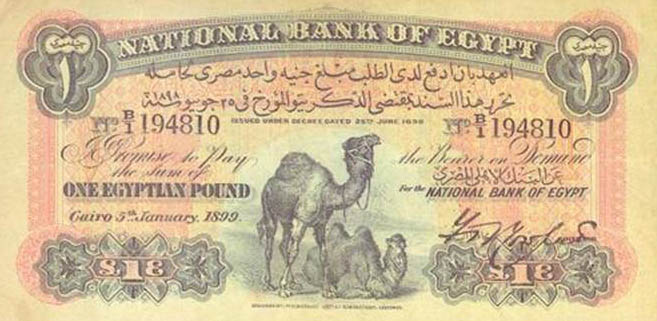
Egyptian_First_pound_bill
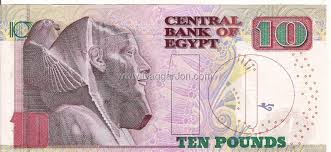
images
url
egypt_10_milliemes_1958
Source: Economy overview provided by CIA Factbook

Currencies Of The African Diaspora – Djibouti

dj-map

Djibouti’s economy is based on service activities connected with the country’s strategic location as a deepwater port on the Red Sea. Three-fourths of Djibouti’s inhabitants live in the capital city; the remainder are mostly nomadic herders. Scant rainfall limits crop production to small quantities of fruits and vegetables, and most food must be imported. Djibouti provides services as both a transit port for the region and an international transshipment and refueling center. Imports, exports, and reexports – primarily of coffee from landlocked neighbor Ethiopia – represent 70% of port activity at Djibouti’s container terminal. Djibouti has few natural resources and little industry. The nation is, therefore, heavily dependent on foreign assistance to help support its balance of payments and to finance development projects. An unemployment rate of nearly 60% continues to be a major problem. While inflation is not a concern, due to the fixed tie of the Djiboutian franc to the US dollar, the artificially high value of the Djiboutian franc adversely affects Djibouti’s balance of payments. Djibouti’s reliance on diesel-generated electricity and imported food and water leave average consumers vulnerable to global price shocks. The government has emphasized infrastructure development for transportation and energy and Djibouti – with the help of foreign partners – has begun to increase and modernize its port capacity.

DJ37

Djibouti-currency

F2262

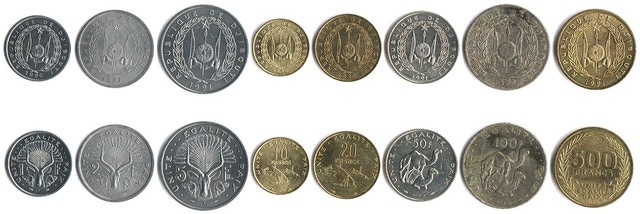
Djibouti_money_coins

Source: Economy provided by CIA World Factbook Africa