Category Archives: Editorial

Guy Kawasaki & Stanford Reminds African America Why HBCUs Are Needed Via Instagram

unnamed

After a crisis we tell ourselves we understand why it happened and maintain the illusion that the world is understandable. In fact, we should accept the world is incomprehensible much of the time. – Daniel Kahneman

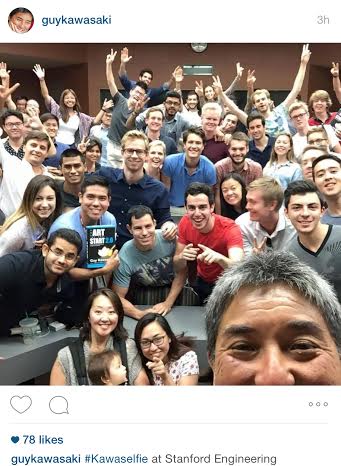
They say a picture is worth a thousand words. If so, then the aforementioned picture should be a thousand words about why HBCUs are African America’s best opportunity for access and opportunity. Unfortunately, the logic the past 60 plus years when a picture like this has surfaced is that African America must try harder or do better to gain access or that even presence of one or two of us is success.

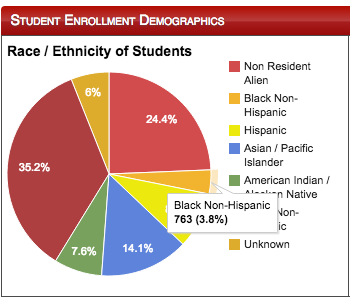
The picture itself shows Guy Kawasaki, one of Apple’s early employees who is now a Silicon Valley angel investor, and an engineering class at Stanford University. Stanford is without question one of America’s premier research universities ranking eleventh with almost $1 billion annually in research expenditures. It is the university that laid the ground work for Silicon Valley itself to come into existence as well as being the environment that produced Google. Sergey Brin and Larry Page, Google’s co-founders, met there while studying computer science doctorates. Stanford also has one of the country’s largest endowments  with $21.4 billion – an amount that is ten times all 100 plus HBCU endowments combined just for perspective. Yet, despite this treasure trove of resources the school’s demographics (see below) do not even come close to matching the African American population in the state of California (7.2 percent) or the country (13.2 percent) as a whole.

Screen Shot 2015-08-19 at 3.20.48 PM

African America does not seem to truly understand the value in investing in its own institutions as other groups seem to in their own. We often do what is best for America, while other groups do what is best for themselves. HBCUs still produce the majority of African American professionals in America. In the engineering field alone, HBCUs currently produce 40 percent of African American engineers (see below) while only constituting three percent of America’s colleges and universities. The value of these institutions is unquestionable, but that value is not marketed or conveyed consistently to African America so that the community truly understands the value and importance of the opportunities provided through the institutions existence, the opportunity they provide, and why they need more attendance and financial support from African America itself.

Screen Shot 2015-08-21 at 5.39.09 PM

HBCUs themselves must also continue to build their programs. There are new fields of engineering to explore. Fields like bioengineering, space engineering, and other emerging engineering disciplines must be offered. HBCUs must think beyond just the basics of chemical, electrical, and mechanical engineering. Premier HBCU engineering programs like North Carolina A&T State University (see below) truly are at the forefront of this expansion and other HBCU engineering programs must forge ahead. They must also continue to expand their research on the graduate level. Research among the top 20 HBCUs constitutes only $450 million in research expenditures, again while a university like Stanford does almost $1 billion alone. Much of the true innovation that happens in the US and around the world happens at the graduate level where the intellectual cream meets. There is no reason that the brightest minds from HBCU undergrads should have to leave the HBCU ecosystem or miss out on opportunities because our graduate schools are an after thought of leadership. We need our intellectual capital to circulate and remain within our ecosystem.

screen-shot-2016-09-08-at-12-03-33-am

The next Google, Facebook, or Microsoft lies within an HBCU engineering department. Perhaps it will be HBCU engineers that will help put the first African country on the moon, Mars, or beyond as they once did for NASA and America. HBCU engineering departments may come together and create our version of Silicon Valley. Whatever the future holds, as Dr. John H. Clarke said, “I am saying what ever the solution is, either we are in charge of our own destiny or we are not in charge.  On that point we got to be clear, you either free or you a slave.” A picture is worth a thousand words, but we only need to remember a few, the power to be free is in our own hands, hearts, and minds.

HBCU Money™ Turns 4 Years Old

By William A. Foster, IV

As you enter positions of trust and power, dream a little before you think. – Toni Morrison

headstart2jpg-81a6c165abdc0f97

Going into our fourth year broods us with a certain calm. HBCU Money™ continues to be a labor of love and passion. The past twelve months while not seeing the growth we expected were still progressive towards our ultimate goal of being a full service financial journalism company. Last year, we brought HBCU Politics™, a political journalism site, into our fold completely with plans to add more sites in the coming years. We believed then and we believe now that there can never be too many quality voices speaking to the eclectic interest of HBCUers around the world. Entrepreneurship is about patience and perseverance. Something we here at HM continue to exude in spades despite setbacks along the way. The HBCUpreneur Corner™ continues to highlight the growing presence of entrepreneurs coming from HBCU ranks who are no longer content at getting jobs, but creating them. Our interview last year with HBCU endowment star, The University of Virgin Islands’ executive director Dr. Haldane Davies, was another shining moment for us giving voice to HBCUs who are lesser known by the mainstream as they forge ahead building a stronger foundation for generations to come. These stories and more are the ones we will continue to tell along with the pertinent economic, financial, and investment information that is vital to our community and its growth.

It is a continued honor to serve as Editor-In-Chief of HBCU Money™ and look forward continuing to do so. There is no time to rest. Enjoy the moment. Now, let us get back to work because as our motto states “Our Money Matters”.

What If LeBron James Were A Doctor?

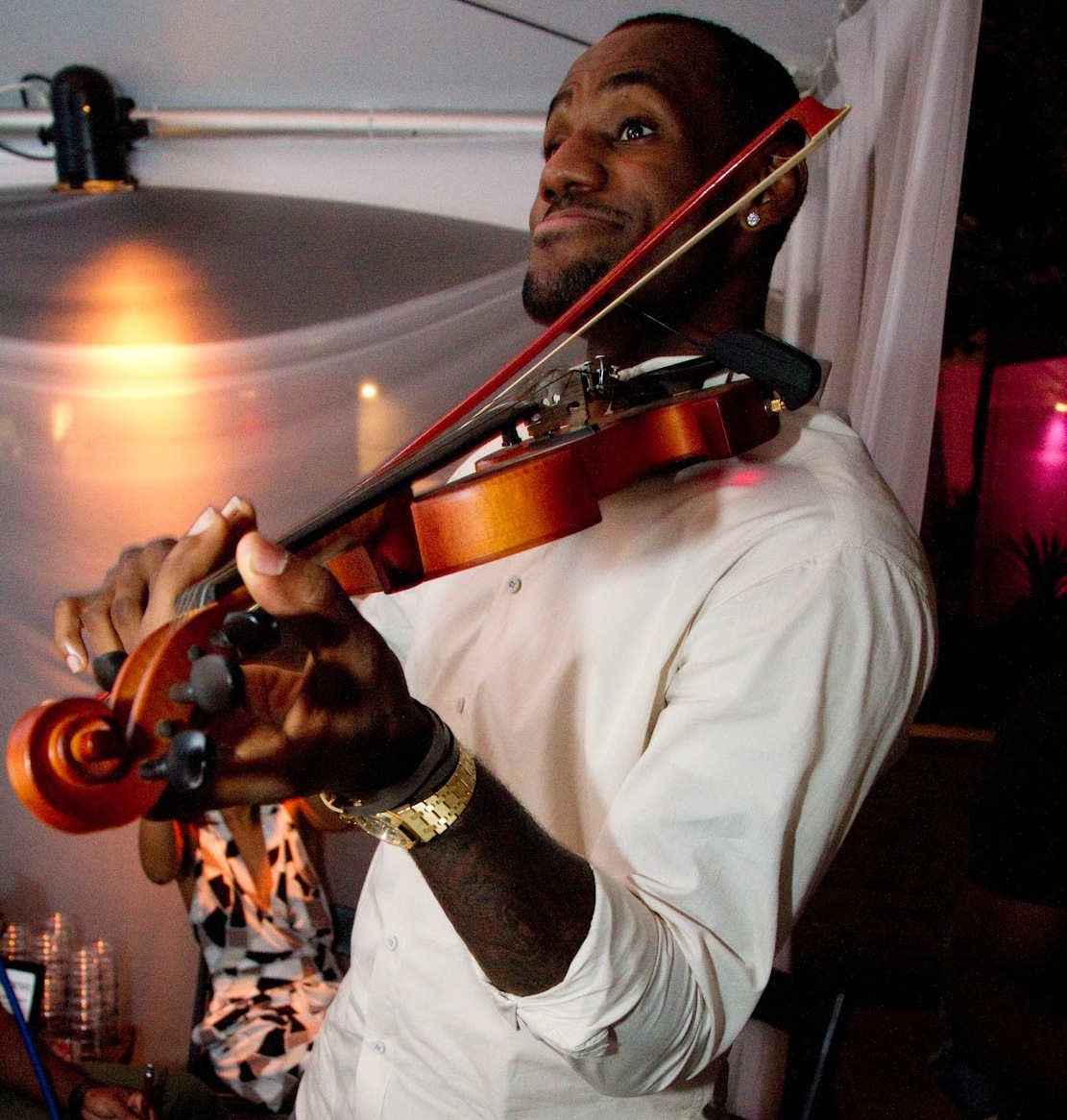
LeBron and Chris playing violin and singing.

The saddest thing in life is wasted talent. – Lorenzo Anello

Somewhere in an alternative universe a call goes out over the hospital intercom, “Paging Dr. James! Dr. James to operating room, please.” Into the operating room walks a 6’8 250 pound surgeon African American man who smiles at his surgical team, but sternly ask, “Has the patient been prepped?” The staff acknowledges to the doctor the patient has and thus the operation begins. For the next few hours it is a battle of skill, touch, and finesse. With nerves of steel it all comes down to a final cut. The doctor steps back, takes a deep breath, and goes in for the final incision. Success! The patient is responding  better than expected and the surgeon leaves the room to debrief the family. As he speaks with the family cheers and tears of rejoicing come from the crowd of family and friends gathered.

There are currently 5,005 and 1,015 African American males on college football and basketball Division 1 rosters on any given year, respectively. That means every year over 6,000 African American males believe either in the coming year or in a few years they will be eligible to become a professional athlete. The NCAA itself reports that only 1.7 percent of college football players will go on to play professionally and 1.2 percent of college basketball players will go to the NBA, respectively. That means that in any given year out of those 6,000 plus athletes, less than 100 will actually go pro. However, speaking with an ambassador at a local Division 1 program with around 100 players on their football roster just how many of his players believe they can go pro – he said at least half. Inquiring further how many really have a chance and he said maybe two. How can there be such a gulf between those two viewpoints? Warren Goldstein’s examination of William Rhoden’s book $40 Million Dollar Slaves offers us some insight, “Consequently, most black athletes lost their connection to a “sense of mission . . . of being part of a larger cause. Young athletes, in particular, dropped the thread that joins them to that struggle and became, instead, a “lost tribe,” adrift in the world of white coaches, boosters, agents, club officials, network executives — those profiting from black muscle and skill.”

African America is desperately in need of more doctors. The Agency for Healthcare Research and Quality reports there are 209,000 primary care physicians in the United States, but only 3.9 percent of that number are African American or a pinch over 8,000. An article in the Philadelphia Tribune reports, “Studies also indicate that when minority patients can select a health care professional, they are more likely to choose someone of their own racial and ethnic background.” That means at current, there is 1 African American physician for every 4,938 African Americans, but the nation as a whole has 1 physician for every 1,435 citizens in the United States. In order for African American to reach the national average, there would need to be an increase in the number of African American physicians by over 300 percent. The state of African American males in the medical field is even more acute according to the Journal of Blacks in Higher Education who recently reported, “A new report from the Association of American Medical Colleges (AAMC) finds that the number of Black males who are applying to medical school has not increased since 1978. In 1978, 1,410 Black males applied to U.S. medical schools. In 2014, the figure was 1,337. In 1978, 542 Black men matriculated at U.S. medical schools, compared to 515 in 2014.”

Unfortunately, basketball and football often detour thousands of African American males (those who do manage to escape prison) from childhood where they are warped early with promises of fame and riches with even the slightest hint of athleticism. This is not to say sports can not be a valuable part of a boys’ upbringing, but we have made it their central and primary focal point. With only 2,000 available slots to fill out all NFL and NBA rosters and even with turnover the odds of these young men finding their way onto one is virtually null. However, primary care physicians and dentist comprise 350 000 positions in the country combined and unlike athletics which is not expanding its rosters or number of teams, there is actually a growing demand for more doctors and dentist in the country. As for the pay, pro-rated until age 65, an NFL player makes a median salary of $34,200 and a NBA players makes a median salary of $144,000, while a primary care physician’s median salary is $220,000. And the economic cost to the community because of the physician shortage is $4.4 billion annually in just lost opportunity wages alone. Not including the lost wages our community suffers due to illness and poor access to primary physicians. Health is wealth takes on whole new meanings.

And it is not just the medical field that is suffering from this brain dumbing (drain). At a time when there is an acute need for Civil Rights lawyers’ in African America along with entrepreneurs, farmers, technologist, psychologist, and even those who can fill a myriad of new green vocational and professional jobs on the horizon, we are ghastly underrepresented in matters of the mind and overrepresented in matters of the body. Claims that the K-12 system fails these young boys would be correct, but then again so do the parents who are largely force their sons down these paths as they too believe it is the only option. 247Sports reports, “For the typical (AAU) program that is traveling to two national tournaments and one regional tournaments the costs end up being (approximately) $1,500-$2,000 per player.” Imagine if you will though that same $1,500-$2,000 per player being spent was on supplemental education for the boys in academic development. The current public elementary and secondary spending per student in the United States is $12,401. The use of the amount spent on them traveling alone if diverted to the aforementioned supplemental education would be an increase of 12 to 16 percent in the value of the education they receive annually and may have a significant impact on increasing the abysmal high school graduation rate for African American males which is currently 59 percent. We may not have an abundance of resources, but there needs to be a discussion and critique of how we are using what we have.

The repercussions of the dumbing down of African American males is already being felt through the social fabric of our communities. African America is the only ethnicity where females outnumber males in employment. This has consequences as it relates to marriage, crime, and a host of other social issues, but we are not paying attention to the damage we are doing to our boys often until it is too late. We are hypnotized by the LeBron Jameses as being the rule for our boys instead of realizing the exception. That most of these young men with athletic aspirations will never see a professional athlete’s paycheck and if they do the career’s are often short and communal impact is zero. We can kid ourselves into thinking that these athletes bring something to our community of value, but it is just entertainment and disillusioned opportunity. Nothing more and nothing less. Meanwhile, what happens to the thousands who do not make it, who lack the skills to do anything meaningful and substantive, to become a valuable asset to the social, economic, and political fabric of the building of African America. They fall by the wayside and we pay the brutal cost as a people, but are we not entertained?

For the same amount of money we dedicate to Pop Warner athletics, if we just took half of it and put it toward “Pop Warner” academics, STEM camps, chess clubs, and other initiatives that made little black boys feel that we value their minds just as much as their bodies we would see a paradigm shift in a generation. We lay so much blame on “others” for what is happening to our boys and take very little ownership or onus on ourselves for what is happening to them. Pimping them out for decades of their life with the hope of lottery style “winnings” instead of sustainable life and community development, then look perplexed when they and our communities lack the basic infrastructure to become viable. A wise man once said never put your destiny in the hands of others, yet we continue to do so at the expense of these young boys. We maybe entertained, but we are certainly not fulfilled.


Harriet Tubman On The Twenty Dollar Bill? The Problem With Symbolism As Progress

I freed a thousand slaves, I could have freed a thousand more if only they knew they were slaves. – Harriet Tubman

20-dollar-bill-transfer-transferframe198

Recently, Harriet Tubman was chosen by New York-based advocacy group Women on 20s as the winner of its campaign to put a woman’s face on the $20 bill. Excuse us while we have flashbacks of 2008 when America voted and elected the first (half) African American president. The country rejoiced and patted itself on the back. Apparently, electing a (half) African American was enough to cleanse the institutional problems that African America faced and continues to face even almost eight years later. But we must be making progress, right? It is 2015 and we elected a (half) African American as president after all. The sad irony about Harriet Tubman being elected to be on the twenty dollar bill is that that her death in 1913 represents arguably the period of economic apex for African America.

2011-wealth-gaps-17

Harriet Tubman may or may not find her way onto the twenty dollar bill, but what of the substantive reality of African America’s economic situation. Between 1888 and 1934, African America started 134 banks. Today, there are less than 25 banks left that do not control even half of one percent of African America’s buying power. African American owned credit unions comprise 340 institutions, but even with that number still do not combine with the banks to even control one percent of the $1.1 trillion in African American buying power. As a result, African Americans are often subject to predatory financial services (even by our own people like Magic Johnson and Russell Simmons), redlining, gentrification, and lack of small business growth which directly impacts wealth creation and community employment. To the last point, the lack of business ownership by African America is frightening since the days of Black Wall St. After owning 500 hospitals in the early twentieth century, African America is down to one leaving serious questions about the economics of the community’s long-term health prospects. The wealth divide between African American and every other group is staggering. Latino America, the second poorest group, is still eleven percent wealthier than African America. One could argue their willingness to engage in labor that African America qualitatively feels is beneath them while increasing their business ownership in their own communities is part of that narrative. Asians and European America have 14 times and 20 times the amount of wealth that African America has, respectively (chart above). In large part, the other three groups have a strong investment in business ownership. Something that is often a byproduct of either a strong banking system or in the Latino American case a strong shadow banking system within the community that is largely reliant on cash and admonishes the use of debt. African American firms (chart below) currently only account for 0.4 percent of America’s total $30 trillion in annual firm sales. This is one of the reasons that the unemployment rate in our community remains stubbornly twice that of the overall rate. While other groups can hire within their own community, African America is largely dependent on public sector employment and external private sector employment, where more times than not they are a quota hire.

sales at 11.56.57 PM

Any time you hear community activist talk about ways to solve the ails of African America’s economic there is always this belief that if we can just get African Americans to circulate the dollar, then all would be solved. Unfortunately, the institution most in charge of circulating the dollar – the bank – we prefer to use ones that are not owned by our community. It is one of the key reasons the dollar circulates less than one time in our community. Circulation also entails more than consumer behavior which is often the thing that is promoted most. However, putting deposits in an African American bank that in turn make loans so an African American family can buy a home in an African American neighborhood and strengthen its social fabric or an African American small business owner can borrow to start a business and employ the community so that unemployment rates are not reaching 20 percent plus like was the case in Detroit often seems loss on us. We can not be too upset though because we are often listening to these same community activists who have little or no economic or financial backgrounds. Collectively known as, the preachers, teachers, and reachers crew. For some reason, we have attributed to knowing the higher power as also knowing supply and demand. The second group, teachers, are anyone who thinks because they have a college degree in anything that they are economically qualified to advise. Lastly, the reachers who think that the federal government somehow can wave some magic economic wand and correct our economic woes.

Seemingly gone are the days of A.G. Gaston and Madam C.J. Walker, two African American titans of business ownership in the early twentieth century. These “activist” both started banks in their communities. Ensuring not only strong capital circulation, but employment as well. Today, where everyone deems themselves an “activist” because it has become the popular thing to do, while adding absolutely no substance or meat and potatoes to their community’s institutional infrastructure beyond marching up and down the street, posting articles on Facebook, or in this case voting for Harriet Tubman to be on the twenty dollar bill. We are not discussing actual economic equality or freedom. We are discussing the faux appearance of it and you know what they say you get what you pay for. It speaks largely to our own economic and financial illiteracy. Unfortunately, even many of the “educated” among us are just as guilty if not more so. African America’s educated behave as if they are somehow wealthy because they have a degree and in turn buy too much house, the latest fashion, or foreign car, but are as asset poor as those on Section 8 living. The accumulation of stocks, emergency savings, investment properties, intellectual property, or other assets that produce wealth and passive income are an absent concern.

Just as Harriet could not free those who did not realize they were slaves, it seems we still have a long way to go to convince many of our own that just having an income, a degree, or using other communities economic ecosystem does not mean you have entered the world of economic freedom. The trip along Harriet’s underground railroad required a sacrifice by individuals and families. It was not a comfortable journey, but it was a real journey toward the start of freedom. We are poorer today than when Harriet died over 100 years ago, an institutional economic ecosystem of our own that is going extinct, but her face on the twenty dollar bill has to be a sign of our freedom, equality, and progress, right? One wonders if Harriet’s revolver still works.

Are African American Churches Derailing African America’s Economic Progress?

“You know our people, they want their leaders to be prosperous. One hand washes the other.” – Brother Baines (character from Malcolm X)

black-church-inc

Recently in Third Ward, an area rich with historic significance to the city’s African American population there was a battle being engaged between the neighborhood of Oak Manor University Woods and their “neighbor” Wheeler Avenue Baptist Church. WABC had already purchased one entire street of forty some homes in the neighborhood and was in the process of expanding once again as its membership had swelled. The church for all intentions appears on its way to becoming one of Houston’s mega-churches. For Oak Manor University Woods, they seemed to be getting closed in on all sides. The current president of the Oak Manor University Woods Civic Club Bettie Patterson said, “I thought the University of Houston would be our albatross, not Wheeler Avenue.” She was referring to the University of Houston’s presence in Third Ward, which itself has spurred a great deal of the rise in gentrification in the area as the school’s profile as a tier one university has attracted a lot of redevelopment in the area. Many homes in the neighborhood on the tax roles see their lots valued for more than the actual homes themselves. Inside Houston’s Inner Loop, land and affordable housing have become something of an oxymoron. Houston, the fourth largest city in the United States, has been booming with high oil prices spurring most of that boom. Unfortunately, African Americans inside the loop have been the primary victims of that boom. Sitting on what has been historically underdeveloped and depressed land and neighborhoods, many developers (or churches) come in and offer many African American home and landowners under market value prices to scoop up the land. Most lack the financial aptitude or savviness to deal with these fast talking developers or churchmen claiming to be doing God’s work and end up selling their land and homes. In the aftermath, they are not able to afford to stay in their community or forced to sell as taxes have skyrocketed due to rising values and payments they can not maintain, with many of the community’s senior citizens on fixed income. In the Oak Manor University Woods and Wheeler Avenue Baptist case, where the church could be working with the neighborhood to build affordable housing, it is instead engaged in battle that will eventually lead to over sixty homes being demolished and over 200 potential African Americans not in the area. The irony, those 200 may drive from some distance to attend the church and after church if they intend to eat or do any shopping, virtually none of the stores will be owned by African Americans in the area or community. It appears we have pushed all of our chips in on the church, and if it can not save us, then we do not want to be saved.

In some ways, I feel sorry for the African American church. It is essentially being asked to be everything institutionally in the development cycle for African America. Every institution whether it is a neighborhood, church, bank, lobbying group, etc. falls under one of three institutional categories of social, economic, or political. The SEP cycle of development follows that exact order in fact. Social institutional development comes first, then economic institutional development, and lastly political institutional development. A church, by its very nature, is suppose to be a social institution. It is a place where social norms and cultural capital is circulated amongst a community. Other social institutions are things like families, neighborhoods, and schools. All circulating a particular a set of norms and values. Economic institutions are businesses, investors, and even banks. The latter has the unique charge of helping circulate capital and exporting financial risk from the community that owns it onto other communities. An acute problem African Americans experience with predatory financial services from institutions like Wells Fargo who just settled for $175 million with the Department of Justice for its predatory behavior with African Americans. Political institution examples are political parties, lobbyist, and PACs. The institutional cycle always follows the same pattern. Currently, the black church though is being asked to be all three. A feat that no institution can pull off. College and universities are social institutions that often serve the needs of economic and political institutional development through their research, but ultimately are still social institutions. The last I checked, there is no research being conducted in the halls of black churches.

Yet, African America has put all of its stock into this institution and starving the independent development of a strong economic and political institutional development. Although many churches are profitable like businesses, they often lack the serious institutional infrastructure or aptitude to operate as such. Last year, HBCU Money’s first ever African American Credit Union Directory in 2014 uncovered some startling findings about the church’s role in African America’s economic institutional landscape. Religious affiliated credit union make up 5.6 percent of US credit unions, while African American religious affiliated credit unions comprise approximately one-third of all African American credit unions and almost one-fourth of all US religious affiliated credit unions. In California, all seven African American credit unions in 2014 were religious affiliated. The sensible thing for them to do would have been if they absolutely had to form their own (as opposed to banking at an African American owned bank or credit union) was for all seven to form one and call it the “Insert famous African-American religious figure from California” of California Federal Credit Union. It would have been a credit union with seven branches, 1 485 members, and $1.7 million in assets. Instead, the median membership and assets among the seven separately was 152 and $165 000, respectively. In other words, not worth the paperwork it probably took to form them and likely limited opportunity for any real scalability or sustainability.

unbanked_large_cities

It is both a gift and curse that one-third of African American credit unions are religious based. The gift is that any opportunity for African Americans that increases financial engagement is a benefit. The Center for American Progress reports, “For African Americans, the unbanked rate declined slightly from 21.4 percent in 2011 to 20.5 percent in 2013, and the underbanked rate decreased from 33.9 percent to 33.1 percent.” Nationally, the figure for unbanked and underbanked was 7.7 percent and 20 percent, respectively. Having more financial institution options is a good thing. The presence of credit unions, be they religious or not, in African America decreases the probability of predatory financial services like payday loans that are often prevalent in our community coming in to fill the void. However, the problem for having such a disproportionate amount of credit unions being religious based is that these credit unions have no ability to scale as the aforementioned example in California showed, which further means they are limited in the types and number of financial services and products they can offer. The reality is that churches are not equipped to be financial institutions and religious based credit unions are limited to the size of their congregation to their growth potential. They also tend to lack the intellectual expertise to grow and perform the functions that provide for stability of operation for their members and the communities they are in. Often times, these religious based credit unions come across as nothing more than the ability for the church to control more of and keep an eye on the congregation’s purse strings to make sure they are getting their cut. This is problematic after reporting two African American banks closed their doors to start 2015, thereby reducing the number of African American banks to twenty-three. A far cry from the 1990s, when there were over fifty African American owned banks.

African American churches are also siphoning off much needed capital from other institutions within the community where capital is vitally needed. Recently, an example of this was shared by Jarrett Carter, Sr. in an editorial for HBCU Digest where he shared, “Last year, I gave more than $10,000 to my church, $1,500 to Alpha Phi Alpha Fraternity Inc., and $150 dollars to my alma mater.” In a 1987 study by Emmett Carson for Joint Center for Political Studies reported, “Over two-thirds (68 percent) of all dollars that are contributed by blacks to charity go to the church.” A figure at the time that was higher than the national average of 46.9 percent. It is hard to imagine that although the study is almost thirty years old that much has changed given the disclosure by Mr. Carter. Some may argue that it has in fact gotten worse. Unfortunately, such a disproportionate amount being given to churches with our limited income leaves little for investment in the rest of African America’s institutions. Over the past 100 years African American owned hospitals have decreased from 500 to 1, African American boarding schools have decreased from 100 to 4, the institutional gap in HWCU/HBCU endowments has grown from 46:1 to 106:1 over the past 20 years, HWCU/HBCU research expenditures gap is 30:1, Harlem and countless other African American communities have been gentrified, and the wealth gap among all other groups (except Native Americans) and African Americans continues to severely widen. Yet, the African American church continues to be a booming industry. As a result we see even the African American non-religous based credit unions and banks anchoring their “business” products to churches.

Let me be clear, I am not against the African American church. It has been a vital institution in our community. Its history and place in our communities is important, but it can not and should not be asked to solve all of our problems. A religious institution is there to be part of our community’s social institutional fabric, but it is not there to enrich and strengthen us economically or politically. Each institution in a community has a purpose and function. None more important than the other and all are needed. The acute investment that African America has put into its churches though has created a situation where all others starve and this has created an ongoing crisis that is on the brink of disaster. Church based credit unions are not setup to make small business loans, which are vitally needed to created more African American businesses and create jobs in our communities. They are not setup to decide which STEM and humanities research should be given grants that can one day be turned into private application or help shape policy, and nor should they be. That is not what their purpose is or ever was intended to be.

620-FF-download

Overall, church attendance in America is declining (above) and has been for the past sixty years, and as is often the case we are behind the curve of change. This despite African American men and Millennials being one of the fastest declining groups in church attendance. African American men are almost twice as likely as African American women to not attend church. Financially, this is not so much of an issue for the church, since African American women lead virtually in every economic category. African America is the only group where the women outnumber the men in employment and are predominantly head of households. The irony if there is any, is that the vast majority of African American churches are still headed by men, but that is another article for another time. African American women hold the proverbial purse strings and they are in the church.

If African America is to ever progress economically, then it needs a lesson in portfolio diversification also known as do not put all your eggs in one basket, one stock, or one institution. Right now, we are overweight in church “stock”. For which I can already hear the rebuttal of, “You can never be to overweight in the Lord!”, but I did not say overweight in your spirituality. I said overweight in the church, and one does not beget the other despite how much we try to convince ourselves otherwise. In an interview on HBCU Digest by the aforementioned Jarrett Carter, I was asked if African America was culturally adverse to economies of scale and I believed then and I believe now that the answer is a resounding no. However, I also remember hearing Tavis Smiley speak once and he said there is a difference between hope and optimism. Hope much like faith does not have to be grounded in anything, but optimism has to be grounded in facts that show a favorable trend. I am hoping for some reason to be optimistic about our economic progress soon, but that will not happen until we decrease what we give and expect from our churches and increase investment into our other institutions, like our banks and credit unions, that are built to serve the purpose of our economic progress. I better pray.