Category Archives: Editorial

2014′s 25 Highest Paid Hedge Fund Managers – No African Americans, Again

Wealth will set us fucking free, okay? ‘Cause wealth is empowering, wealth can uplift communities from poverty, okay? – Chris Rock

Screen shot 2014-05-07 at 5.36.21 PM

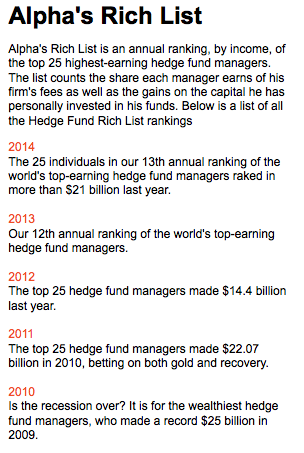
On May 6th, Institutional Investors’ released its 13th annual ‘Rich List’ highlighting the top 25 earning hedge fund managers. The 2014 list saw a combined earnings of $21 billion, an increase of 50 percent from the prior year, but still comes in as only the fourth highest total in the list 13 years. This year’s list required a minimum earnings of $300 million also a 50 percent increase over last year’s minimum, had an average earnings of $846 million per manager, and saw four hedge fund managers clear the $1 billion earnings mark. The back to back champion is David Tepper, founder of Appaloosa Management, earned $3.5 billion in 2013. To put in perspective just how much he earned, Lee Hawkins reported in 2007 that all African American professional athletes in the NFL, NBA, and MLB combined earned $4 billion. A look at more recent numbers show that the top ten earning African American athletes earned $383.2 million, meanwhile the top ten hedge fund managers brought in $15.7 billion or the athletes earned $0.02 for every $1.00 the hedge fund managers earned.

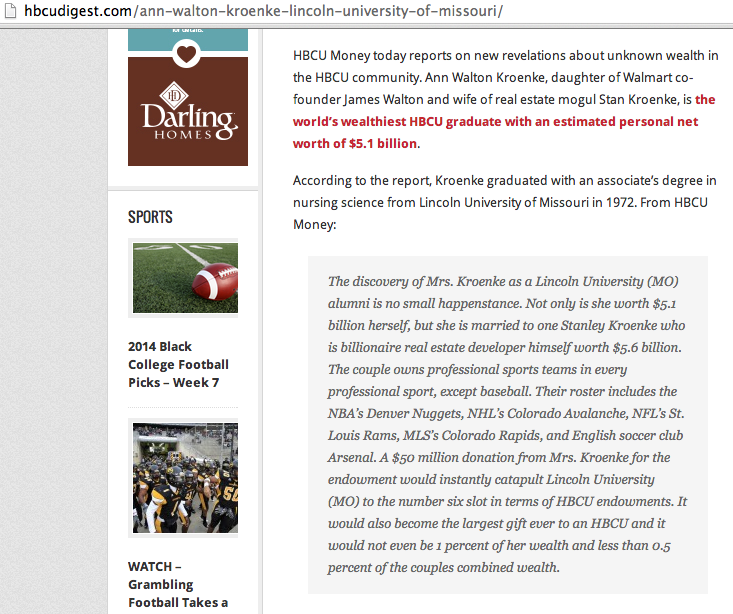
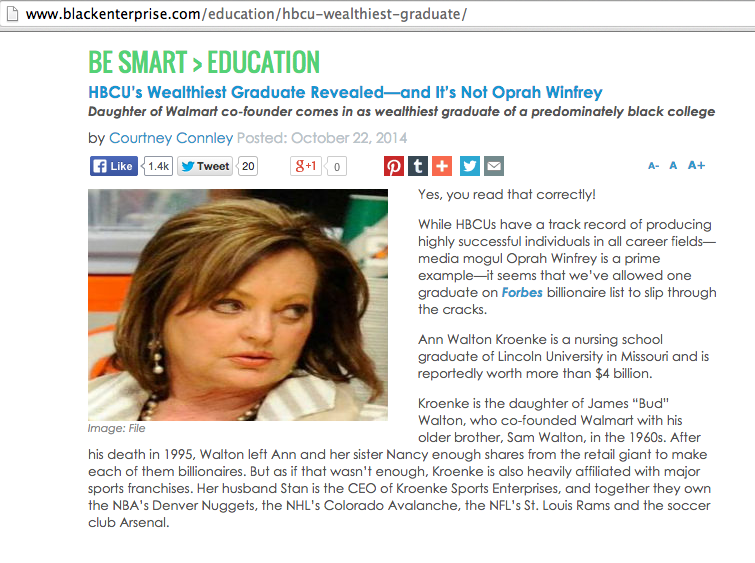
A few of these hedge fund managers also left their mark in college philanthropy. Paul Tudor Jones and his wife donated $12 million to the University of Virginia according to Philanthropy.com to “create the Contemplative Sciences Center to explore the intersection between modern science and the classical medical and contemplative traditions of Tibet.” Leon Cooperman and his wife made a $25 million donation to Hunter College for their library renovations and to seed a scholarship fund. David Tepper donated $67 million to Carnegie Mellon’s business school in 2013 and Kenneth Griffin, ranked number five on the Rich List, donated $150 million to Harvard College for scholarships, the largest ever donation in the school’s history. These four donations alone in the past 12 months are equivalent to over 12 percent of all HBCU endowments combined. The $254 million between these four donations if they were their own HBCU endowment would rank tied for third among HBCU endowments and equal to almost half of Howard University’s total endowment. Yes, just these four donations.

Screen shot 2014-05-07 at 5.37.37 PM

The key thing to remember about all of these hedge fund managers is they founded and own their company. Yes, it is finance and investments, but it is also understanding that entrepreneurship and risk taking is what gets rewarded in this economic system. Far too many of us are still thinking in terms of labor and not enough of us are thinking in terms of ownership regardless of the industry. We want to graduate and get a “good” job. Nor does the business if you decide to start one have to be some social business that changes the world. The president of Hampton University owns a bottling company. It is not sexy, but it does employ a great deal of people and allows him and his wife to be financially generous to Hampton time and time again.

Our intellectual capital continues to be poorly distributed as a community. It often seems the only thing that little African American boys and girls believe they can do is entertain others. We are either singing and dancing or chasing a ball of some sort. The lack of hedge fund managers (among a great many other professions) continues to highlight our perplexing relationship to finance. We like the perks of consumption which requires money, but adverse to the real building of wealth and the vehicles like hedge funds that can create paradigm shifts. It is clear we are playing the game, unfortunately we seem to currently be playing it to lose.

American Professional Sports Teams Valued At Combined $92.4 Billion; African American Stake 0.4 Percent

By William A. Foster, IV

Life is all memory, except for the present moment that goes by you so quick you hardly catch it going. — Tennessee Williams

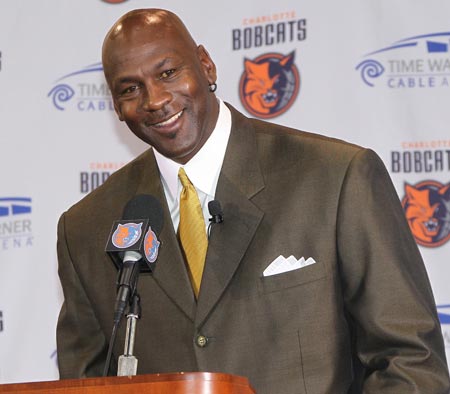
5Michael-Jordan

In 1619, the Dutch introduced the first captured Africans to America. I tend to imagine that in 1819 there was an African standing around saying to himself, “I can not believe this is still happening in the 19th century.” It appears that a year on a calendar is suppose to have some magical power. In 2014, African Americans still stand around and say “I can not believe this is happening in 2014.” Again, they say this as if time has some magic power to make people behave in some way they have not been behaving for the past four hundred years. At some point you wonder if its not them who has the problem, but us who are continuously surprised by it. Do we so desperately want to get along that we ignore the rules of nature? The law of resources and power to ensure survival.

Recently, a NBA owner made some disparaging comment about African Americans. This has been more newsworthy in African America than the 20th anniversary of the Rwandan genocide where 1 million Rwandans were killed in 100 days or 234 Nigerian girls who were kidnapped at gunpoint taking their physics exams. Let that sink in for a minute. African Americans are about to march over something a European American man said, but were virtually silent during the genocide. The team “almost” boycotted a game over a word, but ever since the Jordan-era started in 1984, African American athletes have become increasingly mute on any social issue of substance. That anyone is considering marching over this is a slap in the face for what people actually marched for during the Civil Rights Movement in my humble opinion. Rarely is it remembered that Martin Luther King, Jr.’s last march was about economic empowerment and that he called for African Americans to bank in their own banks, etc.

Almost seventy years after Jackie Robinson unintentionally sealed the fate of African American ownership in professional sports the relationship between African American muscle and European American control of that labor from high school to the pros has become increasingly troubling. Today, there are 141 professional sports teams (NFL, NBA, NHL, & MLS) in America with only 1 African American owner or equal to 0.7 percent. The combined economic value of those teams is $92.4 billion according to Forbes, while African America’s ownership stake in that is 0.4 percent or the $410 million that the Michael Jordan owned Charlotte Bobcats are worth. Jordan’s Bobcats are the only African American owned professional sports team and next to dead last in value of NBA teams.

Jordan himself has been somewhat of an enigma within the African American psyche. He was once one of the investors’ that helped Spike Lee finish funding Malcolm X when the studios cut off his funding for the film. However, most of what he has been known for is the name behind the shoes that have shaped two generations of consumption by African Americans in a way that requires an entire study. I will never forget parents of African American kids in my high school allowing their children to miss the first couple periods of school in order to be the first ones at the mall to buy the shoes. Naturally, they would show up at school with these shoes for the world to see. As a result Phil Knight, the founder and owner of Nike, even in 2014 a full decade plus after Jordan’s last game still sees the company reap $2.25 billion in revenue from the Jordan brand in 2013. Michael Jordan’s “reward” for the stellar year for Nike was $90 million, which sounds great until you realize it is only 4 percent of the revenues generated. The reality is that Nike would have never been the Nike we know it to be without the Jordan brand. However, we also see why capitalism rewards the ownership of hard workers and not the hard worker. Phil Knight is worth an estimated $18.7 billion and Michael Jordan is worth an estimated $750 million or ironically enough 4 percent of Knight’s wealth.

So what is holding up more African American ownership in professional sports? Quite frankly, money, financial aptitude, and poor financial planning. Yes, despite the appearance of making lots of money. In the echelon of wealth, athletes are at best upper middle class. The top 10 earning African Americans earn only $0.07 for every $1.00 their top ten European American counterparts earn annually. In other words, the top ten African Americans earned approximately $700 million in 2012 while David Tepper, hedge fund manager, earned $2.2 billion by himself in 2013. Professional sports teams are rarely ever owned by former players. In fact, other than Michael Jordan only Carolina Panthers’ owner Jerry Richardson is a former player. The latter made his wealth not in sports, but in the food industry. His company, which he started after retiring from a short NFL career in 1961, by 1995 was the largest publicly listed company in South Carolina and owned 2 500 restaurants with over 100 000 employees. Athletes simply do not make enough for a prolonged period of time to generate the kind of wealth it would take to purchase a professional sports franchise. Not even taking into the account most of these athletes make poor investments and have egregious consumption habits as noted in ESPN’s 30 for 30 documentary. If you did not know any better you would think they were the billionaires. The reality is professional sports owners are business tycoons not athletes. Sports teams for them are another investment in their portfolio. Jerry Jones, owner of the Dallas Cowboys, also owns prime residential and retail real estate developments around Dallas, over 100 Papa Johns’ franchises, and still has major stakes in oil and gas wells just to name a few of his enterprises. Then there is Paul Allen, the wealthiest sports owner in America with a net worth of almost $16 billion, owns both the Seattle Seahawks and Portland Trailblazers. He was the co-founder of Microsoft and now is a major real estate owner in Seattle along with a large portfolio of tech, media, and energy stocks.

I could see Jamal Mashburn owning a team one day given his post-NBA career business acumen. He currently owns 71 restaurants in his portfolio and I imagine he will continue to expand his portfolio with prudence. African Americans are still too dependent on entertaining to create wealth and not our brain. There still has never been an African American present on Institutional Investors’ Alpha List that tracks the highest paid hedge fund managers annually. In 2013, to make the Alpha list you needed to have earned $380 million just to make the top ten and $900 million to make the top five. Keep in mind that all African American professional athletes combined earn $4 billion annually. Did I mention David Tepper earned $2.2 billion by himself last year? One thing remains undeniable, the power is in the “briefcase” not the ball.

The Economics Of Playing HBCU Championships At Pro Stadiums – When Winners Still Lose

Essentially, economics is the science of determining whether the interests of human beings are harmonious or antagonistic. – Claude-Frédéric Bastiat

EPDZRZWPRBSRNUA.20130920175354

This past November, I attended the 2013 SWAC championship game with my father despite our family school, Prairie View A&M not being present. My father felt it was important to go out and support the SWAC. Our family annually attends the SWAC’s Labor Day Classic between Prairie View A&M University and Texas Southern University, which was eventually put out of Reliant it is rumored from poor attendance. A very sad indictment since Prairie View and Texas Southern are located 45 minutes and 15 minutes from the stadium, respectively. My father and I discussed why HBCUs have such a difficult time with attendance overall, save for a few select schools that travel really well. Even more importantly to me was whether the economics of playing the SWAC football championship in football at Reliant Stadium and the SWAC basketball championship at Toyota Center made dollars and sense. My father noted as he bought our tickets that the median ticket price was $35 that night and if the attendance came in well that the SWAC and both schools should do well. However, my question was could they do better?

The reported attendance at the game was 38 985 according to HBCU Digest. Calculated with the stated median price from above it equals out to approximately $1.37 million. Not a bad days haul on its first examination. Unfortunately, the SWAC does not own Reliant and therefore having a game there is not free. Based on the financial terms that were given for the UH-SMU game at Reliant, we can start to see just perhaps what that final figure might look like. There is a $75 000 license fee per game. Then there is the facility expense of $85 000 for 30 000 to attend plus $2 for every attendee over 30 000, bringing the total expense for the SWAC game to $177 970. All parking and concession revenue go to Reliant and 20 percent of merchandise sales also go to Reliant. Using a ratio of four people to a car, then the SWAC championship car attendance was 9 746 with parking cost at $10 or revenue of approximately $98 000. The median soda/beer cost at Reliant is $6.13 and a regular nacho (easily the most popular item at the SWAC championship – probably because it was the cheapest) was $7.00. Assuming that half of attendees will purchase at a minimum a drink and nacho that is worth approximately $256 000 based on the game’s attendance. This means that HBCUs are potentially only taking home 61 percent of the potential revenue (not including merchandise) when they play at professional stadiums if this is a standard deal. In the SWAC’s case a loss of revenue equal to $532 000 (not including merchandise) just for the football game.

My father’s argument was that if the game had not been played at the Reliant, then most fans would not come nor do most HBCU stadiums have the capacity for 40 000 fans. Prairie View’s stadium at best holds 5 000 comfortably. He argues that fans want to be in a nice venue, especially if you plan to get the fan who has no rooting interest to come to the game. There is some validity to this since the attendance for the SWAC championship when it was in Birmingham struggled mightily with attendance, even when Alabama A&M or Alabama State were in the game. There is also the issue of lodging, which for rural HBCUs tend to be lacking. That being said, I am not totally convinced.

I believe if the game was located in the central most urban geographic location to both schools playing in the championship, then an opportunity to collect a vast more of the pie could be accomplished. Could I be wrong in this? Absolutely. However, that we have not explored alternatives is an issue that we can ill afford. Given that conferences tend to share the revenues of these games throughout the conferencem it is worth an economic examination. Just as classics should be re-examined and the very questionable deal that HBCUs have with ESPN and the Disney SWAC/MEAC classic where attendance has consistently been less than stellar.

It often feels as if there is a lack of creativity to HBCU athletic departments. HBCU athletics will never be profitable because demographics simply do not allow for it. However, they can be less of a loss leader than they currently exhibit. Already underfunded, instead of trying out of the box scenarios that could draw larger crowds to generate higher revenues, we seem content to just mimic our counterparts who have vast resources and seven and eight figure boosters. Do we believe we can just walk by a penny on the ground? If we do, then we are in real denial about our financial crisis.

A Progressive Minimum Wage: Fair To Business And Labor

By William A. Foster, IV

Most everyone wants to do what’s fair, right, and good, but knowing what that is is often the tough part. – Malcolm Forbes

minimumwage_cartoon

Recently, I was accused of being in support of slavery by the AFL-CIO’s chief economist in an exchange on Twitter for not supporting the minimum wage hike. Our discussion stemmed from my article on how a higher minimum wage would hurt African American small business growth capability. While other groups have many times our resources and wealth and since labor cost are the highest expense for any business I was simply pointing out that as a group having limited resources and higher expenses would make it harder for us to start businesses. This compounds a problem of wealth creation through business ownership and favorable taxes for ownership with employment, since businesses tend to hire within their own community, especially small businesses. By the end of the exchange he resorted to telling me I was only concerned about racism and not slavery. Oddly, I thought we were having a conversation about the minimum wage, not about racism or slavery. I sympathize with his position, but let us not throw the baby out with the bath water.

In a more macro example of why I think a blanket minimum wage hike is a problem is based on business size. Home Depot has a market cap of $110 billion, annual revenues of almost $80 billion, profits of $5 billion, and 300 000 employees of which the vast majority are paid minimum wage or close to it. In comparison, around two-thirds of small businesses, the SBA defines a small business as 500 or less employees, generate less than 100 000 annually in revenue and 88 percent of small businesses have 20 employees or less. Are we to treat these small businesses with the same stick as Home Depot and other national retailers? To bump the minimum wage up on a business with a 20 hour a week worker adds almost $2 800 annually to the cost per worker, which is no small bump to businesses making only 100 000 or less annually in revenue. However, make no mistake the SBA’s definition of a small business does propose a bit of a problem.

Enter asset and capital firms. Hedge funds, private equity, and other asset and capital firms are notoriously small. Appaloosa Management, David Tepper’s firm, reportedly only has 32 employees. Obviously, this qualifies them as a “small” business according to the SBA’s definition. The problem as it were, David Tepper himself made $2.2 billion in earnings through his hedge fund in 2012. A firm which had $25 billion in assets under management in 2012. Why is this problem? Because someone is cleaning Appaloosa’s offices. More than likely the work is contracted out and more than likely that person doing the cleaning is being paid minimum wage to do so – if that. So as you see just defining a business as “small” by its employees can leave a number of loopholes. If you have not been able to tell by the conundrums around the Affordable Care Act, businesses definitely will look for the loopholes to save money.

A better solution to the minimum wage is a progressive wage in the same way the United States has a progressive tax rate. As companies grow revenues, then so should their minimum wage requirement. Even this though is no small cost, even to big companies. If all of Home Depot’s 300 000 employees, of course not all are minimum wage earners, received a $2.85 bump in pay for every 20 hours per week they worked it would equate to an $820 million dollar increase in labor expense or 16 percent of the companies net income. This increase would be passed along to customers which is usually the case when business expenses rise anyway. I would not dare call for a lowering of the minimum wage at small businesses with smaller revenues, but it could be justified if burden were evenly spread out across a simple revenue and net income calculation. This would still raise the overall minimum wage without harming those small businesses at the very bottom trying to grow. It would also require the aforementioned firms like capital firms to ensure any contracted work they pay meets a minimum wage. For instance, if a hedge fund is contracting out its janitorial work and the employer is paying $7.25 a hour to the janitor, then the hedge fund would be responsible for the other $2.85 or whatever range that particular firm falls in based on the progressive minimum wage. This ensures the actual small business based on revenue is not bearing the burden of the higher labor cost.

The populous argument would say 16 percent is no big deal, but most populous arguments have rarely been business owners or investors. They do not take into account capital flight and other things that potentially could cause capital to flee from these companies. This is a problem if your 401(K) happens to have investments in one of these companies, which most often they do. There goes retirement, but at least I can buy that Big Mac today (see below). The high cost of labor is what set auto companies in the United States back as they struggled to compete against foreign manufacturers who could produce the same quality car for a much cheaper price. Save for a government bailout, all of those jobs would be gone today in a true capitalist system or free market economy. Again, be careful what you wish for.

minimum-wage-minutes-big-mac-01

However, one of the things that could be done to offset income disparity is to give companies who are active in managing the ratio between their lowest earning full-time worker and total CEO compensation based on a five year rolling average could receive special tax breaks. The latter is important for those companies who love to give obscene golden parachutes to outgoing CEOs, which often leaves investors just as frustrated as employees. I am by no means in favor of capping anyone’s compensation, but I do believe that maintaining a proper balance between maximum-minimum is important to the overall health of businesses, labor, and the economy. Currently, the ratio between CEO compensation and the average worker of a S&P 500 company is 354:1 according to a recent report by the AFL-CIO. In 1981, the ratio was closer to 40:1 (see below).

Screen-Shot-2013-06-26-at-1.06.21-PM

Unfortunately we exist in a social, economic, and political climate in America currently that everything exist in extremes. The answer in the middle could restore balance, but it would take the belief that there is an actual win-win scenario for both parties also known as compromise. If we do not tax someone who makes millions the same as someone who makes thousands, then why can not the same logic be applied to businesses? Hopefully, we can find moderation because we knows what happens to a boat that leans too much to one side. Now, where did I put my life preserver?

HBCUs Must Become More Afrocentric – Not Less

By William A. Foster, IV

You go busting’ your fist against a stone wall. You’re not usin’ your brain. That’s what the white man wants you to do. Look at you, what makes you ashamed of being black? – Excerpt from White Manz World by Tupac Shakur

Kwame_nkrumah

Kwame Nkrumah – HBCU Graduate, Pan-Africanist, & 1st President of Ghana

It seems more and more the desperation of HBCUs to survive and show they are “American” makes them want to distance themselves or even abandon our mission. That mission is to be part of the ecosystem that increases the institutional power of social, economic, and political assets for African America. Instead, more than a few are mimicking European American colleges or following the advice of those at European American colleges who have all the answers for how to fix HBCUs. Oddly, none of those “fixes” involve relinquishing the resources that have created the disproportionate institutional inequity between our communities. However, I do not expect them to provide those kind of answers. Their answers and solutions are not the ones that sadden  me. It is the leadership at many HBCUs that saddens me most. It often feels that African America more than any other group ignore the rules of engagement – the rules of war (for resources). I often tell friends that if this was a sporting field, African Americans are the group that spends all of its time chasing other groups around the field trying to remind the other groups of the rules and never scoring a single point. We are so focused on getting everyone to play by the perceived rules that we forget to actually score and forgetting that whoever has the most points (power) makes the rules and those rules are fluid (and sometimes they are just there to keep us preoccupied it seems).

Recently, a piece in the New York Times talked about how HBCUs (and African American institutions in general) paid the price for African American “equality”. Unfortunately, what we have perceived as equality has been nothing more than an illusion. There has been no American dream, just a never ending nightmare. Every social, economic, and political statistic you can use as a measurement finds us worse off after this achieved “equality”. Yet, our answer continuously is  to head down a path that has shown us without a doubt that it is not working. Our families are in disarray, land ownership at an all-time low, 50 percent of African American owned banks have disappeared over the past twenty years, predatory lending and payday loans rampant, and HBCUs have seen the HWCU/HBCU endowment gap grow from 46:1 to a staggering 103:1 in the past twenty years as well. Is this progress?

Power comes when a group’s ecosystem is strongly interlocked and circulating the assets within it while accumulating assets of other groups along the way. To this point, I have yet to get an answer if any HBCUs bank with African American owned banks. My guess – ZERO. HBCUs need to understand they are part of an African American ecosystem, not independent of it. They must do things that increase our social, economic, and political circulation of our other institutions within the ecosystem. We educate our students only to send them right back into someone else’s ecosystem to benefit. This is apparent in that under 6 percent of African Americans work for African American owned businesses.   Socially, why do we not play the African American national anthem? Economically, why do we not bank with African American owned banks? Politically, why do we not have a plan in place to make sure HBCU alums are elected on the state level up to governor where state funding truly impacts us.

We know one of the key problems facing HBCUs is lack of African Americans graduating from high school. The high school graduation rate is the second lowest among all groups in the country, only Native Americans are worse off. Our core demographic is not even graduating at a clip that allows them to enter our institutions. Instead of embracing the challenge to solve this, we want to abandon it for the sake of looking like everyone else? We took in others before others ever thought about taking us. We do not have anything to prove in our acceptance of others, but we do have more to prove that we can be the bearers of solving institutional issues that face African America and the African Diaspora. It begins to beg the question of whether we understand the purpose of institutions to a group’s ability to accumulate power. Note, I said power not acceptance.

If we truly believe moving toward the mimic of other institutions and not defining our own path is sound strategy, then I suspect a good deal of our institutions will be lost. This is because if we are trying to be like them and have nothing unique to offer, then all things being equal, students will go to the better school based on finances and social standing of the overall society. A choice we are sure to lose nine out of ten times. The thing that we actually have going for us is our heritage and catering to that heritage. HWCUs have not abandoned their core demographic no matter how many African American athletes they let in or pictures they put up showing one African American amongst a sea of others as “diversity”. They get it, but when will we? I truly hope before it is too late.