Category Archives: Economics

Without Intervention, Syria Could Raise African American Unemployment

By William A. Foster, IV

Employment, which Galen calls nature’s physician, is so essential to human happiness that indolence is justly considered as the mother of misery. – Burton

I have often contended that African Americans struggle to look at things from their own interest. It is no secret that when most of America catches the proverbial cold, we seem to catch pneumonia as the saying goes. Often what is good for other communities is bad for us and vice versa, and what is bad for other communities can sometimes be worse for us. The latter seems to be the case of what will happen if America does not intervene in Syria.

Many African Americans are anti-war because of America’s history of imperialism. These concerns are justified but also misled. Nobody has suffered from America’s imperialism domestically more than African Americans. However, America’s ability to be so prosperous is its ability to control much of the resources around the world either through soft or hard power. While this leaves many chastising American policy abroad, rarely is anyone willing to give up their cushion way of American life. Even for African Americans we enjoy a way of life that many around the world wished they had and that we so often still try to integrate ourselves into. Things like running water, electricity, cheaper gas, and many other basic necessities.This happens because American power allows for the scales to be tilted in the favor of American citizens and their institutions. Unfortunately, we control and own very few of these institutions and tend to end up with the leftovers and scraps instead of the main meals of prosperity.

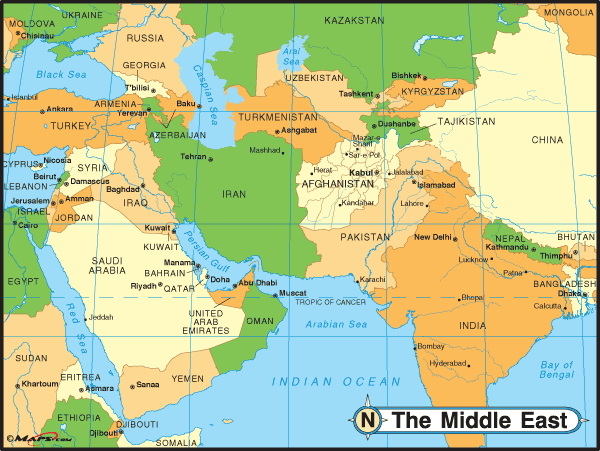
The current African American unemployment rate is 13.0 percent. If the Strait of Hormuz, where 20 percent of the world oil goes through and 35 percent of seaborne traded oil flows, expect American companies to react accordingly. An instant spike of product cost and transportation would most likely lead many companies to cutting labor to deal with the new expenses. Given our history of last hired and first fired due to our dependency on European American owned multinational companies, it would not be hard to imagine that many jobs that we hold in private companies would be in danger upon disruption of the oil supply.

middle_east

Syria on its face is not a major oil supplier and is fairly inconsequential to the actual global oil supply. Timothy Gardener from Reuters in a recent article points out, “Syria has not exported any oil since late 2011, when international sanctions came into force. Prior to the sanctions Syria produced 370,000 barrels per day (bpd), roughly 0.4 percent of global supplies, and exported less than 150,000 bpd, mainly to Europe.” The problem as it were with the Syria situation is just how quickly the situation could be prone to spread to other countries. This possibility alone has caused oil prices to spike more than $8 per barrel since the beginning of August. The many factions at play between Sunni/Shiite groups within Syria and outside influences like Al-qadea, Iran, and others make a complicated matter even more so.

In the end, African America will continue to push the flag of human rights and equality because it is a social value we hold dear in our community. The economic reality for us is another matter in itself and with August numbers showing African American employment at its worst in the past five months the situation in Syria could expedite the downward spiral. Many analyst have already predicted that a U.S. strike could bring oil prices back down. If we want to truly be beholden to our value of human rights, then we ourselves must obtain the economic independence to do so. Whether we like it or not for now, our  economic fate is indeed tied to America’s foreign policy.

African America’s August Unemployment Report – 13.0%

jobs_pic

Overall Unemployment: 7.3% (7.4%)

African America Unemployment: 13.0% (12.6%)

Latino America Unemployment: 9.3% (9.4%)

European America Unemployment: 6.4% (6.6%)

Asian America Unemployment: 5.1% (5.7%)

Analysis: The unemployment rate overall dropped to 7.3 percent. African America is the only group to see their unemployment rate rise and maintains itself firmly in the double digits. Asian America has the most significant drop. Latino and European America saw negligible drops.

African American Male Unemployment: 13.5% (12.5%)

African American Female Unemployment: 10.6% (10.5%)

African American Teenage Unemployment: 38.2% (41.6%)

African American Male Participation: 66.6% (67.6%)

African American Female Participation: 61.5% (62.0%)

African American Teenage Participation: 28.9% (28.4%)

*Previous month in parentheses.

Analysis: The unemployment rate for African American men saw an significant uptick coupled with a dropping participation rate. African American women also experienced an uptick in their unemployment rate while participation rate dropped. Only the teenage group showed improvement in its unemployment rate and participation rate.

Conclusion: The economy added 169 000 new jobs overall. African America saw a decline a 210 000 in its employed ranks. It is the second lowest number of employed African Americans in the past five months and by far its biggest drop in employment over that same period. African America’s labor force is at its lowest in the past five months. The labor force number indicating that many African Americans are simply giving up on the chance of finding employment. The one bit of light in the coal mine is that African American teenagers picked up 30 000 jobs. Overall,  almost every piece of unemployment data is the worse it has been in five months. A frightening measure as many African American families head back into the school year needing to providing more not less.

African America’s July Unemployment Report – 12.6%

jobs_pic

Overall Unemployment: 7.4% (7.6%)

African America Unemployment: 12.6% (13.7%)

Latino America Unemployment: 9.4% (9.1%)

European America Unemployment: 6.6% (6.6%)

Asian America Unemployment: 5.7% (5.0%)

Analysis: The unemployment rate overall dropped to 7.4 percent. African America sees the most significant drop although it remains the only group with double digit unemployment. Latino America and Asian America both experience a rise in their unemployment rate with European America’s rate remaining unchanged.

African American Male Unemployment: 12.5% (13.0%)

African American Female Unemployment: 10.5% (12.0%)

African American Teenage Unemployment: 41.6% (43.6%)

African American Male Participation: 67.6% (67.1%)

African American Female Participation: 62.0% (62.3%)

African American Teenage Participation: 28.4% (28.1%)

*Previous month in parentheses.

Analysis: All African American groups saw a decline in their unemployment rates. However, the women who showed the most significant decline also saw a decline in their participation rate. African American men saw a significant uptick in their participation rate while the teenagers saw a negligible uptick.

Conclusion: The overall economy added 162 000 jobs in the month of July. African America added 228 000 jobs in the month of July. The 16.3 million employed African Americans is the largest employed number in the past five months. The participation rate overall for African America remains unchanged from June’s numbers showing that there has not been much increase in the civilian labor force of African America. It remains at the second lowest participation rate over the past five months. Essentially, those who have been looking for work have maintained but no new surge in confidence about employment opportunities seem to be grasping the rest of African America’s labor force. The female participation rate had a concerning drop as they are the linchpin group of the African American household. Their participation rate is the lowest it has been in the past five months but their number of employed is at its highest in five months so it is a mixed bag of results. Overall, the statistics appear to be moving in the right direction for African America but should be approached with some caution until we see the civilian labor force numbers increasing in conjunction with the employed numbers.

African American Teenage Unemployment: 3rd Highest In Developed World

By William A. Foster, IV

You can be young without money but you can’t be old without it. – Aristotle

teenEMPLOYMENT

There is an unemployment epidemic in African American teenage unemployment. Its ramifications will indict an entire generation of our youth if it is not confronted. Yet, it continues to get brushed under the rug assuming anyone acknowledges it at all. A recent report by the International Labor Organization addressing high youth unemployment in the European Union is quoted as saying “There is a price to be paid for entering the labor market during hard economic times. Much has been learned about “scarring” in terms of future earning power and labor market transition paths. Perhaps the most important scarring is in terms of the current youth generation’s distrust in the socio‐economic and political systems.” However, there seems to be little attention being given to the plight of African American teenagers. Below is a look at a graph of European youth unemployment followed by the US Department of Labor’s view of African American teenage unemployment.

youth unemployment 2013

AAteenage7.42.57 PM

Scarring is the term that economist use in describing long-term unemployment for youth. This is because the compounding impact of it for the individual, household, and community ends up being much like a wound that is almost impossible to heal. Individually, African American teenagers are missing out on the basics of developing work ethic, work skills, networking through employment, early professional success which builds long-term confidence, and a host of other qualitative factors that tend to impact an individuals career trajectory. Because there is high teenage unemployment in African American households and communities it goes without saying that idle time is the devil’s playground. The increased idle time increases the probability of counterproductive behavior especially when there is such an acute quantity of unemployed teenagers.

The economic implications are profound. If we assume a teenager starts working at sixteen and is making minimum wage while working 20 hours a week average, they would earn $6 786 annually after taxes. It does not seem like much on face value but let us dig a little deeper. Let us assume the teenager gives $2 400 a year to the household income, puts aside $1 500 a year for college or vocational training, and lastly puts the remaining $2 886 in a Roth IRA account. First, 38.2 percent of African Americans are in poverty (see chart below) according to the National Poverty Center so an extra $200 a month can often mean the difference between a refrigerator full of groceries and malnutrition for a family. Malnutrition which has been shown to have not only health implications but long-term correlations to academic consequences for children in a household as well. The savings for college would allow the teenager to start college at eighteen with $4 500 in savings. This small amount should not have severe implications on a students’ financial aid but it could be the difference between a student purchasing books at the beginning of the semester as opposed to waiting on their refund which puts students behind during a semester and impacts their chances of academic success and ultimately their ability to graduate in a timely manner. Anyone who has attended an HBCU can readily attest to this reality either for themselves or classmates in experience. Lastly, the $11 544 invested in a Roth IRA after four years with average returns would be approximately $15 000 towards retirement saved at the age of 20. However, they can not touch this retirement account until they are 65. If they did not add another dollar to it and just continued with average returns over the next 45 years that account would be worth $2.5 million by retirement.

povertyrates

The International Labor Organization calls for the following actions to address youth unemployment:

  • Fostering pro-employment growth and decent job creation through macroeconomic policies, employability, labour market policies, youth entrepreneurship and rights to tackle the social consequences of the crisis, while ensuring financial and fiscal sustainability.
  • Comprehensive measures targeting disadvantaged young people in advanced economies with high numbers of unemployed youth. These include education, training, work experience support and recruitment incentives for potential employers.
  • Integrated employment and livelihoods strategies and programmes in developing countries, including training in literacy, occupational and entrepreneurial skills and business support.

These solutions could be applied here in the United States and certainly could be implemented on a more micro level by community organizations operating within African American communities and give a good base for starting to stem the tide. There are 1.9 million African American owned businesses, but 1.8 million of them have no employees. These young people offer an affordable labor option for African American small businesses that in exchange could provide them priceless experience and professional building. Unfortunately, most African American teenagers are ill-equipped for very basic work beyond physical labor so training programs are vital. A difficult task to meet as local city and state budgets are cutting job training programs not expanding them. Therefore, community centered solutions must be examined. Any belief that there will be government assistance or grants should be viewed as no more than a bonus if an organization can get it.

African American teenagers are a silent group suffering and their current condition do not bode well as the stated above reasons show for African America’s future economic condition. They have the least voice among any group it appears in America but given the percentage of African American single parent households are arguably the second most important wage earner in the family. If the children are our (economic) future as Whitney Houston once said, then the future economic condition is looking bleaker and bleaker for African Americans.

African America’s June Unemployment Report – 13.7%

jobs_pic

Overall Unemployment: 7.6% (7.6%)

African America Unemployment: 13.7% (13.5%)

Latino America Unemployment: 9.1% (9.1%)

European America Unemployment: 6.7% (6.7%)

Asian America Unemployment: 5.0% (4.3%)

Analysis: The unemployment rates overall remains unchanged. Two of the four diaspora groups remain unchanged while the other two saw upticks. Asian America saw a significant uptick but remains the group with the lowest unemployment. African America remains the only group with a double digit unemployment rate.

African American Male Unemployment: 13.0% (13.5%)

African American Female Unemployment: 12.0% (11.2%)

African American Teenage Unemployment: 43.6% (42.6%)

African American Male Participation: 67.1% (67.9%)

African American Female Participation: 62.3% (62.5%)

African American Teenage Participation: 28.1% (28.0%)

*Previous month in parentheses.

Analysis: African American women and teenagers saw significant upticks in their unemployment rate while the unemployment rate for men saw a moderate decrease. Participation rate for teenagers remain virtually unchanged while men and women both saw decreases. The men saw a substantial drop in their participation rate.

Conclusion: The overall economy added 195 000 jobs in the month of June. African America shows a loss of 112 000 jobs for the month of June. A significant loss after four straight months of positive job growth. The African American labor force shrunk by almost 100 000 and most disturbing is the participation rate as it dropped to its second lowest rate in the past five months. A sign that fatigue is setting in and the desire to find employment is waning. African American women’s participation rate has held steady over the past five months while the men have shown an alarming drop. The continued crisis of African American teenagers proves to be worsening as the group hit a new high again for its unemployment rate which still stands at the third highest in the developed world. It appears the sequester is setting in and unemployment fatigue is starting to take a turn for the negative in the African American community.

Source: Department of Labor