Category Archives: Economics

Detroit’s Bankruptcy: An Indictment On African America’s Institutional Power

Contrary to the commonly accepted belief, it is the risk element in our capitalistic system which produces an economy of security. Risk brings out the ingenuity and resourcefulness which insure the success of enough ventures to keep the economy growing and secure. – Robert Rawls

Hitsville 2

The year is 1988 and Berry Gordy is completing the sale of Motown Records to MCA and Boston Ventures LP for a reported $61 million or $121.6 million adjusted for inflation today. Motown Records was an African American institution for over two decades and in 1983 was the largest African American owned company in the United States according to Black Enterprise. It had been the stalwart of Detroit’s African American community and the home of legends like Diana Ross, Smokey Robinson, and global icon Michael Jackson. 25 years later the city of Detroit is a shell of its former self and filed the largest municipal bankruptcy in U.S. history at an estimated $20 billion. How did the symbol of African American power have such an inglorious fall from grace?

Detroit is 138.75 square miles and in terms of cities with 100,000 or more people in it there is no city with a larger African American concentration than Detroit with almost 85 percent of the population being African American. In 1950 the city’s population was near 1.9 million. Historically, Detroit was once home to 18 African American owned hospitals between 1917-1991, home to Lewis College of Business, the only HBCU located in Michigan, and First Independence Bank which is still one of African America’s largest owned banks with over $200 million in assets or almost 5 percent of all African America’s combined bank assets. The city’s African American population was thriving thanks to strong institutions throughout the city much like Motown, but many could argue that complacency settled in. The African American middle class there felt like they had “made” it. Time to set the ship on cruise control and go fishing. The problem? There was an iceberg ahead.

Today, none of the African American owned hospitals in Detroit remain, Lewis College of Business struggles to keep the doors open with no working website or functioning phone number, and the unemployment rate still hovers around 20 percent in the city for African Americans despite the country’s recovery. The political infrastructure seems to be more ripe with corruption over the past few decades than leadership doing more to inhibit progress than promote it. Corruption in the city would be epitomized by the fall from grace at the time by one of HBCU’s shining political stars, former mayor and Florida A&M graduate, Kwame Kilpatrick who is now serving 28 years in federal prison for laundry list of scandals as Detroit’s mayor. The city has a reported 70,000 abandoned buildings, 50 percent of the city’s street lights are not working, and over 40 percent of the entire city is currently below the poverty line. Often times it is confused that the auto bailout of General Motors and Chrysler was an assistance to Detroit. Great job on the public relations of that one to John and Jane Taxpayer who bought it hook, line, and sinker. Unfortunately, GM and Chrysler had long moved their headquarters and majority of operations out of Detroit to suburban areas that were more tax-friendly. They were Detroit in spirit only. The $80 billion they received in bailout was not though. A bailout out that would see U.S. taxpayers lose $11.7 billion as the government divested itself of ownership of both.

Detroit has fallen as its African American population has seen its power decline and some very questionable leadership at times from the aforementioned mayor’s office. However, there is real opportunity in Detroit for African America and the barrier to entry has been lowered because of the distress. Capitalism in a nutshell rewards the creation of chaos or the organization of chaos. The latter is what is present in Detroit. A real investment in Lewis College of Business would go a long way to stabilizing the education and social aspect of African Detroitians higher education access. Dan Gilbert, owner of Quicken Loans, Cleveland Cavaliers, and most notably known for his famous social media rant against LeBron James for leaving him, has invested over $1 billion the heart of downtown Detroit. As one Bloomberg reporter pointed out he is  basically sifting through the best of food at the top of the trash can. He has purchased 3 million square feet or the equivalent of 0.07 percent of the entire city. Not a major overhaul by any stretch of the imagination, but probably the best quality of what is there and any revitalization will leave Dan Gilbert reaping immense rewards. Despite a declining population this is still a city with 700,000 residents which means it is the 18th largest city by population in America and $6.7 billion in household income, but is being treated like a ghost town.

There is still a “Hitsville” in Detroit for those that can see through the chaos of the battered and broken city. A chance to bring a phoenix from the ashes if you will. The city is in need of industry and a way to stem its declining population which for someone with a background in community development is like the opportunity given to Michelangelo to paint the sistine chapel. If African America was ever looking for an opportunity for a home run where the stakes of high risk and high reward, then there is no better place in America right now than Detroit. Warren Buffett is famously quoted as saying “be fearful when others are greedy and greedy when others are fearful” and right now Detroit is screaming to African America for an opportunity to be greedy. With 137 square miles still left of needing investment, maybe it is time to put some of that $1 trillion of buying power to use.


African America’s May Unemployment Report – 11.6%

jobs_pic

Overall Unemployment: 6.3% (6.3%)

African America Unemployment: 11.5% (11.6%)

Latino America Unemployment: 7.7% (7.3%)

European America Unemployment: 5.4% (5.3%)

Asian America Unemployment: 5.3% (5.7%)

Previous month in parentheses.

Analysis: The overall unemployment rate remained unchanged. Group increases and decreases were evenly split. African and Asian America saw drops of 10 and 40 basis points, respectively. European and Latino America saw increases of 10 and 40 basis points, respectively. African America remains the only group with a double digit unemployment rate.

African American Male Unemployment: 11.5% (10.8%)

African American Female Unemployment: 10.0% (10.4%)

African American Teenage Unemployment: 31.1% (36.8%)

African American Male Participation: 66.8% (66.4%)

African American Female Participation: 61.2% (61.7%)

African American Teenage Participation: 27.8% (27.9%)

Previous month in parentheses.

Analysis: African American males saw an increase of 70 basis points in their unemployment rate, but also saw an increase in their participation rate of 40 basis points. African American females saw a decline of 40 basis points in their unemployment rate, but also saw a decline of 50 basis points in their participation rate. African American teenagers saw an unprecedented drop of 570 basis points in their unemployment rate and essentially held steady their participation rate.

Conclusion: The overall economy added 217 000 jobs in the month of May. After a stellar past few months of job growth in African America, momentum slowed to a halt in May with only 8 000 jobs added in the month of May. The participation rate dropped 10 basis points, but essentially has not moved out of its 5 month band meaning actual employment numbers even with the appearance of jobs being added are dead in the water. African American women’s sudden drop in participation rate is alarming and unexpected. The backbone of African America’s fragile economy given their propensity to be head of household and/or breadwinner means sudden shifts in their employment state has immediate impacts on families and communities. African American teenagers actually showed real inroads to their employment crisis picking up 38 000 jobs and holding their labor force numbers steady which prompted an acute drop in their unemployment rate and substantive increase in their participation rate. Despite this shining beacon of success the overall African American employment situation is stagnant. African America’s current labor force would need to add 300 000 jobs in one month to get the unemployment rate to 9.9 percent.

Recipe To Get African America’s Unemployment Rate Under 10 Percent – Add Almost 500,000 Jobs And Stir

By William A. Foster, IV

Had I not gone through the ordeal, in more than one country, of landing a job, I would be tempted to lose patience over the number of letters pouring in from fellows who want me or someone else to hand them a job on a silver platter with a guarantee that they will receive the wonderful promotion their talents warrant. But a tragic number of young men and even older men have a notion that it is not up to them to prosecute the bettering process. They look to someone else to perform the trick for them. — B.C. Forbes

VO-1564-p67-black_man_jobs

Imagine for a moment me, a Texan and southerner, moving to Boston for the first time as I did many years ago adjusting to the weather. To say it was a shock would be an understatement. After thinking I had made it through “winter” because I made it through December – Houston winter logic for sure – I was informed that winter was just starting. Wait, what? In Houston, we are warming back up in the 70s by February. Boston was my first time experiencing single digit weather week. Then to experience it for weeks on end made me wonder how anyone in their right mind lived here. It was cold and it was not letting up, but then a strange thing would happen. One day it would happen to creep into the high twenties or low thirties and I would see people out in shorts and riding around with tops down on their convertibles. Insert every confused face one could have. The reality was that after weeks of single digits a dramatic move up even to a temperature still considered freezing would psychologically make them think it was warm. This in a nutshell is what is happening to African America and its “improving” employment situation. It is so bad that even a modest move up makes us feel excited.

The notion of improvement is one thing, but knowing where a healthy unemployment rate versus improving unemployment rate is another. Our goal can not be to simply get the unemployment rate to single digits, but to get it to a competitive rate which currently is around 5 percent. A mark that seems like it would take a miracle for us to get too with our current dependency on affirmative action and the public sector. The reality is despite our dependency on these two things, it is African American companies of which there are not enough, which offer us the best hope. Currently, African American firms with paid employees represent 0.4 percent of all firms in America, but have employees equivalent to approximately 5 percent of the African American labor force.

Every month here at HBCU Money, we release the African American Unemployment Report the Monday after the nation’s job report is released on the first Friday of every month. It gives month to month statistics and analysis along with a rolling five month overview as well. One analysis every month without fail is that “African America remains the only group with double digit unemployment rate” when reviewing the country’s different groups and their unemployment rates.  Currently, African America’s unemployment rate is 450, 660, and 700 basis points higher than Latino, European, and Asian America’s, respectively. The latter having the lowest unemployment rate in the country of any diaspora group. So much for that oppressed minority and people of color boat we keep thinking we are in with Asians and Latinos. The gap between us and other groups – even our “color comrades” – is not even close.

So how many jobs would it take to at least get us to the 9.9 percentage unemployment rate? Approximately 462 000 jobs would be needed at our current labor force based on March’s African American unemployment report. I must admit when I first calculated it was followed with a deep sigh. At the moment, the country as a whole can not even produce 200 000 jobs a month as we are still paying the cost for decades of an over leveraged and an inordinate consumption economy. Over the past five months African America’s job growth has been averaging 62 000 jobs per month, but over the same period the country is averaging 140 000 jobs per month. In other words, we would need an increase of 122 percent just to match the nation’s average in job creation.

Job creation is no easy task for a country or community. It takes a healthy banking sector first and foremost. This allows an increase in mortgages and equity lines. Those in turn also allow people to borrow against their homes for loans or to use their home to secure Small Business Administration loans through their bank to start a business in their community. It would also require those home purchases to be in African American communities. Small businesses tend to be based in or near the communities they live in. The exception it seems in the African American community where businesses are predominantly owned by outsiders that drain the community of capital and employment opportunities. The ingredients may seem simple enough, but we all know cooking a great meal can take all day and when it is hot most do not want to stay in the kitchen.


African America’s April Unemployment Report – 11.6%

jobs_pic

Overall Unemployment: 6.3% (6.7%)

African America Unemployment: 11.6% (12.4%)

Latino America Unemployment: 7.3% (7.9%)

European America Unemployment: 5.3% (5.8%)

Asian America Unemployment: 5.7% (5.4%)

Previous month in parentheses.

Analysis: The overall unemployment saw a decrease of 40 basis points. Asian America was the only group to see an increase in its unemployment rate with an increase of 30 basis points. African, European, and Latino America all saw declines in their unemployment rates at 80, 50, and 60 basis points, respectively. African America remains only group with double digit unemployment.

African American Male Unemployment: 10.8% (12.1%)

African American Female Unemployment: 10.4% (11.0%)

African American Teenage Unemployment: 36.8% (36.1%)

African American Male Participation: 66.4% (67.0%)

African American Female Participation: 61.7% (62.0%)

African American Teenage Participation: 27.9% (25.6%)

Previous month in parentheses.

Analysis: African American male and females both saw declines in their unemployment rates at 130 and 60 basis point drops, respectively. African American teenagers saw an increase of 70 basis points. Participation rates for the male and female groups both saw declines at 60 and 30 basis points, respectively. The teenage group saw an increase of 230 basis points.

Conclusion: The overall economy added 288 000 jobs in the month of April. An increase of 96 000 jobs from March and higher than economists consensus expectations. African America added 119 000 jobs, marking its largest job increase in the past five months. Even with the increase in jobs it comes with some pause. The participation rate can not seem to break out of its band and experienced a drop despite the increase in jobs. There is obvious optimism in the African American economy, but there is not enough of a trend to know if this momentary increase will sustain itself. This is particularly of concern with the government jobs continuing to shrink, where African America is overly dependent on the public sector. Government jobs are at its lowest mark since the recession began and of worth note to continue to watch.

Government Should Finance Growth Through Savings Not Borrowing

By William A. Foster, IV

It took thrift and savings, together with tremendous character and vision, to make our nation what it is today. And it will take thrift and savings, together with constant ingenuity and stamina, to conserve our remaining resources to enable us to continue to be a great nation. — John W. Snyder

Imagine for a moment you were superman/woman. Would you ever walk? Or drive? Or better yet, catch a flight to get anywhere? Of course you would not because you do not have to. You are faster than a speeding bullet  and have the ability to do something that nobody else does – for better or worse. This is the mentality of many governments on the face of the Earth – and maybe on other planets. Too often just because we can, we do.

I am residing in Houston, Texas at the moment. A place that as a whole has been largely insulated from the great recession due to its strict borrowing regulations on real estate and conservative rise in real estate prices which limit the amount of speculating that drowned the rest of the country. As a result of a stronger economy than the rest of the country, there were a large number of bond votes that Houstonians voted for or against in the past few years. Recently, a survey was done on how Houstonians felt about their financial future and it came back so positive that many bonds passed with relative ease. Yet, one has to ponder even for a city so highly insulated from the real estate bubble, but potentially vulnerable to the energy industry is there an unforeseen danger to constant leveraging of tomorrow today. Just ask Detroit.

A government bond is essentially a debt instrument that governments can use to bridge the gap between their tax revenues and their expenditures. These expenditures can include everything from paying employees, funding retirements, improving infrastructure, and a host of other things. On the states level many state constitutions require a balanced budget meaning states can not spend more than they take in a fiscal cycle. This is sometimes misleading as with most things in life there are loopholes. However, at the federal level though there is no mandate to have a balanced budget. The federal government can run deficits meaning it can spend more than it takes in by simply borrowing the margin it needs. I sure wish I had this option in my household, do not you? At the moment that gap (deficit) is annually running at about $1 trillion dollars which has helped create a national debt of approximately $16 trillion. Usually when a household, company, or organization runs a deficit for a prolonged period of time they end up in bankruptcy. The federal government though has the power of the purse meaning they can either print more money or increase taxes, but even this has its limits. That is because it can only work so long as there is an agreeable buyer to buy the debt as an investment.

Screen shot 2014-04-13 at 5.49.18 PM

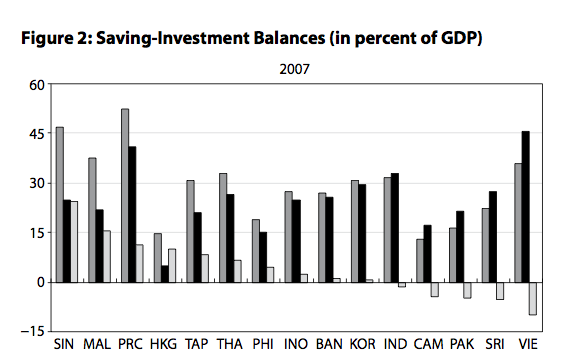
America’s culture of borrow, borrow, and borrow some more is a recent phenom in America seemingly ushered in with the rise of the Baby Boomer generation to power as you can see in the graph above over the past 60 years or so. Americans use to be more prudent savers prior to World War II. In stark contrast, Asia has and continues to be an increasingly acute saving society. The Asian Development Bank studied 14 Asian countries and the Chinese territory of Hong Kong and found their average savings rate to be 29.3 percent (see below) across the continent in its most recent data. Meanwhile, the United States current savings rate according to the St. Louis Fed shows America at 4.3 percent. In other words, it would take a 582 percent increase in America’s current savings rate to match Asia.  We know as the people’s behavior goes so goes their government’s. After all, governments are of the people and so is their fiscal behavior.

Screen shot 2014-04-13 at 5.46.31 PM

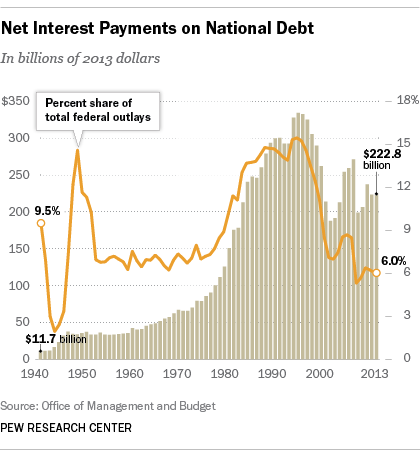
For some reason it has never dawned on governments to plan ahead. It has never dawned on them that debt to finance future purchases is not actually necessary. America’s current infrastructure is in disarray to put it kindly, but when these structures were built did no one think that one day they would decay? The moment we buy a car are we assuming it will run forever? Or it will never need maintenance? Instead, we have taken the attitude that these deferred maintenance or replacement cost can just be borrowed against more and more. Each time requiring more debt than previously borrowed and deferring the liability to another generation. Historically low interest rates are currently suppressing the net interest we are paying on our $17 trillion in debt. As of 2013, we are paying $223 billion in interest or 6 percent of federal outlays. Internal HBCU Money calculations estimate the percentage would be 59 percent of federal outlays or $10 trillion if the Fed funds rate adjusted to market demand.

The American Society of Civil Engineers gave the U.S. a D+ on its infrastructure and estimates it would cost $1.6 trillion to “catch up” by 2020. My elementary math might be a bit rusty, but that equates to currently seven years of interest. I could go on and on about the many number of things America could be doing with that $223 billion like improving our education system, providing more assistance for veterans, or simply putting that money away for a rainy day.

debt_interest2

There is joy in taking a walk, taking a country drive, and even in letting someone else do the flying and looking out of the window at the Earth’s beauty. Financial stress even at the most macro level of government seeps into American households and stresses the very fabric of a country. We see this with the rise of the TEA party and Occupy Wall Street movements. A change in culture is needed and it is needed within our homes. We must be fiscally responsible and teach our children to do the same so that the future generations of leadership in this country can start to remove the glutton of entitlement corrupting the veins of America. A family, community, country must be strong and part of that strength is its fiscal house or as my mother often told me – just because we can do something does not mean we should, superman. There is after all strength in restraint.