Category Archives: Economics

African America’s September Jobs Report – 11.0%

jobs_pic

Overall Unemployment: 5.9% (6.1%)

African America Unemployment: 11.0% (11.4%)

Latino America Unemployment: 6.9% (7.5%)

European America Unemployment: 5.1% (5.3%)

Asian America Unemployment: 4.3% (4.5%)

Previous month in parentheses.

Analysis: The overall unemployment rate dropped 20 basis points. All four groups saw declines in their unemployment rates. Latino America led the way with the largest decline of 60 basis points. African America continues to be the only group that remains with a double digit unemployment rate.

African American Male Unemployment: 11.0% (10.8%)

African American Female Unemployment: 9.6% (10.6%)

African American Teenage Unemployment: 30.5% (32.8%)

African American Male Participation: 68.5% (67.3%)

African American Female Participation: 61.4% (61.5%)

African American Teenage Participation: 28.6% (25.9%)

Previous month in parentheses.

Analysis: African American males saw their unemployment rate raise 20 basis points and their participation rate climb 120 basis points. African American females saw their unemployment rate drop 100 basis points and their participation rate drop 10 basis points. African American teenagers unemployment rate dropped 230 basis points and their participation rates climbed 270 basis points.

CONCLUSION: The overall economy added 248 000 jobs in September. Considered a healthy bounce back after a disappointing August. For the first time in a significant period, African America’s job growth actually outpaced the country adding 288 000 jobs in September. Over the past five months job growth for African America has grown 2.5 percent which outpaces both Latino and European America. The African American teenagers were the run away winners of the September boom with a significant increase  and decrease in participation and unemployment rate, respectively. A group that remains in an employment crisis, but has its largest number of employed in the past five months. A significant impact for African American families who are often dependent on teenager wages. If African America can hold its current labor force and add 210 000 jobs in the month of October, then it will actually break the elusive almost unicorn-like single digit unemployment rate that continues to elude African America.

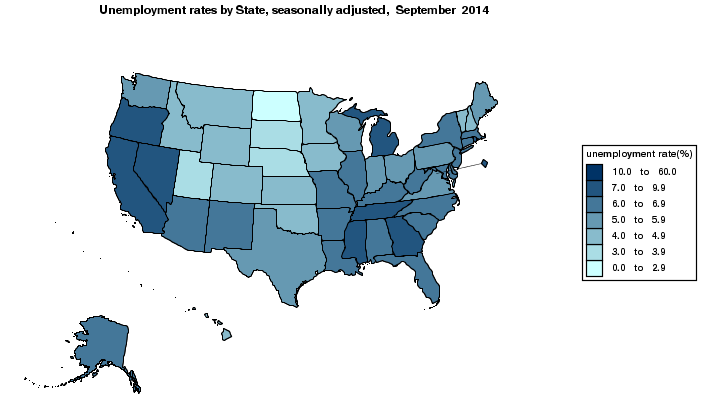
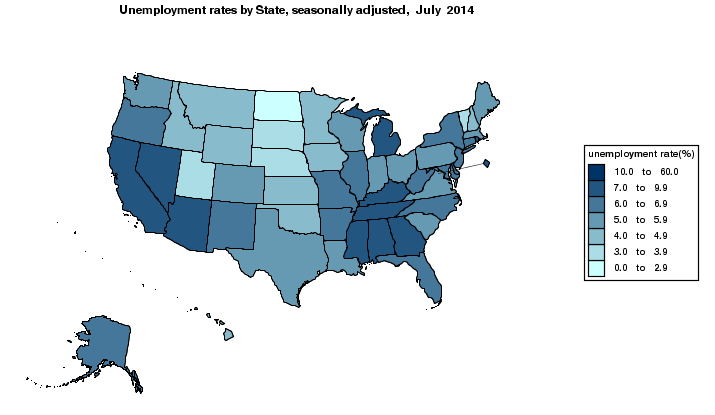
Unemployment Rate By HBCU State – July 2014

Screen Shot 2014-09-12 at 10.23.09 AM

NUMBER OF STATES WITH RISING UNEMPLOYMENT: 15

NUMBER OF STATES WITH DECLINING UNEMPLOYMENT: 1

NUMBER OF STATES WITH UNCHANGED UNEMPLOYMENT: 8

LOWEST: OKLAHOMA – 4.6%

HIGHEST – MISSISSIPPI – 8.0%

ALABAMA –  7.0% (6.8%)

ARKANSAS – 6.2% (6.2%)

CALIFORNIA – 7.4% (7.4%)

DELAWARE – 6.2% (6.1%)

DISTRICT OF COLUMBIA – 7.4% (7.4%)

FLORIDA – 6.2% (6.2%)

GEORGIA – 7.8% (7.4%)

ILLINOIS – 6.8% (7.1%)

KENTUCKY – 7.4% (7.4%)

LOUISIANA – 5.4% (5.0%)

MARYLAND – 6.1% (5.8%)

MASSACHUSETTS – 5.6% (5.5%)

MICHIGAN – 7.7% (7.5%)

MISSISSIPPI – 8.0% (7.9%)

MISSOURI –  6.5% (6.5%)

NEW YORK – 6.6% (6.6%)

NORTH CAROLINA – 6.5% (6.4%)

OHIO – 5.7% (5.5%)

OKLAHOMA – 4.6% (4.5%)

PENNSYLVANIA – 5.7% (5.6%)

SOUTH CAROLINA – 5.7% (5.3%)

TENNESSEE – 7.1% (6.6%)

TEXAS – 5.1% (5.1%)

VIRGINIA – 5.4% (5.3%)

Previous month in parentheses.

African America’s August Jobs Report – 11.4%

jobs_pic

Overall Unemployment: 6.1% (6.2%)

African America Unemployment: 11.4% (11.4%)

Latino America Unemployment: 7.5% (7.8%)

European America Unemployment: 5.3% (5.3%)

Asian America Unemployment: 4.5% (4.5%)

Previous month in parentheses.

Analysis: The overall unemployment rate dropped 10 basis points. Unemployment rates for African, Asian, and European America went unchanged. Latino America saw its unemployment rate drop 30 basis points. African America remains the only group with double digit unemployment.

African American Male Unemployment: 10.8% (11.1%)

African American Female Unemployment: 10.6% (10.1%)

African American Teenage Unemployment: 32.8% (34.9%)

African American Male Participation: 67.3% (68.0%)

African American Female Participation: 61.5% (62.3%)

African American Teenage Participation: 25.9% (25.3%)

Previous month in parentheses.

Analysis: African American males saw their unemployment rate drop 30 basis points and participation rate drop 70 basis points. African American females unemployment rate rose 50 basis points and participation rate drop 80 basis points. African American teenagers unemployment rate dropped 210 basis points and participation rate rose by 60 basis points.

CONCLUSION: The overall economy added 142 000 jobs in August. A significant disappointment from most economist estimates. After 3 straight months of job growth for African America, the growth came to a bruising halt in August with a loss of 76 000 jobs. No group suffered more than African American women who loss 155 000 jobs dropping to their second lowest number of employed over the past 5 months. A disturbing notion since African American women continue to be the cornerstone of the economic health for African American families. Despite the losses, the number of African Americans employed and participation rate are both still the second highest they have been in the past 5 months. The real question is whether this is the start of a trend downward for African America or just a temporary blip. It would take 291 000 jobs to get the African American unemployment rate to 9.9 percent.

Unemployment Rate By HBCU State – June 2014

Screen Shot 2014-08-06 at 3.59.16 PM

NUMBER OF STATES WITH RISING UNEMPLOYMENT: 7

NUMBER OF STATES WITH DECLINING UNEMPLOYMENT: 10

NUMBER OF STATES WITH UNCHANGED UNEMPLOYMENT: 7

LOWEST: OKLAHOMA – 4.5%

HIGHEST – MISSISSIPPI – 7.9%

ALABAMA –  6.8% (6.8%)

ARKANSAS – 6.2% (6.4%)

CALIFORNIA – 7.4% (7.6%)

DELAWARE – 6.1% (5.9%)

DISTRICT OF COLUMBIA – 7.4% (7.5%)

FLORIDA – 6.2% (6.3%)

GEORGIA – 7.4% (7.2%)

ILLINOIS – 7.1% (7.5%)

KENTUCKY – 7.4% (7.7%)

LOUISIANA – 5.0% (4.9%)

MARYLAND – 5.8% (5.6%)

MASSACHUSETTS – 5.5% (5.6%)

MICHIGAN – 7.5% (7.5%)

MISSISSIPPI – 7.9% (7.7%)

MISSOURI –  6.5% (6.6%)

NEW YORK – 6.6% (6.7%)

NORTH CAROLINA – 6.4% (6.4%)

OHIO – 5.5% (5.5%)

OKLAHOMA – 4.5% (4.6%)

PENNSYLVANIA – 5.6% (5.6%)

SOUTH CAROLINA – 5.3% (5.3%)

TENNESSEE – 6.6% (6.4%)

TEXAS – 5.1% (5.1%)

VIRGINIA – 5.3% (5.1%)

Previous month in parentheses.

African America’s July Jobs Report – 11.4%

jobs_pic

Overall Unemployment: 6.2% (6.1%)

African America Unemployment: 11.4% (10.7%)

Latino America Unemployment: 7.8% (7.8%)

European America Unemployment: 5.3% (5.3%)

Asian America Unemployment: 4.5% (5.1%)

Previous month in parentheses.

Analysis: The overall unemployment rate rose 10 basis points. European and Latino Americans saw their unemployment rates go unchanged. Asian America saw a 60 basis point decline in their unemployment rate. African America was the only group to see an increase rising 70 basis points and remaining the only group with double digit unemployment.

African American Male Unemployment: 11.1% (10.9%)

African American Female Unemployment: 10.1% (9.0%)

African American Teenage Unemployment: 34.9% (33.4%)

African American Male Participation: 68.0% (67.5%)

African American Female Participation: 62.3% (61.4%)

African American Teenage Participation: 27.3% (25.2%)

Previous month in parentheses.

Analysis: African American males saw their unemployment rate rise 20 basis points, but also experienced a healthy increase in their participation rate of 50 basis points. African American females short lived single digit unemployment rose 110 basis points, but they also experienced a rise in their participation rate of 90 basis points. African American teenagers continue to struggle with a rise of 150 basis points in their unemployment rate and only a negligible rise in their participation rate.

CONCLUSION: The overall economy added 209 000 jobs in July. Economist overall believe the economy is finally showing signs of healthy and stable recovery as job increases continue over 200 000 per month. African America picked up 69 000 new jobs and set another five month high of employed at almost 16.9 million. The momentum for hiring has definitely picked up African American optimism as the labor force increased by over 200 000, which is the reason the unemployment rate had such a spike. It also speaks to the fact that hiring can not keep pace with the number of African Americans seeking jobs. African American men and women are experiencing five month highs in labor force, employed, and participation rate. Unfortunately, teenagers continue their crisis with a five month low in employed population. The question is can this economy continue its recovery or as the Federal Reserve inches closer to raising interest rates will the usual adage of last hire and first fired come true once again.