
Author Archives: hbcumoney

Not Just Deposits But Shares: Buying A Stake In African America’s Publicly Traded Banks

image1(1)

Editor’s Correction: Broadway Federal Bank located in Los Angeles, California is also publicly traded and information added below (July 19, 2016)

“But not only that, we’ve got to strengthen black institutions. I call upon you to take your money out of the banks downtown and deposit your money in Tri-State Bank. We want a “bank-in” movement in Memphis. Go by the savings and loan association. I’m not asking you something that we don’t do ourselves at SCLC.”- Martin Luther King, Jr.

It has been noted here at HBCU Money that after every tragic death of an African American by a police officer our site spikes. The primary cause for that spike has been a search for African American owned banks and credit unions and it usually last for a few days, then there are marches, pacification, and all returns to normal as does our site’s traffic. After the recent deaths of Alton Sterling and Philando Castile though something changed and the current numbers say it may finally be the groundswell needed for a permanent paradigm shift in African America’s thought process of self-dependence and empowerment. Banks are the foundation of allowing a community, city, state, nation to control its money and circulate their dollars within the aforementioned entities. This has been at the root of African America’s problem with getting dollars to circulate within its community – simply put a lack of dollars within the financial institutions in the community. Deposits turn into loans and those loans turn into mortgages to increase African American home ownership, reduces predatory lending, and helps launch small businesses which translates into jobs and wealth in the community usually of the bank or credit union entity.

The shift has been profound as banks like Unity National Bank and Citizens Trust (featured here) are overwhelmed by the number of new accounts to the point that their staff simply can not process the volume. Lobbies are jam packed with African Americans moving their money. The seed is planted, but it can not stop there. Another leg of this has to be investing in these institutions from an ownership perspective. More demand for their shares will cause the institutions share prices to increase and increase the value of the company. This allows the company to expand, open new offices, hire more people, and eventually buy other banks. As it buys other banks, it can scale up and drive down cost, which it can then pass that savings on to customers. All of this is investment in our institutions leads to a cycle of economic independence and empowerment that begins to grow and feed on itself like a snowball rolling down hill.

Lastly, America has roughly 3,700 publicly traded companies, but there are only four African American owned public companies (0.1% of all American public companies) and three of them are banks. Below are their profiles. If you want to buy shares in these companies, visit our link on Opening A Brokerage Account.

_______________________________________________________

CITIZENS BANCSHARES CORPORATION

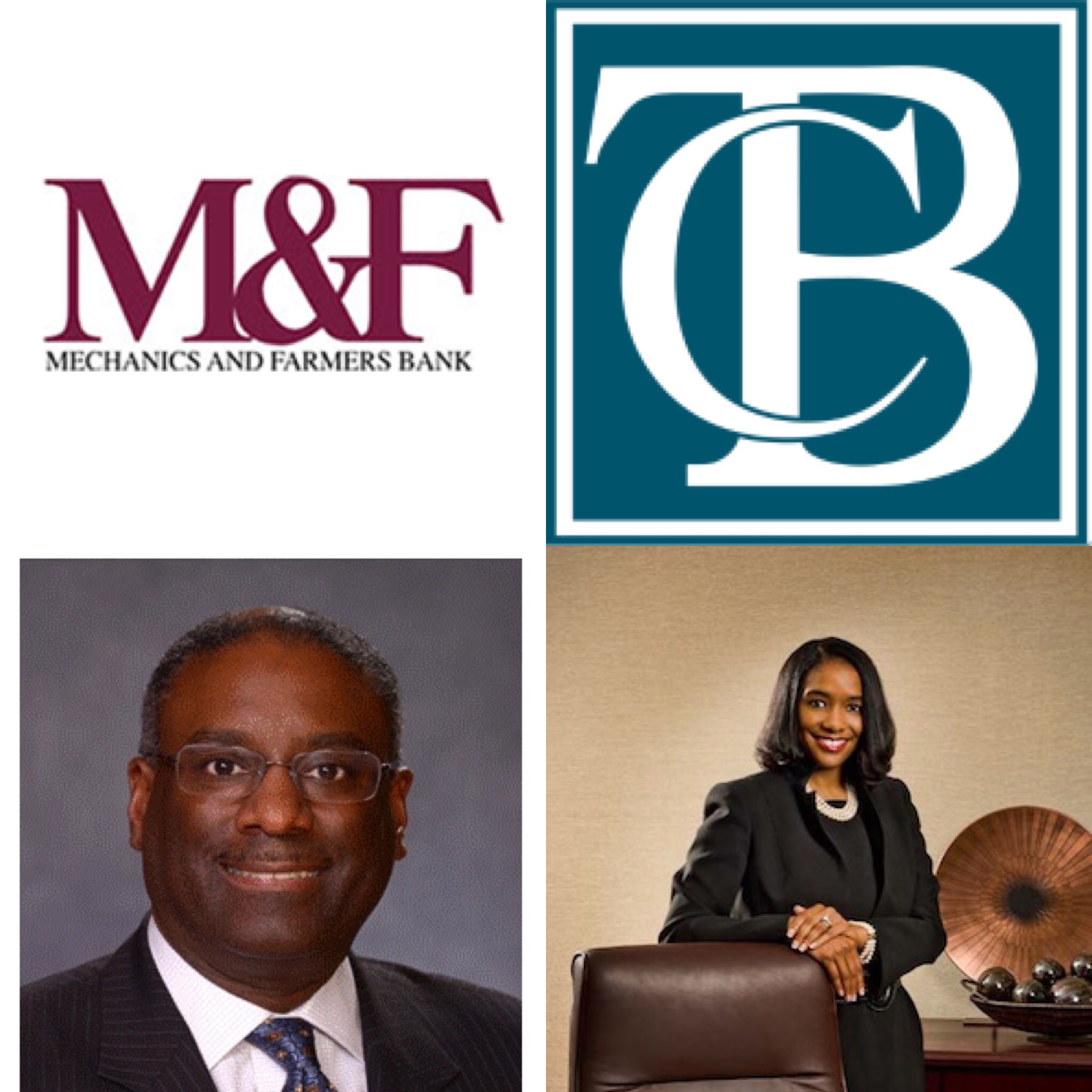
CEO: Ms. Cynthia N. Day, CPA (Above Right)

Ticker Symbol: CZBS

Citizens Bancshares Corporation operates as the holding company for Citizens Trust Bank that provides various commercial banking products and services. The company accepts commercial and consumer deposit accounts, such as non-interest bearing checking accounts, money market checking accounts, negotiable order of withdrawal accounts, individual retirement accounts, time certificates of deposit, sweep accounts, and regular savings accounts. Its loan products include consumer/installment loans, mortgage loans, home equity lines of credit, construction loans, commercial loans, and small business loans. The company operates seven full-service financial centers in metropolitan Atlanta, Georgia; one full-service branch in Columbus, Georgia; one full-service branch in Birmingham, Alabama; and one full-service branch in Eutaw, Alabama. Citizens Bancshares Corporation was founded in 1921 and is based in Atlanta, Georgia.

M&F BANCORP

CEO: Mr. James H. Sills, III (Above Left)

Ticker Symbol: MFBP

M&F Bancorp, Inc. operates as the bank holding company for Mechanics and Farmers Bank that provides consumer and commercial banking products and services in North Carolina. The company offers deposit products, including checking, savings, negotiable order of withdrawal, money market, and individual retirement accounts, as well as certificates of deposit. It also provides loans for real estate, construction, businesses, personal use, home improvement, and automobiles; and equity lines of credit, credit lines, consumer loans, and credit cards. In addition, the company offers safe deposit boxes, Internet and mobile banking services, traveler’s checks, notary services, and automated teller machine services, as well as electronic funds transfer services, such as wire transfers. It operates seven branch offices in Durham, Raleigh, Charlotte, Greensboro, and Winston-Salem, North Carolina. The company was founded in 1907 and is headquartered in Durham, North Carolina.

BROADWAY FEDERAL BANK

CEO: Wayne-Kent A. Bradshaw

Ticker Symbol: BYFC

Broadway Financial Corporation operates as the holding company for Broadway Federal Bank, f.s.b. that provides savings and loan business services for low to moderate income communities in Southern California. The company accepts various deposit products, such as passbook savings accounts, checking accounts, NOW accounts, money market accounts, and fixed-term certificates of deposits. It also provides loan products, including multi-family mortgage, commercial real estate, single family mortgage, church, construction, commercial, and consumer loans. It operates three full service branches comprising two in the city of Los Angeles and one in the city of Inglewood, California. The company was founded in 1946 and is headquartered in Los Angeles, California.

Source: Company profiles provided by Yahoo Finance.

The HBCU Money™ Weekly Market Watch

Our Money Matters /\ July 15, 2016

A weekly snapshot of African American owned public companies and HBCU Money™ tracked African stock exchanges.

NAME TICKER PRICE (GAIN/LOSS %)

African American Publicly Traded Companies

Citizens Bancshares Georgia (CZBS) $7.01 (3.85% UP)

M&F Bancorp (MFBP) $3.22 (0.00% UNCH)

Radio One (ROIA) $3.14 (1.95% UP)

African ETFs

Global X MSCI Nigeria (NGE) $5.16 (2.29% DN)

Market Vectors Africa (AFK) $20.65 (0.48% DN)

African Stock Exchanges

Bourse Regionale des Valeurs Mobilieres (BRVM)  290.29 (0.03% DN)

Botswana Stock Exchange (BSE)  9 983.38 (0.06% DN)

Ghana Stock Exchange (GSE)  1 781.08 (10.72% DN)*

Nairobi Stock Exchange (NSE)  138.30 (N/A)

Johannesburg Stock Exchange (JSE) 53 088.46 (0.48% UP)

International Stock Exchanges

New York Stock Exchange (NYSE) 10 777.34 (0.09% DN)

London Stock Exchange (LSE)  3 606.72 (0.12% UP)

Tokyo Stock Exchange (TOPIX)  1 317.10 (0.45% UP)

Commodities

AG_Screen Shot 2016-07-15 at 2.52.47 PM

ENG_Screen Shot 2016-07-15 at 2.52.37 PM

MET_Screen Shot 2016-07-15 at 2.52.42 PM

Unemployment Rate By HBCU State – May 2016

Screen Shot 2016-07-12 at 3.52.21 PM

STATES WITH RISING UNEMPLOYMENT: 2

STATES WITH DECLINING UNEMPLOYMENT: 17

STATES WITH UNCHANGED UNEMPLOYMENT: 5

LOWEST: ARKANSAS & VIRGINIA – 3.8%

HIGHEST – ILLINOIS – 6.4%

STATE – UNEMPLOYMENT RATE (PREVIOUS)*

ALABAMA –  6.1% (6.1%)

ARKANSAS – 3.8% (3.9%)

CALIFORNIA – 5.2% (5.3%)

DELAWARE – 4.1% (4.2%)

DISTRICT OF COLUMBIA – 6.1% (6.4%)

FLORIDA – 4.7% (4.8%)

GEORGIA – 5.3% (5.5%)

ILLINOIS – 6.4% (6.6%)

KENTUCKY – 5.1% (5.3%)

LOUISIANA – 6.3% (6.3%)

MARYLAND – 4.5% (4.6%)

MASSACHUSETTS – 4.2% (4.2%)

MICHIGAN – 4.7% (4.8%)

MISSISSIPPI – 5.8% (6.0%)

MISSOURI –  4.3% (4.3%)

NEW YORK – 4.7% (4.9%)

NORTH CAROLINA – 5.1% (5.4%)

OHIO – 5.1% (5.2%)

OKLAHOMA – 4.7% (4.5%)

PENNSYLVANIA – 5.5% (5.3%)

SOUTH CAROLINA – 5.6% (5.8%)

TENNESSEE – 4.1% (4.3%)

TEXAS – 4.4% (4.4%)

VIRGINIA – 3.8% (3.9%)

*Previous month in parentheses.

African America’s June Jobs Report – 8.6%

jobs

Overall Unemployment: 4.9% (4.7%)

African America Unemployment: 8.6% (8.2%)

Latino America Unemployment: 5.8% (5.6%)

European America Unemployment: 4.4% (4.1%)

Asian America Unemployment: 3.5% (4.1%)

Previous month in parentheses.

Analysis: Overall unemployment rose 20 basis points. All groups except Asian America saw a rise in their unemployment rate, who saw a 60 basis point decline in their unemployment rate. African America led the way with the largest increase of 40 basis points, followed by European America’s 30 basis points, and Latino America’s 20 basis points.

African American Male Unemployment: 8.2% (7.6%)

African American Female Unemployment: 7.3% (7.4%)

African American Teenage Unemployment: 31.2% (27.1%)

African American Male Participation: 67.8% (67.1%)

African American Female Participation: 60.9% (61.0%)

African American Teenage Participation: 29.2% (28.7%)

Analysis: African American men had a increase of 60 basis points in their unemployment rate, but also experienced a 70 basis point increase in their participation rate. African American women had a decrease of 10 basis points in their unemployment rate, but a 10 basis point decrease in their participation rate. African American teenagers had an increase of 410 basis points in their unemployment rate, but only experienced a 50 basis point increase in their participation rate.

CONCLUSION: The overall economy added 287 000 jobs in June. African America added only 32 000 jobs in June, making May look like an anomaly when African America gained more jobs than the overall economy. It is hard to be overly excited about June’s numbers after May produced only 38 000 jobs overall. A student who gets a 100 and a 0 on test, still has a F average. However, if July delivers a modestly decent number, it could allow the Federal Reserve to put a rate hike back in play for September, which we are still not sure the economy or market is ready for, but desperately needs to heal itself from a decade of fictional interest rates. The fictional interest rates have killed lending and savings and therefore hampered the creation of small business creation in the country. Those are long-term issues though, but issues nonetheless. In the short term, cultural backlash against African America may have some negative labor impact for the rest of the year given African America’s employment dependency on others.

African America needs to create 721 000 jobs to match the nation’s overall unemployment rate.

The HBCUpreneur Corner – Howard University’s Michiel Perry & Black Southern Belle

Untitled-design-16

Name: Michiel Perry

Alma Mater: Howard University

Business Name & Description:  Black Southern Belle, Lifestyle Brand Focused on Showcasing Weddings, Fashion, Home Decor, Food and all things Southern!

What year did you found your company? 2015

What has been the most exciting and/or fearful moment during your HBCUpreneur career?  Deciding to do Black Southern Belle full time versus part time. I knew this was something that needed a full time role, but I also had a mortgage and a husband. It all worked out, but not without some serious scary days.

What made you want to start your own company? I was planning my wedding in Charleston, SC where I am from and decorating my home in Maryland and looking for lifestyle inspiration that was both African American and Southern. After looking with little success I realized this needed to exist and started Black Southern Belle.

Who was the most influential person/people for you during your time in college? I had a constitutional law professor who went above and beyond. He let me miss classes for internship interviews and even passed along my information to senior level executives. From him I learned the value of helping people who aren’t even asking.

How do you handle complex problems? As I am a hot head, I often handle complex problems by first relaxing and then reaching out to my mom or husband who are much more calm than I am and often view something very differently than I would.

What is something you wish you had known prior to starting your company? To reach out to my personal contacts more. I built a large network from my past careers but was afraid to reach out as to seem like an opportunist, but so many people I reach out to want to help even more than I ever thought they would. If you are genuine about your business and really want to make the relationship mutual most people want to help you row.

Some would say that today’s playing field is more leveled with media companies like yours not having to focus on print and being able to be exclusively digital. Do you think that is true and do you have any plans to do anything with print? I would agree. You can grow your brand digitally pretty quickly, you don’t even need a website at this stage, just a large Facebook or Instagram following can help you grow. Just build an audience and the business will come. I have a tech/digital background. The main print I deal with is stationery. If I did something print it would be a partnership, not just myself. I love paper but not enough to launch a magazine but I appreciate those who fulfill that goal as I have more subscriptions than I like to tell my husband.

Pinterest has had a significant impact on lifestyle sharing and your company is very active there. What do you think has allowed that platform to set itself apart from all others in that respect? I think it grabs your attention and is beautiful. It’s first focus was the beauty and then technology which is rare to see.  Often times tech comes first then aesthetics but Pinterest took a different approach.

BSB-Feb-2016-154

We often talk about the need for African Americans to manufacture more products. Being a lifestyle company affords you all to potentially engage a myriad of products with your own brand attached. Do you think this is something your company will pursue? Or are there other avenues of opportunity that you feel are unexplored by lifestyle companies? I love products and I love supporting small businesses. I currently have a signature product line of select items and would love to grow that business more with partners. I think there are so many opportunities and I am all about partnering to help not only myself but other brands grow.

What do you believe HBCUs can do to spur more innovation and entrepreneurship while their students are in school either as undergraduate or graduate students? I would say they can develop mentoring programs for students who want to be entrepreneurs. Like develop an alum system for entrepreneurs like myself to help current students. I also think adding it to the curriculum is an important thing. We already have the network, just need to utilize it more.

How do you deal with rejection? I have always had roles building partnerships and relationships. Most of the time you hear no. I am very used to it. Often times no is temporary and not because of you but because of other factors. I say no is just for now, not permanent so there is really no true rejection in my opinion just bad timing.

When you have down time how do you like to spend it? Antique shopping and watching historical documentaries. I am a serious history buff.

What was your most memorable HBCU memory? Having a Howard Alum find me on the first day of my internship on Capitol Hill. Howard Alum are crazy and will always find you. I do that now and I hope it makes the students feel as special as I did that day.

In leaving is there any advice you have for budding HBCUpreneurs? Take the risk and do full time if you can. If you can’t, don’t be afraid to outsource some work to keep your business growing. Just because you can’t do it full time doesn’t mean it can’t be done but you should find the resources to move forward.