Author Archives: hbcumoney

Merge Or Die: Radio One & Johnson Publishing Company

“Pride is a form of selfishness.” – David Lawrence

Mergers-and-Acquisitions-Insurance-1011

There are two cars traveling across the United States of America. Starting off they they both think they have enough gas to go all the way, but about one-fourth of the way into the trip they realize they only have enough to make it three-fourths of the way there. The two cars had become acquaintances on this journey often seeing each other at the same rest stops and gas stations. From time to time they even exchange small talk and have a distant fondness for each other knowing they were on the same journey. As they finally approached the crossroad of a decision, just how would they make their decision? Well, if the goal is being their guide and not their ego, they decide to pool resources. They “merge” the two vehicles resources into one. In other words, they decide which car is in the best shape, siphon the gas from the other, take spare parts, and ultimately continue on their way. But someone must now give up their control to further this trip and that is ultimately where many African American businesses fail to ever reach the “destination” of becoming or remaining a viable and growing business.

In 2015, Johnson Publishing Company, African America’s largest owned publishing company, decided it needed raise more cash and was going to set about doing so under the direction of CEO Desiree Rogers’ leadership by selling 70 million iconic African American photos it has culminated since its founding for a price tag of $40 million. An amount roughly equal to almost half of the company’s current annual revenues. This follows on the heels of four years earlier the company giving up a 40 percent stake in the company for a cash infusion from J.P. Morgan Chase’s Special Investments Group also under the leadership of Ms. Rogers. The J.P. Morgan infusion clearly has not helped the company as traditional media companies are seeing print go the way of the dinosaur and JPC is no exception. Ebony Magazine, JPC’s flagship brand, saw ad revenue plummet 24 percent in 2014 versus Time’s Essence Magazine, which trails Ebony in average circulation, only saw its ad revenue fall 7.5 percent over the same period. Essence is benefitting by being a part of the larger Time umbrella that allows advertisers to buy spots in multiple publications and platforms offered by Time Inc. and its 90 diverse brands within the publishing juggernaut. Johnson Publishing Company has one. It had two, but Ms. Rogers also early on in her tenure chose to discontinue the historically popular JET Magazine. Now, the company consist of Ebony Magazine and Fashion Fair Cosmetics, a cosmetics company that JPC founded during the 1970s. Oddly, Ms. Rogers decided that keeping a cosmetics company as opposed to JET, even though reports say her strategy is to shore up Johnson Publishing’s core business.

And in the other corner, over the past few years there has also been a story of tumultuous change in nearby Silver Spring, Maryland at Radio One, Inc. The company founded by Cathy Hughes in 1980 and currently run by her son Alfred Liggins, III. One of only three African American owned publicly traded companies has seen its share price drop over 70 percent in the past couple of years. Rumors have it that prior to selling BET to Viacom, founder Bob Johnson, actually approached Ms. Hughes and Co. about a merger. How serious that conversation was is unknown, but what we do know is that it did not happen. Radio One’s leadership ultimately favoring a partnership with Comcast to launch TV One. It would ultimately buyout Comcast in the early part of 2015 after that ten year partnership and have a 99.6 percent controlling interest in the television station. As of its December 2014 10-K filing, the company owned 56 broadcast stations in 16 urban markets which is the core of the company’s business. It also owns some digital properties such as Global Grind, BlackPlanet, and a number of other marginal digital assets. There has been some belief that Radio One could be on the verge of a comeback after converting one of its radio stations from a news station to an 80s and 90s based hip-hop station in Houston. The station itself has received rave reviews from critics and listeners, but what it has seemingly failed to do is  land some of the industry’s blue chip advertisement accounts.

What do these two companies look like merged? Well, first they would have a combined $1.3 billion enterprise value and $540 million in annual revenues. There has not been an African American owned company to generate $1 billion in revenue annually since Virginia State University’s alum Reginald Lewis created TLC Beatrice in the late 80s. This would put the merged company well over half the way there. It would also expand both companies demographic reach. Radio One’s demographics are primarily 18-40, while JPC’s are 40 and up. Radio One’s younger demographic could be exactly is needed to pick up a new generation of readers for Ebony Magazine and may even allow for a relaunch of JET. JPC’s demographic, arguably a more mature, economically stable, and better educated demographic could be what Radio One needs to attract more well heeled advertisement accounts. It would also save the drastic mistake Johnson Publishing Company is making currently with the sale of its photograph collection which could be a source of revenue for the newly merged company across the plethora of digital platforms that Radio One has at its disposal.

mergers-and-acquisitions-in-ecommerce-and-its-impact-on-indian-economy-4-638

It is often baffling that African American businesses continue to get bailouts from companies like J.P. Morgan or Morgan Stanley, but will not consider a merger because everyone continues to want to be the general of a small (perhaps dying) enterprise instead of the soldier of a larger thriving enterprise. We saw it with Carver Bank in New York, once an African American owned bank, but instead of merging with One United in Boston found itself needing to be bailed out after the Great Recession from Citigroup, Goldman Sachs, and Morgan Stanley. Did it approach One United? No, in a “show” of sorts the bank’s CEO, Deborah Wright, tried to assure many of banks constituency that the institution had not lost its way. Radio One and Johnson Publishing Company are looking down the same road. Two companies that desperately need each other and African America desperately needing a sign that our businesses understand the bigger picture beyond egos. Otherwise, both may become historical footnotes well before their time was intended leaving a crater in the African American private sector that does not and did not need to be there. These two companies are heading to the same destination, but will run out of gas well before either reaches it if both are not willing to share the ride there.

2015 Ariel Investments Black Investor Survey Shows Investment Gap Stubbornly Unchanged

masthead1

“The stock market is a device for transferring money from the impatient to the patient.” – Warren Buffett

From 1998 to 2010 Ariel Investments, an African American owned investment firm headquartered in Chicago, has conducted a study on the state of the African American investor in comparison to European American counterparts. Absent for five years, in 2015 the company resumed its research and released an update on the state of the African American investor. Overall, African American participation still trails European Americans by nineteen percentage points and nothing seems to influence that participation among African Americans more than education and income, while European Americans saw negligible change in participation regardless of income or education in the study.

etc_hardchoices14__01__405x270

  • In 2015, black investing is at 67 percent, while white investing is at 86 percent.
  • African Americans between $50 000 and $100 000 per year in household income, 57 percent are investors, while that numbers jumps to 81 percent for households making over $100 000.African Americans earning over $100 000 are 47 percent more likely to be invested than those earning between $50 000 and $100 000. For European Americans, that gap is 10.8 percent.
  • African Americans with graduate degrees have a 72 percent participation rate, while those with a bachelors or less participate at 63 percent. That is a 14.3 percent gap, while for European Americans it is only 2.3 percent in regards to education.
  • Real estate for the first time is not considered the “best investment overall” by African Americans. After being at 61 percent in 2004, real estate dropped to 37 percent as best investment overall. On the flip side, stocks have climbed from 28 percent to 41 percent as best investment overall.
  • The state of retirement has drastically changed from a decade ago where 42 percent of African Americans expected to retire before the age of 60; now that sentiment stands at 17 percent.

Being at a company that offers a retirement plan is critical to African American investing than European Americans. There was a 40 percent more likelihood that for African Americans this was the entry into investing. The most baffling part of the report highlights African American economic illiteracy perhaps. 3 out of 4 African American households feel hopeful about the current U.S. economy, while European Americans were 2 out of 4. Two-thirds of African Americans feel the economy has or is almost fully recovered from the recession, while well under half of European Americans felt the same. And lastly on the economy, African Americans at a two-thirds clip feel bullish about the stock market, while just over half of European Americans do. Ariel Investments reports, “African American bullishness has increased since 2005, whereas for whites, it has decreased in the last decade.” The ascension of President Obama’s election in 2008 certainly can explain some of that, but not much explains the previous four years prior to his election. Even the presence of the President Obama during the greatest recession since the Depression has to make one question African American sentiment and what it was rooted in – if anything. A Great Recession that depleted 83 percent of African American wealth in large part because of that heavy dependency on the aforementioned real estate as the best investment overall. The conundrum is that despite this very bullish conviction on the economy, it is not causing a closure in the investment gap.

BlackFamily

Highlights & Solutions:

Overall investment participation. European Americans are almost 30 percent more likely to be invested.

  • Education and income being the primary drivers, which is a negative. In other words, how do we get less educated and lower income African Americans to participate. One solution is the reemergence of investment clubs tucked in neighborhood organizations. Using small monthly buy-ins of $5-15 per month can potentially be more enticing among lower income, while exposing them and allowing them to reap the benefits of pooled money.

Market participation among Baby Boomers is stark when it comes to race. European Americans over the age of 65 are invested 57 percent more than their African American counterparts.

  • The consequences of this is far reaching. As African American Baby Boomers pass away, the gap in potential inheritance for heirs and African American institutions will be acute to their counterparts. African American Baby Boomers reliance on government employment and its current contraction

In the past five years, African American for the first time find stocks to be a better investment than real estate. A sign that African America is becoming more willing to take on risk in their portfolios.

  • This trend hopefully will continue. However, in a follow up to the question, almost two-thirds of African American investors believe a home improvement is a better investment than stocks. A need for tangible investments versus abstract ones such as stock maybe a cultural hurdle that financial advisers must overcome to engage more African Americans. Investors must do research to make sure the home improvement they are thinking of engaging will actually add value to their home. Remember, there are only two ways to pull value out of a home – sell it or borrow against the equity. In either case, an investor must ask themselves what their plans are with the new capital and how it will impact their portfolio.

There has been no asset class over the past one hundred years with a better return than equities. African America’s lack of disposable income the past few generations have caused it to lose out on many of the wealth gains other groups have experienced. Having the lowest median income of all groups has certainly been a problem, but for those who can engage must do so if we are to have a formidable plan of closing the wealth gap for African Americans.

For the full Ariel Investment report, click here.


OWN Programming STILL Fails To Excite: Women Are Beyond Soap Operas And Chocolate (Maybe Not Chocolate)

“Think like a queen. A queen is not afraid to fail. Failure is another steppingstone to greatness.” – Oprah Winfrey

own-network-preview_x4pzpd

Five years ago, Oprah Winfrey hung up her crown as the greatest daytime host ever to assume the full-time CEO role of her then fledgling network. The Oprah Winfrey Network better known as OWN, a 50-50 partnership between Harpo Productions and Discovery Communications, was suppose to allow Oprah’s rabid fan base to transition from just a few hours of her a day to twenty four hours of programming laid out by the queen of television. You know when they say be careful of what you ask for? This became the question Ms. Winfrey had to be asking herself in the first few years of the new network. Filling twenty four hours of programming versus a few hours proved to be as expected quite a mountainous task. There was shakeup at the network not even one year into its debut as Discovery Communications flexed its muscle in the partnership influencing some changes in leadership. It has helped, but is OWN missing a chance to be a transformative platform for women that can also be a financial juggernaut?

Diverse-Group-of-Women

Filling twenty four hours of quality programming for women actually should not be that complicated. Unfortunately, OWN has reduced women’s interest to a version of Lifetime “light”, Tyler Perry shows, Dr. Phil episodes, and now that Oprah has a ten percent ownership in Weight Watchers International expect viewers to get a full barrage of subtle (or not) hints at body shaming. This new formula has certainly paid off for the network with the most successful quarter in the network’s history coming in the first quarter of 2015. Maybe the expectation that OWN could be much more than it is is unrealistic, but this unimaginative content is not reflective of the myriad of interest that anyone who is a woman or knows a woman has. And it is that very lack of imagination that will keep OWN as a marginal television station and investment for Discovery Communications who may eventually decide to jettison the partnership and financially costing Ms. Winfrey dearly. So what should be done?

The most profitable live television events right now that can not be DVR’d is sports programming, which is why media companies are paying billions to have the licensing rights to the NFL and other live television events in the moment. Sports is an acute missing piece of the OWN programming puzzle, especially when it comes to the NFL where women are the fastest growing demographic fan base. Now, nobody needs to kid themselves that OWN, Discovery, or Ms. Winfrey personally can afford to buy licensing rights to prime NFL games. Disney, a company ten times the size of Discovery Communications and owner of ESPN, pays the NFL almost $2 billion annually just to show NFL games. That being said, where is the “Sportscenter” for women on OWN? Gone are the days where women just sat next to their boyfriend or husband and watched the game. Today, women are as knowledgeable if not more about the game and those who are not are interested in knowing more. A NFL show hosted by women for women could easily take up one or two hours everyday on the network. There are a plethora of women football gurus on social media with devout followings like Lizz Robbins (Lizzs_Lockeroom) with almost 30 000 followers. She tweets about everything from the NFL, NBA, MLB, and even NHL covering a plethora of women demographics that advertisers would love. Never mind it may make the NFL come advertising with OWN instead of the other way around. Secondly, live women’s sporting events often are given the second hand treatment by both men (and women) sporting fans. The WNBA needs more exposure and OWN could offer the league prime time spots. Every professional sport women participate in like the LPGA and WTA could benefit from time on OWN and OWN could benefit from their content. Now, instead of fathers and sons rooting on their favorite athlete it could be mothers and daughters cheering on Serena Williams or Skylar Diggins. You know ESPN’s 30 for 30? What about producing one of those on “Babe” Zaharias, the multi-sport start of the early twentieth century that showed many that women loved to get down and dirty and compete just like her male counterparts. Again, a women-centric view that speaks to not only women’s interest, but highlights women’s participation that is so often overlooked in mainstream media.

1435587109-us-no-1-women-entrepreneurs-still-room-improvement-woman-business-infographic

Beyond sports, there is a treasure trove of other possibilities. A show on technology that features Reshma Saujani, founder of Girls Who Code, and Kimberly Bryant, founder of Black Girls Code, could highlight news on the latest in women’s work and innovation in the field. A political show with both liberal and conservative views featuring the recently released MSNBC host Melissa Harris-Perry and Christina Sommers, respectively. Apart or together they would certainly generate fireworks, ratings, and revenue with both having very strong social media followings. And given women’s increased economic importance to both their household and the nation, a myriad of shows such as financial and investment news featuring Mellody Hobson, president of Ariel Investments in Chicago, or a complete show dedicated to women entrepreneurs who are now responsible for 3 out of every 5 new businesses (see above) started in the United States. The Federal Reserve, arguably the world’s most powerful bank, is led by a woman. The next president of the United States of America maybe a woman. Countless countries around the world are already headed by women. Again, the possibilities for meaningful, substantive, and profitable content are endless because women’s interest are as vast as the land and sea.

It is hard to know whether OWN is actually being held back by its relationship with Discovery Communications, which may have a formula it believes works for women’s programming. The problem is that programming model is outdated. Gone are the days where the belief was that women only want to watch soap operas and eat chocolate. There is an opportunity for OWN to be a trailblazer in reflecting the new reality and profit handsomely from doing so. Women’s importance is no longer behind closed doors, but in the forefront of every aspect of our society today. It is time that mediums, especially ones that are visual and have the ability to impact future generations of girls reflect the new world. The leadership at OWN must realize that being at the vanguard of this will be what ensures its success (and profitability) and not doing so will ultimately doom it to the dustbin. After all, this is business.

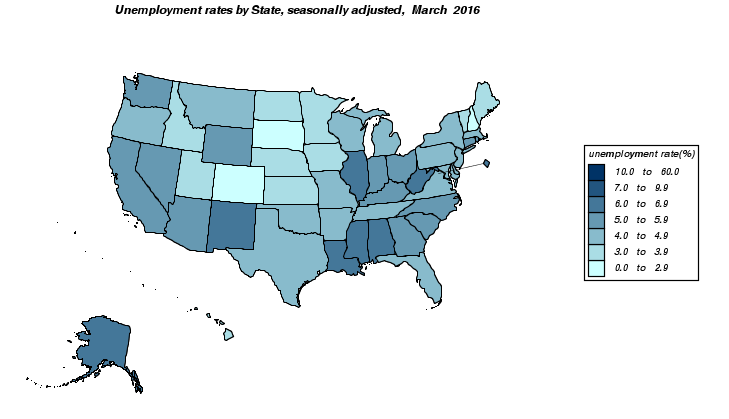
Unemployment Rate By HBCU State – February 2016

Screen Shot 2016-04-04 at 9.55.06 PM

STATES WITH RISING UNEMPLOYMENT: 5

STATES WITH DECLINING UNEMPLOYMENT: 17

STATES WITH UNCHANGED UNEMPLOYMENT: 2

LOWEST: VIRGINIA – 4.1%

HIGHEST – DISTRICT OF COLUMBIA & MISSISSIPPI – 6.5%

STATE – UNEMPLOYMENT RATE (PREVIOUS)*

ALABAMA –  6.2% (5.9%)

ARKANSAS – 4.2% (5.1%)

CALIFORNIA – 5.5% (5.8%)

DELAWARE – 4.6% (5.1%)

DISTRICT OF COLUMBIA – 6.5% (6.6%)

FLORIDA – 4.9% (5.1%)

GEORGIA – 5.4% (5.7%)

ILLINOIS – 6.4% (5.4%)

KENTUCKY – 5.8% (4.9%)

LOUISIANA – 5.9% (6.2%)

MARYLAND – 4.7% (5.1%)

MASSACHUSETTS – 4.5% (4.6%)

MICHIGAN – 4.8% (5.0%)

MISSISSIPPI – 6.5% (5.9%)

MISSOURI –  4.2% (5.0%)

NEW YORK – 4.8% (4.8%)

NORTH CAROLINA – 5.5% (5.7%)

OHIO – 4.9% (4.4%)

OKLAHOMA – 4.2% (4.3%)

PENNSYLVANIA – 4.6% (5.1%)

SOUTH CAROLINA – 5.5% (5.6%)

TENNESSEE – 4.9% (5.6%)

TEXAS – 4.4% (4.4%)

VIRGINIA – 4.1% (4.2%)

*Previous month in parentheses.

African America’s March Jobs Report – 9.0%

jobs

Overall Unemployment: 5.0% (4.9%)

African America Unemployment: 9.0% (8.8%)

Latino America Unemployment: 5.6% (5.4%)

European America Unemployment: 4.3% (4.3%)

Asian America Unemployment: 4.0% (3.8%)

Previous month in parentheses.

Analysis: Overall unemployment rose slightly in the month of March from the previous month. No group to experienced a decline, while European America was the only group to go unchanged. All other groups saw 20 basis point increases in their unemployment rates.

African American Male Unemployment: 8.7% (8.6%)

African American Female Unemployment: 8.0% (7.9%)

African American Teenage Unemployment: 25.3% (23.3%)

African American Male Participation: 67.2% (67.5%)

African American Female Participation: 61.5% (62.0%)

African American Teenage Participation: 30.5% (28.8%)

Previous month in parentheses.

Analysis:African American males had a 10 basis point increase in their unemployment rate and a 30 basis point decrease in their participation rate. African American females had a 10 basis point increase in their unemployment rate and a 50 basis point decrease in their participation rate. African American teenagers unemployment rate increased 200 basis points and participation rate experienced an increase of 170 basis points.

CONCLUSION: The overall economy added 215 000 jobs in March. African America lost 92 000 jobs in March marking the first decrease in the past five months. The African American labor force also pulled back with a decline of almost 60 000 after three months of growth. Thankfully, participation rate over the past five months remains virtually unchanged meaning that African America’s employment situation is basically doggy paddling in the middle of the economic ocean, still. While some believe that improving job conditions are pulling the rest of the nation off the sideline, it appears to be sending African American to it. This could be largely dependent on the types of jobs and where African America is concentrated. An unusual rise for African American teenagers participation rate, while the adults declined. The market and economy are showing modest growth, but the true sustainability of it remains to be seen with so many negative marks in the global macroeconomic environment.

African American needs an increase of 779 000 jobs to match the country’s unemployment rate – an increase of 20 000 jobs from the previous month.