Author Archives: hbcumoney

HBCU Money™ Dozen Links 10/21 – 10/25

twelve

Did you miss HBCU Money™ Dozen via Twitter? No worry. We are now putting them on the site for you to visit at your leisure. We have made some changes here at HBCU Money™ Dozen. We are now solely focused on research and central bank articles from the previous week.

Research

Social engineering: How oversharing information can lead to disaster online l CSOonline

The Radical Right Wing Is Becoming An Unlikely Advocate For Solar Power l Clean Technica

Pairs of entangled photons that act as clocks demonstrate how time might be an illusion l New Scientist

A spate of extreme weather may be due to changing jet streams, but controversy’s in the air l New Scientist

Our scientists help cities save money using green infrastructure l EPA Research

Why does GPS drain your battery? A Google engineer explains l Network World

Federal Reserve, Central Banks, & Financial Departments

Financial Education is All the Rage, but Does it Really Work? l Council For Econ Ed

Find out why more people aren’t making the investment in a college degree l St. Louis Fed

House to vote on disapproval of debt ceiling suspension l Floor Action

Mortgage fraud rises alongside the housing market l Housing Wire

GOP assured government workers won’t ‘double dip’ on unemployment l Floor Action

Microsavings opens door for individuals to invest in themselves l St. Louis Fed

Thank you as always for joining us on Saturday for HBCU Money™ Dozen. The 12 most important research and finance articles of the week.

The HBCU Money™ Weekly Market Watch

Our Money Matters /\ October 25, 2013

A weekly snapshot of African American owned public companies and HBCU Money™ tracked African stock exchanges.

NAME TICKER PRICE (GAIN/LOSS %)

African American Publicly Traded Companies

Citizens Bancshares Georgia (CZBS) $5.51 (0.00% UNCH)

M&F Bancorp (MFBP) $3.25 (0.00% UNCH)

Radio One (ROIA) $3.25 (10.54% UP)

African Stock Exchanges

Bourse Regionale des Valeurs Mobilieres (BRVM)  207.30 (0.58% DN)

Botswana Stock Exchange (BSE)  8 711.53 (0.13% UP)

Ghana Stock Exchange (GSE)  2 094.70 (74.60% UP)*

Nairobi Stock Exchange (NSE)  131.06 (N/A)

Johannesburg Stock Exchange (JSE) 45 124.04 (0.13% UP)

International Stock Exchanges

New York Stock Exchange (NYSE) 10 052.37 (0.23% UP)

London Stock Exchange (LSE)  3 581.33 (0.08% UP)

Tokyo Stock Exchange (TOPIX)  1 178.28 (2.08% DN)

Commodities

Gold 1 351.80 (0.12% UP)

Oil 98.00 (0.92% UP)

*Ghana Stock Exchange shows current year to date movement. All others daily.

All quotes reported as of 4:00 PM Eastern Time Zone

African America’s September Unemployment Report – 12.9%

jobs_pic

Overall Unemployment: 7.2% (7.3%)

African America Unemployment: 12.9% (13.0%)

Latino America Unemployment: 9.0% (9.3%)

European America Unemployment: 6.3% (6.4%)

Asian America Unemployment: 5.3% (5.1%)

Analysis: Overall unemployment dropped 10 basis points. African, European, and Latino Americans saw decreases in their unemployment rates with Latinos seeing the most notable decrease. Asian America saw an uptick but still maintains the lowest unemployment rate of all groups. African America continues to be the only group in double digits.

African American Male Unemployment: 14.0% (13.5%)

African American Female Unemployment: 10.0% (10.6%)

African American Teenage Unemployment: 35.1% (38.2%)

African American Male Participation: 67.9% (66.6%)

African American Female Participation: 61.2% (61.5%)

African American Teenage Participation: 29.4% (28.9%)

*Previous month in parentheses.

Analysis: The unemployment rate for African American men sees a healthy rise of 50 basis points, but participation rate sees its highest number in the past 5 months. African American women see their unemployment rate drop. It worryingly is dropping on the back of the fifth straight month of participation decline for African American women. The teenage group is the only one of the three who sees a drop in unemployment rate and rise in participation. A rare double win for any of the three groups.

Conclusion: The economy added 148 000 jobs as a whole. African American saw a net plus of 151 000 new jobs. The good news is that government hiring picked up, which favors African American employment rising. The bad news is that African America is still too dependent on government employment, something that will continue to be in the crosshairs as governments deal with pension liabilities and other debt. In September, the number of employed African Americans falls dead in the middle with no real trend upwards or downwards over the past five months. The participation rate is at its second lowest over the past five months, but sees its first uptick after four months of straight declines. At this point, the data is hard to get a trending pattern of African American unemployment either way. It could be that for now – no news is good news (or bad news).

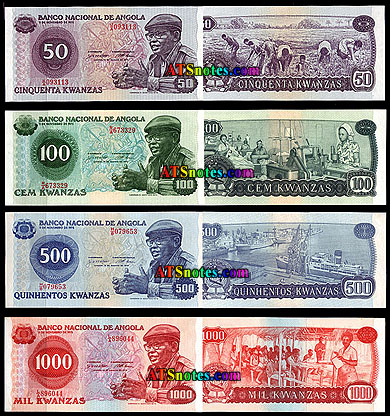
Currencies Of The African Diaspora – Angola

Angola’s high growth rate in recent years was driven by high international prices for its oil. Angola became a member of OPEC in late 2006 and its current assigned a production quota of 1.65 million barrels a day (bbl/day). Oil production and its supporting activities contribute about 85% of GDP. Diamond exports contribute an additional 5%. Subsistence agriculture provides the main livelihood for most of the people, but half of the country’s food is still imported. Increased oil production supported growth averaging more than 17% per year from 2004 to 2008. A postwar reconstruction boom and resettlement of displaced persons has led to high rates of growth in construction and agriculture as well. Much of the country’s infrastructure is still damaged or undeveloped from the 27-year-long civil war. Land mines left from the war still mar the countryside, even though peace was established after the death of rebel leader Jonas SAVIMBI in February 2002. Since 2005, the government has used billions of dollars in credit lines from China, Brazil, Portugal, Germany, Spain, and the EU to rebuild Angola’s public infrastructure. The global recession that started in 2008 temporarily stalled economic growth. Lower prices for oil and diamonds during the global recession slowed GDP growth to 2.4% in 2009, and many construction projects stopped because Luanda accrued $9 billion in arrears to foreign construction companies when government revenue fell in 2008 and 2009. Angola abandoned its currency peg in 2009, and in November 2009 signed onto an IMF Stand-By Arrangement loan of $1.4 billion to rebuild international reserves. Consumer inflation declined from 325% in 2000 to about 10% in 2012. Higher oil prices have helped Angola turn a budget deficit of 8.6% of GDP in 2009 into an surplus of 12% of GDP in 2012. Corruption, especially in the extractive sectors, also is a major challenge.

Angola tourism destinations

angola-114

AO139

AngolaKwanzas1995

ang-5-99

Source: Economy overview provided by CIA Factbook

Grambling Football Needs A Lifeline – Call Washington D.C. And Ask For Daniel Snyder

Anyone who has ever struggled with poverty knows how extremely expensive it is to be poor. – James Baldwin

If there is a heaven, then Eddie Robinson is somewhere up there raising hell. It goes without saying that since the late great coach’s passing, the most historic program in black college football has seen itself take an unexplainable and precipitous decline over the past decade. A far cry from the expected restoration of the program to its pinnacle after Doug Williams took over in 1998 and proceeded to win three consecutive SWAC championships for the university. The future looked promising and then the wheels began to fall off after Williams returned to the NFL for a stint as a personnel executive. An attempted second tour of duty was too little and too late. Looking forward though the question is how can the program be restored. My solution – call Daniel Snyder.

155931926

Let us face facts, when Grambling State University had the opportunity to leverage its winning ways to raise funds like many HBCUs have, it arguably simply did not strike enough of the iron while it was hot. Now, its cold – ice cold. Furthermore, at this point with HBCU public university alumni giving rates at five percent according to a recent article by HBCU Digest, help is certainly not coming at this point from alumni. The football program needs an infusion of millions and they needed it yesterday to get itself to proper standards that accompany a Division 1 program – not a middle school program. Players not having access to cool water during scorching practices in Louisiana heat, is a recipe for a player death and worse still a lawsuit. While it is hard to pinpoint Grambling’s actual university endowment, it is safe to say it is well under $10 million and that might be being generous. So why should Daniel Snyder come to the rescue or even care?

The Washington Redskins, valued at $1.7 billion are the third most valuable team in the NFL and the third most profitable NFL team with 2012 profits of almost $105 million. Their owner, Daniel Snyder, has an estimated net worth of $1.3 billion derived primarily from ownership of the Redskins, private equity, and a number of other enterprises. However, the team has been embroiled in a public relations that seems to never end over the team’s mascot name. Seen as offensive to many Native American groups whose primary ally tends to be African Americans, as it is often noted the only group who has suffered worse in America than African Americans are Native Americans. This often creates a great deal of sympathy for Native American causes among African Americans. Although the team technically plays its games in Maryland, do not be mistaken it is Washington D.C.’s team. A city whose population is 50 percent African American, home to two HBCUs, and two hours drive either way pushes that HBCU number swells to almost ten institutions. Beyond the geographical connection, the Washington Redskins connection to HBCUs runs directly into its own history with Doug Williams being not only an alum of Grambling State University, but the quarterback who led Washington to one of its most memorable Super Bowl victories becoming the first, and still only African American quarterback to do so.

dm_130128_nfl_doug_williams_more_than_a_game

To say it pains me that we must look outside of our community to resolve our needs is an understatement for anyone who knows me. However, this is a dire situation and it is calling for dire solutions. Daniel Snyder and the Washington Redskins could use some goodwill in the public as it deals with a growing agitation over the team name and a perceived view of European American owners lack of regard for minority sensitivity. It could use its relationship with Doug Williams connection to both the Washington Redskins and Grambling State University as a way to quell some of that angst. On Grambling’s part they need the public goodwill themselves and show some proactive behavior to resolve this sinking ship. If it means that the president and AD need to go hat in hand to Doug Williams to facilitate the meeting with Daniel Snyder, then pride be damned they need to do it.

HBCUs overall have done a poor job of conveying to their alumni bases just how costly and unprofitable athletic programs actually are. There is still too much confusion of just how much university money can actually be diverted into athletics at public universities which have major restrictions on such activity. It also begs a long-term question if HBCUs can not properly fund their athletic programs, then exactly what is the plan? These type of incidents leave a scar on not only the athletic programs but the universities themselves and HBCUs as a whole. Spelman’s approach was to disband its athletic program as a whole in favor of more wellness programs, which is certainly one approach. There is also the Ivy League approach where there are no athletic scholarships at all. Whatever the solution, Grambling State University needs to act quickly and make a major splash in its resolution before the ghost of Eddie Robinson returns, and if anyone remembers Coach Robinson in a bad mood – it will not be a pleasant hau – I mean return.