Author Archives: hbcumoney

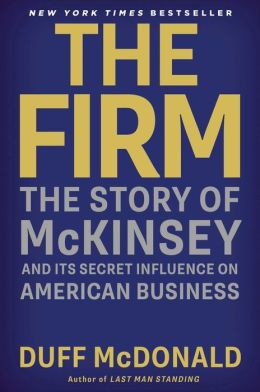
HBCU Money™ Business Book Feature – The Firm: The Story of McKinsey and Its Secret Influence on American Business

9781439190999_p0_v5_s260x420

It ranks among the unquestioned laws of American big business over the last half century: If you want to be taken seriously, you hire McKinsey & Company.

FOUNDED IN 1926, McKINSEY CAN LAY CLAIM to the following partial list of accomplishments: its consultants have ushered in waves of structural, financial, and technological change to the nation’s best organizations; they remapped the power structure within the White House; they even revo­lutionized business schools. In this book, star financial journalist Duff McDonald shows just how, in becoming an indispensable part of decision making at the highest levels, McKinsey has done nothing less than set the course of American capitalism.

But he also answers the question that’s on the mind of anyone who has ever heard the word McKinsey: Are they worth it? After all, just as McKinsey can be shown to have helped invent most of the tools of modern management, the company was also involved with a number of striking failures. Its consultants were on the scene when General Motors drove itself into the ground, and they were Kmart’s advisers when the retailer tumbled into disarray. They played a critical role in building the bomb known as Enron.

McDonald is one of the few journalists to have not only parsed the record but also penetrated the culture of McKinsey itself—a corporate mandarin elite whose methods have been compared (by oth­ers and by themselves) to those of the Jesuits or the U.S. Marines. They feel so strongly about themselves that they have insisted on a proper noun where one need not exist. To an outsider, they are a consulting firm. To themselves, simply, The Firm. This revealing book uncovers the inner workings of what just might be the most influential private organization in America.

HBCU Money™ Dozen 1/20 – 1/24

numbers12

Did you miss HBCU Money™ Dozen via Twitter? No worry. We are now putting them on the site for you to visit at your leisure. We have made some changes here at HBCU Money™ Dozen. We are now solely focused on research and central bank articles from the previous week.

Research

Why yes, your laptop is watching you. What you need to know to protect yourself l CSOonline http://ow.ly/sW0Qy

Gmail Goes Down, Google Investigating the Cause l CIOonline http://trib.al/IPvck6J

Microsoft lawyer: Let customers decide country where cloud data is stored l NetworkWorld http://ow.ly/sW1kl

Research hints that nanotech could protect against heat in electronics, boosting computing power l Sandia Labs http://bit.ly/1htdnQR

Paradigm whiplash, anyone? “Stephen Hawking: ‘There are no black holes'” l Nature News http://bit.ly/1g9HgJj

Tech and telecom vendors spend millions on lobbying in DC l Computerworld http://ow.ly/sW1NP

Federal Reserve, Central Banks, & Financial Departments

Small towns’ survival may require borrowing a few ideas from the big city l St. Louis Fed http://bit.ly/KVnjHR

Chart shows number of jobs created by sector in Texas in 2013 l Dallas Fed http://bit.ly/1aTbngs

Video: How are students dealing with the growing burden of student loans? l St. Louis Fed http://bit.ly/19namMS

Fed continues to worry about banks that could crash the system l Housing Wire http://hwi.re/4mp6Ww

Why getting accurate data on global hunger poses a challenge l World Bank http://wrld.bg/sTjgc

How do we encourage entrepreneurship? We surveyed more than 1,000 entrepreneurs l World Economic Forum http://wef.ch/i3CXS

Thank you as always for joining us on Saturday for HBCU Money™ Dozen. The 12 most important research and finance articles of the week.

The HBCU Money™ Weekly Market Watch

Our Money Matters /\ January 24, 2014

A weekly snapshot of African American owned public companies and HBCU Money™ tracked African stock exchanges.

NAME TICKER PRICE (GAIN/LOSS %)

African American Publicly Traded Companies

Citizens Bancshares Georgia (CZBS) $6.16 (0.0o% UNCH)

M&F Bancorp (MFBP) $3.85 (0.00% UNCH)

Radio One (ROIA) $4.91 (1.80% DN)

African Stock Exchanges

Bourse Regionale des Valeurs Mobilieres (BRVM)  244.42 (1.21% UP)

Botswana Stock Exchange (BSE)  9 338.02 (0.02% UP)

Ghana Stock Exchange (GSE)  2 218.23 (3.40% UP)*

Nairobi Stock Exchange (NSE)  140.57 (N/A)

Johannesburg Stock Exchange (JSE) 46 462.14 (1.24% DN)

International Stock Exchanges

New York Stock Exchange (NYSE) 10 096.34 (1.69% DN)

London Stock Exchange (LSE)  3 565.54 (1.61% DN)

Tokyo Stock Exchange (TOPIX)  1 264.60 (1.78% DN)

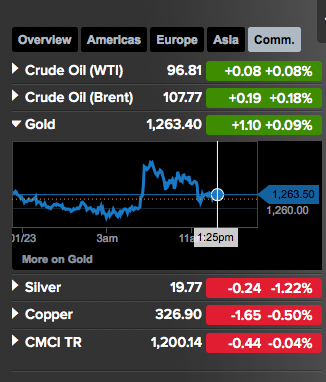
Commodities

Screen shot 2014-01-24 at 12.46.31 PM

The HBCUpreneur Corner – Virginia State University’s Koren Underdue & KU Real Estate

KU Real Estate Logo

Name: Koren Underdue

Alma Mater: Virginia State University

Business Name & Description: KU Real Estate, specializing in selling residential real estate in the Triangle Area of North Carolina

What year did you found your company? 2011

What was the most exciting and/or fearful moment during your HBCUpreneur career? Taking the first step of starting my own business was both exciting and fearful at the same time. It was like having a baby. You are excited because you know what you just created is a blessing; however, you also know that you are the most vital player in its success. You must feed it, nurture it, and help it grow with leadership, integrity, and humility.

What made you want to start your own company? Prior to starting my own business I was managing for one of the largest banks in America and worked in their subprime market. With the failing economy, I soon realized that I needed to find something fast due to the uncertainty of our department and its future. Instead of looking for another job, I took the opportunity to begin real estate investing which lead to me starting my own brokerage company, KU Real Estate.

prof headshot 2012

Who was the most influential person/people for you during your time in college? My peers, it was incredible to be around “like minded” individuals who all brought something different to the table. Not only did we share ideas, goals, and aspirations, but we also challenged each other for greatness and encouraged each other to pursue our dreams.

How do you handle complex problems? That’s easy, simplify them. In general, problems are only as complex as we make them. I am learning through my experiences not to focus on the problem, yet focus on the solution.

What is something you wish you had known prior to starting your company? Honestly, I just wish that I was instilled with the “principals of success” at an early age. As a mother of three now, it is essential that I instill habits of success and leadership. I want them to know that they can aspire to do whatever their hearts desire; however, they must not be afraid of hard-work and dedication. As an entrepreneur, I strive to help them understand free enterprise and how it can provide more control of their financial future as they live their American Dream.

What do you believe HBCUs can do to spur more innovation and entrepreneurship while their students are in school either as undergraduate or graduate students? I would love to see HBCUs encourage students to step out more and challenge them to find their passion, their why, and assist them in starting their own business even while in school. Not only should HBCUs provide the fundamentals, but provide them with hands-on tools and resources to develop action plans. It would be great to see more business mentorships and also develop mastermind groups within the student body. Bill Gates was 20 when he started Microsoft, and Mark Zuckerberg launched Facebook from his dormitory of Harvard University also at the age of 20. I bring this up to state they were both young individuals with bright ideas and took a chance. Why can’t our young HBCU students do the same? They can and I can’t wait see the new movement of our HBCU community!

How do you deal with rejection? I accept rejection, and it does not discourage me, it motivates me. In business you will find many times someone telling you no or an opportunity you were hoping for fails. The great thing is it’s not the end of the world. I learned to accept it for what it is and embrace it. I never take it personally, but I do however examine the rejection. What was the reason why I was rejected? Is this something I can overcome? If so, I am developing my plan of action immediately to do so. What can I learn from this experience? Please note: Every rejection is an opportunity for a learning experience which will benefit the growth of your business no matter the outcome.

When you have down time how do you like to spend it? I love to spend time with my family, relax, and travel the world.

What was your most memorable HBCU memory? My most memorable HBCU memory was my graduation. That day represented accomplishment from years of hard work and dedication. It was a day to reflect on friendship, leadership, and how I was truly proud to be a VSU Trojan Alumni.

In leaving is there any advice you have for budding HBCUpreneurs? Just do it and don’t quit. Most businesses fail because they quit. Fail forward and never let go of your dream!

CALM DOWN: African America’s $1 Trillion In Buying Power Is Only 6 Percent of America’s Buying Power

Progressiveness is looking forward intelligently, looking within critically, and moving on incessantly. – Waldo Pondray Warren

I think if I hear that African America has over $1 trillion in buying power one more time from another person I might just lose it. It is usually coming from some well meaning liberal or African American “conscious” type trying to show that if only we harness our buying power, then all of our economic ails would be fixed. YACHTS for everyone! The problem is they throw this number around with absolutely no context. In reality, African America’s buying power is not even equal to the size of its population and highlights the daunting income disparity for African Americans.

Screen shot 2013-12-28 at 1.51.22 AM

To put it another way, Asian America has 8.2 million employed citizens with a buying power of $718 billion. African America has 16.2 million employed citizens with a buying power of $1.1 trillion. That essentially means, Asian Americans have two-thirds of the buying power of African American with only half the population. This is possible because the median income for Asian Americans is approximately $66 000, but for African Americans it is $34 000. So while Asian Americans only comprise 4.8 percent of the population, they control 5 percent of the country’s buying power.

Due to a mixture of factors like a weak education infrastructure in African American communities from K-12 through college, and lack of African American owned firms with paid employees we tend to be regulated to low-wage earning jobs. This has direct implications into the buying power that a community has at its disposal. It also creates a vicious cycle of being unable to accumulate wealth building assets and forces a disproportionate of low-income families which are predominantly African Americans to file bankruptcy. So while the buying power of African Americans looks like a lot because of the “trillion” behind the number, it is more than a bit misleading.

If African America’s buying power was equivalent to our population, then it would be valued at $2.2 trillion. That is approximately 100 percent higher than what it is currently. For that to happen with the current employment situation for African America the median African American income would need to rise from approximately $34 000 to $68 000. An almost impossible task currently for a number of the reasons stated previously. However, what is clear that we must stop just taking a number and throwing it around without broader context of what is it against the entire nation’s buying power or what does that break down to per person. Otherwise, it is just a “big” number. I think?